I. 서 론
다양한 광물에 포함되어 있는 석영은 지구표면의 12% 이상을 차지하며, 광물에 약 17% 정도 존재하 고 있어 광물을 취급하는 사업장은 분진의 형태로 노출될 수 있다(Madson et al., 1995). 이렇듯 석영은 건설업과 광업은 물론 주물, 금속가공업, 석재가공, 요업, 유리제조 등의 제조업에서도 노출될 가능성이
크다(Smith, 1992; Balaan & Banks, 1992; Kelly, 1995). 한국산업안전보건공단은 국내에서 석영은 200여개의 사업장에서 5만 여명의 근로자가 노출되 고 있으며, 연간 300만 톤 이상을 사용하는 것으로 보고하였다(KOSHA, 2007).
규폐증(silicosis)은 석영 등의 결정형 규산이 원인이 되며 특히 작업자가 호흡성 크기에 노출되었을 때 발생 된다(Weber & Banks, 1994). 또한, 석영은 그 자체로
*Corresponding author: Young Gyu Phee, Tel: 053-819-1590, Fax: 053-819-1208, E-mail: [email protected] Faculty of Health Science, Daegu Haany University. 1 Hannydae-ro, Gyeongsan-si, Gyeongbuk 38610 Received: August 29, 2017, Revised: September 9, 2017, Accepted: September 20, 2017
This is an Open-Access article distributed under the terms of the Creative Commons Attribution Non-Commercial
License(http://creativecommons.org/licenses/by-nc/3.0) which permits unrestricted non-commercial use, distribution, and reproduction in https://doi.org/10.15269/JKSOEH.2017.27.3.163
광물성분진 노출사업장의 공기 중 석영의 농도 비교
정경선1ㆍ배혜정1ㆍ남미란1ㆍ정종현2ㆍ피영규2*
1
대구한의대학교 산업보건연구소,
2대구한의대학교 보건학부
Comparisons of Airborne Quartz Concentrationsin Mineral Dust Exposure Industries
Gyeong Seon Jeong1ㆍHye Jeong Bae1ㆍMi Ran Nam1ㆍJong-Hyoen Jung2ㆍYoung Gyu Phee2*
1
Institute for Industrial Health, Daegu Haany University
2
Faculty of Health Science, Daegu Haany University
ABSTRACT
Objectives: This study was conducted toestimate quartz concentrations and contents in the airborne respirable dust from various industries.
Methods: A total of 818 samples were collected from 174 industries. Respirable dust samples were collected using a cyclone equipped with a 37 mm, 5 ㎛ pore size PVC filter. The quartz concentrations were identified using the intensity of the absorption peak of quartz at 799 cm
-1by Fourie Transformed Infrared Spectroscopy(FTIR).
Results: The respective geometric means for quartz concentrations in the respirable dust were 0.0050, 0.0049, 0.0025, and 0.0019
㎎/㎥ in foundries, ceramics, construction, and cement/stone. The geometric mean of quartz contents analyzed by FTIR were respectively 3.43, 1.99, 1.04, and 0.82% for ceramics, foundries, cement/stone, and construction. The rate of exceeding the Korean Occupational Exposure Limit(0.05 ㎎/㎥) was 2.03%, but rate of exceeding the American Conference of Governmental Industrial Hygienist(ACGIH) Threshold Limit Value(0.025 ㎎/㎥) was 7.12%.
Conclusions: Given that foundries had a higher quartz concentration, there is a need to reduce respirable dust, such as through wet operation. In order to protect the health of workers exposed to mineral dust, it is necessary to actively consider strengthening the Korean Occupational Exposure Limit.
Key words: concentration, quartz, respirable dust
규폐증을 발생시킬 뿐만 아니라, 활석, 석탄분진, 규조 토와 같이 혼합되면 그 분진의 독성이 더욱 증가 되고 (KOSHA, 2013), 만성폐쇄성 폐질환 및 악성종양, 자가 면역 질환 등도 유발한다(MoEL, 2005). 이에 국제암연 구기구(International Agency for Research on Cancer, IARC)에서는 석영 등을 포함한 결정형 규산 동형이성 체를 인체 발암물질(Group 1)로 분류하고 있으며 (IARC, 1997), 미국정부산업위생전문가협의회(American Conference of Governmental Industrial Hygienist, ACGIH)는 인체 발암예상물질인 A2로 구분하고 있다 (ACGIH, 2015). 우리나라도 현재 석영을 사람에게 충 분한 발암성 증거가 있는 물질인 발암성 1A로 분류하 고 있다(MoEL, 2016a).
우리나라에서 2015년 발생된 직업병자 총 1,959명 중 1,125명(57.5%)이 진폐증으로 보고되어 직업병 중 가장 높은 비율을 차지고 있으며, 2014년 발생된 진폐 증 직업병 1,019명에 비해서도 증가되었다(MoEL, 2016b). 또한, 2015년 직업병으로 인한 사망자 현황을 보면 총 514명 중 427명이 진폐증으로 사망하여 전체 의 83.1%로 대부분을 차지하고 있다. 이에 산업안전보 건법에서는 진폐증을 예방하기 위하여 광물성분진이 노출되는 작업장에 대해 정기적으로 작업환경측정을 실시하고 그 결과에 따라 관리하도록 규정하고 있다 (MoEL, 2016c). 또한, 작업환경측정 결과에 대한 평가 기준으로 석영에 대한 노출기준은 호흡성분진으로서 0.05 ㎎/㎥로 제시하고 있지만(MoEL, 2016a), ACGIH TLV(Threshold Limt Value)는 0.025 ㎎/㎥로 더욱 엄격 하게 관리하고 있다(ACGIH, 2016).
우리나라에서 석영에 대한 연구는 초기에 주로 광업 이 대상이 되어 탄광 내 석영을 정량 분석하는 연구가 대부분이었으며(Choi et al., 1987; Kim et al.,, 1991;
Song & Lee, 1994), 그 이후 요업 사업장(Oh et al., 1994; Kim et al., 1999), 주물 사업장(Phee et al., 1997;
Kim et al., 1998; Park et al., 2003), 석재 사업장(Kim et al., 1999; Kim et al., 2013), 콘크리트 사업장(Bae et al., 2013) 등 제조업을 중심으로 노출평가에 대한 연구가 수행되었다. 또한, 건설업(Lee, 2012)과 토공사 (Sung et al., 2015)를 대상으로 석영에 대한 노출평가 연구도 수행한 바 있다. 그러나 이 모든 연구는 특정 업종에 한정되어 연구가 수행되거나 지역, 시료, 공정 수 등이 제한적이었다.
따라서 본 연구는 광물성분진에 노출되는 업종 및 공정별 석영의 노출수준과 함유량을 파악하여 근로 자들의 진폐증 예방을 위한 기초자료로 활용되고자 하였다.
Ⅱ. 대상 및 방법
1. 연구 대상
광물성분진 노출사업장의 공기 중 석영농도 및 함유 량에 대한 노출수준을 확인하기 위하여 2014년 1월부 터 2016년 9월까지 174개 사업장을 대상으로 총 818개 의 시료를 확보하였다. 광물성분진 중 석영이 노출되 는 다양한 업종 중 건설업, 주물업, 시멘트 및 석재가공 업, 요업을 대상으로 하였다.
2. 연구 방법
1) 공기 중 호흡성분진의 채취
광물성분진에 대한 작업환경측정은 여과채취방법에 따라 호흡성분진으로 시료를 채취하고, 석영, 크리스 토바라이트, 트리디마이트를 분석할 수 있는 방법으로 수행하도록 하고 있다(MoEL, 2016d). 미국국립산업안 전보건연구원(National Institute for Occupational Safety
& Health, NIOSH) 0600 공정시험법은 PVC 여과지를 2단 카세트에 담아 사이클론에 장착하여 사용한다 (NIOSH, 1998).
2) 호흡성분진 중 석영의 분석
석영의 분석은 NIOSH의 7602 방법을 가급적 준용 하였다(NIOSH, 2003). 미국표준과학연구소(National Institute of Standard & Technology, NIST)의 표준물질 (Standard Reference Material, SRM) 1878a(Respirable quartz, NIST, USA)와 KBr(160-8010, PIKE, USA)를 혼합하여 펠렛(pellet)화 하였고 7개 농도수준으로 검 량선을 작성하였다. PVC필터는 도가니에 넣어 뚜껑 을 덮은 후 회화로에서 650℃로 2시간 동안 필터 내 유기물을 회화시킨 후, KBr 200 ㎎을 막자사발을 사 용하여 시료와 혼합하였다. 혼합된 시료를 13 ㎜ die 를 사용하여 펠렛을 만들어 FTIR(Cary 640, Agilent, USA)로 1500 ㎝-1~400 ㎝-1까지 주사하였고, 799 ㎝-1 에서 석영의 흡광도를 측정하였다.
3. 자료의 분석
조사한 자료들의 통계분석은 SPSS(Version 20.0K, USA) 프로그램을 사용하였다. 공기 중 석영 농도는 대수정규분포를 보여 기하평균과 기하표준편차로 제 시하였고, 참고적으로 산술평균과 표준편차도 수록 하였다. 석영농도에 대한 업종, 공정별 비교는 Kruskal-Wallis test를 이용하였다.
Ⅲ. 연구결과
1. 업종별 호흡성분진 중 석영의 농도
업종별 호흡성분진 중 석영의 기하평균 농도는 주 물업이 0.0050 ㎎/㎥으로 가장 높았고, 요업(0.0049
㎎/㎥), 건설업(0.0025 ㎎/㎥), 시멘트 및 석재가공업 (0.0019 ㎎/㎥) 순이었으며, 그 차이는 통계적으로 유 의하였다. 우리나라 석영의 노출기준(0.05 ㎎/㎥) 초 과율은 평균 2.0%로 나타났으며, 시멘트 및 석재가 공업이 3.8%로 가장 높았다. ACGIH의 TLV(0.025
㎎/㎥) 초과율은 평균 7.1%이었고, 주물업이 11.4%로 역시 가장 높았다(Table 1).
2. 업종에 따른 공정별 호흡성분진 중 석영의 농도 건설업의 공정별 호흡성분진 중 석영의 기하평균 농도는 코팅공정이 0.0029 ㎎/㎥ 으로 가장 높았고, 기 타공정 0.0025 ㎎/㎥, 후처리공정 0.0020 ㎎/㎥, 주입공 정 0.0007 ㎎/㎥이었으며, 우리나라 석영의 노출기준 초과율은 기타공정이 3.3%로 가장 높은 수준이었고, ACGIH의 TLV 초과율은 후처리공정이 40.0%로 가장 높게 나타났다(Table 2). 주물업의 공정별 석영의 기하 평균 농도는 코팅공정이 0.0118 ㎎/㎥으로 가장 높은 수준이었고, 우리나라 노출기준 초과율이 가장 높은
공정은 후처리공정(6.1%)이었고, ACGIH의 TLV 초과 율은 코팅공정에서 50.0%를 보였다. 시멘트 및 석재 가공업의 석영의 기하평균 농도는 주입공정이 0.0120
㎎/㎥으로 가장 높았고, 그 다음으로 기타공정, 혼합공 정, 성형공정, 후처리공정 순으로 나타났다. 공정별 우 리나라 석영의 노출기준과 ACGIH의 TLV 초과율은 주입공정이 25.0%이었다. 요업에서 석영의 기하평균 농도는 코팅공정이 0.0114 ㎎/㎥으로 가장 높았고, 혼 합공정(0.0061 ㎎/㎥), 기타공정(0.0052 ㎎/㎥), 주입공 정(0.0045 ㎎/㎥), 성형공정(0.0034 ㎎/㎥) 순이었지만, 통계적 유의성은 없었다. 요업의 경우 우리나라 석영 의 노출기준을 초과하지 않았지만, ACGIH의 TLV 공 정별 초과율은 성형공정(50.0%)이 가장 높은 수준이 었다.
3. 업종별 호흡성분진 중 석영의 함유량
업종별 석영함유량은 요업이 3.43%로 가장 높게 나타났으며, 주물업(1.99%), 시멘트 및 석재가공업 (1.04%), 건설업(0.82%) 순이었고, 그 차이는 통계적 으로 유의하였다(Table 3).
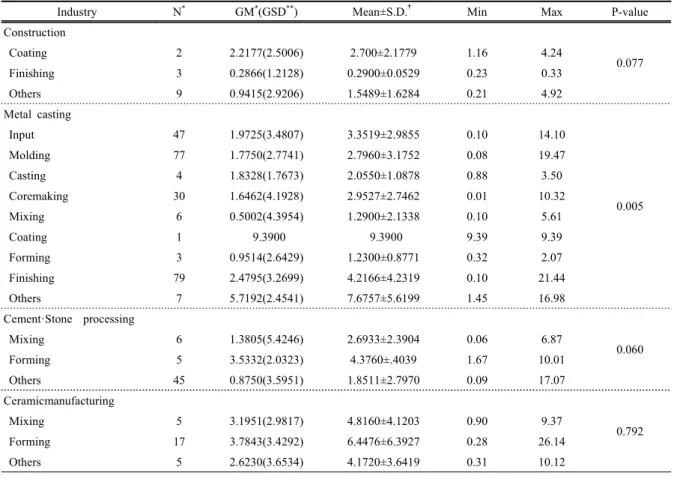
4. 업종에 따른 공정별 호흡성분진 둥 석영의 함유량 건설업의 공정별 석영함유량 기하평균은 코팅공 정이 2.22%로 가장 높았고, 기타공정 0.94%, 후처리 공정 0.29% 순으로 다소 차이가 있었으나 통계적 유의성은 없었다(Table 4). 주물업은 코팅공정(9.39%) 이 유의하게 가장 높았으며, 기타공정(5.72%), 후처 리공정(2.48%), 주입공정(1.97%), 주조공정(1.83%)순 으로 나타났다. 시멘트 및 석재가공업의 공정별 호 흡성분진 중 석영의 기하평균 함유량은 성형공정이 3.53%로 가장 높았으며, 그 다음으로는 혼합공정
Industry N
*GM
†(GSD
‡) Mean±S.D.
§Min Max ER1
ǁER2
¶P-value
Construction 102 0.0025(3.5574) 0.0068±0.0166 0.0001 0.1106 2.94 6.86
Metal casting 586 0.0050(4.1844) 0.0120±0.0193 0.00003 0.1752 2.90 11.43 0.01 Cement·Stone processing 79 0.0019(4.9924) 0.0117±0.0393 0.0010 0.2318 3.80 6.33 Ceramic manufacturing 51 0.0049(3.8566) 0.0094±0.0091 0.0030 0.0342 0.00 7.84
*
N : Number of samples
†GM : Geometric Mean
‡
GSD : Geometric Standard Deviation
§S.D. : Standard Deviation
ǁ
Exceed Rate1(%) : (Number of samples over KOEL / Number of samples) × 100
¶
Exceed Rate2(%) : (Nnmber of samples over ACGIH TLV / Number of samples) × 100
Table 1. Airborne Quartz concentrations in respirable dust by industrial classification (Unit : ㎎ / ㎥ )
Industry N
*GM*(GSD**) Mean±S.D.
†Min Max ER1
§ER2
ǁP-value Construction
0.466
Input 1 0.0007 0.0007 0.0007 0.0007 0.00 0.00
Coating 4 0.0029(1.6529) 0.0032±0.0016 0.0019 0.0050 0.00 0.00
Finishing 5 0.0020(11.8280) 0.0122±0.0162 0.0003 0.0312 0.00 40.00
Others 92 0.0025(3.3889) 0.0067±0.0171 0.0001 0.1106 3.26 5.43
Metal casting
0.001
Input 76 0.0042(4.8199) 0.0089±0.0093 0.0001 0.0613 1.31 1.31
Molding 221 0.0050(4.0117) 0.0119±0.0200 0.0001 0.1752 2.71 11.76
Casting 17 0.0051(2.8139) 0.0080±0.0072 0.0008 0.0239 0.00 0.00
Coremaking 75 0.0029(4.2755) 0.0085±0.0203 0.00003 0.1630 1.33 6.67
Mixing 8 0.0021(4.7465) 0.0086±0.0126 0.0003 0.0321 0.00 12.50
Coating 2 0.0118(6.6306) 0.0240±0.0296 0.0031 0.0450 0.00 50.00
Forming 13 0.0037(2.4235) 0.0050±0.0037 0.0006 0.0120 0.00 0.00
Finishing 147 0.0076(3.3918) 0.0167±0.0234 0.0002 0.1432 6.12 19.73
Others 27 0.0060(3.3225) 0.0112±0.0122 0.0006 0.0475 0.00 14.81
Cement·Stone processing
0.494
Input 4 0.0120(19.2209) 0.0619±0.0867 0.0002 0.1885 25.00 25.00
Mixing 8 0.0016(8.1911) 0.0245±0.0663 0.0002 0.1885 12.5 0.00
Forming 5 0.0013(1.8854) 0.0015±0.0009 0.0006 0.0027 0.00 0.00
Finishing 4 0.0011(3.1557) 0.0015±0.0010 0.0002 0.0025 0.00 0.00
Others 58 0.0018(4.3378) 0.0081±0.0308 0.0001 0.2318 1.72 3.45
Ceramic manufacturing
0.675
Input 51 0.0049(3.8566) 0.0094±0.0091 0.0030 0.0342 0.00 7.84
Mixing 2 0.0045(13.9528) 0.0149±0.0201 0.0007 0.0291 0.00 50.00
Coating 16 0.0061(2.6884) 0.0085±0.0052 0.0007 0.0166 0.00 0.00
Forming 2 0.0114(1.0062) 0.0115±0.0001 0.0114 0.0115 0.00 0.00
Others 17 0.0034(4.5986) 0.0089±0.0116 0.0004 0.0341 0.00 11.76
Table 3. Weight percent of quartz in respirable dust by industrial classification (Unit : %)
Industry N
*GM
*(GSD
**) Mean±S.D.
†Min Max P-value
Construction industry 14 0.8247(2.9875) 1.4436±1.5599 0.21 4.92
p<0.001
Cast of Metal 254 1.9945(3.3382) 3.4539±3.6156 0.01 21.44
Cement·Stone processing 56 1.0408(3.7904) 2.1668±2.8594 0.06 17.07
Ceramic industry 27 3.4268(3.2615) 5.7241±5.5467 0.28 26.14
Table 2. Quartz concentrations in respirable dust of industries by process (Unit : ㎎ / ㎥ )
(1.38%), 기타공정(0.88%)으로 통계적으로 유의한 차이가 있었다. 요업의 공정별 석영함유량은 성형공 정에서 3.78%, 혼합공정 3.20%, 기타공정 2.62%로 나타났다.
Ⅳ. 고 찰
결정형 규산은 약 20년의 잠복기를 가지며 규폐증 을 유발하고 고농도에 노출될 경우 2년 이내에 급성 규폐증의 발생도 가능하다. 규폐증은 석영의 입자 중 석영의 호흡성 크기에 노출되었을 때 발생되며 이에 따른 노출양과도 관계가 깊다(Weber & Banks, 1994). 화학물질 유통·사용 실태조사 결과 결정형 규 산을 사용하는 사업장은 총 221개소이며, 총 근로자 는 47,725명, 취급근로자 1,905명, 사용·취급량은 1년 간 2,960,469톤으로 보고하였다(KOSHA, 2007). 이에 우리나라도 산화규소 화합물의 위해성으로부터 근로
자 건강보호를 위하여 2008년부터 석영에 대한 노출 기준을 0.1 ㎎/㎥에서 0.05 ㎎/㎥으로 강화하였고, 결 정형은 석영, 크리스토바라이트, 트리디마이트, 트리 폴리 4가지로 분류하여 호흡성분진으로 표기하였다 (MoEL, 2016a).
본 연구에서 가장 많은 업종은 주물업으로 공기 중 석영의 기하평균 농도는 0.005 ㎎/㎥로 나타나 Park et al.(2003)의 0.03 ㎎/㎥, Phee et al.(1997)의 0.015 ㎎/㎥∼0.046 ㎎/㎥과 Kim et al.(1998)의 0.01
㎎/㎥∼0.03 ㎎/㎥에 비해 낮게 평가되었으나, 석영의 함유량의 경우 Park et al.(2003)은 2.25%로 Phee et al.(1997)은 4.60%∼6.37%, Kim et al.(1998) 4.39%∼
4.41%로 보고하여 본 연구결과 3.45%와 큰 차이를 보이지는 않았다. 건설업의 경우 비교하는데 다소 무 리는 있지만 Sung et al.(2015)의 경우 토공사의 노출 평가 결과 석영농도를 0.0075 ㎎/㎥로 보고하여 건설 업 중 토공사에서 분진과 석영의 노출이 많은 것으
Industry N
*GM
*(GSD
**) Mean±S.D.
†Min Max P-value
Construction
0.077
Coating 2 2.2177(2.5006) 2.700±2.1779 1.16 4.24
Finishing 3 0.2866(1.2128) 0.2900±0.0529 0.23 0.33
Others 9 0.9415(2.9206) 1.5489±1.6284 0.21 4.92
Metal casting
0.005
Input 47 1.9725(3.4807) 3.3519±2.9855 0.10 14.10
Molding 77 1.7750(2.7741) 2.7960±3.1752 0.08 19.47
Casting 4 1.8328(1.7673) 2.0550±1.0878 0.88 3.50
Coremaking 30 1.6462(4.1928) 2.9527±2.7462 0.01 10.32
Mixing 6 0.5002(4.3954) 1.2900±2.1338 0.10 5.61
Coating 1 9.3900 9.3900 9.39 9.39
Forming 3 0.9514(2.6429) 1.2300±0.8771 0.32 2.07
Finishing 79 2.4795(3.2699) 4.2166±4.2319 0.10 21.44
Others 7 5.7192(2.4541) 7.6757±5.6199 1.45 16.98
Cement·Stone processing
0.060
Mixing 6 1.3805(5.4246) 2.6933±2.3904 0.06 6.87
Forming 5 3.5332(2.0323) 4.3760±.4039 1.67 10.01
Others 45 0.8750(3.5951) 1.8511±2.7970 0.09 17.07
Ceramicmanufacturing
0.792
Mixing 5 3.1951(2.9817) 4.8160±4.1203 0.90 9.37
Forming 17 3.7843(3.4292) 6.4476±6.3927 0.28 26.14
Others 5 2.6230(3.6534) 4.1720±3.6419 0.31 10.12
Table 4. Weight percent of quartz in respirable dust of industries by process (Unit : %)
로 추측할 수 있다.
Higgins et al.(1995)는 요업사업장의 호흡성분진 중 석영의 함유량을 2.9%∼37.3%, Saiyed et al.(1995)는 4.2%∼27.7%로 보고하여 본 연구의 석영함유량 2.6%
∼3.8%보다 다소 높은 수준이었는데 이는 요업과 도자 기업에 사용되는 점토 등의 원재료와 차이에 기인된 것으로 추정된다.
시멘트 및 석재사업장의 경우 공기 중 석영의 기 하평균 농도는 0.0019 ㎎/㎥(0.001 ㎎/㎥∼0.23 ㎎/㎥) 으로 나타났다. 이는 콘크리트 사업장을 대상으로 한 Bae et al.(2013)의 석영의 기하평균 농도인 0.002 ㎎/
㎥∼0.004 ㎎/㎥와는 유사한 수준이었으나, Kim et al.(1999)의 기하평균 농도 0.017 ㎎/㎥∼0.024 ㎎/㎥, Kim et al.(2014)의 기하평균 농도 0.048 ㎎/㎥∼0.170
㎎/㎥에 비해서는 낮은 수준이었다. 또한, Koskela et al.(1987)이 수행한 석재공장의 석영농도는 0.3 ㎎/㎥
∼0.42 ㎎/㎥에 비해서는 다소 낮은 수준이었으나, Meijer et al.(2001)이 조사한 콘크리트 사업장에서의 공기 중 석영농도 0.06 ㎎/㎥에 비해서는 높은 수준 이었다. 시멘트 및 석재사업장의 공기 중 석영함유량 의 경우 Kim et al.(2002)은 10.27%∼25.12%로 보고 하였고, Kim et al.(1999)은 7.54%∼7.97%, Bae et al.(2013)은 2.62%∼4.67%, Kim et al.(2014)은 4.49%
∼6.49%, Guenel et al.(1989)의 석재사업장 석영함유 량은 3%∼35%로 발표하였는데 대부분 본 연구의 석 영함유량인 0.88%∼3.53%에 비해서는 다소 높은 수 준이었다.
본 연구의 제한점으로는 연구목적으로 시료를 채 취한 것이 아니고 산업안전보건법에 의한 작업환경 측정결과를 활용함에 따라 농도가 다소 과소평가된 점과 자료를 분류 할 때 업종에 대한 세분류 과정에 서 정확한 분류가 어려웠다는 한계점이 있었다.
Ⅴ. 결 론
본 연구는 2014년 2월부터 2016년 9월까지 우리나 라에 소재한 광물성분진 노출사업장 174개소를 대상 으로 업종별, 공정별 공기 중 석영농도 및 석영함유 량을 파악하였다. 그 결과 호흡성분진 중 석영의 농 도는 주물업이 다른 업종에 비해 가장 높았고, 공정 별로는 건설업, 주물업 및 요업은 코팅공정, 시멘트
및 석재가공업 주입공정에서 높은 수준을 보였다. 석 영의 우리나라 노출기준 초과율은 2.03%이었고, ACGIH TLV 초과율은 7.12%로 나타났으며, 업종별 초과율은 주물업이 11.4%로 가장 높았다. 업종별 석 영의 함유량은 요업이 가장 높았고, 공정별로 구분해 보면 건설업, 주물업은 코팅공정, 요업, 시멘트 및 석 재가공업은 성형공정에서 높은 수준을 보였다.
우리나라 광물성분진 노출사업장의 공기 중 호석 영의 농도 및 노출기준 초과율을 확인한 결과 주물 업의 농도가 가장 높게 나타나 다른 업종에 비해 우 선적 관리가 필요한 것으로 판단된다. 석영에 대한 노출평가 결과 우리나라 노출기준 초과율은 2.03%이 었으나, ACGIH TLV 초과율은 7.12%로 나타나 광물 성분진에 노출되는 근로자의 건강보호를 위하여 노 출기준 강화를 적극적으로 고려할 필요가 있다.
References