대한수학교육학회지 수학교육학연구 제 22 권 제 4 호 Journal of Educational Research in Mathematics Vol. 22, No. 4, 517 ~ 534. Nov 2012
The Impact of Unbalanced Development between
Conceptual Knowledge and Procedural Knowledge to Knowledge Development of Students' in Rational Number Domain
Kim Ahyoung*
As observing the learning of middle school mathematics students for three years, I examined the relationship between students' procedural knowledge and their conceptual knowledge as they develop those knowledges in the rational number domain. In particular, I explored the implications of an unbalanced development in a student’s conceptual knowledge and procedural knowledge by considering two conditions: (a) the case of a student who has relatively strong conceptual knowledge and weak procedural knowledge, and (b) the case of a student who has relatively weak conceptual knowledge and strong procedural knowledge.
Results suggest that conceptual knowledge and procedural knowledge are most productive when they develop in a balanced fashion (i.e., closely iterative or simultaneously), which calls into question the assumption that one has primacy over the other.
* Ewha Womans University/Soosong Junior High School ([email protected])
I. Introduction
1. The necessity and the purpose of the research
Since the early 1980s, emphasis on the development of conceptual understanding has led to substantial changes in curriculum design, pedagogical methods, and, to some extent, testing (Conference Board of the Mathematical Sciences, 1989). Less can be said, however, regarding our understanding of procedures and their applications.
Often the literature on mathematics education
reform runs the risk of becoming overly polarized, i.e., either throwing the procedural “baby out with the bathwater,” or at the other extreme, rejecting the conceptual approach in favor of developing arithmetic skill and algebraic symbol manipulation.
I attempt, in this paper, to examine the co-development of conceptual knowledge and procedural knowledge in a medium-scale, longitudinal study that traces the evolution of individual children’s conceptual knowledge and procedural knowledge over a three-year period.
2. Research Question
In my study, I examine this interweaving, paying particular attention to instances where a child has relatively high ability on one type of knowledge, if it leads the development of the other type of knowledge naturally. Foreshadowing, I show that when one feature is lacking, students have tremendous difficulty compensating, either using concepts to develop new procedures, or to abstract general rules from specific skills.
II. Review of the Literature
1. Preceding research
The distinction and the relationship between conceptual knowledge and procedural knowledge is one of the oldest issues in the field of psychology and mathematics education because it is an important key to know what configurations of information give rise to students’ solution strategies and how different types of tasks and problem configurations are organized cognitively. It is also useful to make judgments about the adequacy and extent of students’ knowledge from the procedures they invent or deploy. Many scholars distinguish between these types of knowledge, using different terms such as declarative to roughly correspond to conceptual, or propositions to roughly correspond to procedural (e.g., Anderson, 1983; Hiebert &
Lefevre, 1986; Piaget, 1978; Skemp, 1978), but the basic view that people have to have some store of information like facts and rules that they can then apply in some temporal order to initiate and sustain behaviors is relatively universally agreed up on. Early analyses of the relationship between the
two types of knowledge focused on which one was better or which one came first cognitively (e.g., Briars & Siegler, 1984; Gibb & Castaneda, 1975;
Piaget, 1964). In this perspective, the two types of knowledge are treated as separate entities, and at best coexisting as disjoint neighbors.
For example, representing the cognitive science perspective, Briars and Siegler’s work (1984) argued preschoolers’ skill in executing the standard counting procedure precede understanding of the principle of counting. Children in their study were found to count correctly before they consistently judged incorrect another individual’s counting errors.
On the contrary, Piaget (1964) found rote counting didn’t help the development of children’s number concepts. He insisted the concept of number comes from conservation of quantity by one-to-one correspondence, not from the rote counting. Based largely on the influence of Piaget’s work, many scholars insisted conceptual knowledge is more important than procedural knowledge or at least that a concept has to be developed first before a procedure can then operate on the concept. As a result, mathematics education throughout the 1980’s through the present has tended to emphasize concept more than procedure.
These two studies represent each side of perspective about which type of knowledge is better or which one comes first cognitively and their seemingly opposing conclusions make us confused. Only three scenarios are possible: Either 1) neo-constructivism is correct, and concepts drive the development of procedures by which concepts can be enacted in overt behavior, or 2) the information-processing approach is correct and
procedures, through successive approximation and refinement, generate concepts that differentiate their application and that provide the key datum by which procedural slots can be filled, or 3) the situation is really more complex where the two types of knowledge co-develop either iteratively or in parallel, each informing the other. Part of the problem of determining how aspects of knowledge develop stems from the problem of definition.
2. Defining Conceptual and Procedural Knowledge
In mathematics education, the discussion of conceptual knowledge and procedural knowledge offered by Hiebert and Lafevre (1986) is one of the most authoritative guides for distinguishing between these two types of knowledge. In their seminal volume, they described conceptual knowledge (mixed use with the term “conceptual understanding”) as a network, rich in relationships.
It is the relationships in fact, that define the network of individual facts and propositions. It is distinguished at two levels: 1) The primary level, gathering and making sense more or less directly from the environment, and 2) the reflective level where these initial sense-making behaviors are abstracted into mental representations. Procedural knowledge (mixed use with the term
“computational skill”) also contains two parts: 1) The first composed of the formal language, or symbol representation system of mathematics and 2) the other composed of prescribed instructions such as the algorithms, rules, or procedures used to solve mathematical tasks.
Even in this account, however, there are critical
problems of definition. In particular, “conceptual knowledge” as it is used in this volume includes both information about and understanding of mathematical procedures. “Procedural knowledge,”
for its own part, contains knowledge of symbols and formal language, areas normally ascribed to the conceptual domain in cognitive science. In addition, in spite of Hiebert’s own mention about the current trend of emphasis on “informal procedures,” the notion of formal or standard procedures and those which are invented ad hoc are not defined. This distinction is further muddied when one begins to try to piece out standard mathematical procedures versus mental operations.
It is clear that there are more mental operations at play in the cognitive processing of the long-division algorithm than the steps which can be stated in a textbook. As a result, there is still disagreement about the distinction between two types of knowledge among scholars (e.g., Baroody, Feil, & Johnson, 2007; Star, 2005).
These compromises accepted by mathematics educators have had some recent criticism.
Specifically, these definitions diverge significantly from the larger and more rigorous body of theory and empirical evidence in cognitive science (see Star’s research commentary on this subject, 2005).
In particular, the depiction of conceptual knowledge as being rich in relationships represents an instructional bias that favors highly connected, deep knowledge. But ontologically, concepts do not have to be rich, highly connected, or deep. Ironically the mathematics education literature acknowledges that students do not often develop rich mathematical connections, leaving such knowledge undefined theoretically.
Schopenhauer (1974) explains that in terms of development, a concept starts forming from what is known through intuitive perception, and becomes accessible through abstraction (see also Hiebert &
Lefevre, 1986). It is typically associated with some corresponding representation in language or symbol, but a concept itself cannot be visualized. At the beginning of the formation of a concept, the concept is closely related to perception and consists of several examples and non-examples of the concept (Davis, 2006). If we borrow Vinner’s term (1992), it can be labeled as a “concept image.” He describes the process of concept formation as the process of denoting all of the objects in a given category of class of entities, interactions, phenomena, or relationships between them and developing an abstracted meaning which he calls the “concept definition.”
Therefore, a child’s initial concepts have relatively few links; they are superficial, isolated, and inflexible (Baroody, 2003), but they grow in interconnections over time through experiences with like and unlike objects, behavior patterns, and other phenomena. So not all “concepts” are typically included in the term “conceptual understanding.” In fact, conceptual knowledge does not have to denote much if any understanding, but can lie inert without links to other concepts or procedures to enact the concept in performance. Therefore, conceptual knowledge has to be ordered on a continuum of understanding ranging from weak to strong.
Similarly, procedural knowledge cannot be thought of as synonymous with computational skill, or procedural skill. A procedure is a sequence of operations or that accomplishes some goal. The
term “skill” emphasizes specific procedures stored to perform certain behaviors under certain eliciting conditions. It is a mechanistic model of procedural knowledge. However heuristics, plans, and strategies are also procedural knowledge. They are not mathematic content domain specific skills, but ways of gathering information about task structure and recruiting the specific skills to make sense of and solve complex problems (Schoenfeld, 1979;
Star, 2005).
To account for these inconsistencies in definitions in current usage in mathematics education, Haapasalo and Kadijevich (2000) offer a modified version of Hiebert’s definition of two types of knowledge. They state that conceptual knowledge denotes knowledge of, and ability to access elements of discrete information which can be concepts, rules (algorithms, procedures, etc.) and even problems (a solved problem may introduce a new concept or rule) given in various representation forms. They also state that procedural knowledge denotes dynamic and successful utilization of particular rules, algorithms or procedures within relevant representation form(s).
This requires not only the knowledge of the object being utilized but also the knowledge of formal and syntax for the representational system(s) expressing them. However it makes the distinction between two kinds of knowledge type more blurry because now some parts of procedure can be included in conceptual knowledge.
As it now stands in the field, most researchers use the term “conceptual knowledge” as a broad term that includes “conceptual understanding” as a subcategory. Concept itself has a more narrow meaning dealing with a bounded set of information
with some semantic structure. Also the term
“procedural knowledge” is used as the broad category with “computational skill” or “procedural skill” as specific subcategories. Procedure is more specific still, referring to particular courses of action including algorithms, strategies, and tactics (e.g., Baroody, 2003; Hiebert & Lefevre, 1986;
Rittle-Johnson, Siegler, & Wagner Alibali, 2001).
We use these “good-enough” definitions when we refer to conceptual or procedural knowledge throughout this manuscript.
III. Method
1. Participant
The study was conducted at a middle school in an inner city in the southwest United States as a part of a three-year longitudinal study of the development of ratio and proportion knowledge in middle school children. At the first year of the study, I started interview with 8 sixth grade students among original interview group of 32 students and followed them. Manuel, one of the students I interviewed, was chosen as an epistemic subject, representing the entire set of data. He was a patient student and did not give up easily. Even though he could not solve given problem immediately, he tried to solve it using different ways. Also, he was anxious to explain what he did and what he think. His mathematics test score at his school was intermediate at the beginning of the study, but at the third year of the study, his score was high at his mathematics class. A pseudonym was used for him.
2. Research Method and Research Design
The original project started with 41 sixth graders and 10 seventh graders and each successive year, the original sixth graders were followed up. In the second year of the study, small replacement samples of sixth graders were added and followed into seventh grade in the third year to enable the project team to go back and test hypotheses on successive cohorts. At the end of the study, 32 students (allowing for attrition) were finished complete interviews for the duration of the study.
Interviews were conducted for one hour every two to three weeks for three full academic years. They consisted of tasks written to explore the student's understanding of the five sub-constructs of rational numbers (Behr, Harel, Post, & Lesh, 1992; Lamon, 2005). The first and last two protocols in the second and third year were benchmark protocols that consisted of multi-level complex word problems. They covered the five sub-constructs of rational numbers. The remaining protocols examined individual sub-constructs by both contextualized word problems and decontextualized calculation problems.
Interview procedures followed those of a constructivist teaching experiment (Steffe &
Thompson, 2000). Students was asked to think aloud as they solved the problems, and made hypotheses regarding what students were thinking and what procedures they used through provided the problem text. Probing questions (e.g., “why did you do that?”; “Show me how that works”) was used in an attempt to draw out students’ verbal, gestural, and written evidence of their thinking.
weak conceptual knowledge
& weak procedural knowledge
strong conceptual knowledge
& weak procedural knowledge
weak conceptual knowledge
& strong procedural knowledge
strong conceptual knowledge
& strong procedural knowledge
Conceptual knowledge
weak strong
[Figure 1. Four possible conditions of knowledge a student may exhibit when solving a problem (adapted from Star, 2005)]
Also, concrete objects such as fraction bars, circular fraction area mode, and rectangular fraction area model were provided to the students.
Particular attention was placed on recording student’s inscriptions, including written remarks, and the use of supporting physical models. Each interview was videotaped and transcribed.
3. Data analysis framework
To better understand the developmental relationship between conceptual knowledge and procedural knowledge, I administrated parallel protocols at the beginning and at the end of each academic year to see changes in students’ concepts and procedures over the three years of our project.
My prior research led me to identify four possible conditions where conceptual knowledge and procedural knowledge can interact (See Figure 1).
Within this framework, strong conceptual knowledge is defined as a student’s being able to represent his or her thinking in which may be required to understand and solve the given task, but not necessarily being able to carry out
operations or computational steps in generating a correct answer. If a student cannot represent his or her thinking correctly in any representation forms necessary to solve a given task, this is defined as weak conceptual knowledge. On the other hand, strong procedural knowledge is defined as a student’s ability to demonstrate relatively error-free execution of a set of skills to correctly find a solution and demonstrate more than one way of obtaining a solution. The lack of knowledge of the formal and syntactical representational system(s) the inability to express knowledge of those systems in external, behavioral form, or failure to correctly execute a problem-solving procedure (and correct it if a mistake is made), It is defined as weak procedural knowledge.
To investigate the influence of the unbalanced development between conceptual knowledge and procedural knowledge, I focused my analysis on the two categories which provide the best opportunity to examine the relationship between conceptual and procedural knowledge: Category I - When the student who has strong conceptual knowledge demonstrates weak procedural
strong
knowledge, and Category II - when the student who has weak conceptual knowledge demonstrates strong procedural knowledge. These two categories were selected since they provide instances in which the relationship between conceptual knowledge and procedural knowledge breaks down. These are instances which force students to confront their conceptual knowledge and procedural knowledge as they attempt to repair one or the other.
IV. Results
In order to clearly delineate problems that had a higher potential for eliciting one type of knowledge over the other, I classified problems according whether or not a procedural operation is given explicitly by a mathematical symbol. When an operation is not given explicitly, a problem solver needs to make decision regarding what relationships exist in the problem and what operation(s) correspond to those relationships; in this type of questions, the student has to choose which concept he brings to working memory. So he must collect and organize information of the problem, choose or invent a procedure (or series of procedures) corresponding to his concept, and execute it. On the protocols, when a contextualized word problem was given to students, they followed this path. To even approach solving this type of problems, a problem solver needs to reach at least Category I in Figure 1; strong conceptual knowledge and weak procedural knowledge.
A second type of problem I gave consisted of an operation(s) explicitly requested by a mathematical symbol (e.g., ÷) or explicit operation
term (e.g., “divide”). If a student can recognize the operation symbol, then he will execute the operation in either a formal or informal way. In my protocols, when a decontextualized calculation problem was given to students, they followed this path. To start solving this type of problem, a problem solver needs to reach at least Category II in Figure 1; strong procedural knowledge and weak conceptual knowledge. In both types of problems, informal procedures may be invented to solve the problem. Such inventions were examined specifically to see how students growing understanding implied conceptual change and proceduralization.
The episodes that I used in this paper were from third year of the interview.
1. Category I : When the student who shows strong conceptual knowledge demonstrates weak procedural knowledge
During the entire three years of the experiment, Manuel always started to solve similar contextualized problems (changing only the difficulty of the numbers) with the same ways of thinking. He became more efficient computing big numbers, which he related number facts using simple whole number factors and multiples, but he didn’t show little progress in procedural skills or on formal ways of computing.
Task 1. Marilyn’s friends Jose and Jamie are wrapping gifts and they need 2/5 of a yard of red ribbon to wrap around each present. They have a red ribbon that is three yards long. Draw the ribbon and show where
2/5 of a yard is. Then tell how many gifts they can wrap with the 3 yards of red ribbon.
Manuel started to solve the problem by drawing a group of objects which represents a ribbon. He drew three separate rectangles to represent three yards of ribbon. Then he divided each rectangle into five equal pieces and shaded two of them in first rectangle (Figure 2).
[Figure 2. Manuel’s inscription of Task 1]
Following this, he quickly counted the number of small rectangles in the first rectangle by hand.
Immediately, he answered they could wrap 15 gifts. When the interviewer reminded him how many yards he needed to wrap a gift, he started to count all the small rectangles by pairs.
Interviewer : For wrapping one gift, how many yards do you need?
Manuel : Oh! They need two pieces of a yard per gift, so they can…
Interviewer : Can you represent it as a fraction?
Manuel : They need
for wrapping a present,
so they can wrap one, two, three, Four, five, six, seven (he counted each pairs one by one pointing his fingers.), and they would have left
(of a yard).
At the beginning of the solution, even though 3
yards of a ribbon is a continuous object, Manuel drew it as three separate objects. After that, to search how many
were in 3 yards, he didn’t
count all of the small rectangles in the three big rectangles. Instead he only counted small rectangles in the first big rectangle and got fifteen
in the
three big rectangles. This behavior showed he thought multiplicatively using number facts in whole number domain: three groups of five equal pieces. However, at the very next moment, he counted all pairs of
to solve how many
of
a yard in 3 yards. It showed he didn’t think multiplicatively in rational number domains: three groups of two and half equal pieces or three groups of half of five equal pieces or three groups of
. He only thought additively in rational
number domain. Also, his inscription (Figure 2) proved he had strong concept about fractional quantity and his conceptual knowledge was strong enough to solve the task, but it didn’t show he could represent his thinking to formal mathematical symbols and he had ability to manipulate them.
To examine how flexibly he could use his conceptual knowledge without relating procedural knowledge, the interviewer asked a following question: How many gifts he could wrap with 50 yards of a ribbon if of a yard is need to wrap a gift?
Manuel was sitting on a chair staring at his picture on the paper without any motion. After his long silence, the interviewer reduced the number to 10.
Interviewer : instead of 50, if I give ten yards, can you do it?
Manuel : (he thought and nodded.) 25 because a yard can wrap 2, but Because it’s even, five groups of two yards, so with two yards, they can wrap 5, and 5 times 5 is 25 because there are five groups (into 10 yards).
Interviewer : I see. So you can wrap 25 gifts.
Then now can you deal with 50?
Manuel : (he nodded with smile and said immediately.) 125.
Still, he couldn’t think multiplicatively in fraction domain: ten groups of two and half equal pieces or ten groups of 5/2. However, he actively combined his multiplicative thinking in whole number domain with informal procedures in fraction domain. He added
of yards continually
until he filled in whole number yards with whole number pairs of equal pieces. Finally, when he found there were five pairs of equal pieces in two yards, he solved the task using number facts without drawing ten yards of ribbon: five groups of five pairs of equal pieces. After, he could get an answer for 50 yards easily. However, when the interviewer investigated his corresponding formal mathematic representation and procedural knowledge, his answer was superficial.
Interviewer : so in this question (original task 1), you solved it with a picture. Can you get the same answer without drawing?
Manuel : no.
Interviewer : can you represent this picture with mathematical symbol? Like +, -, × ÷ ?
Manuel : (he thought for a while) “plus.”
Interviewer : how?
Manuel : because I added them.
Even though he solved the problem by measuring his area model with its fractional part, he didn’t interpret his informal procedure either as multiplication or as division operation because he didn’t recognize he actually did double counting;
he counted how many times
was added to
cover three yards of ribbon while he added
s
repeatedly. As a result, he chose addition to represent the situation. Without explicit recognition of his action, he could not develop his multiplicative thinking beyond whole number domain nor develop or activate his formal procedural knowledge corresponding to this conceptual knowledge. Furthermore, his weak procedural knowledge impeded developing his conceptual knowledge when he tried to construct a formal mathematic representation that would abstract and transfer his current understanding to new situations. Let’s look at the next example, a parallel problem given six months later.
Task 2. Marilyn’s friends Jose and Jamie are wrapping gifts and they need 1/3 of a yard of red ribbon to wrap around each present. They have a red ribbon that is two yards long. Draw the ribbon and show where 1/3 of a yard is. Then tell how many gifts they can wrap with the 2 yards of red ribbon.
Manuel solved this task in a very similar way
as he did Task 1 six months earlier. He drew two separate rectangles, divided one of them to three pieces, shaded one piece to represent 1/3, and then he counted the small rectangles. He answered,
“they can wrap six gifts,” partitioning the second rectangle into three pieces.
[Figure 3. Manuel’s inscription of task 2]
Manuel : They can wrap 6 gifts.
Interviewer : If you get an answer without drawing, how you can find it? Which operation do you need to get 6?
Manuel : maybe… there are two yards and one third, so times,
·
, then we can do
it by reciprocal, so
·
.
[Figure 4. Manuel’s procedure for task 2]
Until that time, he never tried to solve this type of contextualized task in formal way, so he had to construct symbolic inscription to represent the situation using his existing knowledge. He knew he had 2 and
, and he had counted six times. He
remembered 2 times 3 equals 6, and
and 3 are
reciprocal numbers. For him, reciprocal numbers meant a pair of numbers which the location of the
numerator and the denominator is opposite and he knew all natural number could be written as a fraction which had denominator 1. However, he didn’t know how reciprocal numbers are manipulated in symbolic operation. He made an ad-hoc procedure such as: 2×3=6 → 2×
=6, so
that his result matched what he came up with using his informal procedure and the fraction bar inscription. At the same time he constructed improper ad-hoc procedure which produced right answer to the question, he constructed wrong concept of reciprocal numbers and wrong representation about the problem situation. That is, his weak procedural knowledge dragged down his conceptual knowledge.
Summary of Category I Development. Manuel started problem solving with strong conceptual knowledge in above problems. To represent his thinking, he related various concepts and procedures efficiently. However, even though he succeeded to solve original task using his conceptual knowledge about fractions as measure and his informal procedures which were cutting and counting actions in diagram, and even though he also solved the additional question which had bigger number in the same context by connecting the same conceptual knowledge he had with multiplicative structure between numeric whole numbers and adding number facts to the same informal procedures he used, he didn’t recognize explicitly what he did and how he did, so he was unable to reflect correctly his actions to formal mathematical expressions. Also, his ad-hoc procedure by combining his weak procedural knowledge about reciprocal numbers and wrong
mathematical expression produced a right number answer, so he could not develop his conceptual knowledge beyond concrete operation level.
Therefore in summary, the knowledge of the Category I (strong conceptual knowledge and weak procedural knowledge) led first, Manuel to succeed the tasks which had simple numbers and diagram inscriptions, but it didn’t make him generate reflected conceptual knowledge. Second, when the task gave complex numbers beyond his intuition or different type of inscription with original question, conceptual knowledge couldn’t produce a solution without helping of procedural knowledge. Third, when Manuel tried to construct a symbolic representation, which describes the problem situation, from the result of the task, his ad-hoc procedure was a wrong procedure which brought right answer. As a result, he constructed wrong concept to give support to his procedure.
Therefore, conceptual knowledge without support of procedural knowledge has a limit in its development.
2. Category II – when the student who has weak conceptual knowledge demonstrates strong procedural knowledge
In contrast to those problems where an explicit context enabled Manuel to use his strong(er) conceptual knowledge to cover weak(er) procedural knowledge, when he was given a decontextualized division problem which was treated most general form of fraction division problem, he was able to demonstrate appropriate formal division algorithm without strong conceptual knowledge. The following tasks were given roughly after three
weeks from the interview of task 1.
Task 3 :
÷
[Figure 5. Manuel's inscription of his procedure for Task 3]
Interviewer : Why did you choose multiplying?
Where and when did you get it?
Manuel : 7th grade. (I) Divided, change(d) the denominator and numerator on the second.
Interviewer : Do you know why
÷
equals
×
?
Manuel : (he shook his head.)
Interviewer : Then when do you use that method?
Manuel : When do I use it? I use it with two fractions.
Interviewer : Two fractions? If you only have one fraction, then you don’t use it, or you can’t use it?
Manuel: I don’t know.
When Manuel saw the division sign, he immediately changed the division sign to a multiplication sign and inverted the second fraction (Figure 5). He explained division as “the reciprocal way of multiplication” but he couldn’t explain why it worked. It showed he had good procedural skill for these particular type of questions, but he had poor conceptual understanding corresponding to the procedure. This result told me that at least some
strong procedural skills could be developed with weak conceptual knowledge. However, because Manuel’s primary connection between his procedural knowledge and conceptual knowledge was the division symbol, not the meaning of division in a mathematical sense, his procedural knowledge had severe restriction: This kind of strong procedural skill couldn’t lead naturally the development of corresponding conceptual knowledge at the highest level of understanding according to Davis (1996). In other words, his knowledge was procedural and what concepts were co-developing with his procedures pertained only narrowly to those situations that presented themselves as naked division of fractions problems. The next vignette illustrates that by changing the dividend into a whole number and the divisor into a fraction which numerator was 1 elicited a completely different solution procedure from Manuel.
Task 4 : ÷
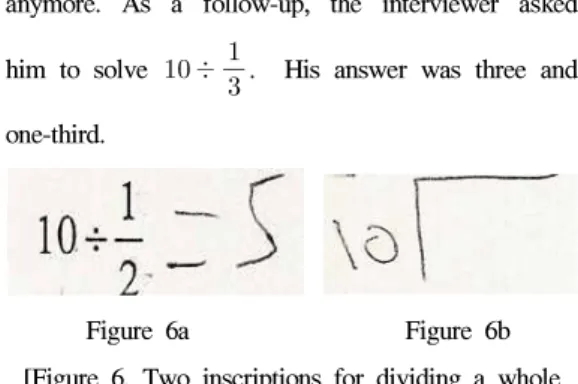
When Manuel saw a division sign between a whole number and a fraction with a numerator 1, he interpreted the problem as half of 10, so he got 5 (figure 6a). The interviewer asked him if he could check correctness of his answer with a division problem which both dividend and divisor were whole numbers, showing one of his previous division solution “ ÷ ”. He checked his answer by multiplying the quotient and the divisor (e.g., × ).
After that, however, he was unable to reconcile what he had just used to check the whole number division, with division of a whole number by a fraction (it is likely, because of his good recall of facts that Manuel might have noticed that he
couldn’t reach original number 10 by multiplying the quotient
and divisor 5). Instead of
extending the checking method to fraction number domain and considering his answer’s correctness, he kept his answer probably in his belief that was division made quotient smaller, and he rejected the checking method in fraction number domain division problem. He tried to use a different method to verify his answer: long division algorithm (figure 6b). However, he put the dividend outside of a long division sign, and then hesitated. The reason was probably he never put fraction to long division symbol and he confused
“dividing by” with the colloquial “dividing into”.
Whatever the reason was, he couldn’t go forward anymore. As a follow-up, the interviewer asked him to solve ÷
. His answer was three and
one-third.
Figure 6a Figure 6b
[Figure 6. Two inscriptions for dividing a whole number by a fraction]
Summary of Category II Development. Manuel’s case shows that, although a student may have automatic procedural skill responding to specific conditions, and may be able to solve difficult problems presented in a particular format, if a student’s procedural knowledge is not supported by a larger understanding of the procedure, how it corresponds to a central conceptual idea, and why it works the way it does, its utility is limited to only those formats from which it was learned.
Manuel could do division by multiplying reciprocal number of divisor if and only if the dividend was a fraction and the divisor was a fraction which numerator was not 1 in a number sentence (See task 3). In his understanding, division as multiplication of the inverse was useful only for fractions and not for all division problems. In addition, after he solved the problem with formal mathematic procedure, he didn’t try to make sense to his answer: he didn’t need to do it because he already knew correct execution of a correct procedure yields correct results regardless of his understanding of the procedure. However he could not relate it with other his mathematical knowledge or apply it to division of a whole number by a fraction just 3 weeks later. He still wanted to solve the problem procedurally, so he invented a procedure which involved a reciprocal ad hoc and construct an explanation (modifying his own concept), to verify his new procedure. Below is the part of the interview from task 4.
Interviewer : What is 10 divided by 2?
Manuel : 5.
Interviewer : You said 10 divided by
is also
5. It means 10 divided by 2 equals 10 divided by
. It means 2 equals
,
right?
Manuel : …But it’s rare, sometimes I had done when I change reciprocal of this, 2 and
, like 1 is, it does mean nothing, so I
just leave 2, so it just 10 divided by 2.
Even though he demonstrated strong procedural
skills in the third task, the lack of understanding of the reciprocal relationship between multiplication and division made his skill useless in other situation. In task 4, he also recognized the long division sign as another representation of division, but only remembered part of the procedure because this skill wasn’t supported by conceptual understanding that includes fractions. Finally I concluded that students could have procedural knowledge without correct corresponding conceptual knowledge; however, without support of correct conceptual understanding, procedural knowledge application is limited since it doesn’t have a role in developing students’ mathematical ability.
V. Discussion
Figure 7 illustrates, in a flowchart, the general pattern of Manuel’s problem solving for the two types of problems. From the figure, two distinct structures are evident. On the left we see the way in which he approached problems in context, utilizing conceptual understanding to choose and invent procedures towards a solution. On the right, we see how he utilized his recognition of the operations signified by number sentences to recall learned procedures (and in cases where they didn’t quite fit, ‘tweak’ them a bit to try to generate a reasonable answer). As can be seen, these two systems do not overlap significantly except in the middle when concepts and procedures are highly related. In Figure 7, the dotted arrows represent accommodation processes by which, when previously distinct concepts were connected, the resulting amalgamation (i.e., higher-order concepts)
[Figure 7. Flowchart illustrating the relationship between conceptual and procedural knowledge in Manuel’s solving rational number problems]
contained the procedures previously associated with each of the constituent ideas. Likewise, when previously dissociated procedures were combined, they appeared to bring with them their associated conceptual domains, generating new, higher-order understandings.
As Manuel’s case illustrates, it seems a reasonable leap of faith to accept that when a student has multiple (reasonable) procedures
“attached” to a particular concept, s/he is able to solve the problem by refining their procedures to fit the situation at hand. Likewise, when a student has multiple (reasonable) concepts “attached” to a procedure, s/he is able to solve the problem by examining the relationships between concepts to see how the procedure should be instantiated. I have seen in other children in my sample that they tend to have well developed systems that appear to be parallel to each other, similar to Manuel my epistemic subject (Helding, Middleton, & Louis,
2007). This evidence reinforces the general body of evidence that strong conceptual knowledge helps students perceive the general picture a question paints. It can assist students to begin a correct approach to a solution before calculation and also it may help them make sense of their solution.
Conceptual knowledge is used as a basis for selection and execution of learned procedures. It may also be used to call upon heuristic strategies if the structure of the problem and its probable solution paths are unclear (Schoenfeld, 1979).
Following conceptual recognition, if automation of each step in a corresponding procedure is acquired well, a student doesn’t need to consciously attend to its’ corresponding concept fully. That is, conceptual knowledge is used implicitly as a background for framing the execution of a well-learned procedure. However if a student doesn’t have the concept at the heart of the procedure, or s/he doesn’t cannot relate the
procedure to other procedures, then as I observed in task 3 with Manuel, the student is unlikely to have the capacity to “weak” his procedure appropriately for current task information. Subsequently s/he can only use their procedural skill in same conditions under which s/he learned it.
Moreover, even near-transfer is made difficult when inconsistent or erroneous conceptual notions are associated with formal procedures. This is not to say that transfer has not occurred, quite the contrary is shown here. Manuel transferred his knowledge of whole number division and rationally applied that knowledge, both conceptually and procedurally, to division by fractions. The problem for us was that Manuel transferred concepts that were mathematically incorrect. The general findings in the literature showing that individuals tend to over-use simple but familiar procedures over more refined, efficient ones in novel situations seems to be a likely outcome of strong procedural knowledge and relatively weak concepts being brought to bear (Helding et al., 2007; Simon, 1990).
On the other hand, if automation of each step in a procedure is not yet acquired, but a student understands the concept of the problem and makes connection from it to other concepts or other procedures, then as I observed in the extension of the Manuel’s task 1, he/she can bring out corresponding concepts using more informal or invented procedures. Additionally, in a modular fashion, students can connect two or more related concepts and extend or modify corresponding procedures which become associated with the new, merged, concept. In this situation, conceptual knowledge is used explicitly.
VI. Conclusions
Our understanding of the interrelationship between the development of conceptual knowledge and procedural knowledge is still poor, fragmented, and over-reduced to the examination of each type of knowledge separately (Star, 2005). Even though conceptual knowledge and procedural knowledge are both important in mathematics, the research and education communities have shown a tendency to value one type of knowledge above the other.
On both sides of the debate, there is a firm belief that the stronger type of knowledge will naturally lead to the development of the other. As a result, the current discourse in the reform of mathematics education still downplays procedural skill, assuming it should play a secondary, supporting role to conceptual understanding in students’ learning of mathematics (Carpenter, Franke, Jacobs, Fennema,
& Empson, 1998; Pesek & Kirschner, 2000;).
In contrast, the data in this paper shows that when students construct their mathematical knowledge, if one side of these two different types of knowledge is extremely weak compared to the other, the weaker side can impede the development of the stronger knowledge. The results suggest the notion that, at least in instructional situations, they co-develop. In other words, students tend to build procedural knowledge and conceptual knowledge together as components of the same structure when learning fractions (Byrnes & Wasik, 1991;
Rittle-Johnson & Alibali, 1999; Rittle-Johnson et al., 2001).
Manuel presented a good case to examine the interrelationship between developing conceptual knowledge and procedural knowledge. Manuel
consistently showed strong conceptual thinking but weak procedural skills for contextualized problems involving division of fractions. But when he faced with division-by-fractions problems presented as number sentences, the very same person exhibited strong procedural skills but weak conceptual understanding. This case illustrated that each type of knowledge has developed unevenly in these situations and that, at least for knowledge that yields mathematically coherent and correct answers, they have not yet intertwined with each other. This is not to say that Manuel did not develop conceptual knowledge associated with his strong procedural knowledge, nor do I suggest that Manuel did not have proceduralized his strong conceptual knowledge. It is clear from the transcripts that he had rather developed notions that happened to be incorrect conceptually or “buggy”
procedurally. The co-development of conceptual and procedural knowledge, at least for rational numbers and other complex mathematical situations, therefore, appears to require something else altogether if the resulting knowledge is to be both transferable and useful practically (Davis, 2006;
Scardamalia & Bereiter, 2006). Attention must be paid to the purposeful connecting of procedures and concepts (the dotted arrows in Figure 7) in instructional settings such that context, mathematical structure, and procedural operations are to develop into a coherent system of knowledge.
References
Anderson, J. R. (1983). The architecture of
cognition. Cambridge, MA: Harvard University Press.
Baroody, A. J. (2003). The development of adaptive expertise and flexibility: The integration of conceptual and procedural knowledge. In A.
J. Baroody & A. Dowker (Eds.), the development of arithmetic concepts and skills: Constructing adaptive expertise (pp.1–33). Mahwah, NJ:
Lawrence Erlbaum.
Baroody, A. J., Feil, Y., & Johnson, A. R. (2007).
An alternative reconceptualization of procedural and conceptual knowledge. Journal for Research in Mathematics Education, 38(2), 115-131.
Behr, M. J., Harel, G., Post, T., & Lesh, R.
(1992). Rational number, ratio, & proportion. In D. A. Grouws (Ed.), Handbook of Resesarch on Mathematics Teaching and Learning(pp. 296-333).
New York: Macmillan.
Briars, D., & Siegler, R. S. (1984). A featural analysis of preschoolers’ counting knowledge.
Developmental Psychology, 20(4), 607-618.
Byrnes, J. P., & Wasik, B. A. (1991). Role of conceptual knowledge in mathematical procedural learning.Developmental Psychology, 27(5), 777-786.
Carpenter, T. P., Franke, M. L., Jacob, V. R., Fennema, E. H., & Empson, S. B. (1998). A longitudinal study of invention and understanding in children’s multidigit addition and subtraction.
Journal for Research in Mathematics Education, 29, 3-20.
Conference Board of the Mathematical Sciences (1989). Everybody counts: a report to the nation on the future of mathematics education. Washington, DC: National Academy Press.
Davis, E. J. (2006). A model for understanding in mathematics. Mathematics Teaching in the Middle
School, 12(4), 190-197.
Gibb, E. G., & Castaneda, A. M. (1975). Experience for young children. In J. N. Payne (Ed.), mathematics learning in early childhood (37th yearbook, pp. 96-124). Reston, VA: National Council of Teachers of Mathematics.
Haapasalo, L. & Kadijevich, D. (2000). Two types of mathematical knowledge and their relation.
Journal für Mathematik-Didaktik, 21(2), 139-157.
Helding, B., Middleton, J. A., & Louis, E. (2007).
Pivots as Leverage Points in the Problem Space:
Cases of Rational Number Development. Tempe, AZ: Arizona State University.
Hiebert, J., & Lefevre, P. (1986). Conceptual and procedural knowledge in mathematics: An introductory analysis. In J. Hiebert (Ed.), Conceptual and procedural knowledge: The case of mathematics (pp. 1-27). Hillsdale, NJ: Lawrence Erlbaum Associates.
Lamon, S. (2005). Teaching Fractions and Ratios for Understanding (2nd Ed.). London, UK:
Routledge.
Pesek, D. D., & Kirschner, D. (2000). Interference of instrumental instruction in subsequent relational learning. Journal for Research in Mathematics Education, 31, 524-540.
Piaget, J. (1964). Six psychological studies. New York: Vintage
Piaget, J. (1978). Success and understanding. Cambridge, MA: Harvard University Press.
Rittle-Johnson, B., & Alibali, M. W. (1999).
Conceptual and procedural knowledge of mathematics:
Does one lead to the other? Journal of Educational Psychology, 91(1), 175-189.
Rittle-Johnson, B., Siegler, R. S., & Alibali, M.
W. (2001). Developing conceptual understanding and procedural skill in mathematics: An iterative process. Journal of Educational Psychology, 93, 346-362.
Scardamalia, M., & Bereiter, C. (2006). Knowledge Building: Theory, pedagogy, and technology. In K. Sawyer (Ed.), Cambridge Handbook of the Learning Sciences. Cambridge, UK: Cambridge University Press.
Schopenhauer, A. (1974). Parerga and paralipomena:
Short philosophical essays. Sketch of a history of the ideal and the real. (vol.1) (E. F. J.
Payne, Trans.) Oxford, Eng.: Clarendon Press.
Schoenfeld, A. (1979). Can heuristics be taught? In J. Clement & J. Lochhead (Eds.),Cognitive Process Instruction: Research on Teaching Thinking Skills. Hillsdale, NJ: Lawrence Erlbaum.
Simon, H. A. (1990). Invariants of Human Behavior.
Annual Review of Psychology. 41(1), 1-19.
Skemp, R. R. (1978). Relational understanding and instrumental understanding. Arithmetic Teacher, 26(3), 9-15.
Star, J. R. (2005). Reconceptualizing procedural knowledge. Journal for Research in Mathematics Education, 36, 404-411.
Steffe, L. P., & Thompson, P. W. (2000). Teaching Experiment Methodology: Underlying Principles and Essential Elements. In A. E. Kelly & R. A.
Lesh (Eds.), Handbook of Research Design in Mathematics and Science Education (pp. 267-306).
Mahwah, NJ: Lawrence Erlbaum Associates.
Vinner, S., (1992). The role of definitions in the teaching and learning of mathematics. In D. O.
Tall (Ed.), Advanced mathematical thinking, (pp.65–81). Kluwer, Dortrecht.
개념적 지식과 절차적 지식 간의 불균형한 발달이 학생들의 유리수 영역의 지식 형성에 미치는 영향
김 아 영 (이화여자대학교 교육대학원/수송중학교)
이 논문에서 연구자는 중학생들의 수학 학습 을 삼 년간에 걸쳐 관찰하면서 그들이 유리수 범위에서 형성한 개념적 지식과 절차적 지식 사이의 발달 관계에 대하여 조사하였다. 특히, 아래의 두 상황에서 학생들의 개념적 지식과 절차적 지식 사이의 불균형한 발달이 이후의 지식 발달에 어떤 영향을 미치는 지에 관하여 조사하였다: (a) 상대적으로 강한 개념적 지식
과 약한 절차적 지식을 가진 경우; (b) 상대적 으로 약한 개념적 지식과 강한 절차적 지식을 가진 경우. 연구 결과는 개념적 지식과 절차적 지식이 균형적인 방식으로 (즉, 아주 근접하게 되풀이되거나 동시에) 발달될 때 가장 생산적 이라는 것을 시사하며 또한 어느 한 가지 유형 의 지식이 다른 유형의 지식보다 우위에 있다 는 가정에 의문에 제시한다.
key words : conceptual knowledge (개념적 지식), procedural knowledge (절차적 지식), rational number (유리수), constructivism(구성주의)
논문접수 : 2012. 10. 10 논문수정 : 2012. 10. 25 심사완료 : 2012. 11. 12