Res. Plant Dis. 17(1) : 32-37 (2011)
© The Korean Society of Plant Pathology
태양열 소독시 유기물과 석회질소 병행 처리에 의한 딸기 시들음병균 방제
남명현*·김현숙·김홍기1
충남농업기술원 논산딸기시험장, 1충남대학교 응용생물학과
Control of Fusarium Wilt of the Strawberry Caused by Fusarium oxysporum f. sp.
fragariae of Solarization with Compost and Calcium Cyanamide Application
Myeong Hyeon Nam*, Hyeon Suk Kim and Hong Gi Kim1 Nonsan Strawberry Experiment Station, Chungnam ARES, Nonsan 320-862, Korea
1Department of Applied Biology, Chungnam National University, Daejeon 305-764, Korea (Received on November 10, 2010; Accepted on February 23, 2011)
Field experiments were conducted to evaluate the effectiveness of soil solarization at the Nonsan Strawberry Experiment Station, Korea in 2006 and 2008. In in vitro tests, exposure times to achieve an LD100 of Fusarium oxysporum f. sp. fragariae were 6.6 days and 5.1 days at 45oC and 50oC, respectively. A 100% lethal temperature was 46.7
±0.1
oC for the same fungus. For field trials, solarization was conducted during the summer season using polyethylene mulch in a plastic house. The organic matter+calcium cyanamide+solarization treatment increased pH, organic matter, and calcium content compared to those before treatment in soil analysis, but no effect had an urea + solarization treatment. The temperatures at 10 cm depth were different in each treatment and the highest temperature was recorded from July 30 to August 10. The average temperature in organic matter+calcium cyanamide+solarization treatment at 10 cm depth was 3~4oC higher than that in all the other treatments. All solarization treatments reduced the soil population of F. oxysporum f.
sp. fragariae at 100% in 2008 relative to the non-treated control. All solarization treatments reduced Fusarium wilt incidence to 0% in 2006 and 2008. The effect of organic matter+calcium cyanamide+
solarization against F. oxysporum f. sp. fragariae indicates that there may be future alternatives to traditional solarization for disease control as well as reducing the time needed.
Keywords : Control, Fusarium wilt, Solarization, Strawberry 딸기의 각종 병해 발생은 재배양식에 따른 품종과 관 련이 깊은데 1970~80년대 ‘Hokowase’ 품종에서 시들음 병 발생으로 큰 피해가 있었으나(Cho와 Moon, 1984) 그 후 시들음병에 강한 ‘Nyoho’와 ‘Akihime’ 품종의 도입으 로 한동안 문제가 되지 않았다. 그러나 최근 국내에서 육 종된 ‘매향’과 ‘금향’ 품종, 일본에서 육종된 ‘Dochiotome’
와 ‘Redpearl’ 품종은 시들음병에 감수성으로 육묘기 재 배농가에서 많은 피해가 발생하고 있다(Nam 등, 2005).
또한 최근에는 저항성 품종으로 인식되어 온 ‘Akihime’
품종에서도 연작을 하는 일부 재배포장에서 발생이 되고 있으며 국내 60% 이상을 차지하는 ‘설향’에서도 남부지
역에서 시들음병 발생이 매년 증가추세에 있다(Nam 등, 2009a).
Fusarium oxysporum f. sp. fragariae에 의한 딸기 시들 음병(Winks와 Williams, 1965)은 토양 전염성 병해로 병 원균이 토양에서 오랜 기간 생존할 수 있다. 따라서 시들 음병 방제를 위한 토양 소독방법으로 methyl bromide 등 을 이용한 토양 훈증(De Cal 등, 2004; Shaw와 Larson, 1999; Yuen 등, 1991), 미생물을 이용한 생물적 방제(Nam 등, 2009b), validamycin의 관주처리(Ishikawa 등, 2005) 등 이 적용되고 있다. 그러나 methyl bromide를 이용한 토양 훈증은 오존층 파괴라는 환경문제에 접하여 이를 대체할 수 있는 방법 등의 연구가 진행되고 있으며, 미생물과 약 제 관주처리에 의한 방제는 주로 병이 발생하기 전에 예 방적으로 처리하여야 하며 토양에 병원균 밀도가 높은 상
*Corresponding author
Phone) +82-41-733-3161, Fax) +82-41-733-3163 Email) [email protected]
DOI: 10.5423/RPD.2011.17.1.032 보문 Open Access
태에서는 만족할 만한 방제효과를 나타내지 못한다.
토양 병 방제를 위해 친환경적이며 병해충 종합방제의 일환으로 작물의 수량도 증가시켜 주는 태양열 소독방법 이 예전부터 많이 연구가 되었으며(Chellemi 등, 1997;
Pinkerton 등, 2002; Stapleton, 2000; Tamietti와 Valentino, 2006), 태양열 소독시 40oC 전후의 온도로 8~14일 처리 시 시들음병균이 검출되지 않는다고 보고하였다(Komada 와 Fukui, 1982a). 태양열 소독 효과증진을 위해 노지 포 장에서 비닐 멀칭과 석회질소(Calcium cyanamide, CaCN2) 를 병행처리 한 것은 멀칭 단독처리한 것과 차이가 없다 고 하였으나(Komada와 Fukui, 1982b) 오이를 재배하는 비닐하우스 내의 F. solani f. sp. cucurbitae 및 선인장의 basal stem rot을 일으키는 F. oxysporum 방제에 효과적이 라 하였다(Bourbos 등, 1997; Choi 등, 2007). 또한 Lodha (1995)는 척박한 토양의 태양열 소독 시 요소(Urea, (NH2)2CO)를 처리하면 무처리에 비해 F. oxysporum f. sp.
cumini와 Macrophomina phaseolina 방제에 효과적이라 한 바 있다.
따라서, 본 연구에서는 점차 피해가 심해지고 있는 딸 기 시들음병에 대한 보다 효과적인 방제방법을 개발하고 자 in vitro상에서 시들음병균의 치사온도와 처리시간을 조사하고, 시설하우스에서의 태양열 소독효과 증진시키기 위해 유기물 외 석회질소와 요소 병행 처리에 의한 시들 음병 방제 효과를 검토하였다.
재료 및 방법
딸기 시들음병균의 온도에 대한 민감도 조사. 공시한 F. oxysporum f. sp. fragariae는 충남 논산의 딸기 재배포 장으로부터 채집된 전형적인 시들음병 병반(뿌리와 관부) 으로부터 분리한 후 딸기에 병원성이 확인된 7개 균주를 실험에 이용하였다(Nam 등, 2005). 이들 균주의 치사온 도와 치사율을 조사하기 위해 potato dextrose agar(PDA;
Difco, USA) 배지에 치상 후 28, 35, 40, 45, 50oC의 인 큐베이터에서 1, 3, 5, 7일 동안 배양 후 꺼내어 28oC 암 조건에서 2일간 배양하여 균사생장율을 조사하였다. 균 사생장 억제율(%)은 (1−온도별 배지에서의 균총 직경/
28oC배지에서의 균총 직경)×100의 공식에 의해 계산하 였다(Park 등, 2002). 실험은 처리 당 4반복으로 실시하 였으며 시들음병균에 대한 온도의 억제활성은 Microsoft Excel의 EXP함수를 이용하여 LT90과 LT100을 기초로 분 석하였다.
태양열 소독. 여름철 딸기 재배포장 비닐하우스의 태 양열 소독효과 증진을 위해 2006년과 2008년 2년에 걸쳐
시험을 수행하였다. 태양열 소독은 비닐하우스 내에 유기 물 처리구[밭사랑비료(돈분뇨 50%, 톱밥 50%), 제일비료;
3톤/10a], 유기물[밭사랑비료(돈분뇨 50%, 톱밥 50%), 제 일비료; 3톤/10a]+석회질소[입상석회질소, 20(질소)−55(석 회)−55(시아나미드), 조비㈜; 60 kg/300평] 처리구, 요소 [질소 46% 이상, 삼성정밀화학㈜; 2 kg/300평] 처리구, 태 양열단독 처리구의 4처리로 처리구와 처리구 사이는 3.0 m2 의 buffer구를 두었으며 대조구로 태양열 무처리구를 설 정하였다. 처리구당 면적은 40 m2의 단구제로 실시하였다.
태양열 소독은 2006년은 7월 20일부터 8월 23일, 2008년 은 7월 25일부터 8월 23일까지 실시하였다. 태양열 소독 을 하기 전 이병토를 만들기 위해 딸기 시들음병균 Fo79 균주를 MM 배지(Correll 등, 1987)에서 28oC, 180 rpm으 로 7일간 진탕 배양하여 포자현탁액(1×10⁵ 포자/ml)을 만 들었다. 포자현탁액은 소형분무기로 토양에 분무접종(20 l/
40 m2)한 후 토양을 경운하였다. 경운 후 토양에 분수호 스를 깔고 촉촉하게 관수한 다음 비닐을 덮고 하우스를 밀폐하여 태양열 소독을 실시하였다. 처리구간 지중 온도 측정은 각 처리구의 지중 10 cm 깊이에 지온센서를 연결 한 후 비닐하우스 외부에 설치된 데이터로거(WatchDog model 2000, Spectrum Tech. Inc., USA)로 데이터를 수집 하였으며 바로 옆에 있는 비닐하우스 내부의 온도와 노 지 재배포장의 온도도 동일한 방법으로 수집하였다.
토양의 화학성 및 시들음병균 밀도 조사. 태양열 소독 처리 전과 후의 토양 이화학성 조사를 위해 처리구별 3 지점에서 표면을 모종삽으로 걷어내고 5 cm 깊이까지의 토양을 채취하였다. 채취한 토양의 화학성은 토양이화학 분석기준(농촌진흥청)에 따라 유기물, pH, K, Ca, Mg을 조사하였다. pH는 토양과 증류수를 1:5로 희석하여 pH meter로 측정하였고, 토양유기물은 Tyrin법, 치환성양이온 은 1 N-NH4OAc(pH7.0) 법으로 유도결합 플라즈마 분광 분석기(Inductively Coupled Plasma)를 이용하여 측정하였 다. 처리 전과 후 토양내의 시들음병균 밀도는 토양 이화 학분석을 위해 채취한 토양 1 g에 대한 균총수를 선택배 지인 peptone PCNB 배지(Nash와 Snyder, 1962)를 이용하 여 조사하였다.
딸기 시들음병 방제효과. 태양열 소독이 끝난 후 2006년 ‘금향’과 2008년 ‘설향’ 품종의 조직배양묘로 증 식한 자묘를 처리구에 정식하여 시들음병 이병주율을 조 사하였다. 시험구 배치는 완전임의배치 3반복으로 면적은 처리 당 40 m2로 하였다. 처리간 비교는 CoStat 통계 프 로그램(CoHort software, Berkeley, CA)을 이용해 non- parametric 방법을 이용하여 Kruskal-Wallis test 분석을 실 시하였다.
결과 및 고찰
딸기 시들음병균의 온도에 대한 민감도 조사. 딸기에 서 분리한 F. oxysporum f. sp. fragariae 7개 균주의 치사 시간을 조사한 결과 45oC에서 50% 치사는 1일, 100% 치 사는 6.6일이 소요되었으며 50oC에서의 50% 치사는 0.1 일, 100% 치사는 5.1일이 소요되는 것으로 조사되었다
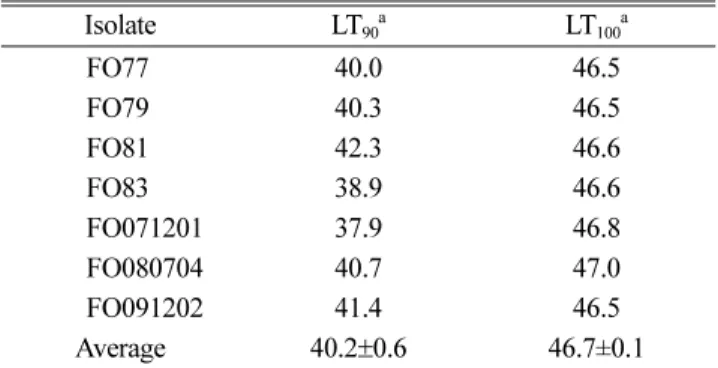
(Table 1). 또한 딸기 시들음병균 7개 균주의 90% 치사를 일으키는 평균온도는 40.2±0.6oC이었고 100% 치사는 46.7±0.1oC로 조사되었다(Table 2). Verticillum dahliae, Pythium ultimum, Thielaviopsis basicola, Rhizoctonia solani에 대한 agar 배지 상에서 열처리에 의한 치사온도 와 시간은 균주에 따라 다르지만 LD90에 도달하는 시간 이 50oC에서 23, 27, 33, 68분이었다고 보고하였는데 (Pullman 등, 1981) 본 시험에 사용된 F. oxysporum f. sp.
fragariae의 경우는 50oC에서 100% 치사시간이 5.1일로 이전에 보고된 다른 균보다는 치사시간이 길게 조사되었 다. 따라서 이러한 결과는 재배포장에서 딸기 시들음병 방제를 위한 태양열소독을 실시할 경우 처리시간과 온도 에 대한 유용한 정보를 제공할 것이다.
태양열 소독방법별 토양의 화학적 특성 및 지온변화.
태양열 소독효과를 증진하기 위한 방법으로 태양열 소독 과 함께 유기물, 석회질소, 요소를 각각 병행 처리한 결 과, 유기물 처리구는 처리전보다 유기물 함량이 증가하였 고, 석회질소 처리구는 pH, 유기물, 칼슘 함량이 증가하 였으나 요소 처리구는 큰 변화가 없었다(Table 3).
태양열 소독 무처리구의 대기 온도는 최고 35.6oC인 반 면 태양열 소독시 지온은 처리간에 차이를 나타냈으며 토 양 깊이 10 cm에서 7월 30일부터 8월 10일까지가 가장 높은 지온(48.4~54.8oC)을 보였는데 유기물+석회질소 처 리구가 다른 처리구보다 평균온도가 3~4oC 높게 유지되 었고 유기물 처리구와 요소 처리구에서도 태양열 단독 처 리 보다 1~3oC 높게 나타났다(Table 4). 47oC 이상의 시 Table 1. Lethal days for Fusarium oxysporum f. sp. fragariae
isolates by temperature treated
Temperature LD50a (days) LD100a (days) 50oC 0.1 days 5.1 days 45oC 1.0 days 6.6 days
aDays to lead 50 and 100 percent lethality.
Table 2. Lethal temperatures for Fusarium oxysporum f. sp.
fragariae isolates
Isolate LT90a LT100a
FO77 40.0 46.5
FO79 40.3 46.5
FO81 42.3 46.6
FO83 38.9 46.6
FO071201 37.9 46.8
FO080704 40.7 47.0
FO091202 41.4 46.5
Average 40.2±0.6 46.7±0.1
aTemperature for 90 and 100% mortality.
Table 3. Chemical properties of soil before and after solarization alone and combination
Treatment Year Timing pH
(1:5)a
OM (%)
K Ca Mg
Ex. Cations (cmol+/kg)
Solarization+organic matter (OM)
2006 Before 6.9 21 0.14 5.6 1.7
After 7.2 30 0.24 6.7 2.2
2008 Before 4.8 16 0.81 5.8 3.9
After 5.5 19 0.68 3.8 2.9
Solarization+OM+
calcium cyanamide
2006 Before 6.7 18 0.16 5.7 1.9
After 7.8 24 0.23 9.4 0.8
2008 Before 5.0 11 0.61 4.5 2.3
After 5.6 16 0.62 4.5 2.6
Solarization+urea
2006 Before 7.1 23 0.19 6.0 2.0
After 7.2 9 0.10 5.9 1.4
2008 Before 5.0 13 0.70 4.5 2.9
After 5.1 15 0.70 4.5 3.4
Solarization 2006 - 6.4 13 0.11 5.8 1.7
2008 - 5.8 22 0.81 5.6 3.1
aSoil dilution.
간은 유기물+석회질소 처리구가 111시간으로 가장 길게 나타났고 다음으로 요소 처리구와 유기물 처리구 순이었 다. 딸기 시들음병균에 대한 in vitro상에서 100% 치사온 도인 46.7oC 이상의 시간은 태양열 소독 모든 처리에서 11시간 이상 측정되어 7월 하순부터 8월 하순까지 1달 정 도의 태양열 소독은 Table 1의 결과를 고려할 때 시들음 병균을 치사시키기 충분한 온도 및 시간이 되었다. 일본 의 딸기 재배포장에서는 45oC에서 6일, 50oC에서 2일, 55oC에서 12시간이면 딸기 시들음병균이 사멸한다고 보 고한 결과와도 일치하였다(Kodama와 Fukui, 1982a,b). 특 히 유기물+석회질소 처리구에서 다른 처리구보다 지온이 상승한 원인은 유기물과 석회질소에 의한 온도상승이 주 요 원인이라고 사료된다. 기존의 보고에 따르면 오이 시 들음병 발생은 석회질소+유기물을 처리하고 태양열 소독 을 6주동안 실시하면 석회질소 단독 처리보다 6.4% 감소 한다고 했지만(Bourbos 등, 1997), 선인장 시들음병의 경 우는 처리간 방제효과에 차이가 없다고 하였다(Choi 등, 2007).
석회질소는 F. oxysporum에 의해 발생하는 병해를 감소 시킨다고 알려져 있으며 주로 살충과 선충 방제효과가 있 고 특히 토양에 잔류가 없으며 질소와 칼슘으로 분해되 어 안전하다고 한다(Royal Society of Chemistry, 1984). 또 한 석회질소는 수화반응에 의해 반응열을 발생시키는데 생석회 100 g으로 1 l의 물을 27.8oC 올릴 수 있다고 하 며 (주식회사 조비 개인교신) 이런 반응에 의해 석회질소
가 지온을 상승시키는 효과를 가져온다고 볼 수 있다. 따 라서 유기물+석회질소를 처리 후 태양열 소독방법은 짧 은 시간내 태양열 소독을 할 수 있는 유용한 방법이 될 수 있으며 토양의 산도 보정에도 효과적이라 사료된다.
그러나 pH 상승효과를 고려할 때 처리전 토양의 pH가 높은 토양의 경우에는 사용을 피해야 하겠다.
딸기 시들음병 방제효과. 토양내 시들음병균의 밀도는 각 태양열 소독 처리구 모두에서 시들음병균이 검출되지 않았다(Table 5). 2006년과 2008년 포장시험에서도 각 태 양열 소독처리 후 시들음병 이병주율 조사에서 무처리는 2006년 20%, 2008년 13.3%의 시들음병 발병율을 나타낸 반면 태양열 소독 처리구 모두에서는 시들음병 발생이 없 었으며 처리간의 유의성도 나타나지 않았다(Table 6). Katan 등(1976)은 비닐멀칭에 의한 태양열 소독을 실시할 경우 F. oxysporum f. sp. lycopersici는 지하 5 cm, 15 cm, 25 cm Table 4. Average and high temperature at 10-cm soil depth in solarization and non-solarization plots at the Nonsan Strawberry Experiment Station in 2008
Treatment Average Temp. (oC) High Temp. (oC) Hours > 47oC
Solarization+organic matter (OM) 38.6 49.7 29
Solarization+OM+calcium cynamide 40.5 54.8 111
Solarization+urea 39.1 51.5 51
Solarization 38.3 48.4 11
Plastic house 32.4 39.2 0
Atmosphere 26.8 35.6 0
Table 5. Effects of soil solarization on the soil population of Fusarium oxysporum f. sp. fragariae
Treatment
Propagules of F. oxysporum f. sp. fragariae (×105 CFU)/g soil
2006 2008
Before After Before After
Solarization+organic matter (OM) 7.7 0 3.5 0
Solarization+OM+calcium cyanamide 3.7 0 4.0 0
Solarization+urea 5.3 0 4.5 0
Solarization 9.0 0 4.0 0
Control 9.3 9.0 4.0 3.5
Table 6. Rate of Fusarium wilt incidence caused by Fusarium oxysporum f. sp. fragariae according to different treatment
Treatment 2006 2008
Solarization+organic matter (OM) 0 az 0 a Solarization+OM+calcium cyanamide 0 a 0 a
Solarization+urea 0 a 0 a
Solarization 0 a 0 a
Control 20.0 b 13.3 b
zWithin a column, the same letters do not differ significantly based on the non-parametric Kruskal-Wallis’s test (p=0.05).
에서 각각 94~100%, 68~100, 54~63%까지 감소하며 Verticillium wilt도 25~95%까지 방제효과를 보인다고 보 고하였다. 또한 Tamietti와 Valentino(2006)는 5 cm 깊이에 서 97~99.7%의 방제효과를 나타내었는데 본 연구에서도 태양열 소독을 실시할 경우 딸기 시들음병 방제에 효과 적이었으며 태양열 소독 시 유기물, 요소, 석회질소 병행 처리는 병 방제 외에 토양의 화학적 환경의 변화를 일으 켜 수량이나 환경의 변화를 줄 수 있으므로 추후 이에 대 한 검토가 필요할 것으로 사료된다.
요 약
유기물, 석회질소, 요소 병행처리가 딸기 시들음병의 친 환경적 방제인 태양열소독의 효과 증진여부를 밝히고자 논산딸기시험장의 비닐하우스에서 2006년과 2008년에 분 석하였다. 딸기에서 분리한 Fusarium oxysporum f. sp.
fragariae 7개 균주의 100% 치사시간은 45oC에서 6.6일, 50oC에서는 5.1일이 소요되었고 100% 치사온도는 46.7±
0.1oC로 나타났다. 태양열 소독에 의해 유기물 처리구는 처리전보다 토양내 유기물 함량이 증가하였고, 석회질소 처리구는 산도, 유기물, 칼슘 함량이 증가하였으나 요소 처리구는 차이가 없었다. 태양열 소독시 지온은 처리간에 차이를 나타냈으며 7월 30일부터 8월 10일까지가 가장 높았고(48.4~54.8oC) 유기물+석회질소 처리구가 다른 처 리구보다 3~4oC 높게 유지되었다. 또한 토양내 시들음병 균은 각 처리구 모두에서 사멸되었다. 시들음병 이병주율 은 무처리는 2006년 20%, 2008년 13.3%의 발병율을 나 타낸 반면 태양열 소독 처리구 모두에서는 시들음병 발 생이 없었으며 처리간 유의성이 있었다. 따라서 딸기 시 들음병 방제를 위한 유기물+석회질소를 병행한 태양열 소독 방법은 기존의 태양열소독방법을 보완하여 처리기 간을 줄이면서도 효과적인 방법이 될 것이다.
Acknowledgements
This work was carried out with the support of
“Cooperative Research Program for Agriculture Science &
Technology Development (Project No. PJ0066752010)”
Rural Development Administration, Republic of Korea.
참고문헌
Bourbos, V. A., Skoudridakis, M. T., Darakis, G. A. and Koulizakis, M. 1997. Calcium cyanamide and soil solarization for the control of Fusarium solani f. sp. cucurbitae in
greenhouse cucumber. Crop Prot. 16: 383-386.
Chellemi, D. O., Olson, S. M., Mitchell, D. J., Secker, L. and McSorley, R. 1997. Adaptation of soil solarizatrion to the integrated management of soilborne pests of tomato under humid conditions. Phytopathology 87: 250-258.
Cho, C. T. and Moon, B. J. 1984. Studies on the wilt of strawberry caused by Fusarium oxysporum f. sp. fragariae in Korea.
Korean J. Plant Prot. 23: 74-81.
Choi, H. W., Chung, I. M., Sin, M. H., Kim, Y. S., Sim, J. B., Kim, J. W., Kim, K. D. and Chun, S. C. 2007. The effect of spent mushroom sawsust compost mixes, calcium cyanamide and solarization on basal stem rot of the cactus Hylocereus trigonus caused by Fusarium oxysporum. Crop Prot. 26: 162- 168.
Correll, J. C., Klittich, C. J. R. and Leslie, J. F. 1987. Nitrate nonutilizing mutants of Fusarium oxysporum and their use in vegetative compatibility tests. Phytopathology 77: 1640-1646.
De Cal, A., Martinez-Treceno, A., Lopez-Aranda, J. M. and Melgarejo, P. 2004. Chemical alternatives to methyl bromide in Spanish strawberry nurseries. Plant Dis. 88: 210-214.
Ishikawa, R., Shirouzu, K., Nakashita, H., Lee, H. Y., Motoyama, T., Yamaguchi, I., Teraoka, T. and Arie, T. 2005. Foliar spray of validamycin A or validoxylamine A controls tomato Fusarium wilt. Phytopathology 95: 1209-1216.
Katan, J., Greenberger, A., Alon, H. and Grinstein, A. 1976. Solar heating by polyethylene mulchiung for the control of diseases caused by soil-borne pathogens. Phytopathology 66: 683-688.
Komada, T. and Fukui, T. 1982a. Solar heating in closed plastic house for control of soilborne diseases V. Application for control of Fusarium wilt of strawberry. Ann. Phytopathol. Soc.
Japan 48: 570-577.
Komada, T. and Fukui, T. 1982b. Heating with plastic-film mulching in the out-door field for control of Fusarium wilt of strawberry. Ann. Phytopathol. Soc. Japan 48: 699-701.
Lodha, S. 1995. Soil solarization, summer irrigation and amendments for the control of Fusarium oxysporum f. sp.
cumini and Macrophomina phaseolina in arid soils. Crop Prot.
14: 215-219.
Nam, M. H., Jung, S. K., Kim, N. G., Yoo, S. J. and Kim, H. G.
2005. Resistance analysis of cultivars and occurrence survey of Fusarium wilt on strawberry. Res. Plant Dis. 11: 35-38.
Nam, M. H., Nam, Y. G., Kim, T. I., Kim, H. S., Jang, W. S., Lee, W. K., Lee, I. H., Kang, H. K., Park, Y. J., Choi, J. M. and Whang, K. S. 2009a. Compendium of strawberry diseases and pests. Chungnam strawberry association. 204 pp.
Nam, M. H., Park, M. D., Kim, H. G. and Yoo, S. J. 2009b.
Biological control of strawberry Fusarium wilt caused by Fusarium oxysporum f. sp. fragariae using Bacillus velezensis BS87 and RK1 formulation. J. Microbiol. and Biotech. 19:
520-524.
Nash, S. N. and Snyder, W. C. 1962. Quantitative estimations by plate counts of propagules of the bean rot Fusarium in field
soil. Phytopathology 73: 458-462.
Park, S. W., Kim, J. T., Kim, J. J. and Kim, H. T. 2002. Sensitivity of Colletotrichum spp. isolated from red-pepper to sterol biosynthesis inhibiting-fungicides and their field fitness. Res.
Plant Dis. 8: 239-244.
Pinkerton, J. N., Ivors, K. L., Reeser, P. W., Bristow, P. R. and Windom, G. E. 2002. The use of soil solarizartion for the management of soilborne plant pathogens in strawberry and red raspberry production. Plant Dis. 86: 645-651.
Pullman, G. S., DeVay, J. E. and Garber, R. H. 1981. Soil solarization and thermal death: A logarithmic relationship between time and temperature for four soilborne plant pathogens. Phytopathology 71: 959-964.
Rotal Society of Chemistry. 1984. The Agrochemical Handbook.
Unwin Brothers, Surrey, UK.
Shaw, D. V. and Larson, K. D. 1999. A meta-analysis of
strawberry yield response to preplant soil fumigation with combinations of methyl bromide-chloropicrin and four alternative systems. HortScience 34: 839-845.
Stapleton, J. J. 2000. Soil solarization in various agricultural production systems. Crop Prot. 19: 837-841.
Tamietti, G. and Valentino, D. 2006. Soil solarization as an ecological method for the control of Fusarium wilt of melon in Italy. Crop Prot. 25: 389-397.
Winks, B. L. and Williams, Y. N. 1965. A wilt of strawberry caused by a new form of Fusarium oxysporum. Queensland J.
Afric. Animal Sci. 22: 475-479.
Yuen, G. Y., Schroth, M. N., Weinhold, A. R. and Hancock, J. G.
1991. Effects of soil fumigation with methyl bromide and chloropicrin on root health and yield of strawberry. Plant Dis.
75: 416-420.