Determination of Fatty Acid Composition in Peanut Seed by Near Infrared Reflectance Spectroscopy
Jeong Min Lee 1 , Suk-Bok Pae 2† , Myoung-Gun Choung 3 , Myoung-Hee Lee 2 , Sung-Up Kim 2 , Eun-young Oh 2 , Ki-Won Oh 2 , Chan-Sik Jung 2 , and In Seok Oh 2
ABSTRACT This study was conducted to develop a fast and efficient screening method to determine the quantity of fatty acid in peanut oil for high oleate breeding program. A total of 329 peanut samples were used in this study, 227 of which were considered in the calibration equation development and 102 were utilized for validation, using near infrared reflectance spectroscopy (NIRS).
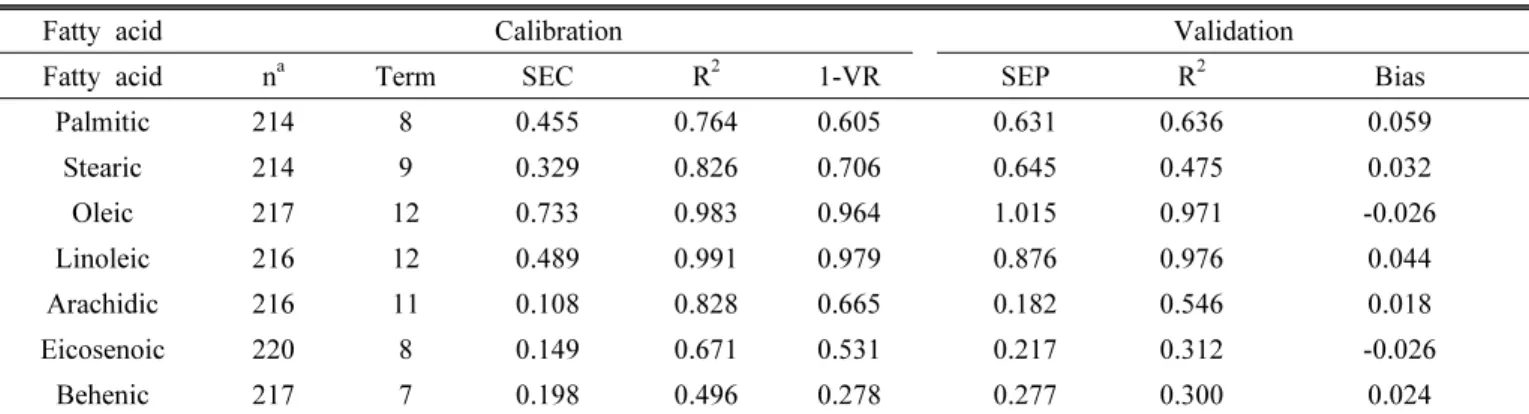
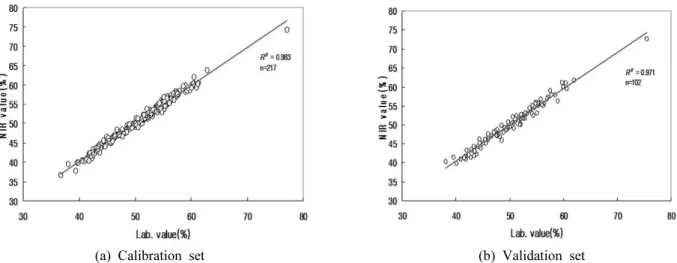
The NIRS equations for all the seven fatty acids had low standard error of calibration (SEC) values, while high R2 values of 0.983 and 0.991 were obtained for oleic and linoleic acids, respectively in the calibration equation. Furthermore, the predicted means of the two main fatty acids in the calibration equation were very similar to the means based on gas chromatography (GC) analysis, ranging from 36.7 to 77.1% for oleic acid and 7.1 to 42.7% for linoleic acid. Based on the standard error of prediction (SEP), bias values, and R
2statistics, the NIRS fatty acid equations were accurately predicted the concentrations of oleic and linoleic acids of the validation sample set. These results suggest that NIRS equations of oleic and linoleic acid can be used as a rapid mass screening method for fatty acid content analysis in peanut breeding program.
Keywords : Fatty acid, Linoleic acid, NIRS, Oleic acid, Peanut
DOI : http://dx.doi.org/10.7740/kjcs.2016.61.1.064Original Research Article
ⓒ 본 학회지의 저작권은 한국작물학회지에 있으며, 이의 무단전재나 복제를 금합니다.
This is an Open-Access article distributed under the terms of the Creative Commons Attribution Non-Commercial License (http://creativecommons.org/licenses/by-nc/3.0) which permits unrestricted non-commercial use, distribution, and reproduction in any medium, provided the original work is properly cited.
1
Natural Products Research Team, National Marine Biodiversity Institute of Korea, Seocheon 33662, Korea
2
Department of Southern Area Crop Science, National Institute of Crop Science, Rural Development Administration, Miryang 50424, Korea
3
Department of Herbal Medicine Resource, Kangwon National University, Samcheok 25913, Korea
†
Corresponding author: Suk-Bok Pae; (Phone) +82-55-350-1215; (E-mail) [email protected]
<Received 17 July, 2015; Revised 11 March, 2016; Accepted 12 March, 2016>
Peanut is an important food crop grown in over 100 countries with a total production of 38 million tons in 2010. Peanut seeds are rich source of oil (48 to 50%), protein (25 to 28%), vitamins and minerals (Janila et al., 2013). Peanut oil is extensively used for cooking purpose, because it contains rich fatty acids such as oleic, linoleic, palmitic, stearic, arachidic, and behenic acids.
Recently, more emphasis has been placed on breeding for improving the peanut oil quality, so a fast efficient mass screening method to determine the content of fatty acids has required in breeding program. For measuring oil and its fatty acid contents in peanut seed, the soxhlet and gas chromatography (GC) methods are widely utilized. However, these methods and related methodologies are relatively complicate and time consuming and involved corrosive chemicals and required elaborate laboratory facilities, which has deterred use in many breeding program (Williams et al., 1984;
Pazdermik et al., 1997). Then rapid and less hazardous methods such as the use of near infrared reflectance spectroscopy (NIRS)
is needed to estimate fatty acid contents in peanut seeds.
The NIRS is a multi-trait technique that fulfills most of the
requirements for rapid, accurate, and cost-effective mass screening
for several seed quality trait in many crops (Pazdemik et al.,
1997; Valasco et al., 1997; Perez-Vich et al., 1998; Oh et al.,
2000; Lee and Choung, 2008; Ahn and Kim, 2012). NIRS has
been used to measure moisture, protein, oil, starch, antocyanin
and lignan contents in many cereals, legumes, forage, sesame
and other food commodities over the past 30 years (Roy et al.,
1993; Hatty et al., 1994; Halgerson et al., 1995; Kim et al.,
2007b; Kim et al., 2008). Although the oil contents have been
accurately estimated using NIRS in foreign countries (Oh et al.,
2000), the NIRS applications and studies of fatty acids of peanut
were insufficient in Korea. Therefore, the objectives of this
study were to develop the accurate NIRS equation to estimate
fatty acid contents in peanut and to provide the mass screening
technique for high oleate peanut breeding.
MATERIALS AND METHODS Plant material
The 329 peanut germplasms were used in this study. The peanuts were grown at the experimental field of Department of Southern Area Crop Science, NICS, Miryang, Korea. The peanut seed samples were ground with a ball mill and sieved with a 1.0 mm screen. The ground samples were well-mixed and used for scan of NIRS spectral data and analyzed the content of oil and its fatty acids by standard methods.
Fatty acid content analysis
The oil content was determined by auto-soxhlet method with Buchi B-811 (Switzerland) extracted system. Two grams of each ground sample were extracted by hexane for 2 hours, preheated for ten minutes, and then dried 2 hours at 105°C. This condition was confirmed by preconditioning experiment (data not shown).
The moisture content was analyzed by oven-dry method with 105°C for 2 hours and then oil content was converted to dry matter base. Fatty acid methyl esters (FAMEs) were prepared from total oils by acid-catalyzed trans-esterification as described by Christie (2003). Oil (1 mg) was re-suspended in 1 ml toluene, and then 2 ml of methanolic H
2SO
4(1% v/v) was added. The reaction mixture was heated at 100°C for 1 hour, and 3 ml of H
2O with 2 ml of hexane was used to extract the FAMEs. The fatty acid content were analyzed from FAMEs by gas chromatography (Agilent 7890A, USA) with a HP-FFAP capillary column (30 m
× 0.318 mm, 25 µm). The oven temperature was kept 150°C for 1min, and increased to 230°C and kept for 1min, and finally to 240°C for 2 min. The temperatures of both injector and detector were 260°C. The flow rate of N
2carrier gas was 1ml/min, the injection volume was 1µl, and the split ratio was 50:1. The percentage of fatty acid was calculated by standard values of peak areas of C16:0, C18:0, C18:1, C18:2, C20:0, C20:1, and C22:0.
Scanning and pretreatment of NIRS spectra The spectra in the visible-near infrared region were measured on a NIR System Model 6500 (Silver Springs, MD) monochrometer near infrared reflectance spectrophotometer by using a standard cell cup. The NIRS spectral data were recorded between 400 nm and 2500 nm at 2-nm intervals and stored as the reciprocal logarithm (log 1/R) of the reflected energy. NIRS instrument
control as well as all graphics and NIRS specific calculations were all performed with the software package WinISI (version 1.02a) by Infrasoft International (PortMatilda, USA). In WinsISI software package, two programs, Center and Select, were used to screen samples for spectral outliers and to choose samples that represented 329 peanut samples. The Center program defined spectral boundaries that eliminated outliers, defined as having a maximum standardized Malalanobis distance (H-distance) of 3.0 from the samples mean, and the Select program eliminated samples with similar spectra and one validation set (102 samples) were randomly selected from the log 1/R spectra of 329 peanut germplasm by method of Choung (2001).
Calibration and validation
The NIRS calibration equations for fatty acid contents were developed for ground seeds of peanut calibration sample set using the WinISI program Calibrate with the MPLS (Modified Partial Least Squares) regression of 3 different derivative math treatment (log 1/R, D
1log 1/R and D
2log 1/R). The MPLS regression method is used better accuracy than the PLS (Partial Least Squares) and MLR (Multiple Linear Regression). The mathematical treatments using in the 2, 8, 6, 1 (the first number is the second derivative of log 1/R, the second number is the gap in data points over which the derivative was calculated, the third and fourth denote the number of average data points that are curved to smooth spectrum) (Shenk and Westerhaus, 1991). The
“SNV-D” (Standard Normal Variate and Detrend) was implemented for scatter correction (Shenk and Westehaus, 1991). And the wavelengths at every 2 nm across the entire visible (408~1092 nm) plus near infrared (1108~2492 nm) spectrum were used for calibrations. A trimmed spectrum including only the near infrared range was tested against the entire spectrum. The SEC (Standard Error of Calibration), R
2(Coefficient of determination), SECV (Standard Error Cross-Validation) and/or 1-VR (one minus the ratio of unexplained variance to total variance) statistics were used to select the best calibration equation (Windham et al., 1989).
The fatty acid NIRS equation of ground peanut seeds was
monitored with the WinISI program Monitor, using the validation
set of 102 samples. The SEP (Standard Error of Prediction), R
2,
bias, standard deviation of residual and SEP/Mean (Standard
Error of Prediction per Mean) statistics were analyzed to determine
the accuracy of prediction (Windham et al., 1989). The 102
Table 1. The content of oil of peanut seeds used in this experiment.
Sample accession Oil content (%)
Highest Lowest Mean SD
329 56.0 37.7 48.4 2.32
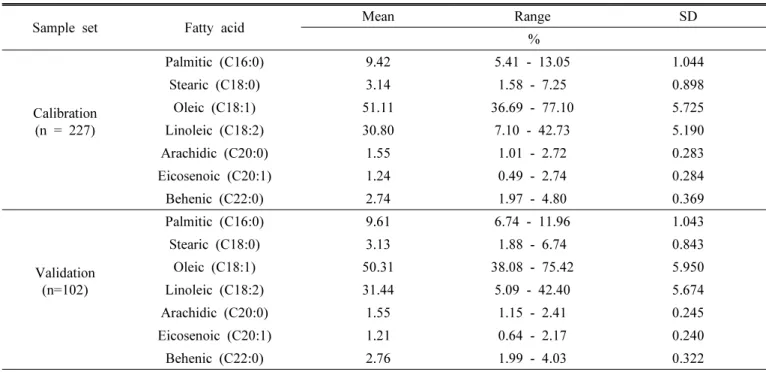
Table 2. Laboratory reference value statistics of fatty acid composition based on ground peanut samples used in both calibration and validation.
Sample set Fatty acid Mean Range SD
%
Calibration (n = 227)
Palmitic (C16:0) 9.42 5.41 - 13.05 1.044
Stearic (C18:0) 3.14 1.58 - 7.25 0.898
Oleic (C18:1) 51.11 36.69 - 77.10 5.725
Linoleic (C18:2) 30.80 7.10 - 42.73 5.190
Arachidic (C20:0) 1.55 1.01 - 2.72 0.283
Eicosenoic (C20:1) 1.24 0.49 - 2.74 0.284
Behenic (C22:0) 2.74 1.97 - 4.80 0.369
Validation (n=102)
Palmitic (C16:0) 9.61 6.74 - 11.96 1.043
Stearic (C18:0) 3.13 1.88 - 6.74 0.843
Oleic (C18:1) 50.31 38.08 - 75.42 5.950
Linoleic (C18:2) 31.44 5.09 - 42.40 5.674
Arachidic (C20:0) 1.55 1.15 - 2.41 0.245
Eicosenoic (C20:1) 1.21 0.64 - 2.17 0.240
Behenic (C22:0) 2.76 1.99 - 4.03 0.322
validation samples had the standardized H-distance of 3.0 or less from the mean of the calibration samples set.
RESULTS AND DISCUSSION
Oil, fatty acid contents and NIRS spectra
In the previous studies, oil contents of peanut was reported that the peanut cultivars shell in Pakistan was ranged 49.8% to 53.0% (Hassan and Ahmed, 2012) and the peanut seeds was ranged 48% to 50% (Janila et al., 2013). In this study, the mean oil contents of total peanut sample sets were 48.4%, ranged 37.7% to 56.0%, with a standard deviation of 2.32% by auto- soxhlet system (Table 1). Oil contents of peanut were similar to the previous results.
The descriptive statistics including mean, range, and standard deviation (SD) for individual fatty acid composition for ground peanut samples used in the calibration (227 accessions) and validation (102 accessions) sets are shown in Table 2. Each
reference value of fatty acid composition in a calibration set was similar to those in the validation sample set. Mean value of individual fatty acid composition was 9.4% palmitic acid ranged 5.4 to 13.1%, 3.1% stearic acid ranged 1.6 to 7.3%, 51.1% oleic acid ranged 36.7 to 77.1%, 31.8% linoleic acid ranged 7.1 to 42.7%, 1.6% arachidic acid ranged 1.0 to 2.7%, 1.2% eicosenoic acid ranged 0.5 to 2.7%, and 2.7% behenic acid ranged 2.0 to 4.8% in the calibration set, showing similar values to those in the validation set. The oleic acid and linoleic acids were main fatty acids and had widely differed. Previous reporters suggested that sufficient variation exist among the samples to develop useful NIRS equation (Rinne et al., 1975; Hilliard and Daynard, 1976).
The log (1/R) spectra of the ground peanut samples and high
and low compositions of oleic acid were shown in Fig. 1. The
arrows of Fig. 1 mean irrelevant content and simple absorption
spectrum. The D
2log (1/R) spectra and mean standard deviation
spectrum of calibration samples that were obtained by using the
entire wavelength range of 400~2500 nm. Several high standard
(a) (b)
Fig. 1. The log spectra of ground peanut samples (a), and high and low compositions of oleic acid (b).
Table 3. Comparison on the statistics of fatty acid concentration calibration and validation results with MPLS conditions.
Fatty acid Calibration Validation
Fatty acid n
aTerm SEC R
21-VR SEP R
2Bias
Palmitic 214 8 0.455 0.764 0.605 0.631 0.636 0.059
Stearic 214 9 0.329 0.826 0.706 0.645 0.475 0.032
Oleic 217 12 0.733 0.983 0.964 1.015 0.971 -0.026
Linoleic 216 12 0.489 0.991 0.979 0.876 0.976 0.044
Arachidic 216 11 0.108 0.828 0.665 0.182 0.546 0.018
Eicosenoic 220 8 0.149 0.671 0.531 0.217 0.312 -0.026
Behenic 217 7 0.198 0.496 0.278 0.277 0.300 0.024
a