한국추진공학회 2008년도 춘계학술대회 논문집 pp.14~17 2008 KSPE Spring Conference
- 14 -
* 한국항공우주연구원 발사체미래기술연구실 연락저자, E-mail: [email protected] ** 한국항공우주연구원 발사체미래기술연구실
산화제 개폐밸브의 힘평형에 관한 연구
홍문근* ․ 이수용**
On the Force Balance of a Main Oxidizer Shutoff Valve
Moongeun Hong* ․ Soo Yong Lee**
ABSTRACT
A poppet type shutoff valve under the pneumatic control has been adapted for the MOV (Main Oxidizer shutoff Valve) for KSLV (Korea Space Launch Vehicle). The MOV controls the supply of liquid oxygen into the combustion chamber just by opening and shutting operations. The poppet part of the poppet valves is usually connected with the piston, but on the other hand that of the MOV is separated and just contacted with the piston in order to secure the flexibility of the valve design. For the prevention of the collision with valve body by an undesirable movement of the piston part, it is necessary to evaluate the force during the valve closing. The analysis of the force balance of the MOV at the moment of the valve closing have been performed and some important design parameters for the force balance control have been introduced.
초 록
비교적 단순한 개폐작동을 통해 액체추진기관 연소기로의 극저온 액체산소 공급을 조절하는 산화제 개폐밸브로써, 공압으로 작동하는 포펫 타입의 밸브가 채택되어 관련 연구개발이 진행되고 있다. 일반 적인 포펫 타입의 밸브들은 포펫과 피스톤이 연결되어 일체로 움직이면서 유로 개폐를 제어하지만, 개 발 중인 산화제 개폐밸브는 밸브 설계의 유연성을 확보하기 위해 포펫과 피스톤 부분이 서로 접촉되어 있을 뿐 독립적으로 분리되어 있다. 포펫과 피스톤 부분이 분리되어 있는 포펫 타입의 밸브 개폐 시, 피스톤 부분이 밸브 몸체와 충돌할 수 있기 때문에 이와 같은 충돌을 피하기 위해 밸브가 닫히는 동안 의 힘평형에 대한 분석이 필수적이다. 따라서 본 연구에서는 산화제 개폐밸브가 닫히는 동안의 힘평형 에 대한 분석 내용을 소개하고, 결과적으로 안전한 밸브 작동을 확보할 수 있는 힘평형 조절을 위한 주요 설계 변수를 유도하기로 한다.
Key Words: Main Oxidizer Shutoff Valve(산화제 개폐밸브), Poppet Valve(포펫 밸브), Force Balance(힘평형), Liquid Rocket Engine(액체로켓엔진)
1. Introduction
- 15 - A poppet shutoff valve under the pneumatic control has been adapted for the MOV (Main Oxidizer shutoff Valve) of KSLV (Korea Space Launch Vehicle). For rocket valves, there are strict requirements on envelope, mass, and reliability. The prime consideration of the propellant shutoff valve is to achieve the required flow with the least system pressure loss with staying within valve envelope and weight requirement[1,2].
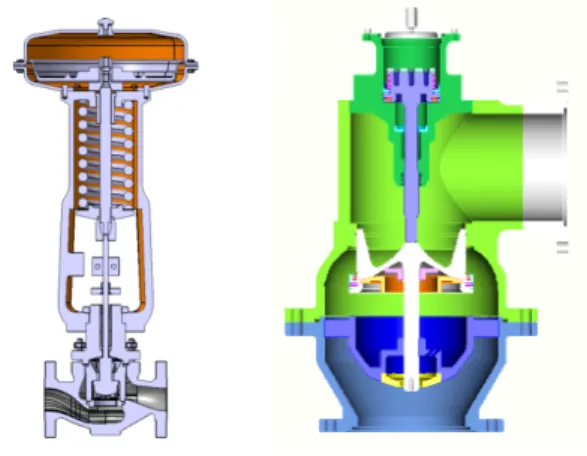
Figure 1 shows the general poppet valve for industrial uses and the candidate poppet valve for the MOV of KSLV. As shown in Fig. 1, as well as the difference of the overall shape of valves, a critical difference is the disconnection with piston and poppet assemblies, which make it possible to decouple the development of both assemblies.
Fig. 1 General poppet/globe valve for industrial uses and MOV model
A simple force balance equation is introduced in Section 2. In Section 3, the preliminary study on the force balance with some design parameters is presented.
2. Force Balance
As a first analysis of force balance, the force relations during the valve closing are examined to prevent a physical separation of moving parts of the valve. The moving parts consist of the piston operated by pneumatic force and the poppet which plays a role in the shutoff of the flow. The mass of the moving parts, is sum of that of these two components, and represent the mass of poppet assembly and piston assembly. The force balance equation during the valve closing can be expressed as follows:
Here, is the position of the piston end which is contacted with the poppet. means the position at valve closing and has a positive direction from closed position to open position. The drag force during the movement of the poppet, is assumed to be negligible. is the pneumatic force expressed by the multiplication of the pneumatic pressure, and the piston pressure area, . In the same manner, the hydraulic fore due to the pressure difference across the poppet is expressed as
. is the differential pressure and is the pressure area of the poppet. Three spring forces are the multiplication of spring constants and its spring compressed lengths, which are sum of the initially compressed lengths and the displacements by the
movement of valve: .
means the dynamic friction force to resist the
- 16 - valve movement.
At the moment of , the force driving the piston assembly to move continuously,
should be less than the opposite force to resist the piston movement, . and
could be evaluated as follows:
Here, is the acceleration.
3. Preliminary results
In this section, the preliminary results on the force balance of the poppet valve are presented. For simple calculation of the preliminary level, there are two important assumptions: The first one is that is assumed to be a simple quadratic function of
. However, a CFD analysis should be necessary for the more reliable calculation[3].
The second one is that the friction force due to the control gas pressure could be negligible.
Figure 2 shows the effects of the variations in design parameters on the force balance. As shown in Fig. 2 (a), it is advantageous to keep a small discharge diameter of the control gas pressure in the sense of the force balance requirement. However, this slow discharge could result in the slow reaction time of the valve operation. The preliminary results show also that the friction force should have a enough large value for an easy installation of the piston assembly and a sufficient margin of
.
One main result of this study is shown in Fig. 2 (c), as it were, the force balance could be controlled easily just by spring constants.
0 5 10 15 20 25
500 1,000 1,500 2,000 2,500 3,000 3,500 4,000 4,500
Valve travel [mm]
F-, F+ [N]
Dd : 3mm Dd : 3mm Dd : 2mm Dd : 2mm Dd : 4mm Dd : 4mm
(a) Discharge diameter, Ff=500N
0 5 10 15 20 25
500 1,000 1,500 2,000 2,500 3,000 3,500 4,000 4,500
Valve travel [mm]
F-, F+ [N]
Ff : 500N Ff : 500N Ff : 1000N Ff : 1000N Ff : 1500N Ff : 1500N
(b) Friction force, Dd=3mm
0 5 10 15 20 25
500 1,000 1,500 2,000 2,500 3,000 3,500 4,000 4,500
Valve travel [mm]
F-, F+ [N]
k : no increment k : no increment k : 10% increment k : 10% increment k : 20% increment k : 20% increment
(b) Spring constant, Ff=500N, Dd=3mm
Fig. 2 The effect of the variations in design parameters on the force balance (black line : , blue line : )
- 17 - The increments of the spring constants results in the argumentation of during the valve closing. Consequently, the increase of this pneumatic fore brings a effect of the growth of the force margin of .
4. Conclusions
A preliminary analysis of the force balance of the MOV, which is a poppet type shutoff valve, have been performed for the moment of the valve closing and some important design parameters for the force balance control have been introduced. The results show that high values of friction force and spring force would be favorable for the prevention of the collision with valve body by an undesirable movement of the piston assembly. Moreover, it is found that the spring force (or spring constant) is a
main key parameter to control the force balance in the sense that the spring constant could be designed independently and easily.
However, There is a lack of exact evaluation of the hydraulic and friction force, and efforts should be made in that direction for future analysis on the force balance of MOV.
References
1. Anon., "Liquid Rocket Valve Components,"
NASA SP-8094, 1973
2. Anon., "Liquid Rocket Valve Assemblies,"
NASA SP-8097, 1973
3. Cho, T.-D., Yang S.-S., Lee H.-Y., and Ko S.-H., " A Study on the Force Balance of an Unbalanced Globe Valve," Journal of Mechanical Science and Technology, Vol.
21, 2007, pp.814-820