• 검색 결과가 없습니다.

A Fuzzy Inference based Reliability Method for Underground Gas Pipelines in the Presence of Corrosion Defects

N/A
N/A
Protected

Academic year: 2021

Share "A Fuzzy Inference based Reliability Method for Underground Gas Pipelines in the Presence of Corrosion Defects"

Copied!
8
0
0

로드 중.... (전체 텍스트 보기)

전체 글

(1)

1. Introduction

In Korea, city gas became widespread since 1980s and now it is treated as one of life necessities.

As more than thirty years have passed, there is much attention in safety assessment of the underground gas pipeline. One of main causes in the pipeline failure is metal corrosion. According to an international report[1], corrosion defects account for about fifteen percent of failures in the gas pipeline. Corrosion leads to the thinning and/or the cracking of the pipe wall and, then, pipeline failures may occur in various forms. Therefore, an adequate identification of corrosion defects is a fundamental step in predicting remaining lifetime of the pipeline.

Many works have been done for predicting residual lifetimes of the gas pipeline. Approaches to those works can be broadly classified into deterministic and probabilistic ones. However, a recent attention is focused on the probabilistic approach because it provides more practical results as pointed out by Li et al.[2]. The probabilistic approach to reliability assessment includes some moment-based methods such as first order second moment (FOSM), first order reliability method (FORM), and second order reliability method (SORM)[3].

Both FOSM and FORM use a first order Taylor ’s series expansion to obtain the probability of failure approximately. Although FORM gives a better accuracy of approximation, FOSM is widely used because of its simplicity. SORM employs the second order Taylor ’s series expansion for better approximation and, however, it needs a lot of computational effort.

Reliability is defined as the probability that a lifetime is larger than a given time point. The probability of failure is equal to 1 minus reliability. Hence, once the reliability or the probability of failure is provided as numerical value, the remaining lifetime can be straightforwardly determined by field standards, for example, ISO 16708[4]. A pipeline reliability is affected by many parameters

A Fuzzy Inference based Reliability Method for Underground Gas Pipelines in the Presence of Corrosion Defects

Seong-Jun Kim*

, Byung Hak Choe**, Woosik Kim***, and Ikjoong Kim***

*Department of Industrial Engineering and Management Science, Gangneung-Wonju National University (GWNU)

**Department of Metal and Advanced Materials Engineering, Gangneung-Wonju National University (GWNU)

***Research Institute, Korea Gas Corporation (KOGAS)

Abstract

Remaining lifetime prediction of the underground gas pipeline plays a key role in maintenance planning and public safety. One of main causes in the pipeline failure is metal corrosion. This paper deals with estimating the pipeline reliability in the presence of corrosion defects. Because a pipeline has uncertainty and variability in its operation, probabilistic approximation approaches such as first order second moment (FOSM), first order reliability method (FORM), second order reliability method (SORM), and Monte Carlo simulation (MCS) are widely employed for pipeline reliability predictions. This paper presents a fuzzy inference based reliability method (FIRM). Compared with existing methods, a distinction of our method is to incorporate a fuzzy inference into quantifying degrees of variability in corrosion defects. As metal corrosion depends on the service environment, this feature makes it easier to obtain practical predictions. Numerical experiments are conducted by using a field dataset. The result indicates that the proposed method works well and, in particular, it provides more advisory estimations of the remaining lifetime of the gas pipeline.

Key Words : Underground Gas Pipeline, Corrosion Defect, Probability of Failure, Reliability Method, Fuzzy Inference

This research was supported by Korea Gas Corporation (KOGAS).

This is an Open-Access article distributed under the terms of the Creative Commons Attribution Non-Commercial License (http://

creativecommons.org/licenses/by-nc/3.0) which permits unrestricted non-commercial use, distribution, and reproduction in any medium, provided the original work is properly cited.

JKIIS

http://dx.doi.org/10.5391/JKIIS.2016.26.5.343

Received: Sep. 20, 2016 Revised : Oct. 12, 2016 Accepted: Oct. 18, 2016

Corresponding authors

[email protected]

(2)

such as pipe diameter, wall thickness, tensile strength, operating pressure, defect size and occurrence frequency. Most of information regarding its configuration can be found in specification documents and operation standards. However, reliability methods have a difficulty in configuring both defect size and defect frequency because there is uncertainty and vagueness in the corrosion defect data collected by in-line inspection[5].

The commission environment of pipeline is influenced by changes of underground temperature, moisture, and soil characteristics, all of which make the corrosion process very complex. Furthermore, due to measurement imperfection, it is hardly possible to quantify the degree of corrosion in a crisp manner. Fuzzy inference or fuzzy logic is one of promising way to dealing with uncertainty and imprecision appeared in real world problems where no precise boundaries are found[6]. Fuzzy approach has an advantage in that subjective knowledge is easily incorporable with well-developed analytical models. In this paper, a fuzzy inference based reliability method (FIRM) is presented for reliability assessment of corroded gas pipelines. In order to consider uncertainty and vagueness of corrosion defects, defect size and occurrence likelihood are handled by fuzzy variables. To validate the proposed method, an illustrative example is given by using a modified field dataset. The result shows that our method has flexibility in processing non-uniform growths of corrosion observed throughout the whole pipeline. It is also useful for predictive maintenance planning because our FIRM presents more advisory predictions on the pipeline failures.

The rest of this paper is organized as follows. Section 2 introduces related works on reliability methods developed for the underground gas pipeline with corrosion defects. A framework of fuzzy inference is described as well. Section 3 presents a reliability method based upon fuzzy inference for underground pipelines. In Section 4, an illustrated example is given by using a modified field dataset. Finally our works are concluded with summary in Section 5.

2. Related Researches

Ahammed[7] developed a pipeline reliability model based upon ASME B31G, a well-known code to calculate failure pressures, and he investigated the effect of some parameters on the pipeline reliability. According to the paper, radial growth rate of corrosion

is most significant to pipeline failures. Teixeira et al.[8] used FORM and Monte Carlo simulation to predict explosion pressures and to conduct uncertainty analysis. Basic parameters such as yield strength, diameter, thickness, and operating pressure are considered in that study. In particular, a Gumbel distribution is used in order to illustrate statistical variations in operating pressure. Kim et al.[9]

pointed out that, because corrosion pattern changes with time and place, a whole pipeline should be divided into several segments.

According to that scheme, each segment has its own reliability and it is helpful to identify more urgent segment in the whole pipeline.

Such feature is useful for maintenance planning and it was illustrated by using Battelle code which is one of widely used codes.

A pipeline failure occurs when its operating pressure is larger than the pipe failure pressure at any point. Besides, the probability of pipeline failure depends on the choice of failure pressure code.

A comparative study was conducted by Caleyo et al.[10]. Several major codes, such as ASME B31G, modified ASME B31G, Battelle, DNV 99, and Shell 92 were included in the study. They showed that Shell 92 provides relatively higher failure probability among them.

This observation is also supported by Li et al.[2]. They pointed out that Shell 92 has most conservative output and thus it is desirable for long term prediction. In their study, it was also reported that defect depth is more influential than defect length and, in terms of growing direction, radial growth has more impact to failures than axial growth.

Corrosion defects which took place on the underground pipeline can be detected through in-line inspection (ILI). However, due to measurement error and incomplete data processing, there is much uncertainty and vagueness in ILI defect dataset. To cope with this difficulty, fuzzy inference has been adopted by some researchers.

Among them, Jamshidi et al.[5] developed a new fuzzy inference

system (FIS) for pipeline risk assessment. In order to derive pipeline

risk scores, they took into account eight factors as fuzzy variables

and then established a FIS network by applying Mamdani algorithm

and max-min composition method. They also showed, through a

numerical case study, that their proposed method can improve the

possibility of complete risk assessment for pipelines. Similarly, Singh

and Markeset[6] proposed a fuzzy logic based model for estimating

the rate of corrosion in carbon steel pipes. This model took the

plant operation parameters as fuzzy variables, which include CO

2

partial pressure, total pressure, temperature, wall shear stress, and

pH. Moreover, the inspected rate of corrosion and the efficiency

(3)

of inspection were also considered as fuzzy variables. They also showed that the estimated rate of corrosion is close to the inspected rate of corrosion. Recently, Zhou et al.[11] presented a fuzzy model for estimating corrosion failure likelihood (CFL) of the pipeline. By considering the complexity and uncertainty of corrosion problems, their model used a fuzzy logic method to establish a fuzzy graph for describing the relationship between CFL index and influential parameters. To demonstrate the feasibility of the method, it was applied to a gas transmission pipeline in Southwest China.

According to the result, their model can effectively estimate CFL of pipelines without accurate and complete failure data.

By virtue of its own flexibility, fuzzy approaches are now widespread for fault diagnosis and detection of engineering parts and materials. For more applications, the readers can see references 12, 13, and 14. As described above, estimating the pipeline reliability from corrosion defect data is crucial for risk assessment of underground gas pipeline. Fuzzy inference has been successfully employed to deal with uncertainty and vagueness encountered in the process of reliability estimations. However, relatively little work has been done for the reliability method incorporated with fuzzy inference. The purpose of the paper is to develop a fuzzy inference based reliability method (FIRM).

3. The Proposed Method for Pipeline Reliability Estimations

3.1 Reliability Method

A pipeline fails when its operating pressure exceeds the pipe failure pressure at any location. In fact, means the pressure at which a corrosion defect leads to leakage. Thus the probability of failure (POF) for a single corrosion defect on the pipeline is defined as:

(1)

Here, is called a limit state function of pipe pressure.

As mentioned earlier, many simulation codes have been developed for calculating approximately. Among them, Battelle code is adopted in this paper because it is widely used and well matched with field practices. In Battelle code, is expressed as:

(2)

where . In the

equation S, D, and t denote respectively ultimate tensile strength, diameter, and wall thickness of the pipe. As a function of corrosion defect size grown with time, includes time dependence. Both depth and length of corrosion defects at time T are assumed by

and where

and are recent sizes of defect depth and length observed at the time . Note that the radial and axial growth rates and are assumed to be constant with time.

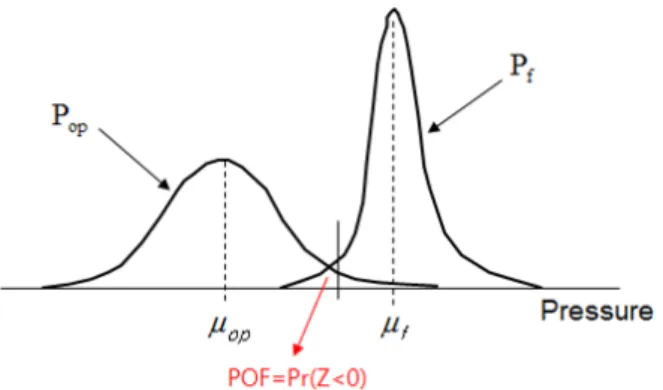
However, it is very difficult to obtain POF in (1) since pipeline variables are random in nature and, therefore, failure pressure has a complicated probability distribution. Figure 1 below illustrates this situation based upon a load-resistance model which is widely accepted in the field of reliability engineering.

Fig. 1. Probability of failure in load-resistance model

In order to overcome this difficulty, several approximation methods have been developed, for example, first order second moment (FOSM), first order reliability method (FORM), and second order reliability method (SORM). Among them, because it is most simple and easy to implement, FOSM is considered in this paper.

Nevertheless, it is noted that FIRM proposed in this paper is also incorporable with any other reliability methods including FORM and SORM. In order to obtain POF, FOSM uses the first order Taylor series expansion to approximate the limit state function Z as the following:

(3)

(4)

where is the vector of pipe variables in (1)

and denotes the mean of .

Taking expectations on both sides of (3), we can obtain the mean of the limit state function Z as following.

(4)

Similarly, taking variances on both sides of (3) yields the variance of Z as following:

(5)

where is the standard deviation of . By assuming that Z f o l l o w s Gaussian distribution and by inserting (4) and (5) into (1), the failure probability can be rewritten as:

(6)

where is the cumulative Gaussian distribution function.

Hence, once all of POF for each defect are given, the probability of failure for the whole pipeline can be calculated as:

(7)

where is the number of defects on the pipeline and denotes POF of an individual detect[2, 9, 10].

So far, standard deviations are used to represent degrees of variability. However, coefficients of variation are preferred in the field of pipe engineering. The coefficient of variation (CV) of is defined by:

(8)

As seen by (8), CV represents a relative magnitude of variability on the basis of mean. This makes it possible for CV by itself to explain the variability. Hereafter, in this paper, CV is used instead of standard deviation.

3.2 Fuzzy Inference based Reliability Method (FIRM)

The limit state function Z includes 6 parameters, which are ultimate tensile strength, pipe diameter, wall thickness, operating

pressure, depth and length of the corrosion defect. For FOSM to be operational, means and CVs of the parameters should be provided.

As for the former 3 parameters, we can easily obtain needed information from product specifications. As for the operating pressure, we can refer operation procedure documents. However, as for the depth and length of the defect, a difficult situation is encountered. Although means of two variables are coming from ILI measurements, their CVs are unknown. Consequently in (5) is impossible to evaluate directly.

In order to tackle such difficulty, a fuzzy inference technique is applied in this paper. Due to lack of information and complexity of corrosion process, it is very vague to specify CVs of depth and length. As described in Section 1, fuzzy inference is a promising way of dealing with these situations. We assume that corrosion variability, i.e., coefficient of variation (CV) is influenced by growth speed (GS) and occurrence likelihood (OL) of the corrosion defect.

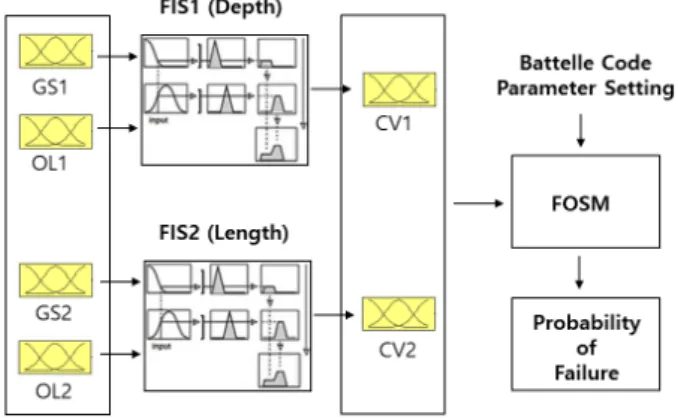
Thus, by using GS and OL as fuzzy variables, fuzzy inference system (FIS) is organized as shown by the following figure.

Fig. 2. Framework of the proposed FIRM

Actually, two fuzzy inference systems are established in this paper. One is for CV1, CV of depth, and the other is for CV2, CV of length. Subsequently, FIS1 and FIS2 are fuzzy inference systems for CV1 and CV2. They are incorporated with FOSM in order to estimate the probability of failure. In the next section, our proposed FIRM is illustrated by numerical example.

4. Numerical Illustration

4.1 Dataset

A numerical case study is presented for illustrating the feasibility

(5)

and the potential application of the proposed model. This application is based on information from a natural gas pipeline in South Korea. This pipeline has commissioned since 1999 and passes through various regions. The length of the pipeline to be considered is approximately 20km. In 2014, through in-line inspection (ILI) by automated pigging, total 75 corrosion defects were found. However, in this study, measured values of defect size are modified by linear transform. Such modification would be allowable for illustration purpose. Figure 3 below plots the modified corrosion data.

Fig. 3. Modified data of corrosion depth and length

As shown in the figure, both defect size and occurrence frequency are considerably varied throughout the pipeline. This indicates that corrosion process is influenced by service environment and its consequence is quite different along the pipeline.

4.2 Parameter Setting

Once a corrosion size is provided, the corresponding probability of failure can be approximated as described in Section 3.1. As pointed out earlier, for the reliability method to be operational, means and CVs of pipeline parameters should be identified. In this study, they are established as shown in Table 1.

As described earlier, means and CVs in the table are obtained by

product specification and/or operation documents. As for the depth and length of defect, ILI measurements are directly used. Further, their means are assumed to be proportional to time elapsed.

As shown by Figure 2, coefficient of variation (CV) is supposed as a function of two fuzzy variables, growth speed (GS) and occurrence likelihood (OL). In this illustration, GS is categorized into 3 classes: Fast, Medium, and Slow. OL is categorized into 3 classes:

High, Medium, and Low. And the output CV has three categories:

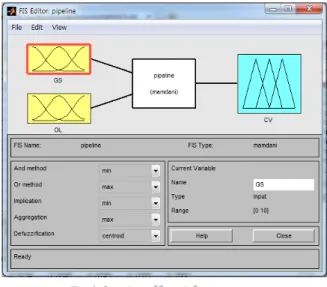
Large, Medium, and Small. All the categories of the above variables are mapped from fuzzy membership functions. This study uses triangular membership functions because they have reasonable compromise between descriptive power and computational efficiency[11]. Using FIS Editor provided by MATLAB, we construct fuzzy inference system as shown in the following figure.

Fig. 4. Overview of fuzzy inference system

Several composition methods can be used to construct Mamdani- type fuzzy model. Among them, as seen from Figure 4, this study adopts max-min composition which is one of the most used methods[5]. As for the defuzzification, centroid method is applied.

This choice is most popular in the process of defuzzification and it has an advantage that all membership functions contribute to obtain the final crisp value[5].

Table 1. Pipeline parameter setting for illustration

Parameter Mean CV(%)

Diameter, D Thickness, t Operating pressure, P

op

Ultimate tensile strength, S Depth of defect, d(T) Length of defect, L(T)

508mm 6.4mm 7.85Mpa

564Mpa As measured As measured

0.1

0.1

4.2

5.2

N/A

N/A

(6)

A collection of fuzzy rules is also essential in fuzzy inference system. Fuzzy rules are represented in the IF-THEN format and they are used to describe the relations between input and output variables. These rules are in general established based upon domain knowledge given by experts and standard documents. In this example, 7 fuzzy rules are established by using FIS Editor as shown in Figure 5.

Fig. 5. Rules for CV of corrosion depth

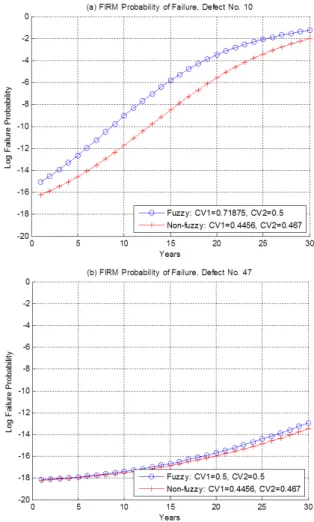
As all of CVs are now available, the parameter setting for FOSM is accomplished. In Figure 6, POF estimated by our FIRM are presented in the logarithmic scale because all of the values are very small. For the purpose of comparison, estimation results by nonfuzzy method are provided as well.

As noted earlier, our sample dataset includes 75 corrosion defects, all of which has its own probability of failure. Among them two defects are chosen. One is big-sized defect and the other is medium-sized defect. The corresponding estimations are respectively depicted in Figure 6(a) and 6(b). A gap between fuzzy and non-fuzzy estimations is observed in Figure 6(a). It suggests that our fuzzy method is more advisory than non-fuzzy method.

This feature is useful to plan predictive maintenances under severe service environments. On the other hand, as shown in Figure 6(b), the difference is negligible when the defect size is small or moderate.

Once probabilities of failure for each defect are given, the probability of failure for the whole pipeline can be calculated by the former equation (7). Figure 7 depicts the pipeline POFs of the two methods for the next 30 years. Based upon ISO 16708, the reliability target of the sample pipeline is given as 5.44e-5.

As seen from the figure, the pipeline failure probability obtained

by the proposed method exceeds reliability target after 18 years.

In other words, the remaining lifetime of the pipeline is 18 years.

On the other hand, the remaining lifetime obtained by non-fuzzy Fig. 6. Comparison of POF by of fuzzy and non-fuzzy methods

Fig. 7. Comparison of remaining lifetimes estimated by fuzzy and non-fuzzy

methods

(7)

method is 23 years. This difference is very significant in maintenance planning practices.

5. Conclusions

Reliability prediction plays a key role in maintenance planning and safety assurance of corroded gas pipeline. However, due to uncertainty and vagueness encountered in processing corrosion data, it is very hard to estimate reliability efficiently. To cope with the problem, in this paper, fuzzy inference is proposed to be incorporated with reliability methods. According to the numerical case study, the proposed method is helpful to deal with incompleteness and vagueness of corrosion data. In particular, the remaining lifetime predictions by the proposed method were preventive, compared with non-fuzzy method. This result is persuasive for justifying early maintenance planning required in severe environments. In addition, it is underscored that our proposed scheme is applicable to other reliability methods.

However, the proposed reliability method depends on the setting of pipeline parameters. An appropriate choice of membership functions should also be essential in evaluating the probability of failure. Therefore, a sensitivity analysis would be fruitful for future research. Corrosion process is affected by service environment and, hence, occurrence pattern of corrosion defects is quite varied along the pipeline. Pipeline segmentation by defect clustering would be another interesting topic for future study.

References

[1] EGIG, The 6th Report of the European Gas Pipeline Incident Data Group, EGIG, 2008.

[2] S. Li, S. Yu, H. Zeng, J. Li and R. Liang, “Predicting corrosion remaining life of underground pipelines with a mechanically- based probabilistic model, ” Journal of Petroleum Science and Engineering, vol. 65, pp. 162-166, 2009.

[3] K. Yang and H. Younis, “A semi-analytical Monte Carlo simulation method for system ’s reliability with load sharing and damage accumulation, ” Reliability Engineering and System Safety, vol. 87, pp. 191-200, 2005.

[4] ISO 16708, Petroleum and natural gas industries, pipeline

transportation systems, reliability-based limit state methods, International Standards, 2006.

[5] A. Jamshidi, A. Yazdani-Chamzini, S. H. Yakhchali and S.

Khaleghi, “Developing a new fuzzy inference system for pipeline risk assessment, ” Journal of Loss Prevention in the Process Industries, vol. 26, pp. 197-208, 2013.

[6] M. Singh and T. Markeset, “A methodology for risk based inspection planning of oil and gas pipes based on fuzzy logic framework, ” Engineering Failure Analysis, vol. 16, pp. 2098- 2113, 2009.

[7] M. Ahammed, “Probabilistic estimation of remaining life of a pipeline in the presence of active corrosion defects, ” International Journal of Pressure Vessels and Piping, vol. 75, pp. 321-329, 1998.

[8] A. P. Teixeira, C. Guedes Soares, T. A. Netto and S. F. Estefen,

“Reliability of pipelines with corrosion defects,” International Journal of Pressure Vessels and Piping, vol. 85, pp. 228-237, 2008.

[9] S. Kim, B. Choe and W. Kim, “A prediction method of the gas pipeline failure using in-line inspection and corrosion defect clustering, ” Journal of Korean Institute of Intelligent Systems, vol. 24, pp. 651-656, 2014.

[10] F. Caleyo, J. L. Conzalez, and J. Hallen, “A study on the reliability methodology for pipelines with active corrosion defects, ” International Journal of Pressure Vessels and Piping, vol. 79, pp. 77-86, 2002.

[11] Q. Zhou, W. Wu, D. Liu, K. Li and Q. Qiao, “Estimation of corrosion failure likelihood of oil and gas pipeline based on fuzzy logic approach, ” Engineering Failure Analysis, vol. 70, pp. 48-55, 2016.

[12] Y. Kim, H. Lee, and S. Rhee, “The visual inspection of key pad parts using a fuzzy barbarization algorithm, ” International Journal of Fuzzy Logic and Intelligent Systems, vol. 11, no. 3, pp 211-216, 2011.

[13] H. Bae, S. Kim, and G. Vachtsevanos, “Fault detection and diagnosis of winding short in BLDC motors based on fuzzy similarity, ” International Journal of Fuzzy Logic and Intelligent Systems, vol. 9, no. 2, pp. 99-104, 2009.

[14] M. E. Orchard and G. J. Vachtsevanos, “A Particle filtering

approach for on-line failure prognosis in a planetary carrier

plate, ” International Journal of Fuzzy Logic and Intelligent

Systems, vol. 7, no. 4, pp. 221-227, 2007.

(8)

저 자 소 개

김성준 (Seong-Jun Kim)

1989년 : 연세대학교 응용통계학과 학사 1991년 : KAIST 산업공학과 석사 1995년 : KAIST 산업공학과 박사

1995년~현재 : 강릉원주대학교 산업경영공학과 교수

2005년~현재:한국지능시스템학회 이사

관심분야 : Soft Computing, Statistical Modeling, Big Data Analytics Phone : +82-33-760-8815

E-mail : [email protected]

최병학 (Byung Hak Choe) 1984년 : 서울대학교 금속공학과 학사 1986년 : 서울대학교 금속공학과 석사 1990년 : 서울대학교 금속공학과 박사 1995년~현재 : 강릉원주대학교

신소재금속공학과 교수

관심분야 : Failure Analysis, Remained Life Assessment of Engineering Materials

Phone : +82-33-640-2365 E-mail : [email protected]

김우식 (Woosik Kim)

1985년 : 서울대학교 금속공학과 학사 1989년 : 서울대학교 금속공학과 석사 1993년 : 서울대학교 금속공학과 박사 1993년~현재 : 한국가스공사 연구개발원

수석연구원

관심분야 : Pipeline Integrity Assessment, Remained Life Prediction Phone : +82-31-400-7470

E-mail : [email protected]

김익중 (Ikjoong Kim)

2009년 : 성균관대학교 기계공학부 학사 2011년 : 성균관대학교 기계공학부 석사 2016년~현재 : 성균관대학교 기계공학부

박사과정

2014년~현재 : 한국가스공사 가스기술연구원

관심분야 : Pipeline Integrity Assessment, Fracture Mechanics Phone : +82-31-400-7474

E-mail : [email protected]

수치

Fig. 1. Probability of failure in load-resistance model
Fig. 2. Framework of the proposed FIRM
Table 1. Pipeline parameter setting for illustration
Fig. 5. Rules for CV of corrosion depth

참조

관련 문서

Others: waste heat in distillation tower, waste heat recovery, natural gas pressure turbine, by-product gas Source: The monthly report on major electric power statistics,

The objective of this research is to propose a method for evaluating service reliability based on service processes using fuzzy failure mode effects analysis (FMEA) and grey

“This program was supported by korea Foundation for the Advancement of Science and Creativity(KOFAC)grant funded by the

- "This work was supported by the Korea Foundation for the Advancement of Science and Creativity(KOFAC) grant funded by

The sublimation purification method is similar to the vapor deposition process ,in which crystallization occurs after evaporation from a solid state to a

In this thesis, this method choosing the node having reliable RSSI values based on the reliability of the signal is proposed for the... more accurate

In this paper, we introduce different types of software reliability models and propose a sequential probability ratio test as a technique for determining

~ a model in which the entire resistance to diffusion from the liquid surface to the main gas stream is assumed to occur in a stagnant or laminar film of constant thickness