Ⅰ. 서 론
최근 우리 사회에서는 4차 산업혁명에 대한 논의 가 활발히 진행되고 있으며, 이에 따라 미래 사회
에서 필요한 핵심 역량에 대한 사회적 관심도 함께 증가해왔다. 교육계에서도 이를 반영하여 미래 사 회 핵심역량에 대한 연구를 지속해서 수행해왔으며 핵심 역량이 강조된 2015 개정 교육과정이 2018년 부터 학교현장에서 전면적으로 시행되고 있다. 이
PISA 2015 과학 영역에 나타난 학생 성취수준 집단 및 성별에 따른 교육맥락 변인의 특성 및 영향력 분석
구자옥・구남욱
*한국교육과정평가원
The analysis of characteristics and effects of contextual variables in terms of student achievement levels and gender
based on the results of PISA 2015 science domain
Jaok Ku・Namwook Koo
*Korea Institute for Curriculum and Evaluation
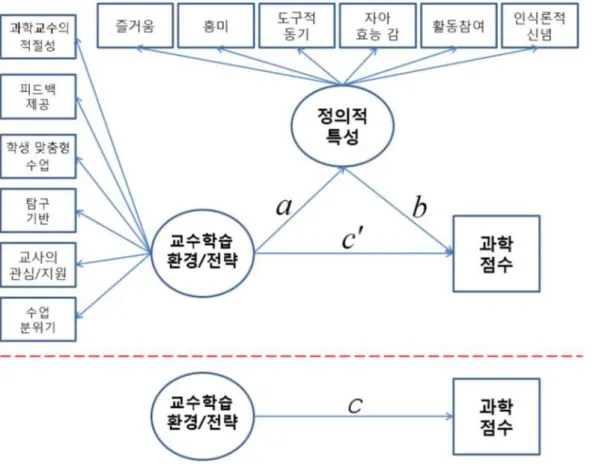
Abstract : This study compares and analyzes the characteristics and effects of various educational contextual variables according to students' achievement level and gender groups based on the results of PISA 2015 science domain. PISA 2015 included additional variables about teaching-learning and affective characteristics in the field of science, because science was the main domain of PISA 2015. The results of the mediation analysis using a multiple group structural equation model showed that the environment and strategy for the teaching and learning had a positive effect on the affective characteristics, and also positively affected science achievement through the mediator of the affective characteristics. Particularly, the environment and strategy for the teaching and learning was the most effective in improving the affective characteristics for the low achievement group. It was found that the difference of the mediated effect between achievement level groups was statistically significant, but that between male and female students was not. Therefore, the appropriate the environment and strategy for the teaching and learning will need to be emphasized consistently to improve students' cognitive and affective achievement. The implications and suggestions of these results were discussed.
keywords : PISA 2015, context variables, science achievement, innovative teaching and learning, affective dimension of learning science
*
교신저자: 구남욱 ([email protected])
**
본 연구는 한국교육과정평가원에서 수행한 “OECD 국제학업성취도 평가 연구: PISA 2015 결과 심층 분석 보고서 (Ku et al. , 2017) 연구의 과학 영역 관련 내용의 데이터를 활용하여 재구성하였음.
***