144
Research Article Weed & Turfgrass Science
Weed & Turfgrass Science was renamed from both formerly Korean Journal of Weed Science from Volume 32 (3), 2012, and formerly Korean Journal of Turfgrass Science from Volume 25 (1), 2011 and Asian Journal of Turfgrass Science from Volume 26 (2), 2012 which were launched by The Korean Society of Weed Science and The Turfgrass Society of Korea founded in 1981 and 1987, respectively.
수용성 규산염 시용에 따른 한국잔디의 생육효과
한정지1·이광수1·박용배1·최수민1·양근모2·배은지1*
1국립산림과학원남부산림자원연구소, 2단국대학교 녹지조경학과
Effect of Water Soluble Silicate on Zoysiagrass Growth
Jeong-Ji Han
1, Kwang-Soo Lee
1,Yong-Bae Park
1, Su-Min Choi
1, Geun-Mo Yang
2, and Eun-Ji Bae
1*1Southern Forest Resources Research Center, Korea Forest Research Institute, Jinju 600-300, Korea
2Department of Green Landscape Architecture Science, Dankook Univ., Cheonan 600-300, Korea
서 론
현재 우리나라에서 잔디는 도로절개지, 도로주변, 산림훼 손지 및 택지 개발지의 토양침식 방지와 공원, 정원, 스포 츠 경기장, 골프장, 공항 착륙대 녹지 등의 관상목적으로 이용범위가 급격히 넓어지면서 수요가 증가되고 있다(Choi and Yang, 2006; Jang et al., 2011; Yoo et al., 2002). 2009년 잔디 생산액이 약 306억원에서 2012년에는 약 708억원으 로 2배이상 증가하였고(Korea Forest Service, 2012), 잔디 재배 면적과 농가 수가 급증하고 있는 실정이다(Bae et al., 2013b; Choi and Yang, 2006; Lee et al., 2014).
잔디는 빈번한 깎기 조건에서 계속적인 생장이 이루어지 기 때문에 다른 작물에 비해 영양 요구도가 높으며, 이러 한 요구를 충족시키는 화학비료 중심의 시비관리 결과 칼
슘과 마그네슘 같은 생장필수양분의 결핍으로 토양의 영 양불균형을 초래될 수 있다(Ham et al., 1996; Hwang and Choi, 1999). 특히 토양 산도가 적정 범위를 벗어나고 벼 등 농업분야에서는 토양 유효규산 함량 157 mg kg-1으로 권 장하고 있으나 주요 잔디재배지의 경우 유효규산 함량이 기준치 이하로 나타나 고품질 잔디 생산을 위한 토양의 물 리, 화학적 조건을 개량할 필요가 있으며, 잔디의 안정적 생육 및 수확을 확보하기 위해서는 영양분의 지속적인 관 리가 요구된다(Bae et al., 2013c; Kim et al., 2003; Joo and Lee, 2011).
규소는 식물의 필수원소는 아니지만 화본과 작물에 있어 그 효과가 입증되어 왔으며, 표피세포와 목질부 세포벽에 규소가 축적되어 세포벽의 견고성을 높이고(Epstein, 1994;
Mengel and Krikby, 1987), 잎의 크기와 두께의 생장을 촉 ABSTRACT. Silicate fertilizers known to be effective in improving the growth and density of zoysiagrass. Most silicate fertilizers being used in Korea are slag-originated silicate fertilizer, but some water soluble silicate fertilizers are commercially available recently. This study was conducted to know the effect of water soluble silicate fertilizer, on the growth of zoysiagrass and the change of soil chemical properties in Wagner pot and field experiment. Root length, fresh and dry weight of shoots and stolons, the number of shoots and stolons, total of stolons length and the SiO2 content of internal plant were significantly increased by the SiO2 content but chemical properties of the soil were not significantly changed by the SiO2 content. The SiO2 contents of 18 and 36µl ml-1 did not show significance difference, and therefore a reasonable application the content of SiO2 was thought to be 18µl ml-1. Foliar spray of water soluble silicate fertilizer is believed to enhance the growth and density of zoysiagrass than soil application.
Key words: Available SiO2, Inorganic nutrient, Liquid fertilizer, Water soluble silicate, Zoysiagrass Received on February 16, 2015; Revised on March 12, 2015; Accepted on March 12, 2015
*Corresponding author: Phone) +055-760-5039, Fax) +055-759-8432; E-mail) [email protected]
© 2015 The Korean Society of Weed Science and The Turfgrass Society of Korea
This is an Open-Access article distributed under the terms of the Creative Commons Attribution Non-Commercial License (http://cre- ativecommons.org/licenses/by-nc/3.0) which permits unrestricted noncommercial use, distribution, and reproduction in any medium, provided the original work is properly cited.
진시켜 단위 면적당 건물중을 증가시킨다(Liang et al., 2008;
Ma, 2004). 규소는 주로 잔디 잎의 표피세포 향축면과 기 동세포에 축적되어 잎에서 광의 이용률을 증가시켜 광합 성 작용을 상승시킨다고 하였다(Adatia and Besford, 1986;
de Melo et al., 2010; Liang, 1999). 토양개량제로서의 역할 이 크고, 중금속에 의한 독성의 피해를 절감시키는데 효과 적이라고 보고되고 있다(Ma and Tahakash, 2002). 또한 규 소는 잔디에 있어서 시용 효과가 인정되고 있으며(Bae et al., 2013a; Kang et al., 2007), 크리핑 벤트그래스(Agrostis palustris Huds)의 여름철 뿌리길이 생육에 효과가 있고 (Lee et al., 2008), 세인트 어거스틴그래스(Stenotaphrum secundatum (Walt.) Kuntze)의 생육과 내건성을 향상시키고, 회색잎반점을 억제한다(Brecht et al., 2004; Trenholm et al., 2004). 들잔디(Zoysia japonica Steud) 재배시 규산질 비료 시용은 질소의 흡수 이용율을 증진시켜 질소시비량을 저 감할 수 있다고 보고되었다(Han et al., 2014). 입상과 분상, 사상의 형태로 공급되고 있으며 생성 및 제조과정이 상이 하여 규산의 제품형태와 유효성분 함량이 다른 것으로 보 고되고 있다(Joo and Lee, 2011; Lim et al., 1981).
대부분 이용되는 슬래그 규산질 비료의 경우 물에 잘 녹 지 않고, 토양 미생물이 유기물을 분해할 때 발생되는 유 기산이나 뿌리에서 분비되는 유기산에 의해 녹는다(Lee et al., 2005). 슬래그 규산질 비료는 토양 경운을 통해 전층이 나 심층시비를 하여 규산질 비료가 토양 내에서 용해되어 규산을 이용할 수 있게 해야 되는데 잔디 재배지의 특성상 전층과 심층시비가 어려워 규산의 유효도를 평가하기가 힘 들고, 유효규산 성분이 매우 느리게 용출되어 식물초기 생 육에 필요한 규산의 양분 요구도를 충족시킬 수 없다(Kang et al., 2007). 최근에는 슬래그 형태의 규산질 비료 대신에 수용성 규산염을 원료로 한 규산질 비료들이 개발되어 시 판되고 있으나 수용성 규산염에 대한 연구 결과는 미흡한 실정이다(Joo and Lee, 2011).
따라서 본 연구에서는 수용성 규산염을 원료로 한 규산 질 비료 시용에 따른 한국잔디의 생육과 토양화학성 변화 를 알아보고자 시험을 수행하였다.
재료 및 방법
실험재료 및 시비관리
공시재료인 들잔디(Zoysia japonica Steud.)를 이용하여 수 용성 규산시용에 따른 효과를 알아보기 위해 실험을 수행 하였다. 2013년 3월부터 8월까지 남부산림자원연구소 부속 농장(경상남도 진주시 진주대로)에서 직경 18.0 cm, 높이 30.1 cm 와그너포트(1/3000a)를 사용하여 노지에서 시험을 하였고, 동시에 진주시 대평면 잔디 재배지에서 포장시험
을 수행하였다. 시험에 사용된 수용성 규산염(Kosi liquid formulation, Kosibio Co. Ltd., Chungbuk Jincheon, Korea) 의 규소형태는 Na2SiO3H2O로 총 함량 중 17.80%를 함유하 였으며, 규산(SiO2)은 3.54%를 함유하고 있었다.
와그너포트에 사토(sand 96%, silt 4%, clay 0%)를 동일한 양으로 채운 후 진주시 대평면 시험포장에서 2013년 3월 13일에 포복경을 채취하여 지퍼백에 넣어 냉장보관 한 후 3월 14일에 포트당 길이 10 cm에 마디가 3-4개가 되는 포 복경을 7개씩 이식하였다. 이식일로부터 3주까지는 매일 관수를 하였으며 그 이후에는 일주일에 한번씩 관수하였 고, 실험이 완료될 때까지 잔디깎기는 수행하지 않았다. 본 실험에 사용한 비료의 3요소는 무처리구를 제외한 모든 처 리구에 동일량을 처리하였고, 시비 전 잔디는 와그너포트 의 1/5 정도 피복된 상태였다. 2013년 5월 1일과 6월 25일 2회로 나누어 시비하였고, N은 요소비료를 이용하여 24 g m-2, P는 구용성 인산 17%의 용과린, K는 분자식 K2O 성 분 60%의 염화칼륨을 각각 12 g m-2로 처리하였다. 실험구 의 배치는 완전임의배치법 3반복으로 하였고, 수용성 규산 염은 5월 27일과 7월 7일에 2회 관주하였다. 실험구 처리 는 대조구와 규산함량 0(무처리), 9(추천량의 50%), 18(추 천량), 27(추천량의 150%), 36(추천량의 200%) µl ml-1 농 도로 하였다. 와그너포트 처리구당 500 ml씩 처리하였고, 처리구별로 규산의 함량은 각각 0, 4.5, 9.0, 13.5과 17.5 µl 가 포함되어 있었다.
진주시 대평면 잔디 재배지 포장시험에서 한 시험구당 5 m× 5 m (25 m2) 규격으로 전체 16개의 시험구(400 m2)를 난괴법 4반복으로 조성하였다. 토성은 사양토(sand 69%, silt 19%, clay 12%)였고, 관수는 자연강우를 활용하였다. 모 든 처리구에 시비는 복합비료(Power 21, Dongbu Co. Ltd., Seoul, Korea, N : P : K = 21:17:17)로 질소 순성분량 34 g m-2 기준으로 4월 11일, 5월 10일, 5월 30일, 6월 20일 4회로 나 누어 시비하였고, 잔디깎기는 6회 실시하였다. 규산 함량 0(무처리), 9(추천량의 50%), 18(추천량), 36(추천량의 200%) µl ml-1 4개 수준으로 처리하였다. 시험구 면적당 20 L씩 처 리하였고, 처리구별로 규산의 함량은 각각 0, 0.18, 0.36와 0.72 ml가 포함되어 있었으며, 5월 24일과 6월 26일 2회 시 비하였다.
생육조사 및 식물체 분석
잔디생육조사는 처리구별 초장, 근장, 지상부, 포복경과 지하부의 생체중과 건물중, 지상부 개체수, 포복경 길이를 조사하였다. 와그너포트의 경우 생육조사는 포복경 정식일 로부터 169일, 수용성 규산염을 처리한 실험개시일로부터 64일 후인 8월 29일에 실시하였고, 재배지는 수용성 규산 염을 처리한 실험개시일로부터 102일 후인 9월 3일에 실
시하였다. 초장과 근장은 처리구당 생육진전속도가 비슷한 줄기의 10개체를 무작위로 선택하여 측정한 후 평균을 계 산하였다. 재배지의 경우 50 cm × 50 cm 규격의 뗏장을 처 리구당 4 반복으로 떼어내어 지상부, 포복경과 지하부의 생체중과 지상부 개체수, 포복경 길이를 측정한 후 m2으로 환산하여 결과를 나타내었다. 식물체에 흡수된 무기이온의 함량을 알아보기 위해 식물체를 건조기(Model DS-80-5, Dasol Scientific Co. Ltd., Gyeonggido, Korea)로 80℃에서 48 시간 건조하여 분쇄하였다. 식물체 분석은 농촌진흥청 국 립농업과학원 식물체분석법(I.A.S., 1987)에 준하여 분석하 였으며, SiO2조규산은 H2O2-H2SO4 분해법을 이용하였으며, N은 Indophenol blue법으로 P은 Vanadata법으로 비색 측정 하였고, 나머지 K, Ca, Mg의 무기성분들은 유도결합 플라 즈마 분광계(Optima 4300DV/5300DV, Perkin Elmer Inc., Waltham, MA)로 측정하였다.
토양 이화학성 및 유효규산 함량 분석
토양분석은 농촌진흥청 국립농업과학원 토양분석법(I.A.S., 1987)에 준하였다. 토양 pH와 전기전도도(EC)는 토양과 증 류수 1:5 비율로 하여 진탕한 현탁액을 pH meter (Starter 3000, Ohaus Co. Ltd., USA)와 EC meter (Starter 3000 c, Ohaus Co. Ltd., USA)를 사용하여 측정하였다. 유기물 함 량은 Tyurin법, 총질소는 Kjeldahl법으로 분석하였고, 유효 인산은 Lancaster법으로 측정하였다. 치환성 양이온은 1N- NH4OAc법으로 추출하여 그 액을 유도결합 플라즈마 분광 계(Optima 4300DV/5300DV, Perkin Elmer Inc., Waltham, MA)로 분석하였다. 유효규산 함량은 1N NaOAc (pH 4.0) 완충용액을 이용하여 파장 700 nm에서 흡광도를 측정하여 분석하였다(Hallmark et al., 1982).
통계 분석
통계분석은 SAS 프로그램(v. 9.1, Cary, NC, USA)을 사 용하여 ANOVA 분석을 실시하였고, 처리구 평균간 유의성
검정은 DMRT (Duncan’s Multiple Range Test) 5% 수준에 서 유의성을 실시하였다.
결과 및 고찰
수용성 규산염 시용에 따른 한국잔디 생육효과
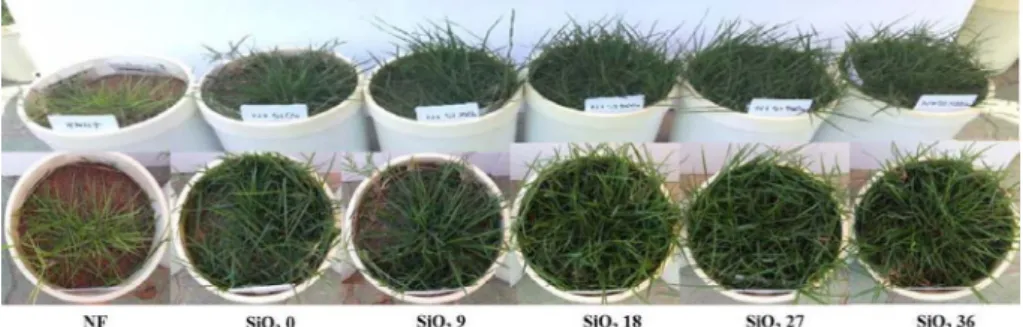
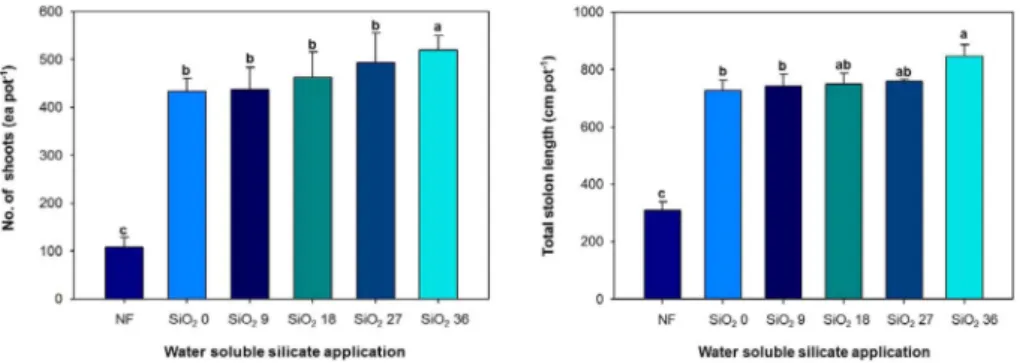
수용성 규산염 시용에 따른 한국잔디의 규산 시비효과를 알아보기 위해 규산 함량별 처리 후 와그너포트 시험의 생 육조사를 한 결과 3요소와 규산 무처리구(NF)와 규산 무 처리구를 제외하고, 규산 함량이 높을수록 초장, 근장, 지 상부와 포복경의 생체중과 건물중이 유의성 있게 증가하 였다(Fig. 1과 Table 1). 규산 무처리구에 비해 규산 처리구 가 초장과 근장이 길었으며, 규산 함량 18, 27과 36 µl ml-1 처리구는 초장과 근장의 유의한 차이가 없었다. 지상부의 생체중은 규산 함량 27과 36 µl ml-1 처리구에서 각각 51.6 과 52.3 g으로 가장 높았고, 지상부의 건물중은 규산 함량 18, 27과 36 µl ml-1처리구에서 각각 12.8, 13.2와 13.8 g으 로 높게 나타났지만 처리간에 유의차가 없었다. 포복경의 생체중과 건물중은 규산 함량 36 µl ml-1 처리구에서 각각 29.1과 9.1 g으로 가장 높게 나타났으며, 지하부의 생체중과 건물중은 규산 처리간 유의한 차이를 보이지 않았다. 지상 부 개체수는 규산 함량 36 µl ml-1 처리구에서 520.0개로 가 장 많았고, 다음으로는 규산 함량 18과 27 µl ml-1 처리구에 서 각각 463.3과 493.7개로 많았으나 처리간 유의한 차이 가 없었다(Fig. 2). 포복경 길이는 규산 함량 36 µl ml-1처 리구에서 845.5 cm로 가장 길었으나 규산 함량 9, 18과 27 µl ml-1 처리간의 유의한 차이가 나타나지 않았다. 규산 처리 에 따른 한국잔디의 생육량이 증가하였으며, 규산 함량 36µl ml-1 처리구의 생육량이 가장 높았으나 규산 함량 18 과 27 µl ml-1 처리구간의 생육량은 유의한 차이가 없었다.
잔디 재배지에서 수용성 규산염 시용에 따른 한국잔디의 규산 시비효과를 알아보기 위해 규산 함량별 시용 후 포장 시험의 생육조사를 한 결과 동일수준의 3요소 처리조건에
Fig. 1. Effect of water soluble silicateapplication on the growth of zoysiagrass in the Wagner pot. NF was no fertilizer. Water soluble silicate (SiO2) was applied at 0, 9, 18, 27 and 36µl ml-1 respectively. Nitrogen, P2O2 and K2O were applied at 24, 12 and 12 g m-2 respectively.
서 규산 무처리구에 비해 규산 함량이 증가할수록 근장, 지 상부, 포복경과 지하부의 생체중과 건물중이 유의성 있게 증가하였다(Table 2). 초장은 규산 무처리구와 처리구간의 유의성을 나타내지 않았으며, 근장은 규산 함량 36 µl ml-1 처리구가 7.8 cm로 가장 길었으나 규산 함량 9와 18 µl ml-1
처리구는 각각 7.3과 7.5 cm로 유의한 차이를 보이지 않 았다. 지상부의 생체중은 규산 함량 36 µl ml-1 처리구가 1220.2 g으로 가장 높게 나타났고, 다음으로 규산 함량 18 µl ml-1 처리구가 1084.5 g으로 높았다. 지상부의 건물중은 규 산 함량 36 µl ml-1 처리구가 304.4 g으로 가장 높았으며, 규 Table 1. Effect of water soluble silicate application on shoot and root length, fresh and dry weight of zoysiagrass in the Wagner pot.
Treatmentz (µl ml-1)
Shoot length (cm)
Root length (cm)
Fresh weight (g pot-1) Dry weight (g pot-1)
Shoot Stolon Root Shoot Stolon Root
NF 12.2cy 33.0ab 7.9d 9.0c 10.3b 2.4c 3.3c 2.2b
SiO2 0 18.0b 33.5ab 36.1c 22.4b 18.4a 8.6b 7.5b 4.0a
SiO2 9 21.5ab 29.7b 40.9bc 26.3ab 19.0a 11.2ab 8.2ab 4.1a SiO2 18 22.6a 35.9a 45.6ab 26.9ab 18.7a 12.8a 7.9b 4.2a
SiO2 27 22.0a 36.2a 51.6 a 27.2ab 18.9a 13.2a 7.1b 4.4a
SiO2 36 22.4a 36.8a 52.3a 29.1a 20.8a 13.8a 9.1a 4.5a
The growth characteristics were measured at the 169th day after planting and the 64th day after first water soluble silicate fertilizer application.
zNF was not fertilized. Water soluble silicate (SiO2) was applied at 0, 9, 18, 27 and 36µl ml-1 respectively. Water soluble silicate (SiO2) was treated for a total 2 times, on May 27 and July 7. Nitrogen, P2O2 and K2O were applied at 24, 12 and 12 g m-2 respectively.
yMean separation within columns by Duncan’s multiple range test, p = 0.05.
Fig. 2. Effect of water soluble silicate application on number of shoots and total stolon length of zoysiagrass in the Wagner pot. NF was not fertilized. Water soluble silicate (SiO2) was applied at 0, 9, 18, 27 and 36µl ml-1 respectively. Nitrogen, P2O2 and K2O were applied at 24, 12 and 12 g m-2 respectively. The growth characteristics were measured at the 64th day after first water soluble silicate application. Data are the mean± S.D. of three replicates. Different letters are significantly different by Duncan’s multiple range test p = 0.05.
Table 2. Effect of water soluble silicate application on shoot and root length, fresh and dry weight of zoysiagrass in the field experiment.
Treatmentz (µl ml-1)
Shoot length (cm)
Root length (cm)
Fresh weight (g m-2) Dry weight (g m-2)
Shoot Stolon Root Shoot Stolon Root
SiO20 10.1ay 6.8b 952.2c 776.8c 354.9b 213.6c 281.6b 100.9b SiO2 9 10.6a 7.3ab 998.6bc 936.6b 548.2a 249.8b 337.7a 121.9a SiO2 18 10.1a 7.5ab 1084.5b 942.2b 608.6a 271.9b 346.1a 129.1a SiO2 36 10.7a 7.8a 1220.2a 1040.9a 596.4a 304.4a 367.4a 126.7a The growth characteristics were measured at the 102nd day after first water soluble silicate fertilizer application.
zWater soluble silicate (SiO2) was applied at 0, 9, 18 and 36µl ml-1 respectively. Water soluble silicate (SiO2) was treated for a total 2 times, on May 24 and June 26. Nitrogen, P2O2 and K2O were applied using compound fertilizer (N : P : K = 21:17:17).
yMean separation within columns by Duncan’s multiple range test p = 0.05.
산 함량 9과 18 µl ml-1 처리구에서는 유의한 차이가 없 었다. 포복경의 생체중은 규산 함량 36 µl ml-1 처리구가 1040.9 g으로 가장 높게 나타났으나 규산 함량 9과 18 µl ml-1 처리구에서는 각각 936.6과 942.2 g으로 유의한 차이가 없 었고, 포복경의 건물중은 규산 함량 9, 18과 36 µl ml-1 처 리구에서 각각 337.7, 346.1과 367.4 g으로 유의차가 나타나 지 않았다. 지하부의 생체중과 건물중은 수용성 규산 무처 리구에 비해 증가하는 경향을 보였으나 처리구간의 유의 차는 나타내지 않았다. 지상부 개체수는 수용성 규산 함량 36µl ml-1 처리구에서 m2당 17994.5개로 가장 많았고, 다음 으로는 규산 함량 18 µl ml-1 처리구가 m2당 16311.1개로 나 타났다(Fig. 3). 포복경 길이는 규산 함량 18과 36 µl ml-1 처리구에서 각각 m2당 322.9와 337.8 m로 처리구간의 유의 한 차이가 없었다. 잔디 재배지 포장시험에서도 와그너포 트 시험 결과와 비슷하였으며, 규산 처리에 따른 한국잔디 의 생육량이 증가하였고, 규산 함량 36 µl ml-1 처리구가 다 소 생육량 많았으나 규산 함량 18 µl ml-1 처리구와 차이가 적은 경향을 보였다. 이러한 결과를 통해 수용성 규산염 처 리가 잔디생육 향상에 도움이 되고 있음을 알 수 있었고, 한국잔디의 생육량과 소비자의 경제성을 고려하였을 때 18µl ml-1가 적합한 규산 함량인 것으로 판단되었다.
본 연구결과는 크리핑 벤트그래스에 규산염을 처리하였 을 때 무처리구보다 규산염 처리구에서 유의성 있게 근장 이 길었으며, 이는 규산염이 잔디 뿌리발육에 효과가 있다 고 보고한 결과와 유사하였다(Lee et al., 2008). 규소 농도 가 높을수록 생육이 양호하여 크리핑 벤트그래스의 예초 물 생산이 증가된다고 하였고(Uriarte et al., 2004), 규소는 seashore paspalum의 신초생육과 품질을 향상시킨다고 보 고하였다(Trenholm et al., 2001). 또한 한지형 잔디의 초장, 지상부와 지하부의 생체중과 건물중이 규소처리로 증가한 다고 보고하였는데 본 실험의 결과와 일치 하였다(Kang et
al., 2007). 규소는 극성을 가지지 않는 단량체인 규산[Si(OH)4] 의 형태로 pH 9 이하에서 식물의 뿌리를 통해 흡수된다고 알려져 있다(Ma and Takahasi, 2002). 뿌리를 통해 흡수된 규소는 식물의 증산에 따라 식물체의 지상부로 즉시 이동 되고 식물체 잎의 세포에 축적된다(Yosida, 1965). 일반적 으로 뿌리를 통해 체내에 축적되는 규소의 양은 0.1~10.0%
정도인 것으로 알려져 있으며(Epistein, 1999), 쌍자엽 식물 보다 단자엽 식물에서 더 많이 축적 되는 것으로 보고되고 있다(Ma and Takahasi, 2002). 단자엽 식물 특히 화본과 식 물에서 규소의 시용은 생육의 발달과 촉진이외에 광합성 의 증대 등의 효과가 있는 것으로 보고되었다(Epistein, 1999;
Ma, 2004).
수용성 규산염 시용에 따른 한국잔디 무기이온 함량 및 토양 특성의 변화
수용성 규산염 시용 후 와그너포트 시험에서 한국잔디의 무기이온 함량을 조사한 결과 3요소와 규산 무처리구(NF) 와 규산 무처리구에 비해 규산 함량이 증가할수록 식물체 내 조규산 함량이 증가하였고, 규산 함량 36 µl ml-1처리구 가 116.7 g kg-1으로 가장 높게 나타났다(Table 3). 식물체내 질소와 인산은 수용성 규산 처리에 따라 증가하는 경향을 나타내었고, 규산 함량 27 µl ml-1 처리구에서 각각 20.3과 4.2 g kg-1로 높았다. 식물체내 칼륨, 마그네슘과 칼슘 함량 은 수용성 규산 무처리구에 비해 수용성 규산 처리구에서 증가하는 경향을 나타내었다. 본 연구결과는 규소 처리농 도가 높을수록 한지형 잔디의 신초의 규산 함량이 증가한 다는 보고와(Kang et al, 2007) seashore paspalum (Trenholm et al., 2001), 벼(Chang et al., 2006) 등에서도 규소 시비량 이 많을수록 식물체내 규소 함량이 증가한다는 보고와 유 사한 경향을 보였다. 잔디 재배지에서 수용성 규산 시용에 따른 한국잔디의 무기이온 함량을 조사한 결과는 처리구 Fig. 3. Effect of water soluble silicate application on the number of shoots and total stolon length of zoysiagrass in the field experiment. Water soluble silicate (SiO2) was applied at 0, 9, 18 and 36µl ml-1 respectively. Water soluble silicate (SiO2) was treated for a total 2 times, on May 24 and June 26. Nitrogen, P2O2 and K2O were applied using compound fertilizer (N : P : K = 21:17:17).
The growth characteristics were measured at the 102nd day after first water soluble silicate fertilizer application. Data are the mean± S.D. of four replicates. Different letters are significantly different by Duncan’s multiple range test, p = 0.05.
간의 유의한 차이를 보이지 않았다.
와그너포트 시험과 잔디 재배지 포장시험 수용성 규산 시용 후 토양 특성을 분석한 결과 처리구간의 유의한 차이 가 없었다. 슬래그 규산질비료를 처리하였을 때 토양 pH, 토양 내 유효규산, 치환성 칼슘과 유기물 함량이 증가하여 토양 비옥도 증진 효과가 있다고 하였으나(Han et al., 2014;
Joo and Lee, 2011), 본 연구에서는 수용성 규산 시용에 따 른 토양 화학적 변화를 보이지 않았다. 이와 같은 결과는 수용성 규산 함량이 증가할수록 유효규산 함량이 증가하 는 경향을 보였지만 유의적인 차이를 나타내지 않았고, 슬 래그 규산질 비료보다 효과가 크지 않으며, 벼의 흡수에 필 요한 유효규산 함량에는 미치지 못한다는 결과와 유사한 경향을 보였다(Joo and Lee, 2011).
본 시험결과를 통해 수용성 규산 시용에 따라 한국잔디 의 생육과 밀도는 유의하게 증가하였고, 적정 규산 함량은 18µl ml-1으로 판단되었다. 규산 함량이 증가할수록 식물체 내 조규산 함량은 증가하였으나 토양 개량에는 효과가 없 는 것으로 나타났다. 식물체 내 조규산의 공급원으로서 수 용성 규산을 토양에 직접시비보다는 엽면시비를 통해 토 양 시비량보다 적은 양으로 한국잔디의 생장에 기여할 수 있을 것으로 판단된다.
요 약
규산질 비료는 잔디에 있어서 생육과 밀도 향상 효과가 인정되고 있다. 대부분 슬래그 규산질 비료를 사용하고 있 지만 최근에는 수용성 규산염을 원료로 한 규산질 등이 개 발되어 시판되고 있다. 본 연구에서는 수용성 규산염에 대 한 연구가 미흡한 실정으로 수용성 규산 시용에 따른 한국 잔디의 생육과 토양화학성 변화를 알아보고자 수용성 규 산(SiO2) 함량별 처리 후 와그너포트 시험과 잔디 재배지
포장시험을 수행하였다. 수용성 규산 무처리구에 비해 수 용성 규산 함량이 높을수록 근장, 지상부와 포복경의 생체 중과 건물중, 한국잔디의 밀도가 유의성 있게 증가하였으 며, 식물체내 조규산 함량은 유의하게 증가하였으나 토양 화학성에는 유의한 차이가 없었다. 수용성 규산 함량 18과 36µl ml-1처리구간의 유의한 차이가 크지 않아 적정 수용 성 규산 함량은 18 µl ml-1으로 판단되었고, 식물체 내 조규 산의 공급원으로서 수용성 규산을 토양에 직접시비보다는 엽면시비로 한국잔디의 생장에 기여할 수 있을 것으로 판 단된다.
주요어: 유효인산, 무기이온, 액비, 수용성 규산염, 한국잔디
References
Adatia, M.H. and Besford, R.T. 1986. The effects of silicon on cucumber plants grown in recirculating nutrient solution. Ann.
Bot. 58:343-351.
Bae, E.J., Lee, K.S., Hwang, J.Y. and Park, Y.B. 2013a. Effect ofsilicate and lime fertilizer on growth of zoysiagrass (Zoysiajaponica).
Kor. Turfgrass Sci. 26:76. (Abstr. In Korean)
Bae, E.J., Lee, K.S., Kim, D.S., Han, E.H., Lee, S.M. et al. 2013b. Sod production and current status of cultivation management in Korea. Weed Turf. Sci. 2:95-99. (In Korean)
Bae, E.J., Lee, K.S., Park, Y.B., Lee, S.M., Yang, G.M. et al. 2013c.
Growth and contents of inorganic nutrient during cultivation of zoysiagrass. Weed Turf. Sci. 2:82-87. (In Korean)
Brecht, M.O., Datnoff, L.E., Kucharek, T.A. and Nagata, R.T. 2004.
Influence of silicon and chlorothalonil on the suppression of gray leaf spot and increase plant growth in St. Augustinegrass.
Plant disease. 88:338-344.
Chang, K.W., Hong, J.H., Lee, J.E. and Lee, J.J. 2006. Effects of the Table 3. Inorganic nutrient content of zoysiagrass by different contents of water soluble silicate in the Wagner pot.
Treatmentz (µl ml-1)
SiO2 N P2O5 K2O MgO CaO
- - - -g kg-1- - - -
NF 55.7dy 4.7d 2.5c 6.8c 1.5b 2.4c
SiO2 0 52.1d 7.2c 2.4c 9.6b 1.6b 3.0b
SiO2 9 72.1c 11.8b 3.9b 11.9ab 2.3a 3.5b
SiO2 18 74.5c 15.2ab 3.9b 13.2a 2.8a 4.9ab
SiO2 27 95.5ab 20.3a 4.2a 12.5a 3.0a 6.5a
SiO2 36 116.7a 17.7ab 3.5b 12.5a 2.7a 6.6a
The growth characteristics were measured at the 169th day after planting and the 64th day after first water soluble silicate fertilizer application.
zNF was not fertilized. Water soluble silicate (SiO2) was applied at 0, 9, 18, 27 and 36µl ml-1 respectively. Water soluble silicate (SiO2) was treated for a total 2 times, on May 27 and July 7. Nitrogen, P2O2 and K2O were applied at 24, 12 and 12 g m-2 respectively.
yMean separation within columns by Duncan’s multiple range test, p = 0.05.
granular silicate fertilizer (GSF) application on the rice growth and quality. Korean J. Soil Sci. Fert. 39:151-156. (In Korean) Choi, J.S. and Yang, G.M. 2006. Sod production in South Korea.
Kor. Turfgrass Sci. 20:237-251. (In Korean)
De Melo, S.P., Monteiro, F.A. and de Bona, F.D. 2010. Silicon distribution and accumulation in shoot tissue of the tropical forage grass Brachiaria briznatha. Plant and soil. 336:241-249.
Epstein, E. 1994. The anomaly of silicon in plant biology. Proc.
Natl. Acad. Sci. USA. 91:11-17.
Epstein, E. 1999. Silicon. Ann. Rev. Plant Physiol. Plant Mol. Biol.
50:641-664.
Hallmark, C.T., Wilding, L.P. and Smeck, N.E. 1982. Silicon. pp.
263-273. In Methods of soil analysis, Part 2: Chemical and microbiological properties, Soil Science Society of America, Madison, WI, USA.
Ham, S.K., Kim, H.J., Shim, G.Y. and Kim, S.T. 1996. Management of cultural practices by using lime and silicate fertilizer in golf course. Kor. Turfgrass Sci. 38:39. (Abstr. In Korean)
Han, J.J., Lee, K.S., Park, Y.B. and Bae, E.J. 2014. Effect of growth and nitrogen use efficiency by application of mixed silicate and nitrogen fertilizer on zoysiagrass cultivation. Weed Turf. Sci.
3:137-142. (In Korean)
Hwang, Y.S. and Choi, J.S. 1999. Effect of mowing interval, aeration, and fertility level on the turf quality and growth of zoysiagrass (Zoysia japonicaSteud.). Kor. Turfgrass Sci. 13:79- 90. (In Korean)
IAS. 1987. Analysis methods of soil and plant. Institute of Agricultural Science. RDA. Suwon, Korea.
Jang, D.H., Park, N.I., Yang. S.W. and Shim, G.Y. 2011. Present situation of zoysiagrass (Zoysiaspp.) culture, sod production, and bland by prefecture in Japan. Asian J. Turfgrass Sci. 25:229- 236. (In Korean)
Joo, J.H. and Lee, S.B. 2011. Assessment of silicate fertilizers application affecting soil properties in paddy field. Kor. J. Soil Sci. Fert. 44:1016-1022. (In Korean)
Kang, H., Lim, C.K., Jang, G.M., Hyun, H.N. and So, I.S. 2007.
Influence of silicon treatment on growth and mineral elements of cool-season turfgrass species. J. Kor. Soci. for People, Plants and Environment. 10:7-14. (In Korean)
Kim, Y.S., Lee, K.S. and Ham, S.G. 2003. The effect of liquid fertilizer contained amino acids on the growth of bentgrass (Agrosti spalustris Hubs) and the chemical characteristics of soil.
Kor. Thrfgrass Sci. 17:147-154. (In Korean)
Korea Forest Service. 2012. Production survey of forest products in
2011. p. 588. Korea Forest Service. Daejun, Korea.
Lee, C.H., Yang, M.S., Chang, K.W., Lee, Y.B., Chung, K.Y., et al.
2005. Reducing nitrogen fertilization level of rice (Oryza sativa L.) by silicate application in Korean paddy soil. Kor. J. Soil Sci.
Fert. 38:194-201. (In Korean)
Lee, C.M., Kwon, O.G., Lee, K.S., Lee, S.M., Choi, S.H., et al. 2014.
Insect pests in turf sod production areas in Korea. Weed Turf.
Sci. 3:114-120. (In Korean)
Lee, J.P., Yoo, T.Y., Moon, S.J., Ham, S.K. and Kim, D.H. 2008. Effect of silicate on creeping bentgrass growth of green at the golf course during summer in Korea. Kor. Turfgrass Sci. 22:217-224.
(In Korean)
Liang, Y.C. 1999. Effects of silicon on enzyme activity, and sodium, potassium and calcium concentration in barley under salt stress. Plant Soil. 209:217-224.
Liang, Y.C., Zhu, J., Li, Z., Chu, G., Ding, Y., et al. 2008. Role of silicon in enhancing resistance to freezing stress in two contrasting winter wheat cultivars. Environ. Expt. Bot. 64:286- 394.
Lim, S.K., Shin, J.S. and Park, Y.S. 1981. Study on increase of slag utilization. Research report of National Institute of Agricultural Science and Technology. p. 9-36.
Ma, J.F. and Takahashi, E. 2002. Soil, fertilizer, and plant silicon research in Japan. Elsevier Science, Amsterdam.
Ma, J.F. 2004. Role of silicon in enhancing the resistance of plants to biotic and abiotic stress. Soil Sci. Plant Nutri. 50:11-18.
Mengel, K. and Krikby, E.A. 1987. Principles of Plant Nutrition, International Potash Institute, Bern, Switzerland. pp. 577-582.
Trenholm, L.E., Duncan, R.R., Carrow, R.N. and Snyder, G.H.
2001. Influence of silica on growth, quality, and wear tolerance of seashore paspalum. J. Plant Nutrition. 244:245-259.
Trenholm, L.E., Datnoff, L.E. and Nagata, R.T. 2004. Influence of silicon on drought and shade tolerance of St. Augustinegrass.
Hort. Technol. 14:487-490.
Uriarte, R.F., Shew, H.D. and Bowman, D.C. 2004. Effect of soluble silica on brown patch and dollar spot of creeping bentgrass. J.
Plant Nutrition. 27:325-339.
Yoo, S.H., Jung, Y.S., Joo, Y.K., Choi, B.K., Wu, H.Y., et al. 2002. Soil amendment for turfgrass vegetation of the Incheon international airport runway side on the Yeongjong reclaimed land. Kor J. Soil Sci. Fert. 35:93-104. (in Korean)
Yoshida, S. 1965. Chemical aspects of the role of silicon in physiology of the rice plant. Bull. Natl. Inst. Agric. Sci. 15:1-58.