The Effects of Bronchiectasis on Asthma Exacerbation
Hye Ran Kang, M.D., Gyu-Sik Choi, M.D., Sun Jin Park, M.D., Yoon Kyung Song, M.D., Jeong Min Kim, M.D., Junghoon Ha, M.D., Yung Hee Lee, M.D., Byoung Hoon Lee, M.D., Sang-Hoon Kim, M.D. and Jae Hyung Lee, M.D.
Division of Pulmonology and Allergy, Department of Internal Medicine, Eulji General Hospital, Eulji University School of Medicine, Seoul, Korea
Background: Bronchiectasis and asthma are different in many respects, but some patients have both conditions. Studies assessing the effect of bronchiectasis on asthma exacerbation are rare. The aim of this study is to investigate the effect of bronchiectasis on asthma exacerbation.
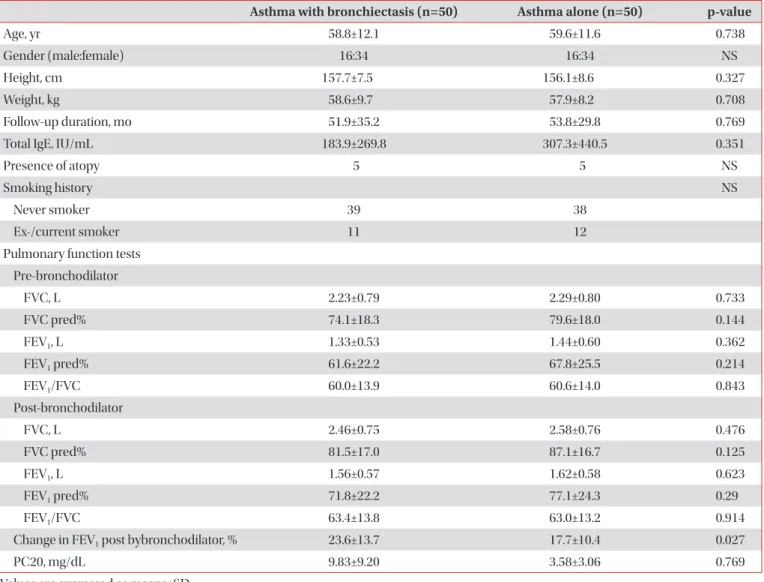
Methods: We enrolled 2,270 asthma patients who were followed up in our hospital. Fifty patients had bronchiectasis and asthma. We selected fifty age- and sex-matched controls from the 2,220 asthma patients without bronchiectasis, and assessed asthma exacerbation and its severity based on the annual incidence of total asthma exacerbation, annual prevalence of steroid use, and frequency of emergency room visits and hospitalizations due to asthma exacerbation in each group.
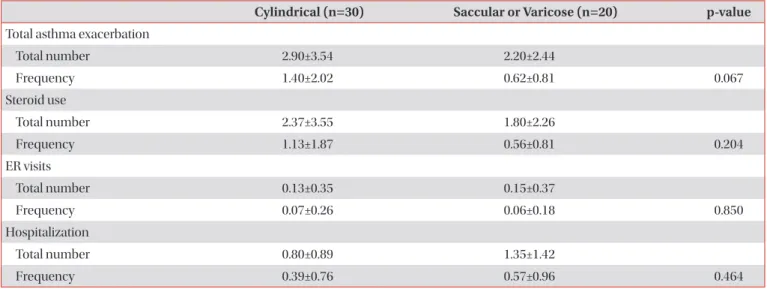
Results: Fifty patients (2.2%) had bronchiectasis and asthma. The annual incidence of asthma exacerbation was higher in patients with asthma and bronchiectasis than in patients with asthma alone (1.08±1.68 vs. 0.35±0.42, p=0.004). The annual prevalence of steroid use (0.9±1.54 vs. 0.26±0.36, p=0.006) and the frequency of emergency room visits (0.46±0.84 vs. 0.02±0.13, p=0.001) due to asthma exacerbation were also higher in patients with asthma and bronchiectasis than in patients with asthma alone.
Conclusion: Bronchiectasis is associated with difficult asthma control.
Keywords: Bronchiectasis; Asthma; Disease Exacerbation
Introduction
Asthma is a clinical syndrome characterized by three distinct components, such as recurrent episodes of airway obstructions, airway hyperresponsiveness, and airway inflam- mations. Exacerbation of asthma is indicated by episodes of progressively increasing shortness of breath, coughing, wheezing, or chest tightening, or some combination of these symptoms. Asthma exacerbations are associated with a vari- ety of risk factors including allergens, viral infections, pollut- ants, drugs, obesity, emotional stress, rhinitis, sinusitis, gastro- esophageal reflux, and menstruation
1.
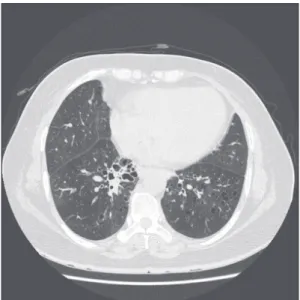
Bronchiectasis is defined as permanently dilated airways due to chronic bronchial inflammation caused by inappro- priate clearance of various microorganisms and recurrent or chronic infection
2. Although the true prevalence is unknown for most regions, bronchiectasis is now being diagnosed with Copyright © 2014
The Korean Academy of Tuberculosis and Respiratory Diseases.
All rights reserved.
Address for correspondence: Jae Hyung Lee, M.D.
Division of Pulmonology and Allergy, Department of Internal Medicine, Eulji General Hospital, Eulji University School of Medicine, 68 Hangeulbiseong-ro, Nowon-gu, Seoul 139-711, Korea
Phone: 82-2-970-8208, Fax: 82-2-970-8621 E-mail: [email protected]
Received: Jul. 1, 2014 Revised: Jul. 30, 2014 Accepted: Aug. 28, 2014
cc