ABSTRACT
Background: The incidence of asthma exacerbation (AE) and the predictive value of spirometry and fractional exhaled nitric oxide (FeNO) in school children have not been evaluated.
Objective: We sought to evaluate the efficacy of spirometry measurement and FeNO monitoring for predicting AE in school children in the Cheongju area in Korea.
Methods: With parental agreement, we studied 170 students aged 7–12 years. Children were evaluated by an asthma specialist using baseline spirometry, skin prick test, seasonal FeNO measurement, and asthma control test. The study participants underwent a physical examination and their medical history was also evaluated by the specialist. They were assessed for asthma control status during regular doctor visits for 1 year.
Results: In total, 160 children (94.1%) completed follow-up and FeNO monitoring. Of which, 26 children (16.3%) had AE. AE was associated with male children and children with allergic rhinitis (p < 0.05). While, children with AE tended to have higher FeNO than those without AE, no significant difference was found. The maximum value of FeNO ≥35 ppb was associated with AE (p < 0.05). Children with AE had a significantly decreased baseline forced expiratory volume in 1 second/forced vital capacity (FEV1/FVC), %predicted, forced expiratory flow at 25%–75% of FVC (FEF25%–75%). FEV1/FVC < 80% was associated with AE in children regardless of inhalant allergen sensitization (all p < 0.05).
Conclusion: Baseline spirometry had a predictive value of AE in school children. Sensitive spirometric parameters such as FEV1/FVC and FEF25%–75% can be used as prognostic factors to predict future childhood AE. FeNO value ≥ 35 ppb during monitoring was associated with AE in school children.
Keywords: Asthma; Exacerbation; Child; Exhaled nitric oxide; Spirometry
Original Article
Received: Oct 21, 2019 Accepted: Jan 23, 2020
*Correspondence to Sung-Il Woo
Department of Pediatrics, Chungbuk National University Hospital, 776 1(il)sunhwan-ro, Heungdeok-gu, Cheongju 28644, Korea.
Tel: +82-43-269-6044 Fax: +82-43-264-6620 E-mail: [email protected]
Copyright © 2020. Asia Pacific Association of Allergy, Asthma and Clinical Immunology.
This is an Open Access article distributed under the terms of the Creative Commons Attribution Non-Commercial License (https://
creativecommons.org/licenses/by-nc/4.0/) which permits unrestricted non-commercial use, distribution, and reproduction in any medium, provided the original work is properly cited.
ORCID iDs Min-Gyu Kang
https://orcid.org/0000-0002-3239-4492 Sung-Il Woo
https://orcid.org/0000-0003-1896-6279 Conflict of Interest
The authors have no financial conflicts of interest.
Min-Gyu Kang 1, Shin-Ae Yoon2, Ju-Han Sim3, and Sung-Il Woo 2,*
1 Department of Internal Medicine, Chungbuk National University Hospital, Chungbuk National University College of Medicine, Cheongju, Korea
2 Department of Pediatrics, Chungbuk National University Hospital, Chungbuk National University College of Medicine, Cheongju, Korea
3Oksan and Gangnae Elementary School, Chungbuk, Cheongju, Korea
Fractional exhaled nitric oxide and forced expiratory volume in 1 second/
forced vital capacity have predictive
value of asthma exacerbation in Korean
school children
Author Contributions
Conceptualization: Sung-Il Woo, Ju-Han Sim. Data curation: Sung-Il Woo. Formal analysis: Sung-Il Woo, Min-Gyu Kang. Funding acquisition: Sung-Il Woo. Methodology: Sung- Il Woo. Project administration: Sung-Il Woo, Ju-Han Sim. Visualization: Sing-Il Woo, Min- Gyu Kang. Writing - original draft: Sung-Il Woo, Min-Gyu Kang. Writing - review & editing:
Sung-Il Woo, Min-Gyu Kang, Shin-Ae Yoon.
INTRODUCTION
Asthma is one of the most common chronic diseases with the highest prevalence (9.9%) in school-aged children (5–14 years) [1]. Childhood asthma is the most common cause of school absences, and 57.9% of asthmatic children have experienced asthma exacerbation (AE) more than once a year [2, 3]. Despite the high prevalence and socioeconomic burden of childhood asthma, diagnosing childhood asthma remains challenging since it is difficult to distinguish it from recurrent wheeze or bronchiolitis in the early stages [3]. Further, asthma is more likely to be overlooked in younger children. Although childhood asthma can resolve spontaneously, some adolescents experience acute initial symptoms despite no previous history of asthma.
Since diagnosis and management of childhood asthma are difficult, several developed countries have an asthma-friendly school program (AFSP) [4]. AFSP screens for asthma and allergic diseases based on the International Study of Asthma and Allergies in Childhood (ISAAC) survey for school-aged children [4, 5]. Several studies conducted in AFSP measured the burden of childhood asthma and the prevalence of asthma in many schools was found to be 4.0%–6.7%
[6]. However, the annual incidence of AE in school-aged children is still unknown.
The amount of air one can forcefully exhale in 1 second, or forced expiratory volume (FEV1), is an independent predictor of AE and considered important in defining asthma severity [7]. The National Asthma Education and Prevention Program guidelines suggest regular spirometry for children with asthma who are ≥5 years of age [8].
FeNO is a noninvasive biomarker for eosinophilic airway inflammation [7] because FeNO can be easily performed independent of forced respiration and is particularly useful in diagnosis of asthma in children [8]. The National Institute for Health and Care Excellence and the British Thoracic Society guidelines recommend the use of FeNO as a tool for diagnosing asthma in children [9]. However, studies have not yet examined its predictive value on asthma prognosis in asthmatic children [7, 10].
The goal of this study was to determine the real impact of asthma in schoolchildren from Cheongju area of South Korea, such as AE and asthma-related school absences through prospective monitoring in order to get information for developing a proper asthma school management. The secondary aim of this prospective study was to identify the predictive ability of spirometry measurement and FeNO monitoring for acute exacerbation of loss of asthma control in elementary schools.
MATERIALS AND METHODS
Study design
This prospective study was performed to identify the predictive value of spirometry measurement and FeNO monitoring for AE including asthma attack. A total of 170
elementary school students in the Cheongju area were enrolled in our study. The participants and their families understood the objectives of this study and provided informed consent.
Initially, participants were asked to answer the ISAAC core questionnaire, the presence of early childhood wheezing episodes, and the existence of a current diagnosis of asthma, including any current treatment modality [11]. The questionnaire defined recurrent wheezing
as a lifetime wheeze of more than 3 episodes. Recurrent wheeze must have at least one physician-diagnosed wheeze. Diagnosed asthma was defined as physician-diagnosed asthma.
Trained specialists performed baseline spirometry, skin prick test for common aeroallergens and child allergy specialists performed a routine physical examination and clinical assessment for allergic disease. Study participants prospectively had a regular check-up for asthma control status and history of exacerbation and performed the seasonal FeNO measurement every 3 months. Patients were allowed to receive asthma management from their own physicians.
When a participant had AE on regular check-up, we offered prompt in school management for AE and referred the student to his/her primary physician. The Ethics Committee of Chungbuk National University Hospital Institutional Review Board approved the study (2011-09-062) and written informed consent was obtained from the parents of all subjects.
Measurements
Fractional exhaled nitric oxide
FeNO was measured by chemiluminescence using an online nitric oxide monitor (NIOX MINO; Aerocrine AB, Solna, Sweden), according to the European Respiratory Society/
American Thoracic Society (ERS/ATS) guidelines [11] and expressed as parts per billion (ppb). The children were instructed to avoid eating, drinking, and to perform any strenuous exercise 2 hours before the FeNO measurements. After inhaling ambient air to total lung capacity through a nitric oxide scrubber, the participants exhaled against expiratory resistance, excluding nasal air. Exhalation times were 10 seconds with a 2-minute analysis period. Repeated exhalations (2 values that agree within 5%, or 3 that agree within 10%) were performed without a nose clip at a constant flow rate of 50 mL/sec.
Pulmonary function testing
Lung function tests were performed with a spirometer (Vmax SensorMedics, Yorba Linda, CA, USA) in accordance with ATS/ERS recommendations [12, 13]. The following variables were obtained from the best of 3 reproducible FVC, FEV1, forced expiratory flow at 25%–75%
of FVC (FEF25%–75%), and FEV1/FVC ratio. Percent predicted values were calculated based on the Third National Health and Nutrition Examination Survey III [14]. None of the participants received inhaled short-acting β2-agonists and asthma controllers in the 12 hours prior to evaluation of lung function.
Skin prick test
Skin prick testing was performed with common aeroallergens, including house dust mite (Dermatophagoides farinae and Dermatophagoides pteronyssinus), Alternaria, dog, cat, cockroach, mugwort, ragweed, Japanese hop, grasses mix, and a 2-tree pollen mix). The longest and orthogonal diameters of the wheal were measured, and those with a mean wheal of at least 3 mm were considered positive. Atopy was defined as sensitivity to at least more than one common aeroallergen.
Asthma Control Test
We used the Korean version of the Asthma Control Test (ACT) or childhood ACT (C-ACT) questionnaire. The ACT survey is a patient-completed questionnaire with 5 items. Each item includes 5 response options corresponding to a 5-point Likert-type rating scale (total score range, 5 to 25). The participants along with their parents completed the C-ACT, and the questionnaire was scored as the sum of the responses of 7 items. On their own or with a caregiver's guidance, the child selects a frowning to smiling face with a score from 0
to 3, respectively, in response to 4 questions regarding the intrusiveness of their asthma symptoms. Further, the parents respond to 3 additional questions regarding the child's condition at home prior to the regular check-up. These 3 questions are scored on a 5-point Likert-type rating (total score range, 0 to 27). Children and parents were encouraged to discuss their problems or doubts in completing the questionnaire. A score of 20 or more in ACT or C-ACT indicated an adequately controlled asthma.
Asthma exacerbation
Participants were found to have AE if they had (1) a diagnosis of acute AE based on Global Initiative for Asthma guideline had been made by the participant's doctor at the clinic, (2) AE with use of systemic steroid or step-up of asthma controller, (3) a history of hospitalization, emergency department visit, unscheduled visit, or school absence due to asthma, (4) loss of asthma control on ACT, (5) a history of asthma symptoms, with frequent visits to the nurse's office resulting in limited or reduced school activities, and distressing symptoms even with self-rescuer medication.
Statistical analysis
Demographic and clinical data were presented as means and standard deviation as
continuous variables. Differences among patients according to allergic disease, spirometry, or FeNO level were compared by using Fisher exact or χ2 test, Mann-Whitney, or t tests, as appropriate. FeNO values were logarithmically transformed to assume a normal distribution and expressed as geometric means (GMs) with 95% confidence intervals (CIs). A p value
<0.05 was considered significant. Statistical analyses were performed using the commercially available IBM SPSS Statistics ver. 25.0 (IBM Co., Armonk, NY, USA).
RESULTS
Patient characteristics
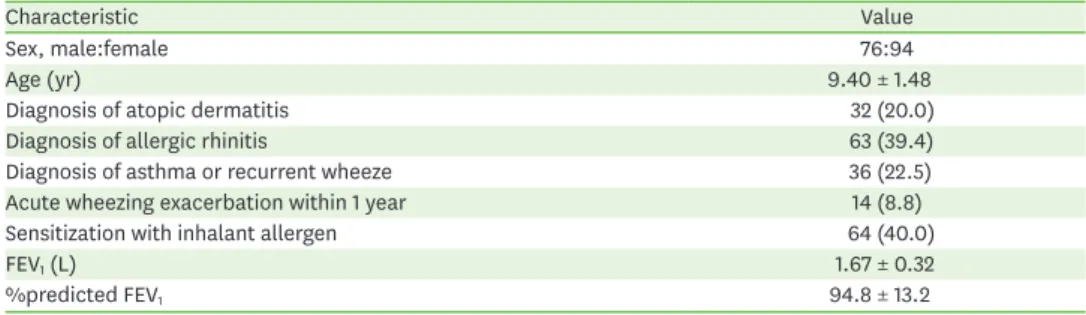
Among the 170 study participants, 160 students (94.1%) completed the 1-year regular follow- up and FeNO measurement every season. The reasons for the dropout were (1) a change in school (n = 4), (2) poor accomplishing spirometry test (n = 4), and (3) frequent school absence (n = 2). The demographic and clinical characteristics are shown in Table 1. A total of 36 children (22.5%) were diagnosed as asthmatic or had recurrent wheezing episodes. The proportion of children with allergic rhinitis and atopic dermatitis was 39.4% and 20.0%, respectively. Sixty-four children (40%) had inhalant allergen sensitization.
Table 1. The demographic and clinical characteristics of subjects (n = 160)
Characteristic Value
Sex, male:female 76:94
Age (yr) 9.40 ± 1.48
Diagnosis of atopic dermatitis 32 (20.0)
Diagnosis of allergic rhinitis 63 (39.4)
Diagnosis of asthma or recurrent wheeze 36 (22.5)
Acute wheezing exacerbation within 1 year 14 (8.8)
Sensitization with inhalant allergen 64 (40.0)
FEV1 (L) 1.67 ± 0.32
%predicted FEV1 94.8 ± 13.2
Values are presented as mean ± standard deviation or number (%).
FEV1, forced expiratory volume in 1 second.
AE and allergic disease status
During 1 year of the study period, 26 students (16.3%) had experienced AE. There was no significant difference in age, comorbid allergic disease except allergic rhinitis, wheezing- associated illness, and inhalant allergen sensitization between the children with AE and children without AE (Table 2). However, allergic rhinitis and male gender were significantly higher in children with AE (p = 0.046 and p = 0.037, separately). A total of 6 students (3.8%) experienced school absences due to AE.
Pulmonary function, FeNO, and AE
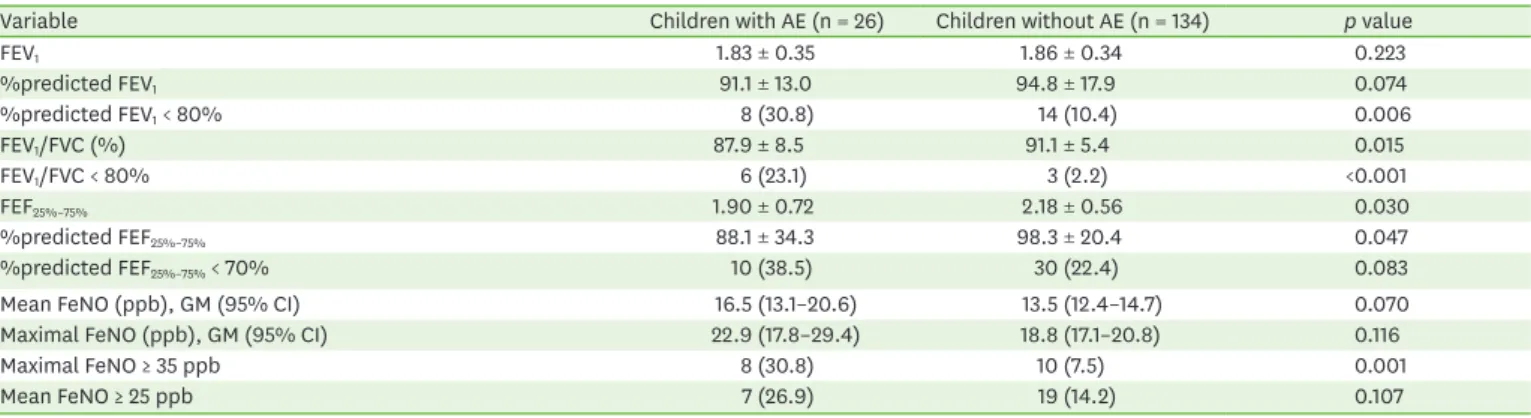
The baseline spirometry and FeNO monitoring values are listed in Table 3. Baseline FEV1 did not significantly differ between children with AE and children without AE. However, baseline FEV1/FVC and %predicted FEF25%–75% were significantly lower in children with AE than children without AE (both, p < 0.05). Proportion of children with %predicted FEV1 < 80%, FEV1/FVC < 80% were higher in children with AE (p < 0.01, p < 0.001, respectively).
GM of the FeNO level did not significantly differ between children with AE and children without AE. Although not significant, the FeNO GM trended higher in children with AE (22.9 ppb vs. 19.9 ppb) than in children without AE. However, a high proportion of children with AE had a maximal FeNO ≥ 35 ppb during the study period (p < 0.01).
Pulmonary function, FeNO, and AE in children with inhalant allergen sensitization
Of 64 children with inhalant allergen sensitization, 14 (21.8%) had AE. The spirometry and FeNO values in these children are listed in Table 4. There was a significant difference in
Table 2. Characteristics of children with and without asthma exacerbation (AE) within 1 year
Variable Children with AE (n = 26) Children without AE (n = 134) p value
Sex, male:female 17:9 59:75 0.046
Age (yr) 9.1 ± 1.7 9.5 ± 1.4 0.198
Diagnosis of asthma or recurrent wheeze 5 (19.2) 31 (23.1) 0.663
Wheezing exacerbation within the previous 1 year 3 (11.5) 11 (8.2) 0.582
Diagnosis of atopic dermatitis 7 (26.9) 25 (18.7) 0.335
Diagnosis of allergic rhinitis 15 (57.7) 48 (35.8) 0.037
Sensitization with inhalant allergen 14 (53.8) 50 (37.3) 0.115
Values are presented as mean ± standard deviation or number (%).
Table 3. Spirometry and FeNO level of children with and without AE within 1 year
Variable Children with AE (n = 26) Children without AE (n = 134) p value
FEV1 1.83 ± 0.35 1.86 ± 0.34 0.223
%predicted FEV1 91.1 ± 13.0 94.8 ± 17.9 0.074
%predicted FEV1 < 80% 8 (30.8) 14 (10.4) 0.006
FEV1/FVC (%) 87.9 ± 8.5 91.1 ± 5.4 0.015
FEV1/FVC < 80% 6 (23.1) 3 (2.2) <0.001
FEF25%–75% 1.90 ± 0.72 2.18 ± 0.56 0.030
%predicted FEF25%–75% 88.1 ± 34.3 98.3 ± 20.4 0.047
%predicted FEF25%–75% < 70% 10 (38.5) 30 (22.4) 0.083
Mean FeNO (ppb), GM (95% CI) 16.5 (13.1–20.6) 13.5 (12.4–14.7) 0.070
Maximal FeNO (ppb), GM (95% CI) 22.9 (17.8–29.4) 18.8 (17.1–20.8) 0.116
Maximal FeNO ≥ 35 ppb 8 (30.8) 10 (7.5) 0.001
Mean FeNO ≥ 25 ppb 7 (26.9) 19 (14.2) 0.107
Values are presented as mean ± standard deviation or number (%) unless otherwise indicated.
FeNO, fractional exhaled nitric oxide; AE, asthma exacerbation; FEV1, forced expiratory volume in 1 second; FVC, forced vital capacity; FEF25%–75%, forced expiratory flow at 25%–75% of FVC; GM, geometric mean; CI, confidence interval.
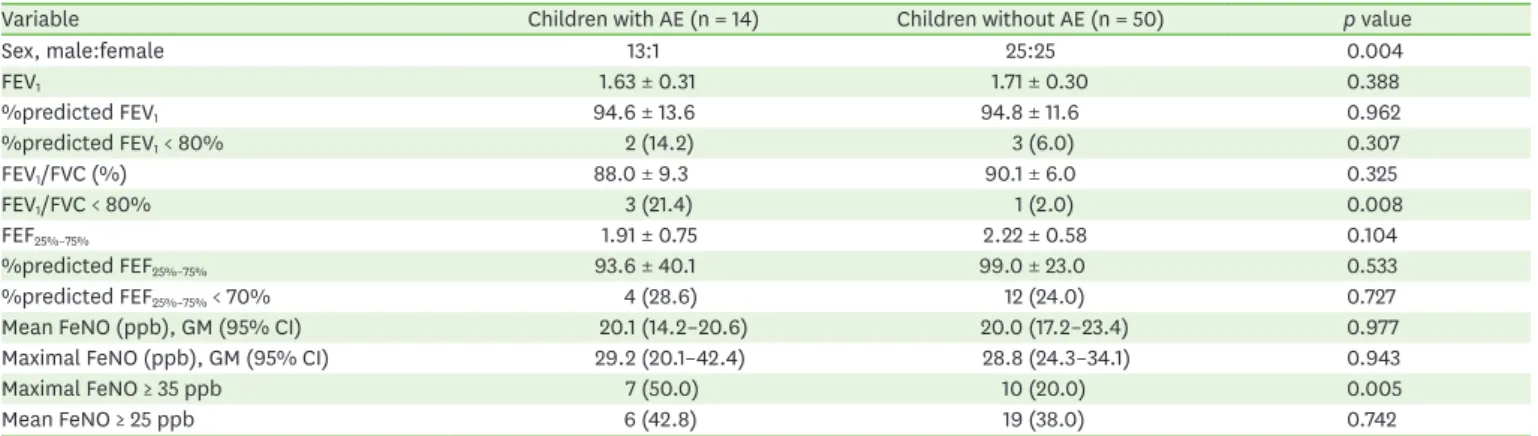
sex, the proportion of children with FEV1/FVC < 80%, and maximal FeNO ≥ 35 ppb between children with AE and children without AE. AE was more common in male than female children with inhalant allergen sensitization. There was no significant difference in FeNO levels between children with AE and children without AE. However, a significantly high proportion of children with AE had a maximal FeNO ≥35 ppb (p < 0.05). Although there were few children with FEV1/FVC < 80%, this indicator was also associated with AE among children with inhalant allergen sensitization (p < 0.01).
Pulmonary function, exhaled nitric oxide, and AE in children without inhalant allergen sensitization
Of 96 children without inhalant allergen sensitization, 12 (12.5%) had AE. Each spirometric parameter (%predicted FEV1, FEV1/FVC, %predicted FEF25%–75%) had a significant difference between children with AE and children without AE. Half of the children with AE had levels of less than 80% of % predicted FEV1. It was also associated with AE among children without inhalant allergen sensitization (Table 5).
Table 4. Characteristics, spirometry and FeNO level of children with and without AE among children with inhalant allergen sensitization
Variable Children with AE (n = 14) Children without AE (n = 50) p value
Sex, male:female 13:1 25:25 0.004
FEV1 1.63 ± 0.31 1.71 ± 0.30 0.388
%predicted FEV1 94.6 ± 13.6 94.8 ± 11.6 0.962
%predicted FEV1 < 80% 2 (14.2) 3 (6.0) 0.307
FEV1/FVC (%) 88.0 ± 9.3 90.1 ± 6.0 0.325
FEV1/FVC < 80% 3 (21.4) 1 (2.0) 0.008
FEF25%–75% 1.91 ± 0.75 2.22 ± 0.58 0.104
%predicted FEF25%–75% 93.6 ± 40.1 99.0 ± 23.0 0.533
%predicted FEF25%–75% < 70% 4 (28.6) 12 (24.0) 0.727
Mean FeNO (ppb), GM (95% CI) 20.1 (14.2–20.6) 20.0 (17.2–23.4) 0.977
Maximal FeNO (ppb), GM (95% CI) 29.2 (20.1–42.4) 28.8 (24.3–34.1) 0.943
Maximal FeNO ≥ 35 ppb 7 (50.0) 10 (20.0) 0.005
Mean FeNO ≥ 25 ppb 6 (42.8) 19 (38.0) 0.742
Values are presented as mean ± standard deviation or number (%) unless otherwise indicated.
FeNO, fractional exhaled nitric oxide; AE, asthma exacerbation; FEV1, forced expiratory volume in 1 second; FVC, forced vital capacity; FEF25%–75%, forced expiratory flow at 25%–75% of FVC; GM, geometric mean; CI, confidence interval.
Table 5. Characteristics, spirometry and FeNO level of children with and without AE among children without inhalant allergen sensitization
Variable Children with AE (n = 12) Children without AE (n = 84) P value
Sex, male:female 4:8 34:50 0.758
FEV1 1.57 ± 0.39 1.68 ± 0.32 0.327
%predicted FEV1 85.9 ± 16.1 96.1 ± 13.2 0.017
%predicted FEV1 < 80% 6 (50.0) 11 (13.1) 0.002
FEV1/FVC (%) 87.6 ± 8.0 91.6 ± 5.4 0.021
FEV1/FVC < 80% 3 (25.0) 2 (2.4) 0.001
FEF25%–75% 1.90 ± 0.71 2.16 ± 0.55 0.145
%predicted FEF25%–75% 82.3 ± 27.3 98.0 ± 18.9 0.014
%predicted FEF25%–75% < 70% 6 (50.0) 18 (21.4) 0.033
Mean FeNO (ppb), GM (95% CI) 13.0 (10.0–16.9) 10.7 (10.0–11.3) 0.166
Maximal FeNO (ppb), GM (95% CI) 17.3 (12.9–23.1) 14.7 (13.5–15.9) 0.127
Maximal FeNO ≥ 35 ppb 1 (8.3) 0 (0) 0.125
Mean FeNO ≥ 25 ppb 1 (8.3) 0 (0) 0.125
Values are presented as mean ± standard deviation or number (%) unless otherwise indicated.
FeNO, fractional exhaled nitric oxide; AE, asthma exacerbation; FEV1, forced expiratory volume in 1 second; FVC, forced vital capacity; FEF25%–75%, forced expiratory flow at 25%–75% of FVC; GM, geometric mean; CI, confidence interval.
DISCUSSION
Exhaled nitric oxide has been extensively investigated as a noninvasive marker of airway inflammation in asthma. Eosinophilic inflammation in the airway increases exhaled nitric oxide that can be easily monitored in small amounts of exhaled breath from asthmatics.
Since childhood asthma is more atopic than adult asthma, FeNO is proven to be effective in diagnosing childhood asthma. However, its predictive value about control and prognosis in children has not been sufficiently evaluated [8, 10].
We found that a greater number of children with AE had FeNO levels ≥ 35 ppb as compared to children without AE. However, there were no significant differences in the GM of the FeNO level between the 2 groups. Atopy and comorbid allergic diseases correlated with elevated FeNO levels. Nonatopic asthmatic children showed low levels of FeNO during a study period.
Although a substantial portion of atopic children was not yet diagnosed with asthma, a sizable portion of these patients showed increased FeNO levels during the study period.
Allergic rhinitis is a known risk factor for the development of asthma [15, 16].
In this study, 26 children (16.3%) had a higher incidence of AE than asthma prevalence from other study in Korean children [6]. School-based surveys face potential selection bias resulting from consenting parents who have a greater interest in their child's health. A high incidence also accounted for industrial regional characteristics, regular, and precise checkups in school by an allergy specialist. Interestingly, only 5 children with AE were previously diagnosed as asthmatic or with recurrent wheeze. The comorbidity of asthma and allergic rhinitis is remarkably high. Childhood asthma used to be underdiagnosed due to a lack of symptom recognition and awareness when children were younger. The diagnosis of allergic rhinitis was significantly higher in children with AE than in children without AE. Ten children with no diagnosis of asthma but with the diagnosis of allergic rhinitis had AE and seasonal allergen sensitivity. Concomitant air pollutants with the seasonal change in Korea could have likely influenced this AE. However, since we lacked data on inhalant allergen and air pollution exposure and had only a small number of children with AE in our study, we could not examine this further.
FeNO levels were higher in children with allergic rhinitis compared to children in the control group and showed a significant correlation with PC20 (provocative concentration causing a 20% fall in FEV1) levels [17]. The relationship between increased FeNO in children with allergic rhinitis and onset of symptomatic asthma should be further studied in a long-term prospective study. In children and adults with atopic asthma, FeNO level
> 300% of expected normal (approximately 35–50 ppb depending on individual factors) predicting both impairment with excessive use of short-acting bronchodilators and risk of exacerbations in the following year [18]. Increased FeNO level was previously associated with a relapse of asthma in children with clinical remission [19]. The highest FeNO measurement taken from serial measurements served as an independent predictor of the upcoming loss of asthma control in children with atopic asthma [20]. Current evidence suggests that FeNO values above the high cutoff (35–50 ppb) could be interpreted as a high degree of T-helper type 2-driven inflammation and a high likelihood of asthma diagnosis and an increased risk of worsening of symptoms and exacerbations in asthmatics with ongoing treatment [21]. Linn et al. [22] reported a high FeNO (≥35 ppb) in children is related to late-onset childhood asthma, low FEV1, and FVC. Our findings were consistent with these studies.
The serial measurement of lung function is essential for the assessment of suspected chronic disease of the airways. Lung function, particularly FEV1 as a percentage of predicted, is an important part of the assessment of future risk [8]. However, asthmatic children usually have relatively higher FEV1 than asthmatic adults. As a result, FEF25%–75%, FEV1/FVC proves a more sensitive index of airway obstruction than FEV1 in childhood asthma [23]. FEV1/FVC ratio has nadir between 8 to 12 years during childhood and adolescence [24]. These findings suggest that FEV1/FVC is a more predictive value than FEV1 for AE. In our study, FEV1/FVC < 80% had an association with AE for future risk, regardless of aeroallergen sensitization. In our study, the later FEV1/FVC, FEF25%–75%, and FEV1 values were less in children with AE among children without aeroallergen sensitization. This finding suggests that pulmonary function measurements, rather than FeNO, provides a more predictive value of AE in children without aeroallergen sensitization.
The combination of spirometry and FeNO provided higher sensitivity and specificity for diagnosing asthma [25]. Higher FeNO and FEV1/FVC < 80% significantly associated with asthma in school children [26]. In a previous clinical study, combined serial measurements of FeNO and FEF25%–75%, rather than a snapshot measurement, may be more useful in monitoring asthma control and may play a role in the early detection of asthma progression [27]. Several studies have stratified patients with pediatric asthma or risk of future AE [28-30].
In this study, serial measurements of FeNO and FEV1/FVC may play a role in the prediction of future exacerbated symptoms. We expect that prospective and more long-term monitoring will reveal more information about predicting AE. These findings may aid comprehensive asthma management and improve asthma control in school children.
There are several limitations to our study. First, our study could not check periodic spirometry during the study. Lung function is an integral part of the assessment of future risk. Although the proper spirometry interval remains unknown in children, current guidelines recommend periodically measurements for ongoing risk assessment [8]. Second, most AE and loss of control were obtained via a questionnaire based on the memory of parents and children despite annual physical examination by subspecialists, increasing the possibility of recall bias. Last, we speculate that we could not exclude the influence of individual exposure to smoking, air pollutant and inhalant allergen.
In conclusion, we showed that high FeNO values ≥ 35 ppb and the sensitive spirometric parameters such as FEV1/FVC were associated with future AE. In particular, the maximal FeNO value of monitoring was associated with AE. The maximal value predicted AE in the whole study group, especially in cases of children with inhalant allergen sensitization. Because there was non-atopic asthma, spirometry should also be added to the toolkit for assessing or predicting asthma status and AE. In this regard, FeNO and spirometry-based risk stratification for predicting asthma may be beneficial for managing asthma in school children.
REFERENCES
1. Centers for Disease Control and Prevention. Most recent asthma data. 2017 [Internet]. Atlanta (GA):
Centers for Disease Control and Prevention; [cited 2017 Jan 20]. Available from: https://www.cdc.gov/
asthma/most_recent_national_asthma_data.htm. 2017.
2. Cain A, Reznik M. Asthma management in New York City schools: a classroom teacher perspective. J Asthma 2016;53:744-50.
PUBMED | CROSSREF
3. Asher MI, Keil U, Anderson HR, Beasley R, Crane J, Martinez F, Mitchell EA, Pearce N, Sibbald B, Stewart AW, et al. International Study of Asthma and Allergies in Childhood (ISAAC): rationale and methods. Eur Respir J 1995;8:483-91.
PUBMED | CROSSREF
4. Bruzzese JM, Evans D, Kattan M. School-based asthma programs. J Allergy Clin Immunol 2009;124:195-200.
PUBMED | CROSSREF
5. Abramson JM, Wollan P, Kurland M, Yawn BP. Feasibility of school-based spirometry screening for asthma. J Sch Health 2003;73:150-3.
PUBMED | CROSSREF
6. Jackson DJ, Gangnon RE, Evans MD, Roberg KA, Anderson EL, Pappas TE, Printz MC, Lee WM, Shult PA, Reisdorf E, Carlson-Dakes KT, Salazar LP, DaSilva DF, Tisler CJ, Gern JE, Lemanske RF Jr. Wheezing rhinovirus illnesses in early life predict asthma development in high-risk children. Am J Respir Crit Care Med 2008;178:667-72.
PUBMED | CROSSREF
7. National Asthma Education and Prevention Program. Expert panel report 3 (EPR-3): guidelines for the diagnosis and management of asthma-summary report 2007. J Allergy Clin Immunol 2007;120(5 Suppl):S94-138.
PUBMED | CROSSREF
8. Masoli M, Fabian D, Holt S, Beasley R; Global Initiative for Asthma (GINA) Program. The global burden of asthma: executive summary of the GINA Dissemination Committee report. Allergy 2004;59:469-78.
PUBMED | CROSSREF
9. White J, Paton JY, Niven R, Pinnock H. Guidelines for the diagnosis and management of asthma: a look at the key differences between BTS/SIGN and NICE. Thorax 2018;73:293-7.
CROSSREF
10. Dweik RA, Boggs PB, Erzurum SC, Irvin CG, Leigh MW, Lundberg JO, Olin AC, Plummer AL, Taylor DR; American Thoracic Society Committee on Interpretation of Exhaled Nitric Oxide Levels (FENO) for Clinical Applications. An official ATS clinical practice guideline: interpretation of exhaled nitric oxide levels (FENO) for clinical applications. Am J Respir Crit Care Med 2011;184:602-15.
PUBMED | CROSSREF
11. American Thoracic Society; European Respiratory Society. ATS/ERS recommendations for standardized procedures for the online and offline measurement of exhaled lower respiratory nitric oxide and nasal nitric oxide, 2005. Am J Respir Crit Care Med 2005;171:912-30.
PUBMED | CROSSREF
12. Miller MR, Hankinson J, Brusasco V, Burgos F, Casaburi R, Coates A, Crapo R, Enright P, van der Grinten CP, Gustafsson P, Jensen R, Johnson DC, MacIntyre N, McKay R, Navajas D, Pedersen OF, Pellegrino R, Viegi G, Wanger J; ATS/ERS Task Force. Standardisation of spirometry. Eur Respir J 2005;26:319-38.
PUBMED | CROSSREF
13. Wanger J, Clausen JL, Coates A, Pedersen OF, Brusasco V, Burgos F, Casaburi R, Crapo R, Enright P, van der Grinten CP, Gustafsson P, Hankinson J, Jensen R, Johnson D, Macintyre N, McKay R, Miller MR, Navajas D, Pellegrino R, Viegi G. Standardisation of the measurement of lung volumes. Eur Respir J 2005;26:511-22.
PUBMED | CROSSREF
14. Hankinson JL, Odencrantz JR, Fedan KB. Spirometric reference values from a sample of the general U.S.
population. Am J Respir Crit Care Med 1999;159:179-87.
PUBMED | CROSSREF
15. Leynaert B, Neukirch C, Kony S, Guénégou A, Bousquet J, Aubier M, Neukirch F. Association between asthma and rhinitis according to atopic sensitization in a population-based study. J Allergy Clin Immunol 2004;113:86-93.
PUBMED | CROSSREF
16. Di Cara G, Carelli A, Latini A, Panfili E, Bizzarri I, Ciprandi G, Buttafava S, Frati F, Verrotti A. Severity of allergic rhinitis and asthma development in children. World Allergy Organ J 2015;8:13.
PUBMED | CROSSREF
17. Kim YH, Park HB, Kim MJ, Kim HS, Lee HS, Han YK, Kim KW, Sohn MH, Kim KE. Fractional exhaled nitric oxide and impulse oscillometry in children with allergic rhinitis. Allergy Asthma Immunol Res 2014;6:27-32.
PUBMED | CROSSREF
18. Zeiger RS, Schatz M, Zhang F, Crawford WW, Kaplan MS, Roth RM, Chen W. Elevated exhaled nitric oxide is a clinical indicator of future uncontrolled asthma in asthmatic patients on inhaled corticosteroids. J Allergy Clin Immunol 2011;128:412-4.
PUBMED | CROSSREF
19. Pijnenburg MW, Hofhuis W, Hop WC, De Jongste JC. Exhaled nitric oxide predicts asthma relapse in children with clinical asthma remission. Thorax 2005;60:215-8.
PUBMED | CROSSREF
20. Yang S, Park J, Lee YK, Kim H, Hahn YS. Association of longitudinal fractional exhaled nitric oxide measurements with asthma control in atopic children. Respir Med 2015;109:572-9.
PUBMED | CROSSREF
21. Bjermer L, Alving K, Diamant Z, Magnussen H, Pavord I, Piacentini G, Price D, Roche N, Sastre J, Thomas M, Usmani O. Current evidence and future research needs for FeNO measurement in respiratory diseases.
Respir Med 2014;108:830-41.
PUBMED | CROSSREF
22. Linn WS, Rappaport EB, Berhane KT, Bastain TM, Avol EL, Gilliland FD. Exhaled nitric oxide in a population-based study of southern California schoolchildren. Respir Res 2009;10:28.
PUBMED | CROSSREF
23. Lebecque P, Kiakulanda P, Coates AL. Spirometry in the asthmatic child: is FEF25-75 a more sensitive test than FEV1/FVC? Pediatr Pulmonol 1993;16:19-22.
PUBMED | CROSSREF
24. Quanjer PH, Stanojevic S, Stocks J, Hall GL, Prasad KV, Cole TJ, Rosenthal M, Perez-Padilla R, Hankinson JL, Falaschetti E, Golshan M, Brunekreef B, Al-Rawas O, Kühr J, Trabelsi Y, Ip MS; Global Lungs Initiative.
Changes in the FEV₁/FVC ratio during childhood and adolescence: an intercontinental study. Eur Respir J 2010;36:1391-9.
PUBMED | CROSSREF
25. Szefler SJ, Mitchell H, Sorkness CA, Gergen PJ, O'Connor GT, Morgan WJ, Kattan M, Pongracic JA, Teach SJ, Bloomberg GR, Eggleston PA, Gruchalla RS, Kercsmar CM, Liu AH, Wildfire JJ, Curry MD, Busse WW.
Management of asthma based on exhaled nitric oxide in addition to guideline-based treatment for inner- city adolescents and young adults: a randomised controlled trial. Lancet 2008;372:1065-72.
PUBMED | CROSSREF
26. Grzelewski T, Witkowski K, Makandjou-Ola E, Grzelewska A, Majak P, Jerzyńska J, Janas A, Stelmach R, Stelmach W, Stelmach I. Diagnostic value of lung function parameters and FeNO for asthma in schoolchildren in large, real-life population. Pediatr Pulmonol 2014;49:632-40.
PUBMED | CROSSREF
27. Yoon JY, Woo SI, Kim H, Sun YH, Hahn YS. Fractional exhaled nitric oxide and forced expiratory flow between 25% and 75% of vital capacity in children with controlled asthma. Korean J Pediatr 2012;55:330-6.
PUBMED | CROSSREF
28. Forno E, Fuhlbrigge A, Soto-Quirós ME, Avila L, Raby BA, Brehm J, Sylvia JM, Weiss ST, Celedón JC. Risk factors and predictive clinical scores for asthma exacerbations in childhood. Chest 2010;138:1156-65.
PUBMED | CROSSREF
29. Lara M, Rosenbaum S, Rachelefsky G, Nicholas W, Morton SC, Emont S, Branch M, Genovese B, Vaiana ME, Smith V, Wheeler L, Platts-Mills T, Clark N, Lurie N, Weiss KB. Improving childhood asthma outcomes in the United States: a blueprint for policy action. Pediatrics 2002;109:919-30.
PUBMED | CROSSREF
30. Hanson JR, Lee BR, Williams DD, Murphy H, Kennedy K, DeLurgio SA Sr, Portnoy J, Reddy M.
Developing a risk stratification model for predicting future health care use in asthmatic children. Ann Allergy Asthma Immunol 2016;116:26-30.
PUBMED | CROSSREF