•^1
•회지 제32^
제1
호7 0 9 (1988)
Yakhak HoejiVol. 32
,No. 1
허혈 및 재관류한 흰쥐 심장에 미치는 인삼의 영향
金 炳 采 • 金 洛 斗
서울:大學校 藥學*學
(Received January 28, 1988)
Effects of Ginseng on Global Myocardial Ischemia and Reperfusion in the Rat Heart Byung Chae Kim and Nak Doo Kim
College of Pharmacy、Seoul National University Seoul 151,Korea
Abstract—The effect of Ginseng on global myocardial ischemia and reperfusion was examined in isolated perfused rat hearts. The Ginseng ethanol extract (lOOmg/kg/day) was administered orally for 10 days. The rat hearts were removed and perfused at 75cm H20 by the Langendorff method. After 25 min. of global ischemia, the hearts were reperfused. The myocardial contents of adenosine 5,-triphosphate, creatine phosphate, and calcium were assayed. There no differences in ATP levels in all group of normal and Ginseng-treated hearts. Both in non-ischemic and ischemic heart, Ginseng increased significantly tissue creatine phosphate levels compared with control. Whereas, in ischemic-reperfused heart, there was no significant difference. In the control groups, myocardial calcium contents in the ischemic hearts were decreased compared with the non-ischemic hearts. But, in the Ginseng-treated groups, the calcium contents in the ischemic Herts were not changed with the nonischemic hearts. Therefore,Ginseng appears to exert its protective effect against ischemic heart condition, not against ischemic-reperfused heart condition, by regulating energy metabolism and maintaing cellular function.
적출심장에 무산소중 또는 허혈을 유발시키면 심근 세포 손상이 나타난다. 1, 2> 무산소증 또는 허혈의 유발시간이 충분히 길어지면 산소를 재 공급 하였을때 또는 관류액을 재관류 시켰을때 오히 려 세 포손상 정 도가 더 욱 악화되 는 역 설적 인 현상이 나 타 난 다 .1, 3서 허혈후 재관류로 인하 여 심근 세포 손상을 일으키는 요인들이 많이 알려저 있으며,심근 수축력의 감소5아 광범위 한 세포구조의 파괴6*'9), 빠르고 다량의 세포내 내 용물의 유리4, 10, 11), adenosine ^-triphosphate
(A T P )와 creatine phosphate 등의 고 에너지 인 산량의 감소12, 23),조직내 전해질량의 변화 특히
K+이온의 유리1 4 Na+이온과 Ca+2이온의 유
입15~17> 등이 보고되어 있다.
A P T 는 심근 수축시 직접적인 에너지 원으로 쓰이므로 허혈로 기 인한 여러가지 생화학적 변 화중에서 조직내 A T P 량의 감소가 특히 중요한 의미를 지닌다. 적출 심장을 허혈시키면 수축력
과 A T P 량의 감소를 가져오는데 즉시 재관류시 키면 수축력은 원래상태까지 회복된다. 12, 18)
그터나 허혈시간이 길어짐에 따라 재관류시 수축
력회복 정도도 줄어든다.12세 1> A T P 량은 극히 짧은 시간의 허혈만으로도 재관류에 의해 완전 히 원래 상태까지 회복되지 못한다. 22, 23) Dobbs2^
등은 심 폐 수술시 심 장을 보호하기 위 하여 쓰이 는 cardioplegic 용액으로 인한 심장 정지 허혈시 에도 A T P 량이 감소되었다고 보고하였다. 허혈 전에 A T P 룰 투여하면 허혈후 재관류시 심근세 포에 대 하여 보호작용이 있다는 보고도 있다. 25, 26>
Reimer27) 등은 A T P 량의 감소와 고에너지 인산
의 재생능력의 감소, 세포외형 보존 능력의 감
소, 세포 투과성 이온의 농도 구배유지 능력의
감소와 상관성이 있다고 보고하였다. 최근에는
심내근 A T P 량과 심근 수축력과도 상관성이 있
음이 입 중되었 다. 12, 18〜2 이 그러 므로,심 근수축력
과 심근내 A T P 량은 재관류한 적출 심장의 회복
70
허’설 설 재4 류찬 흰쥐' 섬 잔에 53ᅵ치'는 0J 삼의’ 영 # 71 정도를 나타내는 중요 지표가 된다.
Katz28> 등은 심근 수축이완 운동은 세포내 Ca+2 이온 농도 이동에 따라서 조절된다고 보고 하였다. 그러므로,재관류시 나타나는 심근 수 출력의 변화 또한 세포내 Ca+2이온 농도 이동의 변화를 수반한다. Shen29) 등은 40분간 허혈후 재관류한 개의 심근 세포내에서 Ca+2이온량이
10~20배 증가되었음을 관찰 하였다. Narita30) 등은 재관류시 심근의 이완기 압력이 상승하는 것은 세포내 Ca+2이 온 농도의 증가로 커인되었 다고 보고하였다. Ca+3 길항제 인 diltiazem을 사 용하면 재관류시 A T P 합성 능력 이 보존되고3V 2>, 수축력이 회복되며 세포 괴사 정도를 억제한다 는 보고33, 34)가 있으므로, 재관류시 나타나는 심 근 세포 손상 현상에 대한 정확한 기전은 모르 지만, Ca+2이온 항상성과 관련이 있음을 보여 주고 있다. 이를 바탕으로한 치료법으로 Ca+2이 온의 세포내 유입 량을 억제하는 방법을 연구 중 인데 이에는 크게 재관류 초기에 낮은 Ca+2이온 농도를 갖는 완충용액 을 관류하는 방법35, 361이 있 고, 다른 방법으로는 Ca+2 길항제를 허혈전에 투 여하는 방법37, 38)이 있다.
Brekhman391 등은 인삼의 효과는 정상 상태에 서 보다 병적 인 상태 에서 비특이적 인 저 항력 을
나타낸다고 보고하였다. 김 등 은 인삼 엑기
스를 경구투여한 흰쥐의 적 출심 장에서 수축력 퇴화 정도가 대조군에 비 해 지 연됨 을 관찰하였 고, Sung43> 등은 인삼이 시간 경과에 따른 sarcoplasmic reticulum에 의한 Ca+2이온 유입기 능의 약화를 지연함을 보고하였다. 이에 저자는
A T P 량과 creatine phosphate량 그 리 고 C a+2이온 량을 기준으로 허혈 및 재관류시 나 타 나 는 세포 손상에 대해 인삼의 효과를 검토하기 위하여 본 실험을 실시하였다.
실험 방법
실험재료
인삼 E th a n o l E x tr a c tᅳ시중에서 구 입 한 금 산산 4〜 5년근 백삼을 분절하여 70% ethanol로 70°C에서 추출하고, 이 추출액을 rotary evapo- rator에서 감압 농축하여 분말 상태로 조 제 한 것 을 사용하였다.
실 험 동물ᅳ서 울대 학교 실 험 동물사육장에 서 구 입한 체중 200〜 300g의 건강한 웅성 Sprague- Dawley계 랫트를 전 실험에 사 용 하 였 다 .
실험방법
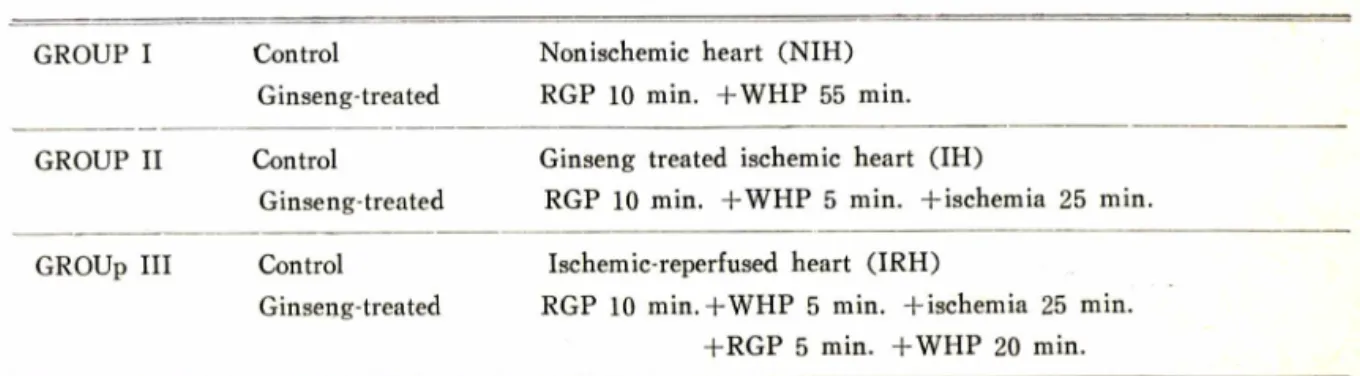
실험 군은 Table I 에서 와 같이 비 허 혈 심 장군 (N IH ), 허혈 심 장군(IH ) 그리고 허 혈 후 재 관류 한 심 장군 (IR H ) 등 3군으로 하고, 또 그 각 군 을 인삼 투여군과 대조군으로 나누었다. 인삼 투여 군은 인삼 에탄올 엑기스를 2차 증류수에 용해 하여 100mg/kg의 용량으로 1일 1회 10일간 , 2ml 씩 경구 투여 하였다.
1) 심 장의 관류一Neely44) 등에 의 한 방법 에 따 라 적 출 심 장 의 관류를 실시하였다. 심 장 적 출 2 시 간 전에 heparine sodium (2~ 3m g)을 복강내 주사하였다. Ether로 가볍게 마취시킨후 심장을 적출하여 빙냉한 Krebs-Henseleit bicarbonate 완 충 용액이 들어있는 petri-dish에 넣고 지 방 및
Table I —
Experimental groups
GROUP I Control Ginseng-treated
Nonischemic heart (NIH) RGP 10 min. +W HP 55 min.
GROUP II Control
Ginseng-treated
Ginseng treated ischemic heart (IH)
RGP 10 min. +W HP 5 min. + ischemia 25 min.
GROUp III Control Ginseng-treated
Ischemic-reperfused heart (IRH)
RGP 10 min.+WHP 5 min. + ischemia 25 min.
+RGP 5 min. +W HP 20 min.
Above abbreviations are used as follow; RGP, retrograde perfusion: WHP, working heart perfusion.
Vol 32t No.
i,
19887d
4 채•
집 나 牟결합조직을 제거하였다
. Stainless steel cannula
를 대동맥에 삽입하여 결찰한 다음Langendor
任 장치(Fig. 1
) 에 현수하였다.
관류액의 조성은N aCl 118mM, KC1 4 .7mM, CaCl2 3. OmM, M g S 0 4 • 7H20 1. 2mM, K H 2P 0 4 1. 2mM, Na- H C 0 3 25mM, N a2E D T A 0 .5mM, glucose 5.5 m M
로 하였다.
실험중 관류액에95% 0 2
〜5%
C 0 2
혼합가스를 계속 공급하여 포화시켰으며온도는 38 0C로 유지 시 켰 다. 관류액 은 glass filter
로 여과한 후peristatic pump
로 순환시켰다-
대동맥 압력은aortic bubble trap
을 심장에 서75cm
위에 장치하여 유지하였고,
좌심실 압 력은atrial bubble trap
을 심장에서10cm
위 에 장치하여 유지하였다. Retrograde perfusion
(RGP)
은 대동맥 압력으로 관류액을 대동맥
cannula
를통하여 유입하여 실시하였고, working heart perfusion(W H P)
은 대동맥 압력과 좌심실압력을 유지하고 대동맥
cannula
와 좌심실측cannula
를 모두 열어 심장운동에 의해 관류액이pressure chamber
로 유출되도록 하여 실사하였 다.
대동맥cannula
에 연결된tube
에pressure transducer
를 부착하여 대동맥cannula
를10
초동 안 막은 상태에서 압력변화와 심장박동수를「retrograde perfusion 10 min.
| working he art perfusion 5 min7 measurement pressure development and rate of contraction 10 sec.
, ischemia 25 min.
I retrograde perfusion 5 min.
I working heart perfusion 20 min.
measurement pressure developroont and rate of contraction 10 sec.
freezing heart with aluminum clamps precooled in liq u id nitrogen
tissue acid extraction for Alp and creatine phosphate assay
assay with atomic absorption spectrophotomoter
F ig . 1ᅳ
Perfusion apparatus for ischemic hearts.
Water jackets are indicated by black shading.
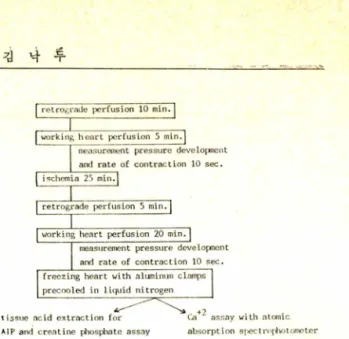
Fig. 2ᅳFlow scheme for the preparation of ischemic- reperfused heart samples.
physiograph (W ashington 400MD 4C) 로 측정 하 였다.
비허 혈 심 장군(N IH )은 다음과 같은 조작을 가하였다. 심장을 현수한 다음 아무런 외부자극 을 가하지 않은채 10분동안 R G P 을 하여 피를 제거하고 심장을 안정화 시켰다. 이 10분동안에 폐정맥을 통하여 cannula를 좌심실에 삽입하고 결찰하였다. 이때의 관상 혈류 유출 속도는 30.2 土0. lm l/m in g /g dry wt•이 었다. 그후 S5분 동 안 W H P 를 실시하였다.
허혈 심장군( I H ) 은 다음과 같은 조작을 가하 였다. R G P 을 10분동안 한 후 5분동안의 W H P 을 하고 좌심실과 대동맥 cannula를 모두 막은 상태 로 380C 에 서 25분동안 유지 하여 global ische- mia를 유발시켰다.
허 혈 후 재 관류한 심 장군 (IR H )은 Fig. 2와 같 이 허혈 심 장군과 같은 조작을 한 후 5분동안의 R G P을 하고 W H P 을 20분동안 실시하여 조작을 끝마치었다.
2) A T P 오 卜 creatine phosphate의 추출 및 정 량一(1) 추출一Williamson45) 등의 방법을 사용 하여 A T P 와 creatine phosphate를 추출하였다.
관류가 끝난 심장을 미리 액체 질소로 얼린 aluminum clamp로 신속하게 얼린후 ᅳ 60oC 냉 장고에 서 보관하였다. A T P 와 creatine phosphate 측정 에 는 이 심 장을 미 리 액체질소로 얼 린 mortar에서 분말로 한 후 이것을 dry ice에서
J . Pharm. Soc. Korea
허
4 ^
재4
류면:
흰쥐 실장에 미치는 인상의 설향 75frozen heart
pulverization in liq u id nitrogen- cooled crucibles
| powdered tissue
homogenization with 6 volumes of 8
%(v/v) HC10라 in 40 % (v/v) ethanol homogenate
centrifuge, 25,000g for 10 min. at 2°C supernatant
neutralization with 3 M in 0.5 M triethanolamine base
standing for 1 hr. in an ice bath removing the precipitate of KCIO^
neutralized acid extract
F ig.
3—Preparation of tissue acid extraction for the enzymatic determination of ATP and creatine hopsphate.
빙냉하여 평량한
10ml homogenizing tube
에 넣 었다.
이tube
의 무게를 평량한 후8 % (v /v ) HC10
4가 함유된4 0 % (v/v ) E tO H
을 조직g
당6
배의 용량을 가하여 균질화하였다.
이것을15ml
짜리 원심 분리용 시험관에 옮기고2°C,
25,000g
에서10
분동안 원심분리 하였다.
상등 액 일정량을 시험관으로 옮긴후 시험관을 계속 흔들어 주면서0 .5M triethanolamine
염이 함유 된3M K 2C 0
3로pH
를6
〜7
로하여 중화시켰다.
4°C
에서1
시간동안 방치한후 상등액을 시험용액으로 하였다
. Fig. 3
에 이 조작순서를 나타내 었다.
시험용액은 ᅳ20 °C
에서 정량하기전(2
일이 내)까지 보관하였다.
(2)
정량一Lamprecht461
등에 의한 방법으로A T P
와creatine phosphate
를 정량하였다. UV cell에 triethanolamine 완충용액 (50mM : pH 7. 5
〜7. 6) 2270///, N A D P
용액(10mM)
100사, M gC l
2용액( 0 .1M) 200
ᄍ/, glucose-6-phosphate dehydrogenase용액 (lm g protein/ml) 10ᄍ/,시
험용액
200
서/를혼화하고 홉광도가 일정하여지면
glucose
용액(0 .5M) 300
서/를 주입한 후 바 로 홉광도( E 0
룰340nm
에서 측정하였다.
그후30초 이내에 hexokinase용액 (2mg protein/ml) 20/났를 넣고 15분후에 흡 광도(E 2) 롤 측정하였
다
.
그후A D P
용액(22m M ) 20/^
를 넣고 홉광도가 일정해질 때까지 기다려 홉광도
(E 3)
를 측정하였다
. Creatine kinase
용액© m g protein/m l) 10
ᄍ/롤 넣고15
분후에 홉광도(E
4) 를 측정하였 다.
의 값을A T P
에 의한 홉광도, E 4-E3
의 값을creatine phosphate
에 의한 흡광도로 하 여계산하였다.
3) 심근내 총 Ca+2량의 정량
一Dolara 등 47, 48>
의 방법을 사용하여 심근내 총
Ca
+2량을 측정하
였다. 2
) 의(1)
추출시의 심장분말을12
시간동 안110°C oven
에서 건조한 후hood
내에서 건조g
당 약10
배량의 농후H N 0 3
를 가하여 조직을digestion
시키고 또10
배량의 농후HC1
을 가하 였다.
이 염산 용액을 가열하여 완전히 건조시 켜chloride
염형태인Ca+2
을얻었다.
이것을1%
LaCl3
가 함유된5% HC1
용액에 녹 여atomic absorption spectrophotometer (Tokyo Photo E le
ctric Co., Ltd. Japan. Model A N A -180)
로Ca+2
량을 정량하였다.
4) 통계처리_
두 군간의 유의성 검정은2-tail probability t-test
로써 하였다.
실 험 결 과
인삼이 C ard iac fu n c t io n 에 미치는 영 향 ᅳ Cardiac function
은 관류초기15
분후에 측정한 대동맥 수축기 최대 압력과 그때의 심박율을 곱 한 값을 기준으로 하여,
관류가 완전히 끝난때 인65
분후에 측정한 값을 % 로 나타내었다.
인삼 처리군과 대조군 각군에 대하여 비허혈 심장군
( N IH )
과 허혈후 재관류한 심장군( I R H )
의cardiac function
을 비교하면Fig. 4
와 같다.
N IH
군에서는cardiac function
이87. 3 ± 1 1 .1 %
이었으며,IR H
군에서는2 8 .1 ± 5 .0 %
로I R H
군 의cardiac function
은N IH
군의32%
의 값을 나 타내었다.
인삼처치한N IH
군에서의cardiac function
은8 6 .1± 8
.\%,IR H
군에서는30. 9± 4 . 0
% 로 각군에 대하여 인삼 처치군과 대조군의 유 의성 있는
cardiac function
변화를 보이지 않았다
.
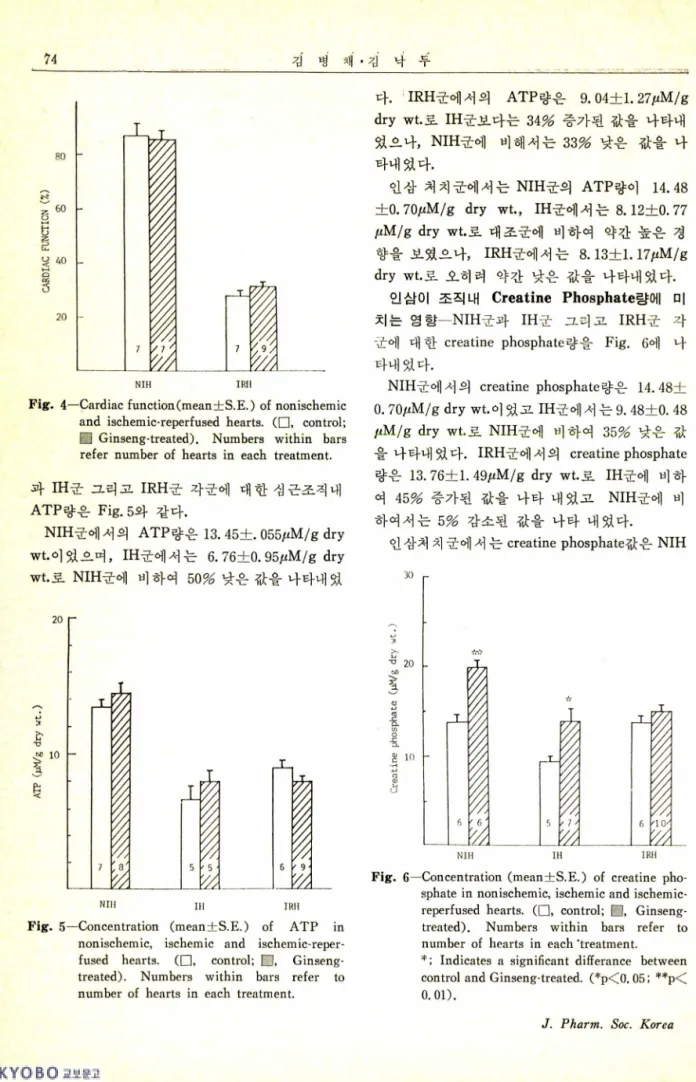
인삼이 조직내 A T P 량에 미치는 영향一N IH 군
Vol. 32, No. 1, 198874
김*
병'
채'
•년 나 羊NIH IRH
F ig .
4—Cardiac function (mean ± S.E.) of nonischemic and ischemic-reperfused hearts. (□, control;
國 Ginseng-treated). Numbers within bars refer number of hearts in each treatment.
과
IH
군 그리고IR H
군 각군에 대한심근조직내A T P
량은Fig. 5
와 같다.
N I H군에서의
A T P
량은13. 45土.
055ᄍM / gdry wt.
이었으며,IH
군에서는 6 . 76土0 .
95juM /gdry w t
•로 N I H군에 비하여 50% 낮은값을나타내었TRH
F ig .5—Concentration (mean士S.E.) of ATP in
nonischemic, ischemic and ischemic-reper
fused hearts. (□, control; 國, Ginseng- treated). Numbers within bars refer to number of hearts in each treatment.
다
. IR H
군에서의A T P
량은9. 04
土1. 27>M/g dry w t.
로IH
군보다는34%
증가된 값을 나타내 었으나,N IH
군에 비해서는33%
낮은 값을 나 타내었다.
인삼 처치군에서는
N IH
군의A T P
량이14.48
± 0 .7 0
;«M /g dry wt., IH
군에서는8 . 12
土0. 77
셔M /g dry w t
.로 대조군에 비하여 약간 높은 경 향을 보였으나, IR H
군에서는8 . 13
土L 17/xM/g dry wt
•로 오히려 약간 낮은 값을 나타내었다.
인삼이 조직내
Creatine Phosphate
량에 미 치는 영향一N IH
군과IH
군 그리고IR H
군 각 군에 대한creatine phosphate
량을Fig. 6
에 나 타내었다.
N IH
군에서의creatine phosphate
량은14. 48
土0. 70
;wM/g dry wt
•이었고IH
군에서는9. 48
土0. 48 ftM/g dry wt
•로N IH
군에 비하여35%
낮은 값 을나타내었다. IR H
군에서의creatine phosphate
량은13. 76±1. 49
ᄍM /g dry wt
•로IH
군에 비하 여45%
증가된 값을 나타 내었고N IH
군에 비 하여서는5%
감소된 값을 나타 내었다.
인삼처치군에서는
creatine phosphate
값은N IH
20
•g. 03
NIH IH IRH
Fig. 6—Concentration (mean士S.E.) of creatine pho
sphate in nonischemic, ischemic and ischemic- reperfused hearts. (□,control; 國,Ginseng- treated) . Numbers within bars refer to number of hearts in each .treatment.
* ; Indicates a significant differance between control and Ginseng-treated. (*p<0. 05 ; **p<
0
.
01).
J. Pharm, Soc. Korea
군이
19. 92±0. 73//M/g dry wt•
로 대조군에 비 하여 유의성 있는45%
높은값을 나타내었으며, IH
군에서는13. 98±1. 33//M/g dry w t
•로대조군에 비하여 유의성 있는
47%
높은 값을 나타내었다
.
IR H
군에서의creatine phosphate
값도15. 12
土2. 03/<M/g dry w t
•로 대조군에 비하여10%
높 은 값을 나타내었으나 유의성은 없었다.
인삼이 심근내 총
C a
+2량에미치는 영향ᅳN IH
군과IH
군ᅳ그리고IR H
군 각군可 대한 심근내Ca+2
량은Fig. 7
과 같다.
N IH
군에서의Ca+2
량은6. 35±0. 39j«M/g dry wt.
이었다. IH
군에서의Ca+2
량은4.82±0. 45
ᄍM /g dry w t
로N IH
군에 비하여24%
낮은 값 을 나타내었다. IR H
군에서의Ca+2
량은9. 09
土0. 87>M/g dry w t.
로N IH
■군에비하여서는43%
높은 값을
IH
군에 비하여서는89%
높은 값을 나타내었다.
인삼처치군에서의
Ca+2
량은N IH
군에서5.78
±0. 25j«M/g dry wt., IH
군에서는5. 42±0. 29 juM/g dry wt.
그리고IR H
군에서는10. 06
土0. 71
ᄍM /g dry wt
•로 대조군과 유의성 있는 변화를 나타내지 않았다.
Fig. 7—Myocardial Ca+2 contents (mean士S.E.) in nonischemic, ischemic and ischemic-reperf- used hearts. (□ ,control; ■,Ginseng-tre
ated). Numbers within bars refer to number of hearts in each treatment.
고 찰
적출 심장을 허혈후 재관류 시켰을 때 나타나 는 세포손상을 일으키는 기전은 그 요인들이 많 고 또 서로 연관되어 있어 명확히 밝혀져 있지 않으나
,
저농도(<50/xM
) 의Ca
+2이온을 함유하 는 영양액을 수분간 관류시킨 후 정상농도의Ca
+2이온을 함유하는 액을 관류시켰을 때 나타 나는“Calcium Paradox” 10, 49)
라는 현상에서의 많 은 점들이 일치한다.
K ram er^
등은 허혈후 재관류시 허혈시간이심근 수축력과 세포손상정도를 결정한다고 보고 하였다
.
또한Langer
5» 등은 허혈시간이 심근세 포에서의Ca
+2이온의 유출량과 세포막 주위에서 의Ca
+2이온의 유출량정도를 결정하며, 재관류 시의Ca
+2이온의 유입량도 결정한다고 보고하였 다. Hearse521
등에 의하면 허혈후 재관류시1
〜2.5m M
의Ca
+2이온을 함유하는관류액을 관류시 키면 완전한calcium paradox
를 일으키는데 이때 의 실험 재현성이 가장좋다고 보고하였다.
본 실험에서는 재현성을 높이기 위하여 관류 액중의
Ca
+2이온 농도를 심근 세포내 유리Ca+2
이온 농도의2
배인2. 5m M
로 하였고 허혈시간은 회복될 수 없는 완전한 세포손상 정도를 나타내 는25
〜30% cardiac function
을 갖는 시간인25
분으로 하였다.
또 재관류 시간도 심근 세포내
Ca
+2이온 축적 시간곡선이 포화를 이루는25
분15,16)으로 하였 다. Ca
+2이온의 양은 세포내 유리Ca
+2이온량으 로 나타내어야 그것이 지니는 생리적 의의가 크 나,기존의Tomlinson53, 541
등에 의한 수지처리Ca
+2정량법은 세포의 분획을 완전히 제거하지못하며
A T P
량 등의 에너지 파괴를 가져오므로A T P
와Ca
+2이온의 동시 정량이 불가능하다.
또 한 심근내 총Ca+2
량으로도calcium paradox
현 상을 관찰할 수 있으므로 본 논문에서는 심근내Ca+2
량으로 보고하였다.
인삼은 장기 연용시 심근 수축력과 심근내
A T P
량에는 별 영향이 없었으나 심근내creatine phosphate
농도를 증가시키는효과가관찰되었다.
^
혈 및 재관류한 흰쥐 ^장 에 미치는 인삼의^
향 ᅳ75
8 4
{ 3J
cji -o Oo/ H il. ) J cau
n^J -H -a t-l so/ c z.
C+J
Vol.
52
,No. h 1988이는
Lee55)
등이 보고한 마우스에 인삼 추출물 을4
주간 투여(10mg/day
) 하였을때 인삼투여군 에서 인삼 비투여군 보다 심근 조직내creatine
phosphate
량이 현저히 증가하였던 결과와 일치한다
.
인삼이 심근내
creatine phosphate
량과 심근내Ca
+2이온의 량에 미치는 효과를 보면creatine phosphate
값은 인삼의 장기연용으로정상군에서 보다 증가된 상태를 나타내었으며 허혈을 시킬 때 민삼투여군에서도대조군과비례하여creatine
phosphate
량이 감소되기는 하나 허혈시킨 대조군에서 보다 유의성 있는 높은 값을 유지하고 있었다
.
한편 심근내Ca
+2이온량은 허혈로 인하 여 감소되었으나 인삼처치군에서는 비허혈군과 유사한 값을 유지하고 있었다.
이는 인삼투여로 인하여creatine phosphate
값이 높아 있기 때문 에 허혈을 시킨때에도 심장기능 유지에 필요한 에너지를 유지하고 있다고 보며 또한Ca
+2이온 량도 비허혈시와 같은 농도를 유지하고 있기때 문에 심기능을 유지하고 있다고추측할수있다.
그러나 허혈후 재관류시에는 대조군에서와 마 찬가지로 심기능이 억제되어
creatine phosphate
량과Ca
+2이온량 모두가대조군에서와같은수준 을 유지하고 있었다.
이상의 결과를 종합하여 보면 본 실험 모델에 서 인삼은 허혈후 재관류시 즉 심기능이 심히 억제된 상태에서는 효과를 나타내지 못하나 심 기능이 심히 억제되지 않은 허혈 상태에서는 심 근내에서 고에너지를 보유함으로써 심기능을 정 상상태로 유지하려는 예방효과를 나타내는 것으 로 사료된다
.
결 론
허혈 및 재관류 함으로써 심부전을 일으키는 모델을 사용하여 인삼이 심기능에 미치는 효과 를 관찰하였다
.
인삼을10
알간100mg/kg
단위로rat
에 경구 투여한 후 심장을 적출하고Langen
dorff
장치를 사용하여 비허혈 심장군(N IH
) 과 허혈심장군
(IH )
그리고 허혈후 재관류한 심장군(IR H
) 를 만들았다.
이3
개군에서 인삼처리군과인삼 비처치군의
cardiac function
과심근내A T P
농도,
심근내creatine phosphate
농도 및 심근내Ca
+2이온량을 비교 측정하였다.
그 결과는 다음 과 같다.
1) cardiac function
은N IH
군에 비하여IR H
군 에서60%
억제 효과가 있었다.
심근A T P
농도 는N IH
군에 비하여IH
군에서는50%
감소가나 타났으며 다시 재관류한IR H
군에서는IH
군에 비하여33
%의증가를 나타내었다.
심근creatine phosphate
량은N IH
군을 기준으로IH
군에서는31%
감소하였으나,IR H
군에서는 완전히 회복 되었다.
심근Ca
+2량은N IH
군에 비하여IH
군에 서는24%
감소 하였다.
2)
인삼투여시cardiac function
은 대조군과별 차이가 없었다.
심근A T P
농도는 대조군에 비해N IH
군과IH
군에서 높은 값을, IR H
군에서는낮 은 값을 나타내었으나 유의성 있는 차이는 없었 다.
심근creatine phosphate
량은 대조군에 비하 여N IH
군에서45%
,IH
군에서는47
%의유의성 있는 높은 값을 나타내었고,IR H
군에서는10%
높았으나 유의성은 없었다
.
심근Ca
+2량은 대조 군과 차이는 없었으나 허혈로 인한 감소현상이 관찰되지 않았다.
이상의 결과로 보아 본 실험 모델에서 인삼은 허혈후 재관류시의 심근에는 별 영향이 없으나,
허혈시에는 심근의 에너지대사에 영향을주어 보 호작용을 나타내는 것으로 사료된다
.
감사의 말씀
: 1987
년도 서울대학교병원 특진 연구비 보조로 이루어진것임.
문 헌
1) Ganote, C.E., Liu, S.Y., Safavi, S. and Kaltem- bach, J.D.: Anoxia, calcium and contracture as mediators of myocardial enzyme release.
J. Mol.Cell. Cardiol.
13, 93 (1981).
2) Ganote, C.E., Seabra-Gomes, R., Nayler, W.G.
and Jennings, R.B.: Irreversible myocardial injury in anoxic perfused rat hearts.
Am. J.Pathol.
80,419 (1975).
3) Sakai, K.,Gebhard, M.M.,Spieckerman, P.G.
and Bretschneider, H.J.: Enzyme release resulting
J. Pharm. Soc. Korea허혈 및 재관류한 횐쥐 심장에 미치는 인삼의 영향
77 from total ischemia and reperfusion in the
isolated, perfused guinea pig heart.
J. Mol. Cell.Cardiol.
7, 827 (1975).
4) Hearse, D.J., Humphrey, S.M. and Bullock, G.R.:
The oxygen paradox and the calcium paradox:
Two facets of the same problem.
J. Mol. Cell.Cardiol
10, 641 (1978).
5) Henry, P.D., Shuchleib, R .,Davis, J., Weiss, E.S. and Sobel, B.E.: Myocardial contracture and accumulation of mitochondrial calcium in ischemic rabbit heart.
Am. J . Physiol.233,H677 (1977).
6) Muir, A.R.: A calcium-induced contracture of cardiac muscle cells.
J. Anat.102, 148 (1968).
7) Yates, J.C. and Dhalla, N.S.: Structural and functional changes associated with failure and recovery of hearts after perfusion with Ca+2 free medium.
J. Mol. Cell. Cardiol.7, 91 (1975).
8) Frank, J.S. and Rich, T.L.: Ca+2 depletion and repletion in the heart: Age-dependent changes in the sarcolemma.
Am. J. Physiol.245, 11343 (1983).
9) Ruigrok, T.J.C., Boink, A.B., Slade, A., Zimm
erman, A.N.E., Meijler, F.L. and Nayler, W.G.:
The effect of verapamil on the calcium paradox.
Am. J. Pathol.
98, 769 (1980).
10) Zimmerman, A.N.E. and Hulsmann, W.G.:
Paradoxical influence of calcium ions on the permeability of the cell membrances of the isolated rat heart.
Nature211, 646 (1966).
11) Hearse, D.J., Baker, J.E. and Humphrey, S.M.:
Verapamil and the calcium paradox.
J. Mol. Cell.Cardiol
12, 733 (1980).
12) Watts, J.A., Koch, C.D. and LaNoue, K.F.: Low Ca+2 reperfusion of ischemic rat hearts.
Federation Proc.38,976 (1979).
13) Reibel, D.K. and Rovetto, M.J.: Myocardial ATP synthesis and mechanical function following oxygen deficiency.
Am. J. Physiol.234, H620 (1978).
14) Crevey, B.J., Langer, G.A. and Frank, J.S.:
Role of Ca+2 in the maintenance of rabbit myocardial cell membrane structural and function integrity.
J. Mol. Cell. Cardiol.10,1081 (1978).
15) Alto, L.E. and Dhalla, N.S.: Myocardial cation
contents during induction of calcium paradox.
Am. J . Physiol.
237, tt713 (1979).
16) Nayler, W.G. and Grinwald, P.M.: The effect of verapamil on calcium accumulation during the calcium paradox.
J. Mol. Cell. Cardiol.13,435 (1981).
17) Shen, A.C. and Jennings, R.B.: Myocardial calcium and magnesium in acute ischemic injury.
Am. J . Pathol.
67, 417 (1972).
18) Watt, J.A., Koch, C.D. and LaNoue, K.F.: Effect of Ca+2 and heart function after ischemia.
Am.J. Physiol.
238, H909 (1980).
19) Nishioka, K. and Jarmakani, J.M.: Effect of ischemia on mechanical function and high energy phosphate in rabbit myocardium.
Am. J . Physiol.242, H1077 (1982).
20) Ohhara, H .,Kanaide, H.,Yoshimura, R .,Okada, M. and Nakamura, M.: A protective effect of coenzyme Q10 on ischemia and reperfusion of the isolated rat heart.
J. Mol. Cell. Cardiol.13. 65 (1981).
21) Vary, T.C., Angelakos, E.T. and Schaffer, S.W.:
Relationship between adenine nucleotide metabo
lism and irreversible tissue damage in isolated perfused rat heart.
Cir. Res.45, 218 (1979).
22) Swain, J.L., Sabina, R.L. and McHale, P.A.:
Prolonged myocardial nucleotide depletion after brief ischemia in the open-chest dog.
Am. J.Physiol.
242,H818 (1972).
23) Kloner, R.A., DeBoer, W.U. and Darsee, J.R.:
Prolonged abnormalities of myocardium salvaged by reperfusion.
Am. J. Physiol.241, H591 (1981).
24) Dobbs, W .A., Richard, E.M. and Rousou, J.H.:
Residual metabolism of the hypothermic arrested pig heart.
J. Surg. Res.31,319 (1981).
25) Paratt, J.R. and Marshall, R.J.: The response of isolated cardiac muscle to acute anoxia: Protective effect of adenosine triphosphate and creatine phosphate.
J . Pharm. Pharmacol.26, 427 (1973).
26) Hearse, D.J., Stewart, D.A. and Brimbridge, M.V.: Myocardial protection during bypass and arrest.
J . Thorac. Cardiovasc. Surg.72, 88Q (1976).
Vol. 32’ No. 1,1988
78
김 병 채 • 김 낙 두27) Reimer, K.A., Jennings, R.B. and Hill, M.L.:
Total ischemia in dog hearts,
in vitro:I I ,High energy phosphate depletion and associated defects in energy metabolism, cell volume regulation, and sarcolemmal integrity.
Circ. Res.49, 901
(1981).
28) Katz, A.M.: The contractile proteins of the heart.
Physiol. Rev.
50,63 (1970).
29) Shen, A.C. and Jennings, R.B.: Kinetics of calcium accumulation in acute myocardial ischemic injury.
Am. J . Pathol.67,441 (1972).
30) Narita, H., Nagao, T., Sato, M., Nakajima, H.
and Kiyomoto, A.: Ischemia-reperfusion induced elevation of diastolic tension in the isolated guinea pig heart and the effects of calcium antagonists.
Jpn. Heart. J.
24,277 (1983).
31) Bush, L.R., Li, R-P.,Shlafer, M.,Jolly, S.R.
and Lucchesi, B.R.: Protective effects of diltiazem during myocardial ischemia in isolated cat hearts.
J . Pharmacol. Exp. Ther.
218,653 (1981).
32) Nagao, T.,Matrib, M.A., Franklin, D., Millard, R.W. and Schwartz, A.: Effects of diltiazem, calcium antagonist on regional myocardial fun
ction and mitochondria after brief coronary occulusion.
J. Mol. Cell. Cardiol.12,29 (1980).
33) Jolly, S.R., Menahan, L.A. and Gross, G.L.:
Diltiazem in myocardial recovery from global ischemia and reperfusion.
J. Mol. Cell. Cardiol.13, 359 (1981).
34) Zamanis, A., Verdetti, J. and deleiris, J.: Red
uction of ischemia-induced myocardial necrosis in the rat with permanent coronary artery occulusion under the effect of diltiazem.
J. Mol. Cell.Cardiol
14,53 (1982).
35) Follette, D.M., K.H., Liversay, J.J., Nelson, R.
L., Maloney, J.V. and Buckberg, G.D.: Citrate reperfusion of ischemic heart in cardiopulmonary bypass.
Forum.27, 244 (1976).
36) Shine, K.I., Douglas, A.M. and Ricchiuti, N.V.:
Calcium, strontium and barium movements during ischemia and reperfusion in rabbit ventricle.
Circ.Res.
43, 712 (1978).
37) Fleckenstein, A.: Specific pharmacology of calcium in myocardium, cardiac pacemakers, and vascular
smooth muscle.
Annu. Rev. Pharmacol.17, 149
(1977).38) Reimer, K.A., Lowe, J.E. and Jennings, R.B.:
Effect of the calcium antagonist verapamil on necrosis following temporary coronary artery occlusion in dogs.
Circulation55, 581 (1977).
39) Brekhman, 1.1, and Dardymov, I.V.: New subst
ances of plant origin with increase nonspecific resistance.
Ann. Rev. Pharmacol.9, 419 (1969).
40) 김 낙두, 김봉기,이혜선 : 흰쥐 심 장의 수축력에 미 치는 인삼성분의 효과,약학회지, 26,239 (1982).
41) 오우택 , 김 낙두 : 인삼이 심 장 수축력 과 소포체 기 능에 미치는 영향(제 1보). 약학회지, 27, 155 (1983).
42) 신원, 김낙두,오우택,고광호 : 인삼을 경구투여 한 흰쥐 심장근의 수축력 퇴화율 억제에 미치는 작 용기전 연구. 약학회지,29,217 (1985).
43) Sung, B.Y. and Kim, N.D.: The effect of Ginseng on heart contration and sarcoplasmic reticulum function ( Jl ) ; The effect of Ginseng on 45CaH 2 uptake by sarcoplasmic reticulum fragments of rat heart.
Arch. Pharm. Res.6,69 (1983).
44) Neely, J.R. and Rovetto, M.J.: Techeniques for perfusing isolated rat hearts.
Methods in Enzymology.edited by Hardman, J.G., O’Malley, B.W. New York, Academic. 39,43 (1975).
45) Williamson, J.R. and Corkey, B.E.: Assays of intermediates of the citric acid cycle and related compounds of fluorometric enzyme methods.:
Methods in Enzymology,
edited by Louvenstein, J.M. New York, Academic, 13, 434 (1969).
46) Lamprecht, W .,Stern, P., Heinz, F. and Weisser, H.: Creatine phosphate, determination with creatine kinase, hexokinase and glucose-6- phosphate dehydrogenase.:
Methods of Enzymatic Analysis,
edited by Bergmeyer, H.U. New York, Academic Press. 4, 1777 (1974).
47) Dolara, P., Agresti, A., Giotti, A. and Pasquini, G.: Effect of taurine on calcium kinetics of guinea-pig heart. Eur. J.
Pharmacol.24, 352
(1973).48) Franoni, F.,Martini, F., Stendardi, I., Matucci, R., Zilletti, L. and Giotti, A.: Effect of taurine on calcium levels and contractility in guinea-pig
J. Pharm
,
Soc. Korea허혈 및 재관류한 횐쥐 심장에 미치는 인삼의 영향
79 ventricular strips.
Biochem. Pharmacol.31,3181
(1982).
49) Zimmerman, A.N.E., Daems, W., Hulsmann, W.C., Snijder, J., Wisse, E. and Durrer, D.:
Morphological changes of heart muscle caused by successive perfusion with calcium-free and calcium-containing solutions (calcium paradox).
Cardiovasc. Res.
1, 201 (1967).
50) Kramer, J.H., Chovan, J.P. and Schaffer, S.W.:
Effect of taurine on calcium paradox and ischemic heart failure.
Am. J . Physiol.240,H238 (1981).
51) Langer, G.A.: Structure and function of the myocardial surface.
Am. J . Physiol.235,H461 (1978).
52) Hearse, D.J., Humpherey, S.M. and Bullock, G.R.: Reoxygenation, reperfusion and the calcium paradox; Studies of cellular damage and enzyme
release.:
Enzyme in Cardiology,edited by Hearse, D.J. Wiley & Sons, Chichester. 417 (1978).
53) Tomlinson, C.W. and Dhalla, N.S.: Myocardial contractility II. Effect of changes in cardiac function on the cellular distribution of calcium in the isolated rat heart.
Can. J . Physiol.Pharmacol.
50,853 (1972).
54) Tomlinson, C.W. and Dhalla, N.S.: Excitation- contraction coupling in heart. IX. changes in the intracellular stores of calcium in failing hearts due to substrate lack and oxygen.
Cardiovas. Res.8, 470 (1973).
55) Lee, H.J.’ Hahn, T.R. and Kim, S.J.: Biochemical and pharmacological study on the bioactive principles of Panax Ginseng.
Korean Biochem.J- 12, 91 (1979).
Vol. 32