eISSN 2287-1683 pISSN 1738-8767 Journal of Trauma and Injury Vol. 29, No. 4, December, 2016 http://dx.doi.org/10.20408/jti.2016.29.4.155
� Original Article �
� Address for Correspondence : Byungchul Yoo, M.D.
Department of Trauma Surgery, Gachon University, Gil Medical Center, 774 beon-gil Namdong-daero, Namdong-gu, Incheon 21565, Korea
Tel : 82-32-460-3010, Fax : 82-32-460-2372, E-mail : [email protected]
Submitted : December 5, 2016 Revised : December 10, 2016 Accepted : February 10, 2017
Characteristics of Korean Trauma Patients: A Single-center Analysis Using the Korea Trauma Database
Youngeun Park, M.D., Min Chung, M.D., Gil Jae Lee, M.D., Min A Lee, M.D., Jae Jeong Park, M.D., Kang Kook Choi, M.D., Sung Youl Hyun, M.D., Yang Bin Jeon, M.D.,
Dae Sung Ma, M.D., Yong-Cheol Yoon, M.D, Jungnam Lee, M.D., Byungchul Yoo, M.D.
Department of Trauma Surgery, Gachon University, Gil Medical Center, Incheon, Korea
Purpose: Two years have passed since a level I trauma center was officially opened in the Gacheon Gil Hospital, South Korea. We analyzed 2014 and 2015 registered patient data from the Korean Trauma Data Base (KTDB) to identify trends in trauma patient care and factors that influence the quality of trauma care at the Gacheon Gil trauma center.
Methods: Data was extracted from the KTDB included patient age, sex, systolic blood pressure at emergency room arrival, revised trauma score, injury severity score, trauma injury severity score, transfusion amount, and the cause of death was analyzed.
Results: A total of 3269 trauma patients were admitted to our trauma center in 2014 and 3225 in 2015.
Demographics and mechanism of injury were not significantly different between years. The severity of trauma injury was decreased in 2015 although the mortality rate was slightly increased. This requires further analysis.
Conclusion: The aim of this study was to determine the general status and trends in trauma incidence and manage- ment outcomes for the Incheon area. We noted no significant changes in trauma status from 2014 to 2015. We need to collect and review trauma patient data over a long period in order to elucidate trauma incidence and management trends in the trauma field. Finally, studies using trauma patient data will indicate appropriate quality control factors for trauma care and help to improve the quality of trauma management. [ J Trauma Inj 2016; 29: 155-160 ]
Key Words: Trauma center, Outcome, Quality control, Korean Trauma Data Base
Table 1. Overview of patients registered in the Korean Trauma Data Base in 2014 to 2015
Total ISS>15*
2014 2015 2014 2015
Admission (n) 3269 0322 0511 0472
Blunt, n (%) 2973 (90.9) 2885 (89.5) 494 (96.7) 460 (97.5)
Penetrating, n (%) 0246 (07.5) 0305 (09.5) 011 (02.2) 009 (01.9)
Burn, n (%) 0032 (01.0) 0028 (00.9) 003 (00.6) 003 (00.6)
Others, n (%) 0018 (00.6) 0007 (00.2) 003 (00.6) 0
Male, n (%) 2105 (64.4) 2113 (65.5) 367 (71.8) 352 (74.6)
Age, median (IQR) 49 (31-63) 50 (31-64) 53 (40-65) 53 (38-64)
* Excluding DOA/CPR cases.
Table 2. Injury severity of trauma patients in 2014 to 2015
Youngeun Park, et al. Characteristics of Korean Trauma Patients: A Single-center Analysis Using the Korea Trauma Database
Table 3. Mortality of trauma patients in 2014 to 2015
Total ISS>15*
2014 2015 2014 2015
Mortality, n (%) 138 (4.2) 160 (4.9) 75 (14.7) 70 (14.8)
Death on arrival (DOA) 006 (0.2) 016 (0.5)
Death after CPR (DOA) 33 (1). 045 (1.4)
Death after CPR (nonDOA) 012 (0.4) 013 (0.4)
Death after admission 087 (2.7) 086 (2.7)
* Excluding DOA/CPR cases.
Table 4. Case fatality according to ISS severity Case fatality n (%)
ISS 2014 2015
1-8 07 (0.4) 14 (00.6)
9-15 04 (0.5) 01 (00.3)
16-24 27 (8.7) 29 (08.6)
25 48 (24). 41 (23.6)
Total* 86 (2.7) 85 (02.7)
* Excluding DOA/CPR cases.
Fig. 1. Case fatality according to ISS severity.
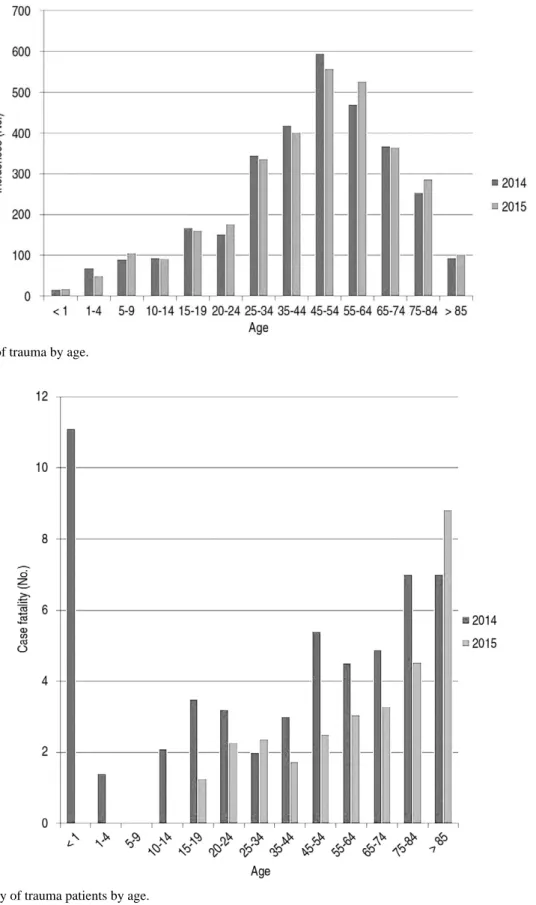
Fig. 2. Incidence of trauma by age.
Youngeun Park, et al. Characteristics of Korean Trauma Patients: A Single-center Analysis Using the Korea Trauma Database
Table 5. Patient injury mechanisms (2014 n=3269, 2015 n=3225)
No. of Patients, N (%) Case fatality, N (%)
Injury Mechanism 2014 2015 2014 2015
Motor vehicle collision 631 (19.3) 598 (18.8) 37 (05.9) 26 (04.3)
Traffic accident, pedal cyclist 130 (04.0) 169 (05.3) 05 (03.8) 01 (00.6)
Traffic accident, motorbike 203 (06.2) 222 (7)00. 12 (05.9) 07 (03.2)
Traffic accident, trains 028 (00.9) 036 (01.1) 03 (10.7) 04 (11.1)
Traffic accident, unknown 012 (00.4) 1 (0). 02 (16.7) 0
Fall 501 (15.3) 679 (21.4) 25 (5)00. 16 (02.4)
Slip down 878 (26.9) 582 (18.3) 21 (02.4) 09 (01.5)
Struck by, against 324 (09.9) 312 (09.8) 03 (00.9) 04 (01.3)
Gunshot 1 (0). 0 0 0
Stab 242 (07.4) 269 (08.5) 07 (02.9) 03 (01.1)
Machinery 078 (02.4) 076 (02.4) 0 0
Drowning 004 (00.1) 004 (00.1) 1 (25). 1 (25).
Suffocation 020 (00.6) 026 (00.8) 10 (50)0. 05 (19.2)
Other specified 107 (03.3) 117 (03.7) 02 (01.9) 0
Not elsewhere classifiable 110 (03.4) 087 (02.7) 09 (08.2) 09 (10.3)
REFERENCES
01) Korea S. 2011 Result on the cause of death statistics. Statistics Korea.
02) K Park, JS Lee, Y Kim, YI Kim, I Kim. The Socioeconomic Cost of Injuries in South Korea. J Prev Med Public Health 2009; 42: 5-11.
03) KY Jung, JS Kim, Y Kim. Problems in Trauma Care and Preventable Deaths. J Korean Soc Emerg Med 2001; 12: 45- 56.
04) H Kim ,KY Jung, SP Kim, SH Kim, HY Jang, HD Yoon, YJ Heo. Changes in Preventable Death Rates and Traumatic Care Systems in Korea. J Kor Soc Emerg Med 2012; 23: 189-97.
05) Available at: http://www.nemc.go.kr/. Assessed June 10, 2009.
06) Moore L, Clark DE. The value of trauma registries. Injury 2008; 39: 686-95.
07) Tohira H, Jacobs I, Mountain D, Gibson N, Yeo A.
International comparison of regional trauma registries. Injury 2012; 43: 1924-30.
08) Nance M. National trauma data bank-annual report. NTDB annual report. 2014.
09) Sakamoto T. Japan trauma data bank report 2009-2013.
2014;JTDB 2014 annual report.
10) BC Yoo, M Chung, GJ Lee, at al. Analysis of KTDB regis- tered trauma patients from a single trauma center in Korea. J trauma and injury 2015; 8: 87-221.
11) Lossius HM, Langhelle A, Eldar S, Pillgram-Larsen J, Lossius TA, Laake P, et al. Reporting data following major trauma and
analysing factors associated with outcome using the new Utstein style recommendations. Resuscitation 2001; 50: 263-72.
12) Dick W, Baskett P. Recommendations for uniform reporting of data following major trauma-the Utstein style: a report of a working party of the International Trauma Anaesthesia and Critical Care Society (ITACCS). Resuscitation 1999; 42: 81-100.
13) Cottington EM, Young JC, Shufflebarger CM, Kyes F, Peterson JR FV, Diamond DL. The utility of physiological status, injury site, and injury mechanism in identifying patients with major trauma. Journal of Trauma and Acute Care Surgery 1988; 28: 305-11.
14) Palmer C, ed. Major Trauma and the Injury Severity Score- Where Should We Set the Bar? Annual Proceedings/Association for the Advancement of Automotive Medicine;2007: Association for the Advancement of Automotive Medicine.
15) Demetriades D, Martin M, Salim A, Rhee P, Brown C, Chan L. The effect of trauma center designation and trauma volume on outcome in specific severe injuries. Annals of surgery 2005; 242: 512.
16) MacKenzie EJ, Rivara FP, Jurkovich GJ, Nathens AB, Frey KP, Egleston BL, et al. A national evaluation of the effect of trauma-center care on mortality. New England Journal of Medicine 2006; 354: 366-78.
17) Demetriades D, Martin M, Salim A, Rhee P, Brown C, Doucet J, et al. Relationship between American College of Surgeons trauma center designation and mortality in patients with severe trauma (injury severity score > 15). Journal of the American College of Surgeons 2006; 202: 212-5.
18) Mains C, Scarborough K, Bar-Or R, Hawkes A, Huber J, Bourg P, et al. Staff commitment to trauma care improves mortality and length of stay at a level I trauma center. Journal of Trauma and Acute Care Surgery 2009; 66: 1315-20.