Vol. 30, No. 1, March, 2017 http://dx.doi.org/10.20408/jti.2017.30.1.6
� Address for Correspondence : Byung Chul Yoo, M.D.
Department of Surgery, Gachon University, Gil Medical Center, 774 beon-gil Namdong-daero, Namdong-gu, Incheon 21565, Korea
Tel : 82-32-460-3244, Fax : 82-32-460-3247, E-mail : [email protected] Submitted : November 9, 2016 Revised : February 13, 2017 Accepted : March 1, 2017
The Impact of Trauma Center Establishment on Laparotomy Patterns and Outcomes in Severe Hemoperitoneum Patients
Min A Lee, M.D., Jungnam Lee, M.D., Min Chung, M.D., Giljae Lee, M.D., Jaejeong Park, M.D., Kangkook Choi, M.D., Byung Chul Yoo, M.D.
Department of Surgery, Gil Medical Center, Gachon University, Incheon, Korea
Purpose: The establishment of the trauma system has changed the quality of trauma care in many countries. As one of the first designated level I trauma centers in Korea, we hypothesized that there were changes in laparotomy patterns and subsequent survival rates after the center was established.
Methods: This was a 5-year retrospective study of all severe hemoperitoneum patients who were transfused with more than 10 units of packed red blood cells (RBCs) within 24 h of hospitalization. Variables related to trauma were collected throughout the study period, and the patients admitted before (period 1) and after (period 2) the establish- ment of a trauma center were compared.
Results: Forty-five patients were managed from January 2009 to March 2015. The baseline patient characteristics of the two groups, including age, Injury Severity Score, blood pressure, and hemoglobin levels, were similar. The time to the operating room (OR) was 144.3±51.5 min (period 1) and 79.9±44.1 min (period 2) (p<0.0001). Damage control surgery (DCS) was performed in 17% of patients during period 1 and in 73% during period 2. The number of actual survivors (n=10) was higher than expected (n=8) in period 2.
Conclusion: This is the first study analyzing the impact of a trauma center on the management of specific injuries, such as severe hemoperitoneum, in patients in Korea. During the study, the time to OR was shortened and DCS was used to a greater extent as a surgical procedure. [ J Trauma Inj 2017; 30: 6-11 ]
Key Words: Trauma, Trauma center, Hemoperitoneum
I. Introduction
Minimizing the time of delay from the emergency department (ED) to the operating room (OR) for severely injured patients requiring immediate laparotomy is critical. The time from ED to OR, which is an audit filter for evaluating the performance of a trauma center, is an important factor affecting the mortality of severely injured patients.(1,2) In a preventable death ratio survey conducted in Korea in 2011, the in-hospital preventable death ratio was as high as
29.8%.(3) Delay in treatment was the main cause of this high preventable death ratio.(4)
Damage control resuscitation (DCR) including dam- age control laparotomy (DCL) is widely known as the most effective treatment for severe hemoperitoneum patients.(5,6) Unlike the conventional definitive laparotomy, DCL is an abbreviated surgical method that includes a definitive operation after correcting the lethal triad (acidosis, coagulopathy, and hypother- mia) using a staged operation concept.(7) However, because of the rarity of the organized trauma sys-
tem and designated trauma centers until 2014, there have been few or no reports on the performance of DCL in Korea.
The Ministry of Health and Welfare in South Korea started a nationwide project of establishing a trau- ma system to reduce the high preventable death rate in 2011.(3) The overriding goal was to establish a regionalized level I trauma center, and our hospital opened a trauma center in January 2014. This was the first trauma center established in Korea. It is equipped with a trauma bay, two ORs dedicated to trauma, a 20-bed trauma intensive care unit (ICU), a trauma intervention room, and dedicated trauma sur- geons working in the hospital. This study was con- ducted to compare the methods of operation, change in the time to OR, and outcome of patients before and after the establishment of the trauma center.
II. Materials and Methods
More than 3000 trauma patients, including 400- 500 severely injured trauma patients with Injury Severity Score (ISS) exceeding 15, are annually hos- pitalized in the single trauma center, which is a 1500-bed teaching hospital, located in Korea. More than 90% of these patients have had blunt traumas.
The emergency medical system is mostly ground- based, but air transportation via a helicopter is also available.
This study examined the medical records of patients who underwent emergency laparotomy and were transfused with more than 10 units of packed red blood cells (RBCs) within 24 h of visiting the emer- gency center and trauma bay and were diagnosed with hemoperitoneum. However, patients who suffered from a severe traumatic brain injury requiring cran- iotomy or those with a score of more than 4 on the Abbreviated Injury Scale (AIS), laparotomy conver- sion patients who failed non-operative management (NOM) for hemoperitoneum, pediatric patients under 18 years of age, and patients who arrived at the emer- gency room more than 6 h after injury were excluded from the analysis. Patients who had bleeding in areas other than the abdomen and needed surgical or radiological intervention were also excluded. The demographics, damage mechanism, Glasgow Coma
Scale (GCS) score at the moment of hospitalization, time sequence of injury and arrival time at the hos- pital, time sequence until arrival to OR, Revised Trauma Score (RTS), ISS, probability of survival (Ps) calculated using the Trauma Injury Severity Score (TRISS) method with National Trauma Data Bank 2009 (NTDB 09) coefficients,(8) information related to operation, and main cause of death were investi- gated by conducting a retrospective review of the patients’medical records. The place of intubation and anaesthetization before admission, GCS score, and respiratory rate were recorded as the values docu- mented just before intubation. Patient data were collected from January 2009 to March 2015. Patients were divided into two groups: before opening the center (period 1) and after opening the center (2014) (period 2).
The Statistical Package for the Social Sciences (SPSS) 18.0 (SPSS Inc., Chicago, USA) was used for analysis. p<0.05 indicated statistical significance. All the data were analyzed using frequency analysis, chi-square distribution for nominal variables, and T-test for continuous variables.
III. Results
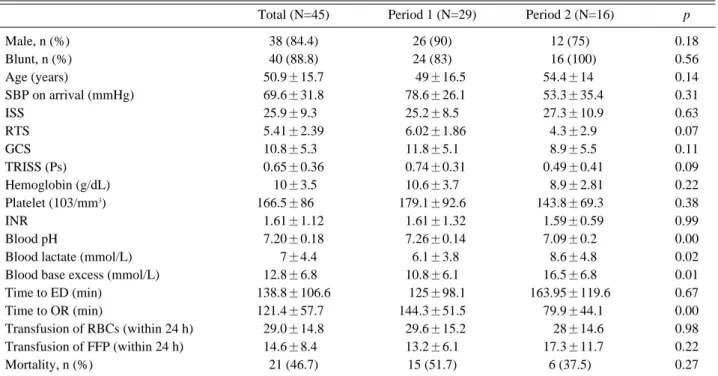
In total, 45 severe hemoperitoneum patients were eligible for this study. The ratio of male patients was 84.4%, and mean age was 50.9±15.7 years. The mean ISS, RTS, GCS score, and TRISS (Ps) values were 25.9
±9.3, 5.41±2.39, 10.8±5.3, and 0.65±0.36, respec- tively. The mean time to OR was 121.4±57.7 min. A mean of 29 units of packed RBCs and 14.6 units of fresh frozen plasma were transfused (Table 1).
Basic characteristics, including gender, age, ISS, and injury mechanism, showed no statistical signifi- cance in the analysis, but the difference in time until operation (the time to OR) was statistically signifi- cant between the two groups (p<0.05) (Table 1) (Fig.
1). A lower value of mortality was measured during period 2 than during period 1, but this difference was not statistically significant (p=0.27) (Table 1).
In comparison of the operation data of period 1 and period 2, no differences in systolic blood pressure (SBP), body temperature (BT), arterial pH, and base deficit were observed between the groups. However,
Table 1. Overview of clinical characteristics in the two period groups
Total (N=45) Period 1 (N=29) Period 2 (N=16) p
Male, n (%) 38 (84.4) 26 (90) 12 (75) 0.18
Blunt, n (%) 40 (88.8) 24 (83) 016 (100) 0.56
Age (years) 50.9±15.7 00.49±16.5 54.4±14. 0.14
SBP on arrival (mmHg) 69.6±31.8 078.6±26.1 053.3±35.4 0.31
ISS 25.9±9.30 25.2±8.5 027.3±10.9 0.63
RTS 5.41±2.39 06.02±1.86 04.3±2.9 0.07
GCS 10.8±5.30 11.8±5.1 08.9±5.5 0.11
TRISS (Ps) 0.65±0.36 00.74±0.31 00.49±0.41 0.09
Hemoglobin (g/dL) .10±3.5 10.6±3.7 008.9±2.81 0.22
Platelet (103/mm3) 166.5±8600. 179.1±92.6 143.8±69.3 0.38
INR 1.61±1.12 01.61±1.32 01.59±0.59 0.99
Blood pH 7.20±0.18 07.26±0.14 7.09±0.2 0.00
Blood lactate (mmol/L) 0.7±4.4 06.1±3.8 08.6±4.8 0.02
Blood base excess (mmol/L) 12.8±6.80 10.8±6.1 16.5±6.8 0.01
Time to ED (min) 138.8±106.6 0.125±98.1 163.95±119.6 0.67
Time to OR (min) 121.4±57.70 144.3±51.5 079.9±44.1 0.00
Transfusion of RBCs (within 24 h) 29.0±14.8 029.6±15.2 00.28±14.6 0.98
Transfusion of FFP (within 24 h) 14.6±8.40 13.2±6.1 017.3±11.7 0.22
Mortality, n (%) 21 (46.7) 15 (51.7) 6 (37.5) 0.27
ISS: injury severity score, RTS: revised trauma score, GCS: Glasgow Coma Scale, TRISS: trauma injury severity score, INR:
international normalization ratio
Fig. 1. Time elapsed from emergency department (ED) to operation room (OR) of 45 consecutive enrolled patients.
Table 2. Surgical data analysis in the two period groups
Period 1 (N=29) Period 2 (N=16) p
Operation time (min) 192.9±67.7 81.8±20.7 0.00
Damage control, n (%) 5 (17) 13 (81) 0.00
SBP in OR (mmHg) (Mean±SD) 098.6±33.8 96.9±26.1 0.96
Body temperature in OR (。C) (Mean±SD) 35.6±0.9 35.1±1.10 0.19
pH in OR (Mean±SD) 07.17±0.18 07.1±0.17 0.24
BD in OR (mmol/L) (Mean±SD) 11.9±60. 15.1±5.90 0.15
the operation time decreased from 192.9±67.7 min to 81.8±20.7 min and the DCS ratio increased from 17% to 81% (Table 2). The survival rates between period 1 and period 2 were compared using the TRISS method. Of a total of 29 patients in the period 1 group, there were 22 expected survivors and 14 actual survivors; among a total of 16 patients in the period 2 group, the number of actual survivors (n=10) was higher than expected (n=8) (Table 3). Hypovolemic shock caused by blood loss was the most common cause of death, followed by sepsis and multiple organ failure. One patient died of a central nervous system (CNS) problem: the patient had minimal sub- arachnoid hemorrhage with an alert mentality on initial presentation; therefore, the patient was includ- ed in this study. The patient’s condition worsened because of brain edema accompanied with diffuse axonal injury; however, this was not diagnostically confirmed (Table 4).
IV. Discussion
The aim of this study was to determine whether the establishment of a trauma center affected the outcome of severely injured trauma patients who required operation with massive transfusion. For this analysis, the operation pattern and time to OR for severe hemoperitoneum patients with high mor- tality were used as the main analysis factors.
Therefore, only patients who were transfused with more than 10 units of packed RBCs were targeted.
Patients with other high possibility factors (except for abdominal surgery) that may have affected the outcome were excluded. Patients who took more than 6 h to arrive to ED were also excluded because the trauma system in Korea was not completely estab- lished. Actually, pre-hospitalization transport takes a longer time in Korea than in other advanced coun- tries, and the inter-hospital transfer ratio from the local medical center is high. To the best of our knowl- edge, this is the first report of a study in Korea using such a cohort.
Improved outcomes for patients managed at des- ignated trauma centers are well established.(9-12) A readily available multidisciplinary trauma team (including physicians and supporting staff), commit- ment to the quality improvement processes, and financial support by the government and institu- tions indicate that trauma centers are well designed to care for severely injured patients. This commit- ment to trauma contributes to improved outcomes.
(13) Our trauma center is properly equipped follow- ing the standard of level I trauma centers in the U.S., with 14 full-time trauma surgeons, two trauma coor- dinators, and seven physician extenders currently working at the center. Emergency physicians, an anesthesiologist, and residents stay at the center, and neurosurgery and orthopedic consultants are available round-the-clock.
When DCL is indicated, patients have no other treatment options for their survival.(14) DCL has three distinct phases: expeditious surgical control of hemorrhage with temporary abdominal closure, cor- rection of the lethal triad in the ICU, and definitive surgical repair of all injuries.(7,15) Therefore, mas- sive transfusion can trigger DCL.(16) DCL was applied to the most severe hemoperitoneum patients who required massive transfusions or maintained low systolic BP during operation in period 2, but the performance ratio of DCL for period 1 was only 17%.
We think that this result may be due to the lack of Table 3. Comparison of survival using TRISS in the two period groups
Period 1 (N=29) Period 2 (N=16)
Actual number of survivors (%) 14 (28.2) 10 (62.5)
Expected number of survivors* (%) 22 (75.8) 8 (50).
* Expected survivors: Probability of survival (Ps) > 0.5
Table 4. Main causes of death
Period 1 Period 2
N (%) N (%)
Bleeding 10 (67) 4 (67)
Sepsis/MOF 04 (27) 2 (33)
CNS 1(7) 0
MOF: multiple organ failure, CNS: central nervous system
trauma education and dedicated trauma facilities.
Quality assurance and improvement programs mainly use mortality, morbidity, and disability as indicators for the evaluation of the quality of medical treat- ment for injured trauma patients. These indicators are critical and powerful, but there is a limitation in evaluating information on the care process. Trauma audits can be helpful in overcoming limitations, making the care process easy and useful. The time to OR (time to laparotomy) can be used as an audit filter for injured trauma patients with abdominal trauma.1 In one study, after the implementation of a dedicated trauma program, there was an approxi- mately 40% decrease in the triage time for patients going to the ICU or OR.(17) In a study by Henderson et al., it was reported that the mean time to OR for a patient undergoing urgent laparotomy was 115 min in England, while the author’s center reported 55 min.(2) Another study on emergency trauma surgery in the U.S. reported the time to OR as 136 min.(18) Porter et al. reported the time to OR as 44 min in cases in which the attending trauma surgeon was in the resuscitation room and 109 min in cases in which the attending trauma surgeon was not in the resus- citation room.(19) A study of patients whose initial SBP was below 90 mmHg reported that the proba- bility of death increased when the time in ED was over 90 min.1 The mean time to OR in this study was 121.4 min; the mean values for period 1 and period 2 were 144.3 min and 79.9 min, respectively. In par- ticular, in case of period 2, the mean time to OR was considered comparable with that in existing studies.
The TRISS method combines the physiological and anatomic assessments of injury with stratification based on patient age and the mechanism of injury.
(20-22) This system was widely used in the first stage of introduction because it is relatively simple to use by comparing the quality between trauma centers. However, there are a number of limitations to the TRISS method. First, it does not account for multiple injuries to a single body part, particularly common in case of truncal penetrating injuries, and it cannot predict the survivability coefficient of elderly patients with comorbid medical disease.
(23,24) Many studies have reported inconsistencies and variabilities in peer review.(25) The size of each
group of patients was small in this study, and no formal peer review board was instituted in period 1;
thus, the comparison of mortality rates is difficult.
Therefore, this study compared unexpected death using the TRISS method in the initial stage of trau- ma system establishment.
There are a few limitations to this study. First, the amount of data was insufficient because of the decline in laparotomy due to the development of interven- tional treatment. Second, a retrospective study was conducted because a randomized controlled study was unavailable due to the characteristics of trauma patients. Third, pre-hospitalization information was insufficient because the emergency treatment med- ical records were inadequate. Finally, the outcomes could not be compared with those of other trauma centers in the same time period because there was no established trauma data bank before 2013.
This is the first study to analyze the impact of the trauma center on the management of specific injuries, such as severe hemoperitoneum, in patients in Korea.
During the study period, the time to OR was short- ened and DCS was used to a greater extent as a sur- gical procedure. The commitment of financial and human resources for the establishment of a dedicat- ed trauma program is a sound investment in terms of improved survival in critically injured patients.
REFERENCES
01) Clarke JR, Trooskin SZ, Doshi PJ, Greenwald L, Mode CJ.
Time to laparotomy for intra-abdominal bleeding from trauma does affect survival for delays up to 90 minutes. J Trauma 2002; 52: 420-5.
02) Henderson KI, Coats TJ, Hassan TB, Brohi K. Audit of time to emergency trauma laparotomy. Br J Surg 2000; 87: 472-6.
03) Kim H, Jung KY, Kim SP, Kim SH, Noh H, Jang HY, et al.
Changes in preventable death rates and traumatic care systems in Korea. Journal of the Korean Society of Emergency Medicine 2012; 23: 189-97.
04) Teixeira P, Inaba K, Hadjizacharia P, Brown C, Salim A, Rhee P, et al. Preventable or Potentially Preventable Mortality at a Mature Trauma Center. J Trauma 2007; 63: 1338-47.
05) Rotondo MF, Schwab CW, McGonigal MD, Phillips GR, Fruchterman TM, Kauder DR, et al. ‘Damage control’: an approach for improved survival in exsanguinating penetrating abdominal injury. J Trauma 1993; 35: 375-83.
06) Cotton BA, Reddy N, Hatch QM, LeFebvre E, Wade CE, Kozar RA, et al. Damage control resuscitation is associated
with a reduction in resuscitation volumes and improvement in survival in 390 damage control laparotomy patients. Ann Surg 2011; 254.
07) Chovanes J, Cannon JW, Nunez TC. The evolution of damage control surgery. Surg Clin North Am 2012; 92: 859-75.
08) Schluter PJ, Nathens A, Neal ML, Goble S, Cameron CM, Davey TM, et al. Trauma and Injury Severity Score (TRISS) coefficients 2009 revision. J Trauma 2010; 68: 761-70.
09) Mains C, Scarborough K, Bar-Or R, Hawkes A, Huber J, Bourg P, et al. Staff commitment to trauma care improves mortality and length of stay at a level I trauma center. J Trauma 2009; 66: 1315-20.
10) Demetriades D, Martin M, Salim A, Rhee P, Brown C, Chan L. The effect of trauma center designation and trauma volume on outcome in specific severe injuries. Ann Surg 2005; 242:
512-9.
11) Demetriades D, Martin M, Salim A, Rhee P, Brown C, Doucet J, et al. Relationship between American College of Surgeons trauma center designation and mortality in patients with severe trauma (injury severity score>15). J Am Coll Surg 2006; 202: 212-5.
12) MacKenzie EJ, Rivara FP, Jurkovich GJ, Nathens AB, Frey KP, Egleston BL, et al. A national evaluation of the effect of trauma-center care on mortality. N Engl J Med 2006; 354:
366-78.
13. Nathens AB, Jurkovich GJ, Maier RV, Grossman DC, MacKenzie EJ, Moore M, et al. Relationship between trauma center volume and outcomes. JAMA 2001; 285: 1164-71.
14) Liao L-M, Fu C-Y, Wang S-Y, Liao C-H, Kang S-C, Ouyang C-H, et al. Risk factors for late death of patients with abdomi- nal trauma after damage control laparotomy for hemostasis.
World J Emerg Surg 2014; 9: 1.
15) Brenner M, Bochicchio G, Bochicchio K, Ilahi O, Rodriguez E, Henry S, et al. Long-term impact of damage control laparo- tomy: a prospective study. Arch Surg 2011; 146: 395-9.
16) Cosgriff N, Moore EE, Sauaia A, Kenny-Moynihan M, Burch JM, Galloway B. Predicting life-threatening coagulopathy in the massively transfused trauma patient: hypothermia and aci- doses revisited. J Trauma 1997; 42: 857-62.
17) Phillips J. Enhanced trauma program commitment at a level I trauma center: effect on the process and outcome of care. Arch Surg 2003; 138: 838-43.
18) LOWE DK, HEDGES JR, MARBY DW, MENDELSON D.
An assessment of time following trauma resuscitation: the transitional evaluation and monitoring phase. J Trauma 1991;
31: 1265-70.
19) Porter JM, Ursic C. Trauma attending in the resuscitation room: does it affect outcome? Am Surg 2001; 67: 611.
20) Champion HR, Sacco WJ, Hunt TK. Trauma severity scoring to predict mortality. World J Surg 1983; 7: 4-11.
21) Boyd CR, Tolson MA, Copes WS. Evaluating trauma care:
the TRISS method. J Trauma 1987; 27: 370-8.
22) Fujita T, Morimura N, Uchida Y, Kaneko I, Ikeda H, Sakamoto T. M-study from an urban trauma center in Tokyo.
J Trauma 2010; 69: 934-7.
23) Demetriades D, Chan L, Velmahos G, Berne T, Cornwell E, Belzberg H, et al. TRISS methodology in trauma: the need for alternatives. Br J Surg 1998; 85: 379-84.
24) Hannan EL, Farrell LS, Cayten CG. Predicting survival of vic- tims of motor vehicle crashes in New York State. Injury 1997;
28: 607-15.
25) WILSON DS, McELLIGOTT J, FIELDING LP. Identification of Preventable Trauma Deaths: Confounded Inquiries? J Trauma 1992; 32: 45-51.