• 검색 결과가 없습니다.

A Study on Men's Wear Production Using Digital Clothing Program

N/A
N/A
Protected

Academic year: 2021

Share "A Study on Men's Wear Production Using Digital Clothing Program"

Copied!
10
0
0

로드 중.... (전체 텍스트 보기)

전체 글

(1)

A Study on Men’s Wear Production Using Digital Clothing Program

Yeonkyung Kang

, Sehee Wu

††

, Young-A Ko

†††

, Anna Kim

††††

, Naeun Kim

†††††

, Jong Chan Kim

††††††

, Kim Cheeyong

†††††††

, Hyeong-Seok Ko

††††††††

ABSTRACT

As contemporary men’s clothing is becoming slimmer, people consider it important not only the existing simple design, but also intricate design and its fitness that can complement one’s body. Therefore, in this study, we reproduced Men’s wear fabrication process with 3D process. As a result, it was well received, as it can check the fitness, and allows modifying the design and mixing different texture easily.

Key words: Digital Clothing, Virtual fashion show, Men’s wear

※ Corresponding Author : Kim Cheeyong, Address : (614-714) 176 Eomgwang-no, Jin-gu, Busan S. Korea , TEL : +82-51-890-2270, FAX : +82-51-890-2265, E-mail

: [email protected]

Receipt date : Nov 1, 2013, Revision date : Jan 16, 2014, Approval date : Jan, 17, 2014

††††††††

Digital Clothing Center, Seoul National Univ.

(E-mail: [email protected])

††††††††

Digital Clothing Center, Seoul National Univ.

(E-mail: [email protected])

††††††††

Digital Clothing Center, Seoul National Univ.

(E-mail: [email protected])

††††††††

Physan (E-mail: [email protected])

††††††††

Physan (E-mail: [email protected])

††††††††

Dept. of Visual Information Engineering, Sunchon Univ. (E-mail: [email protected])

††††††††

Dept. of Visual Information Engineering, Dong- Eui Univ.

††††††††

Dept. of Electrical Engineering and Computer Science, Seoul National Univ

(E-mail: [email protected])

※ This work was supported by Ministry of Culture, Sports and Tourism (MCST) and Korea Culture Content Agency (KOCCA) in the Culture Technology (CT) Research

& Development Programs 2013, the Basic Science Research Program through the National Research Foundation of Korea (NRF) funded by the Ministry of Education, Science and Technology (MEST) (No.

2012R1A2A1A01004891), the Brain Korea 21 Project in 2013, and ASRI (Automation and Systems Research Institute at Seoul National University).

1. INTRODUCTION

As the exchange in the industrial activity be-

tween countries and regions is preceded vigorously with the development of scientific technology and information industry, the global companies in the recent clothing industry are facing the age of limit- less competition. For that reason, the companies are putting efforts into promoting the global com- petitiveness in their structurally vulnerable part including the lack of product differentiation and global sourcing etc. to establish global SCM(Social Chain Management) system and utilizing founda- tion of state-of-the-art functional materials and IT country, and present the vision of cutting-edge textile and fashion country by sophistication of the marketing ability through informatization [1].

When we look at the previous research on 3D

digital clothing, there are comparative studies be-

tween 3D virtual clothing and real clothing [2-5],

studies on 3D virtual clothing and pattern con-

struction [6-12], studies on textile reproducibility

in 3D digital [13-14], and studies on 3D clothing

design development [15]. Apart from them, studies

on digital stores, that are studies on u-shop, avatar,

game clothing, silverware, wearable computer,

customization by the made to measure, RFID,

smart wear etc. are actively pushed forward in the

clothing industry. The luxury brands are also

showing a digital fashion show in the form of a

(2)

Table 1. Design for virtual fashion show

Work 1 Work 2

- Target: Men’s wear

- Item: Shawl collar jacket, Vest, Baggy jean pants - Material: leather, velvet, jean

- Target: Men’s wear

- Item: Jumper, Skinny jean pants - Material: leather, jean, knit performance as a measure to express the brand

identity. The brands include Alexander McQueen and Burberry who showed the holographic fashion show and Ralph Lauren who presented 4D style to feel the smell and wind unlike the previous 3D fashion show. In addition, Ecole de Paris, Fnc.

Kolon, the new designer Harriette Kim, etc. put the same garment as the real one on a virtual model with slight image effect and realized 3D digital fashion show.

Likewise, While digital media is becoming the center of the global industry, demands for the digi- tal clothing technology are rapidly increasing with the unification of the fashion industry and in- novative IT technologies. The appearance of social media and smart phone made men today have in- terests in the fashion trend and a wide range of social sectors for men including men’s magazine, online shopping mall, fashion show etc. is developing. As their interest in fashion increases with the development of media, men these days have more needs for various designs and fitness that can supplement their body shape. For this rea-

son, it is assumed that the development of the cus- tomized digital fashion process and solution that can satisfy new needs in the global fashion and IT industry is required. Complying with the trend, this study realized the production process of men’s wear in the 3D process and produced a fashion show with the clothes. This study aims at verify- ing if the production process of men’s wear is available in the production process and suggesting a new fashion paradigm at the men’s wear market.

2. METHODOLOGY AND CONTENTS

2.1. Subject of Study

For composition of clothing goods for virtual digital fashion show, jean was used as the popular material.

<Work 1> was made up of shawl collar jacket, vest and baggy style jeans. Material of a vest is applied to leather. Bodice, shawl collar and sleeves of a jacket and pants are used denim material.

<Work 2> was composed of a jumper and basic

skinny style jeans. Material of bodice and sleeves

(3)

Fig. 1. Digital production process of men’s wear

Table 2. 3D Virtual model

Surface Front Side Back

of the jumper is leather. Collar, hem of sleeves and bodice of a jumper are used rib knit fabric. Pants is applied to denim material and Table 1 illustrates the work.

2.2. Step for the works

The work process of digitizing the men’s wear in this study is shown in Fig. 1. The software DC Suite was used to create men’s wear. (1) Import the body data created in Maya to DC Suite. (2) Pattern making was done in pattern tab. (3) Construct a garment by virtual sewing and in gar- ment tab. (4) Simulate the garment. (5) Import de- signed garment into MAYA and apply virtual fab- ric image. (6) Finally, simulation of men’s wear was carried out.

3. DEVELOPMENT OF 3D DIGITAL FASHION SHOW PROCESS

3.1. Motion Capture & 3D Body Modeling

Model size is height 195cm, chest circumference 98.2 cm, waist 80.3 cm, and hip circumference 92.4cm. We made the final completion using motion capture of real gestures from a model who has many fitting experience. We then conducted virtual wearing for fitting and form suitability in 3D by importing the final body to DC Suite. Table 2 is the silhouette of the man’s model.

3.2. Pattern Making, Sewing & Simulation

Pattern making of <work 1> and <work 2> was

done in pattern tab of DC Suite, developed in digital

clothing center at Seoul National University. For

(4)

Table 3. The production process in DC Suite

Work 1 Work 2

Pattern Making

3D Garment Construction-positioning & sewing

3D Simulation pattern layout, we placed the panel to the virtual

model from garment tab of DC Suite. As the pants go over the top, first we placed the pants panel and then put the top over. Virtual sewing was done faster than the actual time, as each panel of sewing connected exactly like the actual sewing. To take

a look at the works 1 and 2, we moved to simu-

lation tab, wore it to the virtual model, and com-

pleted the experiment through various mod-

ifications. Table 3 is the process of pattern mak-

ing-panel placement-sewing- simulation in DC

Suite.

(5)

Table 4. Material property & Mapping in Maya-Qualoth

Work 1 Work 2

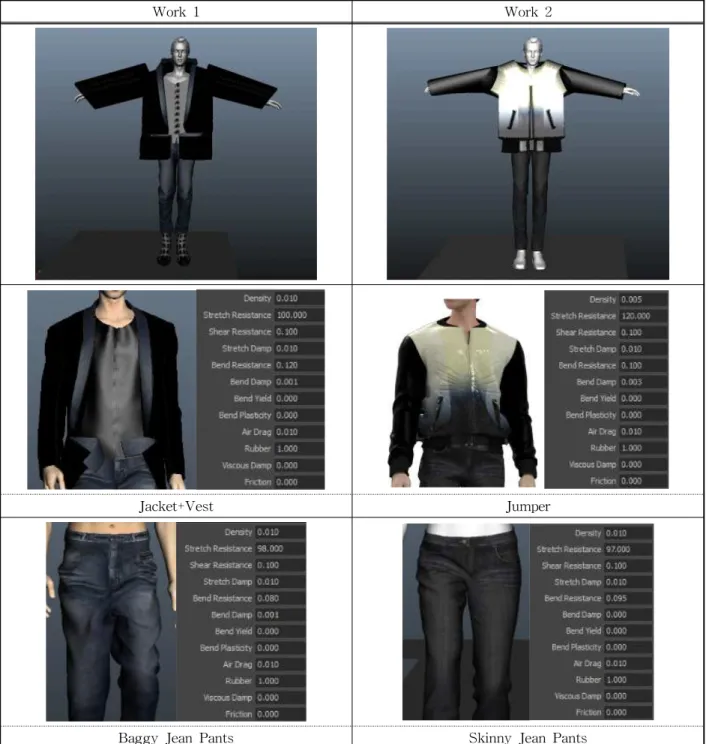
Jacket+Vest Jumper

Baggy Jean Pants Skinny Jean Pants

3.3. Material Property & Mapping

For surface detail of <Work 1> in digital fashion show, we used leather for vest, velvet for the body of jacket, and jean for collar and pants. We used Photoshop CS5(Adobe, Inc.) to create design and fabric image. Also, we used shader and lighting in DC Suite and MAYA to naturally express velvet

jacket, leather vest and jean pants that were cat

sand washed and to make their surface detail as

real as possible. We also used material property in

simulation tab of DC Suite to make material of the

clothes upward the value of bend resistance and

bend damp to lessen the wrinkle, and for the fabric

of jean pants, we adjusted downward the value of

stretch resistance and bend resistance to express

(6)

the elasticity and a little bit of stretch. Regarding the property of matter of leather and velvet, bend resistance value was raised to 0.120 from the basic 0.100, and bend damp value was adjusted to 0.001 from basic 0.000 in order to have less wrinkles, while stretch resistance value was adjusted down- ward, regarding the property of matter of jean, from 100.00 to 98.00, and bend resistance value was adjusted from 0.100 to 0.080 to show the elasticity and some stretching of the material.

For surface detail of <Work 2> we used patent leather, collar and sleeves for jumper’s body and rib band for hemline, and jean for pants. Concern- ing the property of matter of leather, stretch resist- ance value was leveled up from the basic 100.00 to 120.00, while bend damp value was raised from 0.000 to 0.003 respectively to have the stiffness of the material without stretching. In case of the property of the matter of Jean, stretch resistance value was reduced from the original 100.00 to 97.00, and bend resistance value was reduced from 0.100 to 0.095 to show the elasticity and slight stretching of the material. Table 4 shows the material prop- erty applied to <work 1 and 2>.

3.4. Rendering

To make an image that moves along the walking of the virtual model, DC-Suite and Maya had test-rendering and practiced high quality rendering in V-ray program. It is shown in Table 5.

For <Work 1>, we used leather, velvet and jean.

To show the natural sentiment of the velvet jacket, leather vest, and jean pants that had cat sand washing, shader and lighting were controlled to present the textile most similar to the actual one to the maximum.

For jumper body of <Work 2>, we gave convex embossing effect on the front central part with gradation dyeing effect to make motive seen as three-dimensional. For the sleeves, we have tex- ture effect to express stitch in leather and rib band for the hem. To show the difference between plain

leather and patent leather, we used shader such as Phong and Blinn. Also, for material property of leather, we adjusted upward the value of stretch resistance and bend damp to express the stiffness without any stretch. As for material property of jean, we adjusted downward the value of stretch resistance and bend resistance to express elasticity and a bit of stretch. It is shown in Table 6.

4. CONCLUSIONS

With the development of media outlets, men are becoming more interested in fashion, while demand on diverse design and fitness to effectively com- plement one’s body is increasing. In this study, we took it beyond the field of digital clothing that fo- cuses on women’s wear and reproduced a virtual fabrication process of men’s clothing using digital program. Moreover, we compared with real sit- uation and studied its efficiency and how much further it can go. For evaluation, we asked world renowned professionals in the field of menswear for their objective assessment after experiencing firsthand this process.

The result is as follows:

First, the pattern that makes up men’s wear has simple design compared women’s garment, so it was easy for fitness and design modification.

Second, fabric used in men’s wear is relatively lim- ited compared to women’s, but designers can try mixing diverse materials before the production, so it is economical and time-efficient.

However, we discovered some critical points and we found the need to modify it and to complement it. First, compared to women’s wear, men’s wear has some overlap in clothes, so a tool that enables simulation in sequence must be developed. Second, companies have their own software which should be compatible with diverse software.

Also in this study, we did the research using

body size of a male model. However, in future

studies, we hope to find a research on various

(7)

Table 5. Maya & V-ray Rendering

Work 1 Work 2

Maya

V-Ray

(8)

Table 6. Surface detail

Work 1 Work 2

physical forms of a male using size and pattern of a body that real companies are current using.

REFERENCES

[ 1 ] Jeesun You, Apparel Manufacturing , Kyohakyongusa, 2009.

[ 2 ] Juhyun Lee, A Study on the Comparison be- tween 3D Virtual Clothing and Real Clothing , Master’s thesis of Seoul National University, 2007.

[ 3 ] Younga Ko, A Study on the Utilization of Digital Clothing as Clothing Sample Making in Apparel Production , Doctoral thesis of Dongduk Women’s University, 2009.

[ 4 ] Yoonhee Na and Sookjin Kim, “The Comparative Study on a Characteristic Expressivity of Movie Clothings and 3D Virtual Clothings,” Journal of the Korean Society for Clothing Industry , Vol. 14, No. 1, pp. 1-12, 2012.

[ 5 ] Sehee Wu, Yeonkyung Kang, Young-A Ko, Anna Kim, Naeun Kim, Cheeyong Kim, and Hyeong-Seok Ko, “A Study on 3D Virtual Clothing by Utilizing Digital Fashion Show“, Journal of Korea Multimedia Society, Vol. 16, No.4, pp.529-537, 2013.

[ 6 ] Wolhee Do, “Evaluation of Motorcycle Jacket for Men using 3D Clothes Modeling System,”

Journal of the Korean Society of Design Culture , Vol. 14, No. 1, pp. 106-115, 2008.

[ 7 ] Minkyung Kim, Younglim Choi, and Yunja Nam, “Basic Research for 3D Virtual Clothing Simulation of Traditional Korean Dang`ui Costumes,” Journal of the Korean Society of Clothing and Textiles , Vol. 34, No. 11, pp.

1836-1843, 2010.

[ 8 ] Choong Hyo Kim, In Hwan Sul, Hyejun Park, and Sungmin Kim, “Automatic Basic Garment Pattern Generation using Three-Dimensional Measurements,” International J ournal of Clothing Science and Technology , Vol. 20, No.

1, pp. 41-56, 2010.

[ 9 ] Elizabeth Bye, “Fit Analysis using Live and 3D Scan Models,” International Journal of Clothing Science and Technology , Vol. 22, No.

2, pp. 88-100, 2010.

[10] Mikyung Uh, “Development of a Pattern and Visual Image for a One-Piece Dress using a 3D Virtual Clothing System,” The Research Journal of the Costume Culture , Vol. 19, No.

3, pp. 597-611, 2011.

[11] Ginah Park and Wookyung Lee, “Men's Work Clothes Jumper Pattern-making and Its Appearance Evaluation through 3-D Clothing Simulation,” Journal of Fashion Business , Vol. 16, No. 1, pp. 103-120, 2012.

[12] Sungmin Kim, “Mass Production of Digital

(9)

Garments using Multi-Option Data Structure,” International Journal of Clothing Science and Technology , Vol. 24, No. 2, pp.

89-101, 2012.

[13] Sehee Wu, “A Study on Fashion Design Development Utilizing Digital Clothing,” Doc- toral thesis of Dongduk Women’s University, 2009.

[14] Anna Kim, “A Study on Representation of the Virtual Clothing Materials using a Digital Clothing Program,” The Graduate School of Sookmyung Women’s University, 2010.

[15] Sungeun Tak, “A Study on Digital Fashion Production through Computer Graphics and Qualoth,” Master’s thesis of Sejong University, 2007.

[16] Kathi Martin, Hyeong-Seok Ko, “Virtual Historic Costume Collections across Cultures and Disciplines.” IEEE Proc. the 15

th

International Conference on Virtual Systems and Multimedia Vienna , pp. 104-108, 2009.

[17] Sehee Wu, Yeonkyung Kang, Younga Ko, Anna Kim, Naeun Kim, and Hyeongseok Ko,

“A Study on the Case Analysis and the Production of 3D Digital Fashion Show,”

Journal of Fashion Business , Vol. 17, No. 1, pp.

64-80, 2013.

[18] Younga Ko, Hyonsook Choy, and Hyeongseok Ko, “Evaluation of the Clothing Simulation Technology in the Aspects of Color, Material, Structural Detail, and Silhouette,” International Textile and Apparel , Inc-ITAA Conference , 2009.

Yeonkyun Kang

She received her P.h.D degree in Clothing and Textile at Sook- myung Women’s University, Seoul on 2009. Since 2011, she has been working as a re- searcher at the Digital Clothing Center at Seoul National Uni- versity, Republic of Korea.

Her research interests include: 3D Virtual Simulation, 3D Digital Clothing, 3D Animation, Fashion Design.

Sehee Wu

She received her P.h.D degree in Clothing and Textile at Dong- Duck Women’s University, Seoul on 2009. Since 2005, she has been working as a researcher at the Digital Clothing Center at Seoul National University, Re- public of Korea.

Her research interests include: Digital Clothing, Digital fashion, Digital textile design, 3D material mapping.,

Young-A Ko

She received the B.S. degree, M.S. degree and Ph.D. degree from Department of Fashion and textile Design, Dong-Duck Women’s University, Republic of Korea in 1992, 1998 and 2009 respectively.

Since June 2005, she has been a researcher at Seoul National University, Republic of Korea.

Her research interests include: Digital Clothing and 3D Virtual Simulation.

Anna Kim

She received her M.S degree from Department of Clothing &

Textile, Sookmyung Women's University, Republic of Korea in 2010 respectively.

Since May 2012, she has been a researcher at Physan,ltd.

Her research interests include: Digital Clothing and 3D

Virtual Simulation.

(10)

Naeun Kim

She received her M.S degree from Department of Clothing and Textile, Ewha Women’s University, Republic of Korea in 2008 respectively.

Since July 2011, she has been a researcher at Physan,ltd.

Her research interests include: Digital Clothing, Digital fashion, Digital textile design, 3D material mapping.

Jong-Chan, Kim

He received the B.S. degree, M.S.

degree and Ph.D. degree from Sunchon University, Republic of Korea in 2000, 2002 and 2007 respectively.

Her research interests include:

Computer Graphics, Game, HCI.

KIM Cheeyong

He received the B.S. degree, M.S. degree and Ph.D. degree from Inje University, Republic of Korea in 1991, 1994 and 2000 respectively. He is visiting pro- fessor at Oxford University in 2007, and visiting professor of the Digital Clothing Center at Seoul National Universi- ty in 2012. Currently, he is an associate professor of Department of Visual Information Engineering at Dong-Eui University. Prof. Kim held private ex- hibitions four times both in Seoul and China and joined over 200 international group exhibitions. With his deep interest in 3D Animation, Fractal & Chaos Design, Computational Simulation, and 3D virtual fashion fitting.

Hyeong-Seok Ko

He received the B.S. degree, M.S. degree from Seoul National University in 1985 and 1987. He holds a doctoral degree in com- puter graphics from the Penn- sylvania University.

Since June 2005, she has been a director of Digital Clothing Center at Seoul National University, Republic of Korea.

His research interests include: Clothing Simulation and

Animation, Hairstyle Modeling and Animation, Physics-

Based Reproduction of Fluids and Deformable Solids,

Facial Animation

수치

Table 1. Design for virtual fashion show
Fig. 1. Digital production process of men’s wear
Table 3. The production process in DC Suite
Table 4. Material property &amp; Mapping in Maya-Qualoth
+3

참조

관련 문서

In this study, using concept mapping of a variety of learning techniques in the area of science, especially biology, has a positive effect on learning

This study investigates the effect of complex exercise program activities using Motion-based games on high school students with developmental disabilities on

S., An Experimental Study on the Cooling and Heating Performance of a Residential Ground Source Heat Pump System, Korean Journal of Air-Conditioning

‘the special law for digital switchover’ states that is the general planning for vitalization of digital switchover, the program schedule of digital broadcast

근래에 연구되는 격자형 모델은 각 경계범위에서 각기 다른 변수의 영향을 정확 하게 산출하지 못하고 있으나 , 수용모델링을 병행하는 경우 높은 정확도를 추정할

출처 : IAEA 발표 자료(Comprehensive inspection exercise at bulk handling facilities, “U-235 Enrichment measurements by gamma-ray spectroscopy”) 13.  Uranium

Third, this study developed a music education program using block coding that can be used in music class, explained its content and functions and

Taken together the results of this study, has brought a change in the Step-Box exercise program, body composition, it had a positive impact on the changes in the strength, if