123
"J. Korean Soc. Radiol., Vol. 11, No. 2, April 2017"
Mental Status Change of Patients Receiving Radiation Therapy
Eun-Ju Yang,1 Seung-chul Lee,2,3 Young-Jae Kim4,*
1Department of Clinical Laboratory Science, Daegu Haany University
2Department of Radiological Technology, Dongshin University
3Department of Radiation Oncology, Catholic Univ.of Korea Uijeongbu Hospital
4Department of Radiologic Technology, Daegu Health College
Received: March 15, 2017. Revised: April 15, 2017. Accepted: April 30, 2017
ABSTRACT
Patients diagnosed with the serious disease of cancer may have anxiety and fear of closed spaces while receiving radiation therapy. This study investigated patients receiving treatment based on Linac and Tomotherapy to look into this anxiety and fear. Study method was survey. The survey was performed according to treatment duration (treatment within 5 minutes, 10 minutes, over 20 minutes, and over 30 minutes). The patients were also surveyed about any experience of changing treatment rooms or machines due to machine failure. A total of 200 survey questionnaires with full answers were researched in this study. As a result, it was found that the less the patients’ experience on radiation therapy, the higher their anxiety was. The dominating reason for this result was because the patients expected possible pain during the treatment process. In terms of treatment machine, Linac showed the highest anxiety of all for the openness of its patient stand. The most stable status was found in the case of treatment between 20 minutes and 30 minutes using Tomotherapy. The reason was the coziness of Tomotherapy machine. In the case of receiving the treatment for over 30 minutes, patients felt anxious for the isolation from the outside. The study findings are expected to serve as the necessary data for quality medical service with enhanced patient satisfaction in the clinical field.
Keywords: radiation therapy, patient satisfaction, medical service, cancer
Ⅰ. INTRODUCTION
The national cancer statistics released in December 2016, indicated that the survival rate of cancer patient s for 5 years or over increased gradually to exceed 7 0% in 2014. Female cancer patients’ survival rate was higher than male cancer patients’ survival rate. The su rvival rate of patients with thyroid cancer, prostate ca ncer and breast cancer went above 90%. The number of cancer patients, excluding thyroid cancer cases, incr eased by 1,886, emphasizing the necessity for cancer care management at the national level.[1]
To treat cancer patients, operations, chemotherapy a nd radiation therapy are utilized. Although there can b e differences according to cancer types diagnosed, met astases status, etc., it is known that most of the cancer patients experience asthenia, loss of appetite, hypothy mia, defecation problem, physical discomfort due to n ausea, etc. Depression, in particular, discourages patie nts’ participation in their treatment and, sometimes, be comes serious to lead to suicide. For this reason, prop er treatment intervention is essential.
Practical difficulties in personal life, family and occ upation work as a stress factor potentially leading to
*Corresponding Author: Young-Jae Kim E-mail: [email protected] Tel: +82-53-320-1314 https://doi.org/10.7742/jksr.2017.11.2.123
psychiatric diseases. Reportedly, 20~40% of the patien ts complain about depression and anxiety cases requiri ng therapeutic intervention.[2,3]
Many cancer patients lose health, part of body, psy che, social function, self-esteem, sexual function, occu pation and many others to lose their personal balanced status and suffer from extreme mental confusion.[4] M ost of the patients diagnosed with a cancer and under medical treatment, therefore, experience various emoti onal changes such as anxiety, fear, depression, emotio nal shock and frustration.[5]
Cancer patients under radiation therapy receive med ical treatment for a relative brief duration on the daily basis. They can visit their hospital as outpatients and continue daily activities as usual. As these patients me et medical staff for the long term such as doctors, nur ses, and radiological technologists; they receive great
support from them. Still, it is true that they are under depression and sense of hopelessness because of the s elf-deprecative mental pressure that they are cancer pa tients.[6] Moreover, as cancer treatment becomes more successful amid medical development, patients’ life ex pectancy is extended and living quality improvement is demanded in terms of both the physical aspect and mental aspect.
According to the study by Ferrans, living quality is deemed emerge as a relevant indicator under the awar eness that a result measurement variable is necessary, which covers a larger area beyond tumor reaction or s urvival rate.[7] in this understanding, the present study researches the mental status of cancer patients during their radiation therapy with a view to help improve cu stomer service (CS) for patients as well as their mental quality of living.
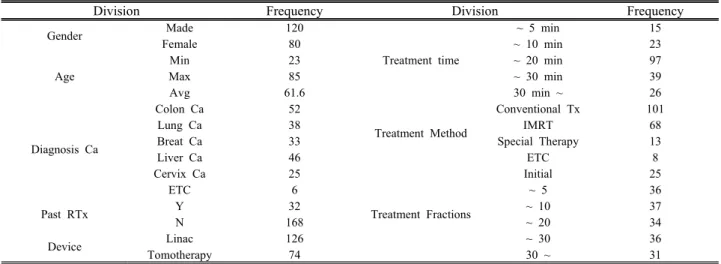
Table 1. Features of survey respondents
Division Frequency Division Frequency
Gender Made 120
Treatment time
~ 5 min 15
Female 80 ~ 10 min 23
Age
Min 23 ~ 20 min 97
Max 85 ~ 30 min 39
Avg 61.6 30 min ~ 26
Diagnosis Ca
Colon Ca 52
Treatment Method
Conventional Tx 101
Lung Ca 38 IMRT 68
Breat Ca 33 Special Therapy 13
Liver Ca 46 ETC 8
Cervix Ca 25
Treatment Fractions
Initial 25
ETC 6 ~ 5 36
Past RTx Y 32 ~ 10 37
N 168 ~ 20 34
Device Linac 126 ~ 30 36
Tomotherapy 74 30 ~ 31
Ⅱ. MATERIAL AND METHODS
1. Study participants
This study employed statistical analysis based on su rvey as the main research technique in order to investi gate diverse discourses on mental effects during radiat ion therapy and such mental effects themselves. For th is study analysis, 200 patients were surveyed with their consent, who had been diagnosed with cancer at the
U university hospital and S university hospital from May 1, 2015 to December 31, 2016 and under radiati on therapy. The 200 respondents’ characteristics are s hown as table 1.
2. Main survey questions
For the study experiment, the survey included quest ions on the respondents’ gender, age, diagnosed cance r name, therapeutic method, previous radiation therapy experience, name of present treatment equipment, freq
"J. Korean Soc. Radiol., Vol. 11, No. 2, April 2017"
uency of present radiation therapy, etc.
Such questions were included to gain information on the respondents’ mental status according to their diagn osed cancer name, differences in anxiety perceived ac cording to therapeutic methods and duration, psycholo gical burden depending upon different therapeutic mac hines.
Ⅲ. RESULT
1. Basic information of respondents
The total of 200 survey respondents of this study in clude 120 men and 80 women, having 40 more men than the number of women. Their average age was fo und 61.6, ranging from 23 to 85 shown as table 2.
Colorectal cancer cases were the most frequent among the diagnosed cancer cases, followed by liver cancer, lung cancer and breast cancer. The numbers are releva nt to the national cancer statistics. Concerning the pre vious radiation therapy experience, about 16% of them were found to have such experiences.
In terms of the therapeutic machine they used for treatment, Linac accounted for 63%, larger than Tomo therapy accounting for 37%.
With respect to the therapy duration, the largest part of the respondents answered it was about 20 ~ 30 min utes. Regarding the therapeutic methods, general thera py was most frequent followed by intensity-adjusted radiation therapy and special therapy.
To enable two-way comparison, therapy frequency in the survey was adjusted from first time to thirty times or over to examine about 30 patients.
2. Mental status change according to gender Each question uses a 5-point scale (1=mentally stable, 5=very unstable). As a result of investigation patients’
mental status change according to gender, men recorded 4.2 (N=120) and women, 4.1 (N=80), indicating little gap between men and women (p<0.001). The survey
essay questions asking reasons of mental instability fou nd that main causes were the denial of reality that they were a cancer patient and concerns about their family.
Table 2. Psychological changes according to gender
Items Psychological
state p-value
Male 4.2
< 0.001
Female 4.1
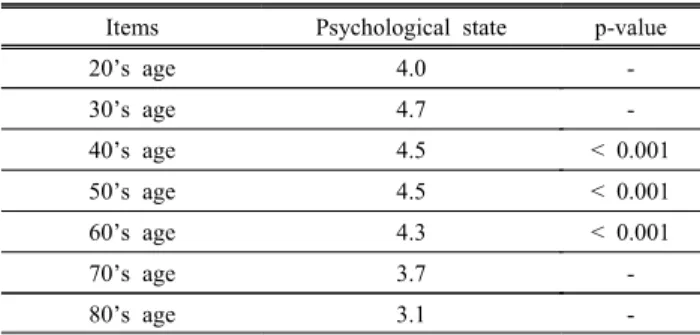
3. Mental status change according to age Mental status change according to age was investiga ted based on the same scale of questions on gender. It was found that patients in their 20s to 80s recorded 4.0, 4.7, 4.5, 4.5, 4.3, 3.7, and 3.1, respectively, indicating that the mid-aged groups had most serious anxiousness shown as table 3. The questions asking reasons of psy chological anxiety found that those in their 20s had the largest hope and positive expectation that they could recover sooner to record 4.0 in their mental status. Pat ients in their 80s recorded 3.1 seemingly because of their resignation about recovery.
Table 3. Psychological changes according to old
Items Psychological state p-value
20’s age 4.0 -
30’s age 4.7 -
40’s age 4.5 < 0.001
50’s age 4.5 < 0.001
60’s age 4.3 < 0.001
70’s age 3.7 -
80’s age 3.1 -
4. Mental status change according to cancer type
With respect to mental status change according to c ancer type; colorectal cancer cases recorded 3.5; lung cancer and liver cancer cases, 4.3 and 4.6; and breast and cervical cancer cases, 2.5 and 2.7. It is deemed th at the breast and cervical cancer cases recorded relativ ely positive mental status for the dominant medical and social context that they are curable diseases shown as
table 4. Essay questions also found that the main reas on was respondents’ understanding that these cancers are curable. On the other hand, lung and liver cancer patients recorded higher anxiety level as these cancers have high relapse rate and mortality.
Table 4. Psychological changes according to Diagnosis Items Psychological state p-value
Rectal Ca 3.5 < 0.001
Lung Ca 4.3 < 0.001
Breast Ca 2.5 < 0.001
Liver Ca 4.6 < 0.001
Cervix Ca 2.7 < 0.001
etc 3.5 -
5. Mental status change according to previous radiation therapy experience
This study examined the patients’ mental status cha nge according to their previous radiation therapy exper ience. As a result, patients with previous radiation ther apy experience recorded 4.5 and those without, recorded 4.4, representing little gap. The results indicate that the anxiety level of cancer patients who had received cancer treatment before increased as their radiation therapy might have begun to treat relapse. The patients receiving radiation therapy for the first time showed higher men tal anxiety for the fact that they were diagnosed with a cancer and the vague uneasiness about radiation therapy.
Table 5. Psychological changes according to Experience
Items Psychological state p-value
Experience O 4.5 < 0.001
Experience X 4.4 < 0.001
6. Mental status change according to therapeutic machines used
Mental status change according to therapeutic machi nes utilized was investigated in this study. As a result, Linac showed 3.0 and Tomotherapy, 2.3. The mental status was more stable than other cases because the trust
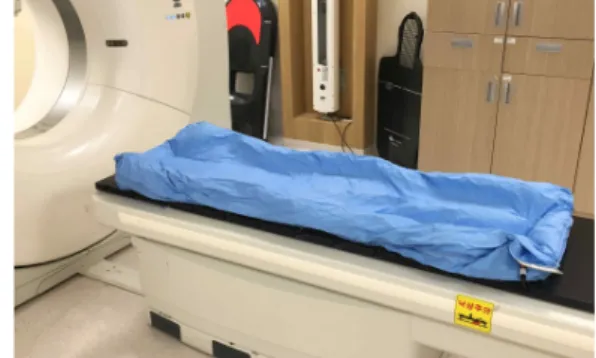
on medical staff including radiological technologist worked as the largest variable. Tomotherapy showed a more stable mental status than Linac reportedly because it provides a patient supporting device called Vaclock to fix their whole body to the treatment stand, which fully embraces patients to make them feel relieved shown as Fig 1.
Fig. 1. Whole Body Vaclock
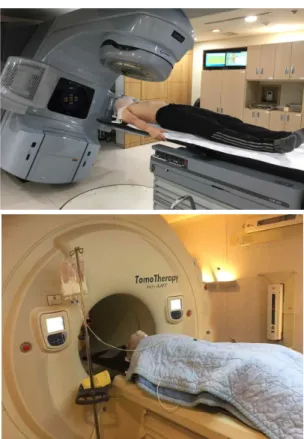
Moreover, Tomotherapy does not show the movement of equipment during the operation, helping patients feel more relaxed. On the other hand, Linac has a rotating Gantry head and rotating Collimator. The movement of Multi Leaf Collimator is showed to patients. Moreover, the patient stand moves whenever necessary, causing a nxiety to patients who has to lie down all the time during the treatment shown as Fig 2 and 3.
"J. Korean Soc. Radiol., Vol. 11, No. 2, April 2017"
Fig. 2. Treatment image of Linac and Tomotherpy
Table 6. Psychological changes according to Therapeutic equipment
Items Psychological state p-value
Linac 3.0 < 0.001
Tomotherpy 2.3 < 0.001
7. Mental status change according to therapeutic duration
The duration of radiation therapy treatment was inv estigated. As a result, the within-5-minute duration sh owed 3.5 and mental anxiety rose along the duration time between 10 minutes and 20 minutes. On the other hand, the duration between 20 minutes and 30 minutes recorded decreased level of mental anxiety. In the case of exceeding 30 minutes, mental stability increased.
This result is deemed because most of the patients receiving treatment relatively longer used Tomotherapy.
Most frequent therapeutic duration was between 10 minutes and 20 minutes. Most of the patients receiving
radiation therapy were found to have the mental anxiety level of 4.2.
Table 7. Psychological changes according to Treatment Time
Items Psychological state p-value
< 5min 3.5 -
5~10min 3.8 -
10~20min 4.2 < 0.001
20~30min 3.6 < 0.001
>30min 3.9 -
8. Mental status change according to therapeutic method
This study investigated patients’ mental anxiety stat us according to different therapeutic methods shown as table 8. As a result, the Conformal Radiation Therapy Method recorded 3.8, the highest and IMRT, 3.6. Spe cial therapy and other therapeutic method recorded 3.5 and 4.2. Conformal Radiation Therapy Method and IMRT Method are presently the most common treatment methods in South Korean and recorded 3.7 on average.
Table 8. Psychological changes according to Treatment Method
Items Psychological state p-value
Conformal Tx 3.8 < 0.001
IMRT / IGRT 3.6 < 0.001
Special 3.5 -
ETC 4.2 -
9. Mental status change according to the present therapy frequency
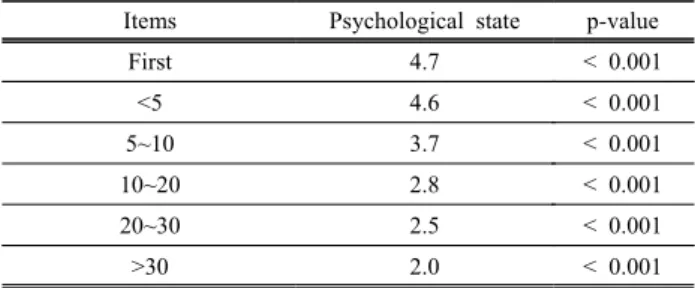
This study examined the effect of therapeutic frequency of the time of survey on their mental anxiety level. it was found the highest at the initial treatment shown as table 9. Those receiving therapy less than 5 times recorded 4.6; 10 times, 3.7; and over 10 times, 2.0 from 2.8, showing decrease in anxiety.
Table 9. Psychological changes according to Number of Treatments
Items Psychological state p-value
First 4.7 < 0.001
<5 4.6 < 0.001
5~10 3.7 < 0.001
10~20 2.8 < 0.001
20~30 2.5 < 0.001
>30 2.0 < 0.001
Ⅳ. DISCUSSION
To treat cancer patients, operative chemical therapy and radiation therapy are implemented. Of them, the radiation therapy is widely utilized to treat from primary cancers to metastatic cancers.
Patients receive radiation therapy alone at a treatment room. In order to prevent radiological technologists and other staff from being exposed to radiation, the place is sealed. Thus, patients are left alone in the room. This study examined patients’ mental anxiety in this case.
As a result, no difference was found according to their gender and all of them were found to feel anxiety (men, 4.2; women, 4.1). in terms of age, patients in their 30s to 60s showed 4.6 on average and those in their 70s or older had less anxiety. Such a result is deemed because they well understood the reality and tended to resign themselves. With respect to cancer types and re sulting anxiety, lung and liver cancers showed higher anxiety while breast and cervical cancers had lower n umbers of 2.5 and 2.7. The results are deemed to corr espond to the ratio of complete recovery of breast can cer and cervical cancer. On the other hand, lung and liver cancers are known to have low survival ratios and high recurrence, thus, patients were found to feel heav ier mental burden.
Regarding the previous experience of receiving radi ation therapy, patients with previous cancer treatment experience showed greater mental anxiety as their can cer relapsed and first-time patients had also heavy anx iety for uneasiness about everything.
With respect to therapeutic equipment, Linac showed higher anxiety level than Many respondents answered that Tomotherapy. Tomotherapy uses Vaclock to embr ace their whole body and the machine itself moved less. When it comes to the time spent for therapy trea tment, patients’ mental anxiety rose until 20 minutes of therapeutic duration while mental stability increased after 30 minutes. Regardless of therapeutic methods, all of the patients were found to have mental anxiety.
Therapeutic frequency and mental anxiety were inve stigated. As a result, the more frequent the therapeutic treatment, the lower the patients’ anxiety level became.
This is deemed a result that patients adapted themselves to radiation therapy.
Patients diagnosed with the severe disease of cancer also suffer from depression which discourages their en gagement in therapy and could lead to a serious situat ion causing death. For this reason, a proper medical intervention is necessary. Multiple stresses could cause patients’ depression and anxiety requiring medical inte rvention.
To help ease patients’ psychological anxiety during radiation therapy, now many hospitals change their tre atment rooms into warmer colors and show clear sky or green trees on the ceilings which patients usually lie down and watch.
According to the study by Lee, et al., aroma therapy can help relieve patients from depression or mental str esses. Therefore, such an olfactory approach seems ne cessary in treatment rooms in addition to the visual ch anges.[8]
Another factor to ease cancer patients’ depression is known to be the love and interest of their family, acc ording to research findings. Jo & Kim, in their study, reported that the group of patients having grudge agai nst their family-in-law, ex-husband or neighbors felt more depressed and painful.[9-10] In this sense, radiolog ical technologists, though they cannot be a family, wo uld still need to show as much interest and caring as they can.
"J. Korean Soc. Radiol., Vol. 11, No. 2, April 2017"
This study investigated patients’ mental anxiety only.
Future study will need to research the sub-dimensions of anxiety such as depression, loss, helplessness, etc.
Multipole attempts should be further researched to ove rcome this mental anxiety.
Ⅴ. CONCLUSION
The survey on the mental anxiety of cancer patients receiving radiation therapy found as follows;
Regardless of gender and age, all of the cancer pati ents complaint about mental anxiety during radiation therapy. Also, depending upon the prognosis of their cancer status, they feel different levels of anxiety.
Excluding patients in their 70s, the mental anxiety levels of other groups of patients were found almost similar. Also, little difference was found between the patient group with previous radiation therapy record and the group without.
With respect to the therapeutic machines, Tomother apy showed higher mental stability and the more frequ ent the treatment, the more stable the patients were.
It is deemed that radiological technologists will need to create warmer atmosphere in treatment rooms for patients’ mental stability and explore both visual and olfactory methods such as aroma therapy.
Reference
[1] Korea Central Cancer Registry. “Cancer registry and statistics. Cancer Statistics, 2015”, CA: A Cancer Jou rnal For Clinicians 2016
[2] Ohnishi H. “Mental distress in cancer patients.” Masui.
Issue. 60, pp.1024-31, 2011.
[3] Bae SH, Park JS. “Symptom distress and spiritual well-being in patients with cancer according to illness and treatment.” Journal of Korean Acad Fundam Nurs.
Vol.14 pp. 457-65, 2007.
[4] Anderson, J. L. “The nurse's role in cancer rehabilita tion” Cancer Nurs, Vol.2, No.12 pp.85-94, 1989
[5] Koh, K. B., & Kim, S. T. “Coping strategy of cancer
patients.” Journal of Korean Neuropsychi Assoc, Vol.1 No.27 pp.140-150, 1988
[6] Yang Young Hee, “Trajectory of Fatigue, Quality of life and physical symptoms in cancer patients receiving radiotherapy” Journal of Korean Acad Nurs Vol.33 No.5 562-569, 2003
[7] Ferrans, C. E. C. H. Yabro, M, H. Frogge, M. Good man, & S. L. Groenwald. “Cancer Noursing : Princi ples and practice(5th ed)” Jones & Bartlett Pub Bost on, Toronto, pp.243-258
[8] Lee, J. R. “Effect of aromatherapy and foot reflex massage on stress, depression, and sleep pattern of the institutionalized elderly.” Unpublished master's thesis, Kyungpook National University, Daegu, 2005
[9] Jo, K. W., & Kim, M. J. “A Study on the quality of life , family support and hope of hospitalized and home care cancer patients” Journal of Korean Acad Nurs, Vol.27, No.2, pp.353-363, 1997
[10] Jongnam Song, Youngjae Kim, Seungil Hong, “The Usability Analysis of 3D-CRT, IMRT, Tomotherapy Radiation Therapy on Nasopharyngeal Cancer” Journal of Korean Society of Radiology, Vol.6, No.5, pp.365 -371, 2012
방사선치료 시 환자의 심리적 상태의 변화 양상
양은주,1 이승철,2,3 김영재4,*
1대구한의대학교 임상병리학과
2동신대학교 방사선학과
3가톨릭대학교 의정부성모병원 방사선종양학과
4대구보건대학교 방사선과
요 약
암(caner)라는 중증의 질환을 가지고 있는 환자의 경우, 방사선 치료시 받을 수 있는 불안감, 폐쇄적 공포 심을 알아보려 하였다. 연구의 대상은 각각 선형가속기의 치료, 토모테라피 치료를 받는 환자를 대상으로 하였으며 연구의 방법은 설문조사의 방법으로 시행을 하였다. 설문의 내용은 치료시간별로 조사 하였고, (5 분 이내의 치료시, 10분이내, 20분 이상, 30분 이상), 장비의 고장으로 인한 치료실 및 치료기기 변경의 경 험에 대한 설문조사를 시행하였다. 설문에 성실히 응답한 200개의 설문지를 연구한 결과 방사선치료의 경 험이 없을수록 불안감이 많았으며 그 이유로는 치료시 고틍이 있을 것 같다는 의견이 지배적이었다. 치료 기로는 선형가속기가 가장 불안감이 높았으며 이유는 환자의 테이블의 개방감 때문인 것으로 나타났다. 가 장 안정적인 상태는 토모테라피 치료를 20분 이상 30분 미만 시행한 경우였으며 치료시 토모테라피 치료 장비의 아늑함이 원인이었다. 30분이 초과된 경우는 외부와 분리에 대한 불안감으로 불안한 심리상태를 보 였다. 본 논문을 통하여 임상에서는 환자의 만족도를 높이는 양질의 의료서비스를 제공하기 위한 제반 자 료로 활용되길 기대해 본다.
중심단어: 방사선치료, 환자만족도, 의료서비스, 암