Journal of Internet Computing and Services(JICS) 2014. Apr: 15(2): 95-107 95
프로젝트 급진성과 조직 혁신성 간의 조화가 공급망 통합에 미치는 영향
☆
Examining the Influence of Fit between Project Radicalness and Organizational Innovativeness on the Supply Chain Integration
민 대 홍 정 승 렬
1*Dae Hong Min Seung Ryul Jeong 요 약
본 연구는 프로젝트 급진성과 공급망의 혁신성 간의 조화가 공급망 통합 정도에 미치는 영향을 실증적으로 살펴보는 것이 목적이 다. 본 연구의 가설을 검정하기 위해 서베이 방법론이 사용되었다. 연구 결과, 공급망 통합의 정도는 프로젝트 급진성과 공급망의 혁신성간의 조화에 따라 다양하게 나타남을 알 수 있다. 특히, 공급망을 이루는 2개의 조직이 모두 변화지향적인 조직이며 동시에 통합 프로젝트가 급진적일 때 공급망의 통합 정도가 가장 높은 것으로 나타났다. 또한, 통합 프로젝트가 급진적이면 비록 공급망을 이루는 조직이 하나는 변화지향적이고 다른 하나는 현상유지 지향적이더라도 여전히 공급망의 통합 정도가 높은 것으로 조사되었다. 하지만 통합 프로젝트가 급진적이지 않고 점진적인 개선을 추구한다면 공급망 조직의 유형이 위와 같은 경우라도 공급망의 통합 정 도는 매우 낮게 나타났다. 마지막으로 만약 공급망을 구성하는 조직이 둘 다 현상유지 지향적이라면 통합 프로젝트가 급진적이든 점진적 개선을 추구하든 상관없이 공급망 통합의 정도는 낮은 것으로 파악되었다. 이러한 결과를 토대로 본 연구는 급진성의 정도 관점에서 조직의 혁신성과 조화를 이룰 수 있는 프로젝트여야만 성공적인 공급망 통합 즉, 성공적인 조직의 변화를 가져 올 수 있다 고 주장한다.
☞ 주제어 : 조화, 프로젝트 급진성, 조직 혁신성, 성공적 조직 변화, 공급망 통합
ABSTRACT
This study was conducted to empirically examine the impact of fit between project radicalness and innovativeness of the supply chain on the degree of supply chain integration. In order to test the research hypotheses, a survey was employed. The results show that the degree of supply chain integration varies on the fit between project radicalness and innovativeness of the supply chain.
Specifically, when a supply chain consists of two morphogenetic organizations and the supply chain integration project is radical, we see very highly integrated supply chain. We also find high-level integration of supply chain when project is radical even though both a morphogenetic and a homeostatic organization compose a supply chain. However, we find opposite result, which is low integration, if a project is incremental rather than radical and a supply chain is composed of same types of the organizations mentioned above.
Interestingly, degree of integration seems to be always low when a supply chain is composed of two homeostatic organizations, regardless of project radicalness. With these findings, this study concludes that a project whose radicalness is match with the supply chain’s innovativeness should be chosen for successful supply chain integration.
☞ Keyword : fit, project radicalness, organizational innovativeness, successful organizational change, supply chain integration
1Graduate School of Business IT, Kookmin University, Seoul, Korea
* Corresponding author ([email protected])
[Received 23 October 2013, Reviewed 4 November 2013, Accepted 3 January 2014]
☆ A preliminary version of this paper appeared in APIC-IST 2013, Aug 12-14, Jeju Island, Korea. This version is improved considerably from the previous version by including new results and features.
1. Introduction
Due to a significant shift in a paradigm that has changed for years in a business environment, competition among individual organizations has changed into a competition among supply chains [1]. With this significant change, the ultimate success of an individual company has been closely related to the degree of the integration of a supply chain [2].
In the view of process thinking, it is reasonable to assume
ISSN 2287-1136 (Online)http://www.jksii.or.kr
a supply chain as a whole process organized with many companies whose performance affects the performance of the supply chain [3].
There are pre-existing debates on the relationships between process change and an organization’s innovativeness. For example, according to Klempa [4], it is expected that an organization successfully implements its process change initiatives when the organization chooses proper process change initiatives that is well-matched with the organization’s innovativeness.
In spite of the precedent studies dealing with the relationship between an organization’s innovativeness and process changes, however, it seems that there is little prior research empirically examining the impact of the organization’s innovativeness on the organization’s process change, nor treating the relationship between the organization’s innovativeness and supply chain integration.
In this regard, this study was carried out to empirically examine the impact of the relationship between the innovativeness of the supply chain and the radicalness of the supply chain integration initiative on the degree of supply chain integration.
2. Theoretical Background
2.1 Process
Process is generally defined as a collection of activities that takes one or more inputs and creates one or more outputs that is of value to the customer [5]. There are different levels of process in an organization [6]. A process can be divided into many sub-processes; in addition, many processes are integrated into a super process. In short, an organization consists of processes and simultaneously is a whole process [6]. The process on the highest level in an organization is the value chain, which consists of the core process and support process [6][7]. The core process consists of value-adding activities that deliver values to an organization’s external customers, whereas the support process is composed of value-enabling activities providing the core process with resources necessary for the organization’s business [8]. There are two types of process changes based on radicalness; process improvement, which
seeks slight increase in efficiency or effectiveness through minor change, and by contrast, process innovation, which transforms the process in a new way through creative and radical change [9].
The supply chain is a network of resources and information that flows within an organization and its suppliers and customers [8][10]. From the process view, a supply chain is a whole process involving a variety of value chains from diverse organizations interrelating with each other and a supply chain serves the end customer as a value chain serves its external customer [11]. For overall performance improvement of a supply chain, each organization in charge of each activity or function on a supply chain should be closely integrated with one other as a whole process [3], as well as a business process, in which an organization can be optimized when many functions and activities included in the process are closely integrated as one [6].
2.2 Organizational Characteristics
There are three organizational characteristics reflecting an organization’s innovativeness that influences an organization’s process change: organizational culture, organizational learning, and knowledge sharing [4].
Organizational culture is defined as the set of shared values and norms that control the interactions of organizational members’ with each other and other people outside the organization [12]. There are three different levels of organizational culture: hidden assumption, values, and norms [13][14]. Hidden assumption, the highest (or the deepest) level, actually decides the group members’ perception, thinking, and feeling [14]; such assumptions are generally shared among organizational members without any controversy [13][14].
Values, more visible than assumption, are the basis of social norms governing organizational members’ behaviors [15].
Norms are the lowest (or the most shallow) level in organizational culture, explaining the organizational members’
behaviors and attitudes. Klempa [4] differentiates the
organizational culture into two types; a homogeneous
organizational culture and a heterogeneous organizational
culture. The first pursues stability and discriminates against
any individual or group that has different culture; the other
has a high tolerance for different cultures and usually adopts
a positive attitude towards different cultures. In this regard, an organizational culture is related with the organization’s business. For example, an organization that has a progressive organizational culture has an explorer position for strategic changes while an organization that possesses a settled culture moves toward stability [16]. According to Saffold [17], an organizational culture develops an organization’s process influencing building and changing the organizational culture, contributing to the organization’s performance through ever-evolving interaction. Hence, it is necessary to make a fit between an organizational culture and the organization’s process to attain competitive advantage [18].
Organizational learning is a group of interrelated activities generating knowledge necessary for an organization to take required action to adapt itself to environmental changes [19][20]. Organizational learning occurs when an organization takes knowledge from individuals in the organization by exchanging the knowledge among organizational members, so organizational learning is different from individual learning [21]. There are two types of organizational learning based on an organization’s innovativeness: single-loop learning (or adaptive learning) and double-loop learning (or innovative learning) [4][22][23][24]. Single-loop learning focuses on the refinement of existing knowledge or solving errors on existing systems [22]. On the other hand, double-loop learning seeks changes by assessing existing knowledge or exploring new ideas [23]. There is a close relationship between organizational learning and an organization’s innovation [25]. Organizational learning severely affects an organization’s performance and long-term survival [26]. If an organization puts too much focus on single-loop learning, the organization may easily fall into traps such as sub-optimization [23]. By contrast, if an organization leans too heavily towards double-loop learning, the organization will face risks derived from accepting new ideas not fully examined [27][28]. Single-loop learning is not only the first step and the basis for double-loop learning [22], but it also exploits the results of double-loop learning [23].
Therefore, an organization should balance itself between single-loop learning and double-loop learning for organization’s survival and prosperity [23], and an innovative organization is an effective learning system [29].
Knowledge sharing is defined as a process of communication among people involving provision and receipt
of knowledge [30]. Knowledge is the basis for an organization’s knowledge creation [31] and knowledge sharing affects team performance [32]. There are many routes and paths where information and knowledge flows in an organization [33][34]. In a hierarchical organizational structure, employees share information and knowledge based on functionality through restricted communication paths; by contrast, there are diverse connections for information and knowledge sharing in a networked organizational structure [4][35]. The reason why employees in a hierarchical organization share less information and knowledge with each other is that layers in the hierarchical structure act as a filter [36].
3. Research Model
The result of an organization’s process change depends not only on the characteristics of the organization, but also on the radicalness of the process change initiative. Although an organization can expect a certain degree of improvement in performance according to the radicalness of a certain process change initiative [5][9], the ill-fit between the radicalness of process change and the innovativeness of organizations results in deficient project results that cannot satisfy the original expectation [4]; for example, if an expanding organization does an innovative process change project with its expanding sub-units, there will be a significant performance improvement because of the fit among the organization, its sub-units, and the process change initiative. In the same manner, if a mature organization does an incremental process change initiative with the organization’s mature sub-units, the change will be successful due to the fit among the organization, its sub-units, and the process change initiative. However, if the mature organization does an innovative process change initiative, it is hard to expect a significant performance improvement.
For the following two reasons, it is expected that the degree
of supply chain integration depends not only on the project
radicalness of the supply chain integration, but also on the
organizational characteristics of the buyer and the supplier. The
first reason is that the relationship between a buyer and a
supplier is similar to those between an organization and its
sub-unit. A buyer evaluates and selects its suppliers by
considering the competitive advantage of the supply chain
[37][38] as an organization includes specific sub-units into the
process change by considering the consequent firm performance improvement [4]. In addition, suppliers are good when managed as part of the buyer [37] [39] and many precedent researches dealing with supply chains are buyer-oriented [10][40][41][42][43][44][45]. The second reason is that the supply chain integration is also one of the organizational process change initiatives. According to Burgess [11], a supply chain is a large process consisting of a set of organizations and any kind of change in a supply chain is similar to any process change in an organization. Therefore, based on the above theoretical background, it is possible to assume that the fit between the innovativeness of a supply chain determined by a buyer’s and a supplier’s organizational characteristics in the supply chain, and the project radicalness of a supply chain integration will have an impact on the degree of supply chain integration. So the hypotheses are as follows.
Hypothesis 1: A supply chain which consists of expanding
organizations (both buyer and supplier) will result in a high degree of supply chain integration through a radical project or low degree of those through an incremental project.
Hypothesis 2: A supply chain which consists of an
expanding organization (buyer) and a mature organization (supplier) will result in a moderately high degree of supply chain integration through a radical project or low degree of those through an incremental project.
Hypothesis 3: A supply chain which consists of mature
organizations (both buyer and supplier) will consistently result in a low degree of supply chain integration without regards to project radicalness.
From the above hypotheses, the research model is as follows (Figure 1).
(Fig. 1) Research Model
4. Method
4.1 Survey Instrument
This study restricted the scope of the supply chain as a buyer and one of its particular suppliers. To measure this unit of analysis, the survey instrument was developed to be answered from the buyer’s perspective. The following two reasons are the basis of this approach. First, a buyer organization knows its particular supplier’s organizational characteristics through interchange and collaboration between a buyer and a supplier [46]. Second, there is an empirical precedent research which used similar methods for data collection [47]. In this regard, the desirable respondent is one who works for a buyer’s organization, knowing the supplier’s organizational characteristics, and the project radicalness and the result of the supply chain integration.
4.2 Measures
There are four variables on the research model: supply chain integration, buyer’s and supplier’s organizational characteristics, and project radicalness. All variables were questioned on a 5-point Likert scale with multiple item scales.
4.2.1 Supply Chain Integration
For the supply chain integration, there are two types of resource flow, even though they are represented in the same way in a supply chain: inventory on passage, and on-hand inventory. Although there is no one best way for inventory management due to the paradoxical relationship between inventory holding costs and inventory ordering costs [8], it is clear that the increase in lead time uncertainty causes the increase in the whole inventory level. Therefore, the optimized (or lowest) levels of both inventories are possible when the lead time uncertainty is minimized [43][48].
Information flow, the other one on a supply chain is
closely related with the resource flow and becomes its basis
[41][49][50]. Inventory holding information, production and
delivery schedules, and demand forecasts are the items
which many precedent researches have mainly focused on
[51]. With this in mind, the levels of both inventories and
three types of information were chosen.
4.2.2 Organizational Characteristics
Heterogeneous organization culture is regarded as an innovative organizational culture due to change-oriented characteristics such as risk-taking attitudes and a high tolerance for different cultures and new ways [52][53].
Martins and Terblanche [54] proposed five dimensions of innovative organizational culture: strategy, structure, support mechanisms, behaviors that encourage innovation, and communication. To measure organizational culture, innovative norms in the previous five dimensions were used to measure organizational culture [55].
An innovative organization should be balanced between adaptive learning and innovative learning whereas a mature organization mainly focuses on adaptive learning [23]. Five types of innovative learning: rich learning, action learning, vicarious learning, unlearning, and experimental learning were used for the measurement of organizational learning [4].
While there are many paths and channels for information and knowledge transfers in an organization [34], structural diversity of knowledge sharing divides an organizations’
knowledge sharing into two types: hierarchical knowledge sharing and networked knowledge sharing [4]. The following four types of the structural diversities in work groups were chosen to measure knowledge sharing:
geographic locations, functional assignments, reporting managers, and business units [33].
4.2.3 Project Radicalness
The nine dimensions that differentiate process innovation and process improvement were considered to measure the project radicalness: level of change, starting point, frequency of change, time required, participation, typical scope, risk, primary enabler, and type of change [9]. Frequency of change, time required, and participation were excluded from the measurement among nine dimensions, due to the following reasons. Process innovation was once considered a one-time fundamental change [9]. However, these days, process innovation is considered to be a combination of radical change and many sequential incremental changes [56]. Therefore, an appropriate frequency of change cannot be decided. In addition, this radical process change seems to
require a longer time frame than needed for the gradual process change [9]; however, the time required is not always equal to the time allowed for implementation in real the world [57]. Finally, because it is difficult to compare the degree of participation between the buyers and the suppliers, it (participation) was not used in measuring the project radicalness in this paper. The remaining six dimensions were used as the items for the measurement of the project radicalness.
4.3 Data Collection
The survey was carried out in Korea during a period of three months. In total, 78 of the 116 respondents who were in charge of supplier strategies, closely interacted with suppliers, or had a heavy influence on the supplier selection in a buyer organization completed the survey and the response rate was above 67 percent. From these completed 78 cases, 60 were used for empirical tests except for 18, which overlapped, had missing values, or offered answers irrelevant or unsuitable to the project. Among 60 responses, each 82 percent of buyer and supplier companies were from logistics, manufacturing, and information and communication technology (buyer organizations: 18 from transportation, 7 from wholesale and retail, 12 from manufacturing, and 12 from publication, broadcasting and information service, and supplier organizations: 14 from transportation, 8 from wholesale and retail, 22 from manufacturing, and 7 from publication, broadcasting and information service).
The classification of buyer companies by firm size is as follows: more than half the buyers have more than three hundred employees (34 firms) and more than thirty million dollars of capital (46 firms). The classification of industries and firm size are based on the Korea Standard Industry Code in the Year Book of Statistics Administration published by the Statistics Korea in 2004 and the Korean basic law on small and medium-sized enterprises (10th partially revised on December 26 in 2008) and the implementing ordinances of the law (partially revised on December 31 in 2009).
The characteristics of the respondents were as follows.
Among 60 respondents, more than 68 percent (41 people)
Number of Items
Cronbach’s alpha Buyer Organizational Culture
Buyer Organizational Learning Buyer Knowledge Sharing Supplier Organizational Culture Supplier Organizational Learning Supplier Knowledge Sharing Project Radicalness Supply Chain Integration
5 4 4 5 4 4 6 5
.798 .610 .648 .775 .724 .686 .834 .793 (Table 2) Reliability
Variable Item Factor Loading
Buyer’s Organizational Culture
BOC1 BOC2 BOC3 BOC4 BOC5
.844 .680 .637 .785 .768 Buyer‘s Organizational
Learning
BOL1 BOL2 BOL3 BOL5
.660 .693 .685 .682 Buyer’s Knowledge
Sharing
BKS1 BKS2 BKS3 BKS4
.739 .771 .697 .576 Supplier’s
Organizational Culture
SOC1 SOC2 SOC3 SOC4 SOC5
.801 .647 .813 .776 .583 Supplier’s
Organizational Learning
SOL1 SOL2 SOL3 SOL5
.772 .793 .635 .763 Supplier’s Knowledge
Sharing
SKS1 SKS2 SKS3 SKS4
.700 .773 .768 .629 Project
Radicalness
PR1 PR2 PR3 PR4 PR5 PR6
.827 .827 .628 .828 .738 .624 Degree of
Supply Chain Integration
PI1 PI2 PI3 PI4 PI5
.586 .807 .824 .786 .709 (Table 1) Factor Analysis
were in charge of managerial role; 23 managers, 13 deputy senior managers, 3 senior managers, and 2 executives, whereas there were only 12 assistant managers 7 staff members. These respondents were mainly from divisions’
related to physical flow (19 from inbound logistics and 5 from production) and information flow (12 people each from both strategy and IT).
5. Results
5.1 Assessment of Measurement
To measure the validity of the survey instrument, a factor analysis was carried out. As a result of the factor analysis, each fourth item from the buyer and supplier organizational learning was removed. There is a reasonable theoretical ground explaining why these two items were taken out of organizational learning; according to Huber [58], unlearning is about information interpretation, whereas the others are about knowledge acquisition. The result of the factor analysis is arranged in Table 1. All factor loadings were greater than .50, which indicates that all factors are practically significant [59].
Similarly, reliability was measured by using Cronbach’s alpha [60]. The result showed that all variables and their dimensions each have their own Cronbach’s alpha higher than 0.6, indicating a reasonable level of reliability [61][62].
The result is as follows (Table 2).
5.2 Hypothesis Test
To test the hypotheses, ANOVA was used. There was a prerequisite for the ANOVA test: the classification of project radicalness and innovativeness of the supply chain. First of all, project radicalness was divided into two types. Score 3 is the threshold; a project that scored higher than 3 is considered an innovative project, and a project that scored equal to or less than 3 is considered an incremental project.
In the case of the supply chain, the type was determined by the combination of its buyer’s organizational characteristics and its supplier’s organizational characteristics. An organization (a buyer or a supplier) is classified according to the average score of the three organizational characteristics
with the division point value of 3; an organization (a buyer
or a supplier) is expanding when the average of the
organization’s (the buyer’s or the supplier’s) three organizational characteristics is higher than 3. By contrast, an organization (a buyer or a supplier) having an average score equal or less than 3 is mature. By matching a buyer organization and a supplier organization, three types of supply chains were determined: the combination of two expanding organizations, an expanding buyer organization and a mature supplier organization (or vice versa), and the last type consisting of both mature organizations. Based on these two types of projects and three types of supply chains, six groups were analyzed. Table 3 shows that Levene’s test was not significant at p-value ≤ .05, and thus there were equal variances assumed among six groups [63].
(Table 3) Test of Homogeneity of Variances Levene Statistic P-value
.988 .434
According to Table 4, there were significant differences among the groups’ averages (P-value = .000). This finding indicates that the degree of supply chain integration is different according to the match of project radicalness and supply chain.
(Table 4) Analysis of Variance Sum of
squares
df Mean square
F P- value Between Group
Within groups Sum
12.662 11.167 23.829
5 54 59
2.532 .207
12.2 .000
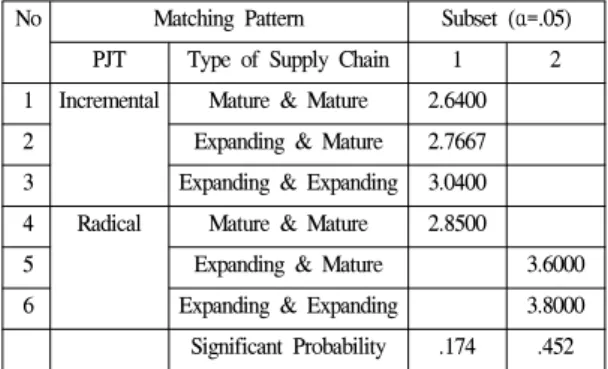
Table 5 shows the result of Duncan’s post hoc test. Six groups were divided into two subsets. Subset 1 includes groups which resulted in a relatively lower degree of supply chain integration whereas the other groups in subset 2 resulted in a high degree of supply chain integration.
Hypothesis 1 expected different supply chain integration results, which a supply chain composed of both expanding organizations achieves through project radicalness. The comparison between group 3 and group 6 shows that a supply chain which consists of two expanding organizations resulted in a high degree of supply chain integration through an innovative project or low degree of those through an incremental project, and thus supports hypothesis 1.
Similarly, the comparisons among three groups; 2, 5, and 6 supports Hypothesis 2, which expected a different integration of a supply chain composed of a mature organization and an expanding organization through the project radicalness. The comparisons show that this type of supply chain results in a low degree of integration through an incremental project, but a high degree of integration through an innovative project.
No Matching Pattern Subset (α=.05) PJT Type of Supply Chain 1 2 1 Incremental Mature & Mature 2.6400 2 Expanding & Mature 2.7667 3 Expanding & Expanding 3.0400 4 Radical Mature & Mature 2.8500 5 Expanding & Mature 3.6000 6 Expanding & Expanding 3.8000 Significant Probability .174 .452 (Table 5) Duncan’s Post Hoc Multiple Comparisons
According to the comparison between group 1 and 4, the last type of supply chains with both mature organizations consistently achieved a lower degree of supply chain integration without regards to the project radicalness unlike the above two types of supply chains, supporting hypothesis 3.
5.3 Discussion
From the above analysis, the adoption of the three
hypotheses has the following significant meanings. First, the
validation of hypothesis 1 and 2 shows that the degree of
supply chain integration is different according to the project
radicalness. As previous research discovered, a more radical
change of process provides a higher performance in an
organization [5][6][9]. Despite these precedent literatures
which discuss the relationship between the radicalness of
process change and the consequent performance
improvement in an organization level, there has been no
empirical examination of this relationship at the supply
chain level. In this study, the analysis of all the hypotheses
shows that there is a gap between the two results according
to the project radicalness.
The second is that the other determinant of the degree of supply chain integration is the innovativeness that the three organizational characteristics explain. Similar to the different results of a process change according to the organizational characteristics, the statistics of this study shows that the more innovative the supply chain, the higher the degree of supply chain integration. Thus, this finding significantly shows that the degree of supply chain integration will rely not only on the project radicalness, but also on the supply chain’s innovativeness.
Lastly, the examination in the impact of the fit between project radicalness and the innovativeness of the supply chain can be considered to be the most important achievement of this study. Especially, the adoption of hypothesis 1 and 3 shows that a supply chain cannot highly integrate both organizations’ processes through an innovative project if this supply chain does not have enough innovativeness which matches well with an innovative project. This finding means that a supply chain will accomplish the expected degree of the supply chain integration through a project whose radicalness is well matched with the supply chain’s innovativeness.
6. Conclusion
Based on the conducted measurement and the consequent analyses, this study has the following academic implications.
First, this study is the first research that empirically examined the effect of innovation potency which explains an organization’s innovativeness on the organization’s business process change. Unlike precedent researches which theoretically discussed or partially examined the innovation potency, this study empirically examined the impact of all organizational characteristics.
Second, this study discovered the importance of the supplier selection when two organizations integrate their processes in a supply chain. As discussed in the above analyses, the innovativeness of a supply chain is an important feature which affects the degree of supply chain integration and this means that a buyer organization cannot solely accomplish a high degree of the supply chain integration without the consideration of its supplier.
Third, this study showed the effect of the project
radicalness on the supply chain integration. Unlike many precedent studies dealing with the relationship between the project radicalness and the process change at the organization level, this study empirically examined the above relationship at the supply chain level.
Finally, this study examined the impact of the fit between project radicalness and innovativeness of supply chain on the degree of supply chain integration. On the theoretical basis which is the relationship between the radicalness of the business process change and the organizational characteristics at the organization level, this study tested the impact of the fit between project radicalness and the innovativeness of supply chain on the degree of supply chain integration and found out that a buyer and a supplier in a supply chain should do a project whose radicalness is well-matched with the supply chain’s innovativeness for a better result of the supply chain integration.
This study also has the following four practical implications. First, the examination of this study informs firms of which criteria to measure to assess a supply chain’s innovativeness. While many organizations have well-recognized the importance of an organization’s innovativeness, they have been no criteria for the measurement of innovativeness. The examination of the three organizational characteristics will help organizations to establish the measure of an organization’s innovativeness and evaluate it.
Second, the discussion of the relationship between the project radicalness and the supply chain integration in this study gives companies an important meaning that more radical projects result in a higher degree of supply chain integration. This indicates that an organization can yield a high degree of supply chain integration through the more radical project as an organization significantly improves performance through a radical process change.
Third, the fact that the more innovative supply chain, the higher the degree of supply chain integration implies the importance of the supplier’s innovativeness; this finding indicates that an organization should evaluate and select an innovative supplier for the high supply chain integration.
Finally, the examination of the above hypotheses
indicates that a supply chain should choose a project whose
radicalness is equal to the supply chain’s innovativeness for desirable supply chain integration results. This finding provides a very important meaning that an organization should evaluate the radicalness of a project and the innovativeness of a supply chain where the organization and its suppliers belong to when the organization and its supplier integrate their organizational processes as one.
While this study has the above implications, there are also the following three limitations. First, this study restricts organizational characteristics to only three dimensions.
However, there are many other organizational characteristics which are not mentioned in this study. Second, this study mainly focused on the supply chain in the operation environment. However, there are not only operations, but also projects in a business environment. In this regard, the lack of the same examinations in the project environment is another limitation of this study. Finally, in this study, the supply chain integration was mainly focused on the integration of logistics (or service delivery) and information sharing. However, there are many other functions besides logistics or firm infrastructure (where information system is located) in an organization [7], or there are other functional integrations between a buyer and a supplier in a supply chain in a business environment such as finance [50].
From the above implications and limitations, there are subjects for future researches as follows. First, examining the impact of the fit between the organization’s innovativeness and the project radicalness on the organization’s process change is a future research. Despite the empirical examination of this study, there is still a lack of empirical examination of the above mentioned impact at the organization level.
Second, examining the impact of the other organizational characteristics not mentioned in this study can be another research problem. While this study focused on the three organizational characteristics, any significant meaning can be found from the other organizational characteristics not mentioned in this study.
Third, further treating process integration on a supply chain can also be a future research topic. There are more flows than what this study discussed in a supply chain; so the latter study will deals with supply chain integration at a variety of detailed flows.
Fourth, a study examining the hypotheses which this study mentioned in the project environment will be a future research topic. Due to the difference between operation and project, examining same hypotheses in the project environment will provide important meanings.
Lastly, comparing the result of the hypotheses in this study through industry differences is also a significant future research topic. Due to each industrial unique characteristic, comparing industry differences of the examination of the hypotheses will provide very useful practical implications.
References
[1] Goh, P.G. “Integrating demand and supply chains,”
In C.S.Tang, CP.Teo, and KK.Wei(Eds.) Sup ply Chain Analysis: A handbook on the interaction of information, system and optimization, Springer, New York, 2008, pp. 261-270.
[2] Lambert, D.M., and Cooper, M.C. “Issues in supply chain management,” Industrial Marketing Management, Vol. 29, No. 1, January, 2000, pp.
65-83.
[3] Lummus, R.R., Krumwiede, D.W., and Vokurka, R.J.
“The relationship of logistics to supply chain management: Developing a common industry definition,” Industrial Management and Data Systems, Vol. 101, Issue. 8/9, 2001, pp. 426-431.
[4] Klempa, M.J. “Understanding business process reengineering: A sociocognitive contingency model,”
in V.Grover and W.J.Kettinger(Eds.) Business Process Change: Reengineering Concepts, Methods and Technologies. Harrisburg, PA: Idea Group Publishing, 1995, pp. 78-112.
[5] Hammer, M., and Champy, J. Reengineering the Corporation: A Manifesto for Business Revolution, Revised and Updated edition, Harper Business Essentials, New York, 2003.
[6] Harmon, P. Business Process Change: A guide for business managers and BPM and Six sigma professionals, Morgan Kaufmann Publishers, 2007.
[7] Porter, M.E. Competitive Advantage: Creating and
Sustaining Superior Performance, Free Press, 1985.
[8] Krajewski, L.J., Ritzman, L.P., and Malhotra, M.K.
Operations Management: Processes and Value Chains, 8thedition, Prentice Hall, 2007.
[9] Davenport, T.H. Process Innovation: Reengineering work through information technology. Harvard Business School Press, Boston, 1993.
[10] Mentzer, J.T., DeWitt, W., Keebler, J.S., Min, S., Nix, N.W., Smith, C.D., and Zacharia, Z.G.
“Defining supply chain management,” Journal of Business Logistics, Vol. 22, No. 2, 2001, pp. 1-25.
[11] Burgess, R. “Avoiding supply chain management failure: Lessons from business process re-engineering,” International Journal of Logistics Management, Vol. 9, No. 1, 1998, pp. 15-23.
[12] Ke, W., and Wei, K.K. “Organizational culture and leadership in ERP implementation,” Decision Support Systems, Vol. 45, No. 2, May, 2008a, pp. 208-218.
[13] Kilmann, R.H., Saxton, M.J., and Serpa, R. “Issues in understanding and changing culture,” California Management Review, Vol. 28, No. 2, Winter, 1986, pp. 87-94.
[14] Schein, E.H. “Coming to a new awareness of organizational culture,” Sloan Management Review, Vol. 25, No. 2, Winter, 1984, pp. 3-16.
[15] De Long, D.W., and Fahey, L. “Diagnosing cultural barriers to knowledge management,” Academy of Management Executive, Vol. 14, No. 4, November, 2000, pp. 113-127.
[16] Naranjo-Gil, D., and Hartmann, F. “Management accounting systems, top management team heterogeneity and strategic change,” Accounting, Organizations and Society, Vol. 32, Issue. 7/8, October, 2007, pp. 735-756.
[17] Saffold, G.S. “Culture traits, strength, and organizational performance: Moving beyond “Strong”
culture,” Academy of Management Review, Vol. 13, No. 4, October, 1988, pp. 546-558.
[18] Soh, C., Kien, S.S., and Tay-Yap, J. “Cultural fits and misfits: Is ERP a universal solution?,”
Communications of the ACM, Vol. 43, No. 4, April, 2000, pp. 47-51.
[19] Daft, R.L., and Weick, K.E. “Toward a model of
organizations as interpretation systems,” Academy of Management Review, Vol. 9, No. 2, April, 1984, pp.
284-295.
[20] Duncan, R.B., and Weiss, A. “Organizational learning: Implications for organizational design,” In B.Staw (Ed.), Research in Organizational Behavior, Vol. 1, Greenwich, Connecticut, JAI Press, 1979, pp.
75-123.
[21] Simon, H.A. “Bounded rationality and organizational learning,” Organization Science, Vol. 2, No. 1, September, 1991, pp. 404-437.
[22] Argyris, C. “Teaching smart people how to learn,”
Harvard Business Review, Vol. 4, No. 2, 1991, pp.
4-15.
[23] March, J.G. “Exploration and exploitation in organizational learning,” Organization Science, Vol. 2, No. 1, February, 1991, pp. 71-87.
[24] Senge, P.M. “The leader’s new work: Building learning organizations,” Sloan Management Review, Vol. 32, No. 1, Fall, 1990, pp. 7-23.
[25] Garcia-Morales, V.J., Llorens-Montes, F.J., and Verdu-Jover, A.J. “Antecedents and consequences of organizational innovation and organizational learning in entrepreneurship,” Industrial Management and Data Systems, Vol. 106, No. 1, 2006, pp. 21-42.
[26] Yukl, G. “Leading organizational learning:
Reflections on theory and research,” The Leadership Quarterly, Vol. 20, No. 1, February, 2009, pp. 49-53.
[27] Blackman, D., Connelly, J., and Henderson, S. “Does double loop learning create reliable knowledge,” The Learning Organization, Vol. 11, No. 1, 2004, pp.
11-27.
[28] Henderson, S. “Black swans don’t fly double loops:
The limits of the learning organization,” The Learning Organization, Vol. 4, No. 3, 1997, pp. 99-105.
[29] Tushman, M., and Nadler, D. “Organizing for innovation,” California Management Review, Vol. 28, No. 3, Spring, 1986, pp. 74-92.
[30] Usoro, A., Sharratt, M.W., Tsui, E., and Shekhar, S.
“Trust as an antecedent to knowledge sharing in
virtual communities of practice,” Knolwedge
Management Research and Practice, Vol. 5, Iss. 3,
August, 2007, pp. 199-212.
[31] Small, C.T., and Sage, A.P. “Knowledge management and knowledge sharing: A review,”
Information Knowledge Systems Management, Vol. 5, No. 3, 2006, pp. 153-169.
[32] Staples, D.S., and Webster, J. “Exploring the effects of trust, task, interdependence and virtualness on knowledge sharing in teams,” Information Systems Journal, Vol. 18, No. 6, November, 2008, pp.
617-640.
[33] Cummings, J.N. “Work groups, structural diversity, and knowledge sharing in a global organization,”
Management Science, Vol. 50, No. 3, March, 2004, pp. 352-364.
[34] Deephouse, D.L., and Heugens, P.P.M.A.R. “Linking social issues to organizational impact: The role of infomediaries and the infomediary process,” Journal of Business Ethics, Vol. 86, No. 4, 2009, pp. 541-553.
[35] Schwalbe, K. Information technology project management 5thedition, Course Technology, 2008.
[36] Al-Alawi, A.I., Al-Marzooqi, N.Y., and Mohammed, Y.F. “Organizational culture and knowledge sharing:
critical success factors,” Journal of Knowledge Management, Vol. 11, No. 2, 2007, pp. 22-42.
[37] Chen, CT., Lin, CT., and Huang, SF. “A fuzzy approach for supplier evaluation and selection in supply chain management,” International Journal of Production Economics, Vol. 102, No. 2, 2006, pp.
289-301.
[38] Ha, SH., and Krishnan, R. “A hybrid approach to supplier selection for the maintenance of a competitive supply chain,” Expert Systems with Applications, Vol. 34, No. 2, February, 2008, pp.
1303-1311.
[39] Putzger, I. “All the ducks in a row,” World Trade, Vol. 11, No. 9, September, 1998, pp. 54.
[40] Cox, A. “Understanding buyer and supplier power: A framework for procurement and supply competence,”
Journal of Supply Chain Management, Vol. 37, No. 2, Spring, 2001, pp. 8-15.
[41] Lee, H.L., Padmanabhan, V., and Whang, S.
“Information distortion in a supply chain: The bullwhip effect,” Management Science, Vol. 43, No.
4, April, 1997, pp. 546-558.
[42] Lee, H.L., So, K.C., and Tang, C.S. “The value of information sharing in a two-level supply chain,”
Management Science, Vol. 46, No. 5, May, 2000, pp.
626-643.
[43] Levy, D.L. “Lean production in an international supply chain,” Sloan Management Review, Vol. 38, No. 2, Winter, 1997, pp. 94-102.
[44] Petersen, K.J., Handfield, R.B., Lawson, B., and Cousins, P.D. “Buyer dependency and relational capital formation: The mediating effects of socialization processes and supplier integration,”
Journal of Supply Chain Management, Vol. 44, No. 4, November, 2008, pp. 53-65.
[45] Shah, R., Goldstein, S.M., and Ward, P.T. “Aligning supply chain management characteristics and interorganizational information system types: An exploratory study,” IEEE Transactions on Engineering Management, Vol. 49, No. 3, August, 2002, pp.
282-292.
[46] Cousins, P.D., Handfield, R.B., Lawson, B., and Petersen, K.J. “Creating supply chain relational capital: The impact of formal and informal socialization processes,” Journal of Operations Management, Vol. 24, No. 6, 2006, pp. 851-863.
[47] Cousins, P.D., and Menguc, B. “The implications of socialization and integration in supply chain management,” Journal of Operations Management, Vol. 24, No. 5, September, 2006, pp. 604-620.
[48] Dolgui, A., and Ould-Louly, M. “A model for supply planning under lead time uncertainty,” International Journal of Production Economics, Vol. 78, No. 2, July, 2002, pp. 145-152.
[49] Ke, W., and Wei, K.K. “Trust and power influences in supply chain collaboration,” In C.S.Tang, CP.Teo, and KK.Wei(Eds.) Supply Chain Analysis: A handbook on the interaction of information, system and optimization, Springer, New York, 2008b, pp.
223-239.
[50] Rai, A., patnayakuni, R., and Seth, N. “Firm performance impacts of digitally enabled supply chain integration capabilities,” MIS Quarterly, Vol.
30, No. 2, June, 2006, pp. 225-246.
[51] Sengupta, K., Heiser, D.R., and Cook, L.S.
“Manufacturing and service supply chain performance: A comparative analysis,” Journal of Supply Chain Management, Vol. 42, No. 4, Fall, 2006, pp. 4-15.
[52] Hopkins, W.E., and Hopkins, S.A. “Effects of cultural recomposition on group interaction processes,” Academy of Management Review, Vol. 27, No. 4, October, 2002, pp. 541-553.
[53] Lee, S.K.J., and Yu, K. “Corporate culture and organizational performance,” Journal of Managerial Psychology, Vol. 19, No. 4, 2004, pp. 340-359.
[54] Martins, E.C., and Terblanche, F. “Building organizational culture that sitmulates creativity and innovation,” European Journal of Innovation Management, Vol. 6, No. 1, 2003, pp. 64-74.
[55] O’Reilly, C. “Corporations, culture, and commitment:
Motivation and social control in organizations,”
California Management Review, Vol. 31, No. 4, Summer, 1989, pp. 9-25.
[56] Davenport, T.H. “Business process reengineering:
Where it’s been, where it’s going,” In V.Grover and W.J.Kettinger (Eds.), Business Process Change:
Reengineering Concepts, Methods and Technologies.
Harrisburg, PA: Idea Group Publishing, 1995, pp.
1-13.
[57] Stedman, C. “Failed ERP gamble haunts Hershey,”
Computerworld, Vol. 33, No. 44, November 1, 1999, pp. 1-2.
[58] Huber, G.P. “Organizational learning: The contributing processes and the literatures,”
Organization Science, Vol. 2, No. 1, February, 1991, pp. 88-115.
[59] Hair, Jr., J.F., Anderson, R.E., Tatham, R.L., and Black, W.C. Multivariate Data Analysis, 4thedition, Prentice Hall, Englewood Cliffs, New Jersey, 1995.
[60] Nunnally, J.C. Psychometric Theory, 2
ndedition, New York, McGraw-Hill, 1978.
[61] Hoffman, M., Pick, W.M., Cooper, D., and Myers, J.E. “Women’s health status and use of health services in a rapidly growing peri-urban area of South Africa,” Social Science and Medicine, Vol. 45, No. 1, July, 1997, pp. 149-157.
[62] Yu, JE., Ha, IS., Choi, MK., and Rho, JJ. “Extending the TAM for a t-commerce,” Information and Management, Vol. 42, No. 7, October, 2005, pp.
965-976.
[63] Field, A. Discovering Statistics using SPSS, 3
rdedition,
London, Sage Publications, 2009.
◐ 저 자 소 개 ◑
민 대 홍
2009년 국민대학교 정보관리학부 졸업(학사) 2011년 국민대학교 비즈니스IT전문대학원 졸업(석사) 현재 한국의약품안전관리원에 재직 중
관심분야 : IT관리, 정보보호, 프로젝트 관리 E-mail : [email protected]
정 승 렬
1985년 서강대학교 경제학과 졸업(학사)
1989년 미국 위스컨신 대학교 경영정보학과 졸업(석사) 1995년 미국 사우스케롤라이나 대학교 경영정보학과 졸업(박사) 1997~현재 국민대학교 비즈니스IT전문대학원 교수
관심분야 : 시스템 구현, 프로세스 관리, 프로젝트 관리, 정보자원 관리 etc.
E-mail : [email protected]