• 검색 결과가 없습니다.

The Effect of Supply Chain Management on Stakeholder Engagement: Empirical Evidence from Indonesia

N/A
N/A
Protected

Academic year: 2021

Share "The Effect of Supply Chain Management on Stakeholder Engagement: Empirical Evidence from Indonesia"

Copied!
8
0
0

로드 중.... (전체 텍스트 보기)

전체 글

(1)

Print ISSN: 2288-4637 / Online ISSN 2288-4645 doi:10.13106/jafeb.2021.vol8.no4.1013

The Effect of Supply Chain Management on Stakeholder Engagement: Empirical Evidence from Indonesia

Ismi DARMASTUTI

1

, Imam GHOZALI

2

, Indi DJASTUTI

3

Received: November 30, 2020 Revised: February 22, 2021 Accepted: March 15, 2021

Abstract

This study examines the role of dynamic socio-emotional capabilities to increase proactive stakeholder engagement in family businesses.

The research sample includes all furniture enterprises scattered in Jepara Regency sub-districts as many as 3,945 companies. The sampling in this research is purposive; as many as 210 respondents, 181 could be used. The sampling unit is the owners and managers, considering that most company owners are also company managers. This study examines how learning and supply chain management in the family business can be integrated to enable a set of resources and capabilities provided by the family to be developed to build closer relationships with stakeholders. The findings showed the importance of a family business’s supply chain management perspective in the relationship between dynamic socio-emotional capabilities to mediate organizational learning to proactive stakeholder engagement significantly. Based on this study’s results, companies can build dynamic socio-emotional capabilities through organizational learning to increase proactive stakeholder engagement. Dynamic socio-emotional capabilities proved to play a role as a mediator for organizational learning by family companies for proactive stakeholder engagement.

Keywords: Organisational Learning, Supply Chain Management, Dynamic Socio-Emotional Capability, Proactive Stakeholder Engagement, Family Enterprise

JEL Classification Code: D1, D10, D23, L20

has the same information seeking and processing behavioral responses as individuals (Hong, 1999). Organizational learning occurs more frequently when more organizational components gain knowledge and recognize it as potentially useful (Huber, 1991).

In the dynamic capabilities concept, organizational learning is treated as a way to incorporate dynamic capabilities into the company’s internal processes. Organizational learning from a historical perspective is also recognized as an essential element in the sustainable competitiveness model. Eisenhardt and Martin (2000) stated that dynamic capabilities become more prominent through a learning process that generates new knowledge.

Stakeholder management is increasingly at the forefront of corporate agendas (Laplume et al., 2008; Westley &

Vredenburg, 1997). At its core is the idea that a company has several objectives other than maximizing shareholder’s economic value, namely to meet and satisfy the needs of several constituents (Donaldson et al., 1995). This requires companies to look beyond their own financial goals to identify and fulfill the desires of various often conflicting parties, such as employees, suppliers, the environment, and society at large.

1

First Author and Corresponding Author. Lecturer, Faculty of Economics and Business, Diponegoro University, Semarang, Indonesia [Postal Address: Jl. Prof. Sudarto, Tembalang, Semarang, Central Java 50275, Indonesia] Email: [email protected]

2

Lecturer, Faculty of Economics and Business, Diponegoro University, Semarang, Indonesia.

3

Lecturer, Faculty of Economics and Business, Diponegoro University, Semarang, Indonesia.

© Copyright: The Author(s)

This is an Open Access article distributed under the terms of the Creative Commons Attribution Non-Commercial License (https://creativecommons.org/licenses/by-nc/4.0/) which permits unrestricted non-commercial use, distribution, and reproduction in any medium, provided the original work is properly cited.

1. Introduction

Learning in family enterprises is not only based on

accumulation, integration, and codification (Zollo & Winter,

2002) but also on the preservation of socioemotional wealth

as described by (Berrone et al., 2012; Gomez-Mejia et al.,

2007; Gomez-Mejia et al., 2010). The general paradigm of

understanding the collective process of cognitive change in

organizations has taken much of the perspective (Huber, 1991)

in which he defines an organization as a single entity that

(2)

PSE is more inclusive and focuses on substantive actions intended to anticipate and accommodate stakeholder requests (Araǵon-Correa et al., 2004). This refers to all stakeholder-oriented practices implemented by the company to uncover issues that are important to key stakeholders and improve their well-being by consolidating company practices that will improve the relationship between company stakeholders.

Rondinelli and London (2003) and Roome and Wijen (2006) suggested that PSE brings certain benefits to organizations that may play an important role in the economic goals of the company – for example, good reputation, increased trust in the communities in which it operates, access to knowledge and better social issues, helping to build an innovative culture, and other intangible elements helping to stabilize the sociopolitical environment. This study attempts to examine the role of dynamic socio-emotional capabilities to increase proactive stakeholder engagement in families.

2. Literature Review and Hypotheses Development

Dynamic capability orchestration in family enterprises is guaranteed by the family learning mechanism (Teece et al., 1997). In a supply chain management outlook, this mecha- nism is essential as a prerequisite for family enterprises’

survival (Lindow et al., 2010; Fakhri et al., 2021). This learning mechanism gives rise to knowledge accumulation, integration, and codification analysis (Zollo & Winter, 2002). Each of these mechanisms is consistent with the role of the family in the company. This debate in the stakeholder management literature revolves around the controversial question of whether companies only respond to stakeholder issues when they arise by adopting symbolic standards and practices. Companies can also take a more active stance towards stakeholders by anticipating their needs and developing company-specific substantive or stakeholder- oriented practices (Hillman & Keim, 2001; Sharma, 2000).

This action is known as proactive stakeholder engagement.

2.1. Impact of Organizational Learning and Dynamic Socio-Emotional Capabilities

Chirico and Salvato (2008) stated that learning in a family enterprise allows a set of resources and capabilities provided by the family to be linked and developed in a supply chain management in order to allow continuous development in order to build closer relationships with stakeholders (Tanwari, 2020; Kittikunchotiwut, 2020). Moreover, from a supply chain management perspective, after family members acquire new knowledge and develop skills and bring it to the company, they can transfer it to other company members and transfer it across generations (Barach & Ganitsky, 1995).

Thus, when it is shared and transferred over time in the firm, knowledge from the family firm produces positive results for the firm (Chirico, 2008).

H1: Organizational learning has an impact on dynamic socio-emotional capabilities.

2.2. Impact of Dynamic Socio-Emotional Capabilities and Proactive

Stakeholder Engagement

Gomez-Mejia et al. (2007) suggest that preserving socio- emotional contributions is very important for families and forms a problem framework, becoming the main point of reference for guiding managerial choices. Suppose there is a threat of losing potential socioemotional wealth or an opportunity to increase potential socioemotional wealth gains. In that case, families are willing to make decisions that are not driven by economic logic, and the family will be willing to put the company at risk if this is what is needed to sustain the donation. This rationale has been used by Berrone et al. (2010) to support their empirical finding that family-controlled firms are more responsive to institutional pressures, for example, regarding the environment: such firms are more likely to bear the costs and uncertainties in pursuing green policies. Managers believe that the risks offset by the benefits of social legitimacy come from more environmental demands from competitors when family owners tend to place a high value on social legitimacy for their own interests, independently of financial considerations, environmental performance is better when the family controls the company (Sharma & Sharma, 2011).

H2: Dynamic socio-emotional capabilities effect on proactive stakeholder engagement.

2.3. Impact of Organizational Learning and Proactive Stakeholder Engagement

Using comparative case studies, Sharma and Vredenburg (1998) find evidence from capability development to stake- holder integration, the ability to order higher learning, and the ability to continue innovations in companies that we label as having a proactive environmental strategy. Organizational ability is the coordination, the most efficient and enabling mechanism competitive use of company assets – is tangible or intangible (Day, 1994). Competitive the advantage of this ability comes from its nature is difficult to understand based on social complexity and firmly entrenched in the organization. They often are invisible, based on tacit learning (Polanyi, 2015; Salim & Rajput, 2021).

H3: Organizational learning effect on proactive

stakeholder engagement.

(3)

3. Research Method

3.1. Population, Sample, Sample Unit, and Subject

This research population is all furniture enterprises scattered in all sub-districts in Jepara Regency as many as 3,945 companies (Jepara Regency in 2019 Figures).

The sampling criterion in this study is a family enterprise.

Simultaneously, the number of samples will also be used because this research will carry out PLS. By using Cohen’s Table (Hair Jr. et al., 2014), to be able to perform calculations with PLS using four independent variables in the structural model with 80% statistical power to detect R

2

of at least 0.25 and 5% probability of error, the recommended data measure to perform PLS is at least 65. The sampling in this research is purposive; as many as 210 respondents, 181 could be used.

The sampling unit is the owners and managers, considering that most company owners in this industry are also company managers.

3.2. Method of Collecting Data

Data were collected using a questionnaire method, namely by providing a list of questions or questionnaires directly to the respondents. The statements in a closed questionnaire are made using a Likert scale, which is in the range of 1 to 7.

3.3. Variable Indicators

Organizational learning is the development of new knowledge that comes from in-depth information processing that has the potential to influence organizational behavior (Huber, 1991). The dimensions and indicators of organizational learning were developed by Templeton et al. (2015), who found broad support for the organizational learning components contained in Huber’s taxonomy.

Dynamic socioemotional capability is the company’s business problem-solving ability and is committed to preserving socioemotional wealth, which mediates entrepreneurial orien- tation towards firm performance. The indicators used are (Teece et al., 1997; Gomez-Mejia et al., 2007) the ability to exercise authority assigned to family members can come from a strong position of ownership; ability to integrate with internal and external stakeholders; ability to reconfigure both the organization’s rapidly changing internal and external resources for altruistic reasons; the ability to engage emotions in order to penetrate the organization, and influence the family business decision-making process; and ability to renew family ties to the company through succession.

Proactive stakeholder engagement is a company’s more active attitude towards stakeholders by anticipating

their needs and developing company-specific substantive (Hillman and Keim, 2001; Sharma, 2000). The indicators used are (Cennamo et al., 2012) the desire to maintain control and influence; a sense of dynasty, which implies a long-term orientation; attention to company reputation.

3.4. Data Analysis

The data analysis method used in this study was Partial Least Square (PLS). The PLS method is a variance-based approach that is used as an alternative to covariance-based SEM. With variance-based, the orientation of the analysis can be changed from testing a causality model to a component prediction model. The PLS method is a method that can be said to be strong because, in this method, the data used does not have to be normally distributed and is not a problem if there is a multicollinearity problem between exogenous variables. In addition, the minimum amount of data that can be used is relatively small. This method can explain the relationship between latent variables and can also be used to prove a theory (Ghozali & Latan, 2015). Using PLS in this study is because, in the study, the variables used are latent variables (variables that are not directly measured). Latent variables can be measured through the indicator indicators (manifest variables) and the level of measurement error, so that researchers will be able to make it easier to analyze the latent indicators and variables that have the strongest and weakest effects.

4. Results and Discussion

The results of 1

st

hypothesis testing indicate that organizational learning affects dynamic socio-emotional capabilities. Zollo and Winter (2012) stated that learning in family enterprises is not only based on accumulation, integration, and codification but also on the preservation of socioemotional wealth as described by (Berrone et al., 2012; Gomez-Mejia et al., 2007; Gomez-Mejia et al., 2010).

There is a supply chain mechanism by which organizations develop dynamic capabilities, which are defined as routine activities directed at the development and adaptation of operational routines, and reflect the role of (1) accumulated experience, (2) knowledge articulation, and (3) knowledge codification processes in dynamic evolution, as well as operational, routine. Dynamic capabilities are formed by the co-evolution of these learning mechanisms (Zollo &

Winter, 2012). The literature on family companies states that preserving the family dynasty or family values through the company fosters a commitment to building supply chain management capability and learning (Berrone et al., 2012).

Dynamic capability orchestration in family enterprises is

guaranteed by the family learning mechanism (Teece et al.,

1997). This supply chain mechanism is very important as

(4)

Table 1: Indicators on Each Dimension on Organizational Learning Awareness Communication Performance Assessment Intellectual Cultivation Environmental Adaptability

Social Learning

Intellectual Capital Organizational Grafting

When employees need specific information, they know who will have it. Management monitors important organizational performance variables. Management proactively addresses problems. Top management integrates information from dif

ferent

organizational areas. Employees are keenly aware of where their knowledge can serve the company

.

Employees use electronic means to communicate. Employees have a large variety of communications tools (telephone, e-mail, Internet, and so on) from which to choose. Employees are encouraged to communicate clearly

.

The company collects data on all facets of performance. The company stores detailed information for guiding operations. There is a formal data management function in the company

.

Management encourages the use of frameworks and models to assist in decision- making.

The company develops experts from within. Management learns from the company’

s

partners (such as customers, suppliers, allies). Management assigns employees to other parts of the organization for cross-training. Management learns new things about the company by direct observation.

Employees make extensive use of IS to support their work. The company makes extensive use of electronic storage (such as databases, data warehousing scanned documents The company is slow to react to technological change. Employees retrieve archived information when making decisions.

Employees keep information (such as numbers, plans, ideas) from other employees. Our employees resist changing to new ways of doing things. Employees learn about the company’

s

recent developments through informal means (such as news stories and gossip).

The company acquires subunits (such as organizations, functions, departments) based on short-term financial gain. The company maintains a certain mix of skills among its pool of employees. The company hires highly specialized or knowledgeable personnel.

Management ignores the strategies of competitor

’s top

management. When internal capabilities are deficient, we acquire them from the outside.

(5)

a prerequisite for family firms’ survival (Lindow et al., 2010). This learning mechanism gives rise to knowledge accumulation, integration, and codification analysis (Zollo

& Winter, 2002). Each of these mechanisms is consistent with the role of the family in the company.

The results of 2

nd

hypothesis testing indicate that dynamic socio-emotional capabilities affect proactive stakeholder engagement. The results of this study are supported by Berrone et al. (2010) that family-controlled companies are more responsive to institutional pressures; for example, regarding the environment, such companies are more likely to bear costs and uncertainties in pursuing environmentally friendly policies.

Sharma and Sharma (2011) also explain that environmental performance is better when the family controls the company.

The drive to increase dynamic socio-emotional capabilities in family firms is not limited to internal organizational processes but transcends company boundaries and influences relationships with external stakeholders. When dynamic socio- emotional capabilities become the principal framework for the family of reference for making strategic decisions, they will consider the greater welfare of their stakeholders.

Gomez-Mejia et al. (2007) suggest that preserving socioemotional wealth is very important for families and forms a problem framework, becoming the main point of reference for guiding managerial choices. Suppose there is a threat of losing potential socioemotional wealth or an opportunity to increase potential socioemotional wealth. In that case, families are willing to make decisions that are not driven by economic logic, and the family will be willing to put the company at risk if this is what is needed to sustain the donation. Much empirical evidence supports this argument.

Regarding positive endeavors, family-controlled firms have been shown to have a strong commitment to philanthropic activities (Deniz & Suarez, 2005) and the quality of life and well-being of their employees (Stavrou & Swiercz, 1998), including more stable jobs (Block, 2010; Stavrou et al., 2007) or the application of external recruitment (hired, non-family employees) even if this protective contract feature is carried out does not have a direct calculated relationship with the economic performance of the company (Berrone et al., 2010).

The results of the 3

rd

hypothesis test show that organizational learning affects proactive stakeholder engagement. Environmental strategies can lead to different learning paths and knowledge creation on the business interface/natural environment for each company. In turn, this learning process resulted in a significant reorientation that involves changing norms, values, world view, or frame of reference (Schön, & Argyris, 1996). To open communication channels to receive input from stakeholders such as local communities and environmental groups, they can see inside and find a way to reach the purpose of this group while producing improvements in their organization. This is seen as a circular process on the outside stakeholder influence triggers internal learning, which, in turn, sparked the innovation that led to demonstrate actions for environmental protection. In turn, this action resulted in better relations with the external group, feeding back as a more significant outside influence to strengthen the organization’s learning (Sharma & Vredenburg, 1998).

Based on the p-value, dynamic socio-emotional capabi- lities are significant in mediating organizational learning to proactive stakeholder engagement. Dynamic socio-emotional capabilities are significantly mediate organizational learning towards proactive stakeholder engagement. Dynamic socio- emotional capabilities are a new concept in this study.

Dynamic socio-emotional capabilities refer to the ability to exercise the authority given to family members, integrate with internal and external stakeholders, reconfigure both the rapidly changing internal and external resources of the organization for altruistic reasons, involve emotions in order to penetrate the organization, and influence the family business decision-making process. as well as renewing family ties to the company through succession. Special ability in this family company will be formed when the family company conducts organizational learning in order to increase proactive stakeholder engagement.

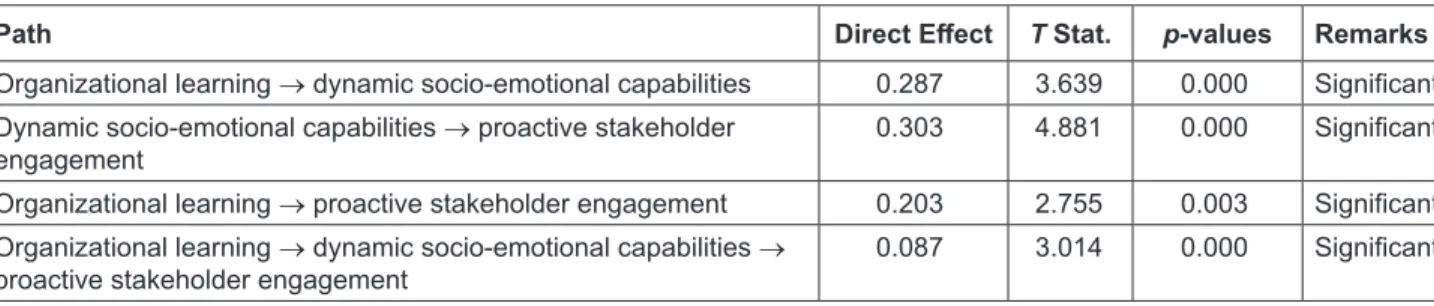
The results of the bootstrapping calculation, along with the results of the VAF calculation in Table 3. The higher the VAF value indicates that the mediation effect is perfect (Ghozali & Latan, 2014).

Table 2: Direct and Indirect Effect

Path Direct Effect T Stat. p-values Remarks

Organizational learning → dynamic socio-emotional capabilities 0.287 3.639 0.000 Significant Dynamic socio-emotional capabilities → proactive stakeholder

engagement 0.303 4.881 0.000 Significant

Organizational learning → proactive stakeholder engagement 0.203 2.755 0.003 Significant Organizational learning → dynamic socio-emotional capabilities →

proactive stakeholder engagement 0.087 3.014 0.000 Significant

(6)

The mediating effect of the dynamic socio-emotional capability constructs in the relationship between organiza- tional learning → dynamic socio-emotional capabilities → proactive stakeholder engagement is 0.1184. This means that dynamic socio-emotional capabilities have partially mediated the relationship between organizational learning and proactive stakeholder engagement.

5. Conclusion

The findings showed the importance of a supply chain management perspective for the family business in the relationship between dynamic socio-emotional capabilities to significantly mediate organizational learning to pro- active stakeholder engagement. Based on this study’s results, companies can build dynamic socio-emotional capabilities through organizational learning to increase proactive

stakeholder engagement. Dynamic socio-emotional capabilities proved to play a role as a mediator for organizational learning by family companies for proactive stakeholder engagement.

References

Aragón-Correa, J. A., Matı́as-Reche, F., & Senise-Barrio, M. í. E.

(2004). Managerial discretion and corporate commitment to the natural environment. Journal of Business Research, 57(9), 964–975. https://doi.org/10.1016/s0148-2963(02)00500-3 Barach, J. A., & Ganitsky, J. B. (1995). Successful Succession

in Family Business. Family Business Review, 8(2), 131–155.

https://doi.org/10.1111/j.1741-6248.1995.00131.x

Berrone, P., Cruz, C., Gomez-Mejia, L. R., & Larraza-Kintana, M.

(2010). Socioemotional Wealth and Corporate Responses to Institutional Pressures: Do Family-Controlled Firms Pollute Table 3: Mediation Effect

Path Direct

Effect Indirect

Effect Total

Effect VAF Remarks

Organizational learning → dynamic socio-emotional

capabilities → proactive stakeholder engagement 0.203 0.087 0.290 0.1184 Partial Mediation

Figure 1: Full Model

(7)

Less? Administrative Science Quarterly, 55(1), 82–113. https://

doi.org/10.2189/asqu.2010.55.1.82

Chirico, F. (2008). The value creation process in family firms.

A dynamic capability approach. Electronic Journal of Family Business Studies. https://www.researchgate.net/

publication/228891927_The_value_creation_process_in_

family_firms_A_dynamic_capabilities_approach

Chirico, F., & Salvato, C. (2008). Knowledge Integration and Dynamic Organizational Adaptation in Family Firms. Family Business Review, 21(2), 169–181. https://doi.org/10.1111/

j.1741-6248.2008.00117.x

Day, G. S. (1994). The Capabilities of Market-Driven Organizations.

Journal of Marketing, 58(4), 37–52. https://doi.org/10.1177/

002224299405800404

Donaldson, T., & Preston, L. E. (1995). The Stakeholder Theory of the Corporation: Concepts, Evidence, and Implications.

Academy of Management Review, 20(1), 65–91. https://doi.org/

10.5465/amr.1995.9503271992

Eisenhardt, K.M., & Martin, J.A. (2000). Dynamic capabilities: what are they? Strategic Management Journal, 21(10–11), 1105–1121.

https://doi.org/10.1002/1097-0266(200010/11)21:10/11%3C11 05::aid-smj133%3E3.0.co;2-e

Fakhri, M., Syarifuddin, S., Winarno, A., Nurnida, I., & Hanum, S.

(2021). Democratic Leadership Practice to Construct Clan Organizational Culture in Family Companies. The Journal of Asian Finance, Economics, and Business, 8(1), 803–811.

https://doi.org/10.13106/jafeb.2021.vol8.no1.803

Ghozali, I. & Latan, H. (2014). Partial least square concepts, methods and applications using the WarpPLS 5.0 program.

Semarang: Universitas Diponegoro.

Ghozali, I. & Latan, H. (2015). Partial Least Squares, konsep, teknik dan aplikasi menggunakan program Smartpls 3.0 untuk penelitian empiris. Semarang: Badan Penerbit UNDIP.

Gómez-Mejía, L. R., Haynes, K. T., Núñez-Nickel, M., Jacobson, K. J. L., & Moyano-Fuentes, J. (2007). Socioemotional Wealth and Business Risks in Family-controlled Firms: Evidence from Spanish Olive Oil Mills. Administrative Science Quarterly, 52(1), 106–137. https://doi.org/10.2189/asqu.52.1.106

Gomez-Mejia, L. R., Makri, M., & Kintana, M. L. (2010).

Diversification Decisions in Family-Controlled Firms. Journal of Management Studies, 47(2), 223–252. https://doi.org/

10.1111/j.1467-6486.2009.00889.x

F. Hair Jr, J., Sarstedt, M., Hopkins, L., & G. Kuppelwieser, V. (2014).

Partial least squares structural equation modeling (PLS-SEM).

European Business Review, 26(2), 106–121. https://doi.org/

10.1108/ebr-10-2013-0128

Hart, S. L. (1995). A Natural-Resource-Based View of the Firm.

Academy of Management Review, 20(4), 986–1014. https://doi.

org/10.5465/amr.1995.9512280033

Hillman, A. J., & Keim, G. D. (2001). Shareholder value, stakeholder management, and social issues: What’s the bottom line?. Strategic Management Journal, 22(2), 125–139.

https://doi.org/10.1002/1097-0266(200101)22:2%3C125::aid- smj150%3E3.0.co;2-h

Hong, J. (1999). Structuring for organizational learning. The Learning Organization, 6(4), 173–186. https://doi.org/10.1108/

09696479910280631

Huber, G. P. (1991). Organizational Learning: The Contributing Processes and the Literatures. Organization Science, 2(1), 88–115. https://doi.org/10.1287/orsc.2.1.88

Kittikunchotiwut, P. (2020). The Roles of Organizational Learning Capability and Firm Innovation in the Relationship between Entrepreneurial Orientation and Firm Performance. The Journal of Asian Finance, Economics and Business, 7(10), 651–661. https://doi.org/10.13106/jafeb.2020.vol7.no10.651 Laplume, A. O., Sonpar, K., & Litz, R. A. (2008). Stakeholder Theory:

Reviewing a Theory That Moves Us. Journal of Management, 34(6), 1152–1189. https://doi.org/10.1177/0149206308324322 Lindow, C. M., Stubner, S., & Wulf, T. (2010). Strategic fit within

family firms: The role of family influence and the effect on per- formance. Journal of Family Business Strategy, 1(3), 167–178.

https://doi.org/10.1016/j.jfbs.2010.08.004

Polanyi, M. (2015). Personal knowledge: Towards a post-critical philosophy. Chicago, IL: University of Chicago Press.

Rhodes, C. (1998). Book Reviews: Chris Argyris and Donald A.

Schon (1996): Organizational learning II: Theory, method and practice Reading, MA: Addison-Wesley, XXIX + 305 pp, $41.95 ISBN 0-201-62983-6. Asia Pacific Journal of Human Resources, 36(1), 107–109. https://doi.

org/10.1177/103841119803600112

Rondinelli, D. A., & London, T. (2003). How corporations and environmental groups cooperate: Assessing cross-sector alliances and collaborations. Academy of Management Perspec-tives, 17(1), 61–76. https://doi.org/10.5465/ame.2003.

9474812

Roome, N., & Wijen, F. (2005). Stakeholder Power and Organizational Learning in Corporate Environmental Manage- ment. Organization Studies, 27(2), 235–263. https://doi.org/

10.1177/0170840605057669

Salim, A., & Rajput, N. A. R. (2021). The Relationship Between Transformational Leadership, Prosocial Behavioral Intentions, and Organizational Performance. The Journal of Asian Finance, Economics, and Business, 8(1), 487–493. https://doi.org/

10.13106/jafeb.2021.vol8.no1.487

Sharma, S. (2000). Managerial interpretations and organizational context as predictors of corporate choice of environmental strategy. Academy of Management Journal, 43(4), 681–697.

https://doi.org/10.2307/1556361

Sharma, P., & Sharma, S. (2011). Drivers of proactive environmental strategy in family firms. Business Ethics Quarterly, 309–334.

https://www.jstor.org/stable/41304431

Sharma, S., & Vredenburg, H. (1998). Proactive corporate

environmental strategy and the development of competitively

valuable organizational capabilities. Strategic management

(8)

journal, 19(8), 729–753. https://doi.org/10.1002/(sici)1097- 0266(199808)19:8%3C729::aid-smj967%3E3.0.co;2-4 Tanwari, A. (2020). A Study on Assessing the Relationship between

Green Marketing and Brand Loyalty in Manufacturing Sector of Greece: A Moderating Role of Green Supply Chain Practices.

Arthatama, 4(1), 44–55. https://arthatamajournal.co.id/index.

php/home/issue/view/8

Teece, D. J., Pisano, G., & Shuen, A. (1997). Dynamic capabilities and strategic management. Strategic Management Journal, 18(7), 509–533. https://doi.org/10.1002/(sici)1097-0266 (199708)18:7%3C509::aid-smj882%3E3.0.co;2-z

Templeton, G. F., Lewis, B. R., & Snyder, C. A. (2002).

Development of a Measure for the Organizational Learning Construct. Journal of Management Information Systems, 19(2), 175–218. https://doi.org/10.1080/07421222.2002.11 045727

Westley, F., & Vredenburg, H. (1997). Interorganizational Collaboration and the Preservation of Global Biodiversity. Organization Science, 8(4), 381–403. https://doi.org/10.1287/orsc.8.4.381

Zollo, M., & Winter, S. G. (2002). Deliberate Learning and the

Evolution of Dynamic Capabilities. Organization Science,

13(3), 339–351. https://doi.org/10.1287/orsc.13.3.339.2780

수치

Table 1: Indicators on Each Dimension on Organizational Learning Awareness Communication Performance  AssessmentIntellectual  CultivationEnvironmental  AdaptabilitySocial LearningIntellectual  Capital Organizational  Grafting
Table 2: Direct and Indirect Effect

참조

관련 문서

In the research model for empirical analysis, supply chain risk factors were classified into sup- ply, demand, operation, network, and external environment, while

Supply Chain Quality Management Model SCQM 프로세스는 7대 핵심요소로 구성되어 있는 데 이들은 품질실현 프로세스와 이를 지원하기 위한 인력양성 프로세스,

We found that the integration and sharing of information between companies have a great influ- ence on supply chain integration, which has positive effects

This study analyzed the effects of direct and indirect support factors on Win-win growth in the supply chain on relationship immersion, trust, and cooperation, which

이러한 측 면에서 CRM(Customer Relationship Management) 와 SCM(Supply Chain Management)에 관한 최근의 연구 결과를 살펴보면 패션기업의 SCM환경에서 CRM의

Chang-Bong Kim and Stephen E. Ronto, “Business Performance, Process Innovation and Business Partnership in the Global Supply Chain of Korean Manufacturers,”