소아 반복성 호흡기 감염의 한약 치료에 대한 임상 연구 동향:
중의학 논문을 중심으로
이지홍․이은주․이보람․장규태
경희대학교 대학원 소아과학교실
Abstract
Review of Clinical Research about Herbal Medicine Treatment on Recurrent Respiratory Tract Infection in Children
Lee Ji Hong․Lee Eun Ju․Lee Bo Ram․Chang Gyu Tae Department of Korean Pediatrics, Graduate School, Kyung Hee University
Objectives
The purpose of this study is to investigate recent clinical studies on effect of herbal medicine treatment for recurrent respiratory tract infection in children.
Methods
We searched some clinical studies about recurrent respiratory tract infection in children from the China Academic Journal (CAJ) of China National Knowledge Infrastructure (CNKI) (January 2011 to December 2015).
Results
50 papers were selected from 168 studies. The herbal decoction was main herbal medicine treatment for recurrent respiratory tract infection in children. Commonly used herbs were Atractylodis Rhizoma Alba, Glycyrrhizae Radix, Astragali Radix, Saposhnikovia Radix and Pseudostellariae Radix. Yupingfeng keli was the most frequently used herbal compound.
Total effective rate was 66.4-100%, experimental group was significantly higher than control group in 45 papers (P<0.05). Immune index (in 22 papers) and curative effect of TCM syndrome (in 7 papers) were significantly higher than those of control group after treatment (p<0.05).
Conclusions
Herbal medicine has been shown as an effective treatment on recurrent respiratory tract infection in children.
These research results can be utilized in other clinical studies and in treatment of recurrent respiratory tract infection for children.
Key words : Herbal medicine, Recurrent respiratory tract infection, Children
Received: April 22, 2016 ∙ Revised: May 13, 2016 ∙ Accepted: May 16, 2016 Corresponding Author: Chang Gyu Tae
Department of Pediatrics of Korean Medicine, Kyung Hee University Hospital at Gang-dong, 892 Dongnam-ro, Gangdong-gu, Seoul 134-727, Republic of Korea.
Tel: +82-2-440-7126 / Fax: +82-2-440-7143 E-mail: [email protected]
ⓒ The Association of Pediatrics of Korean Medicine. All rights reserved. This is an open-access article distributed under the tenus of the Creative Commons Attribution Non-Commercial License (http://creativecommons.org/licenses/by-nc/3.0/), which permits unrestricted non-commercial use, distribution, and reproduction in any medium, provided the original work is properly cited.
ISSN 1226-8038(Print), 2287-9463(Online), http://dx.doi.org/10.7778/jpkm.2016.30.2.082
Ⅰ. Introduction
호흡기 감염은 소아에게 가장 흔한 질환으로 연평 균 6-8회 감염되고1), 면역계가 성숙함에 따라 감소하 게 되어 7세 이후에는 급격히 줄어든다. 초가을부터 늦은 봄까지 가장 흔하고2), 노출 횟수에 비례해서 발 생한다3).
소아의 잦은 호흡기 감염은 기도의 해부학적 및 기 능적 특성과 관련되어 있다. 특히 신생아기나 영유아 기 소아는 기도가 작아 폐쇄질환을 자주 일으키고, 기 도 내 점액선의 밀도가 높아 염증이 생겼을 때 쉽게 많은 점액이 분비된다. 이러한 소아의 특성을 한의학 에서는 “肺常不足”이라고 표현하였고, 肺의 宣肅機能 이 장애를 받아 氣機不利하여 津液이 쌓여 痰이 되고, 痰이 氣道를 막아 기침이 심해진다고 하였다3).
소아가 호흡기 질환에 걸린 후, 초기에 회복되지 않 거나 재감염되면 만성적인 호흡기 증상을 앓게 된다.
한국에서는 이를 하나의 질환 개념으로 보지 않지만 중국에서는 “反復呼吸道感染”의 범주에서 치료하고 있다. 이러한 반복성 호흡기 감염은 소아의 衛外機能 이 취약하여 질병의 이환과 전변이 쉬운 것과 관련되 어 있다4).
한방병원에 내원하는 소아 외래 환자의 주소증 중 호흡기계 질환이 대부분의 비율을 차지하며, 한의치료 에 대한 선호도도 가장 높지만4-6) 소아 반복성 호흡기 감염에 관한 국내 연구는 많지 않다. 강 등4)은 소아 반 복성 호흡기 감염의 내치법, 외치법 및 중서의결합치 료법 등 중의학적 치료를 고찰한 바 있다. 또한 곡 등7) 은 易感冒를 주소로 내원한 肺系虛弱兒에게 加減補肺 養營煎을 투여하여 계절변화 후 호흡기 감염 이환율 감소 및 증상 정도의 경감에 효과가 있음을 밝혔다. 이 는 효과판정 시 보호자의 주관적 서술에 의존하였고, 조사 시점이 한약 복용 후 6-10개월이 지난 때였으므 로 보호자가 정확히 기억하지 못하였을 가능성이 있었 다. 좀 더 신뢰성이 높은 연구 설계가 필요하다고 생각 되어 본 연구에서는 최근 5년간 중의학 임상 논문을 고찰하여 소아 반복성 호흡기 감염에 대한 한약 치료 연구의 기초 자료를 제시하고자 하였다.
Ⅱ. Materials and methods
1. 논문의 검색
논문 검색은 Tsinghua Tongfang (CNKI-The China National Knowledge Infrastructure)에서 제공하는 CAJ (China Academic Journals)를 이용하였다. 검색범위는 medicine & public health 내에서 Traditional chinese medicine에 한정하여, 검색어는 ‘小兒’와 ‘反復呼吸道 感染’을 일차적으로 검색하고, 그 검색 결과에서 ‘臨床’
과 ‘療效’의 추가 검색어를 사용하였으며 2011년 1월부 터 2015년 12월까지 발표된 논문을 대상으로 하였다.
이에 총 168편의 논문이 검색되었다.
2. 논문의 선별
검색된 논문의 초록을 검토하고, 필요한 경우 원문 을 확인하여 소아 반복성 호흡기 감염에 대한 논문을 선별하였다. 검색된 논문에서 한약 치료 (탕약 및 한약 제제)에 대한 임상 논문만을 연구대상으로 하였고, 외 치법 (첩부요법, 추나요법, 침구요법, 주사요법)을 사용 한 논문 (75편), 소아의 반복성 호흡기 감염과 관련이 없는 논문 (24편), review 논문 (8편), 탕약 처방 내용이 나 치료 기간과 같은 연구내용정보가 부족한 경우 (6 편), 개인 임상경험 (5편)은 제외하였다.
3. 자료의 정리
선별된 논문 50편에 대해 증례군 연구 (case series), 대조군 임상연구 (case control study), 무작위배정임상 시험 (randomized controlled trial)으로 구분하였으며, 연 구대상의 숫자, 치료방법, 치료기간, 추적기간, 평가방 법 및 치료결과를 요약하였다 (Table 1).
Ⅲ. Results
1. 연도별 분포
연도별 분포는 2011년 10편, 2012년 9편, 2013년 10 편, 2014년 11편, 2015년 10편이었다.
2. 연구방법분석
무작위배정임상시험은 43편, 대조군 임상연구는 4 편, 증례군 연구는 3편이었다.
Year
First author (Reference
No.)
Study
type SampleA: Treatment group B: Control group
Treatme nt period
Followup period
Evaluation of treatment 1. Total effective rate 2. Immune index
3. Curative effect of TCM syndrome 4. Others
2011 Quo HL (16) CS 60 n=60, 1 - 12 ys
Huaiqihuang keli (槐杞黄颗粒) 2 ms 6 ms 1. 85%
2. IgA, IgG, IgM ↑*
2011 Zhang YZ
(23) CS 56 n=56, 1 - 10 ys
Shashenyuping decoction (沙蔘玉屛湯) 21 ds 3 ms 1. 91.07%
2. IgG, IgM, IgA ↑*
2011 Li SF (24) RCT 50
A. n=25, 1 - 7 ys
WM + Yupingfeng keli (玉屛風颗粒) B. n=25, 1 - 9 ys
WM
3 ms 6 ms 1. A: 88.0%+, B: 60.0%
2011 Yu HJ (25) RCT 86
A. n=43, 1 - 6 ys
WM + Yupingfeng liquid (玉屛風口服液) B. n=43, 2 - 7 ys
WM
1 m 1 y 1. A: 83.72%+, B: 53.49%
2011 Wang ZM
(26) RCT 88
A. n=44, 3.2 ± 0.4 ys
Yibiaoguben decoction (益表固本湯) B. n=44, 3.1 ± 0.6 ys
TFOL
2 ms 6 ms 1. A: 86.36%*, B: 68.18%
2. IL-4↓, IFN-γ↑: sig. diff.*
2011 Xiang CY
(27) RCT 60
A. n=30, 4.34 ± 1.43 ys Jiajianrenshenwuweizi decoction (加减人参五味子汤)
B. n=30, 4.35 ± 1.41 ys
BCG polysaccharide and Nucleic acid injection (斯奇康)
35 ds 6 ms 1. A: 93.3*, B: 83.3%
2. IgA, IgG↑: sig. diff.+
2011 Bai T
(28) RCT 80
A. n=43, 2 - 14 ys
WM + Huangqijing liquid (黄芪精口服液) + Yupingfeng keli
B. n=43, 2 - 14 ys WM
1 m -
1. A: 100%*, B: 70%
4. Duration of symptom (fever, throat redness, cough): sig. diff. *
2011 Lei J
(29) RCT 150
A. n=80, 2 - 6 ys Yupingfeng keli B. n=70, 2 - 6 ys
Xinxibaopian (鋅硒宝片, zinc protein)
3 ms 3 ms 1. A: 93.75%+, B: 48.57%
2011 Feng B
(30) RCT 174
A. n=90, 3.5 ys
A1. Qi and blood deficiency, n=16, Qiguiguizhisan (芪歸桂枝散) A2. Qi deficiency, n=25,
Qiweibaizhusanjiawei (七味白术散加味) A3. Yin deficiency, n=14,
Gonglaodihuangsan (功勞地黄散) A4. Excessive heat, n=35, Qingrejiedusan (清热解毒散)
B. n=84, 2.9 ys TFOL
2 ms 1 y 1. A: 94.44%*, B: 78.57%
2011 Zhou HY
(31) RCT 120
A. n=60, 2.8 ± 2.1 ys WM + Yupingfeng keli B. n=60, 4.5 ± 2.1 ys Rivabirin
1 m 1 y
1. A: 96.7%*, B: 58.3%
2. IgA, IgG, IgM, CD3⁺, CD4⁺/CD8⁺ ↑, CD8⁺↓: sig. diff.*
2012 Wang CQ
(18) RCT 249
A. n=125, 0 - 14 ys
A1. Deficiency of lung and spleen qi (肺脾氣虛) : Tongkangpian (童康片) A2. Deficiency of qi and yin (氣陰兩虛) : Huaiqihuang keli
B. n=124, 0 - 14 ys B1. Tongkangpian placebo B2. Huaiqihuang keli placebo
2 ms 1 y
1. A: 66.40%+, B: 14.52%
3. TCM symptom score A: 88%+, B: 54.84%
Individual symptom score: sig. diff.
except for dysphoria and low heat Table 1. Clinical Studies about Herbal Medicine Treatment for Recurrent Respiratory Tract Infection in Children
Year
First author (Reference
No.)
Study
type SampleA: Treatment group B: Control group
Treatme nt period
Followup period
Evaluation of treatment 1. Total effective rate 2. Immune index
3. Curative effect of TCM syndrome 4. Others
2012 Liu S
(19) RCT 67
A. n=34, 1 y 2 m - 12 ys Cephradine capsule + Yupingfengsan decoction
B. n=33, 1 y 7 m - 11 ys Cephradine capsule
10 ds -
1. A: 100%, B: 100%
3. Incidence of 'Spleen asthenia syndrome after infection' (感染後脾虛綜合征) A: 32.3%, B: 60.6%
4. Adverse reaction A: 14.4%*, B: 33.3%
2012 Wang YC
(32) RCT 77
A. n=36, 1.5 - 8 ys
WM + Shuangbujiuwei decoction (雙補九味湯)
B. n=24, 1.6 - 10 ys WM + TFOL
2 ms 1 y
1. A: 97.56%+, B: 47.22%
2. IgA,IgG,IgM,IL-12, IFN-γ↑
TNF-α↓: sig. diff.+
2012 Ceng MP
(33) RCT 86
A. n=43, 1 - 8 ys
Baoerning decoction (保儿寧湯) B. n=43, 1 - 8 ys
WM
2 ms 3 ms 1. A: 88.37%*, B: 48.84%
2012 Luo WW
(34) RCT 60
A. n=30, 4.36 ± 1.56 ys
Qingxiaofanggan keli (清消防感颗粒) B. n=30, 4.43 ± 1.52 ys
Helao liquid (核酪口服液, Nucleotide and casein oral solution)
2 ms 6 ms
1. A: 93.33%*, B: 73.33%
3. Halitosis, dry stool, thirst, ect.: sig.
diff.*
2012 Li HF
(35) RCT 60
A. n=30, 0 - 14 ys Shenlingbaizhusan decoction (蔘苓白术散加减) B. n=30, 0 - 14 ys TFOL
1 m 1 y 1. A: 90%*, B: 66.67%
2012 Xu WY
(36) CCS 100
A. n=50, 0 - 11 ys WM+ Yifeijianpibushen herb (益肺健脾补肾中药) B. n=50, 0 - 11 ys WM + levamisole
3 ms 6 ms 1. A: 96%, B: 82%
2. IgA, IgG ↑: sig. diff.
2012 Wang XQ
(37) RCT 166
A. n=84, 5.25 ± 2.97 ys
Peitushengjinfang (培土生金方) + WM B. n=82, 4.56 ± 2.88 ys
TFOL + WM
3 ms 1 y
1. A: 86.9%*, B: 64.6%
2. IgG,IgA, CD3⁺, CD4⁺, CD4⁺/CD8⁺
↑, CD8⁺↓: sig. diff.*
2012 Gu XM
(38) RCT 76
A. n=40, 0.8 - 10 ys Ganpitongzhifa (肝脾同治法) B. n=36, 0.9 - 10ys TFOL
1 m 6 ms 1. A: 92.5%*, B: 57.5%
2. IgG, IgA↑: sig. diff.*
2013 Li YH
(20) RCT 86
A. n=43, 3.36 ± 1.68 ys Yupingfengsan decoction B. n=43, 3.34 ± 1.57 ys Livarin, penicillin
14 ds -
1. A: 90.70%, B: 93.02%: not sig. diff.
4. Adverse reaction
A: 4.65%, B: 13.95%: sig. diff.
2013 Qing YP
(39) RCT 98
A. n=49, 8 ms - 14 ys
Huanglongzhike keli (黃龍止咳顆粒) B. n=49, 9 ms - 12 ys
Immunomodifier
1 m 6 - 12 ms
1. A: 89.8%+, B: 73.5%
2. CD3⁺, CD4⁺, CD4⁺/CD8⁺↑, CD8⁺↓
: sig. diff.+
4. Duration of symptom (cough, sputum, rale): sig. diff.+
2013 Cui YQ
(40) RCT 60
A. n=30, 2 - 12 ys Yupingfeng decoction B. n=30, 2 - 12 ys WM + TF capsules
1 m 3 ms
1. A: 93.30%*, B: 73.30%
3. Spontaneous perspiration, anorexia, watery stool: sig. diff.*
2013 Yang N
(41) RCT 88
A. n=66, 1 - 5 ys Yupingfeng capsule B. n=22, 1 - 5 ys Tongkangpian
3 ms -
1. A: 70.77%+, B: 40.91%
3. TCM symptom (anorexia, asthenia, watery stool): sig diff.*
2013 Gao Y
(42) RCT 124
A. n=62, 1 - 12 ys Shenqiyiqiyangyin decoction (蔘芪益氣養陰湯) B. n=62, 1 - 12 ys TFO
2 ms 1 m 1. A: 93.55%*, B: 79.03%
Year
First author (Reference
No.)
Study
type SampleA: Treatment group B: Control group
Treatme nt period
Followup period
Evaluation of treatment 1. Total effective rate 2. Immune index
3. Curative effect of TCM syndrome 4. Others
2013 Hu YS
(43) RCT 63
A. n=30, 1 - 3 ys
Huangqiguizhiwuwu decoction (黄芪桂枝五物湯) + Shenlingbaizhusan granule
B. n=30, 1 - 3 ys WM + Immunomodifier
3 ms 1 y 1. A: 97.0%+, B: 87.9%
2013 Kong FY
(44) RCT 160
A. n=80, 0.5 - 13 ys
Yupingfengsan + Sijunzitang (四君子湯) B. n=80, 0.5 - 13 ys
WM + Tongkangpian
1 m 1 y 1. A: 85.00%*, B: 71.25%
2. IgG↑: sig. diff.*
2013 Ou G
(45) RCT 120
A. n=60, 1 - 7 ys
Yupingfengsan + Shenlingbaizhusan B. n=60, 1 - 7 ys
TFOL
1 m 1 y 1. A: 95%+, B: 80%
2013 Xu WP
(46) RCT 80
A. n=40, 2 - 10 ys Jianpiyifeifang (健脾益肺方) B. n=40, 2 - 10 ys TFOL
3 ms 1 y
1. A: 95.0%*, B: 77.5%
2. CD4⁺/CD8⁺, IgG, IgA↑, CD8⁺↓ : sig. diff.*
CD3⁺, CD4⁺↑: sig. diff.+
2013 Luo P
(47) RCT 98
A. n=50, 0.5 - 10 ys
WM + Astragalus particles (黄芪顆粒) B. n=48, 0.5 - 10 ys
WM
3 ms 6 ms 1. A: 86.0%*, B: 58.3%
2014 Wu SH
(48) RCT 80
A. n=40, 1 - 6 ys
Clostridium butyricum powder (宝樂安) + WM
B. n=40, 1 - 6 ys TF + WM
6 - 9 ms 1 y
1. A: 90%*, B: 75%
2. CD3⁺, CD4⁺ ↑, CD8⁺↓: sig. diff.*
4. Duration of symptom A: 9.52 ± 0.18 ds B: 15.67 ± 1.91 ds+
2014 Huo YM
(49) RCT 552
A. n=278, 1 - 12 ys Huaiqihuang keli + WM B. n=274, 1 - 12 ys WM
6 ms - 1. A: 86.3%*, B: 67.2%
2. IgA, IgG, CD3⁺, CD4⁺↑: sig. diff.*
2014 Xie J
(50) RCT 80
A. n=40, 41.40 ± 25.80 ms Guanyin mixture (觀音合劑) B. n=40, 39.80 ± 25.74 ms Spleen aminopeptide
1 m 6 ms
1. A: 85%*, B: 65%, 2. Saliva SIgA↓: sig. diff.+
3. Curative effect of TCM syndrome A: 90%, B: 62.5%: sig. diff.*
2014 Liu Y
(51) RCT 134
A. n=67, 1.5 - 12 ys
Pidotimod + Kanggan granule (抗感顆粒) B. n=67, 1.5 - 12 ys
Pidotimod
1 m -
1. A: 92.54%*, B: 80.60%
4. Symptom disappearance time (cough,
fever and pulmonary rales) : sig. diff.*
2014 Wu FH
(52) RCT 192
A. n=97, 2.8 ys
Fuyangjianzhong granule (扶陽建中顆粒) B. n=95, 2.4 ys
Levamisole
2 ms 2 ms 1. A: 94.8%*, B: 66.3%
2014 Zhang JP
(53) RCT 80
A. n=40, 1 - 8 ys WM + Sijunzitang B. n=40, 1 - 8 ys WM + Pidotimod
1 m 6 ms 1. A: 97.5%*, B: 77.5%
2014 Yu WB
(54) RCT 66
A. n=33, 8 ms - 6 ys WM + Yupingfeng granule B. n=33, 8 ms - 7 ys WM
2 ms 1 y 1. A: 84.84%+, B: 36.36%
2014 He H
(55) CCS 70
A. n=35, 10 ms - 11 ys
Buzhongyiqi decoction (補中益氣湯) B. n=35, 10 ms - 11 ys
Cephalosporins
2 ms 1 y
1. A: 88.57%*, B: 57.14%
3. Sweating, asthenia, anorexia, abnormal defecate: sig diff.*
Year
First author (Reference
No.)
Study
type SampleA: Treatment group B: Control group
Treatme nt period
Followup period
Evaluation of treatment 1. Total effective rate 2. Immune index
3. Curative effect of TCM syndrome 4. Others
2014 Li BK
(56) CS 100 n=100, 1.5 - 12 ys
Xiaokeyin decoction (哮咳飮) 14 ds - 1. 97%
2014 He R
(57) RCT 120
A. n=60, 0.5 - 6 ys Shenlingbaizhusan keli B. n=60, 0.4 - 5.8 ys Pidotimod
2 ms 1 y
1. A: 95%*, B: 80%
3. Anorexia, sweating, abnormal defecation : sig. diff.*
2014 Ai YH
(58) RCT 268
A. n=60, 2.6 ys
Qingredaozhifang (清熱導滯方) B. n=60, 2 ys
Levamisole
3 ms - 1. A: 96.31%+, B: 71.53%
2015 Yu F
(17) CCS 98
A: n=51, 2.7 ± 1.4 ys Huaiqihuang keli + WM B: n=47, 2.9 ± 1.5 ys WM
3 ms -
1. A: 96%*, B: 79%
2. IgA, IgG, CD3⁺, CD4⁺, CD4⁺/CD8⁺↑, CD8⁺↓: sig. diff.*
2015 Zhao T
(59) RCT 120
A. n=60, 4.7 ± 1.3 ys Buzhongyiqi decoction B. n=60, 4.3 ± 1.2 ys Ketotifen fumarate tablets
40 ds - 1. A: 95%*, B: 75%
2015 Chen S
(60) RCT 75
A: n=40, 4 - 6 ys
Shenlingbaizhu keli + Yupingfeng keli B: n=35, 3 - 7 ys
Yupingfeng keli
3 ms 6 ms
1. A: 87.5%*, B: 68.57%
4. Recurrence rate A: 7.69%
B: 35.71%
2015 Ma CZ
(61) RCT 100
A: n=50, 2 - 10 ys
Jianerfuzhengfang (健兒扶正膏方) B: n=50, 2 - 10 ys
Pidotimod granule
2 ms - 1. A: 96%*, B: 88%
2. IgA, IgG, IgM↑: sig. diff.*
2015 Zhang YF
(62) CCS 116
A: n=58, 1 - 7 ys
Jianpigubiaofang (健脾固表方) + WM B: n=58, 1 - 7 ys
Levamisole + WM
3 ms 1 y 1. A: 96.55%*, B: 79.31%
2. IgA,IgG↑: sig. diff.*
2015 Wang ZM
(63) RCT 112
A: n=56, 6.09 ± 2.29 ys Yigan keli (易感颗粒) B: n=56, 6.12 ± 2.26 ys
TF capsules + Pediatric cough cyrup
while symptom
persists
1 y 1. A: 96.4%+, B: 73.2%
2. CD4⁺↑: sig. diff*.
2015 Xie M
(64) RCT 130
A: n=65, 2 - 12 ys Astragalus particles B: n=65, 3 - 11 ys Pidotimod
14 ds 3 ms 1. A: 96.92%*, B: 76.92%
2. IgA, IgE, IgM↑: sig. diff.*
2015 Ding HL
(65) RCT 120
A: n=60, 1.2 - 10 ys Baogen-Ⅰ decoction (宝根1号) B: n=60, 1.1 - 10 ys Pidotimod
2 ms 1 y
1. A: 91.67%+, B: 66.67%
2. IgA, IgG, IgM, CD3⁺, CD4⁺↑: sig.
diff.*
2015 Chen YY
(66) RCT 80
A: n=40, 5.45 ± 1.65 ys
WM (acute phase) + Yupingfengsan + Yigongsan (異功散)
B: n=40, 5.55 ± 1.55 ys WM (acute phase) + Pidotimod
2 ms -
1. A: 97.5%*, B: 85%
2. IgA, IgG, IgM, CD3⁺, CD4⁺↑, CD8⁺↓: sig. diff.*
2015 Wang WY
(67) RCT 86
A: n=43, 3 - 5 ys Baoerningtang B: n=43, 2 - 6 ys Levamisole
1 m 3 ms A: 97.67%*, B: 87.32%
CS: case series, CCS: case control study, RCT: randomized controlled trial, d: day, m: month, y: year sig. diff.: significantly different between two groups after treatment
* : P<0.05, + : P<0.01
WM (western medicine): when the infection with antibiotics, antiviral drugs or symptomatic treatment TFOL: Transfer factor oral liquid, TF: Transfer factor
3. 연구대상 숫자
50명 이하는 1편, 51명 이상 100명 이하는 31편, 101명 이상 150명 이하는 11편, 151명 이상 200명 이 하는 4편, 201명 이상은 3편이었다.
4. 치료방법
탕약을 대상으로 한 것은 26편, 한약제제는 23편이 었다 (Table 2).
탕약은 증상에 따라 기본 처방에 가감한 논문도 있 었는데, 기본 처방에 대한 약재만을 분석하였다. 白术 이 22회로 가장 많이 사용되었고 甘草가 21회, 黄芪가 20회, 防風이 15회, 茯苓과 太子蔘이 각각 12회였다
(Table 3).
한약제제의 경우, 玉屛風顆粒이 4편, 槐杞黄顆粒, 蔘苓白术顆粒, 黄芪顆粒이 각각 2편이었다 (Table 4).
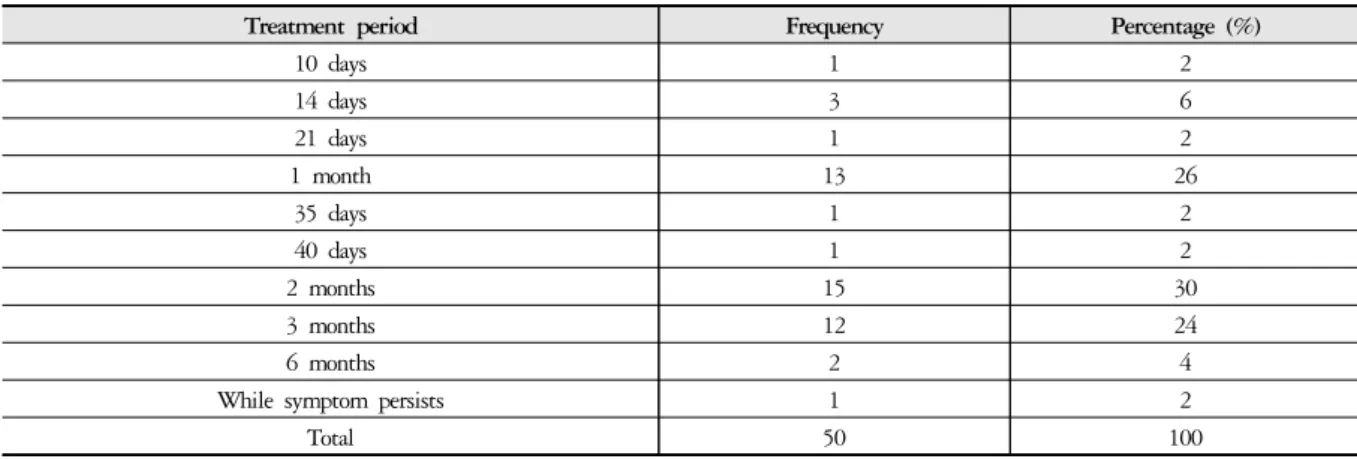
5. 치료기간
2개월이 15편으로 가장 많았고, 1개월이 13편, 3개 월이 12편이었다 (Table 5).
6. 추적기간
1년이 18편으로 가장 많았고, 추적기간 없이 치료 종료 후 바로 판정한 경우가 12편, 6개월이 11편이었 다 (Table 6).
Frequency Percentage (%)
Decoction 26 52
Herbal compound 23 46
Decoction + Herbal compound 1 2
Total 50 100
Table 2. Types of Herbal Medicine
Frequency Herbal name
22 Atractylodis Rhizoma Alba (白朮) 21 Glycyrrhizae Radix (甘草) 20 Astragali Radix (黃芪) 15 Saposhnikovia Radix (防風)
12 Polia Sclerotium (茯笭), Pseudostellariae Radix (太子蔘) 9 Paeoniae Radix Alba (白芍藥)
8 Cinnamomi Ramulus (桂枝), Codonopsis Pilosulae Radix (黨蔘), Citri Reticulatae Pericarpium (陳皮) 6 Platycodi Radix (桔梗), Angelicae Gigantis Radix (當歸), Dioscoreae Rhizoma (山藥)
5 Mahonia fortunei (功勞葉), Crataegii Fructus (山楂), Massa Medicata Fermentata (神麯), Polygonati Rhizoma (黃精) 4 Galli Stomachichum Corium (鷄內金), Liriopes Radix (麥門冬), Schizandrae Fructus (五味子)
3 Fossilia Ossis Mastodi (龍骨), Zizyphi Fructus (大棗), Aucklandiae Radix (木香), Pinelliae Rhizoma (半夏), Amomi Fuctus (砂仁), Bupleuri Radix (柴胡), Fritillaria Thunbergii Bulb (貝母), Dolichoris Semen (扁豆)
2
Trichosanthis Semen (瓜蔞仁), Raphani Semen (蘿蔔子), Hordei Fructus Germiniatus (麥芽), Lilii Bulbus (百合), Adenophorae Radix (沙蔘), Zingiberis Rhizoma Recens (生薑), Rehmanniae Radix (生地黃), Rehmanniae Radix Preparat (熟地黃), Cimicifugae Rhizoma (升麻), Polygonati Odorati Rhizoma (玉竹), Coicis Semen (薏苡仁), Aaurantii Immaturus Fructus (枳實), Gardeniae Fructus (梔子), Scrophulariae Radix (玄蔘)
1
Puerariae Radix (葛根), Agastachis Herba (藿香), Calyx Seu Fructus Physalis (挂金灯), Gynostemma Pentaphyllum (絞股藍), Lonicerae Flos (金銀花), Phragmitis Rhizoma (盧根), Rhei Rhizoma (大黃), Persicae Semen (桃仁), Striga asiatica (獨脚金), Benincasae Semen (冬瓜仁), Forsythiae Fructus (連翹), Ephedrae Radix (麻黃根), Moutan Cortex (牧丹皮), Ostreae Concha (牡蠣), Sinapis Semen (白芥子), Amomi Rotundus Fructus (白荳蔲), Dictamni Radicis Cortex (白鮮皮), Psoraleae Fructus (補骨脂), Tritici Cimmatri Semen (浮小麥), Arecae Semen (檳榔), Belamcandae Rhizoma (射干), Elephantis Dens (象牙絲), Gypsum Fibrosum (石膏), Epimedi Herba (仙靈脾), Cicadae Periostracum (蟬蛻), Agrimoniae Herba (仙鶴草), Asari Herba Cum Radix (細辛), Houttuyniae Herba (魚腥草), Evodiae Fructus (吳茱萸), Arctii Fructus (牛蒡子), Polygalae Radix (遠志), Ginseng Radix (人蔘), Perilliae Semen (紫蘇子), Hominis Placenta (紫河車), Peucedani Radix (前胡), Phyllostachydis Folium (竹葉), Pheretimae Corpus (地龍), Anemarrhenae Rhizoma (知母), Cnidii Rhizoma (川芎), Alismatis Rhizoma (澤瀉), Cuscutae Semen (免絲子), Nelumbinis Folium (荷葉), Armeniacae Semen (杏仁), Natrii Sulfas Exsiccatus (玄明粉), Scutellariae Radix (黃芩)
Table 3. Frequency of Herbs in Prescription
7. 효과분석
50편의 모든 논문에서 총유효율로 효과를 평가하였 다. 그 외에 면역지표 (immune index)로 평가한 것이 22편, 중의징후 개선 (curative effect of TCM syndrome) 이 8편이었다 (Table 7).
Ⅳ. Discussion
호흡기계 허약아는 외부 환경에 대한 적응력이 매 우 약하여 또래에 비해 감기, 폐렴 등 호흡기계 질환에 반복적으로 이환되는 소아를 말한다. 급성 상기도 감
Frequency Herbal compound name
4 Yupingfeng keli (玉屛風顆粒)
2 Huaiqihuang keli (槐杞黄顆粒), Astragalus particles (黄芪顆粒), Shenlingbaizhu granule (蔘苓白术顆粒)
1
Yupingfeng liquid (玉屛風口服液), Huangqijing liquid (黄芪精口服液) + Yupingfeng keli, Qingxiaofanggan keli (清消防感顆粒), Tongkangpian (童康片) + Huaiqihuang keli, Huanglongzhike keli (黄龍止咳顆粒), Yupingfeng capsule (玉屛風胶囊), Clostridium butyricum powder (宝樂安), Guanyin mixture (關音合劑), Kanggan granule (抗感顆粒), Fuyangjianzhong granule (扶陽建中顆粒), Canlingbaizhu keli (蔘苓白术顆粒), Shenlingbaizhu keli + Yupingfeng keli, Jianerfuzheng formula (健兒扶正膏方), Yigan keli (易感顆粒) Table 4. Frequency of Herbal Compound
Treatment period Frequency Percentage (%)
10 days 1 2
14 days 3 6
21 days 1 2
1 month 13 26
35 days 1 2
40 days 1 2
2 months 15 30
3 months 12 24
6 months 2 4
While symptom persists 1 2
Total 50 100
Table 5. Distribution of Treatment Period
Follow-up period Frequency Percentage (%)
1 month 1 2
2 months 1 2
3 months 6 12
6 months 11 22
6 - 12 months 1 2
1 year 18 36
After the end of treatment 12 24
Total 50 100
Table 6. Distribution of Follow-up Period
Frequency Percentage (%)
Total effective rate 50 100
Immune index 22 44
Curative effects of TCM syndrome 8 16
Others 7 14
Table 7. Analysis of Effect
염 증상이 소실된 후에 기침, 콧물, 코막힘 등이 지속되 거나, 과거력으로 모세기관지염, 부비동염, 중이염 등 이 있었던 경우가 많다. 한방소아과에는 易感冒나 기 침을 주소로 내원하게 된다3).
감기는 발열, 두통, 콧물, 기침 등을 주 증상으로 하 며, 발병 빈도는 연평균 6-8회 정도이다. 영양상태가 불량한 경우 발생 빈도가 증가하며 합병증도 많이 발 생한다. 최근 미세먼지와 같은 호흡기 자극 요인이 늘 어나고, 맞벌이 부부의 증가로 집단생활을 과거에 비 하여 일찍 시작하게 되어 감기 발생 횟수가 증가하는 경향을 보인다3).
소아의 병리적 특징인 “易感冒”는 <溫病條辨ㆍ解 兒難>8)에서 “臟腑薄, 藩籬疏, 易于轉變, 肌膚嫩, 神氣 怯, 易于感觸”이라고 표현되듯이 衛外機能이 취약하 여 질병의 이환과 전변이 쉽다는 것이다4). 이와 같이 소아가 쉽게 감기에 걸리고 호흡기 감염이 만성적으로 반복되는 것을 중의학에서는 “反復呼吸道感炎” 또는
“復感兒”라고 지칭하고 있다9).
反復呼吸道感炎 (Recurrent respiratory tract infection, RRTI)은 1년 이내 발생한 상, 하기도 감염의 횟수가 정상범위를 초과 (7-10회 이상)하는 것을 말한다. 임상 적으로 감기, 기관지염, 폐렴 등이 반복적으로 발생하 는 것으로 표현된다9).
진단기준은 연간 호흡기 감염 횟수로 평가되며 만 2세 미만의 경우, 상기도 감염 7회 이상, 하기도 감염 3회 이상이며, 2세 이상 5세 미만의 경우, 상기도 감염 6회 이상, 하기도 감염 2회 이상이고, 5세 이상 14세 미만의 경우, 상기도 감염 5회 이상, 하기도 감염 2회 이상이다. 두 차례 감염의 기간 간격은 7일 이상이어야 한다9).
발병특징으로 병정이 비교적 길어 상기도 감염이 10 일 이상 지속되고 하기도 감염은 3주 이상 지속된다.
또한 호흡기 감염이 다 낫지 않았는데 연이어 감염이 되거나, 초기에는 상기도 감염이었는데 빠르게 하기도 감염으로 발전되기도 한다9).
최 등10)과 이 등5)은 한방병원 한방소아청소년과에 가 장 많이 방문하는 질환 계통은 호흡기 질환 (25.4-37.3%) 이며 감기는 그 중 주된 단일질환 (28.9-34%)이고 易感 冒가 3번째 질환 (19%)이라고 보고한 바 있다. 이처럼 감기로 인하여 내원하는 환자수가 많고, 임상에서 호흡 기계 허약아를 많이 관찰할 수 있음3)에도 불구하고 반 복성 호흡기 감염이나 易感冒에 관한 국내 한의학 임상 연구는 많지 않다4,7).
반복성 호흡기 감염의 임상 효과를 판정하기는 쉽 지 않다. 연간 호흡기 감염의 횟수를 회고해야 하는데, 이를 정확히 파악하기에 어려움이 있을 수 있다. 또한 이원화된 의료체계에서 환자 및 보호자가 한약이나 양 약을 선택하여 복용하기 때문에 복용한 약이나 치료에 대한 정확한 파악이 어렵다. 그렇기 때문에 소아 반복 성 호흡기 감염에 대하여 비교적 활발히 연구가 진행 되고 있는 중의학 임상 논문을 고찰하여 치료 효과 및 임상 연구에 대한 정보를 얻고자 하였다.
본 연구는 CAJ검색을 통해 최근 5년간 (2011년 1월 -2015년 12월) 출판된 중국 임상 논문 50편을 분석하였다.
치료방법으로 탕약을 처방한 것이 26편, 한약제제 가 23편으로, 탕약뿐만 아니라 한약제제에 대한 연구 가 활성화되어있다는 점을 알 수 있었다. 이는 중국에 서 한약제제 사용이 매우 보편화되어있는 상황을 반영 한 것으로, 중국의 대표적 공공의료기관인 衛生部北京 醫院의 경우, 한약처방 중 한약제제의 비율이 88.4%이 고, 탕약은 11.6%라고 하였다11).
한약제제 중 玉屛風顆粒이 4편으로 가장 많이 사용 되었다. 형태는 다르지만 玉屛風散을 기반으로 제조된 玉屛風口服液, 玉屛風胶囊 뿐만 아니라 다른 한약제 제와 합방하여 처방된 것까지 포함하면 총 8편으로 전 체 한약제제 중 34.8%를 차지하였다. 玉屛風散은 <丹 溪心法>12)에 기재된 처방으로 黃芪, 防風, 白朮로 구 성되며, 表虛로 衛陽이 不固하여 나타나는 惡寒自汗 과 風邪에 쉽게 감염되는 것을 치료한다. 黃芪는 益氣 固表하고 白朮은 健脾益氣하여 氣血의 化源을 보조하 여 氣充血旺하게 하며, 防風은 走表祛風하여 결과적 으로 益氣固表, 止汗祛風하는 처방이다13).
탕약 처방 중 가장 많이 사용된 약재는 白朮이었고, 그 다음으로 甘草, 黃芪, 防風, 茯笭, 太子蔘 순서였다.
다용 약재 중 白朮, 黃芪, 防風은 玉屛風散으로 한약제 제에서 다용된 玉屛風散의 구성과 같아, 탕약에서도 빈번히 사용되었음을 알 수 있었다. 甘草는 補脾益氣, 潤肺止咳하고 茯笭은 健脾開胃, 利水滲濕하며 太子蔘 은 補氣生津하는 효능이 人蔘과 유사하여 흔히 代用 되는데, 이 약재들은 치료군에 투여된 四君子湯이나 蔘苓白朮散 처방 내에서 사용되었다13).
급성 감염기에는 모든 피험자에게 동일하게 항생제 나 항바이러스제 및 대증치료를 시행하고, 완해기에 치료군과 대조군에 투약을 달리한 논문이 16편이었다.
대조군에 대한 투약으로 면역증강제 합성물을 사용한 것이 26편, 대조군에 단독으로 항생제나 항바이러스제
를 사용한 것이 5편, 위약을 투여한 것이 1편이었다.
면역증강제 (Immunostimulants)는 동물 및 인체의 면역성을 증가시키는 물질로 정의되며, 범위가 매우 넓고 다양하여 체내 면역조절 물질, 백신의 개념과 중 복되는 미생물 유래의 물질, 천연의 식물에서 유래되 는 물질 등이 포함된다14). 인체에 투여한 후에는 혈액 및 기관지 조직 내 항체를 생성하며, 면역글로불린 (IgM, IgG, IgE), T 세포와 NK 세포 활동을 증가시키거 나 정상화한다. 또한 폐포 대식세포의 활동 자극, CD4/CD8 비율, IgA 및 IgG 농도의 정상화 등이 보고 된 바 있다15). 대상 논문에서 대조군에 투여된 면역증 강제는 pidotimod나 transfer factor oral liquid와 같은 화 학합성물이었다.
중국에서 제정된 RRTI의 중약 임상시험설계지침9) 에 따르면 치료기간은 최소 2-3개월이 되므로 치료기 간 중 1개월을 하나의 치료 과정으로 하여, 중의징후 개선 상황을 중점적으로 고찰해야 한다고 하였다. 또 한 호흡기 감염에는 계절성이 있기 때문에 추적기간은 1년으로 설계되는 것이 좋고, 매 3개월간 1차례 추적조 사를 시행해야 한다고 하였다. 피험아동에 대한 일지 를 작성하여, 추적기간 내 호흡기 감염 횟수, 병정, 지 속기간, 치료약, 유해반응에 대한 상황을 기록하도록 하였다. 또한 Quo의 연구16)에서는 8주간의 치료기간 후, 추적기간을 6개월로 하며, 치료기간에는 매 1-2주 에 1회 진찰하고, 추적기간에는 매월 1회 진찰하며, 주 로 전화로 조사하여 호흡기 감염의 발병 횟수와 정도 를 파악하도록 하였다.
치료효과는 50편의 모든 논문에서 총유효율로 평가 하였다. 또한 면역지표, 중의징후, 기타 방법으로 평가 하였는데, 기타에는 호흡기 증상 (발열, 인후발적, 기 침, 가래 등)의 기간, 재발률, 유해반응 발생률이 포함 되었다.
총유효율은 66.4-100%로 대조군이 설정된 47편 중 45편 (95.7%)의 논문에서 치료 후 대조군에 비하여 유 의하게 높았다 (p<0.05). 총유효율은 한약 투여를 마친 후, 추적기간 내 호흡기 감염 횟수 감소, 발병 시 증상 의 개선 정도 및 치료시간의 단축을 평가하여 측정된 다17).
면역지표로서 혈청면역단백 (IgA, IgM, IgG), T세포 아형 (CD3⁺, CD4⁺, CD8⁺), IL-4, IFN-γ 등이 측정되었 다. 대조군이 설정된 20편 모두에서 치료 후 대조군에 비하여 의미 있는 차이를 나타냈다 (p<0.05).
중의징후는 自汗, 面色少華, 納呆食少, 倦怠乏力, 便溏, 手足心熱, 盜汗, 低熱, 口乾喜飮 등 증상을 점수 화하여 개선정도를 평가하였다. 중의징후를 평가한 모 든 논문에서 치료한 후에 치료 전과 비교하여 개선되 었고, 대조군에 비하여 치료 후 의미 있는 차이가 있었 다. Wang18)의 논문에서 12개월 후 평가한 중의징후 치 료점수에서 치료군의 유효율은 88%로 54.84%인 대조 군에 비하여 유의하게 높았다 (p<0.01). 각 개별 항목에 대해서도 手足心熱과 低熱을 제외한 항목에서 유의미 한 차이가 있었다. 또한 Liu19)의 논문에서 “感染後脾虛 綜合征”의 발생률을 조사하였는데 치료군은 32.3%으 로, 60.6%인 대조군에 비하여 현저하게 낮았다.
感染後脾虛綜合征은 Meng20)이 보고한 것으로 소아 가 1회 이상 급성 및 아급성 감염 후에 오래지 않아 발생하는 脾虛한 증상의 증후군을 말한다. 주요 임상 표현은 食欲不振, 乏力, 多汗, 大便不調, 睡眠不佳, 少 氣懶言, 流涎, 消瘦或虛胖, 面色苍白或萎黄少华, 舌質 淡或胖或有齒痕 등과 같다.
유해반응에 대한 발생률을 조사한 2편의 논문19,21)에 서 대조군에 비하여 의미 있게 낮았다. Li21)는, 玉屛風 散 加味를 처방한 치료군이 항생제를 처방한 대조군에 비하여 총유효율은 의미 있는 차이가 없었지만 (p>0.05) 유해반응 발생률에서는 의미 있게 낮았다고 보고하였다 (p<0.05).
Cochrane review22)에 의하면, 한약 추출물과 같은 면 역 자극 물질은 급성 호흡기 감염에 민감한 아이들에 게 발병률을 평균 40% 감소시키나, 조사된 임상 연구 의 질이 낮고, 일부의 연구에서만 유해반응 (발진, 오 심, 구토, 복통, 설사 등)에 대한 정보가 언급되었다고 지적한 바 있다. 소아의 RRTI에 대한 한약 치료 효과 를 판정함에 있어서 근거의 질이 높은 연구가 필요하 다고 생각되며 다기관 무작위 대조군 연구가 시행되어 야 할 것이다.
이상 중의학 논문을 통해 살펴본 결과, RRTI의 소 아에게 한약 치료를 시행하였을 때, 감염 횟수를 줄이 는 효과 뿐 아니라 면역지표의 개선, 중의징후로 표현 되는 신체 건강 상태 개선과 같은 효과를 볼 수 있었다.
호흡기 감염 예방 효과가 뛰어난 한약에 대하여 임상 연구가 활발히 이루어져야 할 것이며, 본 연구의 결과 가 향후 한약 치료의 임상 연구에서 기초 자료로 활용 될 수 있을 것이다.
Ⅴ. Conclusion
CNKI (The China National Knowledge Infrastructure) 에서 제공하는 CAJ (China Academic Journals)에서 검색 을 통해 선별된 소아 반복성 호흡기 감염의 한약 치료 에 대한 임상 연구 50편을 분석하여 다음과 같은 결과 를 얻었다.
1. 연구방법은 대부분 무작위배정임상시험으로 진행 되었고, 그 외 대조군 임상연구, 증례군 연구였다.
2. 치료방법으로 주로 탕약을 대상으로 하였지만, 한약제제의 치료 효과 역시 활발히 연구되었다.
한약제제 중 가장 많이 사용된 것은 玉屛風顆粒 이었고, 처방된 탕약 중 다용 약재는 白朮, 甘草, 黃芪, 防風, 茯笭, 太子蔘 순서였다.
3. 치료기간은 2개월이 가장 많았고, 추적기간은 1 년이 가장 많았다.
4. 치료 전후의 효과는 모든 논문에서 총유효율로 평가하였으며, 그 외 면역지표 변화, 중의징후 개 선, 유해반응 발생률 등이 평가되었다.
5. 총유효율은 66.4-100%였고, 95.7%의 논문에서 치료군은 대조군에 비하여 의미 있게 높게 나타 났다. 면역지표의 경우 평가된 22편 모두에서, 중 의징후의 경우 8편 모두에서 치료 후 대조군에 비하여 의미 있는 차이를 나타냈다.
References
1. Ahn HS. Textbook of Pediatrics. Seoul: Miraen, 2012:633.
2. Banz K, Schwicker D, Thomas AM. Economic evaluation of immunoprophylaxis in children with recurrent ear, nose and throat infections. Pharmacoeconomics. 1994;
6(5):464-77.
3. Kim KB, Kim DG, Kim YH, Kim JH, Min SY, Park EJ, Baek JH, Sung HK, Yu SA, Lee SY, Lee JY, Lee HJ, Chang GT, Jung MJ, Chai JW, Cheon JH, Han YJ, Han JK. Hanbangsoacheongsonyeonuihak. Seoul: Ui Sung Dang Publishing Co. 2015:168-9, 173, 320, 326, 334, 346.
4. Kang MS, Chang GT, Kim JH. A study on chronic
or recurrent respiratory syndromes. J Pediatr Korean Med.
2002;16(2):83-99.
5. Lee SY. An observation of the chief complaints of pediatric outpatients. J Pediatr Korean Med. 2001;15(1):203-16.
6. Han JK, Kim YH. Health care utilization of pediatrics outpatients in the oriental hospital. J Pediatr Korean Med. 2001;15(2):209.
7. Gok SY, Jung SK, Lyu SA, Lee SY. Effects of Gagam-Bopyeyangyeongjeon on the lung weakness children. J Pediatr Korean Med. 2010;24(2):88-98.
8. Wu T. Wenbingtiaobian. Beijing: People's Medical Publishing House. 1994:190-1.
9. Clinical Evaluation Unit, Pediatric branch of China associa- tion for traditional chinese medicine. Guideline on evalua- tion of new drug of Chinese materia medica for treatment of recurrent respiratory tract infections in Children. Drug Eval Res. 2015;38(3):238-43.
10. Choi MH, Kim DG, Lee JY. A study of the chief complaint of pediatric outpatients in the Kyung Hee Oriental Medicine hospital. J Pediatr Korean Med.
2010;24(3):121-37.
11. The Minjok Medicine News. 2012.11.29. Available from:
http://www.mjmedi.com/news/articleView.html?idxno
=23863
12. Zhu ZH. Danxixinfa. Beijing: China Medical Science Press. 1481:49.
13. Kim SC, Kim SH, No SH, Park SD, Park SG, Seo BI, Seo YB, Shin MS, Lee SI, Lee JC, Lee CH, Ju YS, Choi HY. Herbal prescription. Seoul: Yeong Rim Sa Pulishing Co. 1990:356-7.
14. Korean Intellectual Property Office. 2001 New technol- ogy trend report (Immunostimulants). Daejeon: Korean Intellectual Property Office. 2001:17-20.
15. Bergmann KC. Assessment of the clinical value of using an immunomodulator in respiratory infections. Adv Exp Med Biol. 1995;371B:795-7.
16. Quo HL. Evaluation of clinical effect of Huaiqihuang Keli on the recurrent respiratory tract infections in the children patients. Clin Med. 2011;31(10):121-2.
17. Yu F. Clinical observation of Huaiqihuang Keli in treat- ment of children with recurrent respiratory tract infections. Mod J Intergr Tradit Chin Western Med.
2015;24(8):861-3.
18. Wang CQ, Ma R, Li XM, Hu SY, Wang LN, Yu JE, Wang XF, Zhu XK, Ding Y, Zhang XL. Clinical research on optimization program of treating recurrent respiratory tract infection (RRTI) in children with Chinese medicine. Chin J Tradit Chin Med Pharmacy.
2012;27(4):1136-9.
19. Liu S. Clinical research on the treatment of children with recurrent respiratory tract infection in Jiajianyupingfengsan decoction: a report of 34 cases. Northern Med. 2012;9(7):17.
20. Meng ZF. The clinical observation of spleen weak syn- drome of post-infection in children. J Chin Med.
1988;29(5):35-6.
21. Li YH. Modified Yupingfengsan in treating 43 cases of recurrent respiratory tract infection in children.
Western J Tradit Chin Med. 2013;26(6):60-1.
22. Del-Rio-Navarro BE, Espinosa-Rosales F, Flenady V, Sienra-Monge JJ. Immunostimulants for preventing res- piratory tract infection in children (Review). Cochrane Libr. 2006;4:1-2.
23. Zhang YZ, Tai XT, Chen L. Evaluation of clinical effect of Shashen Yuping decoction on the recurrent respiratory tract infections in the children patients with Qi and Yin deficiency. J Yunnan Univ Tradit Chin Med. 2011;34(6):44-6.
24. Li SF. Evaluation of clinical effect of Yupingfeng Keli on the recurrent respiratory tract infections. Chin Foreign Med Rese. 2011;9(27):22-3.
25. Yu HJ. Evaluation of clinical effect of Yupingfeng liquid on the recurrent respiratory tract infections. Strait Pharm J. 2011;23(10):166-7.
26. Wang ZM. Clinical research on the treatment of children with recurrent respiratory tract infection in Yibiao Guben decoction. Clin J Chin Med. 2011;11(3):14-5.
27. Xiang CY. Clinical research on the treatment of children with recurrent respiratory tract infection in Jiajianrenshenwuweizi decoction. Guiding J Tradit Chin Med Pharmacy. 2011;17(7):42-3.
28. Bai T, Li Y. Evaluation of clinical effect of Zhongyaojiehe treatment on the recurrent respiratory tract infections.
Asia Pac Tradit Med. 2011;7(11):69.
29. Lei J, Liu HH. Evaluation of clinical effect of Yupingfeng keli on the recurrent respiratory tract infections. Jiangxi Med J. 2011;46(11):1027.
30. Feng B, Qi H, Zheng H. Clinical experience of Zheng Qi - zhong on preventing and treating infantile re- current respiratory infection based on traditional Chinese constitution theory. Chin J Chin Med. 2011;26(12):
1443-4.
31. Zhou HY, Ma HY, Yang MY. Evaluation of clinical effect of Yupingfeng keli on the recurrent respiratory tract infections. Guiding J Tradit Chin Med Pharmacy.
2011;17(3):31-2.
32. Wang YC, Zhang LJ, Hu GH, Wang MH, Tang XY, Guo H, Shi YM, Chen SF, Shi CC. Evaluation of clinical effect of Shuangbujiuweitang on the recurrent respiratory tract infections and immune modulation. Chin J Chin Mater Med. 2012;37(7):1039-42.
33. Ceng MP. Evaluation of clinical effect of Baoeernigtang on the recurrent respiratory tract infections. Chin Med Eng. 2012;20(12):144.
34. Luo WW, Wu LC. Evaluation of clinical effect of Qingxiaofanggan keli on the recurrent respiratory tract infections. J New Chin Med. 2012;44(4):72-3.
35. Li HF, Song TD. Shenlingbaizhu powder for the treatment of children with recurrent respiratory tract infections randomized controlled clinical study. J Pract Tradit Chin Intern Med. 2012;26(10):22-3.
36. Xu WM. Traditional Chinese medicine in the treatment of infantile repeated respiratory tract infection: a clinical observation. J Pract Tradit Chin Intern Med. 2012;
26(8):33-4.
37. Wang XQ. Peitushengjinfang for the treatment of chil- dren with recurrent respiratory tract infections. Chin J Exp Tradit Med Formulae. 2012;18(3):216-8.
38. Gu XM, Chen FM, Zhang XY, Wu XC. Perception of recurrent respiratory tract infection by treating with Chinese medicine. Natl Med Frontiers Chin. 2012;7(4):
50-1.
39. Qing YP. Huanglongzhike keli for the treatment of children with recurrent respiratory tract infections.
Shanxi Chin Med. 2013;34(8):943-4.
40. Cui YQ. Song TD. Flavored Yupinfeng powder treatment of infantile repeated respiratory infection and random parallel control study. J Pract Tradit Chin Intern Med.
2013;27(4):29-30.
41. Yang N, Hu SY, Li XM, Tong C, Wang LP, Zhou ZH.
Comparison Yupingfeng capsule with Tongkangpian for the treatment of children with recurrent respiratory tract infections. Liaoning Chin Med. 2013;40(7):1388-90.
42. Gao Y. Shenqiyiqiyangyin method treatment of infantile repeated respiratory infection of random parallel control study. J Pract Tradit Chin Intern Med. 2013;27(3):24-5.
43. Hu YS. The clinical observation of Huangqi Guizhi decoction of five ingredients and Shenlingbaizhu granule in treating 63 cases with RRTI. Med Innov Chin.
2013;10(18):144-5.
44. Kong FY. Bupiyifei method in treating 80 cases with repeated respiratory infection. Shanxi Chin Med. 2013;
34(10):1348.
45. Ou G. Yupingfengsan combined with Shenlingbaizhusan in treating 60 cases with repeated respiratory infection.
Neimenggu Chin Med. 2013;22:19-20.
46. Xu WP. Jianpiyifeifang in treating 40 cases with repeated respiratory infection. J New Chin Med. 2013;445(11):
71-3.
47. Luo P, Wang H. Clinical research on the treatment of children with recurrent respiratory tract infection in Astragalus particles. J Community Med. 2013;11(17):31.
48. Wu SH, Li XS. Clinical analysis of Clostridium Butyricum powder in treatment of 80 cases of children with recurrent respiratory tract infection. Chin Mod Doctor. 2014;
52(13):124-6.
49. Huo YM. Huaiqihuang keli in treating 278 cases with repeated respiratory infection. Mod Diagn Treatm.
2014;25(13):2936-7.
50. Xie J, Liu KL, Sheng BP. Clinical study on Guanyin mixture in treating child recurrent respiratory tract in- fection with lung and spleen Qi deficiency syndrome.
J Hunan Univ Chin Med. 2014;34(1):43-6.
51. Liu Y. Clinical observation of Kanggan granules combined with pidotimod in treatment of children with recurrent respiratory tract infection. J Hubei Univ Chin Med.
2014;16(4):89-90.
52. Wu FH. Clinical study of 97 cases of recurrent respiratory tract infection prevented with Fuyangjianzhong granule.
J Pediatr TCM. 2014;10(5):24-5.
53. Zhang JP. Sijunzitang in treating 40 cases with repeated respiratory infection. Chin J Ethnomed ethnopharm.
2014;46(1):46.
54. Yu WB. Curative effect observation of Yupingfeng granule in the treatment of children recurrent respiratory infection.
Chin Community Doctors. 2014;30(34):101-3.
55. He H. Clinical research on treatment of children with recurrent respiratory tract infection by ingredient-altered Buzhongyiqi decoction. Clinl J Chin Med. 2014;18(6):85-6.
56. Li BK. Xiaokeyin decoction in treatment of children with recurrent respiratory tract infection. Chin Med Pharmacy. 2014;21(4):99-101.
57. He R. Shenlingbaizhusan Keli in treatment of children with recurrent respiratory tract infection. Henan Tradit Chin Med. 2014;34(5):973.
58. Ai YH. Qingredaozhifang in treating 138 cases with repeated respiratory infection. Res Intergr Tradit Chin Western Med. 2014;6(6):308-9.
59. Zhao T. Clinical observation of Buzhongyiqi decoction in treatment of children with recurrent respiratory tract infections. Chin J Clin Ration Drug Use. 2015;8(12):31-2.
60. Chen S. Clinical observation of strengthening the spleen and stomach method combined with Yupingfeng keli in the treatment of 40 cases of children with recurrent respiratory tract infections of Qi deficiency type. J Pediatr TCM. 2015;11(6):34-5.
61. Ma CZ, Du P, Gao D. Clinical study of 100 cases of infantile recurrent respiratory infection treated with Jianer Fuzheng formula. World J Integr Tradit Western Med. 2015;10(1):94-6.
62. Zhang YF. Clinical observation of strengthening the spleen and surface treatment of children with recurrent respiratory tract infection. J Clin Med. 2015;2(10):1895-6.
63. Wang ZM, Wang MC, Xu HX. The clinical effect of Yigan keli in the treatment of recurrent respiratory tract infection of children (attack stage). J Pediatr TCM.
2015;11(3):9-11.
64. Xie M, Lu XY. Clinical efficacy of Astragalus particles in treating children recurrent respiratory tract infection of ying-wei disharmony type. J Pediatr TCM. 2015;
11(4):20-2.
65. Ding HL, Che DD. Clinical observation of “Baogen-Ⅰ Decoction” in treating repeated respiratory tract infection of lung-spleen deficiency in 60 children. Shanghai J TCM. 2015;49(9):43-5.
66. Chen YY, Han CM. Clinical research of tonify spleen
and lung method to improve immunity in children with recurrent respiratory tract infections. J Liaoning Univ TCM. 2015;17(12):162-4.
67. Wang WY, Liu XL. Clinical observation of Baoerningtang in treating repeated respiratory tract infection. J Sichuan TCM. 2015;33(11):101-2.