단삼추출물의 Src-family Kinase 억제에 의한 항앨러지 효과
김영미# 덕성여자대학교 약학대학
(Received July 8, 2008; Revised August 14, 2008)
Salviae Radix Suppresses Mast Cell-mediated Allergic Response:
Inhibition of Src-family Kinase Young Mi Kim
#College of Pharmacy, Duksung Women's University, Seoul 132-714, Korea
Abstract
— In this study, the anti-allergic activity and mechanim of Salviae radix (SR) were investigated. The ethanol extract of SR showed significant inhibitory effect on degranulation from antigen-stimulated mast cells and it also inhibited the expression and secretion of TNF-
αand IL-4 in antigen-stimulated RBL-2H3 cells. In the mast cell-mediated local animal allergy model, it suppressed the passive cutaneous anaphylaxis in a dose-dependent manner. As its mechanism of action, SR inhibited the activating phosphorylation of Syk, a downstream signaling molecule of Src-family kinase, for the activation of mast cells. The results of the study indicate that the anti-allergic activity of SR is mediated by the inhibition of Src-family kinase in mast cells.
Keywords □
Salviae radix, anti-allergic activity, mast cells, Src-family kinase, Syk kinase
비만세포로부터항원의자극에의한기형성된염증성매개체 의분비는계절성알레르기
,
천식,
아토피성피부염등의IgE
매 개성알레르기질환의원인이된다.
1,2)항원에의해활성화된비 만세포에서세포신호전달의활성화는IgE
고친화성수용체(Fc
εRI)
와
Lyn
혹은Fyn
등의Src-family kinase
와의상호반응에의해 시작되며그하위신호전달효소인Syk kinase
의활성화를유도한다
.
3,4)Syk kinase
는상위신호전달물질인Lyn
이나Fyn
에의해서도인산화되어활성화되며
,
또한Fc
εRI
의인산화된ITAM (immunoreceptor tyrosine-based activation motif)
에 결합하여구조적인변화를 일으키서그 자신의활성을 증가시킨다
.
5)이러한 활성화는
LAT, SLP-76, Gab2, phospholipase C
γ 및phospholipase D1
등의하위신호전달물질의활성화를유도한다.
이러한신호를통해비만세포는다양한급만성알레르기반응의 원인이되는히스타민
,
염증성사이토카인,
아라키돈산유도체 등을분비한다.
6,7)알레르기질환을치료하기위해탈감작면역요법
, DNA
백신, IgE
항체, IL-4
수용체,
항히스타민제제등다양한시도가이루 어지고있으나약제내성등으로치료의목적을완전히달성하기 까지는아직많은연구가필요하다.
8,9)이러한이유로최근여러연구자들에의해서비만세포의
tyrosine kinase
억제제의개발을 통한치료제개발이시도되고있다.
10)한편,
한국,
일본,
중국을포함한아시아여러나라에서는전통적으로식물추출물을다양 한질병의치료에응용해왔다
.
이에착안최근천연물유래의항 알레르기효과를가진천연물추출물에대한연구가활발히진 행되고있다.
11,12)단삼
(Salviae radix)
은Salvia miltiorrhiza Bunge(Labiatae)
의 뿌리로써중국에서협심증,
관상동맥질환,
심근경색및고혈압등의심장질환에민간요법으로사용되어왔다
.
13)하지만단삼의항 알레르기효과에대한보고는없었다.
본저자는수종의천연생 약추출물의항알레르기효과를검색을해왔으며,
본논문에서는단삼
(Salivae radix)
의에탄올추출물이 in vitro와in vivo알레르기동물모델에서우수한항알레르기효과가있고그작용 기전은비만세포의활성화초기신호전달물질인
Src-family kinase
활성의억제를통해약효가나타남을보고하고자한다
.
#본논문에관한문의는저자에게로
(
전화) 02-901-8455 (
팩스) 02-901-8386
(E-mail) [email protected]
실험재료 및 방법
실험재료
Minimum essential medium(MEM)
과다른세포배양시약은GIBCO/Life Technologies Inc.(Rockville, MD, USA)
에서구입 하였으며, DNP-BSA(antigen, Ag), DNP-specific IgE,
포름알레 히드,
아라비아검, diphenylhydramine(DPH)
은Sigma Chemical Co.(St. Louis, MO, USA)
에서구입하였다. PP2
는Calbiochem (La Jolla, CA, USA)
에서구입하였고인산화된혹은인산화되지 않은ERK1/2
및Syk
에대한항체는Cell Signaling Technology Inc.(Danvers, MA, USA)
에서구입하였다. LAT
및phosphoty- rosine(4G10)
에대한항체는Upstate Biotechnology(Lake Placid,
NY, USA)
에서구입하였다.
그외모든시약은특급시약을구입하여사용하였다
.
실험동물
4
주령의웅성ICR mice
를대한실험동물센터(
음성,
한국)
에서 구입하여사육조건은온도22
±1
oC
및습도55
±10%
에12
시간light-dark cycle
을유지하였다.
단삼의에탄올추출물제조
단삼추출물
(CA01-028)
은한국식물추출물은행으로부터구입하여사용하였다
. 100 g
의단삼을50
oC
에서에탄올1000 m
l에서 초음파추출기를이용추출하였으며추출액은스피드백을이용 하여40
oC
에서24
시간동안건조하였다.
건조후의수득률은약13.5%
였으며추출물은탈과립억제효과를확인한후실험에사용하였다
.
생쥐골수유래
(BMMC)
및RBL-2H3
비만세포의분리및배양BMMC
는5
주령웅성Balb/c
생쥐에서분리하였다.
14)BMMC
는
10 ng/m
lIL-3
를함유한RPMI
배지(RPMI 1640, 2 mM L- glutamine, 0.1 mM non-essential amino acids, antibiotics
및10% fetal calf serum)
에서배양하였다.
이조건에서배양3
주후약
98%
이상의세포가BMMC
로확인되었다.
세포자극을위해20 ng/m
lDNP-specific IgE
로4
시간이상감작시킨후BMMC
는
Tyrode-BSA
배지(20 mM HEPES, pH 7.5, 135 mM NaCl, 5 mM KCl, 1.8 mM CaCl
2, 1 mM MgCl
2, 5.6 mM glucose, 0.05% BSA)
로교체후20 ng/m
l항원(DNP-BSA)
으로자극하여 단삼추출물의효능을확인하였다. RBL-2H3
비만세포는glutamine, antibiotics, 14% FBS
를포함한MEM
배지에서배양하였으며 항원자극은PIPES
배지(25 mM PIPES, pH 7.2, 159 mM NaCl, 5 mM KCl, 0.4 mM MgCl
2, 1 mM CaCl
2, 5.6 mM glucose, 0.1% fatty acid-free fraction V from bovine serum)
에서
BMMC
와동일하게감작시키고항원자극을시켰다.
비만세포에서탈과립측정
BMMC
와RBL-2H3
비만세포를24-well
배양플라스크(2
×10
5cells/0.4 m
l/well)
에분주하고20 ng/m
lDNP-specific IgE
를포함 한배지에서4
시간이상감작시켰다.
감작시킨세포를PIPES (RBL-2H3
세포)
혹은Tyrode(BMMC)
배지로세척후well
당0.2 m
l의같은배지를첨가하였다.
항원을첨가하기30
분전에 추출물을넣고20 ng/m
l항원을첨가후10
분동안세포를자극하였다
.
탈과립은과립속에포함되어있다세포밖으로분비되는 β-hexosaminidase
의활성으로측정하였다.
Immunoblotting
분석비만세포는
6 well
배양기에서20 ng/m
l항원으로7
분간자극하고얼음위에서반응을중지시켰다
.
자극한세포를약4
oC
의PBS
완충액으로세척후0.25 m
llysis
완충액(20 mM HEPES, pH 7.5, 150 mM NaCl, 1% Noidet p-40, 10% glycerol, 60 mM cotyl
β-glucoside, 10 mM NaF, 1 mM Na
3VO
4, 1 mM PMSF, 2.5 mM nitrophenylphosphate, 0.7
µg/m
lpepstatin, a prease-inhibitro cocktail tablet)
에서30
분간세포를파쇄한다음15,000 g
에서15
분동안냉장원심분리하였다.
원심분리후상등액을시료로사용하여
2
×Laemmli buffer
15)를넣은후95
oC
에 서5
분간가열하였다.
단백질은SDS-PAGE
상에서분리된후nitrocellulose
막에이동시키고5% skim milk
를포함한TBS-T
완충액
(10 mM Tris-HCl, pH 7.5, 150 mM NaCl, 0.05%
Tween 20)
으로1
시간동안처리하였다.
이후측정하고자하는단백질에대한
1
차항체를1 : 1000
배로희석하여약4
oC
에서하 룻밤처리하였다.
막을TBS-T
로세척후HRP-
연결되어있는2
차항체를
1 : 2000
배로희석하여1
시간동안상온에서처리,
세척후목적하는단백질은
chemoluminescent
시약을이용검출하였다
.
Reverse transcription-polymerase chain reaction(RT- PCR)
감작된
RBL-2H3
비만세포(1
×10
6cells/3 m
l/well)
를PIPES
완충액으로세척후
20 ng/m
l항원으로15
분동안자극후차가 운PBS
로 세척하였다. Total RNA
는Trizol
시약(Invitrogen, Carlsbad, CA, USA)
으로추출후Superscript first-strand systhesis system(Invitrogen)
을이용역전사시켰다. PCR
은94
oC
에서45
초
, 55
oC
에서45
초그리고72
oC
에서60
초를30
번반복하며다 음과같은primer
를사용실시하였다. rat TNF-
αprimer
는forward
5'-CACCACGCTCTTCTGTCTACTGAAC-3'
및reverse 5'-
CCGGACTCCGTGATGTCTAAGTACT-3', rat IL-4 primer
는forward 5'-ACCTTGCTGTCACCCTGTTC-3'
및reverse 5'-
TTGTGAGCGGGACTCATTC-3', rat GAPDH primer
는forward
5'-GTGGAGTTACTGGCGTCTTC-3'
및reverse 5'-CCAAGG-
CTGTGGGCAAGGTCA-3'
을각각사용하였다. Enzyme-linked immunosorbent assay(ELISA)
감작된
RBL-2H3
세포를20ng/m
l항원으로4
시간동안자극후세포밖배지로분비된
TNF-
α나IL-4
를ELISA kit(Invitrogen, Carlsbad, CA, USA)
를이용하여측정하였다.
Passive cutaneous anaphylaxis
항원특이
IgE 0.5
µg
을마우스의오른쪽귀에피내주사24
시간후단삼추출물을농도에따라경구로투여한다음
,
한시간후
4%
에반스블루용액에녹아있는250
µg
항원을꼬리정맥을 통해주사하였다.
항원주사1
시간후치사하여귀를제거, 700
µlformamide
용액에넣은후70
oC
에서하룻밤동안추출한후추출된에반스블루색소의양은
620 nm
에서표준선과비교하여농 도를측정하였다.
16)통계처리
결과의표시는최소
3
번반복한실험결과를이용mean
±SEM
로표시하고
one-way ANOVA
및Dunnet's test
를이용통계적유의성을검정하였다
.
실험 결과 및 고찰
단삼추출물의비만세포에서탈과립에대한효과
비만세포가함유하고있는과립에는히스타민및
tryptase
등 다양한알레르기증상을유발하는매개체들이함유되어있어3) 항원에의한이들분비를확인하는것은매우중요하다.
본연구에서는 in vitro항알레르기효과를측정하기위해
RBL-2H3
세포및골수유래의비만세포
(BMMC)
에서항원자극에의해유도 되는탈과립에대한단삼추출물의억제효과를측정하였다.
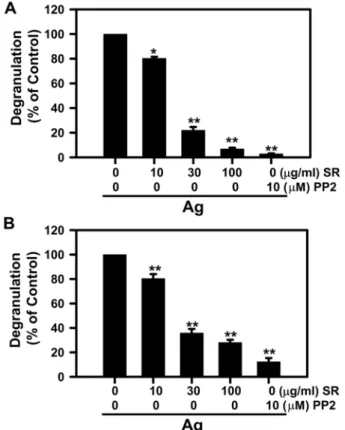
단삼추출물은항원자극에의한비만세포에서의탈과립을농도의존 적으로억제하였으며
IC
50값은약15
µg/m
l였다(Fig. 1A
및1B).
이러한억제효과는최근보고된다른식물추출물의효과에비해 억제효과가우수했다
.
12)단삼추출물의
TNF-
α및IL-4
분비억제효과비만세포에서는
Interleukins 1, 2, 3, 4, 5, 6, 8, 10, 13,
및TNF-
α등다양한종류의사이토카인및케모카인을분비한다.
3)이 중특히, TNF-
α와IL-4
등의사이토카인은비만세포에의해매개되어지는알레르기염증에있어중요하다
.
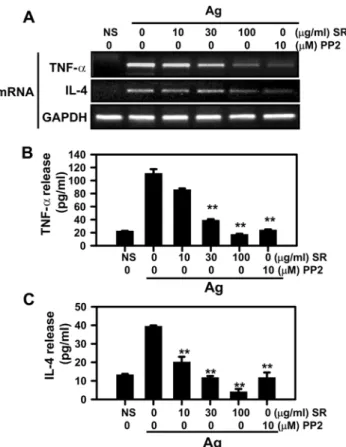
17)따라서단삼추출 물이항원에의한사이토카인의생산과분비에억제효과가있 는지를확인하였다. TNF-
α및IL-4
는단삼추출물에의해농도의존적으로발현이억제되었으며
(Fig. 2A),
세포외분비도농도 의존적으로억제되었다(Fig. 2B
및2C).
이러한결과는단삼추출물이비만세포에의한급성알레르기반응뿐아니라사이토카 인에의한만성알레르기질환에도효과가있음을의미한다
.
단삼추출물의비만세포억제기전
단삼추출물의비만세포억제기전을연구하기위해다양한초기 신호전달물질의활성화에대한단삼추출물의억제효과를측정 하였다
.
비만세포는항원에의해자극이되면Fc
εRI
수용체의 β- subunit
에결합되어있던Lyn
이β및γ-subunit
의ITAM
을인산화시켜세포질에존재하는
Syk kinase
를수용체와결합을유도해초기세포신호전달계를활성화시킨다
.
3)본연구에서는초기 신호전달에대한단삼추출물의Syk kinase
의인산화에대한억 제효과를확인하였다.
그결과단삼추출물은비만세포의초기신호전달에중요한
Syk kinase
의항원에의한인산화를농도의 존적으로억제하였다.
그억제는10
µg/m
l농도에서현저하였으 며100
µg/m
l에서는인산화가전혀관찰되지않았다(Fig. 3A).
Fig. 1 −
Effect of SR on antigen-induced degranulation in RBL-2H3 mast cells and BMMC. RBL-2H3 cells (A) and BMMC (B) were incubated overnight in 24 well cluster plates, with 50 ng/ml DNP-specific IgE, in a complete growth medium.
The medium was replaced with a Tyrode or PIPES buffer
that contained the indicated concentration of SR, before
stimulation with 20 ng/ml antigen (Ag), to measure the
release of
β-hexosaminidase. The values are expressed
as mean±SEM from the three or more independent
experiments. PP2 is a general Src-family kinase inhibitor.
다음으로
Syk kinase
의직접적인세포신호전달의하위기질인LAT
의인산화도같은정도억제되는것을확인할수있었다(Fig
3A).
따라서단삼추출물은Syk
의상위신호전달물질을억제함을추측할수있었다
.
비만세포의활성화과정에서초기신호전 달물질은Src-family kinase
임이잘보고되어왔다.
3)항원에의해비만세포가자극되면아주초기에
Src-family kinase
의한종류인
Lyn
은하위신호전달물질인Syk kinase
의317
번Tyrosine
잔기를인산화시킨다
.
18,19)우리는과연항원에의한Syk kinase
의
317
번Tyrosine
잔기의인산화가단삼추출물에의해억제되 는지를확인하고자인산화된Syk kinase
의317
번Tyrosine
잔 기에특이적인항체를사용하여그효과를확인하였다.
그림에서보여지듯이항원자극에의해증가되는
Syk kinase 317
번tyrosine
잔기의인산화는단삼추출물에의해농도의존적으로억제되었다
(Fig. 3B).
이러한결과를볼때단삼추출물의비만세포억제효과는초기신호전달물질중
Src-family kinase
억제의한효과에서비롯된다는것을알수있었다
.
최근단삼의유효성분중의하나인
5, 16-dihydrotanshinone-I
은비만세포의항원 자극에의한신호전달경로중Syk
을억제하지않았으며PLC
γ2
와
ERK1/2
를억제시킴으로강한항앨러지효과를나타냄이보고되었다
.
20)하지만본연구의추출물은Syk
의활성화를억 제하였고ERK1/2
의활성화에는영향이없었다(Fig. 3A).
이러한결과의차이는본연구의단삼추출물의유효성분은
tanshinone
성분이아님을의미하였다
.
본추출물은비만세포의항원자극 에의한신호전달에서5, 16-dihydrotanshinone-I
의작용점보다상위초기신호전달과정을억제시킴으로서좀더특이적인비만 세포억제제로활용이가능하나추출물의정확한유효성분에대 한추가적인실험이필요하다고생각된다
.
Fig. 2 −
Effects of SR on secretion and expression of TNF-
αand IL- 4 in RBL-2H3 cells. (A) SR was added to the IgE-primed RBL-2H3 cells 30 min before the addition of 20 ng/ml antigen (Ag), or cells were left unstimulated (NS). The cells were stimulated for 15 min before assaying TNF-
αor IL-4 mRNA by RT-PCR. The results are representative gel pictures from three independent experiments. (B and C) The secretion of TNF-
αand IL-4 were measured by ELISA 4 hr after stimulating RBL-2H3 cells with 20 ng/ml antigen.
The values are expressed as mean±SEM for the three independent experiments. PP2 is a general Src-family kinase inhibitor.
Fig. 3 −
Effect of SR on activation of Syk kinase. (A) The RBL-2H3 cells were incubated overnight in 6 well plates with 50 ng/
ml DNP-specific IgE. The cells were stimulated with 20 ng/
ml antigen (Ag), with or without SR, for 7 min. Syk and
LAT were immunoprecipitated with the specific antibodies,
respectively, and the immunoprecipitated proteins were
subjected to immunoblot analysis to detect phosphorylated
or total proteins. (B) The BMMCs were incubated with
50 ng/ml DNP-specific IgE overnight. The cells were
stimulated with 20 ng/ml antigen, with or without SR, for
7 min. The proteins derived from cell lysates were
subjected to immunoblot analysis to detect the phos-
phorylated forms (Y317) of Syk. Representative blots are
shown. PP2 is a general Src-family kinase inhibitor.
단삼추출물의비만세포매개성국소적알레르기반응억제효과 단삼추출물은in vitro에서항알레르기효과를보였다
.
이러한 결과를바탕으로단삼추출물의 in vivo알레르기동물모델에서 알레르기억제효과를측정하였다.
본연구에서는가장보편적으로사용되어지는비만세포매개성국소적알레르기동물모델인
passive cutaneous anaphylaxis
를사용하였다.
이동물모델은 생쥐의귀에IgE
를피내주사하여국소비만세포를감작시키고항원을정맥주사후비만세포활성화에의한에반스블루색소 의혈관으로부터의유출정도를측정하였다
.
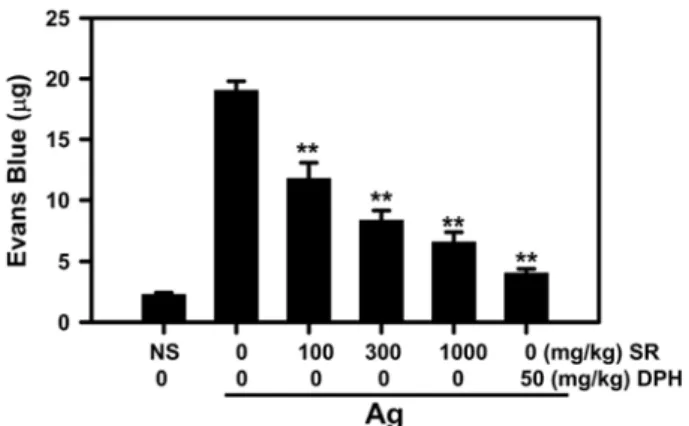
항원에의한에반스 블루의혈관으로부터의유출은항원자극에의해현저히증가함 을관찰할수있었다(Fig. 4).
항원자극에의한에반스블루의유 출은단삼추출물에의해농도의존적으로억제됨을확인하였다(Fig. 4).
이러한실험을통해단삼추출물의항알레르기효과를알레르기동물모델에서도확인할수있었다
.
이러한연구결과단 삼추출물은 in vivo비만세포매개성알레르기반응에도효과가 있는것으로드러났으며이러한결과는현재아이들에게빈발하 고있는아토피성피부염에도치료효과가예상되는바추후연 구가더필요할것으로생각된다.
결 론
본연구에서는단삼추출물의in vitro및in vivo동물모델에 서항알레르기효과와그작용기전을측정하였다
.
단삼추출물은
RBL-2H3
및골수유래의비만세포(BMMC)
에서항원자극에대해농도의존적인항알레르기효과
(IC
50=
약15
µg/m
l)
를보였다
.
또한,
알레르기성염증에중요한TNF-
α및IL-4
사이토카인의생산및분비를억제하였다
.
더나아가단삼추출물은항원에 의해유도된비만세포매개성알레르기동물모델에서농도의존 적으로알레르기반응을억제하였다.
작용기전으로서단삼추출 물은비만세포초기신호전달물질인Src-family kinase
의억제를 통해항알레르기효과를획득하는것으로밝혀졌다.
현재연구로는단삼의어떤성분이약효를나타내는지에대한연구는진 행되어있지않았으므로추후성분에대한연구가심층적으로이 루어져야할것으로생각된다
.
감사의 말씀
이논문은
2007
년도덕성여자대학교연구비의지원을받아수행된연구입니다
.
문 헌
1) Beaven, M. A. and Hundley, T. R. : Mast cell related diseases:
genetics, signaling pathways, and novel therapies, p. 307-355.
In T. H. Finkel and J. S. Gutkind (eds.), Signal transduction and human disease. John Wiley & Sons, Inc., Hoboken, N.J. (2003).
2) Wedemeyer, J., Tsai, M. and Galli, S. J. : Roles of mast cells and basophils in innate and acquired immunity. Curr. Opin.
Immunol.
12, 624 (2000).
3) Gilfillan, A. M. and Tkaczyk, C. : Integrated signalling pathways for mast-cell activation. Nat. Rev. Immunol.
6, 218 (2006).
4) Parravinci, V., Gadina, M., Kovarova, M., Odom, S., Gonzalez- Espinosa, C., Furumoto, Y., Saitoh, S., Samelson, L. E., O'Shea, J. J. and Rivera, J. : Fyn kinase initiates complementary signals required for IgE-dependent mast cell degranulation. Nat.
Immunol.
3, 741 (2002).
5) Siraganian, R. P., Zhang, J., Suzuki, K. and Sada, K. : Protein tyrosine kinase Syk in mast cell signaling. Mol. Immunol.
38, 1229 (2002).
6) Church, M. K. and Levi-Schaffer, F. : The human mast cell. J.
Allergy Clin. Immunol.
99, 155 (1997).
7) Metcalfe, D. D., Kaliner, M. and Donlon, M. A. : The mast cell.
Crit. Rev. Immunol.
3, 2374 (1981).
8) Kay, A. B. : Allergy and allergic diseases. New. Engl. J. Med.
344
, 30 (2001).
9) Kay, A. B. : Allergy and allergic diseases. New. Engl. J. Med.
344
, 109 (2001).
10) Luskova, P. and Fraber, P. : Modulation of the Fc
εRI signaling by tyrosine kinase inhibitors: Search for therapeutic targets of inflammatory and allergy diseases. Curr. Pharmceut. Des.
10,
Fig. 4 −
Effect of SR on passive cutaneous anaphylaxis in mice. An DNP-specific IgE (0.5
µg) was intradermally injected into a mouse right ear. An injection of antigen, 250
µg antigen (Ag, 1
µg/ml in a PBS containing 4% Evans blue), was administered 24 hr later into the mouse tail vein. The SR was administered 1 hr before the treatment of antigen. The mouse was euthanized 1 hr after the challenge of antigen, and the right ear was removed for the measurement of the amount of dye extravasated. The values are expressed as mean±SEM from the three independent experiments.
DPH (50 mg/kg), a typical anti-histamine drug, was used as
a reference.
1727 (2004).
11) Lee, J. H., Kim, J. W., Ko, N. Y., Mun, S. H., Her, E., Kim, B. K., Han, J. W., Lee, H. Y., Beaven, M. A., Kim, Y. M. and Choi, W. S. : Curcumin, a constituent of curry, suppresses IgE- mediated allergic response and mast cell activation at the level of Syk. J. Allergy Clin. Immunol.
121, 1225 (2008).
12) Lee, J. H., Kim, J. W., Ko, N. Y., Mun, S. H., Kim, D. K., Kim, J. D., Kim, H. S., Lee, K. R., Kim, Y. K., Radinger, M., Her, E.
and Choi, W. S. : Camellia japonica suppresses immunoglobulin E-mediated allergic response by the inhibition of Syk kinase activation in mast cells. Clin. Exp. Allergy
38, 794 (2008).
13) Lin, H. C., Ding, H. Y. and Chang, W. L. : Two New Fatty diterpenoids from Salvia miltiorrhiza. J. Nat. Prod.
64, 648 (2001).
14) Saitoh, S., Arudchandran, R., Manetz, T. S., Zhang, W., Sommers, C. L., Love, P. E., Rivera, J. and Samelson, L. E. : LAT is essential for Fc
εRI-mediated mast cell activation.
Immunity
12, 525 (2000).
15) Laemmli, U. K. : Cleavage of structural proteins during the assembly of the head of bacteriophages t4. Nature
227, 680
(1970).
16) Kabu, K., Yamasaki, S., Kamimura, D., Ito, Y., Hasegawa, Y., Sato, E., Kitamura, H., Nishida, K. and Hirano, T. : Zinc is required for Fc
εRI-mediated mast cell activation. J. Immunol.
177
, 1296 (2006).
17) Theoharidies, T. C. and Kalogeromitros, D. : The critical role of mast cells in allergy and inflammation. Ann. N.Y. Acad. Sci.
1088