488
©The Korean Society of Food Science and Technology
소엽 추출물이 마우스모델에서 항알레르기 반응에 미치는 영향
고정아1·임헌선2·김건희3·박지용4·한찬규5·박현진1*
1고려대학교 생명공학부, 2(주)한국메디, 3덕성여자대학교 식품영양학과, 4연세대학교 생명공학과, 5한국식품연구원
Effects of Perilla frutescens Extract on Anti-allergic Reactions in a Mouse Model
Jung A Ko1, Hun-Sun Lim2, Gun-Hee Kim3, Ji-Yong Park4, Chan-Kyu Han5, and Hyun Jin Park1*
1School of Life Sciences and Biotechnology, Korea University
2Department of Bio R&D, Korea Medi Co. Ltd.
3Department of Food and Nutrition, DukSung Women's University
4Department of Biotechnology, Yonsei University
5Korea Food Research Institute
Abstract We investigated the effect of Perilla frutescens (PF) ethanol extract powder (PF-E30) on the local allergic reaction activated by anti-DNP IgE and the mast cell-mediated immediate-type allergic reactions induced by compound 48/
80 in a mouse model. One gram of PF powder extracted with 30% ethanol at 80oC contained 12.3 mg of rosmarinic acid.
Oral administration of PF-E30 (0.1 to 0.5 mg/kg body weight) significantly reduced plasma histamine levels and inhibited histamine release from peritoneal mast cells in mice activated by compound 48/80 or anti-DNP IgE. Moreover PF-E30 dose-dependently inhibited the production of antigen-induced IgE. These results indicate that the PF ethanol extract inhibits mast cell-mediated immediate-type allergic reactions in vivo and in vitro.
Key words: Perilla frutescens, rosmarinic acid, anti-allergic reaction, histamine, antigen-induced IgE
서 론
알레르기는 다양한 화학적 오염원에 의하여 널리 퍼져 있는 임 상적 건강 문제 중의 하나로 산업화된 국가일수록 급격하게 증 가하고 있는 추세이다. 알레르기 치료는 알레르겐을 회피 하거나 항히스타민제, 스테로이드제 또는 면역 억제제의 사용에 근간을 두고 있다. 일본 전통 한방의약 중의 하나인 캄포(Kampo medi- cine)는 일본에서 알레르기 대체 치료로서 주목을 받고 있다(1).
캄포 중의 하나인 시박탕(Saiboku-to, 柴朴湯)은 10종류의 허브식 물로 구성되어 있는데 그 중에는 소엽도 포함되어 있으며, 이 소 엽이 항알레르기 활성의 주 활성 성분으로 여겨지고 있다(2,3).
국내에서도 잘 알려진 소엽은 차조기 또는 차즈기라고도 불리 우며 학명이 Perilla frutescens L. Britton var. acuta Kudo(Labia- tae)로, 전통적인 한방 소재로서 기침을 동반한 감기, 구토 및 기 관지 천식을 치료하는데 사용되고 있다(4). 마우스 모델 실험에 서 소엽추출물의 복강 내 주사는 항원-특이성 IgE(antigen-specific IgE) 생산과 복강 비만세포(mast cell)로부터 히스타민 방출을 억 제시켰으며, 이는 소엽의 알레르기 저해 활성을 시사한다고 할 수 있다(5,6). Makino 등(7)은 로즈마린산(rosmarinic acid)이 소엽
추출물의 항증진 효과를 나타내는 대표물질 중 하나라고 하였고 비만세포는 화학적 매개자를 방출함으로써 알레르겐에 대응하는 즉시형 알레르기 반응(immediate type allergic reactions)을 유발하 는 것으로 현재 입증되어 있다(8). 비만세포의 과립소실(degranu- lation)은 뚜렷한 히스타민 방출을 일으키는 compound 48/80이나 과민반응(anaphylactic reactions)과 관련된 다른 화학적 매개자와 같은 비면역학적 분비 촉진제(non-immunologic secretagogues)에 의하여 유발된다(9,10). 히스타민은 혈관확장과 같은 과민성 반응 (anaphylactic responses)을 유도하며, 혈관투과성과 평활근의 수축 을 증가시킨다(11). 비만세포의 분비반응은 상응하는 항원에 의 하여 IgE에 대한 이들 세포 표면 특이성 수용체(cell surface- specific receptors)를 응집시킴으로써 유발될 수 있다(12).
Passive cutaneous anaphylaxis(PCA) 반응은 수년간 알레르기 반 응의 한 모델로서 이용되어 왔으며, anti-IgE 항체는 즉시형 알레 르기 반응에 대한 전형적 모델로서 PCA 반응을 유발하는데 사 용하여, 동물피부는 PCA반응을 연구하는데 유용한 부위이다(13).
비만세포는 이들 과립(granules)내에 cytokines도 유지하지만(14), 이들 세포는 세포 표면 FcεRI가 특이 항원과 교차결합 후 30분 이내에 TNF-α(tumor necrosis factor-α)를 포함하는 cytokines 생산 을 급격히 증가시킨다(15-18).
본 연구는 소엽 주정추출물의 로즈마린산 함량을 측정하고, 1 형 알레르기 동물실험모델 중 하나인 compound 48/80-induced system 알레르기 및 anti-IgE antibody-induced PCA 반응으로 생 쥐에 소엽-30%주정추출물 분말(PF-E30)을 투여하여 항알레르기 효과를 평가하였다. 또한 compound 48/80이나 anti-DNP IgE에 의 한 혈장 히스타민 량과 복강 비만세포로부터의 히스타민 방출,
*Corresponding author: Hyun Jin Park, School of Life Sciences and Biotechnology, Korea University, Seoul 136-701, Korea
Tel: 82-2-3290-3450 Fax: 82-2-953-5892 E-mail: [email protected]
Received March 26, 2010; revised April 20, 2010;
accepted April 23, 2010
그리고 antigen-induced IgE에 대한 효과를 분석하였다.
재료 및 방법
실험재료
로즈마린산 표준물질, anti-DNP IgE, anti-DNP IgE 항체, bovine serum albumin(BSA), DNP-human serum albumin(HSA), a-minimal essential medium(a-MEM), ortho-phthaldialdehyde(OPA), metrizamide, avidineperoxidase, 그리고 Bordetella pertussis vac- cine은 Sigma-Adrich(St. Louis, MO, USA)에서 구입하였다. An IgE ELISA(enzyme-linked immunosorbent assay) kit는 BD Bio- science(San Jose, CA, USA)에서, Anti-IgE-capture mAb 및 bioti- nylated anti-IgE detecting mAb은 PharMingen(San Diego, CA, USA)에서 공급받았다. Acetonitrile과 acetic acid는 HPLC 분석급 을 사용하였다.
소엽추출물 제조
소엽(Perilla frutescens, PF)은 국내 경상북도 지역에서 재배된 것으로 경동시장(Seoul, Korea)에서 건조한 것을 구입하여, Ball Mill(MM-200, Lab. Corperation, Seoul, Korea) 분쇄기로 분쇄하였 고, 80oC에서 10배(1:10 w/v)의 0-70% 주정으로 8시간씩 3회 추 출하였다. 각 추출물은 0.45 µm filter로 여과하였고, 여과액은 농 축하여 동결 건조하였다. 각 동결 건조한 소엽추출분말은 사용하 기 전까지 −20oC에 보관하였다. 소엽추출분말은 in vivo 또는 in vitro 실험시에는 생리식염수나 Tyrode buffer A(10 mM HEPES, 130 mM NaCl, 5 mM KCl, 1.4 mM CaCl2, 1 mM MgCl2, 5.6 mM glucose, 0.1% bovine serum albumin)에 용해하여 사용하였다.
실험동물
6주령된 수컷 ICR 생쥐는 Oriental Bio(Seongnum, Korea)에서 구입하여, 일주일간 실험실 환경에 적응시킨 후 온도와 습도가 조절되는 환경(22±2oC, 상대습도 55±5%, 12 hr light-dark cycle)하 에서 시판 고형사료와 물은 자유롭게 섭취하게 하였다. 실험은 정해진 규정에 의하여 다루었다. 생쥐는 대조군 그룹과 시험군 그룹으로 나누어 10마리씩을 한 실험군으로 하였다. 대조군 그룹 에는 생리식염수를, 시험군 그룹에는 생리식염수에 용해시킨 소 엽추출물(PF-E30)을 구강 투여하였다.
HPLC에 의한 로즈마린산 정량
소엽추출물과 로즈마린산 표준물질은 50%(v/v) ethanol에 용해 하여, 0.45 µm filter로 여과하고, PDA 검출기가 장착된 HP1100 Series HPLC system(Hewlett-Packard, Palo Alto, CA, USA)으로 분석하였다. 컬럼은 260×4.6 nm, 5 µm particle size의 Symmetry 300Å C18(Waters, Milford, MA, USA)으로 30oC에 유지하였고 검출파장은 330 nm으로 하였다. 분리용 용매는 acetonitrile(eluent A)과 2%(v/v) acetic acid(eluent B)를 22:78 비율로 사용하였고 유 속은 1.0 mL/min이며, 주입량은 10 µL였다. 로즈마린산 정량계산 은 표준용액 로즈마린산을 5-1,000 µg/mL으로 하여 구한 검량선 을 이용하여 산출하였다.
Compound 48/80-induced systemic allergy 반응
Compound 48/80-induced systemic anaphylaxis 반응의 억제를 평가하기 위하여, 각 시험군 그룹의 각 생쥐에는 생리식염수에 용해시킨 PF-E30를 7일간 0.01-0.5 g/kg BW 로 투여하였으며, 대
조군 그룹의 생쥐에는 생리식염수만을 투여하였다. 그리고 각 그 룹의 생쥐는 Kim 등(19)의 설명에 따라서 compound 48/80을 8 mg/kg BW로 하여 복막 내 주사를 하였다. 이후 과민성 쇼크를 유도한 후 생쥐를 1시간 동안 관찰하고 사망률을 확인하였다.
PCA(Passive cutaneous anaphylaxis) 반응
IgE-dependent cutaneous reaction은 anti-DNP IgE를 피부 내에 주사하여 피부를 감작(sensitizing)시켜 유도하였고, 48시간 뒤에 DNP-HAS를 생쥐 꼬리의 정맥에 주사하였다. 즉, 생쥐에는 PBS 에 희석한 0.1 µg anti-DNP IgE를 48시간 전에 면도한 4 dorsal skin site 내에 주사하였으며, 각 피부 부위는 지용성 잉크 펜으 로 표시하였다. 각 생쥐에는 꼬리 정맥을 통해 4% Evans blue(1:1) 을 함유하는 PBS에 용해한 1 mg DNP-HAS를 주사하였다. chal- lenge하기 전에 PF-E30(0.01-0.5 g/kg BW)를 7일간 투여하였다. 그 리고 challenge 30분 후에, 각 생쥐를 희생시키고 dorsal skin을 제 거하여 색소 면적을 측정하였다. Katayama 등(20)의 방법을 근거 로 해서, 이 염료를 0.5 mL의 1.0 N KOH과 4.5 mL의 acetone과 phosphoric acid(5:13, w/w) 혼합액으로 구성된 용액으로 추출하였 다. 염료의 흡광도는 UV-1201 spectrophotometer(Shimadzu, Tokyo, Japan)로 620 nm에서 측정하였다. 표준곡선은 Evans blue를 표준 용액으로 하여 검량선을 작성하여 산출하였다.
복막 비만세포(peritoneal mast cells) 조제
생쥐의 복막 비만세포는 Jippo-Kanemoto 등(21)이 설명한 방법 과 같이 분리하였다. 즉, 생쥐를 에테르로 마취시키고 30 mL tyrode buffer B(137 mM NaCl, 5.3 mM glucose, 12 mM NaHCO3, 2.7 mM KCl, 0.3 mM NaH2PO4)을 복막강에 주사하고, 복부를 약 90초 동 안 부드럽게 마사지하였다. 복막강을 조심스럽게 열고 복막세포 를 함유하는 Tyrode buffer B 용액을 파스테르 피펫으로 흡입하 여 회수하였다. 그리고 복막세포를 실온에서 10분동안 150×g에 서 원심분리하여 회수하고 Tyrode buffer B에 재현탁하였다. 비 만세포는 Yurt 등(22)의 설명에 따라서 복막세포의 주 구성성분 으로부터 분리하였다. 1 mL Tyrode buffer B에 현탁된 복막세포 를 2 mL metrizamide buffer(22.5%(w/v))에 층을 이루도록 시키고 실온에서 15분동안 400×g에서 원심분리 하였다. Metrizamide buffer 인터페이스에 남아있는 세포를 흡입시켜 제거하고, 펠렛내 의 세포를 세척하여 1 mL Tyrode buffer A에 현탁시켰다. 비만세 포 조제물의 순도는 toluidine blue 염색으로 확인시 약 95%였다.
세포의 생존율은 trypan blue uptake로 평가하였을 때 97% 이상 이었다.
히스타민 방출 측정
혈액을 400×g에서 10분동안 원심분리하여 혈장을 빼낸 후, 히 스타민은 Shore 등(23)의 OPA spectroflurometry 방법으로 측정하 였다. 형광강도(fluorescent intensity)는 353 nm에서 exciting시키고 438 nm에서 RF-5301 PC spectrofluorometer(Shimadzu, Tokyo, Japan)로 측정하였다. 정제된 복강 비만세포를 Tyrode buffer A에 재현탁시키고 세포현탁액(2×l05 cells/mL)을 anti-DNP IgE(10 µg/
mL)로 6시간동안 감작시켰다. 처리구의 세포는 PF-E30으로 37oC 에서 10분동안 예비 배양시켜 DNP-HAS(1 µg/mL)을 challenge하 였다. 세포는 4oC에서 5분 동안 400×g에서 원심분리시켜 방출된 히스타민으로부터 분리하였다. 세포 내의 잔존 히스타민은 과염 소산으로 세포를 파괴하여 방출시켜 동일조건에서 원심분리 하 였다. 히스타민 방출 저해율은 다음과 같이 계산하였다.
저해율(%)=(A-B)/A×100
A: PF-E30로 처리하지 않은 경우의 히스타민 방출량 B: PF-E30로 처리했을 경우의 히스타민 방출량
Antigen-induced IgE 분석
생쥐에 Bordetella pertussis vaccine(2×10⁹ cell/mouse), ovalbumin (500µg/mouse)과 alum(1 mg/mouse)으로 구성된 200 µL의 혼합 antigen을 복막내 주사하였다. 각 혈액은 혼합 antigen을 주사 7일 후에 희생시킨 생쥐의 각 심장으로부터 회수하고, IgE은 4oC에서 15분동안 1500×g에서 원심분리하여 얻은 혈장으로부터 측정하였 다. 즉, IgE의 정량은 Kim 등(24)이 제시한 방법으로 mouse IgE 에 captured goat monoclonal antibody와 biotine이 결합된 mouse IgE에 대한 goat monoclonal antibody와의 결합에 의해 측정되는 biotine/avidine sandwich ELISA(enzyme-linked immunosorbent assay) 방법으로, PBS/BSA(1%)로 희석한 avidineperoxidase(1/400) 가 첨가된 후, 15분 방치 후에 발색 정도를 Titertek Multiscan MC 340(Flow Lab., Helsinki, Finland)을 이용하여 405 nm에서 홉 광도를 측정하였다. 기질로서 2,2'-azino-bis(3-thylbenzthiazoline-6- sulfonic acid)를 사용하였다.
통계처리
각 실험 결과의 통계분석은 SPSS(statistical package social sci- ence, version 12.0, SPSS Inc., Chicago, IL, USA)를 이용하였으 며, 모든 결과는 각 실험군의 mean±SD 로 표시하였고, 각 군의 p<0.05 수준으로 ANOVA와 LSD test에 의하여 검정하였다.
결과 및 고찰
HPLC에 의한 소엽추출물의 로즈마린산 함량
로즈마린산(rosmarinic acid, RA)의 크로마토그래피 피크는 ace-
tonitrile과 2% acetic acid을 이동상으로 사용하여 표준물질의 RT (retention time)와 UV spectra을 비교하여 확인하였다. Fig. 1은 로 즈마린산 표준물질의 chromatogram(a)와 소엽추출물의 chromato- gram(b)를 보여 주고 있으며, 상기 조건에서 12분 이내에 분리능 이 양호함을 나타내고 있다. 로즈마린산의 캘리브레이션 그래프 는 여러 시료에서 기대되는 농도 범위를 포함하는 수준으로 실 시하여, 로즈마린산 5-1,000 µg/mL의 범위에서 측정하여 0.9978의 R2(R; correlation coefficient)의 직선을 얻었으며, Campana 등(25) 과 Natera 등(26)이 제시한 LOL(on-line linearity)의 계산식: LOL (%)=100–RSD으로 산출하여 99.15%의 LOL을 얻었다. 여기서 RSD는 퍼센트로 표시되는 기울기의 상대 표준편차이다. Won 등 (27)에 의하면, LOD(the limit of detection)는 다음과 같은 계산식:
(3.3×σ)/S으로 계산하며, LOQ(the limit of quantitation)는(10×σ)/S 으로 계산한다. 여기서 σ는 공시료의 STDEV으로 0.0065이며 S 는 캘리브레이션 그래프의 기울기(slope)로 0.27이었다. LOD approx 및 LOQ approx는 각각 0.08 과 0.24 µg/mL였다. 이 결과 로 볼 때 검출한계는 소엽추출물의 로즈마린산 함량을 측정하는 데 충분히 낮은 것으로 보였다. 로즈마린산의 회수율은 로즈마린 산 표준용액(10, 100 and 500 µg/mL)을 첨가한 시료를 spiking하 여 측정한 결과가 98.40-112.01%였다. 시스템의 정확성을 평가하 기 위하여 주변온도에 보관한 시료용액을 일일 3회 및 7일 이상 3회씩 측정하였다. 시험결과로부터 일중 정확성(intra-day precision) 은 0.90-3.90%, 일간 정확성(inter-day precision)은 0.61-3.19%이였다.
Table 1은 건조 소엽분말을 에탄올 추출했을 경우 물추출 했을 때보다 로즈마린산의 함량이 유의적으로 높게 나왔음을 보여주 며 그중 30% 에탄올로 추출한 경우 로즈마린산 수율이 1.46±0.16 mg/g으로 가장 높았다.
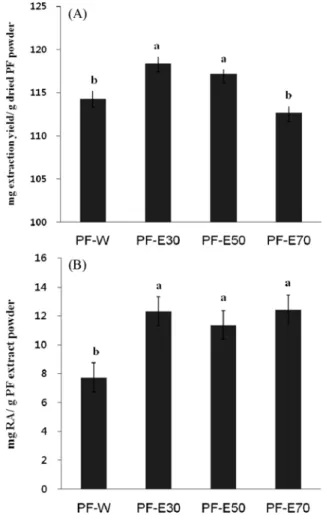
Fig. 2의 결과 역시 건조소엽분말의 에탄올 추출이 물 추출보 다 추출수율이 높게 나옴을 보여주며, 특히 30-70%의 에탄올로 처리한 소엽 주정추출물분말의 경우 로즈마린산 함량이 11.34- 12.45 mg/g으로 물추출물 분말의 경우(7.76 mg/g)보다 높았다. 따
Fig. 1. Chemical structure and chromatogram of peak of rosmarinic acid standard and Perilla frutescens extract. (A) Chromatogram of rosmarinic acid standard, (B) Chromatogram of Perilla frutescens extract (PF-E30).
라서, 이후 진행되는 실험은 수율이 높게 나온 30% 에탄올로 추 출한 샘플(PF-E30)을 사용하였다.
PF-E30의 생쥐에서의 compound 48/80-induced system 알 레르기 반응에 미치는 효과
알레르기 반응계에서 PF-E30 투여의 영향을 생쥐의 systemic allergy 반응으로 평가하였다. Compound 48/80(8 mg/kg BW)을 전 신 systemic fatal allergic reaction inducer로 사용하였다(19). com- pound 48/80을 생쥐의 복막에 주사한 후, 1 hr동안 모니터링하여 사망율을 평가하였다. Table 2에서 볼 수 있듯이, 100% fatal shock
는 대조구로서 200 µL의 생리식염수를 복막내 주사하여 유도되었 다. 생쥐의 각 그룹(n=10/group)에 PF-E30을 0.01-0.5 g/kg BW의 수준으로 7일 동안 투여하였을 때, 사망률은 유의적으로 감소하였다.
PF-E30T의 생쥐에서의 PCA반응에 미치는 효과
Wershil 등(28)의 실험방법에서 알 수 있듯이 PCA 유도는 알 레르기 반응을 평가하는 또 다른 좋은 방법이다. Local extrava- sation는 intravenous antigen challenge을 수반하는 anti-DNP IgE의 피부 주사로 유도하였다. 시험군에서는 생쥐의 오른쪽 dorsal skin sites에 anti-DNP IgE를 주사하였고, 대조군에서는 생쥐의 왼쪽 skin sites에 생리식염수를 사용하였다. 48 hr 후에 모든 동물에 evans blue 염료가 주사된 DNP-HSA으로 정맥내로 주사하였다.
피부 알레르기 반응은 염료의 extravasation에 의하여 육안으로 관 찰할 수 있게 된다. Table 3에서 볼 수 있듯이 PF-E30의 0.01-0.5 g/kg BW의 범위에서 투여한 경우에, 0.1 및 0.5 g/kg BW의 투여 수준 PCA 반응에서 뚜렷한 저해율을 보였다. Makino 등(29, 30) 또한 소엽물추출물 500 mg/kg BW의 투여는 PCA 반응이 43%
저해율로 유의하게 억제시켰고, 이에 상응하는 양의 RA의 투여 는 41% 저해율을 보였으며, RA의 항알레르기 역가는 항알레르 기 약인 tranilast보다 더 효과적이었다고 발표하였다.
PF-E30의 생쥐에서의 혈장 히스타민 방출에 미치는 효과 PF-E30 투여에 의한 compound 48/80-induced plasma histamine 방출에 끼치는 능력을 조사하였다. Compound 48/80을 주사하기 1시간 전까지 PF-E30를 7일간 0.01-0.5 g/kg BW으로 투여하여 혈 장 히스타민 방출의 억제를 측정하였을 때, 사망률의 경우와 상 응하는 결과로 Fig. 3에서 보여주는 것과 같다. PF-E30 투여에 의한 히스타민의 억제율은 0.1 및 0.5 g/kg BW의 투여에서 유의 적이었다. Shin 등(8)은 쥐모델(n=10/group)에서 compound 48/80- 유도 혈장 히스타민 방출의 영향에 대하여 조사하였을 때 소엽 물추출분말에 의한 히스타민의 억제율이 0.5-1 g/kg BW의 투여 에서 매우 효과적이었다고 보고하였다.
Table 1. Rosmarinic acid content of Perilla frutescens
(mg/g, w/w) Treatment Ethanol (%) RA/ PF powder
PF-W 0 0.89±0.04 b
PF-E30 30 1.46±0.16 a
PF-E50 50 1.33±0.08 a
PF-E70 70 1.40±0.18 a
PF-W: Perilla frutescens water extract, PF-E30: Perilla frutescens 30% ethanol extract
a,bp<0.05: significantly different from PF-W.
Each value is presented as the mean±SD value of independent experiments.
Fig. 2. Extraction yield and rosmarinic acid content in extracts of Perilla frutescens. Each data represent the mean±SD of 3 independent experiments, a,bp<0.05: significantly different from the value of PF-W, (A) mg extraction yield/g of PF powder, (B) mg RA/
g of PF extract powder.
Table 2. Effect of PF-E30 on systemic anaphylaxis in mice PF-E30
(g/kg BW)
Compound 48/80 (8 mg/kg)
Mortality (%)
None (saline) + 100
0.01 + 100
0.05 + 45*
0.1 + 23*
0.5 + 0*
0.5 - 0
*p<0.01: significantly different from the saline value.
Table 3. Effect of PF-E30 on PCA reaction in mice PF-E30
(g/kg BW)
Inhibition (%) None (saline) 0.00±1.52
0.01 35.33±3.45*
0.05 42.17±4.48*
0.1 63.00±4.60*
0.5 74.50±4.52*
Each value is presented as the mean±SD value of independent experiments.
*p<0.01: significantly different from the saline value.
PF-E30의 복부 비만 세포로부터 히스타민 방출에 미치는 효과 PF-E30 처리는 Fig. 4에서와 같이 생쥐의 복부 비만 세포로부 터 compound 48/80 또는 anti-DNP IgE-유도 히스타민 방출에 대 한 저해 효과를 나타내었다. Compound 48/80 또는 anti-DNP IgE 처리시, PF-E30에 의한 히스타민 방출의 억제는 0.01-0.5 mg/L에 서 확인되었다. 특히, 0.1 및 0.5 mg/L의 투여에서는 상대적으로 양호한 저해 효과를 보여 주었다. Imaoka 등(6)은 1차 항체 반응 실험에서 소엽 물추출물의 복막내 주사로 anti-DNP IgE 항체 생 산이 매우 억제되는 것을 발견하였다. Compound 48/80 또는 anti- DNP IgE에 의한 비만세포의 자극은 히스타민 방출을 유도하는 신호 전달 기작의 활성화를 개시시킨다(8-11). Tasaka 등(31)은 compound 48/80은 세포막에 작은변화(perturbation)을 일으켜서 지 질 이중층막의 투과성을 증가시킨다고 하였다. Piotrowski 등(32) 은 compound 48/80에 의하여 유도되는 히스타민 방출은 길항제 (antagonists)에 의하여 저해된다고 하였다. PF-E30 투여로 IgE- mediated cutaneous allergy 반응으로부터 보호되었다. 이 효과의 가능한 메커니즘은 adenylate cyclase의 활성화에 관련이 있는 것 으로 보인다(33).
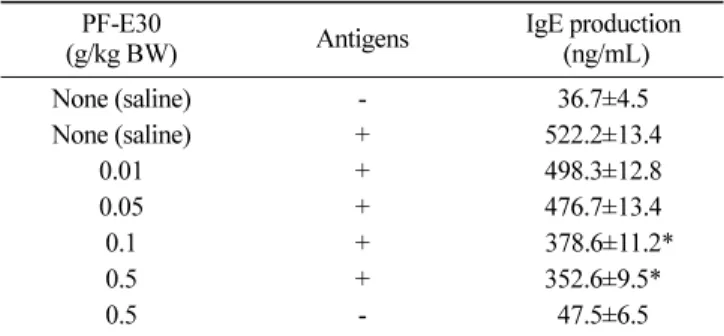
PF-E30의 생쥐에서 antigens-induced IgE 생산에 미치는 효과 PF-E30의 in vivo 실험에서 antigens-induced IgE 생산에 미치는 효과를 시험하기 위하여, Bordetella pertussis vaccine(2×10⁹ cell/
mouse), ovalbumin(500µg/mouse) 및 alum(1 mg/mouse)으로 구성 된 200 µL antigens으로 면역시킨 후, 생쥐에게 7일동안 PF-E30 을 0.01-0.5 g/kg BW으로 투여하였다. PF-E30의 투여농도가 증가 할수록 antigens-induced IgE의 생산이 감소하는 것을 볼 수 있으 며 특히, 0.1 및 0.5 g/kg BW을 투여하였을 때 IgE의 생산이 유 의적으로 감소하였음을 알 수 있었다(Table 4). Makino 등(34)의 연구에서는 ddY mouse(8-42주령)에게 소엽추출물을 투여시 소엽 -처리 생쥐에서의 혈청 IgA의 감소와 연관된 proteinuria 및 glom- erular IgA 축적을 유의적(각각 p<0.01 및 p<0.05)으로 억제하였 다. 몇몇 임상시험 연구에서는 21일간 매일 50 또는 200 mg의 로 즈마린산으로 처리하여 nasal lavage fluid의 neutrophils 및 eosino- phils의 수를 유의적으로 감소시키거나 환자의 징후에 영향을 주 었다고 보고하였으며(35,36) Sanbongi 등(37)의 연구에서는 소엽- 유래 로즈마린산의 투여는 cytokines, chemokines, allergen-specific antibody를 통한 알레르기 천식에 효과적인 하나의 방안이라고 제 시하였다.
따라서 본 연구의 결과는 국내에 자생하는 소엽의 기능성 식 품 개발에 유용하게 사용될 수 있는 자료로 활용될 수 있을 것 으로 기대된다.
요 약
80oC에서 30% 주정으로 추출된 소엽추출물 분말의 로즈마린 산 함량은 12.3 mg/g이었으며, 소엽 30% 주정추출물분말(PF-E30) 은 생쥐모델 실험에서 ant-DNP IgE으로 활성화된 local allergy 반 응과 compound 48/80으로 유도된 mast cell-mediated immediate- type allergy 반응에 대한 억제 효과를 나타내었다. 더욱이, PF- E30(0.1-0.5 mg/kg BW)의 투여는 혈장 히스타민 수준을 유의성있 게 감소시켰으며, compound 48/80 또는 anti-DNP IgE으로 활성 화된 복막 비만세포로부터 히스타민 방출을 억제하였다. 특히 PF- E30는 antigen-induced IgE 의 생산을 농도 의존적으로 억제하였 다. 이런 결과는 소엽 주정추출물이 in vivo 및 in vitro 실험에서 mast cell-mediated immediate-type allergy 반응을 저해한다는 것을 제시한다. 소엽 주정추출물이 알레르기 반응을 억제하는 기능성 식품 소재로서의 개발을 위해서는 mast cell mediated-type allergy 반응에 대한 보다 많은 연구가 필요할 것이다.
Fig. 3. Effect of PF-E30 on plasma histamine inhibition in mice.
*p<0.01: significantly different from the saline value.
Fig. 4. Effect of PF-E30 on compound 48/80 or anti-DNP IgE- mediated histamine release from peritoneal mast cells in mice.
*,**p<0.05: significantly different from the saline value.
Table 4. Effect of antigens-induced plasma IgE production in vivo
PF-E30
(g/kg BW) Antigens IgE production (ng/mL)
None (saline) - 36.7±4.5
None (saline) + 522.2±13.4
0.01 + 498.3±12.8
0.05 + 476.7±13.4
0.1 + *378.6±11.2*
0.5 + 352.6±9.5*
0.5 - 47.5±6.5
Each concentration of IgE represents the mean±SD value of five independent experiments. *p<0.05; significantly different from the saline value.
감사의 글
본 연구는 보건복지부 보건의료기술진흥사업의 지원으로 수행 된 연구결과로 연구지원에 감사드립니다(A050376).
문 헌
1. Borchers AT, Hackman RM, Keen CL, Stern JS, Gershwin ME.
Complementary medicine: a review of immunomodulatory effects of Chinese herbal medicines. Am. J. Clin. Nutr. 66: 1303-1312 (1997)
2. Nishizawa Y, Nishizawa Y, Fushiki S. The inhibitory effect of Saiboku-to on 5-lipoxygenase activity in human alveolar mast cells. J. Traditional Med. 14: 382-383 (1997)
3. Yu HC, Niskanen A, Paananen J. Perilla-The Genus Perilla. Yu HC, Kosuna K, Haga M (eds). Harwood Academic Publishers, Amsterdam, Netherland. pp. 55-70 (1997)
4. Kimura T, But PPH, Guo JX, Sung CK, Han BH, International Collation of Traditional and Folk Medicine (I). World Scientific, Singapore, Singapore. p. 145 (1996)
5. Church MK, Caulfield JP. Mast cell and basophil functions. pp.
5.1-5.12 In: Allergy. Holgate ST, Church MK (ed). Gower Medi- cal Publishing, London, UK (1993)
6. Imaoka K, Inoue S, Takahashi T, Ojima Y. Effect of Perilla frutescens extract on anti-DNP IgE antibody production in mice.
Jpn. J. Allergol. 42: 74-80 (1993)
7. Makino T, Ito M, Kiuchi F, Ono T, Muso E, Honda G. Inhibitory effect of decoction of Perilla frutescens on cultured murine mesangial cell proliferation and quantitative analysis of its active constituents. Planta Med. 67: 24-28 (2001)
8. Shin TY, Kim SH, Kim SH, Kim YK, Park HJ, Chae BS, Jung HJ, Kim HM. Inhibitory effect of mast cell-mediated immediate- type allergic reactions in rats by Perilla frutescens. Immunop- harm. Immunot. 22: 489-500 (2000)
9. Pearce FL. Mast cells: Function, differentiation, and activation.
Curr. Opin. Immunol. 1: 630-636 (1989)
10. Allansmith MR, Baird RS, Ross RN, Barney NP, Bloch KJ. Ocu- lar anaphylaxis induced in the rat by topical application of com- pound 48/80. Dose response and time course study. Acta Opthalmol. 192: 145-153 (1989)
11. Shin TY, Kim HM. Inhibition of immediate-type allergic reactions by the aqueous extract of Salvia plebeia. Immunopharm. Immu- not. 24: 303-314 (2002)
12. Alber G, Miller L, Jelsema C, Varin-Blank N, Metzer H. Struc- ture/function relationships in the mast cell high-affinity receptor for IgE: Role of cytoplasmic domains and of the β subunit. J.
Biol. Chem. 266: 22613-22620 (1991)
13. Saito H, Nomura Y. Screening methods for drug evaluation 3. p.
22. In: Pharmaceutical Research and Development. Suzuki L, Tanaka H, Yajima H, Fukuda H, Sezaki H, Koga K, Hirobe M, Nakajime T (eds). Hirokawa, Tokyo, Japan (1989)
14. Gordon JR, Galli SJ. Mast cells as a source of both preformed and immuologically inducible TNF-α/cachectin. Nature 346: 274- 276 (1990)
15. Plaut M, Pierce JH, Watson CJ, Hanley-Hyde J, Nordan RP, Paul WE. Mast cell lines produce lymphokines in response to cross- linkage of FcεRI or to calcium ionophores. Nature 339: 64-67 (1989)
16. Galli SJ, Gordon JR, Wershil BK. Cytokine production by mast cells and basophils. Curr. Opin. Immunol. 3: 865-873 (1991) 17. Burd PR, Rogers HW, Gordon JR, Martin CA, Jayaraman S, Wil-
son SD, Dvorak AM, Galli SJ, Dorf ME. Interleukin 3-dependent and independent mast cells stimulated with IgE and antigen express multiple cytokines. J. Exp. Med. 170: 245-257 (1989) 18. Inagaki N, Goto S, Nagai H, Koda A. Mouse ear PCA as a
model for evaluating antianaphylactic agents. Int. Arch. Aller. A.
Imm. 74: 91-92 (1984)
19. Kim SH, Park SB, Kang SM, Jeon H, Lim JP, Kwon TK, Park
WH, Kim HM, Shin TY. Anti-allergic effects of Teucrium japoni- cum on mast cell-mediated allergy model. Food Chem Toxicol.
47: 398-403 (2009)
20. Katayama S, Shionoya H, Ohtake S. A new method for extrac- tion of extravasated dye in the skin and the influence of fasting stress on passive cutaneous anaphylaxis in guinea pigs and rats.
Microbiol. Immunol. 22: 89-101 (1978)
21. Jippo-Kanemoto T, Kasugai T, Yamatodani A, Ushio H, Mochi- zuki T, Tohya K, Kimura M, Nishimura M, Kitamura Y. Super- normal histamine release and normal cytotoxic activity of Beige rat mast cells with giant granules. Int. Arch. Allergy Imm. 100:
99-106 (1993)
22. Yurt RW, Leid RW Jr, Austen KF. Native heparin from rat perito- neal mast cells. J. Biol. Chem. 252: 518-521 (1977)
23. Shore PA, Burkhalter A, Cohn VH Jr. A method for fluorometric assay of histamine in tissues. J. Pharmacol. Exp. Ther. 127: 182- 186 (1959)
24. Kim HK, Kweon YT. Inhibitory effect of immunoglobulin E pro- duction by tripoliata. J. Korean Oriental Med. 19: 419-429 (1998) 25. Campana AMG, Rodriguez LC, Barrero FA, Ceba MR, Fernandez
JLS. ALAMIN: A chemometric program to check analytical method performance and to assess the trueness by standard addi- tion methodology. Trends Anal. Chem. 16: 381-385 (1997) 26. Natera Marín R, Castro Mejías R, De Valme García Moreno M,
García Rowe F, García Barroso C. Headspace solid-phase microextraction analysis of aroma compounds in vinegar: Valida- tion study. J. Chromatogr. A 967: 261-267 (2002)
27. Won JB, Jeon WK, Ma JY, Ma CJ. Simultaneous determination of four bioactive constituents in Galgeun Tang by HPLC/DAD.
Korean J. Pharmacogn. 40: 224-228 (2009)
28. Wershil BK, Mekori YA, Murakami T, Galli SJ. 125I-fibrin depo- sition in IgE-dependent immediate hypersensitivity reactions in mouse skin: demonstration of the role of mast cells using geneti- cally mast cell-deficient mice locally reconstituted with cultured mast cells. J. Immunol. 139: 2605-2614 (1987)
29. Makino T, Furuta A, Fujii H, Nakagawa T, Wakushima H, Saito K, Kano Y. Effect of oral treatment of Perilla frutescens and its constituents on type-i allergy in mice. Biol. Pharm. Bull. 24:
1206-1209 (2001)
30. Makino T, Furuta Y, Wakushima H, Fujii H, Saito K, Kano Y.
Anti-allergic effect of Perilla frutescens and its active constitu- ents. Phytother. Res. 17: 240-243 (2003)
31. Tasaka K, Mio M, Okamoto M. Intracellular calcium release induced by histamine releasers and its inhibition by some anti- allergic drugs. Ann. Allergy 56: 464-469 (1986)
32. Piotrowski W, Devoy MA, Jordan CC, Foreman JC. The sub- stance P receptor on rat mast cells and in human skin. Agents Actions 14: 420-424 (1984)
33. Makino H, Saijo T, Ashida Y, Kuriki H, Maki Y. Mechanism of action of an antiallergic agent: Amlexanox (AA-673), in inhibit- ing histamine release from mast cells. Int. Arch. Allergy Imm.
82: 66-71 (1987)
34. Makino T, Ono T, Muso E, Honda G, Sasayama S. Suppressive effects of Perilla frutescens on spontaneous IgA nephropathy in ddy mice. Nephron 83: 40-46 (1999)
35. Osakabe N, Takano H, Sanbongi C, Yasuda A, Yanagisawa R, Inoue K, Yoshikawa T. Anti-inflammatory and anti-allergic effect of rosmarinic acid (RA); inhibition of seasonal allergic rhinocon- junctivitis (SAR) and its mechanism. Biofactors 21: 127-131 (2004)
36. Takano H, Osakabe N, Sanbongi C, Yanagisawa R, Inoue K, Yasuda A, Natsume M, Baba S, Ichiishi E, Yoshikawa T. Extract of perilla frutescens enriched for rosmarinic acid, a polyphenolic phytochemical, inhibits seasonal allergic rhinoconjunctivitis in humans. Exp. Biol. Med. 229: 247-254 (2004)
37. Sanbongi C, Takano H, Osakabe N, Sasa N, Natsume M, Yanag- isawa R, Inoue KI, Sadakane K, Ichinose T, Yoshikawa T. Ros- marinic acid in perilla extract inhibits allergic inflammation induced by mite allergen, in a mouse model. Clin. Exp. Allergy 34: 971-977 (2004)