ISSN 2234-3806 • eISSN 2234-3814
408 www.annlabmed.org http://dx.doi.org/10.3343/alm.2014.34.5.408 Ann Lab Med 2014;34:408-410
http://dx.doi.org/10.3343/alm.2014.34.5.408
Letter to the Editor
Diagnostic Immunology
False-Positive Reactions Against HLA Class II
Molecules Detected in Luminex Single-Antigen Bead Assays
Ji Won In, M.D., Eun Youn Rho, M.D., Sue Shin, M.D., Kyoung Un Park, M.D., and Eun Young Song, M.D.
Department of Laboratory Medicine, Seoul National University College of Medicine, Seoul, Korea
Anti-donor HLA-specific antibodies (DSA) are associated with poor graft outcomes in renal transplantations [1, 2]. Panel reac- tive antibody (PRA) assays using the Luminex platform are commonly used to detect DSA. PRA assays are performed by using three different panels: 1) pooled antigen panels that use bead populations coated in affinity-purified HLA molecules ob- tained from multiple cell lines, which are used as screening tests; 2) phenotype panels that use bead populations bearing HLA proteins from a cell line derived from a single individual;
and 3) single-antigen bead (SAB) assays that use beads coated in molecules representing a single cloned allelic HLA antigen [3]. Each bead population in phenotype panels features more than one type of HLA molecule, thus requiring expertise to inter- pret the results, whereas SAB assays provide accurate identifi- cation of HLA antibodies [3]. However, cloned HLA antigens are not in their native state. Purification and bead coating can lead to conformational changes that could cause binding of clinically irrelevant antibodies [4-9]. Here, we report a case with sus- pected false reactions against denatured HLA class II molecules in SAB assays.
A 74-yr-old male patient who was monitored after penetrating keratoplasty and corneal allograft (November 7, 2012) was re- ferred for PRA screening for anti-HLA antibodies. PRA screen- ing was performed using the LIFECODES LifeScreen Deluxe kit
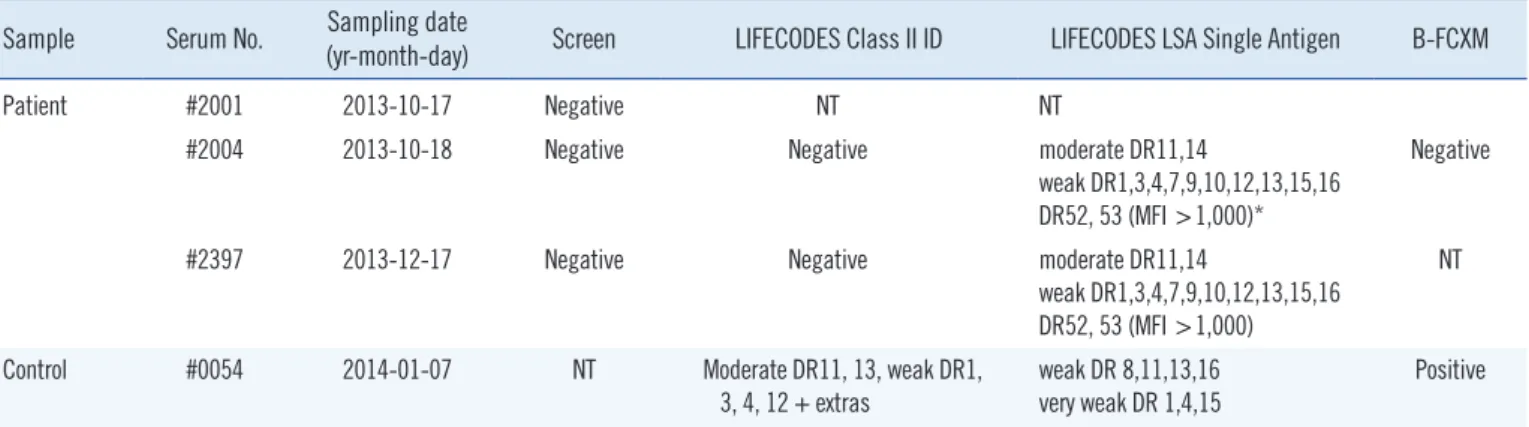
(Immucor, Stamford, CT, USA). The serum drawn on October 17, 2014 (serum No. #2001) was negative for anti-HLA, but showed a slight increase in median fluorescence intensity (MFI) value in one of the four cross-reactive class II group beads. On the following day, a SAB assay was performed on newly col- lected serum (serum No. #2004) by using the LIFECODES LSA Class II Single Antigen kit (Immucor, lot. 10102A). The following positive reactions with HLA antibody specificities were obtained:
1) moderate DR11 and 14; 2) weak DR1, 3, 4, 7, 9, 10, 12, 13, 15, and 16; and 3) DR52 and 53 (MFI >1,000) (Table 1; mod- erate: MFI 3,000-9,999; weak: MFI 1,000-2,999). Two months later, a follow-up test performed using the LIFECODES Class II ID kit (Immucor) was found to be negative (serum No. #2397).
A repeat test was performed on serum #2004 by using the LIFECODES LSA Class II Single Antigen kit to rule out clerical errors; the results obtained were the same as those obtained using the SAB assay performed previously. LIFECODES Screen and Class II ID tests were performed on serum #2004 and were negative. Finally, the LIFECODES Screen test performed on se- rum #2397 showed negative results, and a LIFECODES LSA Single Antigen test performed on serum #2397 by using a kit with a different lot number (06113A) showed results consistent with those of the previous SAB assay.
To rule out false-positive reactions in the SAB assays, flow cy-
Received: March 3, 2014 Revision received: April 14, 2014 Accepted: July 23, 2014
Corresponding author: Eun Young Song
Department of Laboratory Medicine, Seoul National University College of Medicine, 101 Daehak-ro, Jongno-gu, Seoul 110-744, Korea
Tel: +82-2-2072-0197, Fax: +82-2-3672-3337, E-mail: [email protected]
© The Korean Society for Laboratory Medicine.
This is an Open Access article distributed under the terms of the Creative Commons Attribution Non-Commercial License (http://creativecommons.org/licenses/by-nc/3.0) which permits unrestricted non-commercial use, distribution, and reproduction in any medium, provided the original work is properly cited.
In JW, et al.
False reactions in single Ag bead assays
http://dx.doi.org/10.3343/alm.2014.34.5.408 www.annlabmed.org 409
tometric crossmatches (FCXM) were performed on serum
#2004 and serum from a second patient (#0054) with similar HLA antibody specificities as control: moderate anti-DR11 and 13; weak DR1, 3, 4, 12 + extras; and no HLA class I antibody in PRA ID tests. Lymphocytes from two donors with HLA-DR11, 13 and HLA-DR11, 14 were used for FCXM analysis. Serum
#0054 showed positive B-cell (B)-FCXM to both donors, but se- rum #2004 was negative. In a previous study, we showed 90%
of sera containing DSA with moderate MFI (3,000-9,999) in LIFECODES ID tests showed positive B-FCXM [10]. Because the LIFECODES LSA Single Antigen and LIFECODES ID MFI val- ues were similar in our laboratory, the negative B-FCXM result on serum #2004 suggests moderate DSA is less likely. The pa- tient showed a clear corneal allograft at the final follow-up on February 17, 2014.
So-called “natural” antibodies reacting with dissociated forms of HLA class I antigens have been reported in healthy male blood donors [8]. These antibodies could be anti-HLA-E, which is frequently found in healthy people [11] and usually shows low MFI values (less than 1,000) in SAB assays [8]. However, un- predictable false-positive reactions to denatured HLA antigens in SAB assays can show moderate to strong reactivity to both HLA class I [4, 5, 7] and class II antigens [6], which can lead to unnecessary exclusion of organ donors or immunosuppressive therapy. A patient with negative FCXM but positive DSA to dena- tured anti-A*01:01 in SAB assays, who received a kidney trans- plantation, had no rejection episodes in the 5 yr following trans- plantation [4]. Moreover, a patient with DSA to denatured HLA- A*02:01 showed no rejection one year after heart transplanta- tion [5]. Among 8,121 consecutive samples tested using the LABScreen Single Antigen kit (One Lambda, Canoga Park, CA,
USA), 141 sera samples (1.4%) showed an atypical reactivity to denatured HLA-DRB1*09:01, DRB3*01:01, *02:02, *03:01, DPB1*20:01, and *28:01 [6]. While most previous studies were performed using the LABScreen Single Antigen kit [4-6], one study reported identification of antibodies to denatured HLA- B*44:02 by using the LIFECODES LSA Single Antigen test [7].
To the best of our knowledge, we are the first to report identifi- cation of suspected antibodies to denatured HLA class II anti- gens by using the LIFECODES LSA Single Antigen kit, which is widely used in Korea. The limitation of our study is that we did not confirm that the reactivity was specifically toward denatured, but not intact antigens. Further, other possible reasons for false- positive SAB assay reactions could not be ruled out. However, we suggest that SAB assays should be used in conjunction with other types of PRA tests that use extracted HLA molecules to avoid unnecessary barriers to transplantation and inappropriate use of immunosuppressive therapy.
Authors’ Disclosures of Potential Conflicts of Interest
No potential conflicts of interest relevant to this article were re- ported.
REFERENCES
1. Mohan S, Palanisamy A, Tsapepas D, Tanriover B, Crew RJ, Dube G, et al. Donor-specific antibodies adversely affect kidney allograft outcomes.
J Am Soc Nephrol 2012;23:2061-71.
2. Loupy A, Hill GS, Jordan SC. The impact of donor-specific anti-HLA an- tibodies on late kidney allograft failure. Nat Rev Nephrol 2012;8:348- 57.
Table 1. HLA Class II PRA and B-flow cytometric crossmatch results for patient (#2001, #2004, and #2397) and control (#0054) sera Sample Serum No. Sampling date
(yr-month-day) Screen LIFECODES Class II ID LIFECODES LSA Single Antigen B-FCXM
Patient #2001 2013-10-17 Negative NT NT
#2004 2013-10-18 Negative Negative moderate DR11,14
weak DR1,3,4,7,9,10,12,13,15,16 DR52, 53 (MFI >1,000)*
Negative
#2397 2013-12-17 Negative Negative moderate DR11,14
weak DR1,3,4,7,9,10,12,13,15,16 DR52, 53 (MFI >1,000)
NT
Control #0054 2014-01-07 NT Moderate DR11, 13, weak DR1,
3, 4, 12 + extras
weak DR 8,11,13,16 very weak DR 1,4,15
Positive
*Result of the retest was same as that of the routine test.
Abbreviations: PRA, panel reactive antibody; Screen, LIFECODES LifeScreen Deluxe; B-FCXM, B cell-flow cytometric crossmatch; NT, not tested; MFI, medi- an fluorescence intensity.
In JW, et al.
False reactions in single Ag bead assays
410 www.annlabmed.org http://dx.doi.org/10.3343/alm.2014.34.5.408 3. Zachary AA and Leffell MS. Detecting and monitoring human leukocyte
antigen-specific antibodies. Hum Immunol 2008;69:591-604.
4. Pereira S, Perkins S, Lee JH, Shumway W, LeFor W, Lopez-Cepero M, et al. Donor-specific antibody against denatured HLA-A1: clinically non- significant? Hum Immunol 2011;72:492-8.
5. Poli F, Benazzi E, Innocente A, Nocco A, Cagni N, Gianatti A, et al.
Heart transplantation with donor-specific antibodies directed toward de- natured HLA-A*02:01: a case report. Hum Immunol 2011;72:1045-8.
6. Grenzi PC, de Marco R, Silva RZ, Campos EF, Gerbase-DeLima M. An- tibodies against denatured HLA class II molecules detected in luminex- single antigen assay. Hum Immunol 2013;74:1300-3.
7. Jacob EK, De Goey SR, Gandhi MJ. Positive virtual crossmatch with negative flow crossmatch results in two cases. Transpl Immunol 2011;
25:77-81.
8. El-Awar N, Terasaki PI, Nguyen A, Sasaki N, Morales-Buenrostro LE,
Saji H, et al. Epitopes of human leukocyte antigen class I antibodies found in sera of normal healthy males and cord blood. Hum Immunol 2009;70:844-53.
9. Zoet YM, Brand-Schaaf SH, Roelen DL, Mulder A, Claas FH, Doxiadis II. Challenging the golden standard in defining donor-specific antibod- ies: does the solid phase assay meet the expectations? Tissue Antigens 2011;77:225-8.
10. Kim SY, Han BY, Hyun J,Joo SY, Song EY, Park MH. Evaluation of flow cytometric crossmatch results in comparison with donor-specific anti- bodies detected by Luminex-PRA tests in organ transplantation pa- tients. J Korean Soc Transplant 2012;26:92-100.
11. Ravindranath MH, Kaneku H, El-Awar N, Morales-Buenrostro LE, Tera- saki PI. Antibodies to HLA-E in nonalloimmunized males: pattern of HLA-Ia reactivity of anti-HLA-E-positive sera. J Immunol 2010;185:
1935-48.