J o u r n a l o f R h e u m a t i c D i s e a s e s V o l . 2 1 , N o . 1 , F e b r u a r y , 2 0 1 4
http://dx.doi.org/10.4078/jrd.2014.21.1.43 □ Case Report □
<Received:May 24, 2013, Revised:May 28, 2013, Accepted:May 29, 2013>
Corresponding to:Sung-Hwan Park, The Center for Rheumatic Disease, Division of Rheumatology, Department of Internal Medicine, Seoul St. Mary’s Hospital, College of Medicine, The Catholic University of Korea, 222, Banpo-daero, Seocho-gu, Seoul 137-701, Korea. E-mail: [email protected]
pISSN: 2093-940X, eISSN: 2233-4718
Copyright ⓒ 2014 by The Korean College of Rheumatology
This is a Free Access article, which permits unrestricted non-commerical use, distribution, and reproduction in any medium, provided the original work is properly cited.
A Case of Descending Thoracic and Abdominal Aortic Aneurysm with Ankylosing Spondylitis
Yeo-Ree Yang, Rae Seok Lee, Tae-Hyun Ban, Jae Hyun Seo, Dae-Jun Kim, Seung Min Jung, Sung-Hwan Park
Division of Rheumatology, Department of Internal Medicine, Seoul St. Mary’s Hospital, College of Medicine, The Catholic University of Korea, Seoul, Korea
Ankylosing spondylitis (AS) is a systemic inflammatory disorder that affects the axial skeleton. It often involves the extra-articular organs. Cardiovascular involvement is one of the extra-articular manifestations, which is mostly represented by aortic root, valvular heart disease, and con- duction disturbances. An aortic sclerosing inflammatory process induces aortic root thickening and rigidity. An aortic aneurysmal change is a rare complication that often
leads to life threatening conditions. A few cases regarding aortic aneurysm have been reported, but there are no re- ported cases in Korea. We report the first case of descend- ing thoracic and abdominal aortic aneurysm in a patient with ankylosing spondylitis.
Key Words. Ankylosing spondylitis, Extra-articular mani- festation, Cardiovascular, Aortic aneurysm
Introduction
Ankylosing spondylitis (AS) is the most common and severe subtype of spondyloarthritides that primarily affects the axial skeleton, most the sacroiliac joints. It often involves the ex- tra-articular organs represented by anterior uveitis, in- flammatory bowel disease, lung and kidney abnormalities, os- teoporosis, and psoriasis etc. An epidemiological study of 847 patients in Belgium found that 42% had one or more ex- tra-articular manifestations (1).
Cardiovascular involvement is well known extra-articular manifestation of AS. The usual manifestations such as aortic valve insufficiency, conduction abnormalities, and left ven- tricular hypertrophy (LVH) may occur alone or together.
A few cases about complications such as aortic aneurysm and bicuspid valve have been reported abroad, but there is no report in Korea. Here we report a case of a patient with de- scending thoracic and abdominal aortic aneurysm without any other cardiovascular involvements.
Case Report
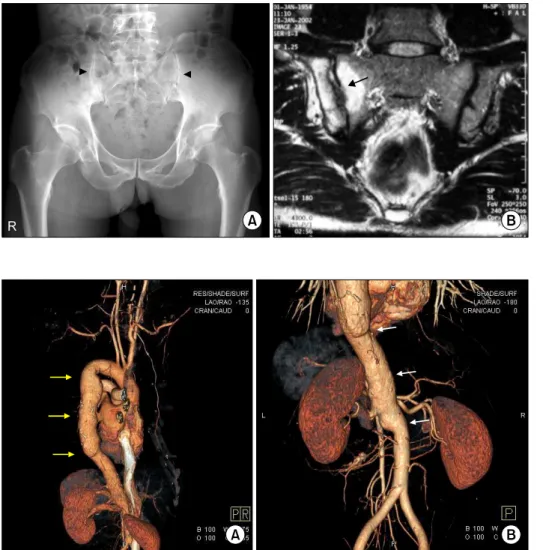
A 59-year-old male patient with 13-year history of AS pre- sented with abdominal aortic aneurysm detected incidentally during the annual medical check-up. He was initially diag- nosed with AS on December, 2001, complaining of in- flammatory back pain. He had limitation of chest expansion and spinal flexion. Pelvic plain x-ray and magnetic resonance imaging showed active sacroiliitis (Figure 1). Erythrocyte sed- imentation rate and C-reactive protein was 58 mm/h and 11 mg/dL. HLA-27 test was negative. He was complicated with anterior uveitis and osteoporosis. Other extra-articular mani- festations were not combined. He was treated with non- steroidal anti-inflammatory drugs (NSAIDs), sulfasalazine, methotrexate and tumor necrosis factor inhibitor, etanercept (enbrelⓇ), was started due to incomplete treatment response since 2004. Recent Bath Ankylosing Spondylitis Disease Activity Index (BASDAI) was 2.55 points.
During the annual medical check-up, the abdominal aortic aneurysm was detected by abdominal computed tomography
44 Yeo-Ree Yang et al.
Figure 1. Sacroiliitis at initial pre- sentation. (A) Subchondral sclerosis with periarticular erosions were observed at both sacroiliac joint in plain pelvic X-ray. Narrowing of the sacroiliac spaces also could be seen (arrowheads: Sacroiliitis, New York classification III). (B) Pelvic magnetic resonance imaging showed bone marrow edema and joint space narrowing in right sacroiliac joint.
Also synovial enhancement and sub- chondral erosions were seen (arrow).
Figure 2. Incidentally detected aortic aneurysm. (A) Chest com- puted tomographic imaging of three-dimensional reconstruction shows a dilated descending aorta (yellow arrows). Aortic root and aortic arch appeared to be normal.
(B) Continuing abdominal aortic aneurysm involves the suprarenal and infrarenal segment of abdo- minal aorta (white arrows).
unexpectedly and following work-up chest computed tomog- raphy revealed additional descending aortic aneurysm. The fu- siform aneurysm involved the entire descending thoracic aorta with small eccentric mural thrombus in distal portion, measur- ing about 4.3 cm in the diameter and total length was about 16 cm. The aortic root and ascending aorta were not involved (Figure 2A). Continuing abdominal aortic aneurysm involved the suprarenal and infrarenal segment of abdominal aorta, measuring about 3.9 cm in the diameter. The distal neck from the aortoiliac bifurcation measured about 6.7 cm in length (Figure 2B).
He did not complain any symptoms except mild chest discomfort. Electrocardiogram showed regular sinus rhythm without any conduction abnormalities. Echocardiography was followed to evaluate the possibility of other cardiovascular involvement. Both aortic valve function and ejection fraction were within normal limit. He is well tolerable without any complications at out-patient clinic.
Discussion
The prevalence of cardiac involvement in patients with AS has been reported to be 10% to 30%. Aortic root, valvular heart disease and conduction disturbances are the most com- mon manifestations. Generally these manifestations follow the arthritic symptoms by 10∼20 years, and rarely precede it (2,3). Roldan et al reported that 82% of the AS patients had subclinical aortic root and valve disease by echocardiography (4). Aortic incompetence was noted in 3.5% of AS patients who had the disease for 15 years and in 10% after 30 years (5). Previous report that analyzed clinical profile of total 721 AS patients in Korea revealed that cardiac involvement was not common in Korea. Only 13 (1.6%) patients had cardiac involvement and 8 of those patients had cardiac conduction abnormalities (6).
In patients with AS, aortic aneurysmal dilation of thoracic or abdominal aorta is an uncommon condition that rarely has been reported. Proceding sclerosing inflammatory process is supposed to induce aortic root thickening and aortic rigidity (7). The following histopathological features of the in-
Aortic Aneurysm in a Patient with Ankylosing Spondylitis 45
flammation in the aorta of 8 AS patients were reported by Bulkley and Roberts in 1973: (i) Focal destruction of muscular and elastic structures of the media; (ii) thickening of intima and adventitia; and (iii) obliterative vessel disease (8). This aortitis leads to aortic root dilatation and aortic valve incompetence. In addition to the aortic root, the chronic in- flammation may extend into the ventricular septum and can cause conduction disturbances (9).
Yuan analyzed 17 cases of aortic aneurysm associated with AS in the English literature (10). There were 13 males and 4 females. Mean age and disease duration of the patients were 44.9 and 13.4 years, which are similar to those of our patient.
However few significant differences from the previous cases are noted. Our case patient was HLA B27 negative, which is not usual pattern of AS. Out of previous 17 patients, 10 pa- tients were not tested for HLA B27, and only one patient was tested for negative. Secondly, the ECG and echocardiography of our patient showed that heart structure and function were normal, unlike some of the previous patients who showed oth- er cardiac manifestations; aortic insufficiency in 7 (41.2%), heart block in 4 (23.5%), and LVH in 7 (41.2%) patients. Last but not least, aneurysmal dilations prior cases were mostly in the aortic root and ascending thoracic aorta; in the aortic root in 3 (17.6%), ascending aorta in 6 (35.3%), ascending aorta and arch in 1, aortic root, ascending aorta and arch in 1 (5.9%) and entire thoracic aorta in 2 (11.8%), respectively.
Our patient had descending thoracic and abdominal aorta in- volvement, and descending thoracic involvement occurred on- ly in 3 patients (17.6%) of the previous cases, and only one case (5.9%) for abdominal aorta involvement.
Mortality attributable to AS is largely the result of ex- tra-articular involvements such as spinal trauma, aortic in- sufficiency, respiratory failure, amyloid nephropathy, or upper gastrointestinal hemorrhage. Circulatory disease is the most frequent cause of death of patients with AS (11). Aortic in- volvement is a rare but often leads to life threatening con- dition that sometimes needs surgical approach.
In this case, we report a patient with AS who had aortic aneurysmal change of unusual site. To our knowledge, it is the first report of aortic aneurysm involving both descending
thoracic and abdominal aorta in AS patients. We should con- sider the possibility of aortic involvement that can affect the clinical outcomes and prognosis of AS.
Summary
Aortic aneurysmal change is a rare cardiovascular involve- ment but often leads to life threatening condition in AS patient. Rheumatologists should carefully consider the possi- bility of this complication to provide appropriate management.
References
1. Vander Cruyssen B, Ribbens C, Boonen A, Mielants H, de Vlam K, Lenaerts J, et al. The epidemiology of anky- losing spondylitis and the commencement of anti-TNF therapy in daily rheumatology practice. Ann Rheum Dis 2007;66:1072-7.
2. Lautermann D, Braun J. Ankylosing spondylitis--cardiac manifestations. Clin Exp Rheumatol 2002;20(6 Suppl 28):S11-5.
3. Roldan CA. Valvular and coronary heart disease in sys- temic inflammatory diseases: Systemic Disorders in heart disease. Heart 2008;94:1089-101.
4. Roldan CA, Chavez J, Wiest PW, Qualls CR, Crawford MH. Aortic root disease and valve disease associated with ankylosing spondylitis. J Am Coll Cardiol 1998;32:
1397-404.
5. Graham DC, Smythe HA. The carditis and aortitis of an- kylosing spondylitis. Bull Rheum Dis 1958;9:171-4.
6. Kim TJ, Kim TH. Clinical spectrum of ankylosing spon- dylitis in Korea. Joint Bone Spine 2010;77:235-40.
7. Palazzi C, D' Angelo S, Lubrano E, Olivieri I. Aortic in- volvement in ankylosing spondylitis. Clin Exp Rheumatol 2008;26(3 Suppl 49):S131-4.
8. Bulkley BH, Roberts WC. Ankylosing spondylitis and aortic regurgitation. Description of the characteristic car- diovascular lesion from study of eight necropsy patients.
Circulation 1973;48:1014-27.
9. El Maghraoui A. Extra-articular manifestations of anky- losing spondylitis: prevalence, characteristics and ther- apeutic implications. Eur J Intern Med 2011;22:554-60.
10. Yuan SM. Cardiovascular involvement of ankylosing spon- dylitis: report of three cases. Vascular 2009;17:342-54.
11. Bakland G, Gran JT, Nossent JC. Increased mortality in ankylosing spondylitis is related to disease activity. Ann Rheum Dis 2011;70:1921-5.