INTRODUCTION
Attention-deficit hyperactivity disorder (ADHD) is a dis- order accompanied by a variety of behavioral problems and difficulties in self-management caused by inattention, hy- peractivity, and impulsivity.
1)In Korea, the number of chil- dren diagnosed with ADHD is increasing, with a 5-year av- erage annual increase rate of 4.2% from 2009 to 2013.
2)Moreover, since September 2016, certain drugs prescribed to adults with ADHD have been covered by insurance.
According to the Diagnostic and Statistical Manual of Men- tal Disorders, 5th edition (DSM-5), core ADHD symptoms are largely categorized into inattention and hyperactivity-im- pulsivity.
3)Inattention is exhibited through difficulty perform- ing tasks, impatience, difficulty maintaining attention, diffi- culty organizing, etc. Hyperactivity is manifested in moving and running around excessively and inappropriately for the
context, excessive movement of hands or feet, excessive talk- ing, etc., while impulsivity is displayed in patterns of disrup- tion or interference when others talk or act, difficulty delay- ing gratification, impetuous decision-making without consideration of long-term consequences, etc. ADHD symp- toms not only reduce the child’s ability to adjust to school, maintain relationships with peers and teachers, observe rules, and achieve proficient academic performance, but also in- fluence their life at home and extracurricular activities after school. Particularly after school, ADHD symptoms can cause conflicts with parents and family, and reduce children’s abil- ity to self-manage, complete homework, and perform extra- curricular activities. In summary, decreased functioning and behavioral problems due to ADHD symptoms have effects both in and out of school.
4)Most children and adolescents with ADHD attend hospi- tal with a guardian (e.g., a family member). During diagnosis and treatment, information on their school life can some- times be directly obtained from teachers, but in most cases in- formation on ADHD symptoms, behaviors, and functioning
This is an Open Access article distributed under the terms of the Creative Commons Attribution Non-Commercial License (http://creativecommons.org/licenses/by-nc/4.0) which permits unrestricted non-commercial use, distribution, and reproduction in any medium, provided the original work is properly cited.
Development of the Attention-Deficit Hyperactivity Disorder-After School Checklist
Hanik K. Yoo 1 , Hannah Huh 1 , Sukhyun Lee 2 , Kwangmo Jung 3 , and Bongseog Kim 2
1
Seoul Brain Research Institute, Seoul, Korea
2
Division of Child & Adolescent Psychiatry, Department of Psychiatry, Sanggye Paik Hospital, School of Medicine, Inje University, Seoul, Korea
3
Seoultop Psychiatric Clinic, Seoul, Korea
Objectives: This study aimed to develop the attention-deficit hyperactivity disorder (ADHD)-After School Checklist (ASK) to evaluate the severity of ADHD symptoms and self-management ability in children and adolescents in South Korea. Additionally, we evaluated the reliability and validity of the scale.
Methods: We developed the ASK to evaluate the effect of ADHD psychopathologies on self-management and interpersonal impulsiv- ity. We investigated the reliability and validity of the scale with 1349 parents (male 56.9%; 1202 parents of non-ADHD children, 147 parents of children with ADHD) in Seoul and Gyeonggi Province, Korea.
Results: According to the construct validity test using principal constant analysis with the varimax rotation method, two factors ex- plained 60.7% of the cumulative variance in ASK scores. Cronbach’s alpha for the whole scale was 0.71. There was no statistical difference between mean ASK scores at test and retest. Mean total ASK scores of the ADHD group were significantly higher than those of the non-ADHD group (p<0.001).
Conclusion: The ASK can be used as a reliable and valid tool to evaluate not only self-management capability of children and adoles- cents with ADHD in their academic and everyday life, but also their impulsiveness in interpersonal relationships.
Key Words: Attention-deficit hyperactivity disorder; Self management; Screening; After School Checklist.
Received: October 16, 2017 / Revision: December 2, 2017 / Accepted: January 2, 2018
Address for correspondence: Bongseog Kim, Division of Child & Adolescent Psychiatry, Department of Psychiatry, Sanggye Paik Hospital, School of Medi- cine, Inje University, 1342 Dongil-ro, Nowon-gu, Seoul 01757, Korea
Tel: +82-2-950-1082, Fax: +82-2-950-8883, E-mail: [email protected]
at school is obtained from families. Thus, teachers’ observa- tions of children’s school life are delivered through parents and the information is likely to be inaccurate.
5)In contrast, direct observation of children’s behavior after school can be obtained from parents. Accordingly, information concern- ing children’s performance and behavioral patterns at home after school is more likely to be accurate than that concern- ing their school life.
5)Despite the clinical need for accurate information on the symptoms and self-management of chil- dren and adolescents with ADHD after school, measurement scales to evaluate these behaviors are still not in use in Korea.
Currently, the measurement scales used to evaluate chil- dren with ADHD in Korea include the Korean version of the ADHD Rating Scale for Parents and Teachers,
6)Conner’s Rat- ing Scale for Parents and Teachers,
7)and the Child and Adoles- cent Behavior Checklist.
8)The Korean version of the ADHD Rating Scale for Parents and Teachers assesses behaviors based on the DSM-IV diagnostic criteria, and consists of nine items measuring inattention and nine measuring hyperactivity- impulsivity. The structure of this scale is very useful for clas- sifying ADHD into three subtypes: predominantly inatten- tive, predominantly hyperactive-impulsive, and combined.
9)Reliability and validity assessments
6)of the Korean version of this scale as well as standardization testing
9)have been conducted. Conner’s Rating Scale for Parents and Teachers is utilized to evaluate childhood behavioral problems, and is designed for parents and teachers to assess hyperactivity and other behavioral problems in children aged 3 to 17 years.
10)Originally, this scale was developed with 93 items for assess- ment by parents and 39 items for assessment by teachers;
however, a shorter form was later developed consisting of 48 and 28 items for parents and teachers, respectively. Many studies were conducted outside Korea on the reliability and validity of Conner’s Rating Scale,
6-10)and the reliability and validity of its Korean version were tested by Park et al.
7)The Child and Adolescent Behavior Checklist contains the social competence scale, to measure sociability and academic per- formance, and the behavioral symptom scale, to assess 119 behavioral problems. The Korean version of these two scales was standardized by Oh et al.,
11)who also demonstrated their reliability and validity. These scales are relatively effective in assessing overall symptom severity, as they evaluate ADHD symptoms in widely ranging life domains. However, their limitation is that the same response scale is used for diverse behavioral patterns in a variety of contexts.
12)ADHD is a disorder in which self-management is difficult due to inattention and impulsivity. Accordingly, a primary treatment goal in ADHD is to increase the individual’s abil- ity to self-manage to the level of their peers.
13)To date, no in- strument has been developed in Korea to evaluate self-man-
agement ability in children and adolescents with ADHD.
Therefore, it is necessary to develop an assessment tool that can be used in clinical practice. The best approach to accu- rately assessing ADHD symptom severity and self-manage- ment ability is direct observation by a trained rater; howev- er, it is difficult to evaluate or discern problems at home using this approach. Therefore, a measurement scale should be de- veloped that can be conveniently used at home to reliably as- sess symptom severity and self-management ability in chil- dren and adolescents with ADHD. With such a scale, it would be possible to determine the need for psychiatric evaluation and intervention for low self-management ability, and eval- uate the effects of therapeutic interventions on the improve- ment of both ADHD symptoms and self-management ability.
Accordingly, the purpose of the present study was to devel- op the ADHD-After School Checklist (ASK), a measurement scale for parents to assess ADHD symptom severity and af- ter-school self-management ability of children and adoles- cents with ADHD, and examine its reliability and validity.
METhODs
Study participants
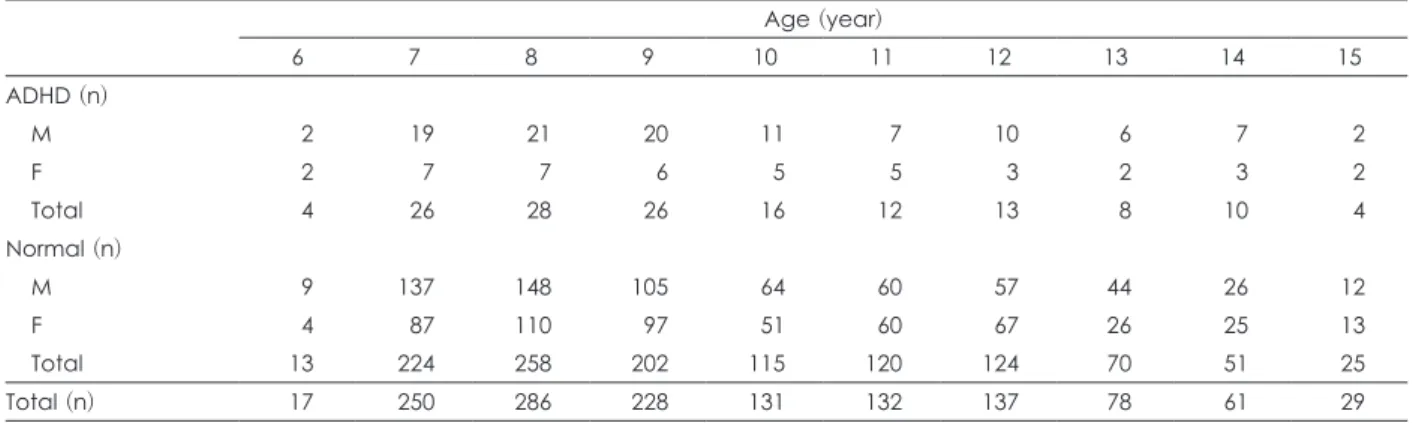
The present study was conducted with 1202 parents of children and adolescents aged 6 to 15 years living in Seoul or Gyeonggi Province and attending general kindergarten, elementary, or middle school; additionally, 152 parents of children and adolescents with ADHD in the same age range who had visited a pediatric psychiatry outpatient clinic in Seoul were included, from which 5 were excluded from the analysis due to incomplete responses. Therefore, data from 1349 parents were analyzed. The final sample comprised 767 male respondents (56.9%) and 582 female respondents (43.1%);
1202 (89.1%) were in the non-ADHD group and 147 (10.9%) in the ADHD group (Table 1).
The diagnosis of ADHD was made by a pediatric psychia- trist based on the DSM-5 diagnostic criteria. Exclusion cri- teria were as follows: an overall IQ score of 70 or lower on Wechsler’s Intelligence Scale; a clear history of brain damage, other than ADHD, due to a genetic disorder or acquired brain injury (e.g., cerebral palsy); comorbidity with seizure disor- der or another neurological disorder; diagnosis of autism spectrum disorder, schizophrenia, bipolar disorder, major depressive disorder, or other psychiatric disorder; and his- tory of taking psychiatric medication.
Development of Attention Deficit Hyperactivity Disorder-After School Checklist
To develop the ASK, a pilot study was conducted with 144
parents of patients with ADHD who visited one of five pedi-
atric psychiatry outpatient clinics in Seoul. In the pilot study, parents were asked the open-ended question “What is the most difficult aspect for you after your child comes home from school due to his/her ADHD symptoms?” The most frequent response was homework and self-studying, followed by daily life management, relationships with friends and siblings, relationship with parents, and extracurricular ac- tivities. The contents of the measurement scale were deter- mined based on the pilot study findings, and the ASK was developed by adding response anchors for each item in order to measure severity.
The final version of the ASK consisted of a total of seven items, each measured on a 5-point scale. The 5 points on the scale for each item were anchored with specific criteria (Sup- plementary Table 1 in the online-only Data Supplement);
the items were categorized into the domains of self-manage- ment and impulsivity in interpersonal relationships. The first three items in the domain of self-management assessed studying and task management: 1) delay in initiating a task, 2) motivation and avoidance, and 3) level of feedback. The re- maining two items in the domain of self-management as- sessed the level of daily life management: 4) voluntary daily life management and 5) completion and delay in daily life management. The items in the domain of impulsivity in in- terpersonal relationships assessed 6) intrusion and 7) disrup- tion and interference.
Procedure
The present study was approved by the Institutional Life Ethics Committee of Inje University Sanggye Paik Hospital (IRB No. SGPAIK 2014-11-012). Participants in the non-AD- HD group were recruited through announcements on the Internet and social network sites. The parents who volun- teered to participate in the study either completed the survey online or filled out a paper version mailed to them. To re- cruit participants in the ADHD group, the researcher visited
pediatric psychiatry outpatient clinics and parents of chil- dren and adolescents diagnosed with ADHD who consented to participate in the study were recruited.
Data analysis
The data were analyzed with SPSS for Windows version 21.0 (IBM Corp., Armonk, NY, USA) and SAS for Win- dows version 9.4 (SAS Institute Inc., Cary, NC, USA). Validi- ty was tested using a factor analysis package, and discrimi- nant validity was tested with an independent group t-test on the scores of the non-ADHD and ADHD groups. With re- spect to reliability, Cronbach’s alpha was computed to assess internal reliability, and a paired t-test was utilized to assess test-retest reliability. Data regarding standardization were examined using descriptive statistics. Statistical significance was determined as p<0.05.
REsULTs
Validity assessment
A factor analysis was conducted to evaluate the validity of the seven ASK items. The results of a principal component analysis showed that the communality of item 3 was 0.4, a generally accepted lower limit, and all other items showed a communality of 0.5 or higher. Thus, all items were included in the final version of the ASK (Table 2).
Items were factor-analyzed into two groups: items 1 through 5, and items 6 and 7. The rotation sums of squared loadings were 2.626 for factor 1 (self-management) and 1.620 for fac- tor 2 (impulsivity); the proportions of variance explained were 37.5% and 23.2% for factors 1 and 2, respectively. Based on these findings, the items could be categorized into two fac- tors: items 1 through 5, and items 6 and 7. Items 1 through 5 assessed self-management, as intended during their develop- ment, and specifically measured parental assessment of their children’s management of study activity and everyday life
Table 1. Demographic data of the study subjects
Age (year)
6 7 8 9 10 11 12 13 14 15
ADHD (n)
M 2 19 21 20 11 7 10 6 7 2
F 2 7 7 6 5 5 3 2 3 2
Total 4 26 28 26 16 12 13 8 10 4
Normal (n)
M 9 137 148 105 64 60 57 44 26 12
F 4 87 110 97 51 60 67 26 25 13
Total 13 224 258 202 115 120 124 70 51 25
Total (n) 17 250 286 228 131 132 137 78 61 29
ADHD: attention-deficit hyperactivity disorder, F: female, M: male
(scheduling, personal hygiene, etc.). Items 6 and 7 referred to impulsivity in interpersonal relationships, measuring paren- tal assessment of their children’s inability to control impul- sivity in interpersonal relationships, and insistence on their own opinion or interference with that of others.
Reliability assessment
To assess the reliability of the ASK, we examined the cor- relations between each test item and individual factors of
the scale as well as the total score, and calculated Cronbach’s alpha (an index of internal reliability). Cronbach’s alpha for all seven items was 0.71. Regarding the individual factors extracted in the factor analysis, factor 1 (items 1 through 5) showed a high reliability (Cronbach’s alpha=0.79), while factor 2 (items 6 and 7) showed acceptable reliability (Cron- bach’s alpha=0.63).
To assess the temporal stability of the ASK, test-retest re- liability was assessed with 20 participants at an interval of 2 weeks. The difference in scores between test and retest was not significant (t=0.382, p=0.644).
Table 2. Factor analysis
Communality Rotated factor matrix
1 2
Q1 0.686 0.819 0.123
Q2 0.612 0.751 0.220
Q3 0.400 0.549 0.314
Q4 0.515 0.714 0.071
Q5 0.579 0.707 0.282
Q6 0.699 0.251 0.798
Q7 0.755 0.134 0.859
Factor Self-management Impulsiveness
Rotation sums of squared loadings
2.626 1.620
Cumulative variance explained (%)
37.5 23.2
Extraction method: principal axis factoring, Rotation method:
varimax with Kaiser normalization
Table 3. Mean and SD of the ASK by age (n=1349)
Age (year)
6 7 8 9 10 11 12 13 14 15
Male (n=767)
16.27±
3.52
15.66±
4.42
14.89±
4.15
15.47±
4.02
14.72±
4.42
14.69±
4.44
14.27±
5.34
14.30±
3.23
15.06±
5.31
13.43±
4.55 Female
(n=582)
15.67±
5.28
14.40±
4.03
13.68±
4.51
13.66±
3.45
12.80±
4.17
13.00±
3.98
11.86±
3.44
11.89±
3.10
12.64±
5.01
13.00±
4.50 Data are presented as mean±SD. ASK: attention-deficit hyperactivity disorder-After School Checklist, SD: standard deviation
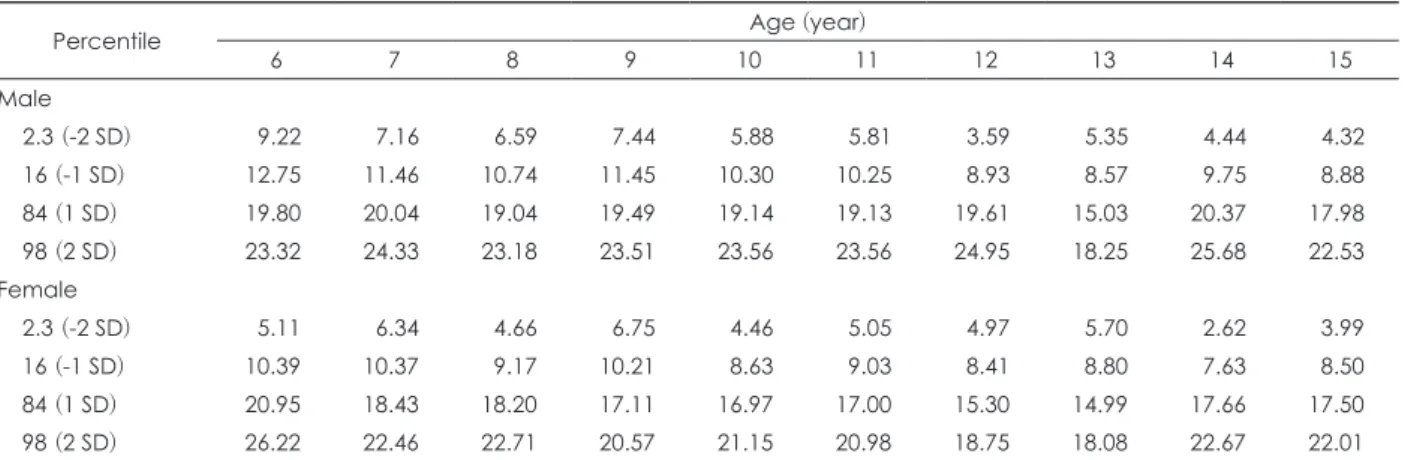
Table 4. Normative data of the ASK
Percentile Age (year)
6 7 8 9 10 11 12 13 14 15
Male
2.3 (-2 SD) 9.22 7.16 6.59 7.44 5.88 5.81 3.59 5.35 4.44 4.32
16 (-1 SD) 12.75 11.46 10.74 11.45 10.30 10.25 8.93 8.57 9.75 8.88
84 (1 SD) 19.80 20.04 19.04 19.49 19.14 19.13 19.61 15.03 20.37 17.98
98 (2 SD) 23.32 24.33 23.18 23.51 23.56 23.56 24.95 18.25 25.68 22.53
Female
2.3 (-2 SD) 5.11 6.34 4.66 6.75 4.46 5.05 4.97 5.70 2.62 3.99
16 (-1 SD) 10.39 10.37 9.17 10.21 8.63 9.03 8.41 8.80 7.63 8.50
84 (1 SD) 20.95 18.43 18.20 17.11 16.97 17.00 15.30 14.99 17.66 17.50
98 (2 SD) 26.22 22.46 22.71 20.57 21.15 20.98 18.75 18.08 22.67 22.01
ASK: attention-deficit hyperactivity disorder-After School Checklist, SD: standard deviation
Fig. 1. Trajectories of the attention-deficit hyperactivity disorder- After School Checklist of general population by sex. SD: stan- dard deviation.
22 20 18 16 14 12 10 8 6
8 6
4 10 12 14 16
Mean ± SD
Male
Female
Standardization
The mean and standard deviation of the total ASK scores are shown in Table 3, according to gender and age. In both boys and girls, the ASK score was highest for 6-year-olds and lowest for 12-year-olds.
The mean total ASK score of boys was 14.9 (SD=4.4), which was significantly higher (t=6.8, p<0.001) than that of girls, 13.3 (SD=4.1). Overall, the total ASK score showed a decreasing trend from age 6 through age 12 in both boys and girls (Fig. 1).
Table 4 summarizes gender- and age-specific total score norms from ages 6 to 15 years that were computed based on the findings of the present study.
Discriminant validity
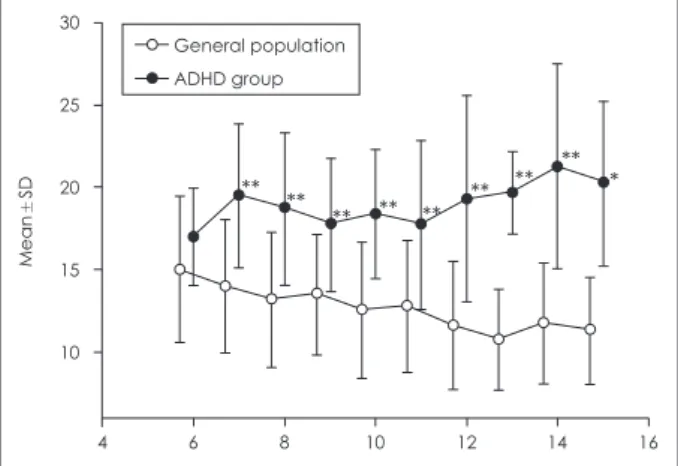
To investigate whether the ASK could discriminate ADHD from non-ADHD, the differences in ASK scores between the ADHD and non-ADHD groups were examined and the re- sults are displayed in Table 5. The total score of the ADHD group, without considering gender, was higher than that of the non-ADHD group by 4.8 points (t=14.0, p<0.001). For boys, the total score was higher by 4.2 points in the ADHD group vs. the non-ADHD group (t=10.0, p<0.001); for girls, it was higher by 5.5 points (t=9.3, p<0.001). A Mann-Whitney
U test was conducted to examine differences in age-specific total scores between the ADHD and non-ADHD groups, and revealed that scores were significantly higher for the ADHD group at all ages, with the exception of 6-year-olds (Fig. 2).
DIsCUssION
In the present study, the ASK, a scale to assess ADHD symp- tom severity and self-management ability in Korean children and adolescents was developed for parental use at home with relative ease. Reliability analyses showed that the internal consistency was high for all items and between the items and each factor, and test-retest score differences were not signifi- cant, suggesting that the ASK is a reliable tool. Discriminant validity analysis showed that ASK scores were significantly different between the groups, demonstrating that the ASK can differentiate between ADHD and non-ADHD. Gender and age comparisons of ASK scores showed that boys scored sig- nificantly higher than did girls, and the scores tended to de- crease with age.
The findings of the present study are in line with those of standardization studies of other scales that are most widely used at present.
9)Regarding the Korean version of the ADHD Rating Scale for Parents and Teachers, boys scored signifi- cantly higher than did girls on the inattention and hyperac- tivity-impulsivity factors, and the same pattern of findings was reported in normative research on Conner’s Rating Scale for Parents and Teachers.
14,15)A normative study conducted with 4- to 19-year-olds in the US utilizing the ADHD Rat- ing Scale found that the scores on inattention and hyperac- tivity-impulsivity decreased with age,
16)which is congruent with the findings of the present study. However, in the present study, the difference in ASK scores between the ADHD and non-ADHD groups was not significant for 6-year-old chil- dren. The mean ASK score of 6-year-olds in the non-ADHD group was 15.77, which is relatively higher than that of non- ADHD children of other ages (13.12). In an age as young as 6 years, difficulty in self-management and impulsivity in in- terpersonal relationships, which are measured by the ASK
Table 5. Differences of the total scores of the ASK between ADHD group and general population Age (year)
6 7 8 9 10 11 12 13 14 15 Total
ADHD (n=147)
17.00±
2.94
19.46±
4.39
18.68±
4.63
17.73±
4.07
18.38±
3.95
17.75±
5.19
19.31±
6.28
19.67±
2.55
21.30±
6.22
20.25±
5.06
18.49
±4.61 Normal
(n=1202)
15.77±
4.42
14.69±
4.03
13.93±
4.09
14.26±
3.67
13.28±
4.11
13.48±
4.01
12.38±
3.89
11.50±
3.06
12.51±
3.67
12.08±
3.21
13.65
±3.99 U value 20.5 1238.5*** 1475*** 1402*** 325.5*** 382.5** 271.5*** 117.5** 54*** 7*
t-value 14.0***
Data are presented as mean±standard deviation. *p<0.05, **p<0.01, ***p<0.001. ADHD: attention-deficit hyperactivity disorder, ASK: ADHD-After School Checklist
Fig. 2. Differences of the trajectories of the ADHD-After School Checklist between general population and ADHD group. *p<
0.05, **p<0.001. ADHD: attention-deficit hyperactivity disorder, SD: standard deviation.
30
25
20
15
10
8 6
4 10 12 14 16
Mean±SD
General population ADHD group