• 검색 결과가 없습니다.

Cognitive Function, Emotional and Behavioral Problems, and Temperament of Premature Children

N/A
N/A
Protected

Academic year: 2021

Share "Cognitive Function, Emotional and Behavioral Problems, and Temperament of Premature Children"

Copied!
8
0
0

로드 중.... (전체 텍스트 보기)

전체 글

(1)

INTRODUCTION

The expression “preterm babies” refers to newborns born before 37 weeks of gestation or before 259 days from final menstruation. Depending on the length of the gestation, they can be subdivided into Late Preterm (between 32 and 37 weeks), Very Preterm (between 28 and 32 weeks), and Ex- tremely Preterm (less than 28 weeks) [1]. As the fetal brain develops during pregnancy, preterm babies are predicted to have lower levels of cognitive functions in comparison to full- term babies.

This assumption has been supported in a number of clin- ical experiments on preterm babies. A large-scale research conducted in Taiwan evaluated the intelligence of 322 5-year- olds who were born as very low-weight infants and 103 5-year- olds who were born as full-term infants using the Wechsler

Preschool and Primary Scale of Intelligence-Revised (WPP- SI-R) [2]. This study showed that full-term children had a mean score of 114.9±11.8 on the Performance Scale, 103.9±12.9 on the Verbal Scale, and 110.6±11.2 on the Full Scale, while very low-weight children showed mean scores of 94.1±16.4 on the Performance Scale, 87.2±12.8 on the Verbal Scale, and 89.5±14.6 on the Full Scale, indicating that very low- weight children have worse cognitive functions in compari- son to full-term children. Another study based on the WPP- SI-R evaluation of 6-year olds showed that children born as full-term infants scored 106.2±14.3 on the Verbal Scale, which was significantly different from the average of 95.3±11.7 ex- hibited by 24 children who were born as very low-weight in- fants [3]. Another study showed that the average cognitive function test score was significantly related to birth weight, regardless of the age at which the test was performed [4].

Therefore, the decreased cognitive function of preterm infants has been reported in previous studies.

The recently revised WPPSI-IV is suggested to be especial-

This is an Open Access article distributed under the terms of the Creative Commons Attribution Non-Commercial License (https://creativecommons.org/licenses/by-nc/4.0) which permits unrestricted non-commercial use, distribution, and reproduction in any medium, provided the original work is properly cited.

Cognitive Function, Emotional and Behavioral Problems, and Temperament of Premature Children

Dong-hyun Ahn

1,2

, Aran Min

1

, Kangryul Kim

1

, Kyung-ah Kim

1

, Mi-Young Oh

1

, Hyun Ju Lee

3

, Hyun-Kyung Park

3

, and Hyewon Park

4

1

Department of Psychiatry, Hanyang University Hospital, Seoul, Korea

2

Department of Psychiatry, Hanyang University College of Medicine, Seoul, Korea

3

Department of Pediatrics, Hanyang University College of Medicine, Seoul, Korea

4

Department of Child & Family Welfare, University of Ulsan, Ulsan, Korea

Objectives: We aimed to compare preterm, neurodevelopmentally disordered and healthy full-term children.

Methods: We enrolled 47 children who were born preterm, 40 neurodevelopmentally disordered children, and 80 healthy children as control participants, in order to assess the cognitive functioning and the risk of behavioral problems at the age of 5. Children were as- sessed using the Korean Wechsler Preschool and Primary Scale of Intelligence-4th edition (K-WPPSI-IV), the Child Behavior Check- list (CBCL), and the Temperament and Character Inventory (TCI).

Results: The mean K-WPPSI-IV score of the preterm group was 87.19±17.36, which was significantly higher than that of the neurode- velopmental disorder group (69.98±28.63; p<0.001) but lower than that of the control group (107.74±14.21; p<0.001). The cumulative CBCL scores of the preterm children were not significantly different from those of the control group. Additionally, the TCI scores for reward dependence of the preterm children were higher than those of the control group.

Conclusion: The cognitive performance of preterm infants was lower than that of healthy full-term infants at the age of 5, and there was an association between slower growth and decreased cognitive ability.

Key Words: Preterm; Korean Wechsler Preschool and Primary Scale of Intelligence; Cognitive function;

Emotional and behavioral problems; Temperament.

Received: August 7, 2018 / Revision: October 2, 2018 / Accepted: October 16, 2018

Address for correspondence: Dong-hyun Ahn, Department of Psychiatry, Hanyang University Hospital, 222 Wangsimni-ro, Seongdong-gu, Seoul 04763, Korea

Tel: +82-2-2290-8425, Fax: +82-2-2298-2055, E-mail: [email protected]
(2)

ly useful to evaluate infants with various neurodevelopmen- tal disorders, because many studies show its relationship with neuroscientific opinions about neurodevelopment and cog- nitive functions.

Furthermore, there have been some studies about the emo- tional behaviors of preterm infants. In a study of the associ- ation of in-class behaviors and birth weight of elementary school children, children with lower birth weight showed worse attention and verbal skills [5]. In comparison with normal children and low-weight children, very low-weight children showed significantly greater difficulty adapting to school and more hyperactivity [6]. A meta-analysis of 6 pre- vious studies compiled by Bhutta et al. [4] reported the pre- term children’s relative risk factor for attention-deficit/hy- peractivity disorder (ADHD) to be 2.64. Other studies are available about the behavioral problems of preterm or very low-weight children.

Some studies are also available on the temperament of pre- term infants. Sajaniemi et al. [7] compared preterm and full- term infants using the Toddler Temperament Questionnaire.

The distribution of temperament type (easy, difficult, slow to warm up) was not significantly related to birth weight, but preterm infants showed lower activity, more adaptability, more positive mood, lower intensity emotions, and lower reaction threshold. Another study showed that preterm toddlers were more likely to have easier temperaments and less likely to have difficult temperaments, but there were no significant differences in temperament and behavior depending on the time of birth [8]. However, there has been no previous study on the temperament of preterm infants using Cloninger’s sev- en-factor model, which can predict personality temperaments.

The Diagnostic and Statistical Manual of Mental Disor- ders, 5th edition (DSM-5), recently revised by the American Psychiatric Association suggests a new scope for the diagno- sis of neurodevelopmental disorders, in which intellectual developmental disorder, autism spectrum disorder, ADHD, communication disorder, motor disorder, and specific learn- ing disorder are included. The common feature among all these is that the symptoms generally occur in the early devel- opmental stages, and that lack of development leads to im- pairment in personal, social, academic, or occupational func- tions. Preterm birth is known to be one of the risk factors of developing these neurodevelopmental disorders.

Although many studies have shown evidence that preterm children have worse cognitive functions in comparison to normal children, there is a lack of research on the compari- son to children with neurodevelopmental disorders. In the case of children with neurodevelopmental disorders, the de- gree of cognitive function may be varied, but it can be predict- ed that cognitive functions of children with neurodevelopmen-

tal disorders, serious enough to receive outpatient treatment, will be worse than those of normal children. Therefore, we formulated the hypothesis that the cognitive functions of preterm children will be worse than those of normal chil- dren, but better than those of children with neurodevelop- mental disorders, and designed our research to test this hy- pothesis.

In our study, we aimed to examine the clinical meaning of the cognitive impairment and behavioral problems of pre- term children by comparing preterm children, children with neurodevelopmental disorders, and normal children in or- der to study the relationship among brain development, cognitive impairment, and behavioral problems. Further- more, we also conducted an evaluation of children’s temper- ament, based on the seven-factor model, to examine wheth- er the behavioral problems of preterm children arise from their temperament or are acquired from the environment.

METHODS

Subjects

Preterm children, children with neurodevelopmental dis- orders, and normal children between the ages of 2 years and 6 months and 7 years and 7 months were enrolled in the study.

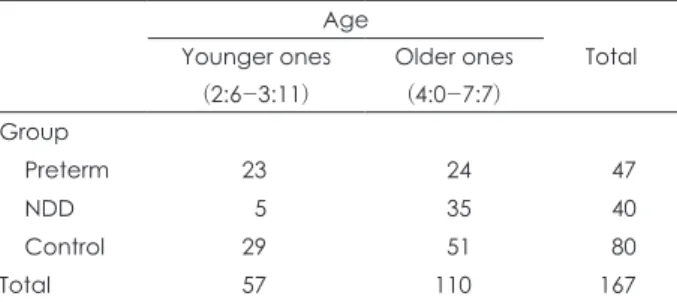
Preterm children (n=47) were recruited, via phone calls and by visiting the Department of Pediatrics, among children who were under 32 weeks of gestation at birth, with a histo- ry of being admitted to a University Hospital located in Seoul. Children with neurodevelopmental disorders (n=40) were recruited, via phone calls and visiting the Department of Psychiatry, among children in the desired age group who were receiving outpatient treatment based on DSM diag- nostic criteria in the University Hospital. Normal children (n=80) were recruited via convenience sampling among children in the desired age group who attended regular day- care centers, kindergarten, and elementary schools in met- ropolitan Seoul, and voluntarily expressed the desire to par- ticipate, with the approval of their parents. However, children who were confirmed to have neurodevelopmental disorders or those who were suspected of have clinical problems based on the Korean version of the Child Behavior Checklist (K-CB- CL) were excluded from the control group. The division be- tween younger-age and older-age groups is shown in Table 1.

Evaluation tools

Korean-Wechsler Preschool and Primary Scale of Intelli- gence-4th edition (K-WPPSI-IV)

The K-WPPSI-IV was developed in the United States in 2012

and translated and standardized into Korean by Park et al.

(3)

[9,10]. The K-WPPSI-IV is intended for young children, be- tween the ages of 2 years and 6 months and 7 years and 7 months. It comprises the Full Scale Intelligence Quotient (FSIQ), which represents overall cognitive skills, index scores representing the cognitive skills for specific cognitive areas (Verbal Comprehension, Visual Spatial, Fluid Reasoning, Working Memory, Processing Speed), and 15 subtest scores.

To reduce the burden of conducting all the subtests on young children, the evaluation system and records were divided into those appropriate for children between 2 years and 6 months and 3 years and 11 months, and those appropriate for chil- dren between 4 years and 0 months and 7 years and 7 months.

The average reliability of the K-WPPSI-IV was shown to be given by a Cronbach’s α of 0.92.

Korean version of the Child Behavior Checklist for ages 1.5-5 (K-CBCL 1.5-5)

Achenbach and Rescorla [11] developed the CBCL 1.5-5 and Kim et al. [12] translated and standardized it into Kore- an version. Ninety-nine items out of 100 are scored 0, 1, or 2 points, and 1 item is open-ended and used to describe the problems of young children and evaluate their degree. The main caretaker considers the frequency of behaviors in the past 2 months to evaluate 7 subareas, which are emotional responsiveness, anxious/depressed, somatic complaints, withdrawn, sleep problems, attention problems, and aggres- sive behavior, as well as 2 factor scores of internalizing and externalizing problems, and a cumulative behavioral prob- lem score. The range of internal consistency and reliability of the K-CBCL 1.5-5 between syndrome indices and inter- nalizing and externalizing total score was 0.56–0.94 in terms of Cronbach’s α, while the Cronbach’s α for the total score including all items was 0.94, and the same value was obtained for internalizing problems and externalizing problems.

The Korean Version of the Preschool Temperament and Character Inventory (K-psTCI)

Cloninger’s Temperament and Character Inventory (TCI), which was originally a self-reported survey format [13], was

adapted by Constantino et al. [14] to use on children of pre- school ages and further translated and standardized into Ko- rean by Park et al. [15]. The 4 factors of temperament are Novelty Seeking (NS), Harm Avoidance (HA), Reward De- pendence (RD), and Persistence (P), and the 3 factors of per- sonality are Self-Directedness, Cooperativeness, and Self- Transcendence. A total of 74 items include 40 items on tem- perament and 34 items on personality. Each item on the 4 temperament factors are scored on a scale of 1–5, ranging from ‘strongly disagree’ to ‘strongly agree.’ 32 items randomly mixed in within the 74 items have a reversed 5-point scale.

The internal consistency and reliability range of K-preschool TCI was 0.62–0.78 (Cronbach’s α).

Process

This research was approved by the Institutional Review Board of the University Hospital in which this study was con- ducted (IRB No. 2013-12-001). Parents of the volunteer sub- jects were informed of the research background and pur- pose, process, risk and discomfort due to participation, and benefits, after which consent was received and the evalua- tion conducted. The total evaluation time was between 40 minutes and 2 hours and 40 minutes, with large variance de- pending on the child’s cognitive and cooperation levels. The evaluation was carried out in the following order: examina- tion instructions and agreement, examination of the child’s intelligence, self-reported exam of the mother, and interview about special factors. The intelligence examination was con- ducted by 3 clinical psychology trainees, who are training with clinical psychologists at a University Hospital after graduat- ing with a master’s degree in a psychology-related field, using standardized procedures. The examiners completed a 3-ses- sions workshop about conducting, scoring, and coding K- WPPSI-IV and were trained on the standardized proce- dures. After completing the examination, the parents of the child were given free feedback about the results of the re- search examination, including the level of cognitive func- tion development.

Statistical analysis

Data were processed and analyzed using SPSS 18.0 (SPSS Inc., Chicago, IL, USA) by statistician in University Medical Research Assist-Center. To examine the sociodemographic characteristics, the chi squared and analysis of variance (ANO- VA) tests were used. The intelligence index data for each group did not fit the equal variance assumption according to Levene’s test, so Welch’s ANOVA was used, and the Games- Howell test was used for post-hoc analysis. Since, instead, the data on behavioral problems and temperament fit the equal variance assumption, ANOVA was used, with Scheffe’s meth-

Table 1. Age distribution of group of subjects Age

Total Younger ones

(2:6-3:11)

Older ones (4:0-7:7) Group

Preterm 23 24 47

NDD 5 35 40

Control 29 51 80

Total 57 110 167

NDD: neurodevelopmental disorder

(4)

od for post-hoc analysis.

Given that the sub-indexes for the 2 years and 6 months to 3 years and 11 months, and from 4 years and 0 months to 7 years and 7 months age groups differ in the WPPSI-IV, the subjects were divided into a younger-age and an older-age group for statistical analysis. The common subtests were an- alyzed using data from all subjects, but fluid reasoning and processing speed, which are only evaluated in the older-age group, were only analyzed for this group.

The sub-indexes for the from 1 years and 6 months to 5 years and 11 months, and from 6 years and 0 months to 7 years and 7 months age groups are different for the CBCL as well, so only the common indexes were analyzed for statisti- cal analysis.

RESULTS

Sociodemographic characteristics

The sociodemographic background of the research sub-

jects is shown in Table 2. Gender, age, birth order, period of gestation at birth, mother’s age at pregnancy, plan of pregnan- cy, marriage status, number of family members, number of children, education level of father and mother were investi- gated and subjected to post-hoc analysis for the three groups.

Age and period of gestation at birth showed statistically sig- nificant differences. Children in the neurodevelopmental disorder group were older than those in the preterm and con- trol groups. The period of gestation at birth was significant- ly lower for preterm group, which is expected given the fact that such group consists of children whose gestation period was 37 weeks or shorter.

Cognitive function

The results of the K-WPPSI-IV cognitive exam are shown in Table 3. The FSIQ, Verbal Comprehension Index (VCI), Visual Spatial Index (VSI), Fluid Reasoning Index (FRI), Working Memory Index (WMI), and Processing Speed In- dex (PSI) all showed significant differences among the three

Table 2. Sociodemographic characteristics of subjects

Variables Preterm

1

(n=47) NDD

2

(n=40) Control

3

(n=80) F Post hoc

Age, years 3.94 (1.47) 5.27 (1.31) 4.30 (1.39) 1.412* 2>1, 3

Sex 2.998

Male 22 27 42

Female 25 14 38

Gestational period 28.31 (3.52) 37.62 (5.38) 39.09 (1.41) 54.405* 2, 3>1

Age of pregnancy 32.56 (4.43) 31.87 (4.08) 31.60 (3.53) 0.849

Scheduled pregnancy 2.196

Yes 33 23 50

No 12 16 30

Status of parents 8.706

Marriage 44 33 74

Divorced 1 6 3

Separated 0 1 2

Number of family 4.44 (1.26) 4.15 (0.92) 4.20 (0.97) 0.854

Number of children 1.82 (0.68) 1.83 (0.64) 1.94 (0.71) 0.588

Birth ranking 4.784

1st 25 26 35

2nd 15 11 35

3rd and more 3 2 6

Educational levels of father 5.157

High school 9 10 21

University 26 19 38

Graduate 8 6 13

Etc 0 1 0

Educational levels of mother 12.439

High school 14 9 29

University 24 18 37

Graduate 5 9 8

Etc 0 2 0

Data are mean (standard deviation) values. *p<0.001. Etc: et cetera, NDD: neurodevelopmental disorder

(5)

groups. The post-hoc analysis showed that the average cog- nitive indexes for all areas in the preterm group were lower in comparison to the control group and higher in comparison to the neurodevelopmental disorder group.

Emotional & behavioral problems

The results about total score, internalizing problems, and externalizing problems extracted from the CBCL are shown in Table 4. The result of the CBCL evaluation of the three groups showed significant differences among them in the total score, internalizing problems index, and externalizing problems index. The Bonferroni post-hoc test among the three groups showed that the neurodevelopmental disorder group showed significantly higher behavioral problem scores compared to the preterm and control groups, but there was

no difference between the preterm and control groups.

The comparisons of the subareas of the CBCL are shown in Table 5. The analysis of the subareas common to all age groups showed significant differences among the three groups in the anxiety/depression index, attention index, and aggressive behavior index. The anxiety/depression index was significantly higher in the neurodevelopmental disorder group than in the control group. The neurodevelopmental disorder group showed significantly higher attention and aggressive behavior scores than the preterm and control groups, but there was no significant difference between the preterm and control groups. There was no significant difference among the groups in the somatic complaints index.

Table 3. Comparison of results of WPPSI-IV between preterm children group, NDD children group, and control group

Subtest Preterm

1

(n=47) NDD

2

(n=40) Control

3

(n=80) F Post hoc

FSIQ 87.19 (17.36) 69.98 (28.63) 107.74 (14.21) 46.10* 2<1<3

VCI 92.49 (16.95) 74.12 (29.72) 112.39 (13.36) 46.21* 2<1<3

VSI 87.28 (16.86) 77.45 (26.48) 103.44 (14.06) 26.86* 2<1<3

WMI 95.89 (17.90) 74.63 (25.35) 106.24 (14.35) 28.53* 2<1<3

FRI 91.13 (16.30) 74.77 (26.86) 104.35 (16.16) 18.56* 2<1<3

PSI 87.00 (19.03) 70.23 (23.96) 105.06 (15.01) 31.79* 2<1<3

Post hoc Games-Howell test. Data are mean (standard deviation) values. *p<0.001. FRI: Fluid Reasoning Index, FSIQ: Full Scale Intelligence Quotient, NDD: neurodevelopmental disorder, PSI: Processing Speed Index, VCI: Verbal Comprehension Index, VSI:

Visual Spatial Index, WMI: Working Memory Index, WPPSI-IV: Wechsler Preschool and Primary Scale of Intelligence-4th edition

Table 4. The comparison of CBCL ratings among preterm, NDD, and control groups

Preterm

1

(n=47) NDD

2

(n=40) Control

3

(n=80) F Post hoc

Total score 50.42 (1.01) 62.46 (8.61) 49.77 (1.48) 23.23* 2>1, 3

Internalizing problems 49.64 (9.22) 58.36 (7.42) 49.67 (9.82) 13.39* 2>1, 3

Externalizing problems 5.42 (1.61) 62.28 (9.51) 5.77 (1.24) 19.28* 2>1, 3

Post hoc Scheffe test. Data are mean (standard deviation) values. *p<0.001. CBCL: Child Behavior Checklist for Ages 1.5-5, NDD:

neurodevelopmental disorder

Table 5. Comparison of result of CBCL subtests between preterm children group, NDD children group and control group

Subtest Preterm

1

(n=47) NDD

2

(n=40) Control

3

(n=80) F Post hoc

Anxious/depressed 53.73 (5.61) 57.74 (7.62) 51.91 (9.99) 6.23* 2>3

Somatic complaints 54.00 (5.57) 53.85 (5.48) 51.86 (9.86) 1.378

Attention problems 54.51 (6.03) 63.03 (9.38) 52.16 (1.23) 19.04

2>1, 3

Aggressive behavior 54.11 (6.89) 61.03 (8.95) 52.36 (12.19) 9.55

2>1, 3

Post hoc Scheffe test. Data are mean (standard deviation) values. *p<0.01,

p<0.001. CBCL: Child Behavior Checklist for Ages 1.5-5, NDD: neurodevelopmental disorder

Table 6. Comparison of result of TCI between preterm children group, NDD children group, and control group

Subtest Preterm

1

(n=47) NDD

2

(n=40) Control

3

(n=80) F Post hoc

Novelty seeking 49.13 (11.22) 57.10 (1.74) 51.34 (9.04) 6.68* 2>1, 3

Harm avoidance 49.69 (7.52) 54.10 (11.17) 50.89 (9.47) 2.31

Reward dependence 52.72 (11.53) 47.36 (12.20) 47.68 (8.31) 3.63* 1>3

Persistence 48.36 (11.90) 41.23 (1.09) 48.30 (9.34) 6.93

2<1, 3

Post hoc Scheffe test. Data are mean (standard deviation) values. *p<0.01,

p<0.001. NDD: neurodevelopmental disorder, TCI:

Temperament and Character Inventory

(6)

Infant temperament

The evaluation results for the temperament and personal- ity of the three groups are shown in Table 6. Regarding tem- perament factors, the NS, RD, and P indexes showed signifi- cant differences among the three groups. The NS score was significantly higher in the neurodevelopmental disorder group than in the preterm and control groups, while the difference between preterm group and control group was not signifi- cant. There was a significant difference between preterm group and control group in the RD index. The P score was signifi- cantly lower for the neurodevelopmental disorder group than for the preterm and control groups, but the difference between the preterm group and the control group was not significant.

DISCUSSION

There were significant differences among the three groups on the intelligence index of all subtests, including the FSIQ.

The control group showed the highest intelligence, followed by the preterm group, while the neurodevelopmental disor- der group was evaluated to be the lowest. In a previous study using the WPPSI-R tool to compare preterm group to the con- trol group, the preterm group scored lower than the control group on the full scale, verbal scale, and performance scale of intelligence, with differences in mean scores of about 10–

20 [2,3,16,17]. Similarly, comparing the preterm group with K-WPPSI-IV in our study also showed differences of about 10–20 points among the neurodevelopmental disorder, pre- term, and control groups in the full scale intelligence, which aligns with previous intelligence evaluation results. In our study we compared the neurodevelopmental disorder group to the preterm group, and we found that the preterm group showed higher score than the neurodevelopmental disorder group by about 10–20 points. Even when considering the possible inclusion of children with intellectual disability, who can affect the average, our results show clinically that the preterm group experiences a cognitive function impair- ment that is not as severe as the neurodevelopmental disor- der group, but still significant compared to the control group.

The preterm group shows a lower score than the control group not only in full-scale intelligence, but also in all sub-indexes.

In particular, verbal comprehension shows the biggest differ- ence between the preterm and control groups. Considering that the control group’s verbal score was measured to be rather high, at 112.39, our result aligns with previous results showing high verbal scores for Korean children [18]. Addi- tionally, Lee et al. [19] found a significant effect of birth- weight on verbal comprehension skills, and that a better verbal comprehension skill was associated with higher birth weight regardless of age; considering the fact that preterm

infants have lower weight than normal infants, this also aligns with previous research.

Considering the reasons why premature babies have worse cognitive functions, we can assume that since the brain of the fetus is developing during pregnancy, the brain of a pre- mature baby is less fully developed, and therefore exhibits worse cognitive functions, in comparison to a full-term baby.

More specifically, the existing literature shows that the growth and migration of brain cells begins at 10 weeks of gestation and ends at 22–24 weeks. When the movement is finished, cortical tissues start to form, and synapses are actively formed until up to 40 weeks [20]. In particular, it can be inferred that wide-ranging cerebral cortex development is difficult in premature infants considering that 100 million synapses form per minute in the last trimester of pregnancy.

Typically, subcortical neurons play a key role in the forma- tion of thalamus-cortex and cortex-cortex synapses. These subcortical neurons are susceptible to hypoxia, and thus im- mature lungs create problems in the formation of the cortex.

In fact, a study confirmed the decrease in academic cogni- tive function of premature children with bronchial and lung abnormalities [21]. Furthermore, the lack of white matter due to premature birth secondarily affects the development of the cortical region, as it affects the axial connections. Therefore, cognitive skills are expected to decrease for premature ba- bies, consistently with the results of this study.

Evaluation of the emotions and behavior of preterm babies showed that behavioral problems were more frequent and significant in the neurodevelopment disorder group than in the preterm and control groups. Reports by parents of be- havioral problems, including internalizing and externaliz- ing problems, in the preterm group were not higher than in the control group, and also showed no consistent results in previous studies. The study by Brown et al. [22] on the CBCL evaluation of 4- to 5-year old preterm children showed them all to be within the normal range. The study by Pomella et al. [23] on the CBCL evaluation of preterm children in all school ages, with comparison to a control group, also showed no clinically significant difference. In contrast, some studies showed increased hyperactivity, attention problems, and in- cidence of ADHD in preterm children [4-6]. The results of our study show that the preterm group did not have more atten- tional problems than the control or the neurodevelopmental disorder group. Considering that ADHD is a very common disorder, occurring in about 5% of all children, it is difficult to conclude that preterm is a risk factor, even if ADHD symp- toms may be observed in preterm children. Various research designs and analysis methods produced inconsistent results about whether ADHD risk is increased in preterm children.

Considering that there are differences among examiners in

(7)

evaluating a child’s externalizing problems in general, stud- ies based on a consistent evaluation by an objective examin- er and objective test data as well as the mothers’ evaluation can help mitigate this controversy.

Existing studies on the temperaments of preterm children did not produce consistent results. However, looking at past studies, which showed results similar to those of this study, a higher tendency towards avoidance of new stimuli [24], higher response intensity to external stimuli, and lower level of concentration on the stimuli [25] were reported in preterm children compared to full-term children. In contrast, our study showed that the neurodevelopmental disorder group showed higher NS than the preterm and control groups. Thus, the preterm group did not seek new and rapid stimulation.

Although direct comparison is difficult, because existing studies do not use Cloninger’s 7-factor model, our results do not confirm the tendency to avoid new stimuli reported in previous studies. This discrepancy may have been affected by differences in variables such as the timing of the assess- ment and evaluation tools, so further research is expected to be necessary in the future. Moreover, Persistence (P) was lower in the neurodevelopmental disorder group than in the preterm and control groups. This also implies that the pre- term group is not particularly less patient. As these findings of our research differ from previous studies, further studies will be needed in the future.

However, RD was significantly higher in the preterm group than in the control group. Temperament is inherited from the parents, but the expression of this temperament and the formation of personality are affected by the development process. Reward dependence is the sensitivity to social re- ward, which is related to the emotional warmth of the par- ents. Cloninger’s theory suggests that individuals high in reward dependence and low in norepinephrine levels are am- bitious, warm, sentimental, sociable, and sensitive, quickly recognize social and unspoken demands, and show effective communication [26-29]. The vulnerability of the preterm child’s physical condition increases the awareness and re- sponsiveness of the parents at the beginning of child care. This affects parent-child attachment relationships, and it can be inferred that active material and emotional support by the parents for their preterm children has to do with the increase in reward dependence-that is, responsiveness to others and increased sociability-in the children.

There are a number of limitations in our study. First, since the evaluation tools other than intelligence tests were based on self-reported surveys that parents completed about their children, the subjective perspective of the parents is reflect- ed, and some answers may have been downplayed or exag- gerated. Second, due to the cross-sectional nature of this

study, only associations among cognitive functions, behav- ioral problems, personalities and temperaments could be drawn, and we cannot find causal relationships among the results. Third, our subjects were children who visited a hos- pital in a specific region, which may not be representative of the general demographic characteristics: Thus it is difficult to generalize the results to all Korean children, and to say that our results represent preterm and neurodevelopmentally disordered children in general. Also, it is difficult to say that our control subjects reflect the general demographic char- acteristics, as we only targeted children living in Seoul. Third, the proportion of younger-age group and older-age group in the preterm group, neurodevelopmental disorder group, and control group were different, and we could not rule out the possibility that such differences affected the results. Fur- thermore, the neurodevelopmental disorder group in our study also included children with various disorders such as intellectual disorder, autism spectrum disorder, and ADHD.

Therefore, our study is limited by the lack of specificity of the neurodevelopmental disorders affecting the children, and thus further research on a more uniform group is needed.

CONCLUSION

Preterm birth has been known to be a risk factor not only for neurodevelopmental disorders, but also for later emo- tional and behavioral problems. Comparing preterm chil- dren to children with neurodevelopmental disorders and normal children showed that the cognitive functions of the preterm group were higher than those of the neurodevelop- mental disorder group, but lower than those of the control group. All the sub-indexes showed the same results, espe- cially in the VCI. There is a lack of agreement on whether preterm children will be troubled in life by a lot of emotional and behavior problems. Our study found no noticeable dif- ference compared to normal children. However, the temper- amental distinctive feature of the preterm group was that they showed more reward dependence than did the control group, showing that preterm children are more sensitive to social stimuli than normal children.

Acknowledgments

This study was funded by the Government (Department of Edu- cation) in 2014 through the National Research Foundation of Korea (NRF-2014S1A5A2A01013621) and was financially supported by re- search funds of Inpsyt.

Conflicts of Interest

The authors have no financial conflicts of interest

(8)

REFERENCES

1) Anonymous. WHO: recommended definitions, terminology and format for statistical tables related to the perinatal period and use of a new certificate for cause of perinatal deaths. Modifications rec- ommended by FIGO as amended October 14, 1976. Acta Obstet Gynecol Scand 1977;56:247-253.

2) Wang PW, Fang LJ, Tsou KI. The growth of very-low-birth-weight infants at 5 years old in Taiwan. Pediatr Neonatol 2014;55:114-119.

3) Litt R, Joseph A, Gale R. Six year neurodevelopmental follow-up of very low birthweight children. Isr J Med Sci 1995;31:303-308.

4) Bhutta AT, Cleves MA, Casey PH, Cradock MM, Anand KJ. Cog- nitive and behavioral outcomes of school-aged children who were born preterm: a meta-analysis. JAMA 2002;288:728-737.

5) Klebanov PK, Brooks-Gunn J, McCormick MC. Classroom behav- ior of very low birth weight elementary school children. Pediatrics 1994;94:700-708.

6) McCormick MC, Gortmaker SL, Sobol AM. Very low birth weight children: behavior problems and school difficulty in a national sam- ple. J Pediatr 1990;117:687-693.

7) Sajaniemi N, Salokorpi T, von Wendt L. Temperament profiles and their role in neurodevelopmental assessed preterm children at two years of age. Eur Child Adolesc Psychiatry 1998;7:145-152.

8) Oberklaid F, Sewell J, Sanson A, Prior M. Temperament and behav- ior of preterm infants: a six-year follow-up. Pediatrics 1991;87:854- 9) Wechsler D. Technical and interpretative manual: WPPSI-IV. New 861.

York: Pearson Inc;2012.

10) Park H, Seo Y, Lee J. A study of concurrent validities of K-WPPSI- IV. Korean J Child Stud 2015;36:65-83.

11) Achenbach TM, Rescorla LA. Manual for ASEBA preschool forms and profiles. Burlington: University of Vermont, Research Center for Children, Youth & Families;2000.

12) Kim YA, Lee J, Moon SJ, Kim YJ, Oh KJ. Standardization study for the Korean version of the child behavior checklist for ages 1.5- 5. Kor J Clin Psychol 2009;28:117-136.

13) Cloninger CR. A unified biosocial theory of personality and its role in the development of anxiety states. Psychiatr Dev 1986;4:167-226.

14) Constantino JN, Cloninger CR, Clarke AR, Hashemi B, Przybeck T. Application of the seven-factor model of personality to early childhood. Psychiatry Res 2002;109:229-243.

15) Park JK, Kim JW, Ki SW, Shin YJ. Reliability and validity of the Korean version of the preschool temperament and character inven- tory (K-psTCI). J Korean Neuropsychiatr Assoc 2004;43:425-434.

16) Espírito Santo JL, Portuguez MW, Nunes ML. Cognitive and be-

havioral status of low birth weight preterm children raised in a de- veloping country at preschool age. J Pediatr (Rio J) 2009;85:35-41.

17) Meio MD, Lopes CS, Morsch DS, Monteiro AP, Rocha SB, Borges RA, et al. Pre-school cognitive development of very low birth weight preterm children. J Pediatr (Rio J) 2004;80:495-502.

18) Park HW, Lee KO. Intellectual characteristics of Korean children:

analyses of K-WPPSI-IV performance. Korean J Child Stud 2016;37:

157-168.

19) Lee SY, Min A, Lee HJ, Park H, Oh MY, Cho JH, et al. The effect of low birth weight and age on the cognitive performance of preterm preschoolers. J Korean Acad Child Adolesc Psychiatry 2017;28:141- 20) Nosarti C, Murray RM, Hack M. Neurodevelopmental outcomes 148.

of preterm birth. New York: Cambridge University Press;2010.

21) Chiriboga CA, Kuban KC, Durkin M, Hinton V, Kuhn L, Sanocka U, et al. Factors associated with microcephaly at school age in a very-low-birthweight population. Dev Med Child Neurol 2003;

45:796-801.

22) Brown L, Burns YR, Watter P, Gibbons KS, Gray PH. Motor perfor- mance, postural stability and behaviour of non-disabled extremely preterm or extremely low birth weight children at four to five years of age. Early Hum Dev 2015;91:309-315.

23) Pomella R, Baldino R, Cravero B. Cognitive, emotional and behav- ioral development of VLBW and ELBW preterm infants: diagnostic and therapeutic follow-up at preschool age. Minerva Pediatr 2013;65:

631-643.

24) Hughes MB, Shults J, McGrath J, Medoff-Cooper B. Temperament characteristics of premature infants in the first year of life. J Dev Behav Pediatr 2002;23:430-435.

25) Goldstein DJ, Bracey RJ. Temperament characteristics of toddlers born prematurely. Child Care Health Dev 1988;14:105-109.

26) Ham BJ, Choi MJ, Lee HJ, Kang RH, Lee MS. Reward dependence is related to norepinephrine transporter T-182C gene polymorphism in a Korean population. Psychiatr Genet 2005;15:145-147.

27) Garvey MJ, Noyes R Jr, Cook B, Blum N. Preliminary confirmation of the proposed link between reward-dependence traits and norepi- nephrine. Psychiatry Res 1996;65:61-64.

28) Gerra G, Zaimovic A, Timpano M, Zambelli U, Delsignore R, Bram- billa F. Neuroendocrine correlates of temperamental traits in hu- mans. Psychoneuroendocrinology 2000;25:479-496.

29) Pud D, Eisenberg E, Sprecher E, Rogowski Z, Yarnitsky D. The tri-

dimensional personality theory and pain: harm avoidance and re-

ward dependence traits correlate with pain perception in healthy

volunteers. Eur J Pain 2004;8:31-38.

수치

Table 1. Age distribution of group of subjects Age TotalYounger ones  (2:6-3:11) Older ones (4:0-7:7) Group  Preterm 23 24 47 NDD 5 35 40 Control 29 51 80 Total 57 110 167 NDD: neurodevelopmental disorder
Table 2. Sociodemographic characteristics of subjects
Table 3. Comparison of results of WPPSI-IV between preterm children group, NDD children group, and control group

참조

관련 문서

Fifth, the children who belong to the higher level of facilitative communication in empathic understanding, unconditional positive regard, and genuineness

Father shared more computing communication with children, children were inclined to be strongly resistable-distrustful, dominant-superior, rival-aggressive,

The above-mentioned findings illustrated that the Gestalt group counseling program was one of efficient programs to boost the internal control of children

Background: 8,000 children died in North Korea in 2013 before they could reach 1 year of age. Consequently, the health of children has been at risk. The

Conclusion: The mean CGRP level in overweight and obese children with headache was not significantly higher than in overweight and obese children without headache. There

According to process analysis ‘the process of establishing peer-relationships between disabled children and non-disabled children in inclusive classeses of

Parents of the children completed a questionnaire, The questionnaire was consisted of the prevalence and types of alternative medicine used in the children,

This result also correspond with the one studying children using the community children center such as 'study on children from low-income family of single parent
