단 신
중·소 화학공장에 적합한 위험성 평가 기법 개발에 관한 연구
이재민·유진환·고재욱† 광운대학교화학공학과
139-701 서울시노원구월계동 447-1 (2006년 11월 17일접수, 2006년 12월 27일채택)
A Study on Hazard Identification Method for Small and Medium Chemical Industries
Jae Min Lee, Jin Hwan Yoo and Jae Wook Ko†
Department of Chemical Engineering, Kwangwoon University, 447-1, Wolgye-dong, Nowon-gu, Seoul 139-701, Korea (Received 17 November 2006; accepted 27 December 2006)
요 약
HAZOP 기법은전문가의경험과지식을기초로브레인스토밍(brainstorming) 방식을적용함으로써체계적으로잠
재위험을분석, 평가하는방법으로검토시누락의가능성을배제하고비교적객관화된평가서를작성할수있는장
점으로인하여널리이용되고있다. 그러나대규모화학공장에서는 HAZOP 기법을이용한위험성평가의실시및
그결과의활용이잘이루어지고있으나, 중·소화학공장들의경우기법적용이용이하지못하여현실적으로많은
어려움을겪고있다. 이에본연구에서는기존에많이사용되고있는위험성평가기법들의장·단점을분석·검토하
여중·소화학공장의현장에적용하기쉬운위험성평가기법을제시함으로써사업장위험관리수준의향상에기여
하고자하였다.
Abstract −HAZOP analysis is a systematic method on the basis of the experts’ experience and knowledge and is used for hazard identification and risk assessment by using brainstorming method. So, HAZOP analysis has been applied to major chemical industries efficiently. But it does not apply to small and midium chemical industries because of the insufficiency of the experts. Hence, in this study a new hazard identification method is proposed by modifying com- plexity and expertise of the HAZOP analysis and will be contributed to improve risk management for small and midium chemical industries.
Keywords: HAZOP, Hazard Identification, Small and Midium Chemical Industry, Release, Fire & Explosion, Process Trouble, Injury
1. 서 론
1996년 PSM 제도의시행으로국내화학공장에공정위험성평
가를위해 HAZOP 기법이도입되었다. 2005년기준으로약 10년
이경과하였으며, 지속적인 PSM 제도이행점검결과와공정안전 문화연구등을통하여위험성평가부분에문제점이있음을인식 하게되었다. 대규모사업장의경우상대적으로풍부한물적자원 과교육수준이높은자원으로인해위험성평가부분의평가결과 가비교적양호하였으나, 중·소규모의사업장은위험성평가부분
의평가결과가하위권에속하는경향을보였다. 따라서 HAZOP 기
법을이용한위험성평가기법이중·소규모사업장에적용하기에 다소어렵고, 그결과위험성평가및위험요소관리가잘이루어
지기힘든상황이다.
따라서본연구에서는기존에많이사용되고있는정성적위험성 평가기법들을분석·검토하고, 실제현장에서많이발생하고있는 화재·폭발·누출사고메카니즘을중심으로분석하였다. 그리고공
정변수들의오조작에의한공정문제점메카니즘및상해(injury)
메카니즘을분석하여각잠재적위험에대하여원인을분류하고, 위 험성평가를위한가이드워드를개발하고자하였다.
또한, 가이드워드들에대한원인·결과, 관련문제사항, 현재안 전조치, 개선사항을포함시켜새로운위험성평가기법의워크시
트를개발하고, 중·소화학공장을대상으로사례연구를실시하여 기법의장·단점을분석하였다. 그리고기존의많이사용되고있는
정성적위험성평가기법중 HAZOP 기법과의비교를통하여중·
소화학공장의현장에적용하기용이하다는것을입증하고이를중·
소화학공장에새로운위험성평가기법으로제시함으로써사업장 위험관리수준의향상에기여하고자한다.
†To whom correspondence should be addressed.
E-mail: [email protected]
2. 본 론 2-1. 사고 원인분석
2-1-1. 화재·폭발·누출사고원인분석
화학공장에서물질누출발생시누출물질의성질에따라화 재·폭발및독성물질확산사고로전개된다. 가연성물질누출 시점화에의한사고로서화재·폭발이발생하며, 화재·폭발사고 는상호연관성이많으며, 대부분복합적으로발생한다. 점화되지 않을경우토양및하천으로흘러들어환경오염등 2차적인영향
을줄수있다.
또한독성물질누출시독성가스확산에의한인체상해및환경 오염사고로전개되는경우그피해가가장심각하며, 대기오염으 로전개될경우그피해범위가광범위해져 on-site뿐만아니라, off- site까지피해를줄수있어지역사회로까지사고가확대될가능성 이있다.
따라서, 점화원및점화시기에따른구분은 Fig. 1과같다. 2-1-2. 공정문제점(process trouble) 원인분석
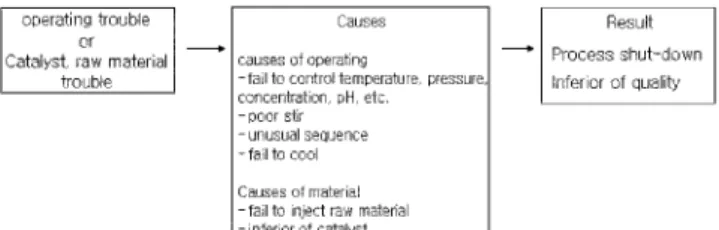
연속식공정에서온도, 압력, 농도, pH, 유량, 액위등공정변수 들의조절실패같은조업적인요인과촉매의불균일및부적절한
교체시기등물질적요인에의해공정 Shut-Down 및품질이상등
공정문제점을초래하게된다.
공정변수및촉매등의요인과더불어조업순서및운전시간이 조업상변수로서공정문제점의원인으로작용한다.
공정문제점의메카니즘은 Fig. 2와같다. 2-1-3. 상해(injury) 메카니즘검토
상해(injury)는산업재해와밀접한관련성을가지며, 유지·보수등
사람의손길이닿아야만이루어지는활동중발생하게된다.
산업재해원인은직접원인과간접원인으로나누어지며, 재해의
과정은다음과같은연쇄관계를거쳐진행한다. 따라서연쇄를절 단하여하나의원인을제거하면사고의발생을방지할수있다.
상해메카니즘은 Fig. 3과같다.
2-2.위험성평가가이드워드(guide words)개발
위험성평가를위한가이드워드는앞절에서분석된사고메카
니즘을기반으로각잠재적위험을위험요소(hazard)와원인·결과
(cause · consequence)로구분하여워크시트작성시적용이용이하도
록가이드워드를개발하였다. 2-2-1. Guide words (1) 잠재위험요소(hazard)
(2) 원인·결과(cause · consequence)
2-3.위험성평가워크시트개발
본연구에서개발한위험성평가를위한워크시트는 HAZOP, PHR 등기존의위험성평가기법을벤치마킹하고, 현장시범적용 을통한현장의견을반영하여완성하였다.
본연구에서개발된가이드워드에서위험(hazard)을 4가지로구
분하고, 그원인·결과를메카니즘분석을통하여정립하였다. 따라 서 워크시트는 가이드 워드의 구성 요소를 이용하여 쉽게 화학공
장에 위험성을 평가할 수 있도록 위험(hazard)과 원인·결과
(causeconsequence) 구조로개발하였다.
따라서, 기본정보입력후가이드워드의 4개위험을선택하여 그원인·결과를찾아가는논리적이고체계적인구조를가지고있 다고할수있으며, 본연구에서개발된워크시트와가이드워드를
이용한위험성평가절차는 Fig. 4와같다.
위험성평가워크시트는기본적으로평가대상공정을정확히알 수있도록기존평가기법들에서대부분기록하는평가공정, 평가 일, 평가팀, 도면번호등기본정보를워크시트상단에구성하였고,
Fig. 4의평가절차를사업장에서손쉽게적용할수있도록워크시
트항목을구성하였다.
누출(release)
화재·폭발(fire & explosion)
공정 trouble(process trouble)
상해(injury)
Fig. 1. The mechanism of fire, explosion & release.
Fig. 2. The mechanism of process trouble.
Fig. 3. The mechanism of injury.
표안의 5가지항목은다음과같다.
■위험(hazard)
사업장에서발생한사고로인하여직·간접적으로인적, 물적, 환
경적피해를입히는원인이될수있는잠재적인위험성으로서본 연구에서는누출, 화재/폭발, 공정문제점및상해 4가지로표현하 였다.
■원인·결과(cause · consequence)
위험요소가발생할수있는사고원인및사고원인으로부터발 생할수있다고예측되어지는사고결과를표현하였다.
■관련문제사항(problem & concern)
해당잠재위험및원인·결과사항에대한주요관심사항및팀 원또는경영진에서생각하는주요쟁점사항등을표현한다. Table 1. Guide words of release
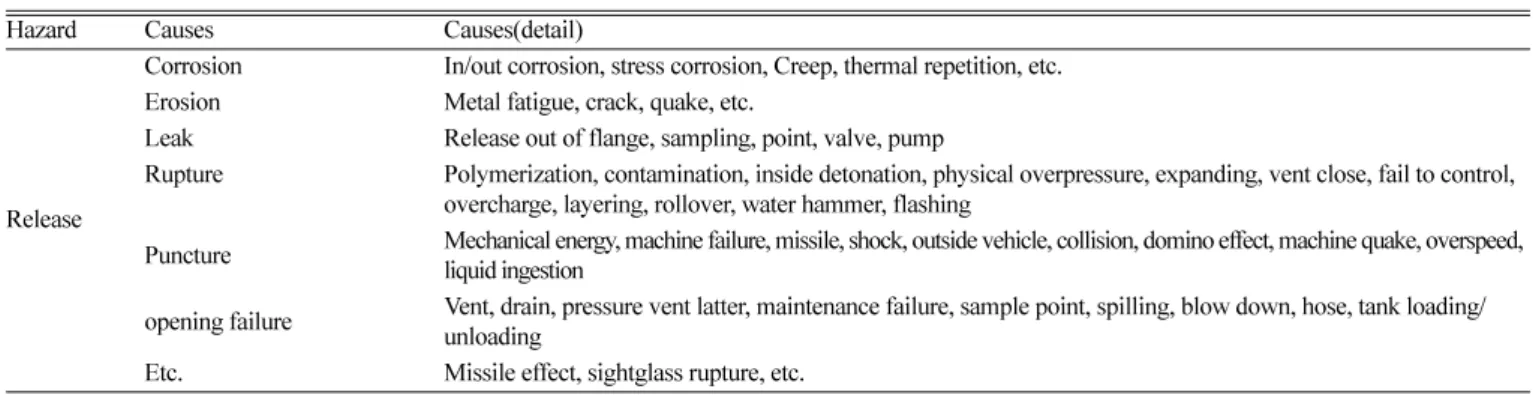
Hazard Causes Causes(detail)
Release
Corrosion In/out corrosion, stress corrosion, Creep, thermal repetition, etc.
Erosion Metal fatigue, crack, quake, etc.
Leak Release out of flange, sampling, point, valve, pump
Rupture Polymerization, contamination, inside detonation, physical overpressure, expanding, vent close, fail to control, overcharge, layering, rollover, water hammer, flashing
Puncture Mechanical energy, machine failure, missile, shock, outside vehicle, collision, domino effect, machine quake, overspeed, liquid ingestion
opening failure Vent, drain, pressure vent latter, maintenance failure, sample point, spilling, blow down, hose, tank loading/
unloading
Etc. Missile effect, sightglass rupture, etc.
Table 2. Guide words of fire and
Hazard Causes Causes(detail)
Fire/Explosion
Physical overpressure Inlet/outlet close, valve close, relief system failure
Handling limit chemical material and dust Fire of flammable mixture, runaway reaction, fire & explosion caused by catalyst failure, composition change caused by pollutant
Ignition source Ignition caused by static, spark, welding, friction heat, radiation, vehicles, flare
Puncture Mechanical energy, machine failure, missile, shock, outside vehicle, collision, domino effect, machine quake, overspeed, liquid ingestion
Opening failure Vent, drain, pressure vent latter, maintenance failure, sample point, spilling, blow down, hose, tank loading/unloading
Etc. Air contact, fuel trouble, etc.
Table 3. Guide words of process trouble
Hazard Causes Causes(detail)
Injury
Unsafety condition (physical causes) Oneself defect, safety guard defect, operating condition defect
Unsafety behavior (human error) Hazard area access, safety guard remove, protection equipment failure, unsefety speed control, hazard material handless, unsafety condition, leave, unsafety position/action, supervision and connection failure
Etc. Otherwise that can’t classify
Table 4. Guide words of injury
Hazard Causes Causes(detail)
Process trouble Operation Failure of temperature, pressure, concentration, pH, stir, operation, sequence, cooling Material Raw material and catalyst failure
Etc. Otherwise
Fig. 4. The procedure of assessment.
■현재안전조치(safe guard)
잠재위험및원인·결과사항에대한안전장치의역할을하고 있는이미설치된장치등을말한다.
■개선사항(recommendation)
잠재위험및원인·결과사항에대한현재안전조치가부족하다 고판단될때안전성을확보하기위해도출된추가적인장치또는 활동등을말한다.
3. 사례 연구
현재 PSM 제도적용대상사업장중본연구에적합한중·소화
학공장((주) OO화학)을선정하여, 효율적인진행을위하여기본교
육후위험성평가를실시하였다.
■진행내용
- 공정안전관리개론및위험성평가방법교육
- 공정위험성평가실시
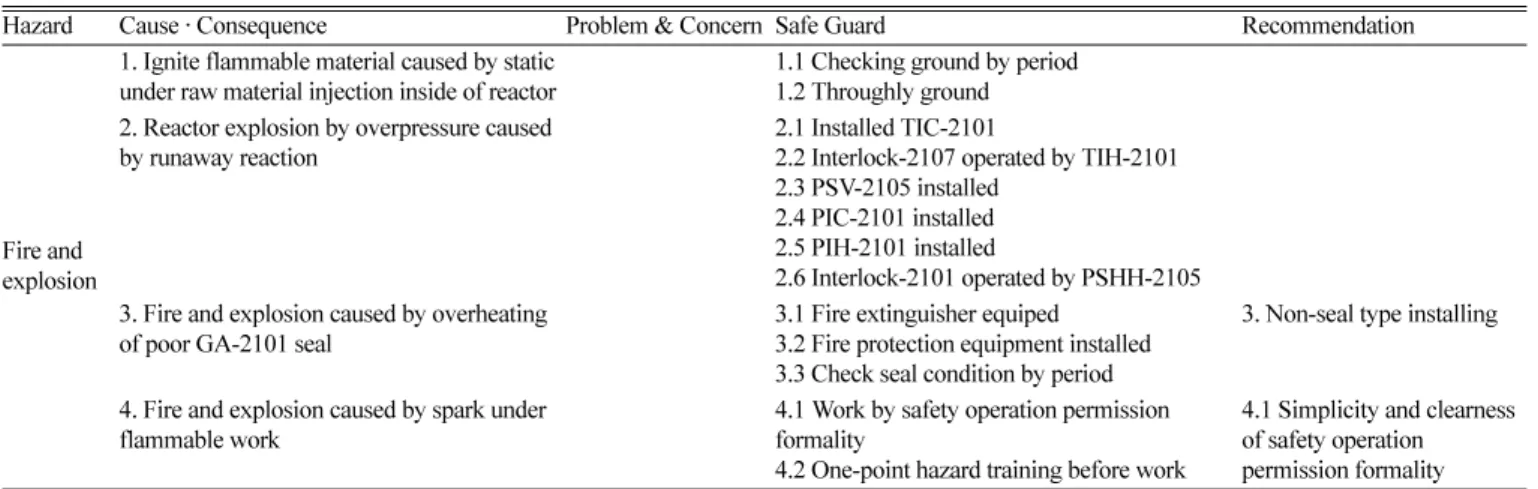
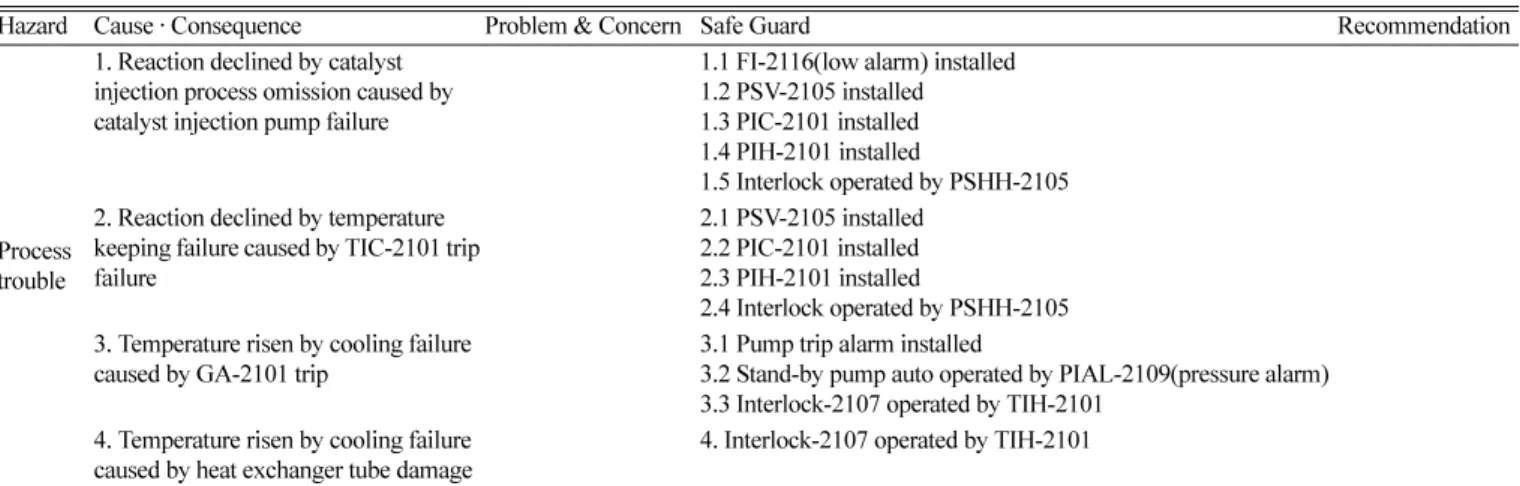
대상사업장을대상으로본연구에서개발한위험성평가기법을 실시한결과는아래 Table 6부터 9와같다.
시범사업장을선정하여나타난문제점은가이드워드개발및 수정과정에현장적용성을극대화하기위하여반영하였으며, 시범
사업장적용결과분석내용은 Table 10과같다.
시범사업장의결과, 본연구에서개발한새로운위험성평가기 법에대한기존의위험성평가기법과의차이점을인식하지못하였
Table 5. The worksheet of risk assessment
Hazard Cause ㆍConsequence Problem & Concern Safe Guard Recommendation
1. Plant : 2. Team : 3. Item : 4. Date : 5. Page : 6. Drawing No.
Table 6. The release worksheet of CASE STUDY
Hazard Cause · Consequence Problem & Concern Safe Guard Recommendation
Release
1. Environment pollution by toxic gas release caused by gasket obsolete and assembly failure
1.1 After repair, operator fail to assemble and used unfit gasket 1.2 Not enough management of flanges and gaskets specification
1. After checking gasket installed 1. Manage the flange and gasket
2. Fire and explosion by pressure rise
caused by overpressure in reactor 2.1 PSV-2105 installed
2.2 PIC-2101 installed 2.3 Interlock-2101 operate 3. Environment pollution by benzene
release caused by GA-pump seal leak 3. Non-seal type is safe but
expensive 3.1 Installed gas detector
3.2 Patrolling interval of 2 hour 3. Non-seal type installing 4. Environment pollution by pipe and
flange metamorphosis and release toxic gas caused by thermal repetition at start-up
4. Observe SOP 5. Pipe and flange rupture caused by pump
alignment failure after repair 5. Test pump after repair
1. Plant : continuous process-1, 2. Team : O O Team, 3. Item : O O, 4. Date : 2005. 07. 27, 5. Page : 1-1
Table 7. The fire and explosion worksheet of CASE STUDY
Hazard Cause · Consequence Problem & Concern Safe Guard Recommendation
Fire and explosion
1. Ignite flammable material caused by static
under raw material injection inside of reactor 1.1 Checking ground by period 1.2 Throughly ground 2. Reactor explosion by overpressure caused
by runaway reaction 2.1 Installed TIC-2101
2.2 Interlock-2107 operated by TIH-2101 2.3 PSV-2105 installed
2.4 PIC-2101 installed 2.5 PIH-2101 installed
2.6 Interlock-2101 operated by PSHH-2105 3. Fire and explosion caused by overheating
of poor GA-2101 seal 3.1 Fire extinguisher equiped
3.2 Fire protection equipment installed 3.3 Check seal condition by period
3. Non-seal type installing 4. Fire and explosion caused by spark under
flammable work 4.1 Work by safety operation permission
formality
4.2 One-point hazard training before work
4.1 Simplicity and clearness of safety operation permission formality 1. Plant : continuous process-1, 4. 2. Team : O O Team, 3. Item : O O, 4. Date : 2005. 07. 27, 5. Page : 1-2
고, 기존의위험성평가기법인 HAZOP의틀에맞추어가려는경 향을보였다.
또한, 워크시트의각항목에대한이해가아직부족했으며, 새로 운가이드워드에익숙하지않아원인·결과를도출하는데어려움이
있었다. 하지만본연구에서개발한평가기법은노드(node) 단위가 아닌단위로평가를수행하기때문에기존의평가기법보다시간이 단축되었으며, 기존에반영되지않은유지보수및노하우등이반 영되어있다.
Table 8. The process trouble worksheet of CASE STUDY
Hazard Cause · Consequence Problem & Concern Safe Guard Recommendation
Process trouble
1. Reaction declined by catalyst injection process omission caused by catalyst injection pump failure
1.1 FI-2116(low alarm) installed 1.2 PSV-2105 installed 1.3 PIC-2101 installed 1.4 PIH-2101 installed
1.5 Interlock operated by PSHH-2105 2. Reaction declined by temperature
keeping failure caused by TIC-2101 trip failure
2.1 PSV-2105 installed 2.2 PIC-2101 installed 2.3 PIH-2101 installed
2.4 Interlock operated by PSHH-2105 3. Temperature risen by cooling failure
caused by GA-2101 trip 3.1 Pump trip alarm installed
3.2 Stand-by pump auto operated by PIAL-2109(pressure alarm) 3.3 Interlock-2107 operated by TIH-2101
4. Temperature risen by cooling failure
caused by heat exchanger tube damage 4. Interlock-2107 operated by TIH-2101 1. Plant : continuous process-1, 2. Team : O O Team, 3. Item : O O, 4. Date : 2005. 07. 27, 5. Page : 1-3 Table 9. The injury worksheet of CASE STUDY
Hazard Cause · Consequence Problem & Concern Safe Guard Recommendation
Injury
1. Fracture caused by misstep in process
drainage cover uninstalled area 1. Some part cover uninstalled 1. cover installed 1. Installing cover 2. Collide with pipe and projection in
process area 2. Pipe positioning impossible place
existence 2. Hard hat putting on, training 1. Caution label installing at usual pass
3. Lumbago caused by weight work under
repair 3.1 Pair work at weight work
3.2 Work that use equipment 3.3 Wear waist safety protection equip 4. After pipe purge for work, injury caused by
remained pressure under take to piece hose 4. Wear goggle 4. Installing vent valve
5. Falling caused by ground freezing and
oil releasing 5. Clean oil release and freezing area 5. Equip oil dustcloth at oil
release and freezing area 6. Scald caused by steam tracing part
touching 6. Wear long-armed working cloth
7. Stricture caused by centrifugal machine
under repair 7. Safety cover installed
1. Plant : continuous process-1, 2. Team : O O Team, 3. Item : O O, 4. Date : 2005. 07. 27, 5. Page : 1-4 Table 10. The result of CASE STUDY
Classification Present Condition Countermeasure
General item
1. Number of employee that is familiar with HAZOP do not recognize a point of difference with new technique in work place
2. There is part that is not so comprehensive and specific, and unfamiliarity about method is felt
3. Convenient than hazop, and is included know-how of maintenance that hazop have not reflected
1. Because employees are familiar to hazop in a place of business, need education
2. Education must clarify and execute role of leader and clerk in charge
3. This method is middle form of what-if and checklist method Worksheet 1. Integration hope of hazard, cause and consequence
2. Substance for 3 item is not specific 1. It will be corrected worksheet after correction and repletion for items
Guide words and assessment methods
1. Plain justice of guide and re-thesis 2. It may have batter greatly extent of node
3. It has better take advantage of past accident case actively including near-miss
1. Accident cause may apply on the basis of PHR method 2. Study node may establish unit process
3. Consequences will include shut-down, deterioration, injury, etc. beside fire, explosion, release
Team composition
1. It have better attend official team and accident investigation team
2. It is thought that leader's role is very important 1. An example workplace assessment result, it need supplementation in estimation team
2. It will reflect in estimation guide
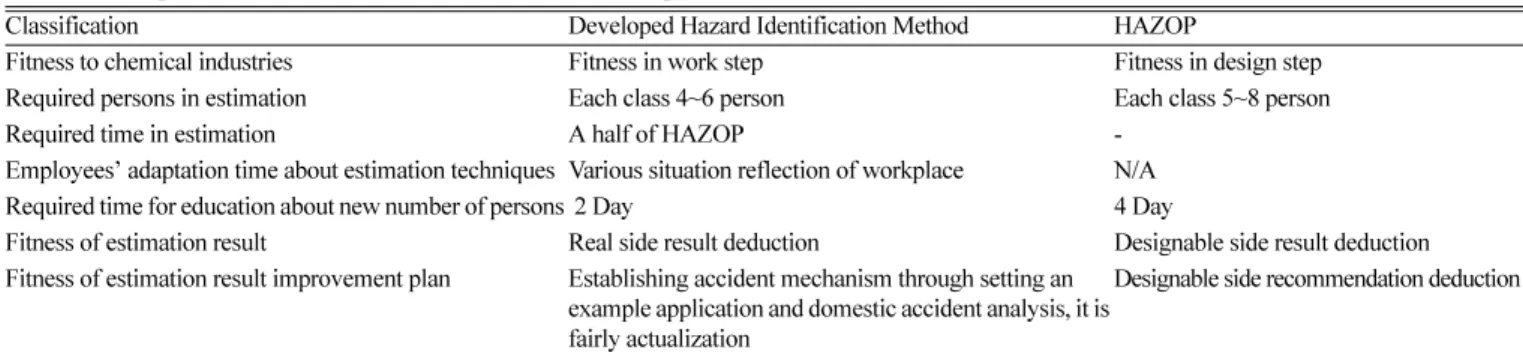
HAZOP과개발한위험성평가기법을비교한결과는 Table 11과 같다.
5. 결 론
1996년 PSM 제도의시행으로국내화학공장에공정위험성평
가를위해 HAZOP 기법이도입되었다. 2005년 3월기준으로약
10년이란기간이경과하였으며, 지속적인 PSM 제도이행점검결
과와공정안전문화연구등을통하여위험성평가부분에문제점 이있음을인식하게되었다.
현재화학공장에서는 HAZOP 기법이화학공장에서의위험성과 운전성을정해진규칙과설계도면에의하여체계적으로분석, 평가 하는방법으로검토시누락의가능성을배제하고비교적객관화된 평가서를작성할수있는등의장점으로인하여널리이용되고있
다. 그러나 HAZOP 기법은팀구성원변경, 리더의경험의지나친
의존, 토론분위기의부자유성및기록의부실화등단점이있으며 지나치게전문적인지식을요구함으로써해당공정에대한오랜경
험및 HAZOP 기법에대한전문지식없이수행하는것이불가능하
다는결정적단점이있으며, 교육수준이높은직원을많이보유한
대규모사업장은 HAZOP 기법을이용한위험성평가의실시및그
결과의활용이잘이루어지고있으나, 소규모사업장의경우기법 적용이용이하지못하여현실적으로많은어려움을겪고있다.
따라서본연구에서는국내 PSM 대상중·소화학공장에서사용
하기쉬운위험성평가기법이필요하다고사료되어이에대한연구 를통해새로운위험성평가기법을개발하였고연구결과는다음과 같다.
■본연구에서개발한가이드워드는화학공장에서발생가능한 화재·폭발·누출메카니즘, 공정문제점메카니즘및상해메카니즘 을분석하여각잠재적위험을회분식과연속식공정을대상으로 별도로구분하여, 위험요소(hazard)와원인·결과(cause·consequence)
로구분하여워크시트작성시적용이용이하도록개발되었다.
■중·소화학공장에대한새로운위험성평가기법의적용결과,
기법의적합성, 위험성평가소요인원, 평가소요시간, 기존직원 들의위험성평가기법에대한적응, 신규인원에대한위험성평가 교육소요시간, 평가결과의적합성등기존의위험성평가기법
(HAZOP)에비해현저히개선되었다.
■본연구에서개발된현장적용이용이한화학공장의위험성평 가기법을사업장에보급함으로써사업장위험관리수준의향상에 기여할수있다고사료된다.
■끝으로, 본연구에서개발된위험성평가기법을사업장에보 급하고신뢰성및적용성을높이고수정및보완을거친다면중·소 화학공장에대한위험성평가시매우유용하리라사료된다.
감 사
이연구결과는한국산업안전공단과소방방재청의지원결과로 수행되었으며연구비지원에감사드립니다.
참고문헌
1. CCPS, “Guideline for Chemical Process Quantitative Risk Anal- ysis,”AIChE, SECOND EDITION, 5-387(2000).
2. CCPS, “Guideline for Technical Management for Chemical Pro- cess Safety,”AIChE, 9-70(1989).
3. CCPS, “Guideline for Hazard Evaluation Procedure,”AIChE, 24- 224(1989).
4. Crowl, D. A. and J. F. Louvar, “Chemical Process Safety : Fun- damentals with Applications, SECOND EDITION,”429-532(2002).
5. David, D. B., “System Analysis and Design for Safety,” Prentice- Hall, Englewood Cliffs, New Jersey(1976).
6. Farmer, F. R., “Experience in the Reduction of Risk,” Institute of Chemical Engineers Symposium Series,” No. 34(1971).
7. Less, F. P., “Loss Prevention in the Process Industries,”Vol. 1,
(1980).
8. Korean Occupational Safety & Health Agency, “Effect Analysis and Development Direction of Process Safety Management Sys- tem,” (2001).
9. Korean Occupational Safety & Health Agency, “Major Indus- trial Accident Casebook,” (2004).
10. Ralph King, “Safety in the Process Industries,” 60-298(1990).
11. Theodore, L., Reynolds, J. P., Taylor, F. B., “Accident and Emer- gency Management,” (1989).
12. Korean Occupational Safety & Health Agency, “KOSHA-Code,”
(2001).
13. “Major Hazard Control : A Practical Manual,”(1988).
Table 11. Comparison of HAZOP and new assessment technique
Classification Developed Hazard Identification Method HAZOP
Fitness to chemical industries Fitness in work step Fitness in design step
Required persons in estimation Each class 4~6 person Each class 5~8 person
Required time in estimation A half of HAZOP -
Employees’ adaptation time about estimation techniques Various situation reflection of workplace N/A
Required time for education about new number of persons 2 Day 4 Day
Fitness of estimation result Real side result deduction Designable side result deduction
Fitness of estimation result improvement plan Establishing accident mechanism through setting an example application and domestic accident analysis, it is fairly actualization
Designable side recommendation deduction