Comparison of Clinical Outcome and Cost-Effectiveness after Various Preoperative Biliary Drainage Methods in Periampullary Cancer with Obstructive Jaundice
The aim of this study was to compare the clinical outcome and cost-effectiveness of preoperative biliary drainage (BD) methods in periampullary cancer, and to suggest guidelines for selecting the appropriate preoperative BD method. Between October 2004 and August 2010, 211 patients underwent pancreatoduodenectomy after preoperative BD.
Clinical outcome and cost-effectiveness of the preoperative BD methods were compared based on the final drainage method used and on intention-to-treat analysis. There was no significant difference in drainage duration between percutaneous transhepatic biliary drainage (PTBD) and endoscopic BD groups (14.2 vs 16.6 days, respectively; P = 0.121) but daily diminution of serum bilirubin level was higher in the PTBD group (0.7 vs 0.6 mg/dL/
day, respectively; P = 0.041). Based on intention-to-treat analysis, drainage duration was shorter (13.2 vs 16.5 days, respectively; P = 0.049), daily diminution of serum bilirubin level was higher (0.7 vs 0.6 mg/dL/day, respectively; P = 0.041). Medical care cost was lower (14.2 vs 15.7 × 10³ USD, respectively; P = 0.040) in the PTBD group than in the endoscopic BD group. When selecting the preoperative BD method, practitioners should consider that PTBD is more cost-effective and safer than endoscopic BD.
Key Words: Drainage; Biliary Cancer; Jaundice; Preoperative; Pancreatoduodenectomy Suk Kyun Hong, Jin-Young Jang,
Mee Joo Kang, In Woong Han, and Sun-Whe Kim
Department of Surgery & Cancer Research Institute, Seoul National University College of Medicine, Seoul, Korea
Received: 15 September 2011 Accepted: 20 January 2012 Address for Correspondence:
Jin-Young Jang, MD
Department of Surgery, Seoul National University College of Medicine, 101 Daehak-ro, Jongno-gu, Seoul 110-744, Korea Tel: +82.2-2072-2194, Fax: +82.2-745-2282 E-mail: [email protected]
This study is supported by a grant from Yonkang Foundation, Seoul, Republic of Korea (No. 30-2009-002-0) and the National R&D Program for Cancer Control, Ministry of Health &
Welfare, Republic of Korea (No. 1120310).
http://dx.doi.org/10.3346/jkms.2012.27.4.356 • J Korean Med Sci 2012; 27: 356-362
INTRODUCTION
The clinical benefit of preoperative biliary drainage (BD) in peri- ampullary cancer with obstructive jaundice is not well estab- lished (1-7). However, preoperative BD is still performed in many cases, for example, when planning preoperative chemoradio- therapy, for preoperative risk evaluation, in preexisting cholan- gitis or liver function abnormality, for severe malnutrition, and when expecting long waiting times for surgery due to insuffi- cient admission beds (8, 9).
Drainage can be accomplished either externally through per- cutaneous transhepatic biliary drainage (PTBD) or internally through endoscopic naso-biliary drainage (ENBD) or endoscop- ic retrograde biliary drainage (ERBD). PTBD makes preopera- tive cholangiography possible and it can be left in place after an operation. It also makes postoperative decompression and chol- angiography possible (10, 11). However, cholangitis, bile perito- nitis due to bile leakage, bleeding, pain at insertion site, tube dysfunction, body fluid loss with electrolyte imbalance are also possible (3, 10-12). On the other hand, both diagnosis and inter- vention are possible when using ENBD and ERBD. These two endoscopic methods have been experimentally shown to have
beneficial effects on restoring nutritional status and immune function and reducing endotoxemia (8, 15). However, reflux of duodenal contents may result in cholangitis or pancreatitis. Du- odenal perforation, bleeding, and tube dysfunction may also be possible when using endoscopic BD (8-11, 13).
To our knowledge, there are few studies comparing these BD methods (14, 15). In the absence of strong evidence, selection of a preoperative BD method in a clinical situation depends on clinician’s or hospital facility’s preferences. The aims of this study were to compare the clinical outcome and cost-effectiveness of these preoperative BD methods in periampullary cancer, con- sidering the final drainage method used and by using intention- to-treat analysis, and to suggest guidelines for selecting an ap- propriate preoperative BD method.
MATERIALS AND METHODS
Clinicopathologic data were prospectively collected in electron- ic medical record form and retrospectively reviewed. A consec- utive series of 343 patients who underwent preoperative BD at Seoul National University Hospital, for periampullary cancer with obstructive jaundice, between October 2004 and August
2010 were included. Preoperative BD was performed when the patient had cholangitis or poor liver function, or when patho- logic confirmation or recovery of general condition was needed in patients with severe comorbidity. Surgery was performed af- ter management for underlying cardiovascular or pulmonary diseases was completed and two weeks after improvement of cholangitis and restoration of liver function tests. Of the 343 pa- tients, 55 were excluded because they underwent operations other than pancreatoduodenectomy, and 77 patients with BD previously performed at other hospitals were also excluded. As a result, 211 patients were included in this study. The preopera- tive BD methods were PTBD, ENBD, and ERBD. The ENBD and ERBD patients were considered as a single endoscopic BD group.
Tumor locations were the ampulla of Vater, distal common bile duct (CBD), pancreas, and duodenum. Operation types were Whipple’s operation and pylorus preserving pancreatoduode- nectomy (PPPD). Daily diminution of serum bilirubin was cal- culated using the initial and final, preoperative serum bilirubin levels and the drainage duration. The definitions of all compli- cations, as well as of their management, were evaluated accord- ing to generally accepted criteria (16-19). We estimated the pa- tient’s total hospital cost by adding up all associated costs from the day the patient visited for diagnosing and performing pre- operative BD to the day the patient was discharged following performance of the pancreatoduodenectomy.
Thirty-nine patients who were initially subjected to endo- scopic BD were switched to PTBD due to a procedure failure or an ineffective endoscopic BD. Therefore, clinical outcome and cost-effectiveness of each preoperative biliary drainage meth- ods were compared on the basis of the final drainage method that was used and on results of intention-to-treat analysis.
Results are expressed as means and ranges or as the number and percentage of patients. The software program SPSS for Win- dows (version 19.0; SPSS Inc., Chicago, IL, USA) was used for all statistical analyses. One-way analysis of variance was used to compare means of continuous variables. Univariate compari- sons for all categorical variables were performed by using the chi-square test or Fisher’s exact test, as appropriate. A probabil- ity (P) value ≤ 0.05 was considered significant.
Ethics statement
This study was approved by the institutional review board of Seoul National University Hospital (IRB No.H-1001-047-307).
Informed consent was exempted by the board for this was a ret- rospective study of prospectively collected data.
RESULTS
Patient demographics
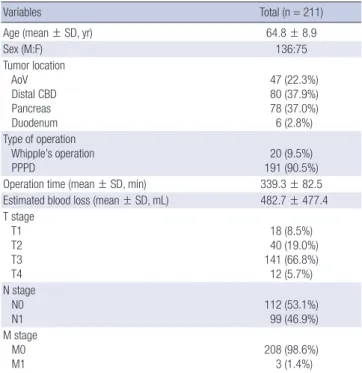
There were 211 patients who underwent pancreatoduodenec- tomy at our hospital between October 2004 and August 2010.
Of those, 136 patients (64.5%) were male and 75 (35.5%) were female. The mean age was 64.8 yr (range 35-89). Of the total, 191 patients (90.5%) underwent PPPD and 20 (9.5%) underwent Whipple’s operation. Forty-seven patients (22.3%) had adeno- carcinoma of the ampulla of Vater, 80 (37.9%) had adenocarci- noma of the distal CBD, 78 (37.0%) had adenocarcinoma of the pancreas, and 6 (2.8%) had adenocarcinoma of the duodenum.
Eighty-one patients (38.4%) had cholangitis before the preop- erative BD procedure. Based on the TNM staging system, 141 patients (66.8%) were T3 and 99 (46.9%) were node positive (Table 1).
Based on the patient’s final BD status, 107 patients (50.7%) underwent PTBD, 53 (25.1%) underwent ERBD, and 51 (24.2%) underwent ENBD. Considering tumor location, PTBD was more frequently performed than endoscopic BD in pancreas cancer (43.9% vs 29.8%) while endoscopic BD was more frequently per- formed than PTBD in distal CBD or ampulla of Vater cancer (70.2% vs 50.4%) (P = 0.001). PPPD was more frequently per- formed than Whipple’s operation in both BD groups. There were no significant differences in operation time, intraoperative blood loss, T stage, and N stage between the PTBD and endoscopic BD groups (Table 2).
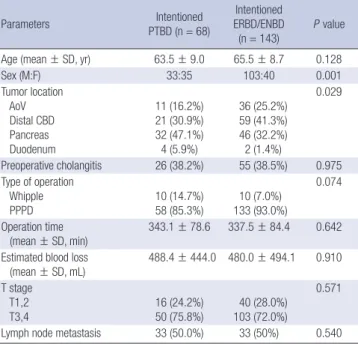
Thirty-nine patients (18.5%) who initially underwent endo- scopic BD were switched to PTBD due to procedure failure (n = 37, 94.9%) or ineffective endoscopic BD (n = 2, 5.1%). On an in- tention-to-treat basis, 68 patients (32.2%) underwent intention- al PTBD and 143 patients (67.8%) underwent intentioned endo- scopic BD. Intentioned PTBD was more frequently performed
Table 1. Clinicopathologic chacteristics of overall patients
Variables Total (n = 211)
Age (mean ± SD, yr) 64.8 ± 8.9
Sex (M:F) 136:75
Tumor location AoV Distal CBD Pancreas Duodenum
47 (22.3%) 80 (37.9%) 78 (37.0%)
6 (2.8%) Type of operation
Whipple’s operation
PPPD 20 (9.5%)
191 (90.5%) Operation time (mean ± SD, min) 339.3 ± 82.5 Estimated blood loss (mean ± SD, mL) 482.7 ± 477.4 T stage
T1 T2 T3 T4
18 (8.5%) 40 (19.0%) 141 (66.8%) 12 (5.7%) N stage
N0
N1 112 (53.1%)
99 (46.9%) M stage
M0
M1 208 (98.6%)
3 (1.4%) AoV, ampulla of Vater; CBD, common bile duct; PPPD, pylorus preserving pancreato- duodenectomy.
than intentioned endoscopic BD in pancreas cancer (47.1% vs 32.2%) while intentioned endoscopic BD was more frequently performed than intentioned PTBD in distal CBD (30.9% vs 41.3%) or ampulla of Vater cancer (16.2% vs 25.2%) (P = 0.029). There was no significant difference in operation time, intraoperative blood loss, T stage, and N stage between the intentioned PTBD and intentioned endoscopic BD groups (Table 3).
Effectiveness of biliary decompression
Overall the initial serum bilirubin level was 11.2 ± 6.9 mg/dL, and the final serum bilirubin level was 3.7 ± 3.3 mg/dL, and mean BD duration was 15.4 ± 11.2 days. There was no signifi- cant difference in drainage duration between PTBD and endo- scopic BD groups (14.2 vs 16.6 days, respectively; P = 0.121);
however, daily diminution of serum bilirubin level was higher in the PTBD group (0.7 vs 0.6 mg/dL/day, respectively; P = 0.041) (Table 4). Within the endoscopic BD group, the ERBD subgroup had a longer drainage duration than the ENBD subgroup (19.0 vs 14.1 days, respectively; P = 0.029), but daily diminution of se-
rum bilirubin was comparable between the two groups (0.5 vs 0.6 mg/dL/day, respectively; P = 0.339) (Table 5, Fig. 1).
On an intention-to-treat basis, drainage duration was shorter (13.2 vs 16.5 days, respectively; P = 0.049) and daily diminution of serum bilirubin level was higher (0.7 vs 0.6 mg/dL/day, respec- tively; P = 0.041) in the intentioned PTBD group than in the in- tentioned endoscopic BD group (Table 4).
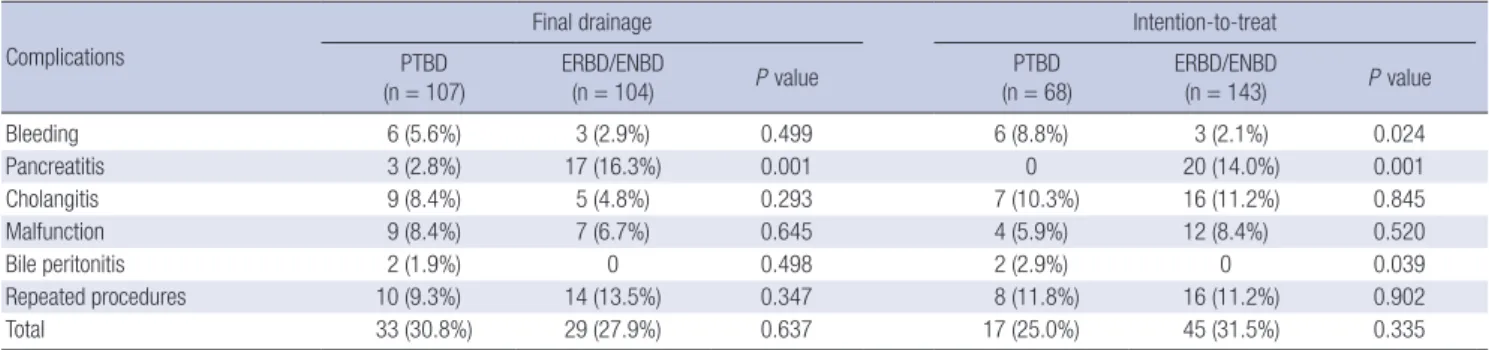
Procedure related and postoperative complications Procedure-related complications are outlined in Table 6. One or more complications occurred in 62 of the patients in the study (29.4%). Among the 6 PTBD patients (5.6%) with a bleeding complication, 3 underwent gelfoam embolization without fur- ther complication. Pancreatitis occurred more frequently in the endoscopic BD group than in the PTBD group (16.3% vs 2.8%, respectively; P = 0.001). Two of the pancreatitis patients in the endoscopic BD group had to wait for surgery for two weeks in order to treat their pancreatitis before surgery. Thirty-nine pa- tients who were initially subjected to endoscopic PBD were
Table 2. Comparision of clinicopathologic characteristics according to final biliary drainage methods
Parameters PTBD
(n = 107)
ERBD or ENBD (n = 104) P value Age (mean ± SD, yr) 63.5 ± 9.0 66.3 ± 8.6 0.022
Sex (M:F) 65:42 71:33 0.254
Tumor location AoV Distal CBD Pancreas Duodenum
18 (16.8%) 36 (33.6%) 47 (43.9%) 6 (5.6%)
29 (27.9%) 44 (42.3%) 31 (29.8%)
0
0.001
Preoperative cholangitis 42 (39.3%) 39 (37.5%) 0.794 Type of operation
Whipple’s operation PPPD
15 (14.0%) 92 (86.0%)
5 (4.8%) 99 (95.2%)
0.022
Operation time
(mean ± SD, min) 347.7 ± 80.6 330.8 ± 83.8 0.139 Estimated blood loss
(mean ± SD, mL) 498.2 ± 522.9 466.9 ± 428.1 0.651 T stage
T1,2
T3,4 25 (23.4%)
82 (76.6%) 33 (31.7%) 71 (68.3%)
0.276
Lymph node metastasis 53 (49.5%) 46 (44.2%) 0.440 PTBD, percutaneous transhepatic biliary drainage; ERBD, endoscopic retrograde bili- ary drainage; ENBD, endoscopic naso-biliary drainage; AoV, ampulla of Vater; CBD, common bile duct; PPPD, pylorus preserving pancreatoduodenectomy.
Table 3. Comparision of cilinicopathologic characteristics according to biliary drain- age methods after intention-to-treat analysis
Parameters Intentioned
PTBD (n = 68)
Intentioned ERBD/ENBD
(n = 143)
P value
Age (mean ± SD, yr) 63.5 ± 9.0 65.5 ± 8.7 0.128
Sex (M:F) 33:35 103:40 0.001
Tumor location AoV Distal CBD Pancreas Duodenum
11 (16.2%) 21 (30.9%) 32 (47.1%) 4 (5.9%)
36 (25.2%) 59 (41.3%) 46 (32.2%) 2 (1.4%)
0.029
Preoperative cholangitis 26 (38.2%) 55 (38.5%) 0.975 Type of operation
Whipple PPPD
10 (14.7%) 58 (85.3%)
10 (7.0%) 133 (93.0%)
0.074
Operation time
(mean ± SD, min) 343.1 ± 78.6 337.5 ± 84.4 0.642 Estimated blood loss
(mean ± SD, mL) 488.4 ± 444.0 480.0 ± 494.1 0.910 T stage
T1,2 T3,4
16 (24.2%) 50 (75.8%)
40 (28.0%) 103 (72.0%)
0.571
Lymph node metastasis 33 (50.0%) 33 (50%) 0.540 PTBD, percutaneous transhepatic biliary drainage; ERBD, endoscopic retrograde bili- ary drainage; ENBD, endoscopic naso-biliary drainage; AoV, ampulla of Vater; CBD, common bile duct; PPPD, pylorus preserving pancreatoduodenectomy.
Table 4. Effectiveness of biliary decompression Parameters
Final drainage Intention-to-treat
PTBD
(n = 107) ERBD/ENBD
(n = 104) P value PTBD
(n = 68) ERBD/ENBD
(n = 143) P value
Initial bilirubin (mg/dL) 12.1 ± 6.7 10.3 ± 7.1 0.068 11.1 ± 6.2 11.2 ± 7.3 0.884
Final bilirubin (mg/dL) 4.4 ± 3.4 3.0 ± 3.0 0.002 4.0 ± 3.1 3.6 ± 3.4 0.370
Daily diminution of bilirubin ([mg/dL]/day) 0.7 ± 0.5 0.6 ± 0.4 0.049 0.7 ± 0.5 0.6 ± 0.4 0.041
Drainage duration (day) 14.2 ± 10.9 16.6 ± 11.5 0.121 13.2 ± 11.5 16.5 ± 11.0 0.049
PTBD, percutaneous transhepatic biliary drainage; ERBD, endoscopic retrograde biliary drainage; ENBD, endoscopic naso-biliary drainage.
switched to PTBD due to procedure failure (94.9%) or ineffec- tive BD (5.1%).
On an intention-to-treat basis, bleeding (8.8% vs 2.1%, respec- tively; P = 0.024) and bile peritonitis (2.9% vs 0%, respectively;
P = 0.039) occurred more often in the intentioned PTBD group than in the intentioned endoscopic BD group. Pancreatitis oc- curred more frequently in intentioned endoscopic BD group than in the PTBD group (0% vs 14.0%, respectively; P = 0.001) (Table 6).
The overall postoperative complication rate was comparable between the PTBD and endoscopic BD groups (39.3% vs 47.1%, respectively; P = 0.155). On an intention-to-treat basis, there was no significant difference in postoperative complication rate between the intentioned PTBD group and the intentioned en- doscopic BD group (Table 7).
Comparison of cost-effectiveness
There was no significant difference in total hospital cost, admis- sion cost, hospital stay duration between the PTBD and endo- scopic BD groups. On an intention-to-treat basis, there was no significant difference in total hospital cost and hospital stay du- ration, but admission cost was significantly lower in the inten- tioned PTBD group than in the intentioned endoscopic BD group (14.2 ± 3.9 × 10³ USD vs 15.7 ± 7.0 × 10³ USD, respective- ly; P = 0.040) (Table 8).
Table 6. Procedure-related complications of each biliary drainage methods Complications
Final drainage Intention-to-treat
PTBD
(n = 107) ERBD/ENBD
(n = 104) P value PTBD
(n = 68) ERBD/ENBD
(n = 143) P value
Bleeding 6 (5.6%) 3 (2.9%) 0.499 6 (8.8%) 3 (2.1%) 0.024
Pancreatitis 3 (2.8%) 17 (16.3%) 0.001 0 20 (14.0%) 0.001
Cholangitis 9 (8.4%) 5 (4.8%) 0.293 7 (10.3%) 16 (11.2%) 0.845
Malfunction 9 (8.4%) 7 (6.7%) 0.645 4 (5.9%) 12 (8.4%) 0.520
Bile peritonitis 2 (1.9%) 0 0.498 2 (2.9%) 0 0.039
Repeated procedures 10 (9.3%) 14 (13.5%) 0.347 8 (11.8%) 16 (11.2%) 0.902
Total 33 (30.8%) 29 (27.9%) 0.637 17 (25.0%) 45 (31.5%) 0.335
PTBD, percutaneous transhepatic biliary drainage; ERBD, endoscopic retrograde biliary drainage; ENBD, endoscopic naso-biliary drainage.
Table 7. Postoperative complications Complications
Final drainage Intention-to-treat
PTBD
(n = 107) ERBD/ENBD
(n = 104) P value PTBD
(n = 68) ERBD/ENBD
(n = 143) P value
Bleeding 2 (1.9%) 2 (1.9%) 0.977 1 (1.5%) 3 (2.1%) 0.755
Sepsis 0 2 (1.9%) 0.149 0 2 (1.4%) 0.327
Pancreas fistula 30 (28.0%) 27 (26.0%) 0.734 22 (32.4%) 35 (24.5%) 0.228
Intraabdominal abscess 1 (0.9%) 5 (4.8%) 0.091 0 6 (4.2%) 0.087
Wound problem 11 (10.3%) 11 (10.6%) 0.944 7 (10.3%) 15 (10.5%) 0.965
Bowel obstruction 1 (0.9%) 2 (1.9%) 0.54 1 (1.5%) 2 (1.4%) 0.967
Portal vein thrombosis 1 (0.9%) 0 0.323 0 1 (0.7%) 0.489
Overall 42 (39.3%) 49 (47.1%) 0.155 27 (39.7%) 64 (44.8%) 0.294
PTBD, percutaneous transhepatic biliary drainage; ERBD, endoscopic retrograde biliary drainage; ENBD, endoscopic naso-biliary drainage.
Table 5. Comparison of effectiveness of biliary decompression in endoscopic BD method
Parameters ERBD
(n = 53)
ENBD
(n = 51) P value Initial bilirubin (mg/dL) 10.3 ± 7.5 10.3 ± 6.7 0.979 Final bilirubin (mg/dL) 2.2 ± 2.3 3.9 ± 3.4 0.005 Daily diminution of bilirubin
([mg/dL]/day) 0.5 ± 0.5 0.6 ± 0.4 0.339
Drainage duration (day) 19.0 ± 11.5 14.1 ± 11.2 0.029 ERBD, endoscopic retrograde biliary drainage; ENBD, endoscopic naso-biliary drain- age.
Fig. 1. A graph of bilirubin decline pattern in the endoscopic BD groups. ERBD, endo- scopic retrograde biliary drainage; ENBD, endoscopic naso-biliary drainage.
Bilirubin (mg/dL)
Day
3.9 ERBD ENBD
5.5 6.8
7.9 10.3
2.2 3.5
4.7 6.8
10.3
Initial D2 D4 D6 Final
12 10 8 6 4 2 0
DISCUSSION
In 4 of 5 randomized trials, preoperative BD by means of PTBD was the standard mode of drainage used, whereas endoscopic BD is currently preferred in some hospitals, although evidence to support this preference is lacking (2, 20, 21). PTBD enables preoperative and postoperative biliary decompression and chol- angiography, but complications such as cholangitis, bile perito- nitis, bleeding, pain at insertion site, tube dysfunction, and elec- trolyte imbalance may occur. Endoscopic BD methods make both diagnosis and intervention possible, which give chance to direct visualization of duodenum and papilla, biopsy for tissue diagnosis, and direct cholangiography. However, reflux of duo- denal contents may result in cholangitis, pancreatitis, duodenal perforation, or bleeding. Hwang et al. (22) reported that the thick- ness and degree of inflammation of the CBD wall was more se- vere in their endoscopic BD group, and indicated that CBD in- flammation may have resulted from reflux of duodenal contents.
There are few comparative studies comparing these BD methods (14, 15); therefore, in the absence of strong evidence, selection of a preoperative BD method in many cases depends on clini- cian’s or hospital facility’s preferences.
In this study, clinical outcome and cost-effectiveness were compared between three different preoperative BD methods.
Considering tumor location, PTBD was more frequently per- formed than ENBD or ERBD in pancreas cancer, whereas the latter two were more frequently performed than PTBD in distal CBD or ampulla of Vater cancer, both on a final status basis and on an intention-to-treat basis. In distal CBD or ampulla of Vater cancer, identification of the lesion and tissue confirmation us- ing an endoscopic procedure is possible and, on that basis, would be preferred to the use of PTBD.
We evaluated effectiveness by comparing drainage duration and daily serum bilirubin decline. On the basis of the final drain- age method used, there was no difference in drainage duration between the PTBD and endoscopic BD groups, but daily dimi- nution of the serum bilirubin level was higher in the PTBD group.
The result was similar on an intention-to-treat basis, except for drainage duration: the drainage duration was shorter in the in- tentioned PTBD group than in the intentioned endoscopic BD group. Thirty-nine intentioned endoscopic group patients were changed to PTBD and the number of days spent between the
switch is the reason for the difference in drainage duration. Ad- ditional time is needed to perform PTBD for patients with failed endoscopic attempts. In addition, time is needed to determine whether the serum bilirubin level declines and, if not, check the endoscopic BD function and the perform PTBD. Based on the difference in the decreases in bilirubin levels, the effectiveness of preoperative BD is better with PTBD than with endoscopic BD. However, the optimal duration of BD before surgery has not been established. Experimental and clinical studies have suggested that a period of at least 4-6 weeks is needed for resto- ration of normal major synthesis and clearance functions of the liver, as well as of mucosal intestinal barrier functions (5). In ad- dition, depressed cell-mediated immunity, impaired hepatic reticuloendothelial function (23), and altered lymphocyte trans- formation have been documented, and these functions are un- likely to improve within 4 weeks (24, 25). On the other hand, in- creasing drainage duration increases the risks of stent clogging and secondary inflammatory changes to the bile duct wall. If such complications require readmission to a hospital, this might lead to surgery postponement (7). However, it is not easy to main- tain preoperative BD over 4 weeks in a clinical setting. This study was not a randomized controlled trial, therefore the preopera- tive BD method used was selected according to the clinician’s preference. However, the time to perform the required opera- tion after BD was decided consistently as described earlier (i.e.
following completion of management for underlying cardiovas- cular or pulmonary diseases and at least two weeks after improve- ment of cholangitis and restoration of liver function tests).
With respect to procedure-related complications, the inci- dences of pancreatitis, cholangitis, bleeding, or malfunction in our study was similar to incidences reported by others (26-28).
There were no significant differences in procedure-related com- plication rates between the two groups, with the exception of procedure-related pancreatitis: the pancreatitis rate was higher in the endoscopic BD group than in the PTBD group. Two of the pancreatitis cases in the endoscopic BD group prolonged the postponement of surgery because medical management of the pancreatitis was needed. Such a postponement would be unjustifiable for a potentially resectable tumor.
Cost-effectiveness was evaluated by comparing total hospital cost, admission cost, and hospital stay duration. There were no significant differences between the two groups on the basis of Table 8. Total hospital cost, admission cost, and hospital stay
Cost
Final drainage Intention-to-treat
PTBD
(n = 107) ERBD/ENBD
(n = 104) P value PTBD
(n = 68) ERBD/ENBD
(n = 143) P value
Total hospital cost (103 USD) 16.0 ± 5.9 17.0 ± 7.5 0.299 15.4 ± 6.2 17.0 ± 7.0 0.101
Admission cost (103 USD) 14.8 ± 4.7 15.6 ± 7.4 0.362 14.2 ± 3.9 15.7 ± 7.0 0.040
Hospital stay (day) 25.9 ± 35.7 29.4 ± 13.7 0.348 22.8 ± 43.3 30.0 ± 13.9 0.073
PTBD, percutaneous transhepatic biliary drainage; ERBD, endoscopic retrograde biliary drainage; ENBD, endoscopic naso-biliary drainage.
the final drainage method used; however, on an intention-to- treat basis, admission cost was lower in the PTBD group than in the endoscopic BD group. This could be related to those pa- tients who were initially subjected to endoscopic BD and who were changed to PTBD. There were no significant difference in postoperative complication rate between two groups, but the cost for managing postoperative complications in the inten- tioned endoscopic BD group was higher than in the intentioned PTBD group. This is in contrast with an earlier randomized study in which van der Gaag et al. (29) looked at 202 patients with can- cer of the pancreatic head. In their multicenter, randomized tri- al they found no effect of preoperative BD, primarily attempted endoscopically, on the length of the hospital stay. They explained that the previously observed extended hospital stay durations can be attributed to the use of PTBD, whereas endoscopic BD, as used primarily in their study, is often performed on an out- patient basis. In our study, the hospital stay was comparable between PTBD and endoscopic BD.
There are reports of metastatic tumor seeding along the PTBD sinus tract (28, 30). Takahashi et al. (28) retrospectively investi- gated 445 patients with perihilar and distal cholangiocarcinoma who underwent resection following PTBD and detected PTBD catheter tract recurrence in 23 of those patients. They also re- ported poor prognosis in PTBD catheter tract recurrence pa- tients. Moreover, they supported the association of PTBD with serious complications, such as vascular injury and cancer dis- semination, and suggested that ENBD is the most suitable meth- od for initial preoperative BD. In this study, among 6 PTBD pa- tients with a bleeding complication, 3 patients underwent gel- foam embolization without further complication, and there was no tract recurrence until the last follow up (median follow up of 23 months, range 0.2-46 months). In contrast with their study, our study included periampullary lesions but excluded hilar cholangiocarcinomas. In Klatskin tumor cases, we believe it unlikely that, passing through the tumor during the procedure is not needed and can be succeed safely in periampullary can- cer. However, the only way to answer this question adequately would be to conduct a large prospective, randomized trial.
In conclusion, using an intention-to-treat analysis, the PTBD group revealed a more rapid serum bilirubin decline with a short- er drainage duration and a lower admission cost compared with the endoscopic BD group. Although the role of preoperative BD is still controversial, preoperative BD is needed in some situa- tions. The results in this study indicate that PTBD is more cost- effective and safer than endoscopic BD. Practitioners should consider those factors in selecting a BD method.
REFERENCES
1. Wang Q, Gurusamy KS, Lin H, Xie X, Wang C. Preoperative biliary drain- age for obstructive jaundice. Cochrane Database Syst Rev 2008: CD005444.
2. Pitt HA, Gomes AS, Lois JF, Mann LL, Deutsch LS, Longmire WP Jr.
Does preoperative percutaneous biliary drainage reduce operative risk or increase hospital cost? Ann Surg 1985; 201: 545-53.
3. Speer AG, Cotton PB, Russell RC, Mason RR, Hatfield AR, Leung JW, MacRae KD, Houghton J, Lennon CA. Randomized trial of endoscopic versus percutaneous stent insertion in malignant obstructive jaundice.
Lancet 1987; 2: 57-62.
4. Povoski SP, Karpeh MS Jr, Conlon KC, Blumgart LH, Brennan MF. Asso- ciation of preoperative biliary drainage with postoperative outcome fol- lowing pancreaticoduodenectomy. Ann Surg 1999; 230: 131-42.
5. van der Gaag NA, Kloek JJ, de Castro SM, Busch OR, van Gulik TM, Gouma DJ. Preoperative biliary drainage in patients with obstructive jaundice: history and current status. J Gastrointest Surg 2009; 13: 814-20.
6. Kimmings AN, van Deventer SJ, Obertop H, Rauws EA, Huibregtse K, Gouma DJ. Endotoxin, cytokines, and endotoxin binding proteins in ob- structive jaundice and after preoperative biliary drainage. Gut 2000; 46:
725-31.
7. Sewnath ME, Karsten TM, Prins MH, Rauws EJ, Obertop H, Gouma DJ.
A metaanalysis on the efficacy of preoperative biliary drainage for tumors causing obstructive jaundice. Ann Surg 2002; 236: 17-27.
8. Sewnath ME, Birjmohun RS, Rauws EA, Huibregtse K, Obertop H, Gouma DJ. The effect of preoperative biliary drainage on postoperative complications after pancreaticoduodenectomy. J Am Coll Surg 2001;
192: 726-34.
9. Roebuck DJ, Stanley P. External and internal-external biliary drainage in children with malignant obstructive jaundice. Pediatr Radiol 2000;
30: 659-64.
10. Baijal SS, Dhiman RK, Gupta S, Sharma BC, Roy S, Agarwal DK, Choud- huri G, Saraswat VA, Naik SR. Percutaneous transhepatic biliary drain- age in the management of obstructive jaundice. Trop Gastroenterol 1997;
18: 167-71.
11. Kawarada Y, Higashiguchi T, Yokoi H, Vaidya P, Mizumoto R. Preopera- tive biliary drainage in obstructive jaundice. Hepatogastroenterology 1995; 42: 300-7.
12. Joseph PK, Bizer LS, Sprayregen SS, Gliedman ML. Percutaneous tran- shepatic biliary drainage. Results and complications in 81 patients. JAMA 1986; 255: 2763-7.
13. Karsten TM, Davids PH, van Gulik TM, Bosma A, Tytgat GN, Klopper PJ, van der Hyde MN. Effects of biliary endoprostheses on the extrahe- patic bile ducts in relation to subsequent operation of the biliary tract. J Am Coll Surg 1994; 178: 343-52.
14. Hatfield AR, Murray RS. Pre-operative biliary drainage in patients with obstructive jaundice. A comparison of the percutaneous transhepatic and endoscopic transpapillary routes. S Afr Med J 1981; 60: 737-42.
15. Speer AG, Cotton PB, Russell RC, Mason RR, Hatfield AR, Leung JW, MacRae KD, Houghton J, Lennon CA. Randomised trial of endoscopic versus percutaneous stent insertion in malignant obstructive jaundice.
Lancet 1987; 2: 57-62.
16. Gouma DJ, van Geenen RC, van Gulik TM, de Haan RJ, de Wit LT, Busch OR, Obertop H. Rates of complications and death after pancreaticoduo- denectomy: risk factors and the impact of hospital volume. Ann Surg 2000; 232: 786-95.
17. Huibregtse K. Complications of endoscopic sphincterotomy and their prevention. N Engl J Med 1996; 335: 961-3.
18. van Berge Henegouwen MI, van Gulik TM, Akkermans LM, Jansen JB,
Gouma DJ. The effect of octreotide on gastric emptying at a dosage used to prevent complications after pancreatic surgery: a randomised, place- bo controlled study in volunteers. Gut 1997; 41: 758-62.
19. Kimmings AN, Van Deventer SJ, Obertop H, Rauws EA, Huibregtse K, Gouma DJ. Endotoxin, cytokines, and endotoxin binding proteins in ob- structive jaundice and after preoperative biliary drainage. Gut 2000; 46:
725-31.
20. Hatfield AR, Tobias R, Terblanche J, Girdwood AH, Fataar S, Harries- Jones R, Kernoff L, Marks IN. Preoperative external biliary drainage in obstructive jaundice. A prospective controlled clinical trial. Lancet 1982;
2: 896-9.
21. Lai EC, Mok FP, Fan ST, Lo CM, Chu KM, Liu CL, Wong J. Preoperative endoscopic drainage for malignant obstructive jaundice. Br J Surg 1994;
81: 1195-8.
22. Hwang DW, Kim SW, Yoon YS, Kim JH, Jang JY, Park YH. Preoperative biliary drainage for periampullary cancer: a comparison between endo- scopic drainage and percutaneous transhepatic drainage. J Korean Surg Soc 2003; 65: 413-9.
23. Fan ST, Lo CM, Lai EC, Yu WC, Wong J. T-lymphocyte function in patients with malignant biliary obstruction. J Gastroenterol Hepatol 1994; 9:
391-5.
24. Hunt DR, Allison ME, Prentice CR, Blumgart LH. Endotoxemia, distur-
bance of coagulation, and obstructive jaundice. Am J Surg 1982; 144:
325-9.
25. Hunt CE, Diani AR, Brown PK, Kaluzny MA, Epps DE. Diet induced atherogenic hyperlipoproteinaemia and liver injury in cynomolgus ma- caques. Br J Exp Pathol 1986; 67: 235-49.
26. Christensen M, Matzen P, Schulze S, Rosenberg J. Complications of ERCP: a prospective study. Gastrointest Endosc 2004; 60: 721-31.
27. Williams EJ, Taylor S, Fairclough P, Hamlyn A, Logan RF, Martin D, Riley SA, Veitch P, Wilkinson ML, Williamson PR, Lombard M. Risk factors for complication following ERCP: results of a large-scale, prospective multicenter study. Endoscopy 2007; 39: 793-801.
28. Takahashi Y, Nagino M, Nishio H, Ebata T, Igami T, Nimura Y. Percuta- neous transhepatic biliary drainage catheter tract recurrence in cholan- giocarcinoma. Br J Surg 2010; 97: 1860-6.
29. van der Gaag NA, Rauws EA, van Eijck CH, Bruno MJ, van der Harst E, Kubben FJ, Gerritsen JJ, Greve JW, Gerhards MF, de Hingh IH, Klinken- bijl JH, Nio CY, de Castro SM, Busch OR, van Gulik TM, Bossuyt PM, Gouma DJ. Preoperative biliary drainage for cancer of the head of the pancreas. N Engl J Med 2010; 362: 129-37.
30. ChapmanWC, Sharp KW,Weaver F, Sawyers JL. Tumor seeding from percutaneous biliary catheters. Ann Surg 1989; 209: 708-13.