• 검색 결과가 없습니다.

Staged Management of a Ruptured Internal Mammary Artery Aneurysm

N/A
N/A
Protected

Academic year: 2021

Share "Staged Management of a Ruptured Internal Mammary Artery Aneurysm"

Copied!
4
0
0

로드 중.... (전체 텍스트 보기)

전체 글

(1)

ISSN: 2233-601X (Print) ISSN: 2093-6516 (Online)

− 130 −

Department of Thoracic and Cardiovascular Surgery, Kyungpook National University Hospital, Kyungpook National University School of Medicine Received: June 16, 2015, Revised: October 18, 2015, Accepted: October 20, 2015, Published online: April 5, 2016

Corresponding author: Gun Jik Kim, Department of Thoracic and Cardiovascular Surgery, Kyungpook National University Hospital, Kyungpook National University School of Medicine, 130 Dongdeok-ro, Jung-gu, Daegu 41944, Korea

(Tel) 82-53-200-6589 (Fax) 82-53-426-4765 (E-mail) [email protected]

C

The Korean Society for Thoracic and Cardiovascular Surgery. 2016. All right reserved.

CC
This is an open access article distributed under the terms of the Creative Commons Attribution Non-Commercial License (http://creative- commons.org/licenses/by-nc/4.0) which permits unrestricted non-commercial use, distribution, and reproduction in any medium, provided the original work is properly cited.

Staged Management of a Ruptured Internal Mammary Artery Aneurysm

O Young Kwon, M.D., Gun Jik Kim, M.D., Tak Hyuk Oh, M.D., Young Ok Lee, M.D., Sang Cjeol Lee, M.D., Jun Yong Cho, M.D.

The rupture of an internal mammary artery (IMA) aneurysm in a patient with type 1 neurofibromatosis (NF-1) is a rare but life-threatening complication requiring emergency management. A 50-year-old man with NF-1 was trans- ferred to the emergency department of Kyungpook National University Hospital, where an IMA aneurysmal rupture and hemothorax were diagnosed and drained. The IMA aneurysmal rupture and hemothorax were successfully re- paired by staged management combining endovascular treatment and subsequent video-assisted thoracoscopic sur- gery (VATS). The patient required cardiopulmonary cerebral resuscitation, the staged management of coil emboliza- tion, and a subsequent VATS procedure. This staged approach may be an effective therapeutic strategy in cases of IMA aneurysmal rupture.

Key words: 1. Hemothorax

2. Endovascular procedures 3. Surgery

CASE REPORT

A 50-year-old man with multiple café-au-lait spots on his body was transferred to the emergency department of Kyungpook National University Hospital after the sudden on- set of severe dyspnea. We were aware that he had type 1 neurofibromatosis (NF-1) from a previous visit to our hospital 27 years previously, but he had not undergone any treatment.

On arrival, his mental status was alert and he had a blood pressure of 119/87 mmHg, but he also exhibited tachycardia, with a heart rate of 130 beats per minute. His initial hemo- globin level was 8.2 g/dL, his hematocrit value was 25.3%, and his platelet count was 67×10

3

/L. A chest X-ray showed a massive opacification in the right lung field with a tracheal

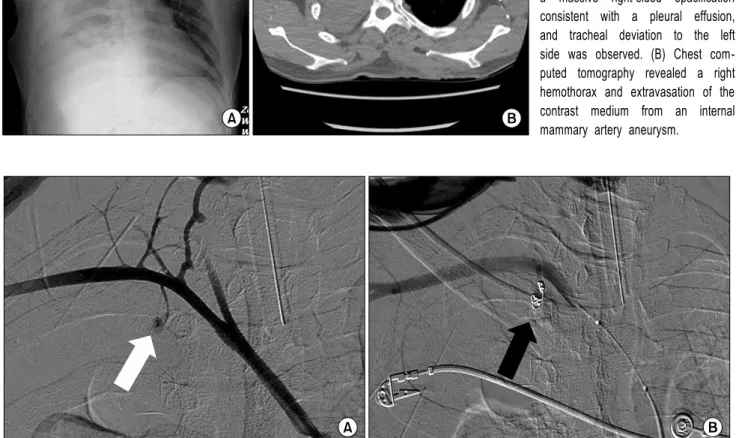
deviation to the left side (Fig. 1A). A chest computed tomog- raphy (CT) scan with medium contrast confirmed a large right hemothorax and extravasation of the contrast medium from an internal mammary artery (IMA) aneurysm (Fig. 1B).

After closed thoracostomy with a chest tube insertion, we removed approximately 1,000 mL of blood. We planned two- stage management for the patient, using endovascular emboli- zation for the proximal portion of the IMA, followed by sur- gery to evacuate the hemothorax and clip the distal portion of the IMA. Immediately after starting the angiogram, the pa- tient suffered cardiac arrest from hypovolemic shock. During cardiopulmonary cerebral resuscitation with volume replace- ment, we planned to perform emergency embolization through the right common femoral artery, and emergency angiography

Korean J Thorac Cardiovasc Surg 2016;49:130-133 □ Case Report □

http://dx.doi.org/10.5090/kjtcs.2016.49.2.130

(2)

Case Report of a Patient with Type 1 Neurofibromatosis

− 131 −

Fig. 1. (A) A chest X-ray confirmed a massive right-sided opacification consistent with a pleural effusion, and tracheal deviation to the left side was observed. (B) Chest com- puted tomography revealed a right hemothorax and extravasation of the contrast medium from an internal mammary artery aneurysm.

Fig. 2. (A) A catheter was inserted through the femoral artery into the right subclavian artery, and contrast medium was injected.

Extravasation was found at the proximal part of the right IMA (white arrow). (B) After coiling was applied (black arrow) to the proximal part of the right IMA, further extravasation was not seen. IMA, internal mammary artery.

revealed a ruptured aneurysm in the right IMA. The interven- tional radiology team occluded the proximal portion of the IMA with two 5-mm Tornado Embolization Microcoils (Cook Medical Inc., Bloomington, IN, USA) (Fig. 2A, B). Subsequ- ently, superselection of the distal IMA was attempted.

However, since the IMA was made discontinuous by an aneurysmal segment, the microcatheter could not reach the distal IMA, making distal embolization impossible. Noneth- eless, the patient’s hemodynamic status recovered, although his mental state could not be determined at that time. After confirming complete occlusion of the proximal portion of the IMA, the patient was moved to the intensive care unit (ICU) and hypothermic therapy was performed there. In the ICU, the patient was semicomatose and a small amount of bleeding

through the chest tube persisted. Serial chest radiographs re- vealed an increasing pleural effusion that was suspicious for blood in the right lung field.

Three days later, the patient was taken to the operating room to drain the pleural effusion and to clip the distal por- tion of the IMA. Through a video-assisted thoracic surgery (VATS) procedure, a massive bloody effusion and clot were evacuated. A ruptured mediastinal pleura was observed in the thoracic inlet and a small amount of blood was found to be leaking through the distal portion of the IMA. We clamped the distal portion of the IMA with two hemostatic clips (Fig.

3). After this procedure, the patient’s mental state gradually

improved and he fully recovered. He was discharged home

one month later without sequelae. After six months of fol-

(3)

O Young Kwon, et al

− 132 − Fig. 3. Operative findings in the right hemithorax. The distal por- tion of the right internal mammary artery was clipped (white ar- row). Further bleeding was not found.

low-up, the patient has remained clinically asymptomatic without recurrent hemothorax.

DISCUSSION

Spontaneous hemothorax caused by a ruptured aneurysm in NF-1 patients is very rare, but can be fatal. Vascular lesions can occur in any vessels, but in the thoracic cavity, ruptures of aneurysms in the intercostal arteries, subclavian artery, and internal mammary artery have been reported in patients with NF-1. The incidence of vascular lesions in patients with NF-1 has been reported to be 3.6% [1]. Hongsakul et al. [2] re- ported that the most common location of artery rupture was the subclavian and intercostal arteries. Spontaneous hemothor- ax caused by aneurysmal rupture in NF-1 is very rare, but may be critical, especially if it occurs in a large artery [2,3].

Symptoms vary depending on the size and location of the vascular lesion. Chest pain, dyspnea, and syncope are the pre- senting symptoms of arterial aneurysmal rupture in the thora- cic cavity [4]. In our case, dyspnea occurred as a symptom of a life-threatening case of hemothorax.

Diagnosis requires chest CT or magnetic resonance imaging scans. Furthermore, serial blood tests are needed due to pro- gressive anemia. The diagnosis should be confirmed by se- lective angiography in order to plan an optimal therapeutic

intervention [3,4].

An aneurysmal rupture in a patient with neurofibromatosis should not be corrected by vessel reconstruction. The treat- ment of choice is surgical or interventional occlusion of the arteries involved. Surgical management is more aggressive and complex, and artery reconstruction is limited by arterial fragility [2-5].

In the case of the rupture of an IMA aneurysm, the treat- ment depends on the patient’s hemodynamic condition. In un- stable conditions, emergency exploratory surgery may be needed [4]. VATS is recommended for cases such as ours.

Surgical exploration includes removing the hematoma, surgi- cal ligation for bleeding, and packing to achieve hemostasis [6]. However, this surgery is aggressive and problematic due to difficulties in finding the source of bleeding and perform- ing surgical ligation associated with the fragile nature of vas- cular tissue [7]. Miura et al. [8] reported that they failed to identify the cause of bleeding during surgery, so they termi- nated the procedure in a patient with an intercostal aneur- ysmal rupture. In patients who are hemodynamically stable, endovascular treatment is the best choice for arterial rupture in NF-1 patients. Coil embolization or stent grafts are often used in these cases because these treatments are safer and less complicated than surgery [5]. However, fatal rebleeding from the aneurysm or due to backflow from collateral branches has been identified as a possible life-threatening complication after an endovascular procedure [2]. A sub- sequent VATS procedure may be indicated for cases of aneurysmal rupture in the thoracic cavity to prevent rebleed- ing and to improve the patient’s symptoms. In our case, re- gardless of whether the patient had been hemodynamically unstable on arrival, we planned a two-stage management strategy that combined endovascular treatment and a sub- sequent VATS procedure. The interventional radiology team was already prepared when the patient was transferred to our hospital, and we were concerned about possible difficulties in finding the bleeding site through surgery. First, coil emboliza- tion of the proximal rupture of the IMA was undertaken, while the distal portion of the IMA was later clipped using two hemostatic clips via VATS.

The prognosis of aneurysmal rupture in NF-1 depends on

the patient’s status. A large arterial rupture in a patient with

(4)

Case Report of a Patient with Type 1 Neurofibromatosis

− 133 − NF-1 is a life-threatening condition that can result in hypo- volemic shock and severe dyspnea. Therefore, when encoun- tering an NF-1 patient with a massive hemothorax, early rec- ognition and treatment are necessary [7].

In conclusion, we planned a two-stage management strat- egy to treat an IMA aneurysmal rupture associated with NF-1. Although the patient required cardiopulmonary cerebral resuscitation, successful results were obtained by coil emboli- zation and a subsequent VATS procedure.

CONFLICT OF INTEREST

No potential conflict of interest relevant to this article was reported.

REFERENCES

1. Riccardi VM. Von Recklinghausen neurofibromatosis. N Engl J Med 1981;305:1617-27.

2. Hongsakul K, Rookkapan S, Tanutit P, Pakdeejit S, Songjamrat A, Sungsiri J. Spontaneous massive hemothorax

in a patient with neurofibromatosis type 1 with successful transarterial embolization. Korean J Radiol 2013;14:86-90.

3. Chang WC, Hsu HH, Chang H, Chen CY. Spontaneous he- mothorax caused by a ruptured intercostal artery aneurysm in von Recklinghausen’s neurofibromatosis. J Formos Med Assoc 2005;104:286-9.

4. Rodriguez-Guzman M, Gallegos-Carrera B, Vicente-Antunes S, Fernandez-Ormaechea I, Zapatero-Gaviria J, Villar-Alvarez F. Spontaneous hemothorax in a patient with von Reckling- hausen’s disease. J Clin Med Res 2014;6:149-52.

5. Kim SJ, Kim CW, Kim S, et al. Endovascular treatment of a ruptured internal thoracic artery pseudoaneurysm present- ing as a massive hemothorax in a patient with type I neuro- fibromatosis. Cardiovasc Intervent Radiol 2005;28:818-21.

6. Vaziri M, Mehrazma M. Massive spontaneous hemothorax associated with Von Recklinghausen’s disease. Ann Thorac Surg 2006;82:1500-1.

7. Fukuda W, Taniguchi S, Fukuda Md Phd I. Endovascular treatment of ruptured intercostal arteriovenous fistulas asso- ciated with neurofibromatosis type 1. Ann Vasc Dis 2012;5:

109-12.

8. Miura H, Taira O, Uchida O, Usuda J, Hirai S, Kato H.

Spontaneous haemothorax associated with von Recklinghausen’s

disease: review of occurrence in Japan. Thorax 1997;52:577-8.

수치

Fig. 1. (A) A chest X-ray confirmed  a massive right-sided opacification  consistent with a pleural effusion,  and tracheal deviation to the left  side was observed

참조

관련 문서

Several mechanisms have been proposed to explain pure SDH caused by rupture of aneurysm : 1) minor aneurysmal leakage make an aneurysm adhesive to the arachnoid membrane with a

Cerebral angiography 20 days after antibiotic therapy reveals that the aneurysm located at the M4 segment of the left mid- dle cerebral artery (MCA) disappears and that the

Ruptured Dissecting Aneurysm of the Middle Cerebral Artery with Spontaneous Resolution: A Case Report.. 자연 소실된 중대뇌동맥의 파열박리성동맥류:

A bronchial artery aneurysm (BAA) is uncommon and usually associated with chronic inflammatory lung disease or a systemic vascular condition, which is rarely the etiology

Wood: Traumatic aneurysms of the internal maxillary artery and their treatment by embolization: a report fo two cases. Nixon: Traumatic aneurysm of the maxillary artery: the

Intrathoracic segment of the subclavian artery is a rare loca- tion for a peripheral arterial aneurysm (1-3).. Intrathoracic seg- mental aneurysm is secondary to atherosclerosis,

The patient under- went an open surgical repair of his aneurysm with graft and liver resection which was complicated later with rupture of aneurysm followed by surgical bypass

One year after coronary artery bypass graft surgery, the right internal mammary artery was totally occluded (blue long arrow), whereas the 3 coro- nary arteries were unchanged