대한화상학회지 제 22 권 제 2 호
49
Journal of Korean Burn SocietyVol. 22, No. 2, 49-52, 2019
ORIGINAL ARTICLE
영유아 화상의 역학조사: 4년간의 후향적 연구
유하현ㆍ최영웅
인제대학교 상계백병원 성형외과
Epidemiology of Burns in Infants: A Four-Year Retrospective Study
Ha Hyun Yu, M.D. and Youngwoong Choi, M.D., Ph.D.
Department of Plastic and Reconstructive Surgery, Sanggye Paik Hospital, Inje University College of Medicine, Seoul, Korea
Purpose: Little information has been published regarding minor burn injuries in infants, most of which are preventable. To fill
this research gap, this study explored the patterns and mechanisms of burn injuries in infants to ascertain whether such in- cidents can be prevented.Methods: This was a retrospective study, based on data collected prospectively from all infants (<12 months old) admitted to
our hospital with burns in the four-year period between January 1, 2015 and December 31, 2018. A medical record review pro- vided basic demographic information, such as age at the time of injury, sex, cause of injury, duration of treatment, operative treatment, and the extent and type of burn, as well as the anatomical region involved.Results: Fifty-seven infants were diagnosed with burn injuries, with scalding being the most common type (47%), followed by
contact (32%) and steam (14%). Seven infants of eight steam burn patients injured by pressure cooker. Superficial second de- gree was the most common depth of injury (72%) followed by first degree (17%) and deep second degree (8%). Average age per injury type was calculated by independent T-test. Average ages of patients with contact and steam burns were sig- nificantly lower (7.06 months; P=0.19) and higher (9.25 months; P=0.005), respectively, than for other burn types.Conclusion: Given that infants cannot control their body movements, talk, or manage by themselves, they are entirely de-
pendent on the proper care of adults. Consequently, in addition to the prevention of burns, special care should be taken for the pressure cooker. (J Korean Burn Soc 2019;22:49 -52)Key Words: Burns, Infant, Accidents, Pediatrics, Injuries
Received: 2019. 7. 29, Revised: 2019. 8. 14, Accepted: 2019. 8. 27 Corresponding author: Youngwoong Choi, Department of Plastic
and Reconstructive Surgery, Sanggye Paik Hospital, Inje University College of Medicine, 1342 Dongil-ro, Nowon-gu, Seoul 01757, Korea
Tel: 82-2-950-1048, Fax: 82-2-932-6373 E-mail: [email protected]
INTRODUCTION
Burns often cause severe injuries, resulting in physical and mental difficulties for patients; and most of these in- cidents are preventable
1). An epidemiological study is mandatory for effective prophylaxis. However, little in- formation has been published regarding minor burn in- juries in the infant population. During the first year of
life, dependence on caregivers for mobilization, eating and drinking, and for the avoidance of potentially haz- ardous situations, puts infants at risk for injuries in gen- eral and burn injuries specifically
2). These patients are, therefore, vulnerable to poor first aid and delayed presentation. The aim of this study was to explore the patterns and mechanisms of burn injuries in infant pa- tients, with a view to determining whether these could be prevented.
MATERIALS AND METHODS
This was a retrospective study, based on data collected
prospectively from all new infant patients admitted to our
hospital with burns in the four-year period between
50
대한화상학회지 Vol. 22, No. 2, 2019Fig. 1. Age distribution of infant patients with burn injuries.
Table 1. Epidemiology of Infant Patients with Burn Injuries
Characteristics Patient numbers
(percentages)
Total patients 57
Average age (months) 8
Sex
Female 25 (44%)
Male 32 (56%)
Type of burn
Scalding 27 (47%)
Contact 18 (32%)
Steam 8 (14%)
Oil 1 (2%)
Friction 1 (2%)
Flame 0 (0%)
Unknown 2 (4%)
Depth of burn (degree)
First 10 (18%)
Second superficial 41 (72%)
Second deep 5 (9%)
Third 0 (0%)
Location of burn
Face 3 (5%)
Upper extremities 36 (63%)
Lower extremities 8 (14%)
Anterior trunk 2 (4%)
Posterior trunk 3 (5%)
Genitals 0 (0%)
Multiple site 5 (9%)
Values are presented as a number (%).
Table 2. Comparison of the Average Age for Each Type of
InjuryType of burn Average age (months) P-valuea
Scalding burn 8.7 0.92
Contact burn 7.06 0.19
Steam burn 9.25 0.005
aIndependent T-test.
January 1, 2015 and December 31, 2018. Inclusion criteria were infants under 12 months of age who sustained a burn injury. A medical record review provided basic demographic information, such as age at the time of in-
jury, sex, cause of injury, duration of treatment, operative treatment, as well as details of the depth and type of burn, and the anatomical region involved.
Type of burn was categorized as scalding, contact, steam, friction, flame, and oil burn. Depth of the burn was determined by clinical appearance, such as color, ca- pillary refill, sensation, and blisters. Anatomical region was categorized as head and neck, upper extremity, lower extremity, anterior trunk, posterior trunk, and genitals.
RESULTS
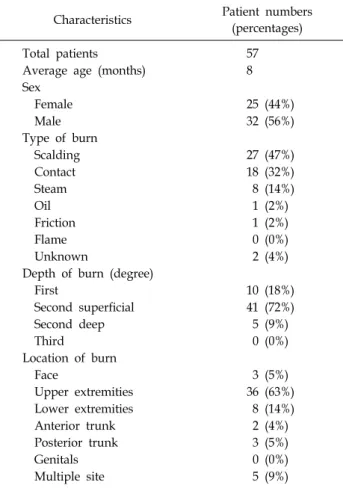
A total of 57 patients aged under 12 months were diag- nosed with burn injuries between January 2015 and December 2018. Although 10 of these patients did not present for final wound follow up, their data was still in- cluded for data analysis. The average age of patients was 8 months (ranged from 1 month to 11 months) (Fig. 1).
The cohort comprised 25 females and 32 males (sex ratio 1:1.28) (Table 1). Average duration of treatment was 9.5 days (ranged from 2 to 30 days).
Scalding was the most common type of burn (27 pa- tients, 47%), followed by contact burn (18 patients, 32%) and steam burn (8 patients, 14%). The cause of injury for two patients was unknown. Superficial second degree was the most common depth of injury (41 patients, 72%), followed by first degree (10 patients, 17%) and deep sec- ond degree (5 patients, 8%). No patients sustained third- degree or flame burns. No patients underwent surgical treatment.
Average age for each type of injury was calculated by
independent T-test. Average ages of patients with scald-
ing, contact, and steam burns were 8.7, 7.06, and 9.25
months, respectively (Table 2). The average ages of pa-
tients with contact burns and steam burns were sig-
nificantly lower (P=0.19) and higher (P=0.005), respectively,
Ha Hyun Yu and Youngwoong Choi:Epidemiology of Burns in Infants
51
than for other types of burn. There were no significant relationships found between age and duration of treat- ment (P=0.57) or between depth of injury and duration of treatment (P=0.25).
DISCUSSION
Although the American Burn Association has reported that the incidence of burn injuries in infants younger than one year of age is increasing
3), little epidemiological data are available on burns in this population. As the skin’s resilience to thermal injury increases with age, infants can sustain a full thickness burn in less than one minute in 60
oC water compared with adults who can tolerate up to 20 seconds
12). As infants cannot control their body move- ments, talk, or manage by themselves, it is important for adults to care for them appropriately.
In the general population, considerably more burns oc- cur in men than in women
3). In some previous studies, the male to female ratio was 1.5:1 for infant patients with burns
1), whereas in other studies, females outnumbered males 1.5:1
4). In our study, the male to female ratio was 1:0.78. A possible explanation for this is that variation in the type of injury might have affected the sex ratio. In the pediatric population, males have a higher rate of trau- ma than females partially because of activities, such as sports
5). However, given that the infant population cannot walk or participate in sports, a more plausible explanation in this regard might be a difference in parenting practices, especially since many infant burns are caused by the child’s parents
6-8). Our study indicated no significant rela- tionship between sex and type of burn injury in the infant population, which is consistent with the findings of pre- vious studies.
Scalding is the most common type of burn in the gen- eral population
9-11)and can result in any burn depth, de- pending on various factors
12). In our study, scalding also accounted for the highest percentage (47%). Some of these occurred when infants tried to grasp hot soup or water.
In previous studies, scalding often occurred when parents were warming milk bottles in hot water and accidently spilt on infants
1). This type of burn can, therefore, be pre- vented through more careful parenting.
Contact is another common type of burn in the general
population
9,10), reportedly representing 10% of pediatric burn injuries
12), and being the second largest contributor to burn injuries in infants under six months old
1). Contact burns are usually caused by hair straighteners, irons, ket- tles, heaters, or hot foods. The dangers hair straighteners pose to young children has been documented
13). In our study, five infants received contact burns from hair straighteners, while eight infants sustained injury from contact with hot foods. As infants reached out to touch the hot object, contact burns resulted in injuries to the up- per extremities (63%), such as the fingers or hands. It is possible that this type of burn injury is so prevalent be- cause infants are developing the curiosity and ability to explore the environment but without a sense of danger.
Steam burn is not the major type of burn observed in the child population. In our study, eight infants (14%) were injured by steam, such as that from a pressure cook- er (seven infants, 87%) or steam cleaner (one infant, 13%).
The pressure cooker is popular in Korea for the prepara- tion of rice, one of the staple foods. This suggests that the type of burn might be affected by the home environ- ments of patients. Many contact and steam burns can be prevented by ensuring that potentially dangerous objects are kept beyond infants’ reach when in use.
In our study, the average age of infants who sustained steam burns (9.25 months) was significantly higher than the average age for other types of burns, possibly affected by infants’ range of movement. As infants begin to crawl or stand supported by something, they have a larger range of movement and can, therefore, be injured more easily.
There were two cases of unusual burns in our study:
one friction burn and one oil burn. The friction burn oc- curred because the infant put his fingers inside a closing drawer; and the infant who sustained the oil burn was injured while his mother was cooking. Both cases re- inforce the preventability of infant injuries through vigi- lant parenting.
CONCLUSION
As infants cannot control their body movements, talk,
or manage by themselves, it is important for adults to
care for them. Unlike other previous studies, there were
52
대한화상학회지 Vol. 22, No. 2, 2019many steam burns in infants patients in our study.
Consequently, in addition to the prevention of burns, spe- cial care should be taken for the pressure cooker.
CONFLICTS OF INTEREST
The authors have no conflicts of interest to declare.
REFERENCES
1) Burlinson CEG, Wood FM, Rea SM. Patterns of burn injury in the preambulatory infant. Burns 2009;35:118-22.
2) Spady DW, Saunders DL, Schopflocher DP, Svenson LW.
Patterns of Injury in Children: A Population-Based Approach.
2004;113:522-9.
3) American Burn Association. National Burn Repository 2019 Update [Internet]. Chicago (IL): American Burn Association;
c2019. Available from: http://ameriburn.org/wp-content/
uploads/2019/04/2019_aba_annual_report_website-content.p df.
4) Laitakari E, Koljonen V, Rintala R, Pyorala S, Gissler M.
Incidence and risk factors of burn injuries among infants, Finland 1990–2010. Journal of Pediatric Surgery 2015;50:
608-12.
5) Breslau N. Gender differences in trauma and posttraumatic stress disorder. The journal of gender-specific medicine:
JGSM: the official journal of the Partnership for Women's Health at Columbia 2002;5:34-40.
6) Mack KA, Gilchrist J, Ballesteros MF. Unintentional injuries among infants age 0-12 months. Journal of Safety Research 2007;38:609-612.
7) Laitakari E, Pyörälä S, Koljonen V. Burn Injuries Requiring Hospitalization for Infants Younger Than 1 Year. Journal of Burn Care & Research 2012;33:436-41.
8) Laitakari E, Koljonen V, Pyörälä S, Rintala R. Outpatient treated burns in infants younger than 1 year in Helsinki during 2005–2009. Burns 2014;40:489-94.
9) Lyngdorf P, Sørensen B, Thomsen M. The total number of burn injuries in a Scandinavian population—a prospective analysis. Burns 1986;12:567-71.
10) Song C, Chua A. Epidemiology of burn injuries in Singapore from 1997 to 2003. Burns 2005;31:S18-S26.
11) Tse T, Poon CHY, Tse K-H, Tsui T-K, Ayyappan T, Burd A.
Paediatric burn prevention: An epidemiological approach.
Burns 2006;32:229-34.
12) Yarrow J, Moiemen N, Gulhane S. Early management of burns in children. Paediatrics and Child Health 2009;19:509-16.
13) Duncan RA, Waterston S, Beattie TF, Stewart K. Contact burns from hair straighteners: a new hazard in the home.
Emergency Medicine Journal 2006;23:e21-e.