• 검색 결과가 없습니다.

Surgery for Partial Anomalous Pulmonary Venous Connections: Modification of the Warden Procedure with a Right Atrial Appendage Flap

N/A
N/A
Protected

Academic year: 2021

Share "Surgery for Partial Anomalous Pulmonary Venous Connections: Modification of the Warden Procedure with a Right Atrial Appendage Flap"

Copied!
6
0
0

로드 중.... (전체 텍스트 보기)

전체 글

(1)

http://dx.doi.org/10.5090/kjtcs.2014.47.2.94 ISSN: 2233-601X (Print) ISSN: 2093-6516 (Online)

Departments of

1

Thoracic and Cardiovascular Surgery and

2

Pediatrics, Samsung Medical Center, Sungkyunkwan University School of Medicine Received: September 5, 2013, Revised: October 13, 2013, Accepted: October 15, 2013

Corresponding author: Tae-Gook Jun, Department of Thoracic and Cardiovascular Surgery, Samsung Medical Center, Sungkyunkwan University School of Medicine, 81 Irwon-ro, Gangnam-gu, Seoul 135-710, Korea

(Tel) 82-2-3410-3484 (Fax) 82-2-3410-0089 (E-mail) [email protected]

C

The Korean Society for Thoracic and Cardiovascular Surgery. 2014. All right reserved.

CC
This is an open access article distributed under the terms of the Creative Commons Attribution Non-Commercial License (http://creative- commons.org/licenses/by-nc/3.0) which permits unrestricted non-commercial use, distribution, and reproduction in any medium, provided the original work is properly cited.

Surgery for Partial Anomalous Pulmonary Venous Connections:

Modification of the Warden Procedure with a Right Atrial Appendage Flap

Chilsung Kim, M.D.

1

, Yang Hyun Cho, M.D.

1

, Mina Lee, M.D.

1

, Ji-Hyuk Yang, M.D.

1

, Tae-Gook Jun, M.D.

1

, Jin Young Song, M.D.

2

, June Huh, M.D.

2

, I-seok Kang, M.D.

2

Background: Surgical repair of a partial anomalous pulmonary venous connection (PAPVC) to the superior vena cava (SVC) may be complicated by sinus node dysfunction or SVC obstruction. We modified the Warden proce- dure by using a right atrial auricular flap to decrease the occurrence of these complications. Methods: Between February 2005 and July 2012, 10 consecutive patients underwent a modified Warden procedure to correct PAPVC.

The median patient age was 5.7 years. Eight patients (80%) had an atrial septal defect. To surgically correct the PAPVC, we made a U-shaped incision on the right atrial appendage and sutured the flap to the posterior wall of the SVC. The anterior wall was reconstructed with various patch materials. Results: No early or late deaths oc- curred, nor did any patient require early or late reoperation for SVC or pulmonary venous obstruction. No new ar- rhythmias appeared during follow-up, which was complete in all patients (mean, 29.5 months). Conclusion: Our modification of the Warden procedure seems to be effective and safe. This technique may lower the risk of SVC obstruction, pulmonary venous obstruction, and sinus dysfunction.

Key words: 1. Congenital heart disease (CHD)

2. Partial anomalous pulmonary venous connection (PAPVC) 3. Modified Warden procedure

INTRODUCTION

Partial anomalous pulmonary venous connection (PAPVC) is an anomaly in which some but not all pulmonary veins connect to the right atrium or its tributaries as opposed to the left atrium [1]. The most common type of PAPVC is related to a sinus venosus malformation; the right upper and middle pulmonary veins connect to the superior vena cava (SVC) or cavoatrial junction, and a sinus venosus-type atrial septal de- fect (ASD) is present in 90% of the patients [2]. The ideal surgical correction of SVC-connected PAPVC creates a nor-

mal physiological flow with separate pulmonary and systemic

venous pathways, while avoiding complications such as sinus

node dysfunction [3]. Various surgical techniques have been

described for the correction of PAPVC that connects to the

SVC. Conventional repair, which creates a pulmonary venous

pathway with one or two patches, carries the risk of pulmo-

nary venous obstruction, SVC stenosis, and sinus node dys-

function [3,5,6]. In the Warden procedure, reported in 1984,

the SVC is divided, and the cephalic SVC is anastomosed to

the right atrial (RA) appendage, while the caudal SVC serves

as a pulmonary drainage conduit [3]. This procedure has been

(2)

Table 1. Preoperative characteristics

Characteristic Value

APV

RUPV only More than RUPV Drainage of APV

SVC

SVC-right atrium junction Atrial septal defect

Sinus venosus Secundum

Patent foramen ovale Intact atrial septum Associated anomaly

Persistent left SVC

Double outlet right ventricle (TOF type) D-Transposition of great artery with

ventricular septal defect

8 (80) 2 (20)

8 (80) 2 (20)

7 (70) 0 1 (10) 2 (20)

4 (40) 1 (10) 1 (10)

Values are presented as number (%).

APV, anomalous pulmonary vein; RUPV, right upper pulmo- nary vein; SVC, superior vena cava.

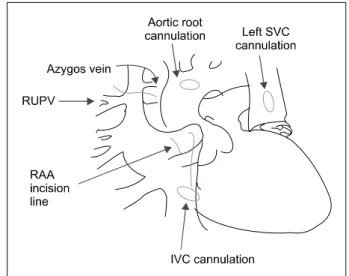
Fig. 1. After standard cardiopulmonary bypass and cardioplegic arrest, we made a long U-shaped incision on the RAA and a longitudinal incision towards the IVC. The auricular flap was made to reach the posterior wall of the divided SVC. The longitudinal incision was made for the anterior patch and intracardiac repair.

SVC, superior vena cava; RUPV, right upper pulmonary vein;

RAA, right atrial auricle; IVC, inferior vena cava.

widely used for surgically correcting PAPVC, which connects to the SVC. Although the Warden procedure has been effec- tive in decreasing the risk of SVC or pulmonary venous ob- struction, there have been a few complications after the Warden procedure, including pulmonary venous obstruction, SVC obstruction, and sinus node dysfunction [8,10,13].

We have modified the Warden procedure by using a RA wall flap along with patch augmentation with autologous or bovine pericardium. In this report, we review the early and mid-term outcomes in patients with PAPVC connecting to the SVC treated using our modified Warden procedure.

METHODS 1) Patient characteristics

The permission to retrospectively review medical records was obtained from the institutional review board of Samsung Medical Center. The need for individual consent for the study was waived.

From February 2005 to July 2012, 10 patients at Samsung Medical Center were treated with a modified Warden proce- dure for PAPVC connecting to the SVC. Diagnoses were per- formed using echocardiography or computed tomography.

Cardiac catheterization was performed in three patients for evaluating the associated anomalies and pulmonary hyper- tension (Table 1).

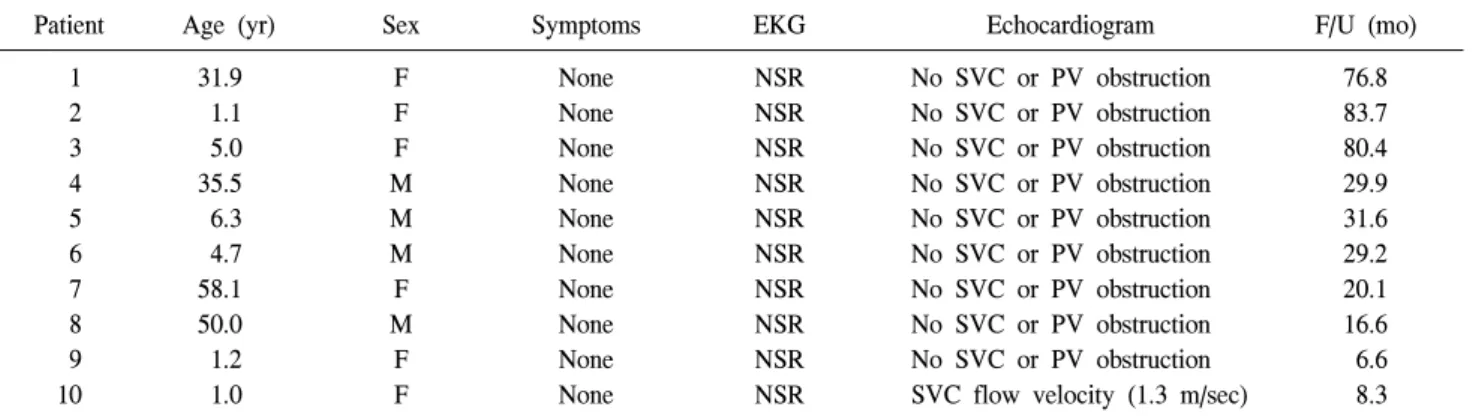
Follow-up data were obtained through medical record re- views, referring cardiologists, or direct telephone contact with patients. The median follow-up duration was 29.5 months (range, 6.6 to 83.7 months). Electrocardiogram (EKG) and echocardiographic data were available for all patients. The categorical variables are presented as frequencies (%), and the numerical data are expressed as median values with ranges.

2) Operative technique

After standard median sternotomy, a large pericardial patch

was harvested and treated with a 0.6% glutaraldehyde

solution. The SVC was dissected circumferentially from the

SVC-RA junction to the level of the innominate vein. The

azygos vein was divided. Cardiopulmonary bypass was estab-

lished by cannulation of the ascending aorta, inferior vena

cava, and innominate vein. If the patient had a persistent left

SVC (four patients), the left SVC was directly cannulated

(Fig. 1). Using moderate hypothermia, we achieved cardiac

arrest with intermittent antegrade cold-blood cardioplegia.

(3)

Table 2. Operative techniques and material used

Pathway Procedure and materials Patients (n=10) Atrial septal defect

Pulmonary venous pathway (baffling)

Systemic venous pathway (anterior wall augmentation)

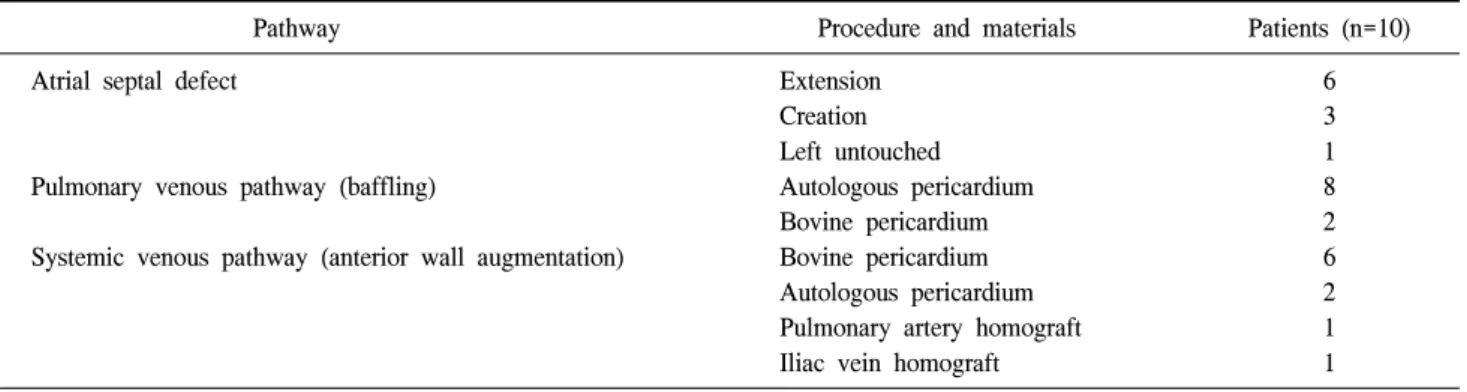
Extension Creation Left untouched Autologous pericardium Bovine pericardium Bovine pericardium Autologous pericardium Pulmonary artery homograft Iliac vein homograft

6 3 1 8 2 6 2 1 1

Fig. 3. The distal end of the transected SVC was opened ante- riorly and then, anastomosed to the edge of the right atrial auri- cle pedicle flap. This served as a posterior wall of the neo-SVC.

The anterior wall of the neo-SVC was reconstructed with a large piece of patch. SVC, superior vena cava.

Fig. 2. The proximal end of the divided SVC was closed directly;

it served as a conduit for pulmonary venous drainage to the left atrium through the ASD. To reconstruct the pulmonary venous pathway, the ASD was enlarged or newly created, and baffling from the SVC orifice to the ASD was performed using patch materials. SVC, superior vena cava; ASD, atrial septal defect.

The SVC was divided just above the uppermost insertion of the anomalous pulmonary vein. The end of the proximal SVC was closed directly, and it served as a conduit for pul- monary venous drainage. Just below the oblique incision along the atrioventricular groove, another small longitudinal incision was made to create the atrial flap at the right atrial auricle (RAA) (Fig. 1). An autologous or bovine pericardial patch was sutured to the margin of the ASD on the SVC or- ifice to create a pulmonary venous pathway (Fig. 2). In the absence of an ASD, a large ASD was created in the fossa ovalis area and the sinus portion. If a small ASD was pres- ent, it was enlarged for creating a non-restrictive pulmonary

blood flow pathway. A RA flap was prepared for the posteri- or wall of the neo-SVC. The pectinate muscle in the RAA was resected to create a smooth atrial flap. This atrial flap was anastomosed to the distal end of the SVC for re- constructing the posterior SVC wall. The anterior wall of the neo-SVC was reconstructed with a generous autologous patch or with prosthetic materials (Fig. 3). We used 5-0 or 6-0 pol- ypropylene suture for the reconstruction. Details of the surgi- cal techniques employed herein are presented in Table 2.

Surgical correction of the associated cardiovascular anoma-

lies was performed before or after the modified Warden pro-

cedure, as needed. Concomitant procedures included tricuspid

annuloplasty in two patients, a modified Cox maze procedure

in one patient, right ventricle-pulmonary artery conduit

change in one patient, and subaortic muscle resection in one

patient. The mean cardiopulmonary bypass time was

(4)

Table 3. Summary of latest F/U data

Patient Age (yr) Sex Symptoms EKG Echocardiogram F/U (mo)

1 2 3 4 5 6 7 8 9 10

31.9 1.1 5.0 35.5 6.3 4.7 58.1 50.0 1.2 1.0

F F F M M M F M F F

None None None None None None None None None None

NSR NSR NSR NSR NSR NSR NSR NSR NSR NSR

No SVC or PV obstruction No SVC or PV obstruction No SVC or PV obstruction No SVC or PV obstruction No SVC or PV obstruction No SVC or PV obstruction No SVC or PV obstruction No SVC or PV obstruction No SVC or PV obstruction SVC flow velocity (1.3 m/sec)

76.8 83.7 80.4 29.9 31.6 29.2 20.1 16.6 6.6 8.3 F/U, follow-up duration; EKG, electrocardiogram; NSR, normal sinus rhythm; SVC, superior vena cava; PV, pulmonary valve.

148.4±88.6 minutes, and the mean aortic cross-clamping time was 102.4±72.5 minutes.

RESULTS

There were 6 female and 4 male patients. The median age at the time of surgery was 5.7 years (range, 1.0 to 58.1 years). All patients had PAPVC to the SVC or near the SVC-right atrium junction. In eight patients, pulmonary veins from segments confined to the right upper lobe were con- nected to the SVC. In the remaining two patients, veins from segments in addition to the right upper lobe were involved.

Seven patients had the sinus venosus-type ASD (70%), two patients (20%) had an intact atrial septum, and one patient (10%) had patent foramen ovale. The associated car- diovascular anomalies included persistent left SVC in four pa- tients, transposition of great arteries with ventricular septal defect in one patient, and double outlet of the right ventricle in one patient. Preoperative EKG showed normal sinus rhythm in eight patients, 1st degree atrioventricular block in one patient, and chronic atrial fibrillation in one patient.

We observed no early mortality, early reoperation, or surgi- cal morbidities. At last follow-up, all patients were asympto- matic and had normal sinus rhythm on the EKG. All patients underwent postoperative echocardiogram. Nine patients had normal flow in the SVC, with unobstructed drainage of the pulmonary veins to the left atrium. In one patient, the SVC flow velocity was slightly increased (1.3 m/sec, estimated pressure gradient=6.76 mmHg), but there was no clinical evi-

dence of SVC obstruction (Table 3).

The eight patients with normal sinus rhythms did not de- velop any arrhythmias post-surgery. The PR interval of the patient with 1st degree AV block normalized after surgery.

Chronic atrial fibrillation converted to a normal sinus rhythm after the Cox maze procedure. Thus, there were no new ar- rhythmias after surgery. No patient required re-operation or re-intervention for systemic or venous pathway stenosis at the last follow-up.

DISCUSSION

Multiple surgical techniques have been previously reported for repairing PAPVC. The classic ones include intra-atrial baffling using one or two patches and repair with a RA flap.

Warden et al. suggested a novel technique for connections of

anomalous pulmonary veins [3]. The Warden procedure trans-

fers the SVC to the RA appendage, while redirecting an

anomalous pulmonary venous flow to the left atrium by using

a single patch. This procedure essentially prevents the ana-

tomical obstruction of the intracardiac blood flow. However,

stenosis at the SVC-RA junction has been reported. Gustafson

et al. [4] reported only one patient with SVC obstruction and

sick sinus syndrome postoperatively in a series of 40 patients

who underwent the Warden procedure. However, SVC ob-

struction developed two years after the Warden procedure in

one patient from among a series of five patients, as reported

by Stewart et al. [7]. This was attributed to a technical prob-

lem resulting from failure to excise all the trabeculations, as

(5)

reported by Warden et al. [3].

The potential causes of stenosis are trabeculations on the RA appendage or tension at the RA-SVC junction. Said et al.

[13] suggested the use of vascular grafts between the SVC and the RA to decrease tension at the anastomosis. However, this modification may not be appropriate in pediatric patients because it may become too small as the child grows.

Therefore, we modified the Warden procedure using an RAA flap and an autologous pericardium.

The technique called ‘RA wall pedicled flap technique’ has been described and clinically used by a few surgeons [10-12].

Nakahira et al. [12] used a pedicled autologus pericardial flap for anterior augmentation of cavoatrial anastomosis with the expectation of a sufficient channel and tension-free anasto- mosis growth potential. However, they did not use the ‘RA wall pedicled flap technique.’ Park et al. [10] reported the use of a modified Warden procedure in 9 cases, with the techniques used in three of these cases being seemingly sim- ilar to our technique, for tension-free anastomosis between the cephalic end of the SVC and the RA appendage where the anomalous pulmonary vein enters the more cephalic por- tion of the SVC. Tao et al. [11] reported that one patient from among their series underwent a similar modification as our patients did. In this study, we described the treatment of 10 patients with the same surgical technique, as well as their early and mid-term clinical outcomes.

As expected, we have not been required to perform any re-operation or re-intervention for obstruction or stenosis in the cardiac venous circulation. The tension-free anastomosis may decrease the risk of postoperative bleeding and thromboembolism. Therefore, this technique has become the standard procedure for surgical correction of PAPVC at our institution.

Sinus node dysfunction is a serious complication after the 1-patch or 2-patch technique, in which the incisions are placed close to the sinus node or its arterial supply [5-7,9].

No sinus node dysfunction was detected in any of the 11 pa- tients from among a series undergoing the Warden procedure reported by Gaynor et al. [8]. Stewart et al. [7] did not report sinus node dysfunction in any of the 5 patients in their series who underwent the Warden procedure. Our modification was similarly associated with a low incidence of sinus node dys-

function, and no patients in our series newly developed ar- rhythmia during follow-up.

We believe that our technique may improve the classic Warden procedure in some ways. It always provides a wide tension-free anastomosis; there is no single circular suture line causing late stenosis; and patients do not need anti- coagulation because of a widely patent pathway and low rate of atrial arrhythmia. Therefore, our modified technique can be a viable option for surgically correcting PAPVC in both pe- diatric patients and adults. Our study is limited by our experi- ence and the retrospective nature of this chart review.

Because PAPVC is a rare situation, multi-institutional studies may be necessary. Our modification requires more complex suture lines than those in the original Warden procedure or other previous modifications. This may lead to technical diffi- culties, a steeper learning curve, or higher chances of bleeding. However, we believe that most experienced con- genital cardiac surgeons are familiar with even such a com- plex suture. In addition, we did not experience any technical errors or postoperative bleeding. Thus, we believe that this is a readily reproducible technique.

In conclusion, the Warden procedure using the RA auric- ular flap and a biological patch for PAPVC treatment was correlated with satisfactory early and mid-term outcomes.

Because this modification may decrease the risk of SVC ob- struction and other possible complications associated with the Warden procedure, it can be considered a viable option in both pediatric and adult patients for surgically correcting PAPVC.

CONFLICT OF INTEREST

No potential conflict of interest relevant to this article was reported.

REFERENCES

1. Hijii T, Fukushige J, Hara T. Diagnosis and management of partial anomalous pulmonary venous connection: a review of 28 pediatric cases. Cardiology 1998;89:148-51.

2. Kyger ER 3rd, Frazier OH, Cooley DA, et al. Sinus venosus

atrial septal defect: early and late results following closure

in 109 patients. Ann Thorac Surg 1978;25:44-50.

(6)

3. Warden HE, Gustafson RA, Tarnay TJ, Neal WA. An alter- native method for repair of partial anomalous pulmonary ve- nous connection to the superior vena cava. Ann Thorac Surg 1984;38:601-5.

4. Gustafson RA, Warden HE, Murray GF. Partial anomalous pulmonary venous connection to the superior vena cava.

Ann Thorac Surg 1995;60(6 Suppl):S614-7.

5. Trusler GA, Kazenelson G, Freedom RM, Williams WG, Rowe RD. Late results following repair of partial anom- alous pulmonary venous connection with sinus venosus atrial septal defect. J Thorac Cardiovasc Surg 1980;79:776-81.

6. Stewart S, Alexson C, Manning J. Early and late results of repair of partial anomalous pulmonary venous connection to the superior vena cava with a pericardial baffle. Ann Thorac Surg 1986;41:498-501.

7. Stewart RD, Bailliard F, Kelle AM, Backer CL, Young L, Mavroudis C. Evolving surgical strategy for sinus venosus atrial septal defect: effect on sinus node function and late venous obstruction. Ann Thorac Surg 2007;84:1651-5.

8. Gaynor JW, Burch M, Dollery C, Sullivan ID, Deanfield JE,

Elliott MJ. Repair of anomalous pulmonary venous con- nection to the superior vena cava. Ann Thorac Surg 1995;

59:1471-5.

9. Nicholson IA, Chard RB, Nunn GR, Cartmill TB. Transcaval repair of the sinus venosus syndrome. J Thorac Cardiovasc Surg 2000;119(4 Pt 1):741-4.

10. Park CS, Kwak JG, Lee C, et al. Partial anomalous pulmo- nary venous connection to the superior vena cava: the out- come after the Warden procedure. Eur J Cardiothorac Surg 2012;41:261-5.

11. Tao K, Pan W, Lin K, et al. Modified cavoatrial anasto- mosis in Warden procedure. Ann Thorac Surg 2010;89:2047- 8.

12. Nakahira A, Yagihara T, Kagisaki K, et al. Partial anom- alous pulmonary venous connection to the superior vena cava. Ann Thorac Surg 2006;82:978-82.

13. Said SM, Burkhart HM, Dearani JA, et al. Outcome of caval

division techniques for partial anomalous pulmonary venous

connections to the superior vena cava. Ann Thorac Surg

2011;92:980-4.

수치

Table 1. Preoperative characteristics
Fig. 2. The proximal end of the divided SVC was closed directly;
Table 3. Summary of latest F/U data

참조

관련 문서

• Hormone Therapy With or Without Combination Chemotherapy in Treating Women Who Have Undergone Surgery for Node-Negative Breast Cancer (The TAILORx Trial)..

With the increase of the dental implant procedure, there are many cases of Maxillary Sinus Floor Elevation Surgery(MSFES). Additionally, its side effect has

Degree Centrality The counts of how many connections a node has Popularity or influence of a node (e.g., word, person) in the network Betweenness Centrality The extent to which

Kameoka, “Sentinel lymph node biopsy for breast cancer patients using fluorescence navigation with indocyanine green,” World Journal of Surgical Oncology, Vol..

⚫ Plasma sheath: the non-neutral potential region between the plasma and the wall caused by the balanced flow of particles with different mobility such as

 Although van der Waals equation is still less accurate at high

void makeTree(Object root, Object left, Object right): Creates a binary tree with root as the root element, left as the left subtree, right as the right

Background: Incidence of complications related extracorporeal membrane oxygenation (ECMO) support as a bridge to lung transplantation (BTT) and its association with the