한국전문물리치료학회지 제 9권 제 4호
KAUTPT Vo
l.9 No. 4 2002.
Landing Analysis Differences of Knee Angle in
Drop-Jump: A Ki nematic Gender
From a
Yi Chung-hwi. Ph.D .. P.T.
Dept. of Physical Therapy , College of Health Science , Yonsei University Institute of Health Science , Yonsei University
Park So-yeon. M.Sc .. P.T.
Dep t. of Rehabilitation Therapy , The Graduate School , Yonsei University Lee Sang-heon. B.H.Sc .. O.T.
Dep t. ofRehabilitation Therapy , The Graduate School , Yonsei University 국문요약
분석 슬관절의 형상학적 (kinematic) 자료
이충휘
연세대학교 보건과학대학 불리치료학과 및 보건과학연구소
박소연
연세대학교 대학원 재활학과
이상헌
연세대학교 대학원 재활학과
수직착지시 성에 따른
이 연구의 목적은 수직착지시 성에 따른 슬관절 가동범위의 차이를 알아보는 것이다.
연구 대상자는 20 대의 건강한 성인 48명(남자 25 명, 여자 23 명)이었다. 연구 대상자에게
40 cm
높이에서 한발로 뛰어내리도록 하고, 2차원 동작측정 기구인 CMS-HS를 이용하여수직착지시 슬관절의 굴곡각도, 최대 슬관절 굴곡각도, 슬관절의 가동 범위, 각속도를 측정 한 후, 남
·
여 두 집단간의 차이를 알아보았다. 이때 사용한 분석방법은 독립적인 두 표본t
검정이었으며 축차적 (stepwise) 다변량회귀분석을 이용하여 체중과 신장을 조절한 상태 에서 납여 간에 차이가 있는지를 분석하였다. 그 결과 수직착지시 슬관절의 굴곡각도에서 는 유의한 차이를 보이지 않았으나, 최대 슬관절 굴곡각도, 슬관절의 가동 범위, 각속도에 는 유의한 차이가 있었다 (p<.05). 체중과 신장이 조절된 조건 하에서 여자는 수직착지시 최대 슬관절의 굴곡각도와 슬관절의 가동범위가 남자보다 작았다. 이러한 결과를 통하여 수직착지시 여자가 남자보다 슬관절 손상의 빈도가 높은 이유 중의 하나는 여자가 슬관절 을 덜 굴곡시킴으로 인해 바닥의 충격을 더 많이 받기 때문이라는 가능성을 발견하였다.핵심단어: 수직착지; 슬관절 굴곡; 운동형상학적 분석
crucmte mJunes populations compared
patello-femoral female
and ligament
Introduction
athletic years counterparts
as 25
past male the the their among
over to documented
been many
instances of greater incidences of anterior have
There
한국전문물리치료학회지 제 9권 저14호
KAUTPT . Vo
l.9 No. 4 2002.
participating in comparable sports such as basketball , volleyball , and soccer (B aker , 1998; Beim and Stone , 1995; DeHaven and Lintner , 1986; Engstrom et al , 199
1;Feretti et al , 1992; Kaiser , 1998; Woodland and Francis , 1992).
Huston et al (200
1)performed a study of 20 young height-matched subjects , 10 male , and 10 female that performed 3 jumps from 3 vertical heights. The largest gender difference in knee angle occurred at the highest jump height of 60 cm. Women were found to land with a significantly straighter knee angle than men at heights , 60 and 40 cm , thus exposing their knee joint to higher forces per unit body weight when landing from a jump than men do.
Lafortune (1 985) compared healthy and previously injured basketball players while rebounding basketballs. The noninjured athletes . demonstrated greater flexion at the hip and knee joints during landing.
Interestingly , previously injured athletes demonstrated less hip and knee flexion (Lafortune , 1985). Huston et al (2001) theorized that smaller knee flexion angle utilized by women during the impact phase of lànding will also increase their vertical grounò reaction forces and knee joint loads.
Landing imposes forces on the body that must be absorbed primarily by the lower extrernity (Ca.ster and Bates , 1995). If loads become too great for the body to accomodate or if impact absorption fails , an injury Will likèly occur (Simpson and Kanter , 1997). These pathomechanics shòuld be considered in the possible cause of the higher rates of knee injuries. for women (H uston et al , 200
1).Several lines of evidence suggest the angle of knee extension on touchdown and impact with the ground will determine the magnitude of the ground impact force , and therefore , indirectly , knee loading. Although drop-landings have been studied extensively , a few studies have been done to examine gender differences (Huston et al , 200
1;McNitt-Gray , 1993). Therefore , this study was conducted to compare the intial knee angle , maximum knee flexion angle , and angular velocity at the instant of impact for drop-landings between healthy men and women.
Methods
Subjects
Twenty-five healthy men (age , 24.6
:t2 .2 yrs; height , 173.3
:t5.7 cm; weight , 7
1.5
:t8.2 kg) volunteers with ages ranging from 2 1-29 years and 23 healthy women (age , 23.0
:t3.8 yrs; height , 16
1.0
:t4.8 cm; weight , 57.5
:t10.3 kg) volunteered to participate as subjects in the study. They were free of injury or other physical impairment in the lower extremity at the time of testing. The age , height , and weight characteristics of the subjects are summarized in Table
1.Table
1.Age , height , and weight charac- teristics of the subjects (N=48)
Variable Male Female
Age (yrs) 24.6
:t2.2* 23.0
:t3.8 Height (cm) 173.3
:t5.7 16
1.0
:t4.8 Weight (kg) 7
1.5
:t8.2 57.5 :tl 0.3
*Mean
:tSD
- 46 -
한국전문물리치료학회지 제 9권 저14호
KAUTPT Vo
l.9 No. 4 2002.
Test Protocol
Participants were instructed to perform three unconstrained jumps from 40 cm high.
The cmS-HSll measuring system was used to analyze the kinematic data. This system consists of a measuring sensor with stand , a basic CMS-HS unit , markers and a cable adaptor with 10 channels can be supplied for operation of individual markers. The measuring procedure is based on the determination of the spatial coordinates of miniature ultrasound transmitters. The sound
‘pulse time between the transmitters and the three microphones integrated in the measuring sensor was measured. Active reflective markers were placed on the right side of the body at 3 sites: the lateral malleolus , the mid-thigh , and lateral femoral epicondyle (Figure n
Fig 1. Experimental setting
In preparation' for the jump , each participant was instructed to drop , not jump , fiom the raised platform onto the ground , attempting to land with their toes
n Zebris Medizintechnik , GmbH. Isny.
Germany:
as close as possible to a mark on the floor 40 cm from the platform , thus attempting to standardize the horizontal jumping distance of the participants. After landing , the subject returned to her normal standing position. The arms were not constrained during the landings and were generally put subjects' sides or waist for balance. Each subject practiced the data collection protocol prior to the time of data collection.
The purpose of the practice sessions was to allow the subjects time to become comfortable with the data collection conditions. The subjects were asked to perform 3 landing trials.
Statistical Analysis
Kn ee joint angular position and velocity were calculated from the kinematic data.
Independent t-tests were used to determine if difference existed between males and females for the intial knee flexion angle at the moment of impact , maximum knee flexion angle , and angular velocity at
veπical
drop-landing. The significant level for difference was set at p<.05. Stepwise multiple regression analysis was used to identify the most informative variable for prediction of range of motion change at knee joint during drop-landing. A dummy variable for gender was used.
Results
At 40 cm height , the means of knee
flexion angle at landing were 4.05
:t3.78
degrees for men and 5 .4 5
:t4.86 degrees for
women. Independent t-test revealed no
significant difference between the two
한국전문물리치료학회지 제 9권 제 4호
KAUTPT -Vo
l.9 No. 4 2002.
Table 2. The kinematic data at landing Male
(N=48)
Female t p
5 .4 5
:t4.86 -1.1 2 .267 Kn ee flexion angle
at landing (degree) 4.05
:t3.78*
Maximum knee
flexion angle (degree) 48. 16
:t4.57 42.74
:t6 .4 7 3.37 .002 Kn ee flexion range**
(degree) 43.64 :t4 .63 37 .4 0
:t6 .2 3 3.95 .000
Ang
1.l1ar velocity (degree/ sec)
*Mean
:tSD
.26
:t.04 .23
:t.04 1. 96 .056
**Maximun knee flexion angle - Knee flexion angle at landing groups (p>.05)(Table 2).
After impact , the knee angle flexes as the vertical momentum of the body is arrested. The maximum knee flexion angle occurred an average of 167 .4 6
:t29 .2 4 msec (172.39
:t23.83 msec in men; 162.
1O:t33.51 msec in women) after impact , in men. Men landed with
‘48.16 :t4 .57 degrees of maximum knee flexion , whereas women landed with 42.74
:t6 .4 7 degrees of maximum knee flexion. There were significant differences between genders in maximurn knee flexion angles (p<.05)(Table 2).
With' respect to the knee flexion range during landing , the means of the angle change were 43.64
:t4.63 degrees in men , 37 .4 0
:t6.23 degrees in women , respectively.
Independent t-test difference between (p<.05)(Table 2).
revealed significant the two groups Conceming the angular velocity , .25
:t.04 degree/sec for men , .23
:t.04 degree/sec for women , respectively. Independent t-test revealed significant difference between the two groups (p<.05)(Table 2).
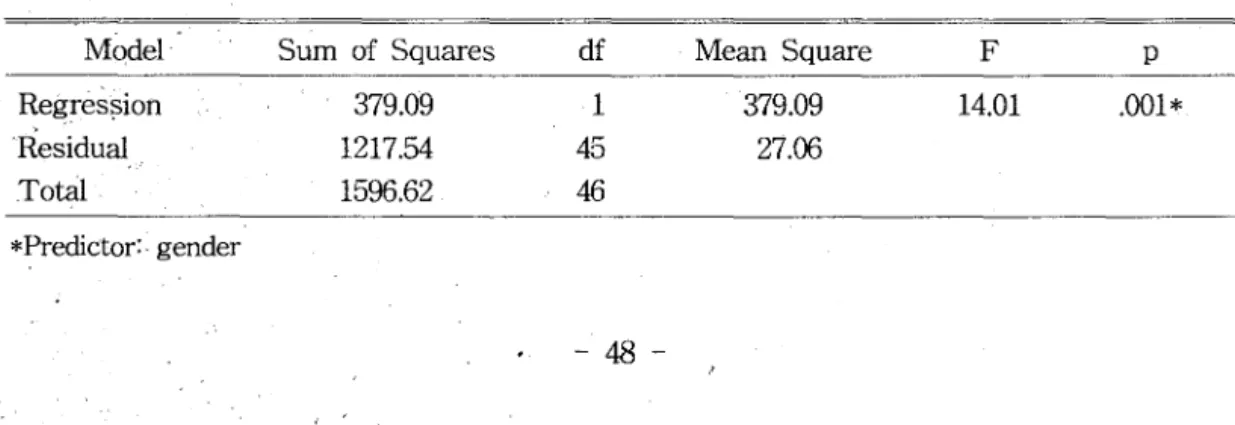
To control the effect of gender , body weight , and height variables , a stepwise multiple regression for knee flexion range was performed. The regression model was obtained below(Table 3 , 4)
Knee flexion range 43.6-5.7
Xgender if gender is 0 , indicates male if gender is 1. indicates female
Table 3. ANOV A output for regression analysis: Knee flexion angle and gender
Model Sum of Squares df Mean Square F p
Regres~ion
379.09 1 379.09 14.01 .001*
Residual 1217.54 45 27.06
Total 1596.62 46
* Predictor:
,gender
- 48 -
한국전문물리치료학회지 제 9권 제 4호
KAUTPT Vo
l.9 No. 4 2002.
Table 4. Coefficients for regression analysis: Knee flexion angle and gender Unstandardized coefficients
Stander error Constant
B 43.645
5.692
1.
040
1.521 Gender
To control the effectof gender , body weight, and height variables, a stepwise multiple regression for angular velocity was . performed. The regression model was obtained below(Table 5, 6).
Angular Velocity .2 57 - .024
Xgender if gender is 0 , indicates .male if gender is 1 , indicates female
Standardized coefficients Beta
.4 87
t
P
4
1.953 .000 -3.743 .001
These factors include both extrinsic and intrinsic factors. Extrinsic factors include contact vs. non-contact mechanisms, muscle strength , conditioning , prior athletic experience and shoe-surface interface.
lntrinsic factors include laxity of joints, anatomic limb variations, Q-angle, and dimensions of the intercondylar notch (Ar endt et al , 1999; Feretti et al , 1992).
Thus far, though, no one particular factor has been proven as the leading cause of
Discussion increased numbers of anterior cruciate ligament and patello-femoral injuries in There have. been many theories as to the female athletes.
etiology of greater incidence of anterior Our investigation set out to exarnine sex cruciate ligament and patello-femoral differences in kinematics in response to a injuries with females in the same sports.
Table 5. ANOV A output for regression analysis: Angular velocity and gender Sum of Squares df Mean Square
Regression .007 1 .007
Residùal .065 45 .001
Total .072 46
*Predictor: gertder
Table 6. Coefficients for regression analysis: Angular velocity and gender
Constant Gender
Unstandardized coefficients Standardized coefficients B
.257 2 .4 E-02
Standard error .008 .011
Beta
-.306
F p
4.638 .037*
t
p33.774 .000
-2.154 .037
한국전문물리치료학회지 제 9권 제4호
KAUTPT. Vo
l.9 No. 4 2002
single leg jump in non-athletic individuals.
Past studies have quantified maximum knee flexion angles on impact , rather than the initial angle on touchdown , which is known to determine the maximum ground reaction force (Nigg , 1994). The results on maximum knee angle from the present study are , however , in agreement with result obtained from Dufek and Bates
(1
99
1).At a height of 59 cm , Dufek and Bates
(1991) reported maximum knee flexion angles to be 77 degrees , whereas in this study , maximum knee flexion angles averaged 45.56 degrees. However , Dufek and Bates (199
1)only examined three male participants as compared to our mixed participants population. Hewett et al (1996)
repoπed
that high school volleyball players' maximum knee flexion angles ranged from 69-72 degrees.
Am oroso et al
(1997) have proposed that a gender difference exists in body configuration at the time of landing from a
free~fall
jump. However , body configuration is unlikely to affect the initial ground reaction force impulse which lasts for only 30 msec , because in this short time , the pelvis and super-incumbent body will not have started to decelerate.
Devita and Skelly
(1992) demonstrated a change in the relative contribution of the ankle , knee ,' and hip joints to energy absorption between soft and stiff landing styles. Devita and Skelly
(1992) determined that the hip , kriee , and ankle absorbed 25 , 37 , and 37% , respectively , of the total eriergy absorbed during soft landings.
Wheri subjects consciously reduced joint range of motion to land stiff , the relative
contribution of the lower extremity joints to total energy absorption was changed to 20 , 31 , and 50% for the hip , knee , and ankle joints , respectively.
Although energy absorption was not measured in this study , there were measured changes in the maximum angular velocity of knee flexion during landing.
The maximum knee flexion angular velocity was , on average , about .25 degree/sec. A reduction in angular velocity could reflect a decrease in energy absorption based on the work-energy relationship. In landing , the angular velocity of the joints is reduced to zero at the end of the decent phase. A higher peak angular velocity reflects a greater angular kinetic energy of the rotating bodies.
Greater negative work , in the form of a torque applied opposite to the direction of rotation , must be done to reduce the angular kinetic energy to zero. The source of the torque to decrease angular velocity at the knee is the eccentric activity in the quadriceps muscles.
This study provide evidence that the ground reaction force is likely to be greater in women per unit body weight than in men because women land with a straighter knee. Because anterior cruciate strain has been found to be greatest when the lower extremity is loaded in full knee extension , and anterior cruciate ligament strain significantly decreases with knee flexion. In the present study , the implication of a straighter in women than in men during landing is that landing with a straighter knee increase the likelihood of a knee injury. However , support of this
- 50 -
한국전문물리치료학회지 제 9권 제4호
KAUTPT
‘Vo l. 9 No. 4 2002
interpretation w i11 require application of an inverse dynarnics analysis to measure the energy absorption during landings with knee extended and with knee flexed.
Given these findings , a review of the incidence and causes of these injuries among female athletes is in order , particularly in basketball , soccer , and volleyb a1l. Such a review rnight suggest areas of further study that could help in
tre~ting
anterior cruciate ligament injuries more effectively in female patients.
Conclusion
From the results obtained we conclude that women land with a straighter knee than . men and landing with a straighter knee might increase the likelihood of a knee injury.
References
Arendt EA , Agel ], Di ck R. Anterior cruciate ligament injury pattems among collegiate men and women. ] of Athletic Training. 1999;34(2):86-92.
Baker' MM. AnteriOr cruciate ligament
In
Juries in the female athlete. ] Women ’ s He a1 th. 1998;7(3):343-349.
Beim G , Stone D A. Issues in the fem a1 e athlete. Orthop Clin North A m.
1995;26(3):443-45 1.
Caster BL , Bates BT. The assessment of mechan iG:a1 and neuromuscular response strategies during landing. Med Sci Sports Exerc. 1995;2 7: 736-744.
DeHaven. KE , Lintner DM. Athletic injuries:
Ccìmparison by age , sport , and gender.
Am ]. Sports Med. 1986;14(3):218-224.
Devita P , Skelly W A. Effect of landing stiffness on joint kinetics and energies in the lower extrernity. Med Sci Sports Exerc. 1992;24:108-115.
Dufek ]S , Bates BT. Biomechanic a1 factors associated with injury during landing in jump sports. Sports Med.
199 1; 12:326-337.
Engstrom B , Forssblad M, Tomkvist H Soccer injuries among elite fe ma1 e players.
Am]
Sφ,rtsMed. 199 1; 19:372-375.
Feretti A , Papandrea P , Conteduca F , et a l.
Knee ligament injuries in volleyball players. Am ] Sports Med.
1992;20(2):203-207.
Hewett TE , Stroupe AL , Nance T A , et a1.
Plyometric training in fem a1 e athletes:
Decreased impact forces and increased hamstring torques. Am ] Sports Med.
1996;24:765-773.
Huston L] , Vibert B , Ashton-Miller ]A , et a1. Gender differences in knee angle when landing from a drop-jump. Am ] Kn ee Surg. 200 1; 14:215-220.
Kaiser D K. The incidence of ACL injury in female interco l1 egiate soccer players.
Supplement to ]oum a1 of Athletic Training. 1998;7(3):343-349.
Lafortune M. ]umping mechanics and jumper ’ s knee. Sports Science and Medicine Quarterly. 1985;2:2-4.
McNitt-Gray ]L. Ki netics of the lower extremities during drop landings from
dπee
heights. ] Bio ræch. 1993;26:1037-1046.
Nigg BM. Modeling. In: Nigg BM , Herzog W , eds. Bi omechanics of the Musculoskelet a1 Syste m. Chichester , United Ki ngdom , Wiley Inc , 1994:458.
Simpson K] , Kanter L. ]ump distance of
dance landings influencing intemal
한국전문물리치료학회지 제 9권 저14호