• 검색 결과가 없습니다.

Characteristics of a Double-Tube Structure for the Hydraulic WIM Sensor

N/A
N/A
Protected

Academic year: 2021

Share "Characteristics of a Double-Tube Structure for the Hydraulic WIM Sensor"

Copied!
5
0
0

로드 중.... (전체 텍스트 보기)

전체 글

(1)

http://dx.doi.org/10.5369/JSST.2014.23.1.19 pISSN 1225-5475/eISSN 2093-7563

Characteristics of a Double-Tube Structure for the Hydraulic WIM Sensor

Young-Soon Moon

1

, Won-Ho Son

2

, and Sie-Young Choi

2,+

Abstract

A new hydraulic tube structure for WIM sensor of a new generation is presented in this paper. The double-tube structure has been developed in order to improve the performance of the hydraulic load cell. The double-tube structure hydraulic element could be reduced by 46% in pressure changes according to temperature compared to a single-tube structure. In addition to the nonlinearity can be reduced by 67.19% at the same load condition. The hydraulic load cell shows an excellent linearity and measurement accuracy as the result of the static load test.

Keywords: Double-tube, Hydraulic load cell, WIM sensor

1. INTRODUCTION

Weight-In-Motion (WIM) sensor is used for measuring the dynamic load of a moving vehicle to estimate the corresponding static load of the vehicle [1,2]. WIM systems have very important benefits in traffic monitoring to reduce accident frequency rates, to reduce fuel consumption and to reduce pavement costs [3,4].

Several kinds of WIM sensors have been developed and are commercially available. A banding plate load cell, the most commonly used low-speed WIM sensor, is performed with relatively high accuracy. However, the installation costs are high, and the accuracy is low in the vehicle traveling at high speed due to the slow response time [5,6]. A piezoelectric sensor is low cost, but does not work properly at low speeds of less than 20 km/h [7,8]. So far, in spite of high accuracy, hydraulic load cell is used for the limited purposes, such as measuring the static load.

Because of the pressure in the sensor is significantly changed by the temperature and that has slow response time by using the corrugated diaphragm. Therefore, the need for the development of a new structure is required.

In this paper, the proposed hydraulic load cell is composed of a spring/hydraulic element and a single sensing element. The

hydraulic element was made by SUS304 as the double-tube structure in order to reduce the pressure changes depending on the temperature to improve accuracy and to speed up the response time. A sensing element detects a change in the internal pressure of the tube caused by an applied load.

2. DESIGN AND FABRICATION

The applied load on the WIM sensor significantly affects the pressure in the hydraulic tube. When the load causes elastic deformation in the range of tensile strength of the tube, the amount of pressure depends on the applied load, the thickness of the tube, the design of the tube and the elasticity of the material.

Fig. 1. shows a schematic view of a WIM sensor. It is a hydraulic load cell with a double-tube structure. The applied load on the top

1

Dept. of Sensor and Display Eng., Kyungpook National University

2

School of Electronics Eng., Kyungpook National University

+

Corresponding author: [email protected] (Received: Dec. 27, 2013, Accepted: Jan. 17, 2014)

This is an Open Access article distributed under the terms of the Creative Commons Attribution Non-Commercial License(http://creativecommons.org/

licenses/bync/3.0) which permits unrestricted non-commercial use, distribution,

and reproduction in any medium, provided the original work is properly cited. Fig. 1. Schematic view of a hydraulic WIM sensor.

(2)

plate delivers its mechanical energy to the hydraulic tube. As a result, the pressure in the tube is changes.

An experiment was carried out to find the characteristics of a single tube structure. Stainless steel grade 304(SUS304) was chosen as the tube material and was cut into 600 mm. The tubes were 1.1 mm thickness, 10 mm height and the width was produced by three different types. Table 1 shows the material properties of a SUS304.

There are several advantages of using SUS304. For example, excellent corrosion-resistant, good tensile strength and large thermal expansion coefficient. SUS304 tubes are processed by CNC and they are connected by the argon welding at intervals of 30 mm.

Hydraulic diameter (D

H

) is primarily used for calculations involving the pressure in non-circular tubes. If completely filled with fluid, the hydraulic diameter for a rectangular tube is,

(1)

where L is length of tube and W is width of tube [9].

Allowable pressures of tube limits by using a safety factor (SF) and the maximum pressure is calculate by,

(2)

where P is pressure, T is thickness of tube, D is outer diameter of tube, and S is material strength.

When SF is 10, the pressure in the T2_C33 is allowed 114.4 bar, T2_C43 is allowed 85.8 bar and T3_C53 is allowed 76.27 bar.

In the above equation, as the width of the tube increase the allowable pressure get smaller. Rated pressure 50 bar pressure sensor is used in this experiment. Therefore the maximum pressure in the tube is limited to less than 50 bar.

In the hydraulic load cell, the pressure transfer medium is water (H

2

0) and its coefficient of the thermal expansion ( 

v

) is 214 10

-6

. Thermal expansion coefficient of H

2

0 is 4.14 times bigger than that of SUS304. The temperature sensitivity of the hydraulic load

cell occurs from the difference in thermal expansion coefficient between the pressure transfer medium and the tube structures.

Fig. 2. shows a cross-sectional view of single-tube structures.

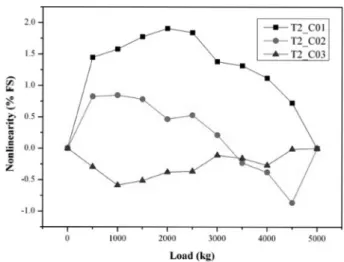
Another experiment for temperature characteristics was carried for comparing single tube structure and double tube structure. A single tube (T2_C01), a solid core tube (T2_C02) and a double tube structure (T2_C03) can be seen in Fig. 3.

D

H

4LW 2 L W  +  ---

=

P 2 S T   D SF  ---

⎝ ⎠

⎛ ⎞

=

Table 1. Material properties of a SUS304

Modulus of Elasticity (GPa) 193

Tensile strength (MPa) 520

Yield strength (MPa) 240

Compression strength (MPa) 210

Poisson’s ratio 0 0.285

Thermal expansion ( 

) 17.2 10

-6

Fig. 2. The cross-sectional view of hydraulic single-tubes.

Fig. 3. Hydraulic tubes; (a) Photos of tubes before welding and (b)

cross sectional view.

(3)

In the other experiment was performed for the temperature characteristics of the double-tube structure according to the pressure transfer medium including a lithium chloride (LiCl) [10].

Fig. 4. show a cross-sectional view of the double-tube structure and its photos.

3. RESULT

3.1 Single-tube structure

The same height and same thickness as the width of the other three types of tubes were prepared. Table 2 shows the dimensions of the single-tube structure.

The temperature sensitivity of the single-tube structure was investigated by increasing temperature from 10 to 60ºC in the chamber and the temperature characteristics of a single-tube structure can be seen in Fig. 5. Temperature dependence of pressure change is observed significantly in the tube due to the difference in the thermal expansion coefficient between the pressure transfer medium of a liquid and the metal structure of a solid. Temperature dependence of the pressure change in the single-tube could be reduced by increasing the ratio of the width and height (W/H) of the tube.

When the load from 0 to 5,000 kg is applied to a single-tube structure, the variation of the internal pressure of the tube was measured. The width of the tube increases, the nonlinearity of the hydraulic load cell becomes large, as shown in Fig. 6.

Large width of the single-tube is designed. That significantly reduce the temperature dependence but the non-linearity is increased, because the changes in the area of the loads caused by

the deformation from the internal pressure variation.

Nonlinearities of the single-tube structure originating from a change in the load area due to the internal pressure variation.

3.2 Comparison of a single-tube and a double-tube Table 3 shows the dimensions of the double-tube structure.

Fig. 4. Hydraulic double-tube structure.

Table 2. Single tube structure

Tube Width

(mm)

Height (mm)

Thickness (mm)

T2_C33 10 10 1.1

T2_C43 20 10 1.1

T2_C53 30 10 1.1

Fig. 5. The temperature characteristics of a single-tube structure according to the width of the tube.

Fig. 6. The nonlinearity of the single-tube structure according to the

width of tube.

(4)

Temperature increased from 10 to 60

o

C in the chamber under the same conditions.

The solid core tube (T2_C02) which has the small volume of the pressure transfer medium of large thermal expansion coefficient can be reduced the temperature dependence of the sensor. A double-tube structure (T2_C03) could be reduced by 46% in pressure changes according to temperature variations at 30ºC compared to a single-tube structure (T2_C01), as shown in Fig. 7.

In a double-tube structure, the temperature dependence of a sensor can be reduced because the pressure is absorbed by the deformation of the inner tube.

Also, the nonlinearity of the double-tube structure can be reduced by 67.19% at the same load condition, as shown in Fig. 8.

The temperature dependence of the hydraulic load cell also can be reduced by using solution of low thermal expansion coefficient.

LiCl is to lower the freezing point of water at the same time lowering the thermal expansion coefficient. Fig. 8 is shows temperature characteristics of the pressure transfer medium in double-tube structure (T2_04). Table 4 shows the dimensions of the T2_C04 tube. In addition, the LiCl aqueous solution of 20 wt% can be lower the freezing point of water to -44ºC.

4. CONCLUSION

A new type of hydraulic load cell for WIM sensor with a double-tube structure has been developed in order to reduce temperature sensitivity and to improve accuracy. The hydraulic element of the double-tube structure was made of the SUS304.

Therefore, the tube could have excellent corrosion-resistant, good tensile strength, and large thermal expansion coefficient. The double-tube structure shows the low temperature dependence, an Table 3. Various kinds of hydraulic tube

Tube W (mm) H (mm) T (mm)

T2_C01 Outer tube 15 15 1.5

T2_C02 Outer tube 15 15 1.5

Inner solid 10 10 10

T2_C03 Outer tube 15 15 1.5

Inner tube 10 10 0.9

Fig. 7. Temperature characteristics of various tube structures.

Fig. 8. Nonlinearities of various tube structure.

Table 4. Double-tube structure

Tube W (mm) H (mm) T (mm)

T2_C04 Outer tube 25 15 1.5

Inner solid 20 10 0.9

Fig. 9. Temperature characteristics of a pressure transfer medium

in a double tube structure.

(5)

excellent linearity and measurement accuracy from the results of the static load test. When using an aqueous solution of LiCl pressure transfer medium, the sensitivity of the temperature of a hydraulic tube also can be reduced. These characteristics are demonstrated the possibility of the new hydraulic load cell for WIM sensor.

ACKNOWLEDGEMENT

This research was supported by Kyungpook National University Research Fund, 2010.

REFERENCES

[1] American Society for Testing and Materials, Standard spec- ification for highway weigh-in-motion (WIM) systems with user requirements and test method, ASTM Int’l, E1318-02, pp. 1-16, 2004.

[2] Y. S. Moon, W. H. Son, J. U. Park, S. H. Kim, and S. Y.

Choi, “Hydraulic load cell with the double-tube structure for WIM sensor”, Conf. of the Korea Sensor Society, vol.

24, no. 1, p. 37, Seoul Korea, 2013.

[3] R Bushman and A. Pratt, “Weight-in-motion technology – economics and performance”, North American Travel Mon- itoring Exhibition an Conf., Charlotte, NC, 1998.

[4] P. Barsanescu, P. Carlesu, and D. M. Stefanescu, “A new weight-in-motion and traffic monitoring system”, IMEKO TC3, 2007.

[5] S. G. Lee, Y. S. Moon, W. H. Son, Y. H. Sohn, and S. Y.

Choi, “Silicon strain gauge load cell for weighting dis- drometer”, J. Sensor Sci. & Tech., vol. 22, no.5, pp. 321- 326, 2012.

[6] F. Ansari, J. Wang, “Rate sensitivity of high birefringent fiber optic sensors under large dynamic loads”, J. Lightw.

Technol., vol. 13, pp. 1992-1997, 1995.

[7] S. Yuan, F. Ansari, X. Liu, and Y. Zhao, “Optic fiber-based dynamic pressure sensor for WIM system”, Sens. Actuator A-Phys., vol. 120, pp. 53-58, 2005.

[8] F. Ansari and J. Wang, “Ratesensitivity of high birefringent fiber optic sensors under large dynamic loads”, J. Light- wave Technol., vol. 13, pp. 1992-1997, 1995.

[9] A. M. Lewis, “Measuring the hydraulic diameter of a pore or conduit”, Am. J. Bot., vol. 79, pp. 1158-1161, 1992.

[10] A. Melinder, “Thermophysical properties of aqueous solu-

tions used as secondary working fluids”, Royal Institute of

Technology, KTH Stockholm Sweden, 2007.

수치

Fig. 1. shows a schematic view of a WIM sensor. It is a hydraulic load cell with a double-tube structure
Fig. 2. shows a cross-sectional view of single-tube structures.
Fig. 4. show a cross-sectional view of the double-tube structure and its photos.
Fig. 7. Temperature characteristics of various tube structures.

참조

관련 문서

To visualize the vari- ation in various transport characteristics (the non-dimen- sional axial velocity and temperature distributions, pressure gradient, rate of heat

The liquid has a specific gravity of 1.60 and negligible vapor pressure. Calculate the flowrate for incipient cavitation in the 75 mm section, assuming that the tube flows

• Flow in the reservoir and central core of the tube: primary forces are pressure and gravity forces.. • Selective withdrawal: Colder water is withdrawn into the intake channel

The feature of the highest temperature is that temperature fluctuation is sharpest in the winter and spring when the change of barometer is big because of

_____ culture appears to be attractive (도시의) to the

Dependence of the chemical potentials of solid, liquid and gas phases on temperature at constant pressure.. The dashed lines are for

The index is calculated with the latest 5-year auction data of 400 selected Classic, Modern, and Contemporary Chinese painting artists from major auction houses..

1 John Owen, Justification by Faith Alone, in The Works of John Owen, ed. John Bolt, trans. Scott Clark, "Do This and Live: Christ's Active Obedience as the