Introduction
Abdominal bracing exercises (ABE) and abdominal hollowing exercises (AHE) are typical methods of neuromuscular rehabilitation for lumbar stabilization in clinical practice. Both methods have been used to ac- tivate the deep and surface muscles of spine-related structures, but their differences are not well understood. Lee and Kim (2015) reported that ABE were more effective than AHE at strengthening and
improving the function of the deep muscles of patients with low back pain. Jang (2016) reported that AHE were more effective than ABE on respiratory function in healthy adults in their 20s. In addition, Kim (2015) observed that AHE were more effective at improving trunk muscle strength and static balance ability in older patients with nonspecific chronic low back pain.
ABE stabilize the body by strengthening the spinal joint through the raising of abdominal pressure and Corresponding author: Seung-chul Chon [email protected]
This research was supported by Basic Science Research Program through the National Research Foundation of Korea (NRF) funded by the Ministry of Education (2017R1D1A3B03031876).
Comparison of the Effects of Abdominal Bracing Exercises and Abdominal Hollowing Exercises on Lumbar Flexibility and
Pulmonary Function in Healthy Adults
Kyung-bin Kim1, MSc, PT, Seung-chul Chon2, PhD, PT
1Dept. of Physical Therapy, The Graduate School, Konyang University
2Dept. of Physical Therapy, College of Medical Science, Konyang University
Abstract
1)Background: Abdominal bracing exercise (ABE) and abdominal hollowing exercise (AHE) improve the lumbar flexibility and pulmonary function in various patients, yet the efficacy of ABE or AHE have not yet been evaluated.
Objects: The purpose of this study was to compare the lumbar flexibility and pulmonary function during both ABE and AHE in healthy adults.
Methods: The study included 40 healthy adults, who were randomly divided into the experimental group and control group, each with 20 subjects. All subjects performed ABE (experimental group) and AHE (control group). The lumbar flexibility such as trunk flexion test (sitting and standing position) and schober test and pulmonary function such as the spirometer including forced vital capacity (FVC) and force expiratory volume in one second (FEV1) and chest circumference measurement (middle and lower chest) were measured, respectively. Two-way repeated analysis of variance was used to compare the lumbar flexibility and pulmonary function, respectively.
Results: No significant effects of lumbar flexibility were observed on trunk flexion test from the sitting position (P=.478) and standing position (P=.096) in the ABE than in the AHE. However, the length of ABE was longer significantly than it of AHE (P=.024). No significant effects of lung function were observed on the FVC (P=.410) and FEV1 (P=.072) in the ABE group than in the AHE group. And also, no significant effects of chest circumference measurement were observed on the inspiration (P=.468) and expiration (P=.563) in middle chest circumference and inspiration (P=.104) and expiration (P=.346) in lower chest circumference.
Conclusion: This study indicated that the ABE is only more effective in lumbar flexibility by lumbar length difference than AHE in healthy adults.
Key Words: Abdominal bracing; Abdominal hollowing; Lumbar flexibility; Pulmonary function.
coordination of both the deep and superficial muscles (McGill, 2001), giving them the advantage of simul- taneously shrinking both slow twitch fiber and fast twitch fiber muscles (Kim, 2015). This technique makes the abdominal muscle tight by reflexively pushing the whole abdominal muscle when someone tries to hit the abdomen. It tightens and fixes the lumbar joint and thoracolumbar fascia by increasing abdominal pressure and the stability of the lumbo- pelvis (McGill, 2001).
AHE are frequently used to improve the stability of the lumbar spine through neuromuscular re- education of the transverse abdominalis and internal oblique muscles (Macedo et al, 2009). These exercises involve selectively contracting muscles made of slow twitch fibers (Kisner and Colby, 2002). They are also effective at stabilizing the transverse abdominalis and multifidus muscles (Kisner and Colby, 2002). This method increases intra-abdominal pressure by pulling the abdomen inward, without any movement of the spine, and reducing lumbar lordosis (Hodges and Richardson, 1999; Kisner and Colby, 2002).
Slow twitch fibers organize primarily the local muscle system of the deep muscle layer. These mus- cles are shorter in length and are appropriate for con- trolling intersegmental motion and responding to alter- ation in posture and external loads. Key local muscles are included in transverse abdominalis, multifidus, in- ternal oblique, deep transversospinalis, and the pelvic floor muscles (Hodges and Richardson, 1999; Kisner and Colby, 2002). On the other hand, fast twitch fi- bers comprise the global muscle system of the super- ficial muscle layer. These muscles are long and have large lever arms, allowing them to produce plenty of torque and gross movements. Key global muscles are included in rectus abdominis, external oblique, erector spinalis, and quadratus lumborum (Hodges and Richardson, 1999; McGill, 2001).
Spinal stabilization exercises such as ABE and AHE have been reported to be closely related to thor- acolumbar flexibility as well as stability of the trunk (Hodges and Richardson, 1999). Kibler et al (2006) re-
ported a high correlation between the stability and flexibility of the lumbar spine, particularly, emphasized the importance of lumbar flexibility. Hodges et al (2007) reported that the non-contraction force between the transverse abdominalis and multifidus muscles may result in lumbar instability associated with pain.
Bø et al (2009) reported that there is a strong corre- lation between lumbar flexibility and back pain.
Although the ABE and AHE are positive for the sta- bility and flexibility of the spine, the study of the dif- ferences between the two exercises is not sufficient.
The movement involved with respiration improves exercise performance related to respiration by nor- malizing the diaphragm and increasing the movement of the chest wall (Troosters et al, 2005). The respi- ratory muscles are divided into the inspiratory mus- cle group, including the diaphragm and the outer in- tercostalis, and the expiratory muscle group, includ- ing the rectus abdominalis, transverse abdominalis, and inner intercostalis. These respiratory muscles can enhance pulmonary function by causing con- traction and expansion of the lungs through strong contractile forces during deep breathing (Kilding et al, 2010; Klimathianaki et al, 2011). Therefore, deep breathing should be preceded for training the respi- ratory muscles (Troosters et al, 2005). Pulmonary function tests are the most commonly used method of respiratory movement (Choi et al, 2016).
Representative indices of the pulmonary function test are forced vital capacity (FVC) and forced expiratory volume in one second (FEV1).
Although ABE and AHE studies have reported im- provement in respiratory muscle function and pain control in various subjects, there are few studies re- lated to problems with flexibility of the lumbar spine and pulmonary function are very limited, particularly, comparative studies both ABE and AHE are still lacking. In addition, the comparison of the two ex- ercise methods is important because the two exercise methods are often used and similar in clinical practice.
Therefore, this study aims to compare the effects of ABE and AHE on the flexibility of the lumbar spine
and pulmonary function in healthy adults.
Methods
Subjects
This study was based on a two-group pre- test/posttest design. Forty healthy adults were ran- domly assigned to the experimental group, comprising 20 subjects who were prescribed ABE, or the control group, consisting of 20 subjects who were prescribed AHE. All the procedures were explained to the sub- jects, and each subject signed an informed consent form. The university Institutional Review Board ap- proved this research (approval number: 2017-035).
The criteria for selection were 1) no history of respi- ration or circulation problems, 2) no abnormal breath- ing capacity, 3) no hypertension, 4) no heart disease, including arrhythmia, 5) no history of cardiovascular or cardiopulmonary disease, and 5) no orthopedic disease. Table 1 shows the general characteristics of the study subjects. All subjects underwent spinal flexibility tests, including the trunk flexion test and Schober test, and pulmonary function tests, including the pulmonary capacity test and chest circumference test, both before and after the intervention.
Interventions
Abdominal bracing exercise (ABE)
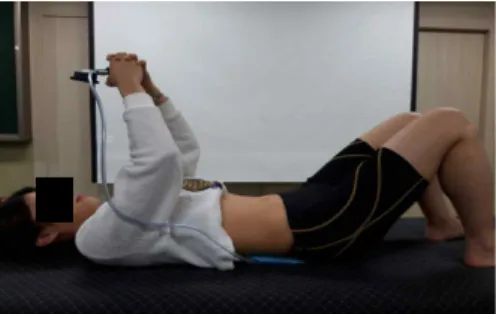
Subjects were trained for 30 minutes on how to perform ABE. The legs were placed in the neu- tral-spine position, with the feet shoulder-width apart, 45° in the hip joint and 90° in the knee joint, in supine hook-lying position (Park et al, 2010). Subjects
were instructed to maximally activate the abdominals without hollowing the lower abdomen. ABE consists of simply tensing (contracting) the abdomen as if the subject is about to be hit in the stomach. The abdo- men will automatically pull the stomach in slightly, but the exercise does not involve pulling in or push- ing out the abdomen. ABE activate all layers of the abdominal muscles along with the deep muscles in the low back. The pressure biofeedback unit (PBU) was located under the lumbar spine area was set 70 ㎜Hg (Hodges and Richardson, 1999) (Figure 1).
Abdominal hollowing exercise (AHE)
Subjects were trained for 30 minutes on how to perform AHE. The legs were widened to shoulder width, 45° in the hip joint and 90° in the knee joint, in supine hook-lying position (Park et al, 2010).
Subjects were instructed to draw the navel in max- imally, in the lower area of the stomach, toward the spine. This activates the deep abdominal muscles but requires very little activation of the superficial ab- dominal muscles. In order to maintain the neutral curvature of the lumbar spine, the subjects were in- structed to pull the navel upward and backward so that the lower abdomen could enter, and the PBU was placed under the lumbar vertebra was increased from 10 ㎜Hg to 60 ㎜Hg (Critchiey, 2002; Hodges and Richardson, 1999) (Figure 2).
Instruments
Lumbar flexibility test
This test measured the range of motion of trunk flexion in both the sitting and standing positions. In the standing position, the subject was placed on a ABEa group (n1=20) AHEb group (n2=20) t p (two-tailed)
Gender (male/female) 4/16 5/15
Age (year) 21.0±1.8c 20.3±.9 .530 .132
Height (㎝) 164.5±8.4 164.7±8.9 -.030 .971
Weight (㎏) 57.4±10.0 60.4±11.2 -.900 .362
aabdominal bracing exercise, babdominal hollowing exercise, cmean±standard deviations.
Table 1. General characteristics of subjects (N=40)
stepbox measuring 35 ㎝ in height to allow the spine to bend forward as far as possible. In the sitting po- sition, attach a pair of feet to the test plate and bend the trunk as far as possible with the knee extended.
The distance between the foot and the middle finger was measured three times before and after the intervention. This test has a high reliability of .97.
Schober test
The Schober test was performed to measure the range of motion of the lumbar spine. The subject’s fifth lumbar vertebra was marked with a black pen in the standing position, and then marked upwards 10 ㎝. The distance between two points was meas- ured when the subject’s trunk was flexed as far as possible in the standing posture. The greater the dif- ference in length between the points, the higher the flexibility (Consmüller et al, 2012).
Pulmonary capacity test
A spirometer (Spirobank G, Medical International Research, Rome, Italy) and software system (Winspiro PRO, Medical International Research, Rome, Italy) were used for the pulmonary capacity test.
The subjects were asked to measure FVC and FEV1
three successive times, with the knee and hip joints flexed 90° in a sitting position. Only the maximum value was used (Engel et al, 2007).
Chest circumference length test
Chest circumference was measured to evaluate the movement of the chest during inspiration and expira- tion, respectively. The middle and lower circum-
ferential lengths of the chest were measured with a tape measure, with the subject in a sitting position.
The middle thoracic circumference length was meas- ured in parallel by connecting the tenth thoracic spi- nous process and the xiphoid process (Bockenhauer et al, 2007), and the lower thoracic circumference length was measured by connecting the center line of both axes and the intersection of the twelfth ribs (Shim et al, 2002). The middle and lower chest cir- cumference length was measured three times, and the mean value was used.
Statistical analysis
The data were analyzed using SPSS version 18.0 (SPSS Inc., Chicago, IL., USA). All variables were tested using the Kolmogorov-Smirnov test, which showed a nor- mal distribution of the data. An independent t-test was used to determine significant differences in the general characteristics of the subjects between the two groups.
Two-way analysis of variance with repeated measures was used to assess the main effects (group and time ef- fects) and interaction effects of lumbar flexibility, the Schober and pulmonary capacity tests, and chest circum- ference in the two groups. The significance level was set at p-value of <.05.
Results
Lumbar flexibility
No significant main effect (F=2.323, p=.136) or inter- action effect (F=.514, p=.478) was found for the trunk flexion test in the sitting position between the groups.
Figure 1. Abdominal bracing exercise. Figure 2. Abdominal hollowing exercise.
However, a significant time main effect (F=35.891, p=.001) was found for the trunk flexion test in the sit- ting position (Table 2). There was no significant group main effect (F=2.703, p=.108) or interaction effect (F=2.918, p=.096) for the trunk flexion test in the standing position. On the other hand, there was a sig- nificant time main effect (F=47.217, p=.001) for the trunk flexion test in the standing position (Table 2).
There was a significant group main effect (F=4.279, p=.045), time main effect (F=35.891, p=.001), and interaction effect (F=5.504, p=.024) for the Schober test (Table 3).
Pulmonary function
No significant group main effect (F=.227, p=.636), time main effect (F=3.163, p=.083), or interaction ef- fect (F=.694, p=.410) was found for the FVC in the
pulmonary capacity test (Table 4), nor was any sig- nificant group main effect (F=2.121, p=.154) or inter- action effect (F=3.419, p=.072) found for the FVC1 in the pulmonary capacity test. However, a significant time main effect (F=5.558, p=.042) was found for the FVC1 in the pulmonary capacity test (Table 4).
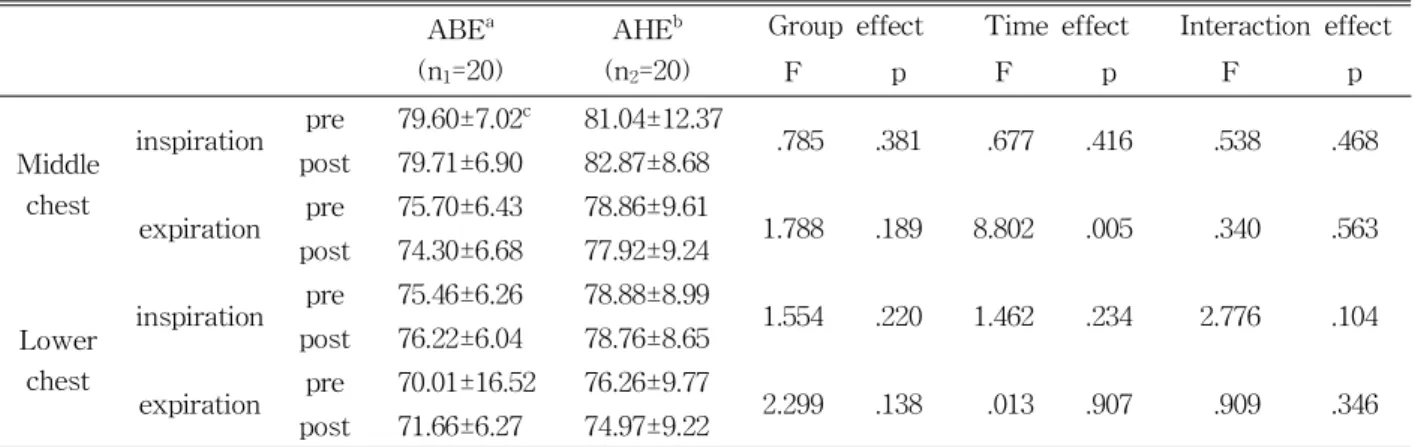
No significant group main effect (F=.785, p=.381), time main effect (F=.677, p=.416), or interaction effect (F=.538, p=.468) was found in the chest circumference length test of the inspiration of the middle chest (Table 5), nor was any significant group main effect (F=1.788, p=.189) or interaction effect (F=.340, p=.563) found in the chest circumference length test of the expiration of the middle chest. However, a significant time main effect (F=8.802, p=.005) was found with re- spect to the chest circumference length test of the expiration of the middle chest (Table 5). No sig- ABEa (n1=20) AHEb (n2=20) Group effect Time effect Interaction effect
F(1,38) p F(1,38) p F(1,38) p
Sitting pre 8.40±10.01c 12.67±7.44
2.323 .136 35.891 .001 .514 .478
post 11.81±8.57 15.36±6.65 Standing pre 5.52±10.72 10.92±7.77
2.703 .108 47.217 .001 2.918 .096
post 9.43±9.28 13.27±7.97
aabdominal bracing exercise, babdominal hollowing exercise, cmean±standard deviations.
Table 2. Comparison of trunk flexion test
ABEa (n1=20) AHEb (n2=20) Group effect Time effect Interaction effect
F(1,38) p F(1,38) p F(1,38) p
Pre 13.72±1.33c 14.60±0.95
4.279 .045 53.073 .001 5.504 .024
Post 14.70±0.87 15.10±0.88
aabdominal bracing exercise, babdominal hollowing exercise, cmean±standard deviations.
Table 3. Comparisons of Schober test
ABEa (n1=20) AHEb (n2=20) Group effect Time effect Interaction effect
F(1,38) p F(1,38) p F(1,38) p
FVCc pre 3.27±.88d 3.34±1.26
.227 .636 3.163 .083 .694 .410
post 3.38±1.01 3.65±1.50 FEV1e pre 1.36±.65 2.82±3.90
2.121 .154 5.558 .024 3.419 .072
post 1.76±.78 2.86±3.88
aabdominal bracing exercise, babdominal hollowing exercise, cforced expiratory vital capacity, dmean±standard deviation,
eforced expiratory volume in one second.
Table 4. Comparison of pulmonary capacity test
nificant group main effect (F=1.554, p=.220), time main effect (F=1.462, p=.234), or interaction effect (F=2.776, p=.104) was found with respect to the chest circum- ference length test of the inspiration of the lower chest (Table 5). Finally, no significant group main ef- fect (F=2.299, p=.138), time main effect (F=.013, p=.907), or interaction effect (F=.346, p=.909) was found with respect to the chest circumference length test of the expiration of the lower chest (Table 5).
Discussion
The purpose of this study was to compare the ef- fects of ABE and AHE on lumbar flexibility and pul- monary function using quantitative assessment tools.
The results demonstrate that ABE were more effective than AHE in terms of the comparison of lumbar flexi- bility through the Schober test method, but no differ- ence was detected between the two exercise groups in terms of lumbar flexibility by the trunk flexion test, the pulmonary function test using a spirometer, or the chest circumference test. The data, therefore, show that ABE are significantly more effective at improving lumbar flexibility as measured by the Schober test.
Intervention-related changes in altered lumbar flexi- bility and pulmonary function were successfully quan- tified by tape measure and spirometer.
Differences in lumbar flexibility measurements in
the standing and sitting positions were not statisti- cally significant, but the Schober test in the standing position showed that ABE increased flexibility by 1.0
㎝ (from 13.7 ㎝ to 14.7 ㎝) and AHE by .5 ㎝ (from 14.6 ㎝ to 15.1 ㎝), indicating that ABE were more effective. These results suggest that of the ABE is more trunk bended by increasing the ex- pansion of the abdominal muscles, which are the pri- mary muscles involved in trunk flexion. Above all, the reason for the significant results in Schober test only is because the ABE and AHE methods are cen- tered on the abdomen and lumbar spine, and also, it is measured more intensely of the lumbar spine area than lumbar flexibility test, which measures the overall flexibility of the spine.
McGill (2001) reported that lumbar flexibility was increased because ABE improved intra-abdominal pressure and pelvic floor muscle strength through the coordinated contraction of the deep and surface mus- cles of the trunk. On the other hand, McGill and Karpowicz (2009) observed that selective strengthen- ing exercises such as AHE could reduce the stability of the lumbar spine. For their part, Koumantakis et al (2005) emphasized the balance and strength of the overall abdominal muscle because the selective acti- vation of the transverse abdominal muscle may re- duce the efficiency of trunk stability and flexibility.
Further, Bø et al (2009) suggested that ABE are more effective at lumbar stabilization because they
ABEa
(n1=20)
AHEb (n2=20)
Group effect Time effect Interaction effect
F p F p F p
Middle chest
inspiration pre 79.60±7.02c 81.04±12.37
.785 .381 .677 .416 .538 .468
post 79.71±6.90 82.87±8.68 expiration pre 75.70±6.43 78.86±9.61
1.788 .189 8.802 .005 .340 .563 post 74.30±6.68 77.92±9.24
Lower chest
inspiration pre 75.46±6.26 78.88±8.99
1.554 .220 1.462 .234 2.776 .104 post 76.22±6.04 78.76±8.65
expiration pre 70.01±16.52 76.26±9.77
2.299 .138 .013 .907 .909 .346
post 71.66±6.27 74.97±9.22
aabdominal bracing exercise, babdominal hollowing exercise, cmean±standard deviation.
Table 5. Comparison of chest circumference length test
improve intra-abdominal pressure in conjunction with the internal oblique and pelvic floor muscles as well as the transverse abdominal and multifidus muscles.
Therefore, it appears that, in this study, ABE in- creased lumbar flexibility better than AHE by im- proving the mutual contractility of the deep muscles, such as the transverse abdominalis and multifidus.
No statistically significant difference was found be- tween the two groups in terms of the FVC and FEV1
pulmonary function measurements, but there was a significant difference in the time effects of FVC and FEV1. FVC and FEV1 are representative measures of pulmonary function, with the rectus abdominal and external oblique muscles working together with the prime muscle at the time of exhalation, together with the transverse abdominal muscle enhanced by the lumbar stabilization effect (Choi et al, 2016;
Klimathianaki et al, 2011). FVC is the volume of air that is measured when a breath is exhaled as quickly as possible, and FEV1 is the maximum amount of air expired per second. In related fashion, Koopers et al (2006) reported that breathing intensification training was positive for improving endurance and quality of life, while McConnell and Romer (2004) reported that aerobic capacity training using feedback breathing equipment aids lung function in healthy adults. In the present study, no significant difference between the two exercise groups was found. However, in spite of the short intervention period, each exercise type tended to be positively related to pulmonary function through the increase of FEV1.
No statistically significant difference was found in the middle and lower thoracic circumference lengths of the two exercise groups, but there was a sig- nificant difference in the time main effect of the measurement of the middle thoracic circumference length. It is possible that ABE may affect the middle thoracic circumference length more than AHE due to the increase of abdominal contractibility. This meas- urement of chest circumference can be easily used by quantifying the changes in the pulmonary function measurements FVC and FEV1 in the clinical field.
This result is supported by Fregonezi et al (2005), who reported that diaphragm respiratory movement increased the mobilization of the thoracic vertebrae and lung volume in patients with myasthenia gravis.
Likewise, Troosters et al (2005) suggested that trunk stabilization exercises through abdominal deep breath- ing may improve the overall volume of pulmonary function related to the chest muscles.
In this study, it was found that ABE, through the lumbar stabilization associated with neuromuscular control, was partially beneficial to lumbar flexibility and pulmonary function more than AHE. In a clinical setting, it has been reported that there is a practical difficulty involved with AHE selectively enhancing the transverse abdominalis muscle in patients with low back pain (Kahlaee et al, 2017). To compensate for this problem, a method has been introduced to improve the operability of the diaphragm (Park et al, 2010). However, this study has the following limitations. First, we measured the initial effect as a short-term comparative study. Second, the experi- ment included only healthy adults. Third, only partial effects of lumbar flexibility and pulmonary function were measured. Therefore, in future studies, it will be necessary to apply various measurements to the subjects over a longer-term intervention period.
Conclusion
This study compares the effects of ABE and AHE using quantitative lumbar flexibility assessments and pulmonary function testing with a spirometer. The results demonstrated that ABE were more effective than AHE, as measured by the Schober test, meas- ured more intensely of the lumbar spine area.
However, no difference between the two exercise groups was found when using the other lumbar flex- ibility and pulmonary function tests. This study sug- gests that ABE training for the general abdominal muscles may be helpful for lumbar flexibility versus AHE for emphasizing the selective strengthening of
the transverse abdominalis.
References
Bockenhauer SE, Chen H, Julliard KN, et al. Measuring thoracic excursion: Reliability of the cloth tape measure technique. J Am Osteopath Assoc.
2007;107(5):191-196.
Bø K, Mørkved S, Frawley H, et al. Evidence for benefit of transversus abdominis training alone or in combination with pelvic floor muscle training to treat female urinary incontinence: A systematic review. Neurourol Urodyn. 2009;28(5):368-373.
http://doi.org/10.1002/nau.20700
Choi JY, Rha DW, Park ES. Change in Pulmonary Function after Incentive Spirometer Exercise in Children with Spastic Cerebral Palsy: A Randomized Controlled Study. Yonsei Med J. 2016;
57(3):769-775. http://doi.org/10.3349/ymj.2016.57.3.769 Consmüller T, Rohlmann A, Weinland D, et al.
Comparative evaluation of a novel measurement tool to assess lumbar spine posture and range of motion. Eur Spine J. 2012;21(11):2170-2180.
http://doi. org/10.1007/s00586-012-2312-1
Engel RM, Vemulpad S. The effect of combining manual therapy with exercise on the respiratory function of normal individuals: A randomized control trial. J Manipulative Physiol Ther.
2007;30(7):509-513.
Fregonezi GA, Resqueti VR, Güell R, et al. Effects of 8-week, interval-based inspiratory muscle train- ing and breathing retraining in patients with generalized myasthenia gravis. Chest. 2005;128(3):
1524-1530.
Hodges PW, Richardson CA. Transversus abdominis and the superficial abdominal muscles are con- trolled independently in a postural task. Neurosci Lett. 1999;265(2):91-94.
Hodges PW, Sapsford R, Pengel LH. Postural and respiratory functions of the pelvic floor muscles.
Neurourol Urodyn. 2007;26(3):362-371.
Jang HR. The effect of abdominal bracing and ab- dominal hollowing technique on the respiratory function of adults in their 20s. Daegu, Daegu university, Master Thesis. 2016.
Kahlaee AH, Ghamkhar L, Arab AM. Effect of the abdominal hollowing and bracing maneuvers on activity pattern of the lumbopelvic muscles dur- ing prone hip extension in subjects with or with- out chronic low back pain: A preliminary study.
J Manipulative Physiol Ther. 2017;40(2):106-117.
http://doi.org/10.1016/j.jmpt.2016.10.009
Kibler WB, Press J, Sciascia A. The role of core stability in athletic function. Sports Med.
2006;36(3):189-198.
Kilding AE, Brown S, McConnell AK. Inspiratory muscle training improves 100 and 200 m swim- ming performance. Eur J Appl Physiol. 2010;108(3):
505-511. http://doi.org/10.1007/s00421-009-1228-x Kim MS. The comparison of effects for hollowing and bracing strategy with spinal stabilization exercise for trunk strength, static balance and low back disability to the elderly women with non-specific chronic low back pain. Seoul, Korea university, Master Thesis. 2015.
Kisner C, Colby LA. Therapeutic Exercise:
Foundations and techniques. 4th ed, Philadelphia, F.A. Devis CO., 2002:657-659.
Klimathianaki M, Vaporidi K, Georgopoulos D.
Respiratory muscle dysfunction in COPD: From muscles to cell. Curr Drug Targets. 2011;12(4):
478-488.
Koumantakis GA, Watson PJ, Oldham JA. Trunk muscle stabilization training plus general ex- ercise versus general exercise only: Randomized controlled trial of patients with recurrent low back pain. Phys Ther. 2005;85(3):209-225.
Lee HJ, Kim SY. Comparison of the effects of ab- dominal draw-in and expansion maneuvers on trunk stabilization in patients with low back pain and lumbar spine instability. Phys Ther Korea. 2015;22(1):37-48.
Macedo LG, Maher CG, Latimer J, et al. Motor con-
trol exercise for persistent, nonspecific low back pain: A systematic review. Phys Ther. 2009;
89(1):9-25. http://doi.org/10.2522/ptj.20080103 McConnell AK, Romer LM. Respiratory muscle train-
ing in healthy humans: resolving the controversy.
Int J Sports Med. 2004;25(4):284-293.
McGill SM, Karpowicz A. Exercises for spine stabili- zation: Motion/motor patterns, stability pro- gressions, and clinical technique. Arch Phys Med Rehabil. 2009;90(1):118-126. http://doi.org/10.1016/
j.apmr.2008.06.026
McGill SM. Low back stability: From formal descrip- tion to issues for performance and rehabilitation.
Exerc Sport Sci Rev. 2001;29(1):26-31.
Park KN, Kwon OY, Kim SH, et al. Effects of soft tissue massage of the posterior deltoid muscle
on shoulder horizontal adduction. Phys Ther Kor. 2010;17(4):35-40.
Shim JH, Oh DW, Lee GW. The effects of thoracic flexibility exercise on vital capacity and chest expansion in patients with idiopathic scoliosis.
Phys Ther Korea. 2002;9(2):145-156.
Troosters T, Casaburi R, Gosselink R, et al.
Pulmonary rehabilitation in chronic obstructive pulmonary disease. Am J Respir Crit Care Med.
2005;172(1):19-38.
This article was received October 10, 2017, was reviewed October 10, 2017, and was accepted November 13, 2017.