The Relationship among Coaches' Transformational Leadership, Exercise Flow, and Repurchase Intention in Sports Centers
Chul-Ho Bum
1*, Stephen H. Shin
21Department of Golf Industry, Kyung Hee University
2Department of Sport Science, Belmont University
스포츠센터 지도자의 변혁적 리더십과 운동 몰입 및 재구매 의도의 관계
범철호1*, 슈테판 신2
1경희대학교 골프산업학과, 2벨몬트 대학교 스포츠 과학과
Abstract This study empirically analyzed the effects of coaches' transformational leadership on customers' exercise flow and repurchase behavior. Using two hundred seventy-five questionnaires, first, charisma, individual consideration, and intellectual stimulation had a positive effect on cognitive and behavioral flow. Second, only individual consideration increased repurchase intention. Third, cognitive flow promoted repurchase intention, but behavioral flow was not statistically significant. Lastly, there was no indirect effect on the relationship among the variables. The results may prove valuable to coaches' understanding how to enhance customers' exercise flow and may improve marketers’ strategic planning decisions to attain organizational goals.
요 약 본 연구는 변혁적 리더십이 회원의 운동 몰입과 재구매 의도에 미치는 영향을 분석하였다. 수집한 설문지 275부를 이용한 결과는 다음과 같이 도출되었다. 첫째, 카리스마, 개인적 배려 및 지적자극은 인지 몰입과 행위 몰입에 긍정적인 영향 을 미치는 것으로 나타났다. 둘째, 개인적 배려만이 재구매 의도에 긍정적인 영향을 미치는 것으로 나타났다. 셋째, 인지 몰입 은 재구매 의도에 긍정적인 영향을 미치는 것으로 나타났으나, 행위 몰입은 유의한 영향이 미치지 않는 것으로 나타났다.
마지막으로 지도자의 변혁적 리더십, 운동 몰입 및 재구매 의도 간의 간접효과는 없는 것으로 나타났다. 이러한 결과는 지도 자에게 고객들의 운동 몰입을 높이기 위한 이해를 돕는데 가치가 있으며, 마케터에게는 조직의 목표를 달성하기 위해 전략적 인 계획을 세우는 데 도움이 될 것이다.
Keywords : Exercise Flow, Repurchase Intention, Sports Centers, Transformational Leadership
*Corresponding Author : Chul-Ho Bum(Kyung Hee Univ.) Tel: +82-31-201-2700 email: [email protected] Received May 26, 2015
Accepted September 11, 2015
Revised (1st August 11, 2015, 2nd August 20, 2015) Published September 30, 2015
1. Introduction
1.1 Need for the Study
As the world has become highly industrialized, the emergence of high-tech machinery along with the development of scientific techniques provides for a more contemporary society, but it may be undeniable
that such machinery reduces the physical activity of human beings and brings about negative effects, such as various adult diseases[1]. Given this situation, an increasing number of people are desiring the improvement of physical strength and energy through exercise in sports centers, as well as enhanced health.
Generally, a sports center provides facilities and
spaces to its members for them to participate in exercises to relieve stress, promote heath, and interact with other members in a local community[2]. Even though many sports centers have been operated to provide facilities for consumers, they are financially struggling due to decreasing memberships caused by an ineffective strategic management[3]. In the circumstances, having qualified coaches would be one of the important factors affecting the financial growth of sports centers, if coaches are able to offer good instruction and coaching to their clients[4].
Leadership has a great influence on a person or an organization; leaders’ effective behavior is regarded as an important element for the attainment of a goal[5,6].
Specifically, transformational leadership is one of the theories frequently appearing in studies about the effectiveness of leaders’ behavior[7]. The terminology was used first by Burns and Bass who defined the theory in the mid 1980s[8,9]. Transformational leaders present a vision, share ideas with followers, and help them achieve organizational goals[10]. This transformational leadership can also be applied to the domain of sport[11].
Csikszentmihalyi[12] argued that "flow is the state in which people are so involved in an activity that nothing else seems to matter" (p. 4). This flow is achieved when playing in various sports or recreational activities, not common in our ordinary and daily life[13].
Repurchase intention is defined as the consumer's positive response affected by a combination of service quality offered by a service provider and customer satisfaction towards the services provided[14]. In addition, Patterson and Spreng[15] pointed out that in post-purchase situations, customers already experienced services provided, they rather rely on the intrinsic self-evaluation based on their own satisfaction/
dissatisfaction than influences by extrinsic motivations such as price, brand and store image, and market communication.
Previous studies of transformational leadership have
mostly focused on finding the relation with job performance in an organization. However, there are still few studies on the effects of coaches’ leadership on customers in sports. Thus, this study empirically analyzed the effects of coaches’ transformational leadership on sports center members’ exercise flow and repurchase behavior. So, it may provide meaningful results necessary for sports managers and marketers to improve their strategic planning decisions which are significant in predicting customers' purchasing behavior and satisfying their desires as well as attaining organizational goals.
1.2 Research hypothesis
1.2.1 The relationship between transformational leadership & exercise flow
The leadership behavior of a coach is significantly related to exercise flow in sports. It was reported that individual consideration and inspiration are important variables in predicting exercise flow in a study of coaches' transformational leadership targeting high-school Taekwondo athletes[16]. In a study of Taekwondo trainees in the United States, their transformational leadership increases exercise flow[17].
Therefore, the hypothesis is as follows:
H1: The transformational leadership of a coach in a sports center has a positive influence on exercise flow.
1.2.2 The relationship between transformational leadership & repurchase intention It was found that leadership behavior is also linked to consumer behavior. It was found that encouragement and charisma, sub-factors of the transformational leadership of sports center coaches, increase customers’
repurchase intention[18]. Furthermore, it was found that the idealized effects (traits), inspirational behaviors, and individual consideration of transformational leadership in the Taekwondo studio have a significant effect on the repurchase intention of trainees[19]. Therefore, the hypothesis is as follows:
Category Frequency Percent
Gender Male 107 38.9
Female 168 61.1
Age group
20-29 69 24.7
30-39 54 19.6
40-49 89 32.4
Over 50 63 23.3
Participation frequency per-week
1-2 80 29.1
3-4 114 41.5
5-6 52 18.9
7 29 10.5
Total 275 100
Table 1. The demographic characteristics of participants H2: The transformational leadership of a coach in a sport center has a positive influence on repurchase intention.
1.2.3 Exercise flow & repurchase intention Flow, in particular, has been recognized as an important factor in predicting customers’ purchasing behavior. It was found that faith and flow to a sports center are important antecedent variables in predicting customers’ repurchase intention[20]. In a study of consumers’ participation in leisure sports, both cognitive flow and behavioral flow have a positive effect on the repurchase intention, as the result variable[21]. Thus, the hypothesis is as follows:
H3: Exercise flow has a positive influence on repurchase intention.
2. Methods
2.1 Data collection & participants
Participants at five sports centers in Seoul were selected as the research participants in this study.
Through convenient sampling, 297 questionnaires were collected. The researcher met with the coaches of the sports centers in person to ask for their understanding and explain the purpose of this study. Participants completed the questionnaire by self-administration.
Two hundred seventy-five questionnaires were used for the analysis, after excluding 22 questionnaires whose answers were not sincere.
2.2 Instruments
To verify the validity of the measurement instrument, an exploratory factor analysis (EFA) was used along with principal component analysis. Factor rotation was conducted through varimax. In addition, the questions whose factor loadings were under 0.4 were excluded from analysis. Internal consistency was measured through Cronbach’s alpha coefficient (i.e., reliability analysis). All questions comprised of five points on a Likert scale: 1=“not at all” and 5 =“very much so.” The questionnaire was composed of 27 items of transformational leadership, 11 items of flow, and 5 items of repurchase intention.
Items 1 2 3 噓
Consideration11 .726 .170 .101
.890 Consideration10 .726 .160 .045
Consideration 1 .703 .123 -.044 Consideration 5 .698 .080 .155 Consideration 9 .698 .134 .058 Consideration 2 .690 .271 .057 Consideration 8 .677 .172 .103 Consideration 6 .644 .072 -.005 Consideration 3 .638 .205 -.059 Consideration 7 .616 .257 .049 Consideration 4 .573 .175 .049
Charisma 9 .114 .702 .146
.874
Charisma 10 .188 .680 .116
Charisma 8 .185 .670 .112
Charisma 4 .088 .669 .026
Charisma 6 .163 .665 .119
Charisma11 .176 .662 .143
Charisma 2 .263 .661 .155
Charisma 7 .166 .638 .103
Charisma 5 .132 .632 .144
Charisma 1 .004 .608 .007
Stimulation 1 .082 .070 .756
.783 Stimulation 2 .045 .055 .743
Stimulation 3 -.098 .189 .721 Stimulation 4 .072 .227 .720 Stimulation 5 .241 .203 .623 eigenvalue 5.332 4.745 2.750 variance% 20.507 18.250 10.578 cumulative% 20.507 38.757 49.335
Table 2. The validity & reliability of transformational leadership
Items 1 2 3 噓 Cognitive flow 6 .757 .234 .143
.895 Cognitive flow 7 .748 .257 .194
Cognitive flow 4 .741 .176 .322 Cognitive flow 1 .706 .307 .179 Cognitive flow 5 .688 .161 .328 Cognitive flow 2 .674 .251 .192 Cognitive flow 3 .649 .240 .299 Repurchase 4 .251 .790 .153
.841 Repurchase 2 .154 .756 .175
Repurchase 3 .248 .743 .214 Repurchase 5 .218 .664 .201 Repurchase 1 .310 .658 .159 Behavioral flow 3 .305 .183 .745 Behavioral flow 4 .269 .160 .745 .772 Behavioral flow 2 .170 .259 .703 Behavioral flow 1 .394 .254 .519
eigenvalue 4.169 3.203 2.468
variance% 26.057 20.018 15.247 cumulative% 26.057 46.075 61.503
Table 3. The validity & reliability of exercise flow and repurchase intention
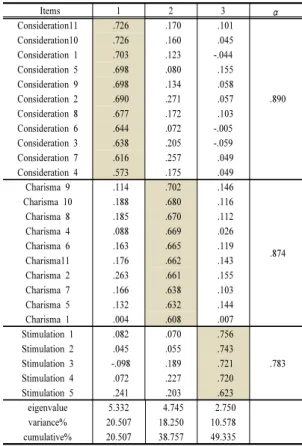
To measure the coaches’ transformational leadership in the sports centers, a widely used measurement instrument, developed by Wright[22], and then translated by Kim and Kim[23] for domestic contexts, was used. The following Table 2 shows the results of the analysis, except for a question about charisma that does not meet the standard factor load value of 0.4.
In previous studies, transformational leadership was extracted into three sub-factors: charisma, individual consideration, and intellectual stimulation. It was found that cumulative variance was about 49.335%. The eigenvalues ranged from 2.750 to 5.332 (i.e., higher than 1.0). The alpha values were .890, .874, and .783, respectively, which means there was no significant problem with the instrument in this study.
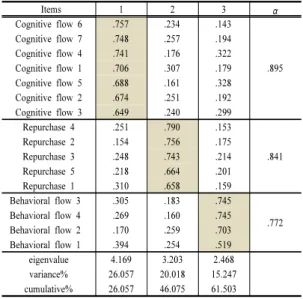
The Expansion of the Sport Commitment Model (ESCM), developed by Scanlan, Carpenter, Schmidt, and Simons[24] and translated by Jung[25] was used to measure exercise flow in this study. To measure members' repurchase intention, an measurement instrument frequently used in previous studies and reorganized by Park[26] was used. As a result of EFA, three factors, such as cognitive flow, behavioral flow, and repurchase behavior were extracted. The two
factors were explained for the mediating variable, and the repurchase behavior was explained for the dependent variable. The cumulative variance was 61.503%, and all eigenvalues were over 1.0.
Cronbach’s alpha coefficients were from .772 to .895 in the current study.
2.3 Statistical analysis
The data of this study were analyzed by SPSS 18.0 and AMOS 18.0. Frequency analysis, correlation analysis, EFA, reliability analysis and confirmatory factor analysis (CFA) were used. A set of hypotheses based on the path coefficient of the research model was verified.
3. Results
3.1 Correlation analysis
The correlation between transformational leadership, exercise flow, and repurchase intention was analyzed in the current study. It was shown that there was a statistically significant relationship among all measuring variables (p<.01).
1 2 3 4 5 6
CL 1
IC .419** 1
IS .370** .207** 1
CF .570** .472** .385** 1
BF .516** .483** .352** .677** 1
RI .561** .531** .313** .615** .568** 1
Note. CL=charismatic leadership, IC=individual consideration, IS=intellectual stimulation, CF=cognitive flow, BF=behavioral flow, RI=repurchase intention.
**p<.01
Table 4. Correlation analysis among the variables
3.2 Confirmatory factor analysis
Using AMOS 18.0 program, CFA was conducted to verify the unidimensionality of the variables. The independent variables were analyzed first, and mediating variables and dependent variables next. It was shown that most values met the criteria for goodness-of-fit indices.
x2 p CMIN/DF GFI AFGI RMR NFI TLI CFI IFI RMSEA
TL 122.360 *** 1.654 .944 .921 .054 .907 .951 .960 .961 .049
EF/RI 180.679 *** 2.077 .923 .894 .058 .914 .943 .953 .953 .063
***p<.001
Table 5. The results of confirmatory factor analysis
3.3 Research model analysis
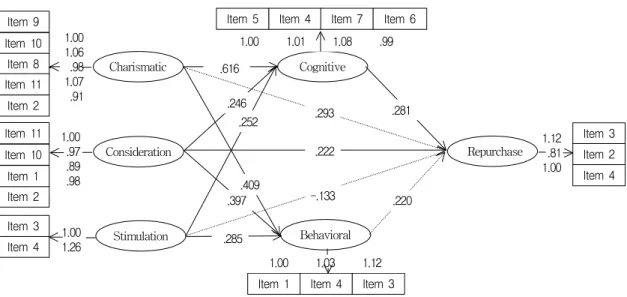
The goodness-of-fit of the research model were as follows: x2=282.687, df=175, p<.001, GFI=.916, AGFI=.889, CFI=.953, RMR=.065, and RMSEA=.047.
These indices were relatively over the baseline, and so this model may be fit. In hypothesis testing 1, charisma, individual consideration, and intellectual stimulation had a statistically significant impact on exercise flow. In testing 2, individual consideration had a positive impact on repurchase behavior, but charisma and intellectual stimulation did not have a significant impact on it. In testing 3, cognitive flow had a significant impact on repurchase behavior, but not behavioral flow. No indirect effects among the variables were shown.
Hypothesis Estimate S.E C.R P
H1
CF ← CL .616 .110 5.603 ***
CF ← IC .246 .072 3.417 ***
CF ← IS .252 .096 2.610 **
BF ← CL .409 .111 3.670 ***
BF ← IC .397 .084 4.710 ***
BF ← IS .285 .106 2.676 **
H2
RI ← CL .293 .157 1.865 .062
RI ← IC .222 .110 2.027 *
RI ← IS -.133 .126 -1.051 .293
H3 RI ← CF .281 .125 2.247 *
RI ← BF .220 .143 1.541 .123
*p<.05, **p<.01, ***p<.001
Table 6. The results of research analysis
4. Discussion
The following was discussed in this chapter based
on the drawn results. First, as a result of analyzing the effects of the sports center coaches’ transformational leadership on members’ exercise flow, it was found that charisma, individual consideration, and intellectual stimulation had a positive influence on the members’
cognitive and behavioral flow. This result was supported by a study of coaches' transformational leadership Taekwondo athletes' exercise flow[16,17].
In this respect, Ivancevich and Matteson[27]
described that leadership had a function of helping group members attain their goals effectively. The transformational leadership represents a leader who stimulated self-interest and self-actualization of group members, suggested clear goals and vision, and made an effort together to attain those on the basis of mutual agreement between a leader and a subordinate[28, 29].
As applied the characteristics of the transformational leadership to sport domain, a positive outcome can also be anticipated in sport organizations[30]. It was proved that if coaches in a sports center show their charismatic behavior and consider members' wants and needs, their behavior can have a positive influence on the members' exercise flow. Given this situation, coaches' role can be elevated by coming up with new and creative way of coaching based on their leadership.
Second, as a result of analyzing the relationship between transformational leadership and repurchase intention, it was found that only the individual consideration increased repurchase intention of members, but charisma and intellectual stimulation did not have a statistically significant influence. These findings partially supported previous studies that encouragement and charismatic behavior of the transformational leadership directly influenced the members' repurchase intention[18].
Item 9 Item 10
Item 8 Charismatic Item 11
Item 2
Item 10 Item 11
Item 2 Item 1
Item 4 Item 3
Consideration
Behavioral Cognitive
Item 3 Item 2 Item 4
Stimulation
Item 4
Item 1 Item 3 Item 6 Item 4 Item 7
1.00 1.06 .98 1.07 .91
1.00 1.26 1.00 .97 .89 .98
1.00 1.01 1.08 .99
1.00 1.03 1.12
1.12 .81 1.00 Repurchase .616
.285 .252
.409
-.133 .220 .246
.397
.222
.281 .293
Item 5
Fig. 1. structural equation model
Transformational leaders are considered as managers or directors who give attention to their subordinates individually, listen attentively to them and respect their opinions, and motivate them to attain their goals based on mutual trust[28].
Therefore, it was proved that these behaviors of coaches had gained members’ respect and trust and exerted a positive influence on repurchase intention.
More importantly, many studies of coaches' leadership were mostly carried out by collecting samples from elite sports, but this study may have a practical implication on non-elite sports and community sports, as the study discovered that coaches' individual consideration is the important factor influencing purchase behavior in commercial sports settings. It seemed that coaches in the front line are suggested to seek various ways to encourage members' purchasing club memberships as well as potential customers who are interested in purchasing memberships.
Third, it was found that customers’ cognitive flow of sports center promoted their repurchase intention, but behavioral flow was not statistically significant.
In a previous study, the flow of customers was found as an important antecedent variable when predicting their repurchase intention[20]. The result from this study partially supported a study of
purchasing leisure sportswear in which consumers’
cognitive and behavioral flow had a positive influence on the repurchase intention[21]. In this respect, Steers and Poter[31] argued that flow was the personal attitude or mind-set which set up a clear faith and goal for certain things and made all efforts to successfully attain these. A sense of satisfaction coming from this flow was one of the driving forces that continuously maintain or strengthen a certain activity[32]. It was found that repurchase intention can be promoted in the sports centers by strengthening the customers' cognitive flow and stimulating them to be continuously engaging in exercise.
Among various and complicated factors influencing the consumer behavior, it was meaningful to find out the cognitive flow that is an important variable for predicting the customers’ repurchasing behavior.
Moreover, this study found that the transformational leadership of coaches had a partial influence on the customers’ exercise flow and consumer behavior. It is suggested for managers and marketers to find effective coaches equipped with qualified leadership.
Additionally, it is recommended to analyze customer data to enhance their exercise flow in various approaches, so that they can eventually attain their organizational goals.
5. Conclusion & Limitation
This study aimed to empirically analyze the relationship between the sports center coaches’
transformational leadership and members’ exercise flow and repurchase intention. The following were the results of this study. First, it was found that charisma, individual consideration, and intellectual stimulation in the sports center coaches’ transformational leadership had a positive effect on the members’ cognitive and behavioral flow. Second, it was found that only the individual consideration in the transformational leadership increased the members’ repurchase intention, but charisma and intellectual stimulation did not have a statistically significant influence. Third, it was found that cognitive flow promoted repurchase intention, but behavioral flow was not statistically significant. In addition, there was no indirect effect on the relationship among coaches’ leadership, flow, and repurchase intention.
Instead of simply predicting consumer behavior based on sports coaches' leadership styles, this study empirically focused on analyzing the effects of coaches' transformational leadership on sports center members' exercise flow and repurchase behavior by conducting structural equation modeling. Based on the results, sports coaches' leadership is not only affecting customers' participation in sports, but also influencing them to continuously participate in sports. Also, it is proven that sports coaches' effective leadership as an antecedent variable, is one of the most important variable among many others. It is suggested that sports centers need to train their coaches by building strategic relationships with professional associations, so that coaches are able to ensure leadership learning opportunities. Eventually, it would be beneficial for sports centers to obtain outstanding coaches who equipped with leadership skills.
More specifically, customers can be more satisfied by how coaches treat them with professional attitude based on their leadership styles. With the role of
coaches, customers can have a positive image about the sports center which can help financial growth due to increased memberships. These results may be a meaningful reference for the operations of sport organizations particularly for sports centers which need to improve their comparative edge. The results of this study may be also helpful to relevant marketers who create business and marketing plan to differentiate from competitors as well as leverage their business to the next level.
Based on the results of this study, the limitations were as follows. It is suggested to research and discover what kind of antecedent variables other than coaches' leadership styles could be significantly influencing the customers' purchasing behavior.
This study was conducted by obtaining data from general members of sports centers. However, it is anticipated to see specific results by different categories of participants such as gender, age, socio-economic status, and sports activities and period of participants. Therefore, follow-up studies should be conducted to seek additional results according to uniqueness of different demographic data. In doing so, tailored marketing strategies and approaches can be developed to target different populations based on market segmentations.
References
[1] S. W. Park, "Present-day life & sports", Mapo-gu, Seoul:
Thwon, 2011.
[2] Y. C. Jo, D. W. Kim, "Characteristics of consumer behavior and satisfaction of commercial sports facility user", Journal of Sport and Leisure Studies, vol.16, pp.1013-1024, 2001.
[3] J. W. Ha, H. M. Jun, "Environmental changes of commercial sport facilities in Korea and their effects on geographical marketing mix strategy", Korean Journal of Physical Education, Vol.41, No.1, pp.301-315, 2002.
[4] D. H. Jung, "Influence of leadership type of sports center leaders on lifestyle and organizational citizenship behavior or participants", Unpublished master’s dissertation,
Chung-Ang University, 2005.
[5] D. Y. Pyun, H. H. Kwon, K. T. Koh, C. J. K. Wang,
"Perceived coaching leadership of youth athletes in Singapore", Journal of Sport Behavior, Vol.33, No.1, pp.25-41, 2010.
[6] R. K. Sharma, "Leadership behavior among elite male and female gymnasts of India", Research Journal of Physical Education & Sports Sciences, Vol.5, pp.79-95, 2010.
[7] T. Dvir, D. Eden, B. J. Avolio, B. Shamir, "Impact of transformational leadership on follower development and performance: A field experiment." Academy of Management Journal, Vol.45, No.4, pp.735-744, 2002.
DOI: http://dx.doi.org/10.2307/3069307
[8] B. J. Avolio, F. J. Yammarino, "Operationalizing charismatic leadership using a levels of analysis framework", Leadership Quarterly, Vol.1, pp.193-208, 1990.
DOI: http://dx.doi.org/10.1016/1048-9843(90)90020-I [9] J. J. Hater, B. M. Bass, "Superiors' evaluations and
subordinates' perceptions of transformational and transactional leadership", Journal of Applied Psychology, Vol.73, pp.695-702, 1988.
DOI: http://dx.doi.org/10.1037/0021-9010.73.4.695 [10] T. C. Slack, M. M. Parent, "Understanding sport
organizations: the applications of organization theory(2nd ed.)", Champaign, IL: Human Kinetics, 2006.
[11] M. C. Murray, B. L. Mann, "Leadership effectiveness".
In J. M. Williams (Ed.), Applied sport psychology (pp.92-114). Mountain View, CA: Mayfield, 1988.
[12] M. Csikszentmihalyi, "Flow: The psychology of optimal experience", New York: Harper & Row, 1990.
[13] J. L. Progen, J. T. DeSensi, "The value of theoretical frameworks for exploring the subjective dimension of sport", Quest, Vol.36, No.1, pp.80-88, 1984.
DOI: http://dx.doi.org/10.1080/00336297.1984.10483803 [14] S. A. Taylor, T. L. Baker, "An assessment of the
relationship between service quality and customer satisfaction in the formation of customers' purchase intentions. Journal of Retailing, Vol.70, No.2, pp.163-178, 1994.
DOI: http://dx.doi.org/10.1016/0022-4359(94)90013-2 [15] P. G. Patterson, R. A. Spreng, "Modeling the relationship
between perceived value, satisfaction and repurchase intentions in a business to business, services context: an empirical examination", International Journal of Service Industry Management, Vol.8, No.5, pp.414-434, 1997.
DOI: http://dx.doi.org/10.1108/09564239710189835 [16] S. N. Na, C. H. Lee, "The effects of Taekwondo
coaches' transactional transformational leadership on
achievement goal orientation and exercise flow", Journal of Korean Physical Education Association for Girls and Women, Vol.22, No.1, pp.149-161, 2008.
[17] T. L. Kim, H. J. Won, "the relationship among transformational-transactional leadership of America Taekwondo center instructor, instructor trust and exercise commitment", The Korea Journal of Sports Science, Vol.21, No.3, pp.31-43, 2012.
[18] M. C. Kang, "The influence of commercial sport center instructors' leadership style on customer satisfaction and consumer behavior", Unpublished master’s dissertation, Korea National Sport University, 2007.
[19] J. P. Choi, B. K. Chung, "The effects of taekwondo masters' transformational leadership styles on customer satisfaction and repurchase behaviors", The Korean Journal of Physical Education, Vol.46, No,4, pp.349-357, 2007.
[20] S. C. Jun, S. H. Cho, "The mediative effect of trust and commitment in relationship between consumer satisfaction and repurchase", Korean Society of Sport Management, Vol.12, No.2, pp.71-81, 2007.
[21] C. H. Kim, "The effect of the leisure sports motivation, self-efficacy and sport commitment on the satisfaction with function and repurchase intention of the leisure sports wear", Unpublished doctoral dissertation, Chung-Ang University, 2011.
[22] P. L. Wright, "Managerial leadership", London Routledge, 1996.
[23] J. Y. Kim, C. N. Kim, "Effects of transformational sport leadership on athletic's trust, identification with leader, and sport behaviors", Korean Society of Sport Psychology, Vol.13, No.3, pp.43-64, 2002.
[24] T. K. Scanlan, P. Carpenter, G. W. Schmidt, J. P.
Simons, "The sport commitment model: Measurement development for the youth-sport domain", Journal of Sport & Exercise Psychology, Vol.15, pp.16-38, 1993.
[25] Y. G. Jung, "(The)influence of sport participation motivation, arousal seeking and affects on the behavior of sport commitment", Unpublished doctoral dissertation, Pusan National University, 1997.
[26] H. S. Park, "The effects of the swimming instructors' teaching service on lesson satisfaction and repurchasing intention according to the swimming instructors' working types in public sports centers. Unpublished master's dissertation. Seoul National University of Technology, 2008.
[27] J. M. Ivancevich, M. T, Matteson, "Organizational behavior and management (6th ed.)", Boston, MA:
McGraw-Hill/Irwin, 2002.
[28] B. M. Bass, "Leadership and performance beyond expectations", New York: Free Press, 1985.
[29] B. M. Bass, "From transactional to transformational leadership: Learning to share the vision", Organizational Dynamics, Vol.18, pp.19-31, 1990.
DOI: http://dx.doi.org/10.1016/0090-2616(90)90061-S [30] M. C. Murray, B. L. Mann, "Leadership effectiveness".
In J. M. Williams (Ed.), Applied sport psychology (pp.92-114). Mountain View, CA: Mayfield, 1998.
[31] R. M. Steers, L. W. Porter, "Motivation and work behavior (3rd ed.)", New York: McGraw-Hill, 1983.
[32] M. G. Kim, "The effects of leadership behaviors perceived by athletes on team cohesion, flow, and athletic satisfaction", Unpublished doctoral dissertation, Dongshin University, 2005.
Chul-Ho Bum [Regular member]
•Dec. 2007 : University of New Mexico, MS
•May. 2013 : University of New Mexico, PhD
•Aug. 2013 ~ current : Kyung Hee Univ., Dept. of Golf Industry, Lecturer
<Research Interests>
Organizational Leadership & Behavior, Coaching Pedagogy
Stephen Hankil Shin [Regular member]
•Aug. 2003 : University of Wisconsin-La Crosse, MS
•May. 2010 : University of New Mexico, PhD
•Aug. 2008 ~ May. 2009 : East Tennessee State University, Dept.
of Kinesiology, Leisure and Sport Sciences, Full-time Instructor
•Aug. 2009 ~ May. 2011 : Northern State University, Dept. of Health and Physical Education, Assistant Professor
•Aug. 2011 ~ current : Belmont University, Dept. of Sport Science, Assistant Professor
<Research Interests>
Ethnic Consumer Behavior & Acculturation, Organizational Leadership & Behavior, Coaching Pedagogy