2011, Vol. 55, No. 3
Printed in the Republic of Korea
DOI 10.5012/jkcs.2011.55.3.541 단 신
마이크로파 조사 조건에서 H5PW10V2O40과 H5PMo10V2O40을 촉매로 사용하여 알코올로부터 아세트산 알킬을 합성하기(Part 2)
Reza Tayebee* and Farokhzad Mohammadi Zonoz
Department of Chemistry, Sabzevar Tarbiat Moallem University, Sabzevar, 397, Iran (접수 2010. 12. 12; 수정 2011. 2. 1; 게재확정 2011. 2. 9)
Synthesis of Some Alkyl Acetates From Alcohols Catalyzed by H5PW10V2O40
and H5PMo10V2O40 Under Microwave Irradiation(Part 2)
Reza Tayebee* and Farokhzad Mohammadi Zonoz
Department of Chemistry, Sabzevar Tarbiat Moallem University, Sabzevar, 397, Iran. *E-mail: [email protected] (Received December 12, 2010; Revised February 1, 2011; Accepted February 9, 2011)
주제어: 보호, Heteropolyoxometalate, 마이크로파, 촉매, 녹색 화학
Keywords: Protection, Heteropolyoxometalate, Microwave, Catalyst, Green chemistry
INTRODUCTION
Esters are important chemical compounds which can be synthesized via esterification of carboxylic acids with alcohols. The conversion of alcohol to ester as an impor- tant industrial functional group transformation is gener- ally catalyzed by usual mineral acids. Considering the importance of environmental health problems in chemi- cal technology, the eco-friendly green approaches have been expanded with the aim to diminish generation of unwanted hazardous and dangerous byproducts. Accord- ingly, the practical feasibility of microwave assisted sol- vent-free protocols in various organic transformations by the mediation of inorganic catalysts provided a number of advantages of environmental interest, including easy iso- lation and recovery from the reaction medium.1,2
Keggin-type heteropolyoxovanadates with the general formula of H3+xPM12-xVxO40 (M= W, Mo and x = 0, 1, 2 and 3) are known to exhibit interesting physical and chemical properties with relevance to catalysis, biochemical pro- cesses, and materials science.3-5 These types of heteropoly- oxometalates are strong Brønsted acid and most of them are stronger in acidity than the usual inorganic acids (HCl, H2SO4, HNO3, HBr etc), even stronger than HClO4 and CF3SO3H. This is of fundamental importance for their applications in acid catalysis. The difference in the acid strength between heteropoly acids and typical inorganic acids can be due to the fact that heteropoly anions are large
anions bearing high negative charge density than inor- ganic acids. Therefore, the strength of bonding between the proton and heteropoly anions should be lower, which implies that the dissociation constants should be lower compared to the usual acids. Polyoxometalates show acid- ity as well as oxidative ability and can be protably used in homogeneous, biphasic, or heterogeneous systems.5-7
Herein, in continuation of our ongoing research pro- gram on using heteropolyoxometalates in organic synthe- sis,8-16 we wish to describe the protection of alcohols under the environmentally benign microwave approach by the mediation of H5PMo10V2O40 and H5PW10V2O40 as vanadium-containing mixed-addenda heteropolyoxomet- alates with Keggin primary structure.
RESULTS AND DISCUSSION
Protection of some alcohols catalyzed by H5PW10V2O40 and H5PMo10V2O40 under microwave irradiation26
Table 1 shows protection of some alcohols catalyzed by H5PW10V2O40 and H5PMo10V2O40 under microwave irra- diation in solvent free conditions. Reactions were per- formed in short times with medium to high conversions, except for (±) menthol and phenol, and with excellent selectivities (~100%). H5PW10V2O40 and H5PMo10V2O40 were effective catalysts in the acetylation of 1-phenyl eth- anol and 1-butanol and led to >78% of conversion after <4 min. It seems that Lewis and Brönsted acidity of the cat-
alysts, inner coordination sphere of the metal ions, and structural features of the catalysts at the molecular levels contribute to the catalytic activity of the catalysts in the protection process.
Protection of 1-butanol with different acetylating agents catalyzed by H5PW10V2O4026
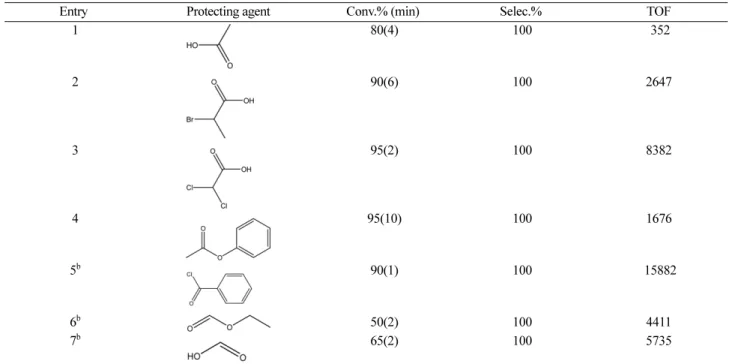
Table 2 describes protection of 1-butanol with different acetylating agents catalyzed by H5PW10V2O40 under microwave. Clearly, more electron deficient carboxylic
groups caused higher tendency of 1-butanol toward acetylation. Dichloroacetic acid, as the most electron defi- cient carboxylic acid, led to the highest activity and pro- duced 95% of conversion after only 2 min, whereas acetic acid gave 80% of product after 4 min. 2-Bromopropionic acid was less effective than acetic acid and obtained 90%
of product after 6 min. Phenyl acetate showed low reac- tivity compared to acetic acid and gave 95% of product after 10 min. In accord with our previous findings,17 ben- zoyl chloride is obviously more effective than acetic acid Table 1. Protection of some alcohols catalyzed by H5PW10V2O40 and H5PMo10V2O40 under microwave irradiationa
Catalyst Substrate Product Conv.% Time(min) Selec.% TOFb
H5PW10V2O40 80 4 100 3529
H5PMo10V2O40 78 4 100 3441
H5PW10V2O40 90 2 100 7941
H5PMo10V2O40 85 3 100 5000
H5PW10V2O40 45 8 100 992
H5PMo10V2O40 40 10 100 706
H5PW10V2O40 <4 5 100 <1411
H5PMo10V2O40 5 10 100 882
H5PW10V2O40 80 3 >98 4705
H5PMo10V2O40 78 4 >97 3441
H5PW10V2O40 20 10 100 352
H5PMo10V2O40 20 12 100 294
aConditions: catalyst (0.034 mmol) was dissolved in a solution of acetic acid (50 mmol) and alcohol (10 mmol) and subjected to microwave irradiation with full power. Microwave irradiations were carried out with pulses of 15s followed by a 5s cooling periods. All acetylated prod- ucts were known compounds and were identified by means of IR and 1H-NMR spectroscopy and/or comparison of their bp or mp with authentic samples. bTurnover frequency (TOF) was calculated by the expression [Product]/[catalyst]×time (h-1).
and obtained fast (<1min) and effective protection of 1- butanol (>90%). Ethyl formate and formic acid were also less effective than acetic acid. Although these two acety- lating agents were effective at short time (<2 min), the protection reactions were stopped at 50-65% and no more conversions were achieved at longer reaction times.
Influence of microwave power on the acetylation of 1-butanol with acetic acid catalyzed by H5PW10V2O4026
The influence of microwave power on the progress of 1- butanol acetylation with acetic acid in the presence of a catalytic amount of H5PW10V2O40 has also been studied (Table 3). The reactions were carried out under 17-100%
microwave power. Rationally, protection was increased along with enhancing power. For example, conversion%
was increased from 30 to 65% by enhancing power from
17% to 50% during 8 min. However, utilizing full power (100%) led to the highest conversion (80%) in short time (4 min). At this power, temperature of the reaction ves- sel was measured to be 72-75oC in repeated experi- ments. Moreover, performing control experiments in an equipped research microwave oven (Micro-SYNTH lab- station), confirmed acceptable reproducibility of the obtained data.
Studying reproducibility of the catalyst26
To study the recycle ability and stability of the catalyst, H5PW10V2O40 was regenerated at the end of the protec- tion reaction. The catalyst was washed with dichlo- romethane, dried at room temperature and finally was heated to 130oC for 3 h. FT-IR spectrum of the regener- ated catalyst showed the four characteristic bands belong- ing to the Keggin structure at 1088 ν(P-O); 998 ν(W-Ot);
890 ν(W-Ob-M, M=W and V); and 778 ν(W-Oc-M).18 Ot and Ob,c refer to terminal and bridging oxygen atoms, respectively, in the Keggin anionic framework. These results clearly demonstrated that the Keggin structure is retained after completion of the acetylation reaction.
Therefore, the recycled catalyst could be reused for sev- eral times without considerable loss of activity. Effects of different reaction parameters on the acetylation of alco- hols with acetic acid catalyzed by other heteropoly acids were also investigated.19
Table 2. Protection of 1-butanol to the corresponding acetate with different acetylating agents catalyzed by H5PW10V2O40 under microwavea
Entry Protecting agent Conv.% (min) Selec.% TOF
1 80(4) 100 352
2 90(6) 100 2647
3 95(2) 100 8382
4 95(10) 100 1676
5b 90(1) 100 15882
6b 50(2) 100 4411
7b 65(2) 100 5735
aThe reactions were carried out as described below Table 1. bThe ratio of protecting agent: alcohol was 1:1.
Table 3. Effect of microwave power on the acetylation of 1- butanol with acetic acid catalyzed by H5PW10V2O40a
Entry Power (%) Conv.% (min) Selec. (%)
1 17 35(7) 100
2 34 60(9) 100
3 50 60(7) 100
4 67 80(6) 100
5 84 90(6) >98
6 100 80(4) >98
aThe reactions were carried out as described below Table 1.
MATERIALS AND METHODS
Typical experimental procedure for the acetylation of alcohols with acetic acid catalyzed by heteropolyoxomet- alates under microwave irradiation
In an open vessel test tube (10 mL) equipped with a magnetic stirrer, the catalyst (0.034 mmol) was dissolved in acetic acid (50 mmol). Then, the corresponding alcohol (10 mmol) was added. The mixture was properly stirred with the help of a magnetic stirrer (15 s) and then irra- diated under safe conditions in a microwave oven (Pana- sonic NN-GT546W operating at 2450 MHz providing a maximum output of 1000 W) for the required reaction time. Microwave irradiations were carried out with pulses of 15 s followed by a 5 s cooling periods. The progress of reactions was followed by GLC. After completion of the reaction, the contents of the test tube were cooled to room temperature. Thereafter, acetic acid was removed under reduced pressure and 20 mL of ether was added. The reac- tion mixture was washed with 5% NaHCO3 solution, then with H2O, and dried with MgSO4. Evaporation of the sol- vent followed by silica gel chromatography provided the pure acetate. The catalysts were prepared and character- ized according to literature procedures.20-25
Preparation of 10-molybdo-2-vanadophosphoric acid, H5[PMo10V2O40 ]
H5[PMo10V2O40] was prepared according to the proce- dure of Tsigdinos et al.24 Sodium metavanadate (12.2 g, 100 mmol) was dissolved in 50 mL of boiling water and then mixed with Na2HPO4 (3.55 g, 25 mmol) in 50 mL of water. After cooling the solution to room temperature, conc sulfuric acid (17 M, 5 mL, 85 mmol) was added, and the solution developed a red color. Then, Na2MoO4.2H2O (60.5 g, 250 mmol) was dissolved in 100 mL of water and was added to the resulting red solution with vigorous stir- ring, followed by slow addition of conc sulfuric acid (17 M, 42 mL, 714 mmol). The hot solution was allowed to cool to room temperature. The 10-molybdo-2-vanadophos- phoric acid was then extracted with 500 mL of diethyl ether. Air was passed through the heteropoly etherate (bottom layer) to free it from ether. The solid remaining behind was dissolved in water and then allowed to crys- tallize. The large red crystals that formed were filtered, washed with water, and air-dried (yield, 78%).
Preparation of 10-tungsto-2-vanadophosphoric acid, H5[PW10V2O40]25
Sodium metavanadate (NaVO3, 12.2 g, 100 mmol) was
dissolved in 50 mL of boiling water and mixed with dis- odium hydrogen phosphate (Na2HPO4, 3.55 g, 25 mmol), dissolved in 50 mL of water. After cooling the resulting solution to room temperature, conc sulfuric acid (17 M, 5 mL, 85 mmol) was added to give a red solution. Sodium tungstate dihydrate (Na2WO4.2H2O, 82.5 g, 250 mmol) was dissolved in 100 mL of water and was added to the red solution with vigorous stirring, followed by slow addition of conc sulfuric acid (17 M, 42 mL, 714 mmol). Extrac- tion of the solution with diethyl ether (500 mL), followed by evaporation in air, afforded H5[PW10V2O40] as a crys- talline, orange-red solid (yield, 74%).
CONCLUSION
In conclusion, an efficient and fast method for acety- lation of alcohols using microwave irradiation is intro- duced. Catalytic amounts of cheap and simple Keggin- type H5PM10V2 (M=W, Mo) led to protection of alcohols with acetic acid in high yields, with reduced reaction times under solvent free conditions. It seems that H5PMo10V2O40 and H5PW10V2 O40 acted not only as Brönsted acid but also as Lewis acid in the acetylation reaction.
REFERENCES
1. Tierney, J.; Lidström, P. Microwave Assisted Organic Syn- thesis, Eds.; Blackwell: Oxford, U. K., 2004.
2. Hayes, B. L. Microwaves: Chemistry at the Speed of Light; CEM Publishing: Matthews NC, 2002.
3. Kozhevnikov, I. V. Chem. Rev. 1998, 98, 171.
4. Okuhara, T.; Mizuno, N.; Misono, M. Adv. Catal. 1996, 41, 113.
5. Misono, M.; Nojiri, N. Appl. Catal. 1990, 64, 1.
6. Nomiya, K.; Nemoto, Y.; Hasegawa, T.; Matsuoka, S. J.
Mol. Catal. A: Chemical 2000, 152, 55.
7. Nomiya, K.; Matsuoka, S.; Hasegawa, T.; Nemoto, Y. J.
Mol. Catal. A: Chemical 2000, 156, 143.
8. Alizadeh, M. H.; Tayebee, R. J. Braz. Chem. Soc. 2005, 16, 108.
9. Tayebee, R. J. Kor. Chem. Soc. 2008, 52, 23.
10. Tayebee, R. Chin. J. Chem. 2008, 26, 2273.
11. Alizadeh, M. H.; Kermani, T.; Tayebee, R. Monatsh. Fur Chem. 2007, 138, 165.
12. Alizadeh, M. H.; Tayebee, R. Monatsh. Fur Chem. 2006, 137, 1063.
13. Tayebee, R.; Alizadeh, M. H. Cur. Sci. 2007, 93, 133.
14. Tayebee, R.; Mahdavi, B. Asian J. Chem. 2009, 21, 1565.
15. Tayebee, R.; Alizadeh, M. H. Chin. J. Chem. 2007, 25, 1031.
16. Tayebee, R.; Alizadeh, M. H. Monatsh. Fur Chem. 2007, 138, 763.
17. Tayebee, R.; Cheravi, F. Bull. Korean Chem. Soc. 2009, 30, 2899.
18. Rocchiccioli-Deltcheff, C.; Fournier, M.; Frank, R.; Thou- venot, R. Inorg. Chem. 1983, 22, 207.
19. Tayebee, R.; Cheravi, F. Asian J. Chem. 2010, 22, 5567.
20. Okun, N. M.; Anderson, T. M.; Hill, C. L. J. Am. Chem.
Soc. 2003, 125, 3194.
21. Ten Brink, G. J.; Arends, I. W. C. E.; Sheldon, R. A. Adv.
Synth. Catal. 2002, 344, 355.
22. North, E. O. Inorg. Synth. 1993, 1, 129.
23. Brevard, C.; Schimpf, R.; Tourne, G.; Tourne, C. M. J.
Am. Chem. Soc. 1983, 105, 7059.
24. Tsigdinos, G. A.; Hallada, C. J. Inorg. Chem. 1968, 7, 437.
25. Farhadi, S.; Taherimehr, M. Acta Chim. Slov. 2008, 55, 637.
26. Some results and discussions are directly copied from our previously published work: Rezaei-Seresht, E.; Moham- madi, F. Z.; Estiri, M.; Tayebee, R. Ind. Eng. Chem. Res.
2011, 50, 1837.