2011, Vol. 55, No. 2
Printed in the Republic of Korea
DOI 10.5012/jkcs.2011.55.2.317 단 신
폴리아자 거대고리 Schiff-염기의 동종이핵 UO2(VI), Th(IV), ZrO(IV) 및 VO(IV) 착물의 합성 및 특성 규명
R. K. Mohapatra*, S. R. Rout†, and D. C. Dash†
Department of Chemistry, Orissa School of Mining Engineering (Degree Stream), Keonjhar-758001, Orissa, India
†School of Chemistry, Sambalpur University, Jyoti Vihar, Burla, Sambalpur-768019, Orissa, India (접수 2010. 3 19; 수정 2010. 10. 8; 게재확정 2010. 12. 14)
Synthesis and Characterization of Homo Binuclear Complexes of UO2(VI), Th(IV), ZrO(IV) and VO(IV) with Polyaza Macrocyclic Schiff-Bases
R. K. Mohapatra*, S. R. Rout†, and D. C. Dash†
Department of Chemistry, Orissa School of Mining Engineering (Degree Stream), Keonjhar-758001, Orissa, India.
*E-mail: [email protected]
†School of Chemistry, Sambalpur University, Jyoti Vihar, Burla, Sambalpur-768019, Orissa, India (Received March 19, 2010; Revised October 8, 2010; Accepted December 14, 2010)
주제어: Schiff-염기, 주형합성, 구조 및 열적성질, IR 및 H1-NMR 스펙트럼
Keywords: Schiff base, Template synthesis, Structure and Thermal Properties, IR, H1-NMR spectra
INTRODUCTION
The introduction of pendant arms into the macrocyclic framework can lead to important changes in the complex- ation capability of the ligands and can enhance the metal- ion selectivity and the stability of metal complexes depend- ing on the coordination properties of the pendant arms.
There is an emerging interest in the synthesis of macro- cyclic complexes of transition and inner transition cations, because of their applications and interesting properties.1,2 One reason for the interest in this field is that it offers exciting possibilities for creative minds to construct novel, supramolecular assemblies that are capable of performing highly specific molecular functions. The precise molec- ular recognition between macrocyclic ligands and their guests provides a good opportunity for studying key aspects of supramolecular chemistry, which are also sig- nificant in a variety of disciplines including chemistry, biology, physics, medicine and related science and tech- nology.
The chemistry of macrocyclic complexes has attracted the interest of both inorganic and bioinorganic chemists in recent years.3 The field of macrocyclic chemistry of met- als is developing very rapidly because of its importance in the area of coordination chemistry.4 Macrocyclic com-
pounds and their derivatives are interesting ligand sys- tems because they are good hosts for metal anions, neutral molecules and organic cation guests.5 The metal ion and host-guest chemistry of macrocyclic compounds are very useful in fundamental studies (in phase transfer catalysis and biological studies).6 Template condensation reactions lie at the heart of the macrocyclic chemistry.7 Therefore template reactions have been widely used for synthesis of macrocyclic complexes.8 The family of complexes with aza-macrocyclic ligands has remained a focus of scien- tific attention for many decades.9 Schiff base polyazamac- rocyclic complexes have under gone a phenomenal growth during the recent years because of the versatility offered by these complexes in the field of industries, catalysis and in biological systems10-15 etc.
The homo-multimetallic complexes have the potential to mediate certain chemical reactions of industrial rele- vance either more efficiently than, or in a different manner to monometallic complexes. They exhibit distinct reac- tivity pattern as compared to corresponding monometal- lic complexes.16 The magnetic interactions and coupling between the metal ions present in such complexes play key role in both natural and synthetic catalysts.17 As a result, the synthesis and characterization of homo bime- tallic complexes continue to attract attention.18
The monohydrazones of benzil and diacetyl may exist in trans position. In the presence of metal ion, they may attain a cis (vicinal) configuration. Complexes involving such hydrazones may be used as an intermediate to pre- pare homo/hetero binuclear complexes by template con- densation with suitably oriented aldehyde or ketones19,20 in the presence of homo/hetero metal ions. In continua- tion of our consistent efforts towards synthesis and char- acterization of such type of complexes21-24 we report here the synthesis and characterization of hither to unknown homo binuclear complexes with some Schiff base mono- hydrazone derivatives obtained from the reaction of thio- carbohydrazide, benzilmonohydrazone/diacetylmonohy- drazone and acetylacetone in presence of UO22+, ZrO2+, Th4+ and VO2+ ions.
EXPERIMENTAL
Materials
All the chemicals used of AR grade. The solvents were purified before use by standard procedures.
Preparation of thiocarbohydrazide
Thiocarbohydrazide was synthesized according to lit- erature method of Audrieth et al..25
Preparation of benzilmonohydrazone/diacetylmono- hydrazone
The analytical monohydrazones were synthesized accord- ing to literature method.26 As the isolation of Schiff base ligand proved futile, all the metal complexes were syn- thesized (in an identical method) in situ by taking differ- ent amount of metal salts, thiocarbohydrazide, benzilmo- nohydrazone/diacetylmonohydrazone and acetylacetone.
Preparation of the complexes
All complexes were prepared according to the following procedure. An ethanolic solution of hydrated UO2(VI)/
Th(IV)/ZrO(IV) nitrates/vanadyl sulphate (1 mmol in 10 mL) was added to a hot ethanolic solution of the mixture of thiocarbohydrazide (1 mmol in 10 mL), benzilmono- hydrazone/diacetylmonohydrazone (2 mmol in 20 mL).
The resulting mixture was refluxed on a water bath for 2-3 hours during which a coloured complex was precipitated out in each case. The ethanolic suspension of the above complexes were treated with acetylacetone (2 mmol in 10 mL EtOH) and thiocarbohydrazide (1 mmol in 10 mL) followed by the addition of corresponding metal salt (1 mmol in 10 mL EtOH). The mixture was again refluxed
for 3-4 hours on a water bath during which the metal com- plexes of different colour than the precursor complexes were obtained. The progress of the reaction was signaled by colour change of the resulting mixture. These were fil- tered off, washed several times with ethanol followed by ether and finally dried over anhydrous CaCl2.
Analysis and Physical Measurements
The metal contents in the complexes were determined gravimetrically following standard procedures.27 A weighed quantity of the compound (0.2-0.3 g) was treated with a few drops of concentrated H2SO4 and 1 cc. of concentrated HNO3. It was heated till all the organic matter decom- posed and sulphur trioxide fumes came out. The same pro- cess was repeated two to three times to decompose the substance completely. Then it was dissolved in water and the resulting solution was used for analysis of metal ions.
Uranium, thorium, zirconium and vanadium were precip- itated as ammonium diuranate, thorium oxalate, zirco- nium mandelate and ammonium vanadate followed by subsequent ignition to their respective oxides as U3O8, thoria (ThO2), zirconia (ZrO2) and V2O5. Sulphur was deter- mined as BaSO4. Room temperature magnetic suscepti- bilities were measured by Gouy method using Hg[Co (NCS)4] as the calibrant. The molar conductance mea- surements were carried out at room temperature with a Toshniwal conductivity Bridge (Model CL-01-06, cell con- stant 0.5 cm-1) using 1×10⁻³ M solution of the complexes in DMSO. Carbon, hydrogen and nitrogen contents of the complexes were determined by using a MLW-CHN microanalyser. FTIR spectra in KBr pellets were recorded on a varian FTIR spectrophotometer, Australia. The elec- tronic spectra of the complexes in DMSO were recorded on a PerkinElmer* spectrophotometer. Thermogravimet- ric analysis was done by Netzch-429 thermoanalyser. The
1H-NMR spectra of the complexes were recorded in DMSO-d6 medium on JEOL GSX-400 model equipment.
RESULTS AND DISCUSSION
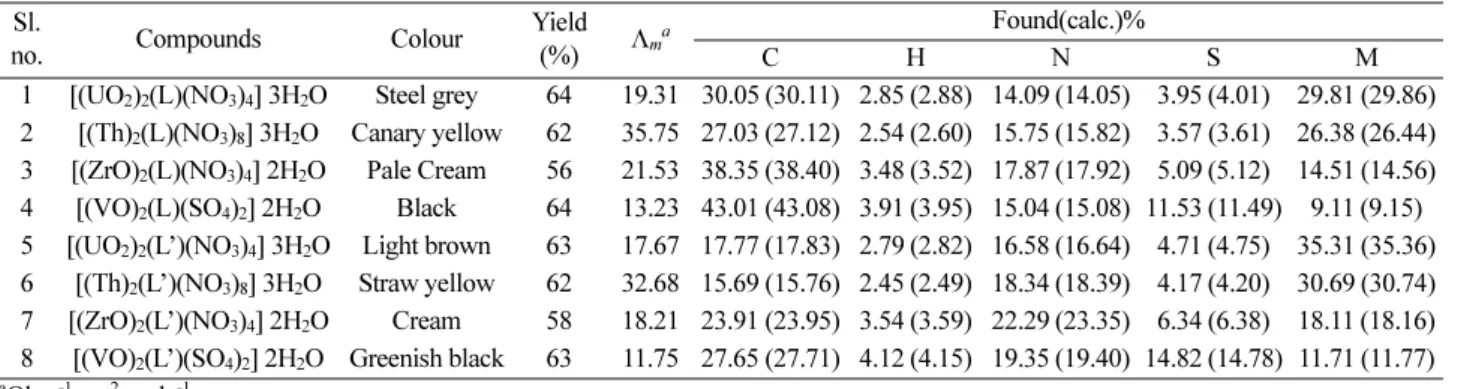
The complexes were formulated from the analytical data and molar conductance data support the suggested formulae (Table 1). The complexes are highly coloured and insoluble in water and common organic solvents such as ethanol, methanol, acetone, CCl4, CHCl3, benzene and ether but moderately soluble in highly coordinating sol- vents such as DMF and DMSO. They are highly stable under normal conditions and all of them decompose above 250oC. The molar conductance data values in DMSO for
the complexes indicate them to be non-electrolyte in nature.
However, the conductivity value is higher than as expected for non-electrolytes probably due to partial solvolysis of the complexes in DMSO medium.28
IR spectra
As the Schiff base ligands could not be isolated, the spectra of the complexes (Table 2) were compared with spectra of the starting materials and other related com- pounds. The bands observed in the spectra of metal com- plexes at ~1525, ~1315, ~1100, ~765 cm-1 are assigned to thioimide I, II, III, IV bands respectively of TCH skeleton.29 All the above bands appear nearly the same position as found in the free TCH implying non co-ordination of thio- imide sulphur or nitrogen atom to the metal ion. The IR spectra of the complexes show strong bands appearing at 1630 and ~1060 cm-1 assignable to azomethine νC=N and νN-N. The position of former band at comparatively lower frequency region than usual free νC=N value (~1650 cm-1)30-32 and that of later band at comparatively higher frequency region than that of free N-N leads us to suggest that
azomethine nitrogen atom has taken part in complexation as evidenced from the appearance of band in the region
~480 cm-1 due to ν(M-N). The occurrence of N-N band at higher frequency in the IR spectra of the complexes is due to reduction of the repulsion between the lone pair of nitrogen atoms as a result of coordination via azomethain nitrogen atoms. The splitting of (νC=N) band is probably due to the presence of the methaine group in different chem- ical environment. One would therefore expect the absence of band due to ν C=O to suggest that Schiff base reaction has taken place. On scanning the spectra of metal complexes no bands due to ν C=O at ~1700 cm-1 is observed. This clearly suggests that Schiff base reaction has taken place.
The uranyl complexes exhibit a strong band in the region 940-910 cm-1 and the medium intensity band in the region 830-810 cm-1 assignable to vas (O=U=O) and vs (O=U=O) mode respectively.33 This observation indicates that the linearity of the O=U=O group is maintained in the com- plexes.34 The band at 1020 cm-1 is assigned to the n2 mode of the NO3 group. The bands at 1475 and 1375 cm-1 are the two split bands ν4 and ν1 respectively, of the coordinated Table 1. Analytical and physical data of the complexes
Sl.
no. Compounds Colour Yield
(%) Λma Found(calc.)%
C H N S M
1 [(UO2)2(L)(NO3)4] 3H2O Steel grey 64 19.31 30.05 (30.11) 2.85 (2.88) 14.09 (14.05) 3.95 (4.01) 29.81 (29.86) 2 [(Th)2(L)(NO3)8] 3H2O Canary yellow 62 35.75 27.03 (27.12) 2.54 (2.60) 15.75 (15.82) 3.57 (3.61) 26.38 (26.44) 3 [(ZrO)2(L)(NO3)4] 2H2O Pale Cream 56 21.53 38.35 (38.40) 3.48 (3.52) 17.87 (17.92) 5.09 (5.12) 14.51 (14.56) 4 [(VO)2(L)(SO4)2] 2H2O Black 64 13.23 43.01 (43.08) 3.91 (3.95) 15.04 (15.08) 11.53 (11.49) 9.11 (9.15) 5 [(UO2)2(L’)(NO3)4] 3H2O Light brown 63 17.67 17.77 (17.83) 2.79 (2.82) 16.58 (16.64) 4.71 (4.75) 35.31 (35.36) 6 [(Th)2(L’)(NO3)8] 3H2O Straw yellow 62 32.68 15.69 (15.76) 2.45 (2.49) 18.34 (18.39) 4.17 (4.20) 30.69 (30.74) 7 [(ZrO)2(L’)(NO3)4] 2H2O Cream 58 18.21 23.91 (23.95) 3.54 (3.59) 22.29 (23.35) 6.34 (6.38) 18.11 (18.16) 8 [(VO)2(L’)(SO4)2] 2H2O Greenish black 63 11.75 27.65 (27.71) 4.12 (4.15) 19.35 (19.40) 14.82 (14.78) 11.71 (11.77)
aOhm-1 cm2 mole-1
Table 2. IR spectral data of the complexes
Complex
Band assignment
1 2 3 4 5 6 7 8
3425 3425 3430 3430 3425 3425 3428 3428 νOH+NH (Combined)
1626 1628 1630 1629 1632 1630 1634 1635 νC= N (Coordinated)
477 475 480 480 475 478 484 482 νM-N
1057 1060 1055 1058 1058 1062 1065 1058 νN-N
763 765 765 762 765 768 762 760 νC=S
1095 1090 1098 1095 1100 1102 1096 1098 νC-S
1370 1470
1372 1472
1375
1475 - 1375
1475
1373 1473
1376
1476 - ν1
ν4 for NO3-
938 - - - 915 - - - νas (O=U=O)
824 - - - 818 - - - νs (O=U=O)
- - 885 - - - 878 - ν (Zr=O)
- - - 945 - - - 950 ν (V=O)
nitrate ion. The magnitude of ∆ν = (ν4 - ν1) = 100 cm-1 shows the unidentate coordination of the nitrate ion.35 The zirconyl complexes exhibit one strong band in the region 890-875 cm-1 which can be attributed to the ν(Zr=O) as reported earlier34 indicating the presence of (Zr=O)2+ moi- ety in these complexes. In the oxovanadium polychelates a strong bands at ~950 cm-1 are assigned to ν(V=O) mode.36 However, in vanadyl complexes, an additional series of four bands appeared at 1155, 1115, 855, 665 cm-1 indicating the coordination of sulphate group in unidentate manner through oxygen atom.37 Besides, the bands observed at
~3430 cm-1 may be assigned to ν(O-H) of coordinated or lattice water. However all the complexes loss water when heated to ~50oC indicating the presence of lattice water molecules which has been conformed by thermal analysis.
Thermal analysis
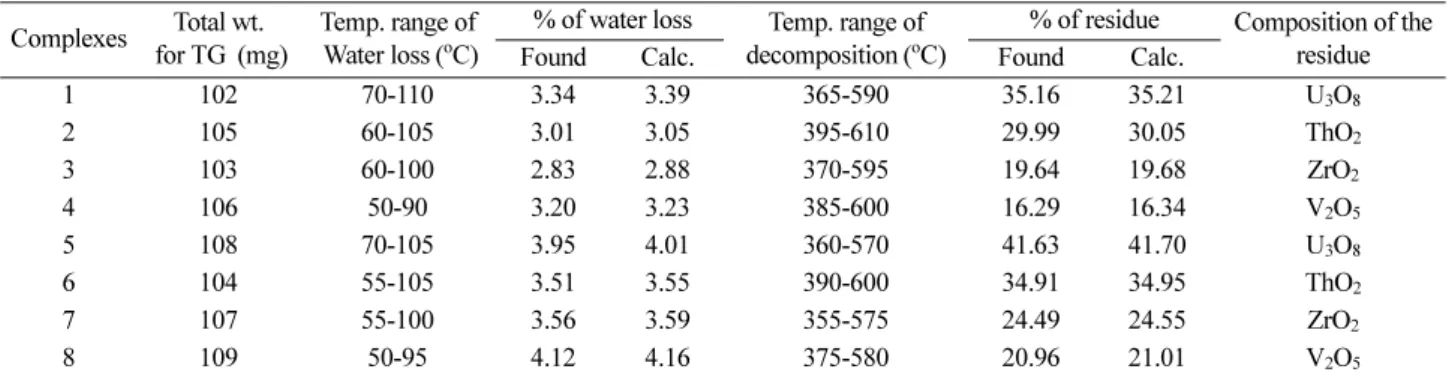
All these complexes follow the same pattern of thermal decomposition. The complexes remain almost unaffected upto ~50oC. After this a slight depression upto ~110oC is observed. The weight loss at this temperature range is equivalent to two for the complexes (3), (4), (7) and (8) and three for the complexes (1), (2), (5) and (6) water mol- ecules in the complexes indicating them to be lattice water38 in conformity with our earlier observations from analytical and IR spectral investigations. Once the lattice water was eliminated, the anhydrous complexes remain stable upto ~355oC and thereafter the complexes show gradual degradation presumably due to decomposition of organic constituents of the complex molecules. The decom- position continues upto ~600oC in each complex as indi- cated by the consistency in weight in the plateau of the thermogram. The decomposition temperature varies for different complexes as shown in Table 3. The thermal sta- bility of the complexes decreases in the order:
(L) complexes: Th(IV) > VO(IV) > ZrO(IV) > UO2(VI) (L’) complexes: Th(IV) > VO(IV) > UO2(VI) > ZrO(IV)
Electronic spectra
The electronic spectra of the UO2(VI) complexes are quite similar. The complexes display mainly one weak band at ~460 nm and a highly intense band in the range 270-290 nm, which may be due to 1Σg+→3Πu transitions and charge transfer transitions respectively.39 The first one of the transition is typical of the O=U=O symmetric stretching frequency of the first excited state.40 It may be noted that the band occurring at 370 nm is due to uranyl moiety because of apical oxygen f0(U) transition41 is being merged with the ligand band due to n→π* transition as evident from broadness and intensity. The electronic spectra of ZrO(IV) complexes exhibit only one extra highly intensive band in the region 350-375 nm which may be due to charge transfer band besides the ligand bands.
However, the electronic spectra could not provide struc- tural details of these complexes. The electronic spectra of VO(IV) complexes show three bands at ~12280, ~18490 and ~25740 cm-1 corresponds to transitions, dxy(b2)→ dxzdyz(e), dxy(b2)dx2
-y2(b1) and dxy(b2)→dz2(a1) respectively, indicating the complexes to be in distorted octahedral environment under C4V symmetry.42
Magnetic moment
All the complexes except VO(IV), are diamagnetic con- sistent with their d0 and f0 electronic configuration. The magnetic moment values for the oxovanadium(IV) com- plexes (4) and (8) lie in the range 2.60-2.70 BM. These val- ues are less than spin-only value required for two unpaired electrons indicating spin-spin coupling in the solid state between unpaired electrons belonging to different VO(IV) ions in the same structural unit.43
1H NMR spectra
The 1H NMR spectra of the diamagnetic complexes are recorded in DMSO-d6 medium. The complexes do not show any signal attributable to amino protons, suggesting
Table 3. Important features of thermo gravimetric analysis (TGA) Complexes Total wt.
for TG (mg)
Temp. range of Water loss (oC)
% of water loss Temp. range of decomposition (oC)
% of residue Composition of the residue
Found Calc. Found Calc.
1 102 70-110 3.34 3.39 365-590 35.16 35.21 U3O8
2 105 60-105 3.01 3.05 395-610 29.99 30.05 ThO2
3 103 60-100 2.83 2.88 370-595 19.64 19.68 ZrO2
4 106 50-90 3.20 3.23 385-600 16.29 16.34 V2O5
5 108 70-105 3.95 4.01 360-570 41.63 41.70 U3O8
6 104 55-105 3.51 3.55 390-600 34.91 34.95 ThO2
7 107 55-100 3.56 3.59 355-575 24.49 24.55 ZrO2
8 109 50-95 4.12 4.16 375-580 20.96 21.01 V2O5
that the proposed skeleton has been formed by the con- densation reactions. The complexes (1), (2) and (3) show a broad multiplet at δ 6.73-7.25 ppm corresponding to aro- matic (C6H5-C=N; 20H) protons44 of four phenyl groups and a twin peak at δ ~2.40, δ ~2.60 ppm corresponding to imine methyl (CH3-C=N; 12H) protons.45 A singlet is also observed in the region δ 2.18-2.26 ppm, which may be assigned to methylene (C-CH2-C; 4H) protons for these complexes. The complexes (5), (6) and (7) show a signal, appear in several groups in the region δ 2.25-2.70 ppm corresponding to imine methyl (CH3-C=N; 24H) and methylene (C-CH2-C; 4H) protons.44 Besides, the signals due to (-NH-N=; 2H) protons appear at δ 6.05-6.17 ppm for all the complexes.
Based on the foregoing observations the following ten- tative structures have been proposed for the present com- plexes.
M = UO2(VI), ZrO(IV) and Th(IV) X = NO3- for Th(IV)
X = 0 for UO2(VI)and ZrO(IV) Y = NO3-
Z = SO42-
R = C6H5, CH3
Fungicidal Screening
The antifungal activity of ZrO(IV) and VO(IV) com- plexes have been studied by potato dextrose agar diffu-
sion method in DMSO solvent against A. niger and A.
flavus. The complexes showed good antifungal activity (Table 4) against the species. This may be explained on the basis that their structures mainly possess C=N bonds.
Moreover, coordination reduces the polarity42,46 of the metal ion mainly because of the partial sharing of its pos- itive charge within the chelate ring formed during coor- dination. This process increases the lipophilic nature of the central metal atom, which favors its permeation more efficiently through the lipid layer of the micro-organism47-49 thus destroying them more aggressively.
Acknowledgement. The authors gratefully acknowledge the services rendered by Director, Regional Sophisticated Instrumentation Center, I.I.T., Madras, for recording the spectra.
REFERENCES
1. Vicente, M.; Bastida, R.; Lodeiro, C.; Macias, A.; Parola, A. J.; Valencia, L.; Spey, S. E. Inorg. Chem. 2003, 42, 6768.
2. Collinson, S. R.; Fenton, D. E. Coordin. Chem. Rev. 1996, 148, 19.
3. Fernandez, M. C.; Basitida, R.; Macias, A.; Valencia, L.;
Lourida, P. P. Polyhedron 2006, 25, 783.
4. Ilhan, S.; Temel, H. Transition Met. Chem. 2007, 32, 1039.
5. Chandra, S.; Gautum, A.; Tyagi, M. Transition Met. Chem.
2007, 32, 1079.
6. Bozic, L. T.; Marotta, E.; Traldi, P. Polyhedron 2007, 26, 1663.
7. Niasari, M. S.; Bazarganipour, M.; Ganjali, M. R.; Norouzi, P. Transition Met. Chem. 2007, 32, 9.
8. Niasari, M. S.; Daver, F. Inorg. Chem. Commun. 2006, 9, 175.
9. Lindoy, L. F. The Chemistry of Macrocyclic Ligand Com- plexes; Cambridge University Press: Cambridge, 1989.
10. Alexander, V. Chem. Rev. 1995, 95, 273 and references therein.
11. Ito, I.; Kato, M.; Yamashita, M.; Ito, H. Coord. Chem.
1986, 15, 29.
12. Mertes, M. P.; Mertes, K. B. Acc. Chem. Res. 1990, 23, 413.
13. Bencini, A.; Bencini, C.; Caneschi, A.; Carlin, R. C.; Dei- and, A.; Gatteschi, D. J. Am. Chem. Soc. 1995, 107, 8128.
Fig. 1
Fig. 2
Table 4. Fungi toxicity of ZrO(IV) and VO(IV) complexes against the fungal pathogens
complexes Aspergillus niger Aspergillus flavus
100 200 400 800 1000 100 200 400 800 1000
[(ZrO)2(L)(NO3)4] 2H2O 12.3 16.4 22.5 33.2 53.1 11.2 15.4 23.3 29.1 53.2 [(ZrO)2(L’)(NO3)4] 2H2O 17.1 22.6 28.3 47.3 62.2 16.4 21.8 30.3 46.2 66.3 [(VO)2(L)(SO4)2] 2H2O 13.4 17.6 23.6 41.4 54.2 13.3 18.1 26.5 34.2 56.4 [(VO)2(L’)(SO4)2] 2H2O 19.5 26.3 34.1 62.3 77.5 18.7 26.5 37.1 67.5 76.4
14. Zhong, Z. J.; Tamaki, H.; Matsumoto, N.; Kida, S.;
Koikwa, M.; Achiva, N.; Hasimoto, Y.; Okawa, H. J. Am.
Chem. Soc. 1992, 114, 6974.
15. Wherland, S.; Gray, H. B. Biological Aspects of Inorganic Chemistry; Wiley Eastern: New York, 1977, p 289.
16. Carlsor, J. B.; Davies, G.; Vorous, P. Inorg. Chem. 1994, 33, 2334.
17. Ladavos, A. K.; Kooli, F.; Moreno, S.; Skaribas, S. P.; Pomo- nis, P. J.; Jones, W.; Poncelet, G. Appl. Clay Sci. 1998, 13, 49.
18. Dutta, S. K.; Nanda, K. K.; Florke, U.; Bhadbhade, M.;
Nag, K. J. Chem. Soc. Dalton Trans. 1996, 2371.
19. Sahoo, B.; Rout, A. K. Indian J. Chem. 1986, 25A, 609.
20. Mohapatra, B. K.; Sahoo, B. Indian J. Chem, 1983, 22A, 494.
21. Panda, A. K.; Dash, D. C.; Mishra, P.; Mohanty, H. Indian J. Chem. 1996, 35A, 843.
22. Panda, A. K.; Dash, D. C.; Mishra, P.; Acharya, S. B.
Synth. React. Inorg. Met.-Org. Chem. 1998, 28(10), 1769.
23. Dash, D. C.; Mohapatra, R. K.; Ghosh, S.; Naik, P. J.
Korean Chem. Soc. 2008, 52(5), 468.
24. Dash, D. C.; Mohapatra, R. K.; Ghosh, S.; Naik, P. J.
Indian Chem. Soc. 2009, 86, 121.
25. Audrieth, I. F.; Scotts, E. S.; Kippur, P. S. J. Org. Chem.
1954, 19, 733.
26. Holm, R. H.; Everestt (J), G. W.; Chakrabarty, A. Progress in Inorganic Chemistry; Interscience: 1966, p 83.
27. Vogel, A. I. A Hand Book of Quantitative Inorganic Anal- ysis, 2nd ed.; Longman, ELBS: London, 1966.
28. Dash, K. C.; Mansingh, P. S.; Mohanty, R. R.; Jena, S.
Indian J. Chem. 1996, 35A, 480.
29. Bellamy, L. J. Advances in Infrared Group Frequencies;
Methuen: London, 1968, p 357.
30. Chandra, S.; Sharma, K. K. Transition Met. Chem. 1983, 8, 1.
31. Rana, V. B.; Singh, P.; Singh, D. P.; Teotia, M. P. Tran- sition Met. Chem. 1982, 7, 174.
32. Malik, W. U.; Bembi, R.; Singh, R. Inorg. Chim. Acta.
1983, 68, 233.
33. Gudasi, K. B.; Goudar, T. R. J. Indian Chem. Soc. 2002, 79, 529.
34. Maurya, R. C.; Jayaswal, M. N.; Verma, R. Synth. React.
Inorg. Met.-Org. Chem. 1998, 28, 1265.
35. Yadava, H. D. S.; Sengupta, S. K.; Tripathi, S. C. Inorg.
Chem. Acta. 1987, 128, 1.
36. Xiu, R. B.; Mintz, F. L.; You, X. Z.; Wang, R. X.; Yue, Q.;
Meng, Q. J.; Lu, Y. J.; Derveer, D. V. Polyhedron 1996, 15, 4585.
37. Rani, D. S.; Ananthalakshmi, P. V.; Jayatyagaraju, V. Indian J. Chem. 1999, 38A, 843.
38. Nikolaev, A. V.; Lagvienko, V. A.; Myachina, I. Thermal Analysis, Academic Press: New York, 1969.
39. Chandra, R.; Synth. React. Inorg. Met.-Org. Chem. 1990, 20, 645.
40. Maurya, R. C.; Maurya, M. R. Rev. Inorg. Chem. 1995, 15, 1.
41. Saha, M.C.; Roy, R.; Ghosh, M. K.; Roy, P. S. Indian J.
Chem. 1987, 26A, 48.
42. Lever, A. B. P. Inorganic Electronic Spectroscopy, Elsevier publication: New York, 1968.
43. Lal, R. A.; Basumatary, D.; Chakraborty, J.; Bhaumik, S.;
Kumar, A. Indian J. Chem. 2006, 45A, 619.
44. Zimmer, M.; Tocher, D. A.; Patra, G. K.; Naskar, J. P.;
Datta, D. Indian J. Chem. 1999, 38A, 1087.
45. Silverstein, Robert M.; Bassler, G. Clayton; Morrill, Ter- ence C. Spectrometric Identification of Organic Compounds, 4th ed., Wiley & Sons: New York, 1981, p 220.
46. Balhausen, C. J., An Introduction to Ligand Field, McGraw Hill: New York, 1962.
47. Chohan, Z. H.; Pervez, H.; Kausar, S.; Supuran, C. T. Synth.
React. Inorg. Met.-Org. Chem. 2002, 3, 529.
48. Chohan, Z. H.; Pervez, H.; Rauf, A.; Supuran, C. T. Met- Based Drugs 2002, 8, 42.
49. Chohan, Z. H.; Scozzafava, A.; Supuran, C. T. J. Enzym.
Inhib. Med. Chem. 2003, 18, 259.