Received: August 24, 2017 Revised: December 11, 2017 Accepted: December 26, 2017
Address for Correspondence: Shahla Safari, Clinical Research Development Center, Imam Ali and Taleghani Hospital, Kermanshah University of Medical Sciences, Shahidbehshti Boulevard, Kermanshah, Iran
Tel: +98-833-83959709, Fax: +98-833-8395970, E-mail: [email protected]
Original Article
pISSN: 2288-6478, eISSN: 2288-6761 https://doi.org/10.6118/jmm.2018.24.1.11 Journal of Menopausal Medicine 2018;24:11-16
J MM
Introduction
Menopause is a natural biological transition in life experi- enced by all women as they age,1,2 which is caused by end of ovarian function resulting in permanent discontinuation of the menstrual cycle.3,4 Women live a third of their life in the period of menopause.5
Some of the respective consequences following the meno- pause characterized by estrogen deficiency are vaginal atro- phy, bone loss, mood and flashes.6 The quality of life of the postmenopausal women is affected by Genitourinary syn- drome7 whose symptoms though are attenuated widely by hormone therapy. Reportedly, there are several complica-
tions following the hormone therapy, including high risk of breast cancer, endometrial cancers,8 breast tenderness and venous thromboembolism.9 Therefore, the herbal medicines nowadays have attracted further attentions as safe alterna- tives by many postmenopausal women.10 To the best of our knowledge, limited studies investigated the effect of herbal medicine on vaginal atrophy among menopausal women and there are some new published trials. Accordingly, it is es- sential to update the knowledge through the systematic re- view or meta-analysis in this regard.
Effect of Herbal Medicine on Vaginal Epithelial Cells:
A Systematic Review and Meta-analysis
Yousef Rahmani1, Khadijeh Chaleh Chaleh1,2, Afshar Shahmohammadi1, Shahla Safari1
1Clinical Research Development Center, Imam Ali and Taleghani Hospital, Kermanshah University of Medical Sciences, Kermanshah, Iran,
2Department of Medical Surgical Nursing, Kermanshah University of Medical Science, Imam Reza Hospital, Kermanshah, Iran
Objectives: The present meta-analysis aimed to assess the effect of the herbal medicine on the vaginal epithelial cells (VECs) among the menopausal subjects.
Methods: The literature related to VECs exposed to various herbal medicines in menopausal women were searched on three databases, MEDLINE (1966-August 2017), Scopus (1990-August 2017) and Cochrane Library (Cochrane Central Register of Controlled Trials; 2014).
Results: Totally, the meta-analysis was conducted on 11 randomised controlled trials. Based on the findings, the standardized mean difference (SMD) of maturation value (MV) was observed to be elevated by 0.48% (95% interval confidence [CI], 0.108-0.871;
P = 0.012), as well as the heterogeneity was high (I2 = 84%; P < 0.001). The MV revealed a significant increase in soy group (SMD, 0.358; 95% CI, 0.073-0.871; P = 0.014) compared to the control group.
Conclusions: The herbal medicines exhibited a statistically significant effect on the VECs. A significant effect on the VECs was also found in the subgroup analysis of the patients, who received soy. However, further and extensive studies are required to achieve reliable outcomes. (J Menopausal Med 2018;24:11-16)
Key Words: Atrophic vaginitis · Menopause · Phytoestrogens
Journal of Menopausal Medicine 2018;24:11-16
J MM
Materials and Methods
1. Study design
The literature concerning the vaginal epithelial cells (VECs) exposed to various herbal medicines in menopausal women was searched on three databases of MEDLINE (1966-August 2017), Scopus (1990-August 2017) and Cochrane Library (Cochrane Central Register of Controlled Trials; 2014).
The keywords for searching were the relationship between
menopause and primrose oil, St. John’s wort, Hypericum- perforatum, Black cohosh, Red clover, Piascledine, Avocado plus, Soy, kava, Cimicifuga racemosa rhizome, Licorice red, Trigonella foenum-graecum, Ginseng, fenugreek, Flaxseed, Dong quai, Vitex Agnus-Castus, Evening primrose oil, Yam, Salvia officinalis, alternative treatments, complementary treatments, Phytomedicine, herbal treatments or herbs.
The study inclusion criteria were the randomised controlled trials assessing oral herbal medicin effects on the maturation
In the initial, 672 trial was explored
Trials was assessed in detail n = 24
Studies included in the meta analysis n = 11
648 trials was exclude after screening titles and abstracts
Studies excluded due to in combination with others herbal medicine,
topical and did not report MV n = 13
Fig. 1. The process of selection of randomized controlled trials to include in the meta analysis. MV:
maturation value.
Table 1. Characteristics of 11 randomized trials included in meta-analysis References Duration
(months) Age
(years) Drop out
(%) Type of treatment
(No. of participants) Quality of
studies
Baird et al.13 1 - 6 Soy foods (n = 63)
Regular regimen (n = 24) 8
Murkies et al.14 3 54 18 Soy flour supplement (n = 23)
Wheat flour (n = 24) 9
Carmignani et al.15 4 51 0 Soy supplementation (n = 20)
Placebo (n = 20) 11
Chiechi et al.16 6 52 43 Soy-rich diet (n = 22)
Regular regimen (n = 41) 8
Radhakrishnan et al.17 6 53 15 Isoflavone powder (n = 44)
Casein protein (n = 41) 10
Knight et al.18 3 53 16 An isoflavone supplementation in the form of a powdered drink (n = 9)
Isocaloric casein-based beverage (n = 11) 11
Levis et al.19 104 52 43 Soy for 1 year (n = 71/81)
Soy for 2 years (n = 66/76) 11
Colli et al.20 24 53 15 Flaxseed extract (n = 28)
Placebo (n = 25) 10
Knight et al.21 3 54 4 High dose of Red clover (160 mg) (n = 12) High dose of Red clover (40 mg) (n = 13) Controls (n = 12)
10
Manonai et al.22 24 48 17 20, 30, or 50 mg of Pueraria mirifica (n = 52)
Placebo (n = 20) 10
D'Anna et al.23 7 50-70 0 Isoflavone supplement (n = 198)
Regular regimen (n = 193) 12
Journal of Menopausal Medicine 2018;24:11-16 Yousef Rahmani, et al. Herbal Medicine and Vaginal Epithelial Cells
value (MV),11 which is measured following equation:10 MV= (% intermediate cells × 0.5) + (% superficial cells)
2. Data extraction and quality assessment
Two reviewers independtly extracted the rerquired data among trials on the databases and the third reviwer was recruited to address the possible disagrements. The data in- cluded year of publication, first author, age of participants, rate of drop out, number of patients in the intervention and control groups. According to Physiotherrapy Eviedence Da- tabase (PEDro) scale, the two reviwers performed indepently the quality assessment of the trials.
3. Statistical analysis
Comprehensive meta-analysis software12 was used to de- termine the standardized mean difference (SMD) for each study. The high heterogeneity among trials made us to re- porte the data on the basis of Random Effect Model (Der- simonian and Laird method).
Results
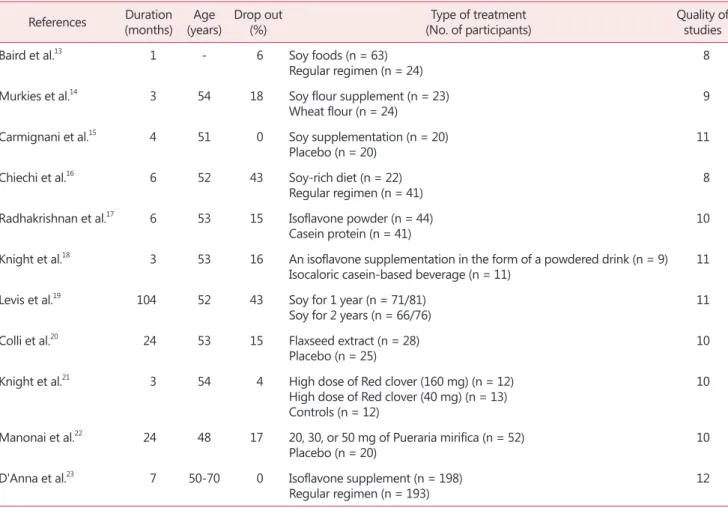
The selection process of randomized controlled trials (RCTs) for enrolling in the current meta-analysis is illustrated in Fig. 1, and the specifications of the studies have been sum-
marized in Table 1. Overall, eleven studies13~23 met our study inclusion criteria. The SMD of the of MV increased up to 0.48% (95% confidence interval [CI], 0.108-0.871; P = 0.012).
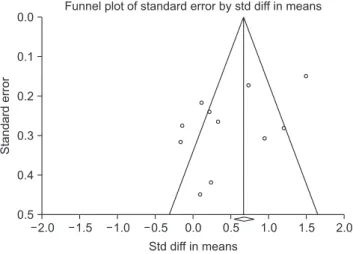
The findings revealed high degree of heterogeneity (I2 = 84%; P < 0.001) (Fig. 2). Therefore, the sensitivity analysis was carried to explore the causes of heterogeneity in cross- over trials. The individually exclusion of each study had no significant changes at the level of heterogeneity. No asym- metry was seen in the funnel plot of the trials assessing the effectiveness of herbal medicine on the of MV (Fig. 3). The absence of the publication bias was confirmed using the Eg- ger’s regression intercept test (P = 0.056) (Fig. 2). We also
Meta analysis
Manonai Pueraria mirifica D'Anna phytoesrogen genisten Knight redclover
Coli flaxseed Baird soy Murkies soy Carmignani soy Chiechi soy Radhakrishnan soy Knight soy Levis soy
Study name Statistics for each study
0.000 0.000 0.564 0.608 0.357 0.002 0.610 0.209 0.589 0.831 0.000 0.012 1.205
1.496 0.242 0.141 0.221 0.951 0.162 0.334 0.117 0.096 0.737 0.489
0.283 0.150 0.419 0.276 0.240 0.308 0.317 0.266 0.217 0.450 0.174 0.195
0.080 0.023 0.176 0.076 0.058 0.095 0.100 0.071 0.047 0.202 0.030 0.038
0.651 1.202 0.580 0.681 0.250 0.347 0.782 0.187 0.308 0.785 0.396 0.108
1.759 1.791 1.063 0.399 0.693 1.554 0.459 0.856 0.543 0.978 1.077 0.871
4.264 9.964 0.577 0.513 0.920 3.088 0.510 1.258 0.540 0.214 4.237 2.512 Std diff
in means Standard
error Variance Lower
limit
Upper
limit Z-value p-value
2.00 1.00
0.00 1.00
2.00
Control group Herbal medicine Std diff in means and 95% CI
Fig. 2. Effects of herbal medicine on vaginal epithelial cells (%). Horizontal line: 95% confidence interval (CI), ■: point estimate, ♦:
combined overall effect of treatment.
Standarderror
2.0 0.0
0.1
0.2
0.3
0.4
Std diff in means 0.5
Funnel plot of standard error by std diff in means
1.5 1.0 0.5 0.0 0.5 1.0 1.5 2.0
Fig. 3. Funnel plot of publication bias.
Journal of Menopausal Medicine 2018;24:11-16
J MM
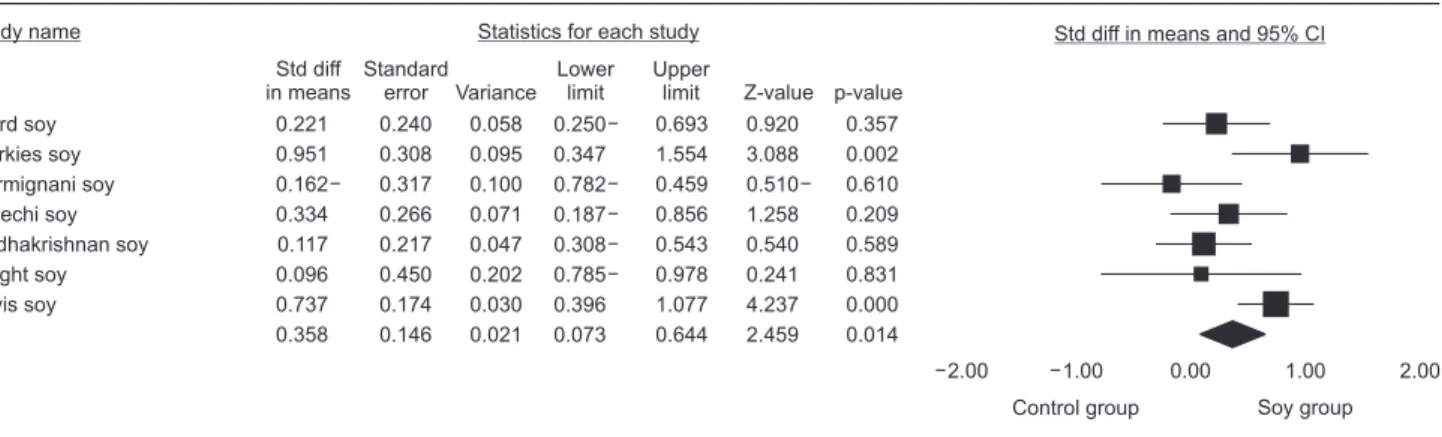
performed subgroup analysis for the women receiving soy.
The of MV showed a significant increase by 0.358% (95% CI, 0.073-0.871; P = 0.014; I2 = 53%; P = 0.052) (Fig. 4).
Discussion
This is the first meta-analysis to explore the herbal medicine effect on the VECs among menopausal women.
According to our findings, the herbal medicine has had sta- tistically significant effect on the vaginal atrophy.
The meta-analysis of several trials demonstrated that the SMD of the MV had significantly borderline increase in the soy group compared to the control group. However, hetero- geneity was high. We performed the subgroup analysis in which the meta-analysis was limited to the trials evaluating the effectiveness of the soy on the VECs, which a significant increase was found in the effect size compared to previous meta-analyses. In addition, our meta-analysis had lower (I2
= 53%) homogeneity compared to the previous investigations (I2 = 81%).10
A systematic review assessed four trials on the effective- ness of administration of topical isoflavones on vaginal at- rophy. The topical isoflavones had a beneficial effect on the vaginal atrophy. However, the authors concluded that there is a need to larger RCTs to confirm their results.24
In contrast to our meta-analysis that revealed a signifi- cant increase in the of MV, a systematic review and meta-
analysis recently performed on the effectiveness of phytoes- trogen on the of MV among menopausal women showed no significant improvement in phytoestrogen group compared to the control group 0.164% (CI, -0.419 to 0.746).25
Several limitations present in this meta-analysis included high heterogeneity, low number of trials, small sample size and methodological flaw, which are better to be addressed in the future studies. The high heterogeneity might be related to the variations and duration of treatment so that some trials did not report pre- and post-treatment means and standard deviations. In addition, no intention-to-treat has been reported in a larger portion of studies contained in the meta-analysis. The quality of trials can be improved due to further trials to follow the CONSORT guidelines.
Conclusion
According to the findings obtained from our meta-anal- ysis, the use of herbal medicines in different studies showed statistically significant positive effects on the VECs. The subgroup analysis of the patients receiving soy indicated also significant effects on the VECs. However, high heterogeneity among the trials makes ambiguous the definitive conclusions on the beneficial effects of herbal on the VECs.
Baird soy Murkies soy Carmignani soy Chiechi soy Radhakrishnan soy Knight soy Levis soy
Meta analysis
Study name Statistics for each study
0.221 0.951 0.162 0.334 0.117 0.096 0.737 0.358 Std diff in means
0.240 0.308 0.317 0.266 0.217 0.450 0.174 0.146 Standard
error 0.058 0.095 0.100 0.071 0.047 0.202 0.030 0.021 Variance
0.250 0.347 0.782 0.187 0.308 0.785 0.396 0.073 Lower
limit
0.693 1.554 0.459 0.856 0.543 0.978 1.077 0.644 Upper limit
0.920 3.088 0.510 1.258 0.540 0.241 4.237 2.459 Z-value
0.357 0.002 0.610 0.209 0.589 0.831 0.000 0.014 p-value
2.00 1.00
0.00 1.00
2.00
Control group Soy group Std diff in means and 95% CI
Fig. 4. Effects of soy on vaginal epithelial cells (%). Horizontal line: 95% confidence interval (CI), ■: point estimate, ♦: combined overall effect of treatment.
Journal of Menopausal Medicine 2018;24:11-16 Yousef Rahmani, et al. Herbal Medicine and Vaginal Epithelial Cells
Conflict of Interest
No potential conflict of interest relevant to this article was reported.
References
1. Abdi F, Mobedi H, Roozbeh N. Hops for menopausal vaso- motor symptoms: Mechanisms of action. J Menopausal Med 2016; 22: 62-4.
2. Ghazanfarpour M, Kaviani M, Abdolahian S, Bonakchi H, Najmabadi Khadijeh M, Naghavi M, et al. The relationship between women’s attitude towards menopause and meno- pausal symptoms among postmenopausal women. Gynecol Endocrinol 2015; 31: 860-5.
3. Golshiri P, Akbari M, Abdollahzadeh MR. Age at natural menopause and related factors in Isfahan, Iran. J Meno- pausal Med 2016; 22: 87-93.
4. Lee HH, Kim TH, Park J, Lee A, Park Y, Byun DW, et al.
Expression of ezrin in vagina cells of postmenopausal rats after dietary administration of omega-3 Fatty Acid for- mula. J Menopausal Med 2014; 20: 97-103.
5. Direkvand-Moghadam A, Delpisheh A, Montazeri A, Sayehmiri K. Quality of life among Iranian infertile women in postmenopausal period: A cross-sectional study. J Menopausal Med 2016; 22: 108-13.
6. Levis S, Strickman-Stein N, Doerge DR, Krischer J. De- sign and baseline characteristics of the soy phytoestrogens as replacement estrogen (SPARE) study--a clinical trial of the effects of soy isoflavones in menopausal women. Con- temp Clin Trials 2010; 31: 293-302.
7. Kim HK, Kang SY, Chung YJ, Kim JH, Kim MR. The re- cent review of the genitourinary syndrome of menopause. J Menopausal Med 2015; 21: 65-71.
8. Kaari C, Haidar MA, Junior JM, Nunes MG, Quadros LG, Kemp C, et al. Randomized clinical trial comparing conju- gated equine estrogens and isoflavones in postmenopausal women: a pilot study. Maturitas 2006; 53: 49-58.
9. Scarabin PY, Oger E, Plu-Bureau G. Differential associa- tion of oral and transdermal oestrogen-replacement ther- apy with venous thromboembolism risk. Lancet 2003; 362:
428-32.
10. Ghazanfarpour M, Sadeghi R, Roudsari RL. The application of soy isoflavones for subjective symptoms and objective signs of vaginal atrophy in menopause: A systematic review of randomised controlled trials. J Obstet Gynaecol 2016; 36:
160-71.
11. Moseley AM, Herbert RD, Sherrington C, Maher CG. Evi- dence for physiotherapy practice: a survey of the Phys- iotherapy Evidence Database (PEDro). Aust J Physiother 2002; 48: 43-9.
12. Borenstein M, Hedges LV, Higgins JPT, Rothstein HR.
Comprehensive meta-analysis. Englewood, NJ: Biostat;
2005.
13. Baird DD, Umbach DM, Lansdell L, Hughes CL, Setchell KD, Weinberg CR, et al. Dietary intervention study to as- sess estrogenicity of dietary soy among postmenopausal women. J Clin Endocrinol Metab 1995; 80: 1685-90.
14. Murkies AL, Lombard C, Strauss BJ, Wilcox G, Burger HG, Morton MS. Dietary flour supplementation decreases post- menopausal hot flushes: effect of soy and wheat. Maturitas 1995; 21: 189-95.
15. Carmignani LO, Pedro AO, Costa-Paiva LH, Pinto-Neto AM. The effect of dietary soy supplementation compared to estrogen and placebo on menopausal symptoms: a random- ized controlled trial. Maturitas 2010; 67: 262-9.
16. Chiechi LM, Putignano G, Guerra V, Schiavelli MP, Cis- ternino AM, Carriero C. The effect of a soy rich diet on the vaginal epithelium in postmenopause: a randomized double blind trial. Maturitas 2003; 45: 241-6.
17. Radhakrishnan G, Rashmi NA, Vaid NB. Evaluation of isoflavone rich soy protein supplementation for postmeno- pausal therapy. Pak J Nutr 2009; 8: 1009-17.
18. Knight DC, Howes JB, Eden JA, Howes LG. Effects on menopausal symptoms and acceptability of isoflavone- containing soy powder dietary supplementation. Climacteric 2001; 4: 13-8.
19. Levis S, Strickman-Stein N, Ganjei-Azar P, Xu P, Doerge DR, Krischer J. Soy isoflavones in the prevention of meno- pausal bone loss and menopausal symptoms: a randomized, double-blind trial. Arch Intern Med 2011; 171: 1363-9.
20. Colli MC, Bracht A, Soares AA, de Oliveira AL, Bôer CG, de Souza CG, et al. Evaluation of the efficacy of flaxseed meal and flaxseed extract in reducing menopausal symptoms. J Med Food 2012; 15: 840-5.
21. Knight DC, Howes JB, Eden JA. The effect of Promensil, an isoflavone extract, on menopausal symptoms. Climac- teric 1999; 2: 79-84.
22. Manonai J, Chittacharoen A, Theppisai U, Theppisai H.
Effect of Pueraria mirifica on vaginal health. Menopause 2007; 14: 919-24.
23. D’Anna R, Cannata ML, Atteritano M, Cancellieri F, Cor- rado F, Baviera G, et al. Effects of the phytoestrogen genistein on hot flushes, endometrium, and vaginal epi- thelium in postmenopausal women: a 1-year randomized, double-blind, placebo-controlled study. Menopause 2007;
Journal of Menopausal Medicine 2018;24:11-16
J MM
14: 648-55.
24. Ghazanfarpour M, Latifnejad Roudsari R, Treglia G, Sade- ghi R. Topical administration of isoflavones for treatment of vaginal symptoms in postmenopausal women: A systematic review of randomised controlled trials. J Obstet Gynaecol
2015; 35: 783-7.
25. Saghafi N, Ghazanfarpour M, Sadeghi R, Najarkolaei AH, Omid MG, Azad A, et al. Effects of phytoestrogens in alle- viating the menopausal symptoms: A systematic review and meta-analysis. Iran J Pharm Res 2017; 16: 99-111.