Detection of Respiratory Viruses in Children by Multiplex Reverse Transcriptase PCR, Direct Immunofluorescence
Assay, and Shell Vial Culture
Kui Hyun Yoon1, Ji Hyun Cho2
1
Department of Laboratory Medicine, Wonkwang University Sanbon Hospital, Gunpo,
2
Department of Laboratory Medicine, College of Medicine, Wonkwang University, Iksan, Korea
Background: Direct immunofluorescence assay (DFA) and shell vial culture (SVC) have been used to diag- nose respiratory viral infections. Recently a multiplex reverse transcriptase PCR (mRT-PCR) for 12 respi- ratory viruses has been introduced. We evaluated the diagnostic usefulness of these methods.
Methods: Among 275 nasopharyngeal aspirates (NPAs) received from pediatric patients during the 3-month period from May through July, 2007, 122 samples were selected so as to include diverse vi- ruses and varying numbers of DFA-positive cells for mRT-PCR. Also, the results of the 85 NPAs that had been analyzed by both DFA and SVC were reviewed retrospectively.
Results: Detection rates for the seven major respira- tory viruses, respiratory syncytial virus (RSV), influen- za virus A and B, parainfluenza virus 1, 2, and 3,
and adenovirus by DFA vs mRT-PCR were 32.0%
and 55.7%, and by DFA vs SVC were 32.9% and 40.0%. A number of adenovirus detected by DFA vs mRT-PCR were 12 and 22, and by DFA vs SVC were 6 and 18. A number of RSV detected were 3 and 6, and 13 and 8, respectively.
Conclusion: mRT-PCR detected the respiratory vi- ruses at the highest rate, followed by SVC and DFA in a decreasing order. However, DFA and multiplex PCR were more sensitive than SVC for RSV, while SVC was more sensitive than the other methods for adenovirus. (Korean J Clin Microbiol 2009;12:110- 115)
Key Words: Direct immunofluorescence assay, Shell vial culture, Multiplex PCR, Respiratroy virus
110
Received 20 February, 2009, Revised 1 June, 2009 Accepted 15 July, 2009
Correspondence: Ji Hyun Cho, Department of Laboratory Medicine, Wonkwang University Hospital, 344-2, Sinyong-dong, Iksan 570-711, Korea. (Tel) 82-63-859-1861, (Fax) 82-63-842-3786, (E-mail) cjh@
wonkwang.ac.kr
서 론
바이러스에 의한 호흡기 감염은 주로 소아, 노인, 면역저하 환자에 많은 질환이다. 주요 호흡기 감염 바이러스에는 respira- tory syncytial virus A와 B (RSVA, RSVB), influenza virus A와 B (FluA, FluB), parainfluenza virus 1, 2, 3 (PIV1, PIV2, PIV3), adenovirus (ADV) 등이 있으며, 하기도 감염으로 입원한 소아 의 40% 이상에서 이들 바이러스가 검출된다[1]. 한편, 근래 임 상적 의미가 알려진 coronavirus, human metapneumovirus (HMPV)와 함께, 과거 주로 상기도 감염의 원인으로 알려졌던 human rhinovirus (HRV)와 enterovirus도 하기도 감염에서의 중 요성이 보고되어[2-5], 주요 호흡기 바이러스 검사 대상에 포함 되어야 할 필요가 있다.
호흡기 바이러스 검사는 병원 환자군의 특성과 검사실의 상 황에 따라 적합한 검사방법의 선택이 필요하며, 항생제와 항바 이러스제 사용 및 감염관리와 관련하여 가능한 다수 호흡기 바 이러스에 대하여 감염 여부를 적절한 시간대에 임상의에게 보 고할 수 있어야 한다[6,7]. 직접면역형광법(direct immunofluo- rescence assay, DFA)과 그 외 신속 항원검사법은 경제성 및 당 일 보고가 가능하다는 점에서 많이 사용되는 방법이다. 바이러 스 배양법은 바이러스 질환의 진단에 표준방법으로서, 신속성 과 편이성을 증대시키고자 mixed cell line과 원심을 이용한 쉘 바이알법(shell vial culture, SVC)이 병원 검사실에서 사용되고 있으나 제한적이다[6,7]. 한편, 분자생물학적 방법은 민감도가 높아 배양이 불가능하거나, 낮은 농도로 존재하는 경우 표준방 법으로 인정되고 있으며, 근래에는 실시간 PCR (real time PCR) 이나 다중 역전사효소 PCR (multiplex reverse transcriptase PCR, mRT-PCR)이 도입됨으로써 다수의 바이러스에 대하여 적절한 시간대에, 정량적 보고가 가능하게 되었다[7-9].
최근 호흡기 바이러스 감염의 진단에, 기존에 사용되고 있는 배양법과 항원검출법에 더하여 분자생물학적 방법의 중요성이
Fig. 1. Electrophoresis of mRT-PCR pro- ducts for 12 repiratory viruses. Abbrevia- tions: Control, internal control; ADV, ad- enovirus; HMPV, human metapneumo- virus; 229E, coronavirus 229E/NL63;
PIV1, PIV2, PIV3, parainfluenza virus 1, 2, 3; FluA, FluB, influenza virus A, B;
RSVA, B, respiratory syncytial virus A, B; HRVA, human rhinovirus A; OC43, coronavirus OC43. M1, 100 bp size mar- ker; M2, viruses marker; NC, negative control; lane 1∼13, patients: patient 1 HRVA, patient 2 HRVA, patient 3 ADV, patient 5 PIV1, patient 7 PIV3, patient 9 RSVA, patient 10 PIV1, patient 12 ADV+RSVA, and patient 13 PIV1. Other patients were negative.
증가하고 있는데[10-12], Jennings 등[10]은 급성 호흡기 바이러 스 감염 환아의 진단에서 기존 방법으로는 검출할 수 없었던 바이러스를 PCR에 의하여 21% 추가 검출함으로써, 환아의 87%에서 원인 바이러스가 검출되었고, 중복감염률이 27%임을 보고하였다. 국내에서도 2007년 Kang 등[13]의 보고에 의하면 핵산증폭법 또는 배양법을 사용하는 검사실이 호흡기 바이러 스 검사를 실시하는 검사실의 42%를 차지하고, 최근 국내에서 는 12종 호흡기 바이러스에 대한 핵산증폭법 검사킷이 개발되 어 사용되고 있다[9,14].
이에 저자들은 소아 환자의 비인두흡인액에서 DFA, SVC와 mRT-PCR에 의한 호흡기바이러스 검출 성적을 비교함으로써 검사실에 적절한 검사방법과 진단적 유용성을 알아보고자 하 였다.
대상 및 방법
1. 연구대상2007년 5월부터 7월까지 원광의대병원에 내원한 소아 환자 중에서, 주요 호흡기 바이러스 7종에 대한 DFA 검사가 의뢰되 었던 비인두흡인액 275검체를 대상으로 하였다. 냉동 보관된 검체 중, DFA 검사결과에 따라 다양한 바이러스와 형광 반응 정도가 포함되도록 122검체를 선택하여 mRT-PCR 검사를 실시
하였으며, 검사실 정보시스템에서 SVC와 DFA가 동시에 의뢰 된 85검체에 대한 바이러스 검출률을 후향적으로 조사하였다.
2. 방법
1) 호흡기 바이러스 검출을 위한 비인두흡인액 처리: 식염수 와 함께 채집된 비인두흡인액 10 mL을 380 g에서 5분 원심하 여 최종 4 mL을 남기고 상층을 제거한 후, 1.2 mL은 SVC, 2.5 mL은 DFA에 사용하고, 0.2 mL은 mRT-PCR을 위하여 −70oC 에 보관하였다.
2) DFA를 이용한 호흡기 바이러스 검출: 검사대상은 주요 호흡기 바이러스 7종, 즉 RSV, FluA, FluB, PIV1, PIV2, PIV3 과 ADV이었다. D3 DFA Screening & ID kit (Diagnostic Hybrid Inc., Athens, OH, USA)을 이용하였으며, 각 바이러스 에 대한 항체가 섞인 선별항체에 양성인 경우 각각의 항체로 동정하였다[15,16]. mRT-PCR 검체로서는 형광 염색 시 100배 시야에서 2개 이상의 양성 세포가 관찰된 검체를 선택하였다.
3) mRT-PCR을 이용한 호흡기 바이러스 검출: cDNA 합성은 random hexamer (RevertAidTM First Strand cDNA Synthesis Kit, Fermentas Co., Ontario, Canada)를 사용하였다. 호흡기 바 이러스 12종 검출을 위한 mRT-PCR은 SeeplexTM RV detection kit (SeeGene Inc., Seoul, Korea)를 이용하여 2 set [set A: ADV, HMPV, coronavirus 229E/NL63 (229E), PIV1, PIV2, PIV3; set
Table 1. Detection of 7 major respiratory viruses in nasopharyngeal aspirates (n=122) by DFA and mRT-PCR methods
DFA mRT-PCR
ADV 11 20 (PIV3)*
FluA 10 12 (ADV)*
FluB 1 4
PIV1 5 8 (PIV3)*
PIV2 0 1
PIV3 9 17 (PIV2)*
RSV 3 (ADV)* 6 (ADV)*
Negative 83 54
*Include 1 case of mixed infection with the virus within the parenthesis.
Abbreviations: ADV, adenovirus; Flu, influenza virus A, B; PIV, parainfluenza virus 1, 2, 3; RSV, respiratory syncytial virus.
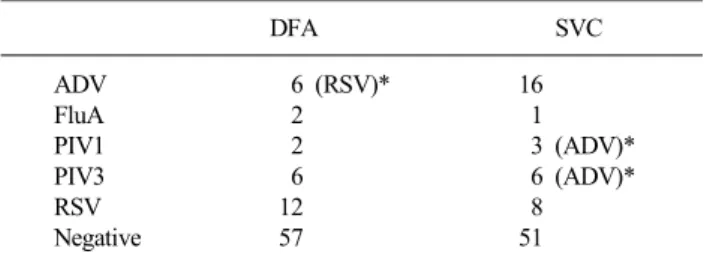
Table 2. Detection of 7 major respiratory viruses in nasopharyngeal apirates (n=85) by shell vial culture (SVC) and direct immunofluo- rescence assay (DFA)
DFA SVC
ADV 6 (RSV)* 16
FluA 2 1
PIV1 2 3 (ADV)*
PIV3 6 6 (ADV)*
RSV 12 8
Negative 57 51
*Include 1 case of mixed infection with the virus within the parenthesis.
Abbreviations: See Table 1.
B: FluA, FluB, RSVA, RSVB, human rhinovirus A (HRVA), co- ronavirus OC43 (OC43)] 실시하였으며, 2% 한천 겔에 전기영 동하여 확인하였다(Fig. 1).
4) SVC를 이용한 호흡기 바이러스 검출: 비인두흡인액 1.2 mL을 수송배지 3 mL에 넣고 세차게 진탕 혼합하여 1,500 g에 서 30분 동안 원심하였다. 상층 300μL를 배양 세포(R-mix ReadyCell, Diagnostic Hybrid Inc., Athens, OH, USA)에 넣고, 700 g에서 45분 동안 원심하여 세포 표면에 흡착되도록 하였으 며, 이후 CO2 배양기에서 37oC, 48시간 배양하였다. 주요 호흡 기 바이러스 7종에 대하여 DFA 검사와 동일한 방법으로 동정 하였다.
5) 통계처리: 호흡기 바이러스 검출방법의 검출률 차이는 SPSS 11.5 (Statistical Package for Social Science, Chicago, IL, USA)를 이용하여 Fisher exact test를 실시하였다.
결 과
1. DFA와 mRT-PCR의 비교122검체를 대상으로 주요 호흡기 바이러스 7종에 대한 검사 에서 DFA는 39검체(32.0%)에서 양성을 나타냈고 mRT-PCR에 서는 68검체(55.7%)가 양성을 보여 mRT-PCR에서 보다 높은 검출률을 보였다(P=0.0001, Table 1). 이 외에 DFA 검사항목에 는 포함되지 않았으나 mRT-PCR에서는 검사가 가능하였던 5종 의 호흡기 바이러스에 대해서도 21검체(17.2%)에서 양성을 나 타내었다.
2. DFA와 SVC의 비교
DFA와 SVC가 동시에 실시된 85검체에서, SVC에서는 34 검체(40.0%)에서 양성을, DFA에서는 28검체(32.9%)에서 양 성을 나타내었다(P=0.0001). ADV의 경우에는 SVC가 DFA보 다 3배 높은 반면, RSV의 경우에는 DFA가 SVC보다 1.5배 높
았다(Table 2).
고 찰
호흡기 바이러스 검출률에 대하여 Henrickson 등[1]은 mRT- PCR 31%, 전통적 배양 16.2%와 EIA를 이용한 항원검사법이 26.9%임을 보고하였으나, Dunn 등[17]은 DFA 음성 검체의 87.1%에서 R-mix 배양에 양성임을 보고한 바 있다. 즉, 바이러 스 검출률은 대상 환자와 검출방법 및 대상 바이러스에 따라 다를 수 있으나, 일반적으로 예민도는 핵산증폭방법, 배양법 및 항원검사법 순으로 감소하는 것으로 알려져 있다[10-12,17-20].
본 연구에서도 주요 호흡기 바이러스 7종에 대한 검출률은, DFA와 mRT-PCR에서 32.0%와 55.8%, DFA와 SVC에서 각각 32.9%와 40.0%를 나타내어, mRT-PCR, SVC, DFA 순으로 검 출률이 감소함을 확인할 수 있었다. 특히, 본 실험에서 각 방법 에 사용된 검체량이 mRT-PCR은 DFA의 1/10 (0.2/2.5 mL), SVC는 절반(1.2/2.5 mL)에 미치지 못한 점을 감안하면, 검출 예민도의 차이는 매우 크다 할 것이다. 이는 mRT-PCR이 바이 러스의 생존과 검체보존 및 검체량 등에 의한 제약을 적게 받 으면서, 대상 핵산을 효율적으로 증폭할 수 있다는 장점이 있 기 때문인 것으로 생각된다. 주요 호흡기 바이러스 7종 이외의 바이러스를 포함할 경우 검체의 73.0%에서 mRT-PCR 양성을 나타냈는데 DFA와 SVC에서 사용 가능한 항체 종류와 비용을 생각할 때 mRT-PCR의 높은 예민도와 다양한 바이러스 검출 능은 매우 중요한 장점으로 생각되었다.
본 연구에서는 검사 방법에 따라 ADV와 RSV 검출률에 차 이가 관찰되었다. 각 방법의 비교에서 ADA의 검출에 있어 mRT-PCR과 SVC가 DFA보다 검출 예민도가 높았는데 이는 본 연구에서 3가지 검사가 동시에 실시된 69검체 중 ADV가 검출 된 경우는 18검체이었는데, SVC 17검체, mRT-PCR 11검체, DFA 6검체인 결과에서도 확인할 수 있었다(data not shown).
Arnold 등[12]은 DFA에 음성 59검체에서 PCR을 이용하여
ADV를 검출하였고 Landry와 Ferguson[16]은 전통적 배양에 의해서 ADV가 분리된 19검체에서 11검체(57.9%) 만이 DFA 양성임을 보고한 바 있다. 즉, DFA에 의한 ADV 검출은 일반적 으로 예민도가 특히 낮아, ADV 감염이 의심되는 경우에는 배 양법을 함께 사용할 것을 권장하고 있다[11]. 그러나 배양과 PCR을 비교함에 있어 Jennings 등[10]은 전통 배양법에 의한 1 건 양성과 PCR에 의한 10건 양성예를 보고하였고, Freymuth 등[20]은 FluA와 ADV의 검출에서 PCR과 전통적 배양의 차이 를 관찰할 수 없었다고 보고하고 있어 보다 많은 검체에서의 확인이 필요할 것으로 생각되었다.
RSV 경우 DFA에서 8주, SVC에서 13주가 검출되어 SVC가 높은 예민도를 나타내었으나 mRT-PCR과 DFA의 비교에 있어 서는 양성 검체수가 적어 검출 예민도를 판단할 수 없었다.
Dunn 등[17]은 RSV 양성검체에서 DFA 양성률 94%, R-Mix 배 양 27%를 보고하였고 Landry와 Ferguson[16]도 호흡기 바이러 스 중에서 RSV에 대한 검출률을 DFA 99%, 배양 58.4%로 보 고하였는데, 이는 RSV의 환경 노출에 대한 취약성 때문에 검 체의 적절한 조작과 신속한 접종을 필요로 하기 때문이다[11].
따라서 RSV가 유행하는 시기의 호흡기 바이러스 배양에서 검 체조작 단계에 보다 주의가 필요할 것으로 생각되었다.
본 연구에서 mRT-PCR에 사용한 시발체는 DPO (dual pri- ming oligonucleotide system) 기술을 적용하여, 일반적인 시발 체에 비하여 예민도가 높을 뿐만 아니라 특이도도 높은 것으로 보고되었다[9,14,21,22]. Yoo 등[14]은 호흡기 바이러스에 대하 여 DPO 시발체를 사용한 mRT-PCR과 DFA에 의한 검출률을 각각 56.0%와 33.0%로 보고하였으며, Roh 등[9]은 하기도 감 염 환자의 비인두흡인액에서 mRT-PCR과 R-mix 배양법을 비 교하여 50검체 중 40검체에서 동일한 결과를 보였으나 1검체 에서 배양 양성, mRT-PCR 음성이었던 데 비하여, 나머지 9검 체는 배양 음성, mRT-PCR 양성을 보고하였다. 한편, Sung 등 [22]은 SeeplexTMRV 키트 검사에 HRVA, HMPV, OC43가 검출 된 47검체의 증폭산물 염기서열이 모두 해당 바이러스와 일치 함을 보고함으로써 본 방법의 특이도를 확인하였다. 본 연구에 서도 비인두흡인액에는 다양한 종류의 핵산이 존재할 것으로 추정됨에도 불구하고, 대부분의 검체에서 전기영동상이 매우 깨끗하여, 일반적으로 알려져 있는 mRT-PCR의 단점인 비특이 적 밴드 생성과 예민도 감소를 DPO 기술이 보완하는 것으로 판단되었다(Fig. 1).
한편, 호흡기 바이러스의 중복감염률은 DFA와 PCR에서 높 으며, 일반 세균감염과는 달리 면역이 억제되지 않은 환자에서 도 5∼10%, 면역억제 환자에서는 10% 이상에 이를 것으로 보 고되었으며, RSV, ADV와 FluA 빈도가 높았다[10,11,23,24].
mRT-PCR을 이용한 경우 중복감염률은 Yoo 등[14]은 8.0%, Jennings 등[10]은 27%로 보고하였으며, 이는 실제 중복감염과 감염 후에도 존재하는 바이러스 핵산을 검출한 경우를 포함한
것으로 추정되고 있다. 본 연구에서도 19검체에서 중복감염이 검출되었는데, ADV와 PIV 중복감염 2검체는 SVC에 의하여 확인되었고, ADV와 RSV 중복감염 1검체는 DFA와 mRT-PCR 에 의하여 확인할 수 있었으나, 나머지 16검체는 mRT-PCR에 서만 검출되었다. 본 연구의 중복감염에서 검출된 바이러스는 모두 40주로써 HRVA 10주, ADV 9주, PIV3 6주, HMPV 5주, FluA 3주, PIV1 2주, RSV 2주, FluB, PIV2과 OC43 각각 1주였 다. 최근까지도, 호흡기 바이러스 중복감염의 임상적인 의미는 정립되어 있지 않으며, 호흡기 바이러스의 중복감염은 해당 바 이러스의 특성일 수도 있으나, 먼저 이에 대하여 실시간 PCR 이나 염기서열 분석 등의 방법으로 확인되어야 할 것으로 판단 되었다[24].
현재까지 호흡기 바이러스 검출에 바이러스 배양이 표준 방 법이지만 배양시설이 없는 경우이거나, 배양이 되지 않거나 증 식이 현저히 느린 바이러스의 경우 분자생물학적 방법이 권장 된다. 그러나 분자생물학적 방법도 고비용뿐만 아니라, 국가기 관에서 진단목적으로 인정된 상품화된 제품이 많지 않고, 실제 감염과 잠복감염 및 불활성화 상태의 구분이 불가능하며, 표준 화가 완벽하지 못하고, 특히 위양성에 대한 확인이 어렵기 때 문에 제한적으로 사용되고 있다[11,25]. 근래에 SVC[11]는 조 기보고가 가능하지만, Carman[7]은 높은 예민도를 나타내는 분 자생물학적 검사법에 의한 음성결과의 조기보고가 임상의에게 양성결과 못지않게 중요함을 강조하였으며, Freymuth 등[20]은 대상 바이러스가 다수이며 조기 보고가 가능한 mRT-PCR과 예 민도는 낮으나 신속보고가 가능한 DFA를 함께 이용하는 방법 을 강조한 바 있다. 본 연구에서 mRT-PCR의 임상 적용에 있어 일부 검체에서 ADV가 검출되지 않은 점, SVC나 DFA로 확인 되지 않은 약한 밴드가 관찰되는 경우, 특히 중복감염 양상으 로 밴드가 2개 이상 관찰될 때에는, 판정에 주의가 필요할 것으 로 생각되었다.
결론적으로, 호흡기 바이러스 검출에 있어서, DFA는 적절한 검체의 질 및 양과 판독자의 높은 숙련도가 요구되나, 술기가 비교적 간단하여 당일 보고가 가능하며, RSV 검출률이 높았 다. mRT-PCR은 기술적 난이도가 높고 고가이었으나, 검체 요 구조건은 덜 까다롭고, 대상 바이러스가 가장 많고 예민도가 높았다. SVC는 검체 요구조건과 기술적 난이도가 높으나, ADV 검사성적이 가장 좋았다. 따라서, 병원환경에 따라 적절 한 방법을 선택하여야 할 것으로 생각되었다.
감사의 글
본 연구는 2007년도 원광대학교 교내연구비 지원으로 수행 되었음.
참 고 문 헌
1. Henrickson KJ, Hoover S, Kehl KS, Hua W. National disease burden of respiratory viruses detected in children by polymerase chain reaction. Pediatr Infect Dis J 2004;23:11S-8S.
2. Larson HE, Reed SE, Tyrrell DA. Isolation of rhinoviruses and coronaviruses from 38 colds in adults. J Med Virol 1980;5:221-9.
3. Kwak YH, Choi EH, Lee HJ. Detection of rhinovirus from children with lower respiratory tract infections by reverse transcription polymerase chain reaction. Infect Chemother 2003;49:1-11.
4. Chung JY, Han TH, Kim SW, Hwang ES. Respiratory picornavirus infections in Korean children with lower respiratory tract infec- tions. Scand J Infect Dis 2007;39:250-4.
5. van den Hoogen BG, de Jong JC, Groen J, Kuiken T, de Groot R, Fouchier RA, et al. A newly discovered human pneumovirus isol- ated from young children with respiratory tract disease. Nat Med 2001;7:719-24.
6. Ogilvie M. Molecular techniques should not now replace cell cul- ture in diagnostic virology laboratories. Rev Med Virol 2001;11:
351-4.
7. Carman B. Molecular techniques should now replace cell culture in diagnostic virology laboratories. Rev Med Virol 2001;11:347-9.
8. Niesters HG. Molecular and diagnostic clinical virology in real time. Clin Microbiol Infect 2004;10:5-11.
9. Roh KH, Kim J, Nam MH, Yoon S, Lee CK, Lee K, et al. Com- parison of the Seeplex reverse transcription PCR assay with the R-mix viral culture and immunofluorescence techniques for detec- tion of eight respiratory viruses. Ann Clin Lab Sci 2008;38:41-6.
10. Jennings LC, Anderson TP, Werno AM, Beynon KA, Murdoch DR. Viral etiology of acute respiratory tract infections in children presenting to hospital: role of polymerase chain reaction and de- monstration of multiple infections. Pediatr Infect Dis J 2004;23:
1003-7.
11. Leland DS and Ginocchio CC. Role of cell culture for virus detec- tion in the age of technology. Clin Microbiol Rev 2007;20:49-78.
12. Arnold JC, Singh KK, Spector SA, Sawyer MH. Undiagnosed respiratory viruses in children. Pediatrics 2008;121:e631-7.
13. Kang JO, Kim EC, Lee KM, Lee NY, Lee CK. Surveillance for respiratory virus testing situation in Korea and epidemiology for the respiratory viruses detected in 5 university hospitals -Report
from virus study group. Korean J Clin Microbiol 2007;10:102-8.
14. Yoo SJ, Kuak EY, Shin BM. Detection of 12 respiratory viruses with two-set multiplex reverse transcriptase-PCR assay using a dual priming oligonucleotide system. Korean J Lab Med 2007;27:420-7.
15. Matthey S, Nicholson D, Ruhs S, Alden B, Knock M, Schultz K, et al. Rapid detection of respiratory viruses by shell vial culture and direct staining by using pooled and individual monoclonal antibodies. J Clin Microbiol 1992;30:540-4.
16. Landry ML and Ferguson D. SimulFluor respiratory screen for rapid detection of multiple respiratory viruses in clinical specimens by immunofluorescence staining. J Clin Microbiol 2000;38:708-11.
17. Dunn JJ, Woolstenhulme RD, Langer J, Carroll KC. Sensitivity of Respiratory virus culture when screening with R-mix fresh cells. J Clin Microbiol 2004;42:79-82.
18. Hindiyeh M, Hillyard DR, Carroll KC. Evaluation of the Prodesse Hexaplex multiplex PCR assay for direct detection of seven respi- ratory viruses in clinical specimens. Am J Clin Pathol 2001;116:
218-24.
19. Kehl SC, Henrickson KJ, Hua W, Fan J. Evaluation of the Hexa- plex assay for detection of respiratory viruses in children. J Clin Microbiol 2001;39:1696-701.
20. Freymuth F, Vabret A, Cuvillon-Nimal D, Simon S, Dina J, Legrand L, et al. Comparison of multiplex PCR assays and conventional techniques for the diagnostic of respiratory virus infections in children admitted to hospital with an acute respiratory illness. J Med Virol 2006;78:1498-504.
21. Chun JY, Kim KJ, Hwang IT, Kim YJ, Lee DH, Lee IK, et al.
Dual priming oligonucleotide system for the multiplex detection of respiratory viruses and SNP genotyping of CYP2C19 gene. Nucleic Acids Res 2007;35:e40.
22. Sung H, Park SJ, Woo YD, Choi BH, Kim MN. Evaluation of Seeplex RV detection kit for detecting rhinovirus, human meta- pneumovirus and coronavirus. Korean J Lab Med 2008;28:109-17.
23. Waner JL. Mixed viral infections: detection and management. Clin Microbiol Rev 1994;7:143-51.
24. Pierangeli A, Gentile M, Di Marco P, Pagnotti P, Scagnolari C, Trombetti S, et al. Detection and typing by molecular techniques of respiratory viruses in children hospitalized for acute respiratory infection in Rome, Italy. J Med Virol 2007;79:463-8.
25. Rabenau HF, Kessler HH, Kortenbusch M, Steinhorst A, Raggam RB, Berger A. Verification and validation of diagnostic laboratory tests in clinical virology. J Clin Virol 2007;40:93-8.
=국문초록=
소아에서 다중 역전사효소 PCR법, 직접면역형광법, 쉘바이알배양법을 이용한 호흡기 바이러스의 검출
1원광대학교 산본병원 진단검사의학과, 2원광대학교 의과대학 진단검사의학교실 윤귀현1, 조지현2
배경: 호흡기 바이러스 감염의 진단에는 직접면역형광법(direct immunofluorescence assay, DFA), 쉘바이알배양법(shell vial culture, SVC) 등이 이용되었다. 최근 12종 호흡기 바이러스를 동시에 검출할 수 있는 다중 역전사효소 PCR (multiplex reverse transcriptase PCR, mRT-PCR)이 도입되어, 이들의 진단적 유용성을 알아보고자 하였다.
방법: 2007년 5월부터 7월까지 원광의대병원에 내원한 소아 환자에서 의뢰된 비인두흡인액 275검체에서, DFA 검사결과 에 따라 다양한 바이러스와 형광 반응 정도가 포함되도록 122검체를 선택하여 상품화된 킷를 이용하여 mRT-PCR을 실 시하였다. 연구기간 중 검사실 정보시스템을 이용하여 SVC와 DFA가 동시에 의뢰된 85검체에서의 바이러스 검출률을 후향적으로 조사하였다.
결과: 주요 호흡기 바이러스 7종(adenovirus, influenza virus A와 B, parainfluenza virus 1, 2와 3, RSV)에 대한 검출률은, DFA와 mRT-PCR에서 각각 32.0%와 55.7%, DFA와 SVC에서 32.9%와 40.0%였다. Adenovirus는 DFA에서는 12주, mRT-PCR에서는 22주가 검출되었고, DFA와 SVD의 비교에서는 각기 6주와 18주가 검출되었다. RSV는 DFA와 mRT- PCR 비교에서 3주와 6주, DFA와 SVC 비교에 각각 13주와 8주가 검출되었다.
결론: 호흡기 바이러스 검출률은 mRT-PCR, SVC, DFA 순이었으며, adenovirus 검출에는 SVC가, RSV는 mRT-PCR과 DFA 가 우수하였다. [대한임상미생물학회지 2009;12:110-115]
교신저자 : 조지현, 570-711, 전북 익산시 신용동 344-2 원광대학교병원 진단검사의학과
Tel: 063-859-1861, Fax: 063-842-3786 E-mail: [email protected]