339
성인의 구강위생용품에 관한 지식수준과 사용태도 조사
윤현서 †
인제대학교 대학원
A Study on Knowledge and Use of Oral Hygiene Devices among Adults
Hyun-Seo Yoon
†Department of Public Health, Graduate School, Inje University, Busan (614-165), Korea
Abstract The purpose of this study was to examine the knowledge of some adults about oral hygiene devices and their use of the oral hygiene devices. After a survey was conducted from December 3 to 17, 2007, the answer sheets from 352 respondents were gathered, and the collected data were analyzed with a SPSS Ver. 17.0 program. The findings of the study were as follows. 1. Concerning the level of knowledge, the adults investigated knew the best that a toothbrush should be kept by making the head upward (76.77). On the other hand, they had little knowledge on water pick, tongue cleaner and interdental brush. 2. As for the level of use, they scored highest on keeping their toothbrushes by making the head upward(76.77), In contrast, they scarcely put water pick, electronic toothbrushes, tongue cleaner to use. 3.
Knowledge impact of general characteristics involving male(62.54), 50s over(66.28) and up, four family members(61.54), graduate school graduate(66.78), self-employed and, professionals(63.63), income of 1 to 1.5 million won(66.66), fathers were smokers(51.89) got the highest marks with a mean. 4. Use impact of the general characteristics female(47.70), 40s over 49s under(47.78), four family members(48.18), graduate school graduate(50.17), professionals(49.79), income of 1 to 1.5 million won(51.89), fathers were smokers(48.10) got the highest marks with a mean.
Key words Dental floss, Interdental brush, Level of use, Level of knowledge, Oral hygiene devices
서 론
우리나라 국민의양대구강질환은치아우식증과치주질 환을들수 있다
.
이를예방하기위해서는환경요인과 숙 주요인및 병원체요인중한가지를제거하거나두가지 이상의요인이 상호 작용하는 기구를차단함으로써 가능 하다1).
치아우식증과치주질환을발생시키는주요원인은치태
(plague)
이며,
이 치태(plague)
는 치은면과 치아표면에24
시간 안에 형성되고 초기 치태
(plague)
형성은 치태(plague)
의침착을가속화시켜1
주일이경과하면다른치아와 치아 표면에도 치태
(plague)
가 형성되며,
계속해서제거되지 않고 방치되면 치태
(plague)
는 석회화 과정을거쳐 치석이 되고
,
이러한 치석은 치주질환을 더욱 가속화시켜구강건강을악화시킨다2)
.
구강내치면세균막을조절하는데는칫솔질이가장효 율적이나
,
칫솔질만으로는완벽한관리를 할 수 없고,
환자에 따라서는 각 개인에 적합한보조구강위생용품을 적 절히 사용함으로써 치면세균막 관리는물론 치간 청결이 나치은맛사지등의효과를높일수있다3)
.
현재 국내에서는 약
200
여종의 다양한 칫솔과40
여종 의 세치제그리고 치간칫솔,
치실,
혀 클리너등을 포함한
10
여종이넘는 구강위생용품이 판매되고 있다4).
효율 적인 구강위생관리를 위해서는 개인의 연령과 구강건강 상태를 고려하여 구강위생용품을 선택하여 사용하는 것 이좋다.
Glickman
이1965
년에20
세 이상의 미국 성인1,434
명을 대상으로조사하였던 결과 칫솔질과 치주질환과의관 계를인지하고 있는사람은
14%
에불과하였으며5),
백6)은한국인의 구강보건실태를조사검토하고평균일인당매 일 칫솔질 횟수가 증가 되고 있으나 치아우식경험 정도 역시증가되고있음을지적하며
,
포괄적인 예방대책과적 절한구강위생용품의사용이필요하다고역설하였다.
장7)은 칫솔질 횟수가많을수록
,
식전보다 식후에 칫솔질하 는 아동이 치아우식경험치지수가 적어짐을 보고했고,
이 등8)은칫솔질이 치아우식증 예방실천방법에서 최우선으 로의존되고있다고보고하였다.
†
Corresponding author Tel: 051-703-8433
E-mail: [email protected]
서울 시민의
93.3%
가가정구강보건행위로칫솔질을하고있으나
,
이쑤시개를제외한보조구강위생용품의사용 이매우낮은것으로조사되어일반치과의사들이구강환 경관리교육과구강위생용품이용이하게구입사용할수 있어야 한다고 주장하였다.
또한 치면세균막관리는 우선 칫솔을 포함한 기계적인 방법을 사용하여구강을 청결히 하는것부터시작되며,
여기에서는칫솔질습관,
방법,
횟수,
시기
,
구강위생보조용품의사용에따라큰차이가있다9).
치간 세정은 치아와 치아 사이를 닦는 행위를 말한다
.
일반적으로 치은염은 치간 유두에서부터 발생되어 치주 질환으로진행된다
.
이러한치은염은어떠한원인으로치 아와치아 사이에 공간이생겨 불결한경우에더욱 자주 발생된다.
따라서칫솔질을 함과아울러치간을세정하여 야 한다.
치간유두염의 발생률이칫솔질로서6.6%
감소 되었으나,
칫솔질을 함과 아울러 칫솔 자루의 끝에 부착되어있는고무원추로치간을세정하였을경우
26.3%
나 감소되었다고Glickman R
10)은 보고하였다.
확실히 치간세정은치간유두염의발생률을감소시킨다고볼수있다
.
이렇듯 구강위생용품과 보조용품을 함께 사용함으로써 구강환경관리가 보다 효과적임을 알 수 있다
.
김11)과 장 등12)은 구강환경관리용품에 대한 정보제공 및 교육의 필 요성을 주장하였고,
허 등13)은 개인치과의원에서 환자에대한 칫솔질 교습이 한정 되어 있으므로 식이조절
,
불소 용액양치,
치실사용 등에 관한 교육을 강화할 필요가 있 다고 주장하였다.
이렇게 많은 선행 연구 논문들에서 단 순한 칫솔질만 으로는 구강위생관리에 부족함을 역설하 였고,
구강위생보조용품에 대하여 적극적인 활용과 교육 이필요함을주장하고있다.
따라서본연구에서는C
지역성인들을 대상으로 구강위생용품에 대한 지식수준과 사 용태도에 대하여 조사 분석함으로써 구강위생용품에 관 한교육과활용에관한기초자료로제시하고자하였다
.
연구대상 및 방법 1. 연구대상
C
지역에거주하는성인을대상으로2007
년12
월3
일부터
17
일까지설문조사하여383
명중부적절한 설문지31
부를제외한
352
명을대상으로하였다.
2. 연구방법 및 내용
설문지는 김 등14)의 선행연구의 설문을 참고하여 연구 의목적에맞게수정하였으며
,
자기기입식에의한설문방법을 실시하였다
.
내용은 일반적인 특성7
문항과구강위 생용품의지식11
문항,
사용태도11
문항으로총29
문항으로구성되었다
.
3. 자료분석
수집된 자료의 분석은
SPSS version 17.0 for window
프로그램을이용하여일반적특성의빈도분석과백분율 을 조사하였으며
,
지식문항과 사용태도 문항의 응답을5
점척도로하여
100
점만점으로환산하였고,
점수가높을수록 구강위생용품에 관한지식과 사용태도가 좋은 것으 로 평가하였다
.
일반적 특성에 따른 지식과 사용태도의 비교는T-test(
검증)
및One-way ANOVA(
일원변량분석)
를실시하였다
.
결 과
1. 연구대상의 일반적 특성
연구대상자의인구사회학적 특성은
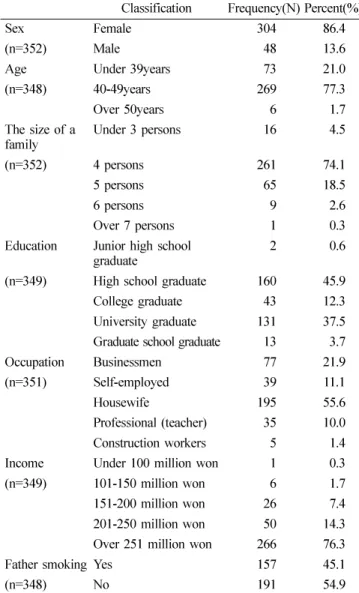
Table 1
과같다.
연구 대상자는총
352
명중 남자48
명(13.6%),
여자304
명(86.4%)
이었고,
연령은39
세 이하21.0%, 40-49
세 이하77.3%, 50
세 이상1.7%
였다.
가족 수는4
명74.1%
로가장 많았고
, 5
명18.5%, 3
명 이하4.5%
순으로 나타났으며
,
학력은고졸이45.9%
로가장많았고,
대졸37.5%,
전문대졸
12.3%
순으로나타났다.
직업은주부55.6%
로가Table 1. General characteristics
Classification Frequency(N) Percent(%)
Sex Female 304 86.4
(n=352) Male 48 13.6
Age Under 39years 73 21.0
(n=348) 40-49years 269 77.3
Over 50years 6 1.7
The size of a
family Under 3 persons 16 4.5
(n=352) 4 persons 261 74.1
5 persons 65 18.5
6 persons 9 2.6
Over 7 persons 1 0.3
Education Junior high school
graduate 2 0.6
(n=349) High school graduate 160 45.9
College graduate 43 12.3
University graduate 131 37.5 Graduate school graduate 13 3.7
Occupation Businessmen 77 21.9
(n=351) Self-employed 39 11.1
Housewife 195 55.6
Professional (teacher) 35 10.0
Construction workers 5 1.4
Income Under 100 million won 1 0.3
(n=349) 101-150 million won 6 1.7
151-200 million won 26 7.4
201-250 million won 50 14.3
Over 251 million won 266 76.3
Father smoking Yes 157 45.1
(n=348) No 191 54.9
장많았고회사원
21.9%,
자영업11.1%
순으로 나타났고,
경제적 수준은
250
만원 이상이76.3%
로 가장 높았으며,
아버지의 흡연여부에서는
‘
아니오’
가54.9%
로 다소 높게 나타났다.
2. 구강위생용품의 지식 정도
구강위생용품에대한지식수준결과는
Table 2
와 같다.
구강위생용품 지식수준은
“
칫솔머리는 위로 향해 보관해야 한다
.” 76.77
점으로 가장 높았으며“
칫솔질 할 때 혀도닦아야한다
.” 74.86
점, “
일반칫솔의올바른사용방법을알고있다
.” 71.84
점순으로나타났다.
Table 2. Knowledge on oral hygiene devices
Item Mean
Know about the right use of a general toothbrush. 71.84 Know about the types of interdental brushes. 52.04 Know about the use of mouth rinse. 56.95 Know about the use of dental floss. 56.41 Know about the use of a tongue cleaner. 48.45 Know about the use of water pick. 38.31 Know about how to do toothbrushing. 58.66 Know that in relation to the parts for toothbrushing,
the gums, teeth and tongue should be all brushed. 71.82 Know that the tongue should be cleaned as well. 74.86 Does toothbrushing for three minutes each. 68.27 The head of a toothbrush should be upward when
it is kept. 76.77
Table 3. Practice attitude on oral hygiene devices
Item Mean
Use a general toothbrush. 74.07
Use an electronic toothbrush. 28.92
Use an interdental brush. 38.43
Use mouse rinse. 36.65
Use dental floss. 33.26
Use a tongue cleaner. 31.61
Use of water pick. 26.21
Do toothbrushing in a manner appropriate for my
mouth. 51.07
Brush my teeth, gums and tongue in the right way. 58.74 Brush my tongue as well as teeth. 69.92 The toothbrush is kept by making the head upward. 76.77
Table 4. Relationship of general characteristics oral hygiene devices knowledge.
Classification N M SD t/F p
Sex Female 296 61.01 13.01 .343 .464
(n=342) Male 46 62.54 14.29
Age Under 39years 67 61.32 13.28 .446 .641
(n=338) 40-49years 265 61.13 13.30
Over 50years 6 66.28 8.43
The size of a family Under 3persons 16 59.09 9.95 .381 .501
(n=342) 4persons 254 61.52 13.39
5persons 64 61.01 13.30
6persons 8 57.67 11.83
Education Junior high school graduate 2 59.09 3.21 1.26 .282
(n=339) High school graduate 152 60.22 13.30
College graduate 43 59.46 13.95
University graduate 129 62.43 12.73
Graduate school graduate 13 66.78 14.74
Occupation Businessmen 73 59.58 12.84 .917 .454
(n=341) Self-employed 38 63.63 14.15
Housewife 190 60.96 12.84
Professional (teacher) 35 63.63 13.94
Construction workers 5 62.27 18.08
Income Under 100 million won 1 54.54 - .785 .535
(n=339) 101-150 million won 6 66.66 14.91
151-200 million won 24 58.04 11.31
201-250 million won 47 60.29 11.18
Over 251 million won 261 61.64 13.67
Father smoking Yes 151 61.55 13.75 .435 .675
(n=338) No 187 60.95 12.81
반면 가장 평점이 낮은 것은
“
물 사출기의 사용방법을알고있다
.” 38.31
점, “
혀 클리너의 사용법을알고 있다.”
48.45
점, “
치간 칫솔 종류를 알고 있다.” 52.04
점 순으로낮게나타났다
.
이는 물사출기,
혀클리너,
치간칫솔등 에대한지식수준이낮음을알수있었다.
3. 구강위생용품의 사용태도 정도
구강위생용품에 대한사용태도 결과는
Table 3
과같다.
“
칫솔머리를 위로 향하게 보관한다.” 76.77
점으로 가장 높았으며“
일반 칫솔을사용하고 있다.” 74.07
점, “
칫솔질할때혀도닦는다
.” 69.92
점순서로나타났다.
반면평점이 가장낮은 순서를 살펴보면
“
물 사출기의 사용방법을알고있다
.” 26.21
점, “
진동칫솔을 사용하고있다.” 28.92
점
, “
혀 클리너의 사용하고 있다.” 31.61
점 순서로 낮게나타났다
.
이는 물 사출기,
혀 클리너,
전동칫솔에 대한사용정도가낮은것으로나타났다
.
4. 일반적 특성에 따른 구강위생용품 지식 정도
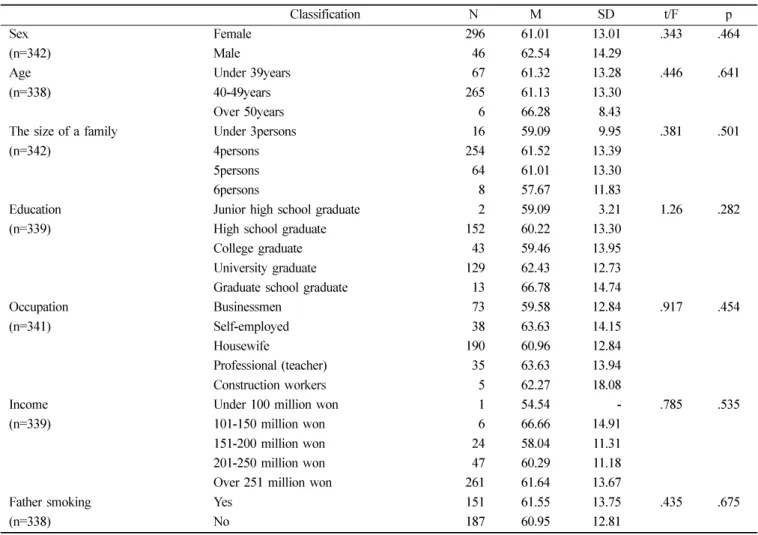
일반적인 특성에따른구강위생용품에대한지식수준을살펴보면
Table 4
와같다.
성별에서는남자62.54
점,
연령은
50
세 이상66.28
점,
가족 수4
명61.52
점,
대학원 졸66.78
점,
자영업과 전문직이63.63
점,
경제수준이101-
150
만원66.66
점,
아버지의 흡연여부에서는‘
예’
가61.55
점으로 가장높게 나타났으나 통계적으로는 유의하지 않 았다
.
구강위생용품지식수준은일반적인특성과는다소관련 성이적음을알수있었다
.
5. 일반적 특성에 따른 구강위생용품 사용태도 정도
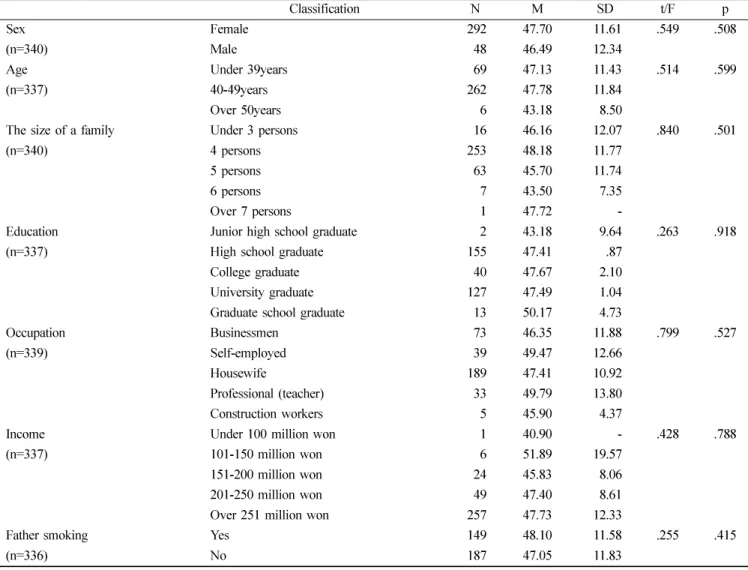
일반적인 특성에 따른 구강위생용품에 대한 사용태도수준을살펴보면
Table 5
와같다.
성별에서는 여자47.70
점
,
연령은40-49
세47.78
점,
가족 수는4
명48.18
점,
학력은 대학원졸
50.17
점,
직업은 전문직49.79
점,
경제수준은
100-150
만원51.89
점,
아버지의 흡연여부는‘
예’
가48.10
점으로 가장 높게 나타났으나 통계적으로는 유의하지않았다
.
구강위생용품실천수준은일반적인특성과는다소관련 성이적음을알수있었다
.
Table 5. Relationship of general characteristics oral hygiene devices practice.
Classification N M SD t/F p
Sex Female 292 47.70 11.61 .549 .508
(n=340) Male 48 46.49 12.34
Age Under 39years 69 47.13 11.43 .514 .599
(n=337) 40-49years 262 47.78 11.84
Over 50years 6 43.18 8.50
The size of a family Under 3 persons 16 46.16 12.07 .840 .501
(n=340) 4 persons 253 48.18 11.77
5 persons 63 45.70 11.74
6 persons 7 43.50 7.35
Over 7 persons 1 47.72 -
Education Junior high school graduate 2 43.18 9.64 .263 .918
(n=337) High school graduate 155 47.41 .87
College graduate 40 47.67 2.10
University graduate 127 47.49 1.04
Graduate school graduate 13 50.17 4.73
Occupation Businessmen 73 46.35 11.88 .799 .527
(n=339) Self-employed 39 49.47 12.66
Housewife 189 47.41 10.92
Professional (teacher) 33 49.79 13.80
Construction workers 5 45.90 4.37
Income Under 100 million won 1 40.90 - .428 .788
(n=337) 101-150 million won 6 51.89 19.57
151-200 million won 24 45.83 8.06
201-250 million won 49 47.40 8.61
Over 251 million won 257 47.73 12.33
Father smoking Yes 149 48.10 11.58 .255 .415
(n=336) No 187 47.05 11.83
고 찰
김 등15)의연구결과에서보듯이구강위생용품을사용하 는 가장 큰 이유는 효율적인구강위생관리에 있다
.
효율 적인 구강위생관리를위해서는 치면세균막을 효율적으로 관리하고 제거하는데 있다.
특히 치면세균막관리에서 칫솔과세치제에 관한연구들은 많이이루어져왔다
.
본 연 구에서도칫솔과구강위생용품에대한조사결과일반칫솔사용에 대한 점수가
74.07
점으로 높은 반면다른 구강위생용품에대한점수는전반적으로낮게나타났다
.
또한 구강위생용품 사용태도에서 다른 구강위생용품에 비하여구강양치용액사용
36.65
점,
치실사용33.26
점으로양치용액의사용이다소높음을알수있는데이는서
등4)의연구결과치실사용
2.5%,
양치용액사용17.2%
와유사한 결과를 보여주고있다
.
특히 치실의 사용에 관한연구는
1991
년(
주)
럭키 연구와 서 등4)의 연구결과와 본연구결과에서 치실의사용은 크게증가하지 않음을짐작 할 수 있다
.
양치용액의 사용은 백6)의 연구에서 양치액 만으로는 치면세균막을 제거할수는 없지만 주어진시간 과 여건이칫솔질을 할 수 없는 상황일경우에는양치액 을사용함으로일정수준의치면세균막감소에효과가있 다고 하였는데 이는 구강 양치액을 사용하는 것이 보다 효율적인 치면세균막관리에도움이됨을알 수있다.
따 라서구강양치액에대한지식과올바른사용방법의교육 이필요하리라사료된다.
“
칫솔질은1
회3
분 닦는다.”
지식점수는68.27
점으로다소높게나타났으며이는칫솔질횟수는하루
3
번닦는 것에비해 한 번 닦으면치면세균막 수치가50%
증가하였고
,
치은의 염증이20%
증가한다고 보고한 임16)의 연구와유사함을짐작할수있다
.
본 연구에서 일반 칫솔에관한지식
(71.84
점)
과사용태도
(74.07
점)
모두 높은 점수인데반하여 치실과 치간 칫솔의 지식
(56.41
점, 52.04
점)
및 사용태도(33.26
점, 38.43
점
)
는낮음을 알 수있다.
이는이 등17)의 가정 구강보건 실태에관한 조사연구에서 서울 시민의93%
가 매일 칫솔질을하고 있으나치실 및 치간칫솔 등의보조구강위 생용품사용률은 매우 저조하다와유사함을나타내고 있 다
.
환자들의 구강위생용품에 관한 지식 및 사용률이낮은 것은 구강건강에 관한 관심도가 적고
,
관심이 있더라도 정확한정보와 사용방법에 대한 기술력의부족이라고 판 단되며 구강보건교육자들에 의한 올바른 구강보건 교육 이필요하다.
최근에는치간 부위나치은연하부위등 칫 솔질이미치지 않는부위의 치태를제거할 수있는 여러 가지보조구강위생용품이개발소개되어병·의원에서도 치과 의사들이나 치과전문 인력들이환자들에게 칫솔질 과함께구강위생보조용품을사용할것을적극적으로권 장하고있으나18) 본연구에서는지식수준(65.35
점)
과사용태도
(47.78
점)
의 점수가 낮아 효율적인 구강위생관리가이루어지지못하는것으로나타났다
.
김19)과김20)의 연구에의하면구강위생용품을사용하게 된 동기는
‘
치과 의료기관에서 전문가가 권장해서’
이유가
47.8%
로가장많았고,
다음이‘
광고’
순으로나타났다.
이는 효율적인 구강위생관리를위해서는 구강보건인력이 각환자개인의특성에맞는구강위생용품을추천하고사 용법에대한교육의실시가필요하다고생각된다
.
따라서전문적인 구강보건인력의 확충과 다양한 홍보매체의 개 발이필요하다
.
본 연구는 일부지역 주민을 대상으로 하여 연령대 및 성별이다소편중되어있어전체를대표할수 없으며
,
추후 설문의 문항을보완하고 연구대상을 다양화시켜 지속 적인연구가필요하리라사료된다
.
요 약
본 연구의 목적은 일부성인들의 구강위생용품에 대하 여 지식수준과 사용태도를 조사하여 구강위생용품에 대 한 지식 및 사용을 향상시키고 이를 위한 교육프로그램
개발의기초자료로사용하기위하여
2007
년12
월3
일부터
17
일까지383
부 중 부적절한 설문지31
부를 제외한352
부를대상으로SPSS version 17.0 for window
를이용 하여분석한결과는다음과같다.
1.
구강위생용품지식수준은“
칫솔머리는위로 향해보관해야한다
.” 76.77
점으로가장 높았으며, “
칫솔질할 때혀도 닦아야한다
.” 74.86
점, “
일반칫솔의올바른사용방법을알고있다
.” 71.84
점순으로나타났다
.
반면 물 사출기,
혀 클리너,
치간 칫솔 등에 대 한지식수준이낮은것으로나타났다.
2.
구강위생용품 실천수준은“
칫솔머리를 위로 향하게보관한다
.” 76.77
점으로 가장높았으며, “
일반 칫솔을 사용하고 있다
.” 74.07
점, “
칫솔질 할때 혀도닦는다
.” 69.92
점순서로나타났다.
반면물사출기,
혀클리너
,
전동칫솔에대한사용정도가낮은것으로나타났다
.
3.
일반적인 특성에 따른 지식수준은 성별에서는 남자62.54
점,
연령은50
세 이상66.28
점,
가족 수4
명61.52
점,
학력은 대학원졸66.78
점,
직업은자영업과전문직
63.63
점,
경제 수준은100-150
만원66.66
점,
아버지의 흡연여부에서는
‘
예’ 61.55
점으로 가장 높 게나타났으나통계적으로는유의하지않았다. 4.
일반적인 특성에 따른 사용태도는 성별에서는 여자47.70
점,
연령은40-49
세47.78
점,
가족수4
명48.18
점
,
학력은 대학원졸50.17
점,
직업은 전문직49.79
점
,
경제수준은100-150
만원51.89
점,
아버지의흡연여부에서는