Received: 2011. 4.21. Revised: 2011. 5.26. Accepted: 2011. 6.20.
Corresponding author: Duk-Soo Bae, MD, PhD
Department of Obstetrics and Gynecology, Samsung Medical Center, Sungkyunkwan University School of Medicine, 50 Irwon-dong, Gangnam-gu, Seoul 135-710, Korea Tel: +82-2-3410-3511 Fax: +82-2-3410-0630 E-mail: [email protected]
Th is is an Open Access article distributed under the terms of the Creative Commons Attribution Non-Commercial License (http://creativecommons.org/licenses/
by-nc/3.0/) which permits unrestricted non-commercial use, distribution, and reproduction in any medium, provided the original work is properly cited.
Copyright © 2011. Korean Society of Obstetrics and Gynecology
Cervical carcinoma is the third most common cancer in women, and the seventh overall, with an estimated 530,000 new cases in 2008 [1] and the one of the most lethal female malignancies in developing countries [2]. Cervical carcinoma can be categorized into subtypes according to histological classification, of which invasive squamous cell carcinoma (SCC) is the most common, ac- counting for about 80% of invasive cancer in the cervix [3]. And other subtypes including adenocarcinoma of uterine cervix are considered as distinct disease entities against SCC from epidemi- ology to clinical manifestations [4].
Squamous cell carcinoma-related antigen (SCC-Ag), which also known as TA-4 (tumor antigen), may be the tumor marker of
http://dx.doi.org/10.5468/KJOG.2011.54.8.428 pISSN 2233-5188 · eISSN 2233-5196
PROGNOSTIC VALUE OF PRE-TREATMENT SCC-AG LEVEL IN PATIENTS WITH CERVICAL CANCER
Jung-Joo An, MD, Yoo-Young Lee, MD, Jin Young Park, MD, Chel Hun Choi, MD, Tae-Joong Kim, MD, Jeong-Won Lee, MD, Byoung-Gie Kim, MD, PhD, Duk-Soo Bae, MD, PhD
Department of Obstetrics and Gynecology, Samsung Medical Center, Sungkyunkwan University School of Medicine, Seoul, Korea
Objective
The purpose of this study is to investigate the prognostic role of pre-treatment squamous cell carcinoma-related antigen (SCC-Ag) level in patients with squamous cell carcinoma of the uterine cervix.
Methods
In this study, we retrospectively enrolled patients with squamous cell carcinoma of the uterine cervix (FIGO stage IB to IVA) who were treated at Samsung Medical Center, Seoul, Korea, from 1996 to 2007.
Results
We retrospectively enrolled 788 patients. Median SCC-Ag level was 1.6 ng/mL (reference range, 0.1-362.0) in all patients. Four hundred seven out of 788 patients had elevating pre-treatment SCC-Ag level (51.6%). When we divided the cohort based on the stage (early cervical carcinoma; IB1 and IIA vs. locally advanced cervical carcinoma [LACC]; IB2 and IIB to IVA) and performed multivariate analysis, pre-treatment SCC-Ag entailed prognostic signifi cance only in LACC (progression-free survival: hazard ratio [HR], 1.007; 95% confi dential interval [CI], 1.003-1.010; overall survival: HR, 1.005; 95% CI, 1.001-1.009). Among patients who showed recurrence disease and had the result of SCC-Ag before recurrence (n=94), 79 patients (84.0%) had the elevation of SCC- Ag level at the time of recurrence.
Conclusion
Pre-treatment SCC-Ag level is an independent prognostic factor for survival in patients with LACC. Measuring pre-treatment serum SCC-Ag may be a cost-effective method to predict prognosis in patients with LACC.
Keywords: Squamous cell carcinoma-related antigen; TA-4; Uterine cervical neoplasms; Prognostic; Survival
choice for SCC [5,6], not for the other types of carcinoma in uter- ine cervix. There was evidence of correlation between treatment response and SCC-Ag drops after treatment [7] and increasing serum SCC-Ag level can precede the clinical diagnosis of recurrent disease in 46-92% of the cases during the follow-up period after initial treatment [8], however, the clinical implementation in pre- dicting prognosis based on pre-treatment serum SCC-Ag assay is still controversial [8,9].
The purpose of this study is to investigate the prognostic role of pre-treatment peripheral SCC-Ag level in patients with SCC of the cervix.
Materials and Methods
1. Patients
Patients with SCC of the cervix (International Federation of Gyne- cology and Obstetrics [FIGO] stage IB to IVA) who were treated at Samsung Medical Center, Seoul, Korea from 1996 to 2007 were retrospectively enrolled in this study. The patients’ clinico- pathological fi ndings as well as laboratory results were collected from electronic medical records with Institutional Review Board approval. We excluded patients with early cervical cancer having mi- croscopic lesions on the cervix including IA1 and IA2; histological subtypes except for SCC and its variants; patients who underwent fertility-saving surgery; patients with concurrent hematologic or infectious diseases; patients who did not have the results of SCC- Ag level within two weeks before starting initial treatment; and patients who received neo-adjuvant chemotherapy before surgery.
2. Treatment
We usually performed surgery-based treatment in patients with early stage cervical cancer (IB1 to IIA), including bulky tumor (IB2) or radiation therapy (RT)-oriented management in patients with locally advanced cervical cancer (IIB to IVA). However, the choice for primary treatment was dependent on the attending physician’s preference. Since 2000, concurrent chemotherapy with radiation therapy (CCRT) has been recommended as either the primary [10]
or adjuvant treatment [11] in cases with more than one high-risk pathological factor for recurrence after surgery (please see below).
Cisplatin-based regimens were used for the concurrent chemo- therapy.
Standard surgery consisted of type III radical hysterectomy with bilateral pelvic lymph node (LN) dissection. Bilateral salpingo-oo- phorectomy and para-arotic LN sampling or dissections were not
routine procedures. Patients who had more than one of the three high-risk factors (positive pelvic or para-aortic LN, microscopic parametrial invasion, and positive resection margins with tumor) received adjuvant RT or CCRT. Patients with at least two of the three intermediate risk factors (stromal invasion of more than half of the cervix or stromal invasion more than 1 cm, lympho-vascular space invasion, and the largest diameter of 4 cm or greater) re- ceived adjuvant RT alone. Radiation protocols were as previously described [12].
Patients had follow-up examinations approximately every three months for the fi rst two years, every six months for the next three years, and every year thereafter. During the routine follow-up, im- aging studies including computed tomography or magnetic reso- nance imaging, and chest X-ray was performed each year. When tumor recurrence was suspected based on clinical findings or imaging studies, biopsy was performed. We defi ned progression- free survival as the time from the initial treatment to relapse noted on images or to the fi nal follow-up visit, and overall survival was defi ned as the time from the initial treatment to death due to cer- vical carcinoma or to the fi nal follow-up visit.
3. Statistical analysis
The Wilcoxon rank sum test or two-sample t test was used to compare the median or mean values, respectively, after checking whether the data had non-normal or normal distributions accord- ing to the Shapiro-Wilks test. The overall and progression-free survival curves were calculated according to the Kaplan-Meier method with the log-rank test. Variables shown to be signifi cant or borderline signifi cant (P < 0.2) in the univariate analysis were selected for the Cox model. The Cox proportional-hazards model was used for the multivariate analyses. Statistical analyses were performed using SPSS ver. 12.0 (SPSS, Chicago, IL, USA). A P-value
< 0.05 was considered statistically significant and all P -values were two-sided.
Results
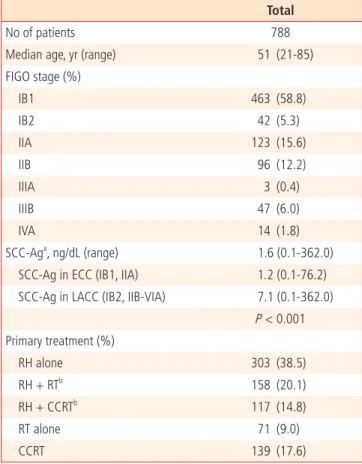
We retrospectively enrolled 788 patients with SCC of the cervix (IB
to IVA). The basal characteristics of these patients are described
in Table 1. The median age of the patients was 51 years (range,
21-85 years) and 407 out of 788 patients had elevating pre-
treatment SCC-Ag level (51.6%). Median SCC-Ag level was 1.6
ng/mL (reference range, 0.1-362.0 ng/mL) in all patients. When
the cohort was divided according to stage as either early cervical
carcinoma (ECC) or locally advanced cervical carcinoma (LACC), patients with LACC had higher pre-treatment level of SCC-Ag (1.2 ng/mL vs. 7.1 ng/mL, P < 0.001). The median follow-up for the pa- tient group was 53.4 months, with a range of 1-181 months, and the fi ve-year survival rate was 87.8%. There were 121 progression (15.4%) and 88 (11.2%) cancer-related deaths during the study period.
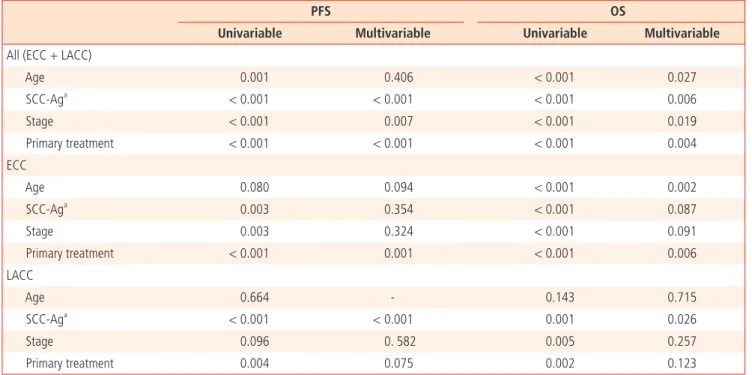
In all patients, the univariate analysis revealed that the most of the clinical parameters including age, pre-treatment SCC-Ag level, stage, and type of treatment had prognostic significance for both progression-free survival and overall survival and these signifi cances remained even after multivariate analysis except for age (Table 2). When we divided the cohort based on the stage (ECC: IB1 and IIA vs. LACC: IB2 and IIB to IVA) and performed multivariate analysis, pre-treatment SCC-Ag entailed prognostic signifi cance only in LACC (progression-free survival: hazard ratio
[HR], 1.007; 95% confi dential interval [CI], 1.003-1.010; overall survival: HR, 1.005; 95% CI, 1.001-1.009). When we dichoto- mized the patients with LACC according the median level of pre- treatment SCC-Ag (7.1 ng/dL), the patients with LACC who had higher pre-treatment SCC-Ag level showed more than 2 times higher progression or death rate compared with patients who did not, in multivariate analysis (Table 3, Fig. 1).
Among patients who showed recurrence disease and had the re- sult of SCC-Ag before recurrence (n=94), 79 patients (84.0%) had the elevation of SCC-Ag level with recurrence and the recurrence cases that showed pre-treatment SCC-Ag level more than 7.1 ng/
dL represented increasing SCC-Ag level with recurrence in 100%
(45/45) (Table 4).
Discussion
In this study, we found that pre-treatment SCC-Ag level is an independent prognostic factor for survival in patients with LACC.
Most of the patients (84%, 79/94) had elevation of SCC-Ag level at the time of recurrent disease and SCC-Ag level increased again in all cases of recurrence, which showed high level of SCC-Ag (≥ 7.1 ng/dL) before the primary treatment (100%, 45/45).
Cervical carcinoma is the only major gynecologic malignancy that is staged clinically [13]. As a result predicting survival based on clinical stage alone may have limitation. For example, lymph node status, which is proven to be an important determinant of prog- nosis [14], is not part of the FIGO staging system. Furthermore, while we can use the post operative findings including lymph node status, parametrial invasion, and tumor present in resection margin to stratify the prognosis in early disease; the main treat- ment is surgery [3], there are no clinical parameters except for clinical stage in clinical staging system to stratify the prognosis of patients with advanced disease, which treatment is usually CCRT.
This is why tumor marker in LACC should be so important in clinic and we could fi nd that clinical impact of SCC-Ag on survival was bigger than that of clinical stage in our study population.
From the discovery [15] of SCC-Ag, which emerged concurrently with squamous formation of the uterine cervix and increased dur- ing the neoplastic transformation of the cervical squamous epi- thelium [6], several clinical researches investigated the prognostic role of SCC-Ag in squamous cell cervical carcinoma [8,16]. In ECC the prognostic role of SCC-Ag was not found in most of the studies [5,9,17,18], which is in line with our results. Even though there was evidence of a link between pre-treatment SCC-Ag level
Table 1. Patients’ characteristicsTotal
No of patients 788
Median age, yr (range) 51 (21-85)
FIGO stage (%)
IB1 463 (58.8)
IB2 42 (5.3)
IIA 123 (15.6)
IIB 96 (12.2)
IIIA 3 (0.4)
IIIB 47 (6.0)
IVA 14 (1.8)
SCC-Aga, ng/dL (range) 1.6 (0.1-362.0)
SCC-Ag in ECC (IB1, IIA) 1.2 (0.1-76.2) SCC-Ag in LACC (IB2, IIB-VIA) 7.1 (0.1-362.0)
P < 0.001 Primary treatment (%)
RH alone 303 (38.5)
RH + RTb 158 (20.1)
RH + CCRTb 117 (14.8)
RT alone 71 (9.0)
CCRT 139 (17.6)
FIGO, International Federation of Gynecology and Obstetrics; SCC-Ag, squamous cell carcinoma-related antigen; ECC, early cervical cancer;
LACC, locally advanced cervical cancer; RH, type III radical hysterectomy;
RT, radiation therapy; CCRT, concurrent chemoradiation therapy.
aTA-4 (tumor antigen); bAdjuvant setting.
and lymph node metastasis in some studies [17,19], its prognostic signifi cance is weak. Takeda et al. [19] reported that pre-operative SCC-Ag seems to be useful in estimating lymph node status and the prognosis for patients with cervical carcinoma. However, the study population was only 103, which was small, and about half of the patients were stage IIB, which is categorized into LACC with recommended management of RT or CCRT. Overall, routine check of serum SCC-Ag before surgery in ECC to predict recurrence may be unreasonable.
On the other hand, the prognostic role of pre-treatment SCC-Ag
in LACC seems to be clear [7,20,21]. For example, Hong et al. [21]
reported that pre-treatment SCC-Ag level higher than 10 ng/mL are an independent predictor for poor prognosis in their study of a single institution with large cohort, which is correspond well with our results. Furthermore we could observe that post-treatment follow-up SCC-Ag levels should be as important as measurement of pre-treatment level in LACC, especially in case of higher pre- treatment SCC-Ag level (≥ 7.1 ng/dL), because all of the cases showed elevation of SCC-Ag level at the time of recurrent cervical carcinoma. However, it was also reported that pre-treatment SCC-
Table 2. Univariable and multivariable analysis for progression-free survival (PFS) and overall survival (OS)PFS OS
Univariable Multivariable Univariable Multivariable
All (ECC + LACC)
Age 0.001 0.406 < 0.001 0.027
SCC-Aga < 0.001 < 0.001 < 0.001 0.006
Stage < 0.001 0.007 < 0.001 0.019
Primary treatment < 0.001 < 0.001 < 0.001 0.004
ECC
Age 0.080 0.094 < 0.001 0.002
SCC-Aga 0.003 0.354 < 0.001 0.087
Stage 0.003 0.324 < 0.001 0.091
Primary treatment < 0.001 0.001 < 0.001 0.006
LACC
Age 0.664 - 0.143 0.715
SCC-Aga < 0.001 < 0.001 0.001 0.026
Stage 0.096 0. 582 0.005 0.257
Primary treatment 0.004 0.075 0.002 0.123
ECC, early cervical carcinoma; LACC, locally advanced cervical carcinoma; SCC-Ag, squamous cell carcinoma-related antigen.
aTA-4 (tumor antigen) and analyzed as a continous variable.
Table 3. SCC-Ag level as a prognostic factor for progression-free survival (PFS) and overall survival (OS) in locally advanced stages of cervical squa- mous cell carcinoma
PFSa
P-value OSa
P-value
HR (95% CI) HR (95% CI)
Age - - 0.809
Stage 0.323 0.138
Primary treatment 0.121 0.141
SCC-Agb (ng/dL)
< 7.1 1 1
≥ 7.1 2.40 (1.42-4.07) 0.001 2.41 (1.30-4.47) 0.005
HR, hazard ratio, CI, confi dential interval; SCC-Ag, squamous cell carcinoma-related antigen.
aCox proportional-hazards model for multivariable analysis.
bTA-4 (tumor antigen) and analyzed as a categorical value.
Ag levels neither predicts pathological response to treatment nor the clinical outcome. Furthermore, they concluded that post-treat- ment SCC-Ag levels are more important to predict pathological response to CCRT and survival outcomes in LACC [22]. This debate should be confi rmed in future studies.
There are some concerns should be discussed in this study. First, we do not have many treatment options to choose in LACC. Be- cause CCRT was proven to be more effective than RT alone in LACC [10], CCRT is only standard treatment of choice in these patients. However, recently, it was reported that consolidation chemotherapy after CCRT may improve survival compared to CCRT alone in patients with LACC [12], which could give physicians a treatment option for patients with high level of pre-treatment SCC-Ag level. Second, other clinical parameters including para- aortic lymph node status on imagining study [23], patient’s perfor- mance scale, or factors which could cause of elevated serum levels
of SCC-Ag such as benign lesions of lung or skin diseases were not considered in this study [24]. Finally, many molecular markers have been investigated to predict prognosis of cervical carcinoma [25-27]. In the future, there should be a well designed prospec- tive study to compare these molecular markers with SCC-Ag or develop prognostic models using combined index consist of these markers.
In conclusion, pre-treatment SCC-Ag level is an independent prognostic factor for survival in patients with LACC. Measuring pre-treatment serum SCC-Ag may be a cost-effective method to predict prognosis in patients with LACC.
References
1. Ferlay J, Shin HR, Bray F, Forman D, Mathers C, Parkin DM.
Table 4. Comparison of squamous cell carcinoma-related antigen (SCC-Ag) between levels at pre-treatment and recurrence among patients (n=94) who had recurrence disease with known SCC-Ag level in locally advanced stages of cervical squamous cell carcinoma
SCC-Ag level (ng/dL) at recurrence
Pre-treatment Pre-treatment
Normal Abnormal < 7.1 ≥ 7.1
Normal 8 (44.4%) 7 (9.2%) 15 (30.6%) 0
Abnormal 10 (55.6%) 69 (90.8%) 34 (69.4%) 45 (100.0%)
P-value 0.001 < 0.001
Normal range of SCC-Ag=0-1.5 ng/dL, if SCC-Ag level was within normal range at the time of recurrence before 6 months and after 6 months, we regarded it as a disease relapse without SCC-Ag elevation.
Fig. 1. Progression-free survival and overall survival according to the squamous cell carcinoma-related antigen level (high vs. low) in patients with lo- cally advanced cervical carcinoma.
Progression free survival (IB2, IIB to IVA) Overall survival (IB2, IIB to IVA)
Cumulative survival Cumulative survival
Month Month
P < 0.001 P < 0.001
≥ 7.1 ng/dL (n = 96) ≥ 7.1 ng/dL (n = 96)
< 7.1 ng/dL (n = 106) < 7.1 ng/dL (n = 106)
GLOBOCAN 2008 v1.2, Cancer Incidence and Mortality Worldwide: IARC CancerBase No. 10 [Internet]. Lyon, France:
International Agency for Research on Cancer; 2010 [cited 2011 Jul 20]. Available from: http://globocan.iarc.fr.
2. Garcia M, Jemal A, Ward EM, Center MM, Hao Y, Siegel RL, et al. Global cancer facts & fi gures 2007 [Internet]. Atlanta (GA):
American Cancer Society; 2007 [cited 2008 Aug 22]. Abail- able from: http://www.cancer.org/acs/groups/content/@nho/
documents/document/globalfactsandfi gures2007rev2p.pdf.
3. Berek JS, Novak E. Berek & Novak’s gynecology. 14th ed.
Philadelphia (PA): Lippincott Williams & Wilkins; 2007.
4. Gien LT, Beauchemin MC, Thomas G. Adenocarcinoma: a unique cervical cancer. Gynecol Oncol 2010;116:140-6.
5. Davelaar EM, van de Lande J, von Mensdorff-Pouilly S, Blan- kenstein MA, Verheijen RH, Kenemans P. A combination of serum tumor markers identifies high-risk patients with early- stage squamous cervical cancer. Tumour Biol 2008;29:9-17.
6. Maruo T, Yoshida S, Samoto T, Tateiwa Y, Peng X, Takeuchi S, et al. Factors regulating SCC antigen expression in squamous cell carcinoma of the uterine cervix. Tumour Biol 1998;19:494- 504.
7. Pras E, Willemse PH, Canrinus AA, de Bruijn HW, Sluiter WJ, ten Hoor KA, et al. Serum squamous cell carcinoma antigen and CYFRA 21-1 in cervical cancer treatment. Int J Radiat On- col Biol Phys 2002;52:23-32.
8. Gadducci A, Tana R, Cosio S, Genazzani AR. The serum assay of tumour markers in the prognostic evaluation, treatment monitoring and follow-up of patients with cervical cancer: a review of the literature. Crit Rev Oncol Hematol 2008;66:10-20.
9. Reesink-Peters N, van der Velden J, Ten Hoor KA, Boezen HM, de Vries EG, Schilthuis MS, et al. Preoperative serum squamous cell carcinoma antigen levels in clinical decision making for patients with early-stage cervical cancer. J Clin Oncol 2005;23:1455-62.
10. Rose PG, Bundy BN, Watkins EB, Thigpen JT, Deppe G, Maiman MA, et al. Concurrent cisplatin-based radiotherapy and che- motherapy for locally advanced cervical cancer. N Engl J Med 1999;340:1144-53.
11. Peters WA 3rd, Liu PY, Barrett RJ 2nd, Stock RJ, Monk BJ, Berek JS, et al. Concurrent chemotherapy and pelvic radia- tion therapy compared with pelvic radiation therapy alone as adjuvant therapy after radical surgery in high-risk early-stage cancer of the cervix. J Clin Oncol 2000;18:1606-13.
12. Choi CH, Lee YY, Kim MK, Kim TJ, Lee JW, Nam HR, et al. A Matched-Case Comparison to Explore the Role of Consolida-
tion Chemotherapy After Concurrent Chemoradiation in Cervical Cancer. Int J Radiat Oncol Biol Phys 2010 Nov 13 [Epub]. DOI: 10.1016/j.ijrobp.2010.07.2006.
13. Pecorelli S. Revised FIGO staging for carcinoma of the vulva, cervix, and endometrium. Int J Gynaecol Obstet 2009;105:103-4.
14. Kidd EA, Siegel BA, Dehdashti F, Rader JS, Mutch DG, Powell MA, et al. Lymph node staging by positron emission tomogra- phy in cervical cancer: relationship to prognosis. J Clin Oncol 2010;28:2108-13.
15. Kato H, Torigoe T. Radioimmunoassay for tumor antigen of human cervical squamous cell carcinoma. Cancer 1977;40:1621-8.
16. Gadducci A, Tana R, Fanucchi A, Genazzani AR. Biochemical prognostic factors and risk of relapses in patients with cervical cancer. Gynecol Oncol 2007;107:S23-6.
17. van de Lande J, Davelaar EM, von Mensdorff-Pouilly S, Water TJ, Berkhof J, van Baal WM, et al. SCC-Ag, lymph node metas- tases and sentinel node procedure in early stage squamous cell cervical cancer. Gynecol Oncol 2009;112:119-25.
18. Gaarenstroom KN, Bonfrer JM, Kenter GG, Korse CM, Hart AA, Trimbos JB, et al. Clinical value of pretreatment serum Cyfra 21-1, tissue polypeptide antigen, and squamous cell carci- noma antigen levels in patients with cervical cancer. Cancer 1995;76:807-13.
19. Takeda M, Sakuragi N, Okamoto K, Todo Y, Minobe S, Nomura E, et al. Preoperative serum SCC, CA125, and CA19-9 levels and lymph node status in squamous cell carcinoma of the uterine cervix. Acta Obstet Gynecol Scand 2002;81:451-7.
20. Hong JH, Tsai CS, Lai CH, Chang TC, Wang CC, Chou HH, et al. Risk stratifi cation of patients with advanced squamous cell carcinoma of cervix treated by radiotherapy alone. Int J Radiat Oncol Biol Phys 2005;63:492-9.
21. Hong JH, Tsai CS, Chang JT, Wang CC, Lai CH, Lee SP, et al. The prognostic signifi cance of pre- and posttreatment SCC levels in patients with squamous cell carcinoma of the cervix treated by radiotherapy. Int J Radiat Oncol Biol Phys 1998;41:823-30.
22. Ferrandina G, Macchia G, Legge F, Deodato F, Forni F, Digesù C, et al. Squamous cell carcinoma antigen in patients with locally advanced cervical carcinoma undergoing preoperative radiochemotherapy: association with pathological response to treatment and clinical outcome. Oncology 2008;74:42-9.
23. Yalman D, Aras AB, Ozkok S, Duransoy A, Celik OK, Ozsaran Z, et al. Prognostic factors in defi nitive radiotherapy of uterine cervical cancer. Eur J Gynaecol Oncol 2003;24:309-14.
24. Torre GC. SCC antigen in malignant and nonmalignant squa-
mous lesions. Tumour Biol 1998;19:517-26.
25. Lomnytska MI, Becker S, Bodin I, Olsson A, Hellman K, Hell- ström AC, et al. Differential expression of ANXA6, HSP27, PRDX2, NCF2, and TPM4 during uterine cervix carcinogenesis:
diagnostic and prognostic value. Br J Cancer 2011;104:110-9.
26. Min L, Dong-Xiang S, Xiao-Tong G, Ting G, Xiao-Dong C.
Clinicopathological and prognostic signifi cance of Bmi-1 ex-
pression in human cervical cancer. Acta Obstet Gynecol Scand 2011;90:737-45.
27. Porika M, Tippani R, Mohammad A, Bollam SR, Panuganti SD, Abbagani S. Evaluation of serum human telomerase reverse transcriptase as a novel marker for cervical cancer. Int J Biol Markers 2011;26:22-6.
자궁경부암 환자의 치료 전 편평세포암종항원 수치의 예후인자로서의 가치
성균관대학교 의과대학 산부인과학교실
안정주, 이유영, 박진영, 최철훈, 김태중, 이정원, 김병기, 배덕수
목적
이 연구의 목적은 자궁경부 편평세포암 환자의 치료 전 편평세포암종항원(squamous cell carcinoma-related antigen, SCC-Ag) 수치의 예 후인자로서의 가치를 알아보기 위함이다.
연구방법
1996년부터 2007년도까지 삼성서울병원에서 치료 받은 자궁경부 편평세포암 환자(FIGO 병기 IB-IVA기)를 대상으로 후향적 연구를 실시 하였다.
결과
후향적으로 총 788명의 환자가 등록되었다. 전체 환자의 SCC-Ag의 중앙값은 1.6 ng/mL (참고치, 0.1-362.0)이었다. 788명의 환자 중 407 (51.6%)명의 환자에서 치료 전 SCC-Ag값이 상승되어 있었다. 이 코호트를 병기에 따라 조기 자궁경부암(IB1과 IIA)과 국소 진행 자궁 경부암(IB2, IIA-IVA) 두 군으로 분류하여 다변량 분석을 실시하였을 때, 국소 진행 자궁경부암군에서만 치료 전 SCC-Ag 수치가 예후 측정 에 있어 유의한 결과를 나타내었다(무진행생존율: 위험률, 1.007; 95% 신뢰구간, 1.003-1.010; 전체생존율: 위험률, 1.005; 95% 신뢰구 간, 1.001-1.009). 또한 재발되기 전 SCC-Ag 결과를 가지고 있는 94명의 재발 환자 중 79명(84.0%)의 환자에서 재발 당시 SCC-Ag 상 승이 관찰되었다.
결론
치료 전 SCC-Ag의 수치는 국소 진행 자궁 경부암 환자의 생존율을 예측하는 독립적인 예후인자이다. 치료 전 혈장 내 SCC-Ag 수치 측 정은 국소 진행 자궁 경부암 환자의 예후를 예측함에 있어 비용 대비 효과적인 방법이다.
중심단어: 편평세포암종항원, 자궁경부암, 예후, 생존