292
CASE REPORTDOI 10.4070 / kcj.2010.40.6.292
Print ISSN 1738-5520 / On-line ISSN 1738-5555 Copyright ⓒ 2010 The Korean Society of Cardiology
Open Access
Successful Treatment of an Iatrogenic Giant Femoral Artery Pseudoaneurysm With Percutaneous Thrombin Injection
Ki-Su Kim, MD, Jun-Mo Youn, MD, Won-Seok Han, MD, Young-Jin Yoon, MD, Jae-Hoon Yoo, MD, Dong-Young Gu, MD and Il Rhee, MD
Department of Medicine, Dong-Eui University College of Oriental Medicine, Cardiac and Vascular Center, Dong-Eui Medical Center, Busan, Korea
ABSTRACT
A femoral artery pseudoaneurysm (FAP) is one of the most troublesome complications following invasive proce- dures related to the femoral arterial access. Post-procedure FAP rarely occurs; however, its occurrence tends to in- crease with the more frequently antiplatelet agents, anticoagulants, and larger-sized catheter used for interventional procedures. Traditionally, surgical repair has been considered as the standard treatment modality for FAP; how- ever, less invasive methods currently exist such as blind manual or ultrasound-guided compression repair (UGCR) as well as percutaneous thrombin injection, both of which have replaced the need for surgery. We report a case of a giant pseudoaneurysm in a femoral artery, which had developed as a complication of stenting in a patient with carotid artery stenosis and ischemic heart disease, and was subsequently successfully treated using percutaneous thrombin injection.
(Korean Circ J 2010;40:292-294)KEY WORDS:
Pseudoaneurysm; Carotid artery stenosis; Thrombin.
Introduction
Iatrogenic femoral artery pseudoaneurysm (IFAP) is an undesirable complication of invasive procedures in- volving a femoral arterial puncture site. The incidence of femoral artery pseudoaneurysm (FAP) varies from 0.05- 8% following interventional procedures.
1)Ultrasound- guided compression repair (UGCR) has replaced surgi- cal repair of FAP as the first-line treatment in many hos- pitals.
2)Recently percutaneous thrombin injection has also become popular. Here, we report the successful tr- eatment of giant FAP, obliterated by percutaneous th- rombin injection after failure of UGCR in a case of ca- rotid artery stenting.
Case
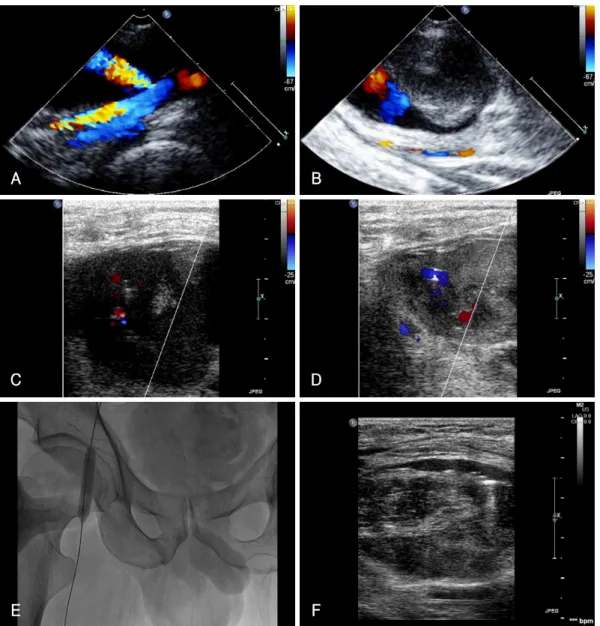
A 59-year-old man was referred due to a pulsatile, ten- der mass in the right groin as well as a swollen leg. Seven- teen days earlier, he had undergone left carotid artery stenting as part of the treatment for a recent stroke via the right femoral artery. Ultrasound (US) confirmed a right FAP (Fig. 1A), sized 55×30 mm, and compression on the pseudoaneurysm neck was applied using a US probe until the flow through the neck was stopped. Re- peated UGCR was unsuccessful resulting in enlargement of the FAP and discomfort to the patient which was pre- sented as vasovagal syncope (Fig. 1B). Following this, th- rombin (1,800 IU) was injected into the cavity of the ps- eudoaneurysm using US guidance (Fig. 1C and D). To avoid distal migration of the thrombin, we occluded the right femoral artery intermittently during thrombin in- jection using an angioplasty balloon (Fig. 1E). The pseu- doaneurysm was thrombosed following the procedure.
A one day post-operative US revealed the clotted cavity of the pseudoaneurysm with a small sized subcutaneous hematoma in the right groin area (Fig. 1F). He was dis- charged without complication or recurrence of pseudo- aneurysm.
Received: November 18, 2009 Accepted: January 2, 2010
Correspondence: Il Rhee, MD,Department of Medicine, Dong-Eui Univer- sity College of Oriental Medicine, Cardiac and Vascular Center, Dong-Eui Medical Center, San 45 Yangjeong 2-dong, Busanjin-gu, Busan 614- 710, Korea
Tel: 82-51-850-8990, Fax: 82-51-850-8999 E-mail: [email protected]
This is an Open Access article distributed under the terms of the Creative Commons Attribution Non-Commercial License (http://creativecommons.
org/licenses/by-nc/3.0) which permits unrestricted non-commercial use, distribution, and reproduction in any medium, provided the original work is properly cited.
cc
Ki-Su Kim, et al.·
293
Discussion
IFAP is one of the complications related to interven- tional procedures at the femoral artery access site. Com- plications of pseudoaneurysm include rupture, distal em- bolization, local pain, neuropathy, and limb ischemia.
3)Traditionally, surgical repair has been the main treat- ment for FAP, especially when pseudoaneurysm larger than 4 cm is indicated or when anticoagulation or GP- IIbIIIa inhibitors are extensively used during the pro- cedure.
4)However, it has been reported that surgical complications occurred in 71% of cases including the need for transfusion (53%), infection (19%), wound de- hiscence (12.7%) and mortality (3.8%).
5)Recently, suc- cessful closures of pseudoaneurysms using nonsurgical techniques have been reported in many institutes. In
particular, the success rate of UGCR has been report- ed as 71-99%.
1)However, there are disadvantages of UGCR including long procedure times, discomfort to patients, and a recurrence rate as high as 25-35% in cases receiving anticoagulant therapy. In addition, UGCR was shown to be less effective in cases of FAP larger than 3-4 cm.
3)On the other hand, US-guided thrombin injection is non-invasive, cost-effective, and has an advantage of decreasing the risk of post surgery morbidity. Overall success rates have ranged from 91% to 100% with pro- cedure times averaging only 15 minutes.
1)Further, recurr- ence rates have been relatively low, ranging from 0% to 9% and have been related to obesity (body mass index
> 30) and extensively combined treatment with antico- agulation.
1)6)The average dose of thrombin utilized in the
A B
C D
E F
Fig. 1. Color flow demonstrating blood flow in right femoral artery, through the neck into the pseudoaneurysm (A), pseudoaneurysm re- curred after UGCR had failed (B), needle entering the pseudoaneurysm (C), coagulation of blood after thrombin injection (D), occlusion of the right femoral artery with a balloon during the thrombin injection (E), completely obliterated neck and no blood signals within the pseudoaneurysm from the thrombus formation (F). UGCR: ultrasound-guided compression repair.
294
·Pseudoaneurysm Treated With Thrombin Injectionliterature has been approximately 1,100 IU with a range of 100 to 5,000 IU.
1)Side effects of thrombin injection have included distal embolism and immunologic cross- reaction to human factor V.
1)7)The current case suggests that US-guided thrombin injection may represent a fea- sible option in the treatment of FAP in situations where both manual and UGCR had failed.
REFERENCES
1) Webber GW, Jang J, Gustavson S, Olin JW. Contemporary mana- gement of postcatheterization pseudoaneurysms. Circulation 2007;
115:2666-74.
2) Ku BK, Kim HS, Ko CW, et al. A case of femoral artery pseudo- aneurysm treated with compression guided by color Doppler ul- trasound. Korean Circ J 1995;25:119-23.
3) Lenartova M, Tak T. Iatrogenic pseudoaneurysm of femoral artery:
case report and literature review. Clin Med Res 2003;1:243-7.
4) Popovic B, Freysz L, Chometon F, et al. Femoral pseudoan- eurysms and current cardiac catheterization: evaluation of risk factors and treatment. Int J Cardiol 2008. DOI:10.1016/j.ijcard.
2008.11.111.
5) San Norberto García EM, González-Fajardo J, Gutiérrez V, Car- rera S, Vaquero C. Femoral pseudoaneurysms post-cardiac cath- eterization surgically treated: evolution and prognosis. Interact Cardiovasc Thorac Surg 2009;8:353-7.
6) Madaric J, Vulev I, Mistrik A, et al. The recurrence of iatrogenic femoral artery pseudoaneurysm after occlusion by ultrasound gu- ided percutaneous thrombin injection. EuroIntervention 2009;5:
443-7.
7) La Perna L, Olin JW, Goines D, Quriel K. Ultrasound-guided th- rombin injection for the treatment of postcatheterization pseudo- aneurysms. Circulation 2000;102:2391-5.