DOI:http://dx.doi.org/10.21218/CPR.2016.4.2.048 eISSN 2508-125X
Influence of Physical Load on the Stability of Organic Solar Cells with Polymer : Fullerene Bulk Heterojunction Nanolayers
Sooyong Lee
1)․ Hwajeong Kim
1,2)․ Youngkyoo Kim
1)*
1)Orgnic Nanoelectronics Laboratory, Department of Chemical Engineering, School of Applied Chemical Engineering, Kyungpook National University, Daegu 41566, Korea
2)Research Institute of Advanced Energy Technology, Kyungpook National University, Daegu 41566, Korea
ABSTRACT: We report the effect of physical load on the stability of organic solar cells under physical loads. The active layers in organic solar cells were fabricated with bulk heterojunction films (BHJ) films of poly (3-hexylthiophene) and phenyl-C
61-butyric methyl ester. The loading time was varied up to 60 s by keeping the physical load constant. Results showed that the open circuit voltage was not influenced by the physical load but other solar cell parameters were sensitive to the loading time. The fill factor was very slightly increased at 15 s, while short circuit current density was well kept for 30 s. The power conversion efficiency was reasonably maintained for 45 s but became significantly decreased by the continuous loading for 60 s.
Key words: Organic solar cells, Bulk heterojunction layer, Physical loading, Stability, Power conversion efficiency
*Corresponding author: [email protected]
Received May 24, 2016; Revised May 26, 2016;
Accepted May 31, 2016
ⓒ 2016 by Korea Photovoltaic Society
This is an Open Access article distributed under the terms of the Creative Commons Attribution Non-Commercial License (http://creativecommons.org/licenses/by-nc/3.0)
which permits unrestricted non-commercial use, distribution, and reproduction in any medium, provided the original work is properly cited.
1. Introduction
Organic solar cells have been spotlighted as one of the most viable next generation solar cells due to their potentials for ultrathin and lightweight low-cost solar modules
1-6). Of various organic solar cells, polymer:fullerene solar cells have been extensively studied because of high power conversion efficiency (PCE) approaching ~12% via gradual advances in light-absorbing semiconducting polymers and fullerene derivatives
7-13). In addition, polymer:fullerene solar cells can be manufactured by employing various wet-coating/printing technologies with continuous roll-to-roll processes at low temperatures, which may enable custom-designed plastic solar modules leading to wide spreading of solar cells in our daily life
3).
In principle, the light-absorbing layers in polymer:fullerene solar cells consist of bulk heterojunction (BHJ) structures that are made between conjugated polymer chains and fullerene derivative aggregates. The resulting BHJ layers should have a proper charge percolation path for the efficient transport of individual charges (electrons and holes) separated from the excitons generated by light absorption. Thus the nanoscale morphology of BHJ layers plays a critical role in achieving such high
PCE
14-16). On this account, a variety of nanomorphology studies have been carried out to optimize the charge percolation paths according to various kinds of conjugated polymers for polymer:
fullerene solar cells
17-19).
As a result, a scenario has been built to achieve reasonably high PCEs for different kinds of polymer materials. A thermal annealing method has been proposed for crystalline polymer- based BHJ systems
20-36), while an additive method is currently used for less-crystalline (amorphous) polymer-based BHJ layers
37-47). However, it is doubtable that such an optimized BHJ layer (system) can withstand external physical loads such as pressing, hitting, rubbing and the like when it comes to the fullerene nano-domains dispersed in the polymer:fullerene mixture structures.
In this work, we have investigated the stability of polymer:
fullerene solar cells under a physical load (11.3 kg/cm
2) according to the loading time. To get an insight for the physical load- induced stability change, a well-established polymer:fullerene solar cell with the BHJ layer of poly (3-hexylthiophene) (P3HT) and [6,6]-phenyl-C
61-butyric acid methyl ester (PC
61BM) has been first introduced.
2. Experimental Section
2.1 Materials and solutions
The P3HT polymer (regioregularity = 95%, weight-average
48
Fig. 1. (a) Illustration for the physical load (pressing) experiment of the P3HT:PC61BM solar cell. (b) Flat energy band diagram for the P3HT:PC61BM solar cell. Note that the minus (-) sign and energy unit (eV) in the energy band diagram were omitted in (b)
molecular weight = 53 kDa, polydispersity index = 1.5) was provided from Solaris Chem Inc. (Canada), while PC
61BM (purity = 99.5%, formula weight = 910.9 Da) was used as received from Nano-C (USA). The binary solutions of P3HT (25 mg) and PC
61BM (25mg) were prepared using chlorobenzene as a solvent at a solid concentration of 50 mg/ml. For making a hole-collecting buffer layer in P3HT:PC
61BM solar cells, aqueous solutions of poly(3,4-ethylenedioxythiophene):poly (styrenesulfonate) (PEDOT:PSS, PH500, conductivity = 300 S/cm) were purchased from HC Starck (Clevios).
2.2 Device fabrication
To fabricate polymer:fullerene solar cells, indium-tin oxide (ITO)-coated glass substrates (sheet resistance = 10 Ω/□) were first patterned to make the ITO electrodes (8 mm × 12 mm) via photolithography/etching processes. The patterned ITO-glass substrates were cleaned using acetone and isopropyl alcohol in order to remove any remained organic residues and/or particles during the photolithography/etching process. After drying the patterned ITO-glass substrates with nitrogen flows, the surface of the dried ITO-glass substrates was treated with a UV-ozone cleaner. Then the PEDOT:PSS layer (thickness = 40 nm), as a hole-collecting buffer layer, was spin-coated on the UV-ozone- treated ITO-glass substrates, followed by thermal annealing at 230 °C for 15 min. After cooling the PEDOT:PSS-coated ITO- glass substrates, the BHJ (P3HT:PC
61BM) layers were spin-coated on the PEDOT:PSS layer parts of the ITO-glass substrates. The BHJ layer-coated samples were soft-baked at 60 °C for 15 min and loaded into a vacuum chamber inside an argon-filled glove box. Finally, aluminum (Al) electrodes (thickness = 95 nm) were deposited on the BHJ layers through a metal shadow mask.
The fabricated solar cells were subject to thermal annealing at 140 °C for 30 min.
2.3 Measurements
A specialized sample holder system with a pressing part was made for the measurement of solar cell performances under a physical load (11.3 kg/cm
2). The sample holder was charged with nitrogen gas during measurement. The current density – voltage (J-V) characteristics were measured using an electrometer (Keithley 2400), while the performance of solar cells was measured under illumination with simulated solar light by employing a home-built measurement system equipped with a solar simulator (92250A-1000, Newport Corp., air mass 1.5G, 100 mW/cm
2). The surface of the film and top electrodes was
examined using an optical microscope (SV-55, SOMETECH).
3. Results and Discussion
As shown in Fig. 1(a), the physical load (pressure) exerted on the Al electrode part of the P3HT:PC
61BM solar cells, whereas the simulated solar light was illuminated through the ITO-glass substrates. The pressing part contacting the Al electrodes was finely processed with very low surface roughness so that it was found not to hurt the surface of the Al electrodes. Although the physical load is applied to the Al electrode part, the P3HT:
PC
61BM solar cells are expected to be operated according to the charge separation/transport mechanism based on the energy band diagram in Fig. 1(b).
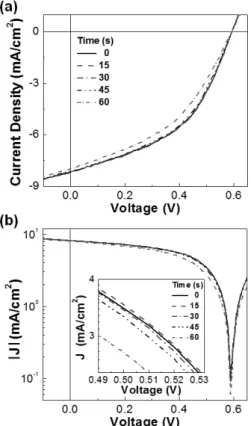
As shown in Fig. 2(a), the light J-V curves of devices were
very slightly changed when the loading (pressing) time increased
up to 45 s. However, a noticeable change in the light J-V curves
was observed at 60 s. The short circuit current density (J
SC) was
reduced from 8.62 mA/cm
2to 7.96 mA/cm
2after loading for 60
s, whereas the open circuit voltage (V
OC) was almost unchanged
Fig. 2. Light J-V curves for the P3HT:PC61BM solar cells according to the loading (pressing) time: (a) Linear scale, (b) semi- logarithmic scale (inset show the enlarged J-V curves)
Fig. 3. Dark J-V curves on a semi-logarithmic scale (inset: linear scale) for the P3HT:PC61BM solar cells according to the loading (pressing) time. The inset photograph shows the top Al electrode part of the solar cell after loading experiment
Fig. 4. JSC, VOC, FF and PCE as a function of the loading (pressing) time for the P3HT:PC61BM solar cells
(see Fig. 2(b)). Interestingly, it is found that the light J-V curve was very marginally improved by loading for 15 s as observed from the enlarged J-V curves (see inset in Fig. 2(b)).
Looking into the dark J-V curves in Fig. 3, the current density in the backward (reverse) direction (<0 V) was almost unaffected by the load irrespective of the loading time. However, the current density in the forward direction (>0 V) was gradually changed (reduced) with the loading time. When the loading time
reached 30 s, the reduced current density was obviously observed at the voltage range of >0.5 V (see the linear J-V curves in the inset figure). This result indicates that the charge transport in the BHJ (P3HT:PC
61BM) layers is influenced by the physical load, even though the surface of the Al electrodes was almost not affected by continuous loading (pressing) of 11.3 kg/cm
2.
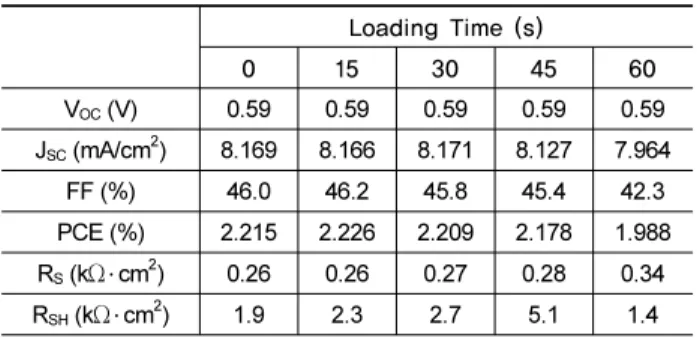
The detailed trend of solar cell parameters is plotted as a function of the loading time in Fig. 4. As discussed in Fig. 2, J
SCwas well maintained up to 30 s, followed by gradual reduction when the loading time was extended to ≥45 s. However, V
OCwas nearly insensitive to the loading time, which informs that
the main bulk heterojunction morphology between P3HT and
PC
61BM domains was excellently preserved. In contrast, the FF
trend was different from the J
SCtrend because it was marginally
increased at 15 s, which can be ascribed to the slightly improved
J-V curve at 15 s as shown in Fig. 2(b) inset. However, FF was
Table 1. Summary of solar cell parameters according to the loading (pressing) time for the P3HT:PC61BM solar cells
Loading Time (s)
0 15 30 45 60
VOC (V) 0.59 0.59 0.59 0.59 0.59
JSC (mA/cm2) 8.169 8.166 8.171 8.127 7.964
FF (%) 46.0 46.2 45.8 45.4 42.3
PCE (%) 2.215 2.226 2.209 2.178 1.988
RS (kΩ ․ cm2) 0.26 0.26 0.27 0.28 0.34
RSH (kΩ ․ cm2) 1.9 2.3 2.7 5.1 1.4
initialized to decrease even at 30 s though J
SCwas well kept at this time. This result may indicate that the charge transport in the BHJ (P3HT:PC
61BM) layers was already slightly affected by the physical load prior to its final influence on J
SC. Further increase in the loading time resulted in the pronounced reduction in FF, which is in agreement with the J
SCtrend. Consequently, the power conversion efficiency (PCE) was very slightly increased up to PCE = 2.23 % at 15 s but showed gradual decreasing trend with time by further loading. As summarized in Table 1, the series resistance (R
S) was similarly starting to increase at 30 s even though it was maintained initially at 15 s. However, the shunt resistance (R
SH) was gradually increased up to 5.1 k Ω․cm
2at 45 s and then abruptly reduced to 1.4 kΩ․cm
2at 60 s. Thus it is expected that the leakage paths in the BHJ (P3HT:PC
61BM) layers might be considerably increased by loading with 11.3 kg/cm
2for 60 s.
4. Conclusions
The stability of polymer:fullerene (P3HT:PC
61BM) solar cells under a physical load (11.3 kg/cm
2) was investigated by varying the loading time up to 60 s. The light J-V curves were subject to marginal change upon the physical load when the loading time was 30 s. However, the shape of J-V curves was pronouncedly changed by the physical loading for 60 s, as supported by the gradually reduced dark current density with the loading time.
The detailed analysis for the solar cell parameters revealed that the FF value was slightly increased by the physical loading for 15 s in the presence of the well-kept J
SCup to 30 s as well as no change in V
OC. As a result, the device efficiency (PCE) was marginally increased at 15 s, whereas further loading for 60 s led to the noticeable reduction in PCE. We expect that the present result may contribute to the stability study of organic solar cells under physical loading and/or touch that is considered another
issue encountered for commercialization of organic solar cells.
Acknowledgments
This work was financially supported by Korean Government grants (NRF_2015R1A2A2A01003743, Human Resource Training Project for Regional Innovation_MOE and NRF-2014H1C1 A1066748, NRF_2014R1A1A3051165, Basic Science Research Program_2009-0093819, Basic Research Laboratory Program_
2011-0020264).
References
1. Scharber, M. C., Sariciftci, N. C., “Efficiency of bulk-hetero- junction organic solar cells”, Prog. Polym. Sci., Vo1. 38, No.
12, pp. 1929-1940, 2013.
2. Huang, X., Han, S., Huang, W., Liu, X., “Enhancing solar cell efficiency: the search for luminescent materials as spectral con- verters”, Chem. Soc. Rev., Vol. 42, pp. 173-201, 2013.
3. Kim, H., Nam, S., Jeong, J., Lee, S., Seo, J. Han, H., Kim, Y.,
“Organic solar cells based on conjugated polymers : history and recent advances”, Korean J. Chem. Eng., Vol. 31, No. 7, pp.
1095-1104, 2014.
4. Franeker, J. J. V., Turbiez, M., Li, W., Wienk, M. M., Janssen, R. A. J., “A real-time study of the benefits of co-solvents in poly- mer solar cell processing”, Nat. Commun., Vol. 6, pp. 6229, 2015.
5. Wu, J. S., Cheng, S. W., Cheng, Y. J., Hsu, C. S., “Donor-ac- ceptor conjugated polymers based on multifused ladder type arenes for organic solar cells”, Chem. Soc. Rev., Vol. 44, pp.
1113-1154, 2015.
6. Dang, M. T., Hirsch, L., Wantz, G., Wuest, J. D., “Controlling the morphology and performance of bulk heterojunctions in so- lar cells. Lessons learned from the benchmark poly(3-hexylth- iophene): [6,6]-phenyl-C61-butyric acid methyl ester system”, Chem. Rev., Vol. 113, No. 5, pp. 3734-3765, 2013.
7. Chen, H. Y., Hou, J., Zhang, S., Liang, Y., Yang, G., Yang, Y., Yu, L., Wu, Y., Li, G., “Polymer solar cells with enhanced open-circuit voltage and efficiency”, Nat. Photonics, Vol. 3, pp.
649-653, 2009.
8. Deng, Y., Liu, J., Wang, J., Liu, L., Li, W., Tian, H., Zhang, X., Xie, Z., Geng, Y., Wang, F., “Dithienocarbazole and iso- indigo based amorphous low bandgap conjugated polymers for efficient polymer solar cells”, Adv. Mater., Vol. 26, No. 3, pp.
471-476, 2014.
9. Ho, C. C., Chen, C. A., Chang, C. Y., Darling, S. B., Su, W. F.,
“Isoindigobased copolymers for polymer solar cells with effi- ciency over 7%”, J. Mater. Chem. A, Vol. 2, pp. 8026–8032, 2014.
10. Guo, X. Zhou, N., Lou, S. J., Smith, J., Tice, D. B., Hennek, J.
W., Ortiz, R. P., Navarrete, J. T. L., Li, K., Strzalka, J., Chen, L. X., Chang, R. P. H., Facchetti, A., Marks, T. J., “Polymer solar cells with enhanced fill factors”, Nat. Photonics, Vol. 7, pp. 825-833, 2013.
11. He, Z., Xiao, B., Liu, F., Wu, H., Yang, Y., Xiao, S., Wang, C., Russell, T. P., Cao, Y., “Single-junction polymer solar cells with high efficiency and photovoltage”, Nat. Photonics, Vol. 9, pp. 174-179, 2015.
12. Tao, Q., Xia, Y., Xu, X., Hedstrom, S., Backs, O., James, D. I., Persson, P. Olsson, E., Lnganas, O., Hou, W., Zhu, W., Wang, E., “D-A1-D-A2 copolymers with extended donor segments for efficient polymer solar cells”, Macromolecules, Vol. 48, No. 4, pp. 1009-1016, 2015.
13. Zhang, S., Ye, L., Zhao, W., Liu, D., Yao, H., Hou, J., “Side chain selection for designing highly efficient photovoltaic poly- mers with 2D-conjugated structure”, Macromolecules, Vol. 47, No. 14, pp. 4653-4659, 2014.
14. Shaheen, S. E., Barbec, C. J., Sariciftci, N. S., “2.5% efficient organic plastic solar cells”, Appl. Phys. Lett., Vol. 78, pp.
841-843, 2001.
15. Li, G., Shrotriya, V., Huang, J., Yao, Y., Moriarty, T., Emery, K., Yang, Y., “High efficiency solution processable polymer photovoltaic cells by self-organization of polymer blends”, Nat.
Mater., Vol. 4, pp. 864-868, 2005.
16. Kim, Y., Cook, S., Tuladhar, S. M., Nelson, J., Durrant, J. R., Bradley, D. D. C., Giles, M., McCulloch, I., Ha, C. S., Ree, M.,
“A strong regioregularity effect in self-organizing conjugated polymer films and high-efficiency polythiophene:fullerene so- lar cells”, Nat. Mater., Vol. 5, pp. 197-203, 2006.
17. Kim, Y., Choulis, S. A., Nelson, J., Bradley, D. D. C., Cook, S., Durrant, J. R., “Device annealing effect in organic solar cells with blends of regioregular poly(3-hexylthiophene) and soluble fullerene”, Appl. Phys. Lett., Vol. 86, No. 6, pp. 063502, 2005.
18. Zhang, Y., Zhou, H., Zhang, Y., Seifter, J., Collins, S. D., Lou, C., Bazan, G. C., Nguyen, T., Heeger, A. J., “Molecular doping enhances photoconductivity in polymer bulk heterojunction so- lar cells”, Adv. Mater., Vol. 25, No. 48, pp. 7038-7044, 2013.
19. Wang, Y., Liu, Y., Chen, S., Peng, R., Ge, Z., “Significant en- hancement of polymer solar cell performance via side-chain en- gineering and simple solvent treatment”, Chem. Mater., Vol.
25, No. 15, pp. 3196-3204, 2013.
20. Lee, S., Nam, S., Seo, J., Jeong, J., Kim, H., Woo, S., Kim, Y.,
“Polymer solar cells with micrometer-scale engraved active nanolayers fabricated by pressing with metal molds”, Energy Technol., Vol. 2, pp. 713-720, 2014.
21. Nam, S., Shin, M., Kim, H., Ha, C. S., Ree, M., Kim, Y.,
“Improved performance of polymer:polymer solar cells by dop- ing electron-accepting polymer with an organosulfonic acid”, Adv. Funct. Mater., Vol. 21, pp. 4527-4534, 2011.
22. Shin, M., Kim, H., Park, J., Nam, S., Heo, K., Ree, M., Ha, C.
S., Kim, Y., “Abrupt morphology change upon thermal anneal- ing in poly(3-Hexylthiophene)/soluble fullerene blend films for polymer solar cells”, Adv. Funct. Mater., Vol. 20, pp. 748-754,
2010.
23. Chen, D., Nakahara, A., Wei, D., Nordlund, D., Russell, T. P.,
“P3HT/PCBM bulk heterojunction organic photovoltaics: cor- relating efficiency and morphology”, Nano Lett., Vol. 11, No.
2, pp. 561-567, 2011.
24. Nam, S., Lee, S., Lee, I., Shin, M., Kim, M., Kim, Y.,
“Nanomorphology-driven two-stage hole mobility in blend films of regioregular and regiorandom polythiophenes”, Nanoscale, Vol. 3, pp. 4261-4269, 2011.
25. Kniepert, J., Lange, I., Kaap, N., Koster, L., Neher, D., “A conclusive view on charge generation, recombination, and ex- traction in as-prepared and annealed P3HT:PCBM blends:
combined experimental and simulation work”, Adv. Energy Mater., Vol. 4, No. 7, pp. 1301401, 2014.
26. Ameri, T., Min, J., Machui, F., Baran, D., Forster, M., Schottler, K. J., Dolfen, D., Scherg, U., Brabec, C. J., “Performance en- hancement of the P3HT/PCBM solar cells through NIR sensi- tization using a small-bandgap polymer”, Adv. Energy Mater., Vol. 2, No. 10, pp. 1198-1202, 2012.
27. Kim, H., Nam, S., Lee, H., Woo, S., Ha, C. S., Ree, M., Kim, Y., “Influence of controlled acidity of hole-collecting buffer lay- ers on the performance and lifetime of polymer:fullerene solar cells”, J. Phys. Chem. C, Vol. 115, No. 27, pp. 13502-13510, 2011.
28. Chang, S., Liao, H., Shao, Y., Sung, Y., Hsu, S., Ho, C., Su, W., Chen, Y., “Enhancing the efficiency of low bandgap con- ducting polymer bulk heterojunction solar cells using P3HT as a morphology control agent”, J. Mater. Chem. A, Vol. 1, pp.
2447-2452, 2013.
29. Nam, S., Lee, S., Jeong, J., Seo, J., Kim, H., Song, D., Kim, Y.,
“Light-induced open circuit voltage increase in polymer solar cells with ternary bulk heterojunction nanolayers”, ACS Sustain.
Chem. Eng., Vol. 3, No. 1, pp. 55-62, 2014.
30. Han, H., Lee, H., Nam, S., Jeong, J., Lee, I., Kim, H., Ha, C.
S., Kim, Y., “Poly (3-hexylthiophene-co-benzothiadiazole) (THBT) as an electron- accepting polymer for normal and inverted type all-polymer solar cells”, Polym. Chem., Vol. 4, pp. 2053-2061, 2013.
31. Duong, D., Wang, C., Antono, E., Toney, M. F., Salleo, A.,
“The chemical and structural origin of efficient p-type doping in P3HT”, Org. Electron., Vol. 14, No. 5, pp. 1330-1336, 2013.
32. Nam, S., Park, S., Seo, J., Jeong, J., Lee, S., Kim, J., Kim, H., Kim, Y., “Influence of annealing temperature on the nano- structure and performance of polymer:polymer solar cells”, J.
Korean Phys. Soc., Vol. 63, No. 7, pp. 1368-1372, 2013.
33. Lobez, J. M., Andrew, T. L., Bulovic, V., Swager, T. M.,
“Improving the performance of P3HT-fullerene solar cells with side chain functionalized poly(thiophene) additives: a new paradigm for polymer design”, ACS Nano, Vol. 6, No. 4, pp.
3044-3056, 2012.
34. Park, S., Nam, S., Seo, J., Jeong, J., Lee, S., Kim, H., Kim, Y.,
“Effect of halogen-terminated additives on the performance and the nanostructure of all-polymer solar cells”, J. Korean
Phys. Soc., Vol. 66, No. 3, pp. 521-525, 2015.
35. Krantz, J., Stubhan, T., Richter, M., Spallek, S., Litzov, I., Matt, G. J., Spiecker, E., Brabec, C. J., “Spray-coated silver nanowires as top electrode layer in semitransparent P3HT:
PCBM based organic solar cell devices”, Adv. Funct. Mater., Vol. 23, No. 13, pp. 1711-1717, 2013.
36. Lee, S., Nam, S., Kim, H., Kim, Y., “Compression-induced open circuit voltage increase in all-polymer solar cells with lith- ium fluoride nanolayers”, ACS Sustain. Chem. Eng., Vol. 1, No. 10, pp. 1280-1285, 2013.
37. Woo, S., Kim, W., Kim, H., Yi, Y., Lyu, H., Kim, Y., “8.9%
single-stack inverted polymer solar cells with electron-rich poly- mer nanolayer modified inorganic electron-collecting buffer layers”, Adv. Energy Mater., Vol. 4, No. 7, pp. 1301692, 2014.
38. Bencheikh, F., Duché, D., Ruiz, C. M., Simon, J., Escoubas, L., “Study of optical properties and molecular aggregation of conjugated low band gap copolymers: PTB7 and PTB7-Th”, J.
Phys. Chem. C, Vol. 119, No. 43, pp. 24643-24648, 2015.
39. Wu, C., Chueh, C., Xi, Y., Zhong, H., Gao, G., Wang, Z., Pozzo, L. D., Wen, T., Jen, A. K. Y., “Influence of molecular geometry of perylene diimide dimers and polymers on bulk het- erojunction morphology toward high performance nonfullerene polymer solar cells”, Adv. Funct. Mater., Vol. 25, No. 33, pp.
5326-5332, 2015.
40. Jeong, J., Seo, J., Nam, S., Han, H., Kim, H., Anthopoulos, T.
D., Bradley, D. C. C., Kim, Y., “Significant stability enhance- ment in high efficiency polymer:fullerene bulk heterojunction solar cells by blocking ultraviolet photons from solar light”, Adv. Sci., Vol. 3, No. 4, pp. 1500269, 2016.
41. Li, N., Brabec, C. J., “Air-processed polymer tandem solar cells with power conversion efficiency exceeding 10%”, Energy Environ. Sci., Vol. 8, pp. 2902-2909, 2015.
42. Lee, C., Kang, H., Lee, W., Kim, T., Kim, K., Woo, H., Wang, C., Kim, B., “High performance all-polymer solar cells via side-chain engineering of the polymer acceptor: the importance of the polymer packing structure and the nanoscale blend mor- phology”, Adv. Mater., Vol. 27, pp. 2466-2471, 2015.
43. Sharma, R., Lee, H., Gupta, V., Kim, H., Kumar, M., Sharma, C., Chand, S., Yoo, S., Gupta, D., “Photo-physics of PTB7, PCBM and ICBA based ternary solar cells”, Org. Electron., Vol. 34, pp. 111-117, 2016.
44. He, Z., Xiao, B., Liu, F., Wu, H., Yang, Y., Xiao, S., Wang, C., Russell, T. P., Cao, Y., “Single junction polymer solar cells with high efficiency and photovoltage”, Nat. Photonics, Vol. 9, pp. 174-179, 2015.
45. Liu, T., Huo, L., Fan, B., Cai, Y., Kim, T., Kim, J., Choi, H., Sun, Y., “Ternary organic solar cells based on two highly effi- cient polymer donors with enhanced power conversion effi- ciency”, Adv. Energy Mater., Vol. 6, No. 6, pp. 1502109, 2016.
46. Kim, W., Kim, J., Kim, E., Ahn, T., Wang, D., Park, J.,
“Conflicted effects of a solvent additive on PTB7:PC71BM bulk heterojunction solar cells”, J. Phys. Chem. C, Vol. 119, No. 11, pp. 5954-5961, 2015.
47. Nam, S., Seo, J., Woo, S., Kim, W., Kim, H., Bradley, D. D.
C., Kim, Y., “Inverted polymer fullerene solar cells exceeding 10% efficiency with poly(2-ethyl-2-oxazoline) nanodots on elec- tron- collecting buffer layers”, Nat. Commun., Vol. 6, pp. 8929, 2016.