1. Introduction
Polymer solar cells have attracted keen attention due to rapid energy payback time and potential for flexible plastic solar modules with ultrathin and lightweight like wall papers.
1-7)To date, most high efficiency polymer solar cells are fabricated with the bulk heterojunction (BHJ) films of electron-donating polymers and electron-accepting fullerene derivatives.
8-20)The advantage of such polymer solar cells can be attributable to the mild fabrication condition in atmospheric pressure, not in vacuum as for conventional inorganic solar cells, by employing wet-coating processes such as spin-coating, spray coating, slot-die coating, inkjet-printing, and gravure printing at low temperatures.
21-25)However, the stability of polymer solar cells is still an on-going issue even though their power conversion efficiency (PCE) has reached ca. 11% in the case of single-stack device structures.
26)It has been suggested that the diffusion and aggregation of fullerene molecules may degrade the performance of polymer:
fullerene solar cells because the fullerene derivatives are small molecules with relatively higher degree of freedom in terms of mobility, compared to macromolecules (polymers), so that they can easily recrystallize and make aggregations.
27-43)Recently, the stability of high efficiency polymer:fullerene solar cells, which are fabricated with the BHJ films of poly[[4,8-bis [(2- ethylhexyl)oxy]benzo[1,2-b:4,5-b']dithiophene-2,6-diyl][3-fluoro- 2-[(2-ethylhexyl)carbonyl]thieno[3,4-b]thiophenediyl]] (PTB7) and [6,6]-phenyl C
71butyric acid methyl ester (PC
71BM), have been reported in order to understand the influence of interfacial layers between electron-collecting buffer layers and BHJ layers.
26,44-45)However, no study has been reported on the change of nano- structures in the thermally-annealed BHJ layers of poly[4,8-bis (5-(2-ethylhexyl)thiophen-2-yl)benzo[1,2-b:4,5-b']dithiophene- alt-3-fluorothieno[3,4-b]thiophene-2-carboxylate] (PTB7-Th) and [6,6]-phenyl C
71butyric acid methyl ester (PC
71BM).
In this work, we tried to measure the change of nanostructures in the PTB7-Th:PC
71BM layers, which are thermally annealed at different temperatures, by employing synchrotron radiation grazing incidence X-ray diffraction (GIXD) techniques. To understand the change of device performances according to the annealing temperature, three different annealing conditions
DOI:https://doi.org/10.21218/CPR.2017.5.3.069 eISSN 2508-125X
Effect of Thermal Treatment on the Performance and
Nanostructures in Polymer Solar Cells with PTB7-Th:PC 71 BM Bulk Heterojunction Layers
Sooyong Lee
1)․ Jooyeok Seo
1)․ Jaehoon Jeong
1)․ Chulyeon Lee
1)․ Myeonghun Song
1)․ Hwajeong Kim
1,2)* ․ Youngkyoo Kim
1)*
1)Organic Nanoelectronics Laboratory and KNU Institute for Nanophotonics Applications (KINPA), Department of Chemical Engineering, School of Applied Chemical Engineering, Kyungpook National University, Daegu 41566, Korea
2)Research Institute of Advanced Energy Technology, Kyungpook National University, Daegu 41566, Korea
ABSTRACT: Here we report the influence of thermal treatment on the performance of high efficiency polymer solar cells with the bulk heterojunction films of poly[4,8-bis(5-(2-ethylhexyl)thiophen-2-yl)benzo[1,2-b:4,5-b'] dithiophene-alt-3-fluorothieno[3,4-b]thiophene-2- carboxylate] (PTB7-Th) and [6,6]-phenyl C
71butyric acid methyl ester (PC
71BM). The crystalline nanostructure of PTB7-Th:PC
71BM layers, which were annealed at three different temperatures, was investigated by employing synchrotron radiation grazing incidence X-ray diffraction (GIXD) technique. Results showed that the device performance was slightly reduced by thermal annealing at 50°C but became significantly poor by thermal annealing at 100°C. The poor device performance by thermal annealing was attributed to the collapse in the crystalline nanostructure of PTB7-Th in the PTB7-Th:PC
71BM layers as evidenced by the GIXD measurements that exhibited huge reduction in the intensity of PTB7-Th (100) peak even at 50°C.
Key words: Polymer solar cells, PTB7-Th, Synchrotron, GIXD, Thermal treatment
*Corresponding author: [email protected], [email protected] Received August 17, 2017; Revised September 12, 2017;
Accepted September 13, 2017
ⓒ 2017 by Korea Photovoltaic Society
This is an Open Access article distributed under the terms of the Creative Commons Attribution Non-Commercial License (http://creativecommons.org/licenses/by-nc/3.0)
which permits unrestricted non-commercial use, distribution, and reproduction in any medium, provided the original work is properly cited.
69
were applied for the fabrication of PTB7-Th:PC
71BM solar cells.
2. Experimental Section
2.1 Materials and solutions
PTB7-Th (weight-average molecular weight = 126 kDa;
polydispersity index = 2.5) and PC
71BM (formula molecular = 1.031 kDa) were received from 1-Material (Canada) and Nano-C (USA), respectively. Zinc acetate dehydrate (purity > 99%) were purchased from Sigma-Aldrich (USA) and used without further purification. Binary solutions of PTB7-Th and PC
71BM were prepared using chlorobenzene (CB) as a solvent and 1,8- diiodooctane (DIO, 3 vol%) as an additive at a solid concentration of 25 mg/ml (PTB7-Th:PC
71BM = 1:1.5 by weight), followed by stirring for better mixing at room temperature for 12 h prior to spin-coating. The zinc oxide (ZnO) precursor solutions were prepared by dissolving 200 mg of zinc acetate dehydrate in the mixture of 2-methoxyethanol (2 ml) and ethanol amine (0.056 ml, stabilizer). The precursor solutions were subject to stirring at 60
oC for 3 h and at room temperature for 12 h.
2.2 Device fabrication
To fabricate PTB7-Th:PC
71BM solar cells, the pre-patterned ITO-coated glass substrates were cleaned using acetone and isopropyl alcohol in an ultrasonic cleaner. The ITO-coated glass substrates were dried with nitrogen gas flow and treated inside a UV-ozone cleaner for 20 min in order to remove any remnant organic residues on the ITO surfaces. The ZnO precursor solutions were spun on the ITO-glass substrates, followed by annealing at 200°C for 1 h in air ambient condition. Next, the PTB7-Th:
PC
71BM layers were spin-coated on top of the ZnO nanolayers in the glove box charged with nitrogen gas. The active layer- coated samples were thermally annealed on a hot plate for 30 s at various temperatures. All samples were transferred to a vacuum chamber in the same glove box and waiting to reach the base pressure of 2.0 × 10
-6torr after pumping. Then molybdenum oxide (MoO
3, 10 nm) and silver (Ag, 80 nm) electrodes were thermally evaporated on the PTB7-Th:PC
71BM layers. The samples for the GIXD measurement were simultaneously prepared without the MoO
3/Ag electrodes.
2.3 Measurements
The solar cell performance of devices, which were mounted inside an argon-filled sample holder, was measured using a
specialized solar cell measurement system equipped with a solar simulator (92250A-1000, Newport Oriel) and an electrometer (Keithley 2400). The incident light intensity was 100 mW/cm
2(air mass 1.5G). The GIXD measurements were performed using the synchrotron radiation X-ray system in Pohang Accelerator Laboratory (PAL, 3C beam line, Republic of Korea): X-ray wavelength = 1.2423 Å, detector size = 0.079 mm, and incidence angle = 0.13°.
3. Results and Discussion
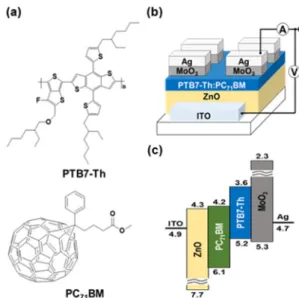
As shown in Fig. 1, the present PTB7-Th:PC
71BM solar cells have an inverted-type structure which features an active layer sandwiched between metal oxide charge-collecting buffer layers.
The hole collection occurs via the MoO
3layer to the Ag electrode, while the electron collection is made via the ZnO layer to the ITO electrode. It is worthy to note that the PTB7-Th has alkylated thiophene ring in the benzodithiophene (BDT) unit instead of alkoxy group in the well-known PTB7, which delivers different lowest unoccupied molecular orbital (LUMO) energy (-3.6 eV for PTB7-Th and -3.3 eV for PTB7) and may lead to a different chain stacking nanostructure.
The current density – voltage (J-V) curves of devices, which were measured under the simulated solar light, are shown in Fig.
2. When the annealing temperature was 50°C, the light J-V curve was slightly changed with a marginal reduction in short circuit current density (J
SC) (from 18.08 mA/cm
2to 17.02 mA/cm
2).
Fig. 1. Materials and device structure: (a) Chemical structures of PTB7-Th and PC71BM, (b) inverted type solar cell structure, and (c) flat energy band gap diagram for PTB7-Th:PC71BM solar cell
However, no change in open circuit voltage (V
OC) was measured (see Table 1). As the annealing temperature increased up to 100°C, the J-V curve shape became remarkably poor with a noticeable reduction in J
SC. This result may imply that thermal annealing is not preferred for the present PTB7-Th:PC
71BM solar cells.
To further analyze the change of device performances, the solar cell parameters are plotted as a function of annealing temperature in Fig. 3. It is evident that the V
OCchange was not serious but the J
SCchange did strongly influence on the PCE change because the J
SCvalue was reduced from 18.08 mA/cm
2(as-coated) to 12.69 mA/cm
2(100°C thermal treatment) but the V
OCvalue was still 0.77 V (100°C thermal treatment). In addition, we note that the fill factor (FF) was also noticeably reduced with the annealing temperature, which may inform that the charge percolation nanostructures could be affected by the thermal annealing treatment on the BHJ layers (PTB7-Th:PC
71BM).
This can be supported by the increased series resistance (R
S) and
the decreased shunt resistance (R
SH) with the annealing time (see Table 1).
To understand the change of device performances according to the thermal annealing, the crystalline nanostructure in the BHJ (PTB7-Th:PC
71BM) films was investigated by employing a synchrotron radiation GIXD technique. As shown in Fig. 4, a dominant face-on polymer chain stacking structure was measured for the as-coated BHJ layers coated on the ZnO/ITO-glass substrates. The Debye ring for the (100) peak of PTB7-Th is
Fig. 2. Light current density-voltage (J-V) curves under illumination with a simulated solar light (air mass 1.5G, 100 mW/cm2) for PTB7-Th:PC71BM solar cells according to the thermal treatment (annealing condition)
Table 1. Summary of solar cell parameters for the PTB7-Th:
PC71BM solar cells fabricated in this work
Parameters
Treatment Condition for PTB7-Th:PC71BM Films
As-coated 50°C
Treatment 100°C
Treatment
VOC (V) 0.78 0.78 0.77
JSC (mA/cm2) 18.08 17.02 12.69
FF (%) 59.8 58.6 49.8
PCE (%) 8.43 7.79 4.87
RS (kΩ・cm2) 0.06 0.08 0.09
RSH (kΩ・cm2) 4.90 4.30 1.30
Fig. 3. VOC, JSC, FF, and PCE as a function of thermal treatment condition for the PTB7-Th:PC71BM solar cells
Fig. 4. 2D GIXD images for the PTB7-Th:PC71BM layers coated on the ZnO/ITO-glass substrates: (a) As-coated, (b) 50°C treatment, and (c) 100°C treatment. The images in the right part are enlarged ones focusing on the (100) peak.
‘(100)_D’ denotes the (100) peak of PTB7-Th (electron donor)
clearly observed in both out-of-plane (OOP) and in-plane (IP) directions but the brightness was much stronger in the OOP direction (see the enlarged image on the right part in Fig. 4a).
Interestingly, the (100) diffraction ring is asymmetric because the scattering vector on the (100) ring is relatively larger in the OOP direction than in the IP direction, which can be attributed to the incomplete (or twisted) face-on stacking in the IP direction.
However, the brightness of the (100) ring became extremely weak in the case of the BHJ layers annealed at 50°C and only a traceable brightness could be measured in the IP direction (see Fig. 4b). When the annealing temperature was increased up to 100°C, the brightness of the (100) ring was further reduced and the (100) spot in the OOP direction was significantly weakened (see the enlarged image on the right part in Fig. 4c). This result informs that the crystalline nanostructure of PTB7-Th chains in the BHJ layers was destroyed upon thermal annealing.
For more detailed investigation the 2D GIXD images were converted into 1D GIXD profiles in the two directions (OOP and IP). As shown in Fig. 5a, the (100) peak in the OOP direction (q = 0.33 Å
-1) was greatly reduced as the thermal annealing
temperature increased. However, the position of the (100) peak was unchanged with the annealing temperature, indicative of no formation of new crystalline states. The similar reduction in the (100) peak intensity was obtained in the IP direction (see Fig.
5b). Here we note that the position of (100) peak (q = 0.28 Å
-1) in the IP direction was different from that in the OOP direction as mentioned above.
30)The 1D GIXD profiles confirm that the chain stacking of PTB7-Th is collapsed upon thermal annealing, which is considered as one of the major reasons for the poor device performances after thermal annealing (treatment) of the BHJ layers (PTB7-Th:PC
71BM).
4. Conclusions
The polymer:fullerene solar cells with the BHJ (PTB7-Th:
PC
71BM) layers, which were thermally treated at different tem- peratures, were fabricated by employing an inverted-type device structure. The performance of PTB7-Th:PC
71BM solar cells was slightly lowered when the BHJ layers were annealed at 50°C. However, thermal annealing at 100°C led to significantly reduced device performances. The synchrotron GIXD measure- ments disclosed that the crystalline nanostructure of PTB7-Th in the PTB7-Th:PC
71BM layers are vulnerable to destruction upon thermal annealing. The face-on stacking of PTB7-Th chains in the OOP direction was significantly destroyed even at 50°C and further collapse was made as the thermal annealing temperature was increased up to 100°C. The destruction of PTB7-Th chain stacking was also measured in the IP direction.
Hence an effective thermal annealing, which cannot change the crystalline nanostructure of PTB7-Th, is of crucial importance to achieve high device performances.
Acknowledgments
This work was financially supported by Korean Government grants ( NRF_2015R1A2A2A01003743, NRF_2016H1D5A1910319 and Basic Science Research Program_2009-0093819).
References
1. Ameri, T., Lia, N., and Brabec, C. J., “Highly efficient organic tandem solar cells: a follow up review”, Energy Environ. Sci., Vol.
6, pp. 2390-2413, 2013.
2. Lu, L. and Yu, L., “Understanding low bandgap polymer PTB7 and optimizing polymer solar cells based on it”, Adv. Mater., Vol. 26, Fig. 5. 1D GIXD profiles for the PTB7-Th:PC71BM layers coated
on the ZnO/ITO-glass substrates: (a) OOP direction, (b) IP direction. ‘(100)_D’ denotes the (100) peak of PTB7- Th (electron donor)
pp. 4413-4430, 2014.
3. Kim, K., Nam, S., Jeong, J., Lee, S., Seo, J., Han, H., and Kim, Y.,
“Organic solar cells based on conjugated polymers: history and recent advances”, Korean J. Chem. Eng., Vol. 31, No. 7, pp.
1095-1104, 2014.
4. Facchetti, A., “Polymer donor-polymer acceptor (all-polymer) solar cells”, Mater. Today, Vol. 16, No. 4, pp. 123-132, 2013.
5. Darling, S. B. and You, F., “The case for organic photovoltaics”, RSC Adv., Vol. 3, pp. 17633-17648, 2013.
6. Heeger, A. J., “25th Anniversary article: bulk heterojunction solar cells: understanding the mechanism of operation”, Adv. Mater., Vol. 26, No. 1, pp. 10-28, 2014.
7. Yan, J. and Saunders, B. R., “Third-generation solar cells: a review and comparison of polymer:fullerene, hybrid polymer and perovskite solar cells”, RSC Adv., Vol. 4, pp. 43286-43314, 2014.
8. Woo, S., Kim, W., Kim, H., Yi, Y., Lyu, H., and Kim, Y., “8.9%
single-stack inverted polymer solar cells with electron-rich polymer nanolayer modified inorganic electron-collecting buffer layers”, Adv. Energy Mater., Vol. 4, No. 7, pp. 1301692, 2014.
9. Wang, N., Chen, Z., Wei, W., and Jiang, Z., “Fluorinated benzo- thiadiazole-based conjugated polymers for high-performance polymer solar cells without any processing additives or post-treatments”, J.
Am. Chem. Soc., Vol. 135, No. 45, pp. 17060-17068, 2013.
10. Padinger, F., Rittberger, R. S., and Sariciftci, N. S., “Effects of postproduction treatment on plastic solar cells”, Adv. Funct.
Mater., Vol. 13, No. 1, pp. 85-88, 2003.
11. Nguyen, T. L., Choi, H., Ko, S., Uddin, M. A., Walker, B., Yum, S., Jeong, J., Yun, M. H., Shin, T. J., Hwang, S., Kim, J. Y., Woo, H.
Y., “Semi-crystalline photovoltaic polymers with efficiency exceeding 9% in a ∼300 nm thick conventional single-cell device”, Energy Enviorn. Sci., Vol. 7, pp. 3040-3051, 2014.
12. Zhang, M., Gu, Y., Guo, X., Liu, F., Zhang, S., Huo, L., Russell, T.
P., and Hou, J., “Efficient polymer solar cells based on benzo- thiadiazole and alkylphenyl substituted benzodithiophene with a power conversion efficiency over 8%”, Adv. Mater., Vol. 25, No.
35, pp. 4944-4949, 2013.
13. Kim, Y., Choulis, S. A., Nelson, J., Bradley, D. D. C., Cook, S., and Durrant, J. R., “Device annealing effect in organic solar cells with blends of regioregular poly(3-hexylthiophene) and soluble fullerene”, Appl. Phys. Lett., Vol. 86, pp. 063502, 2005.
14. Deng, Y., Liu, J., Wang, J., Liu, L., Li, W., Tian, H., Zhang, X., Xie, Z., Geng, Y., and Wang, F., “Dithienocarbazole and isoindigo based amorphous low bandgap conjugated polymers for efficient polymer solar cells”, Adv. Mater. Vol. 26, No. 3, pp. 471-476, 2014.
15. Reyes-Reyes, M., Kim, K., and Carroll, D. L., “High-efficiency photovoltaic devices based on annealed poly(3-hexylthiophene) and 1-(3-methoxycarbonyl)-propyl-1-phenyl-(6,6)C61 blends”, Appl.
Phys. Lett., Vol. 87, pp. 083506, 2005.
16. Liao, S., Jhuo, H., and Cheng, Y., “Fullerene derivative-doped zinc oxide nanofilm as the cathode of inverted polymer solar cells with low-bandgap polymer (PTB7-Th) for high performance”, Adv.
Mater., Vol. 25, No. 34, pp. 4766-4771, 2013.
17. Shaheen, S. E., Brabec, C. J., Sariciftci, N. S., Padinger, F., Fromherz, T., and Hummelen, J. C., “2.5% efficient organic plastic solar cells”, Appl. Phys. Lett., Vol. 78, pp. 841, 2001.
18. Guo, X., Zhou, N., Lou, S. J., Smith, J., Tice, D. B., Hennek, J. W., Ortiz, R. P., Navarrete, J. T. L., Li, S., Strzalka, J., Chen, L. X., Chang, R. P. H., Facchetti, A., and Marks, T. J., “Polymer solar cells with enhanced fill factors”, Nat. Photonics, Vol. 7, pp.
825-833, 2013.
19. Kim, Y., Cook, S., Tuladhar, S. M., Choulis, S. A., Nelson, J., Durrant, J. R., Bradley, D. D. C., Giles, M., McCulloch, I., Ha, C.
S., and Ree, M., “A strong regioregularity effect in self-organizing conjugated polymer films and high-efficiency polythiophene:
fullerene solar cells”, Nat. Mater., Vol. 5, pp. 197-203, 2006.
20. Nam, S., Seo, J., Han, H., Kim, H., Hahm, S. G., Ree, M., Gal, Y., Anthopoulos, T. D., Bradlet, D. D. C., and Kim, Y., “>10%
efficiency polymer: fullerene solar cells with polyacetylene-based polyelectrolyte interlayers”, Adv. Mater. Interfaces, Vol. 3, No. 23, pp. 1600415, 2016.
21. Krebs, F. C., “Fabrication and processing of polymer solar cells: a review of printing and coating techniques”, Sol. Energy Mater. Sol.
Cell., Vol. 93, No. 4, pp. 394-412, 2009.
22. Krebs, F. C., Gevorgyan, S. A., and Alstrup, J., “A roll-to-roll process to flexible polymer solar cells: model studies, manufacture and operational stability studies”, J. Mater. Chem., Vol. 19, pp.
5442-5451, 2009.
23. Lee, S., Kim, H., and Kim, Y., “Influence of physical load on the stability of organic solar cells with polymer:fullerene bulk hetero- junction nano layers”, Curr. Photovoltaic Res., Vol. 4, No. 2, pp.
48-53, 2016.
24. Søndergaard, R., Hösel, M., Angmo, D., Larsen-Olsen, T. T., and Krebs, F. C., “Roll-to-roll fabrication of polymer solar cells”, Mater. Today, Vol. 15, No. 1, pp. 36-49, 2012.
25. Blankenburg, L., Schultheis, K., Schache, H., Sensfuss, S., and Schrönder, M., “Reel-to-reel wet coating as an efficient up-scaling technique for the production of bulk-heterojunction polymer solar cells”, Sol. Energy Mater. Sol. Cell., Vol. 93, No. 4, pp. 476-483, 2009.
26. Nam, S., Seo, J., Woo, S., Kim, W., Kim, H., Bradley, D. D. C., and Kim, Y., “Inverted polymer fullerene solar cells exceeding 10%
efficiency with poly(2-ethyl-2-oxazoline) nanodots on electron- collecting buffer layers”, Nat. Commun., Vol. 6, pp. 8929, 2015.
27. Kim, Y., Nelson, J., Zhang, T., Cook, S., Durrant, J. R., Kim, H., Park, J., Shin, M., Nam, S., Heeney, M., McCulloch, I., Ha, C. S., and Bradley, D. D. C., “Distorted asymmetric cubic nanostructure of soluble fullerene crystals in efficient polymer:fullerene solar cells”, ACS Nano, Vol. 3, No. 9, pp. 2557-2562, 2009.
28. Peters, C. H., Sachs-Quintana, I. T., Mateker, W. R., Heumueller, T., Rivnay, J., Noriega, R., Beiley, Z. M., Hoke, E. T., Salleo, A., and McGehee, M. D., “The mechanism of burn-in loss in a high efficiency polymer solar cell”, Adv. Mater., Vol. 24, No. 5, pp.
663-668, 2012.
29. Kim, H., Shin, M., Park, J., and Kim, Y., “Initial performance changes of polymer/fullerene solar cells by short-time exposure to
simulated solar light”, ChemSusChem, Vol. 3, No. 4, pp. 476-480, 2010.
30. Kim, H., Shin, M., Park, J., and Kim, Y., “Effect of long time annealing and incident light intensity on the performance of polymer:fullerene solar cells”, IEEE Trans. Nanotechnol., Vol. 9, No. 3, pp. 400-406, 2010.
31. Nam, S., Woo, S., Seo, J., Kim, W. H., Kim, H., McNeill, C. R., Shin, T. J., Bradley, D. D. C., and Kim, Y., “Pronounced cosolvent effects in polymer:polymer bulk heterojunction solar cells with sulfur-rich electron-donating and imide- containing electron- accepting polymers”, ACS Appl. Mater. Interfaces, Vol. 7, No. 29, pp. 15995-16002, 2015.
32. Jørgensen, M., Norrman, K., Gevorgyan, S. A., Tromholt, T., Andreasen, B., and Krebs, F. C., “Stability of polymer solar cells”, Adv. Mater., Vol. 24, No. 5, pp. 580-612, 2012.
33. Nam, S., Shin, M, Kim, H., and Kim, Y., “Temperature/time-dependent crystallization of polythiophene:fullerene bulk heterojunction films for polymer solar cells”, Nanoscale, Vol. 2, pp. 2384-2389, 2010.
34. Wang, Y., Xu, W., Zhang, J., Zhou, L., Lei, Gang, Liu, C., Lai, W., and Huang, W., “A small molecule/fullerene binary acceptor system for high-performance polymer solar cells with enhanced light-harvesting properties and balanced carrier mobility”, J. Mater.
Chem. A, Vol. 5, pp. 2460-2465, 2017.
35. Shin, M., Kim, H., Park, J., Nam, S., Heo, K., Ree, M., Ha, C. S., and Kim, Y., “Abrupt morphology change upon thermal annealing in poly(3-hexylthiophene)/soluble fullerene blend films for polymer solar cells”, Adv. Funct. Mater., Vol. 20, No. 5, pp. 748-754, 2010.
36. Foster, S., Deledalle, F., Mitani, A., Kimura, T., Kim, K., Okachi, T., Kirchartz, T., Oguma, J., Durrant, J. R., Doi, S., and Nelson, J., “Electron collection as a limit to polymer:PCBM solar cell efficiency: effect of blend microstructure on carrier mobility and device performance in PTB7:PCBM”, Adv. Energy Mater., Vol. 4, No. 14, pp. 1400311, 2014.
37. Nam, S., Park, S., Kim, H., Lee, J., and Kim, Y., “Strong addition effect of charge-bridging polymer in polymer:fullerene solar cells with low fullerene content”, RSC Adv., Vol. 4, pp. 24914-24921,
2014.
38. Shin, M., Kim, H, Nam, S., Park, J., and Kim, Y., “Influence of hole-transporting material addition on the performance of polymer solar cells”, Energy Environ. Sci., Vol. 3, pp. 1538-1543, 2010.
39. Pranculis, V., Ruseckas, A., Vithanage, D. A., Hedley, G. J., Samuel, I. D. W., and Gulbinas, V., “Influence of blend ratio and processing additive on free carrier yield and mobility in PTB7:
PC71BM photovoltaic solar cells”, J. Phys. Chem. C, Vol. 120, No.
18, pp. 9588-9594, 2016.
40. Han, H., Lee, H., Nam, S., Jeong, J., Lee, I., Kim, H., Ha, C. S., and Kim, Y., “Poly(3-hexylthiophene-co-benzothiadiazole)(THBT) as an electron- accepting polymer for normal and inverted type all-polymer solar cells”, Polym. Chem., Vol. 4, pp. 2053-2061, 2013.
41. Nam, S., Park, S., Seo, J., Jeong, J., Lee, S., Kim, J., Kim, H., and Kim, Y., “Influence of annealing temperature on the nanostructure and performance of polymer: Polymer solar cells”, J. Korean Phys.
Soc., Vol. 63, No. 7, pp. 1368-1372, 2013.
42. Roehling, J. D., Baran, D., Sit, J., Kassar, T., Ameri, T., Unruh, T., Barbec, C. J., and Moule, A. J., “Nanoscale morphology of PTB7 based organic photovoltaics as function of fullerene size”, Sci.
Rep., Vol. 6, pp. 30915, 2016.
43. Nam, S., Hahm, S. G., Han, H., Seo, J., Kim, C., Kim, H., Marder, S. R., Ree, M., and Kim, Y., “All-polymer solar cells with bulk hetero -junction films containing electron-accepting triple bond- conjugated perylene diimide polymer”, ACS Sustainable Chem.
Eng., Vol. 4, No. 3, pp. 767-774, 2016.
44. Jeong, J., Seo, J., Nam, S., Han, H., Kim, H., Anthopoulos, T. D., Bradley, D. D. C., and Kim, Y., “Significant stability enhancement in high- efficiency polymer:fullerene bulk heterojunction solar cells by blocking ultraviolet photons from solar light”, Adv. Sci., Vol. 3, No. 4, pp. 1500269, 2016.
45. Wan, Q., Guo, X., Wang, Z., Li, W., Guo, B., Ma, W., Zhang, M., and Li, Y., “10.8% efficiency polymer solar cells based on PTB7-Th and PC71BM via binary solvent additives treatment”, Adv. Funct. Mater., Vol. 26, No. 36, pp. 6635-6640, 2016.