DOI http://dx.doi.org/10.11004/kosacs.2014.5.3.001
홀의 유무에 따른 평판 좌굴하중 산정을 위한 좌굴계수
베자드 모하마자데1 · 노혁천2
세종대학교 건설환경공학과 박사과정1, 세종대학교 건설환경공학과 부교수2
Use of Buckling Coefficient in Predicting Buckling Load of Plates with and without Holes
Behzad Mohamazadeh1 · Noh, Hyuk-Chun2
1\Ph.D. Student, Department of Civil and Environmental Engineering, Sejong University, Seoul, Korea
2Assistant professor, Department of Civil and Environmental Engineering, Sejong University, Seoul, Korea
Abstract: Buckling, a form of failure happened to plated structures, is investigated in this study. The main focus is to investigate the effects of thickness of the plates having through-thickness holes on buckling when the plate is subjected to in-plane compression. Plates having length of 200mm and width of 100mm are chosen to have thickness in range from 0.50mm to 10mm. Two holes of diameters of 20mm are implemented in plates. The finite element procedure using ABAQUS is applied for analyses. Then using the Gerard and Becker equation compressive buckling coefficients, Kc, are calculated and presented to enable engineers to calculate buckling load for the desired plate with holes in specific dimension. In order to generalize the obtained results, verification analysis has been performed by taking plates having different dimensions from the original ones used in this study. The verification showed the capability of buckling coefficients to predict buckling stresses of plates in various dimensions.
Key Words: Buckling stress, Buckling coefficient, Plates with holes, ABAQUS
주요어: Buckling stress, Buckling coefficient, Plates with holes, ABAQUS Corresponding author: Noh, Hyuk-Chun
Department of Civil and Environmental Engineering, Sejong University, 98 Gunja-dong, Gwangjin-gu, Seoul 143-747, Korea.
Tel: +82-2-3408-3292, Fax: +82-2-3408-4332, E-mail: [email protected] 투고일: 2014년 9월 12일 / 수정일: 2014년 9월 22일 / 게재확정일: 2014년 9월 23일
1. INTRODUCTION
Thin steel plates exist in many structures, such as deck and bottom of ship structures, plate and box girders of bridges, platforms of offshore structures, and structures used in aerospace industries. Sometimes depending on requirements, it is needed to make holes in plates. The presence of holes in plates will change the strength and stiffness of the plate, so the amounts
of stress and their distribution which induce the change in the load bearing capacity of the plate, which might be different from plates without holes (Choi et al. 2012;
Cristopher et al. 2009).
When a plate element is subjected to direct compression, the plate may buckle locally before the member as a whole becomes unstable or before the yield stress of the material is reached. When a plate has a hole, the compressive stress arises near the hole, and the stress may cause local buckling of the plate
(Gerard et al. 1957). Local buckling behavior is characterized by distortion of the cross-section of the member (Hong et al. 1993). The theoretical or elastic critical local bucking load is not a satisfactory basis for design purpose of plates. Ultimate strength of plates may be less than the critical local buckling load due to yielding, or may exceed the critical local buckling loads(Jodoin et al. 2012).
As an alternative several studies investigated the buckling of plates with or without holes from various aspects. Husam Al Qablan et al. (2009) investigated the buckling behavior of composite plates with hole subjected to in-plane shear. The results showed that, in the case of shear loading compared to uniaxial and biaxial compression, there is significant reduction in the buckling load by increasing the size of holes. For relatively small size cutouts, a better performance has been achieved if the cutout was kept close to the edge of the plate, however, for a relatively large size of cutout, a higher buckling load was achieved if the cutout was kept in the middle of the plate.
Khaled M. El-sawy and Aly S.Nazmy (2001), through their study, assessed the effects of aspect ratio (ratio of length ‘a’ to width ‘b’) on the plate buckling load. Two shapes of perforation, circular and rectangular with curved corners, with various location of center of the hole are considered to evaluate the buckling load. Results showed that the use of a rectangular hole, with curved corners, with its short dimension positioned along the longitudinal direction of the plate is a better option than using a circular hole, from the plate stability point of view.
This study deals with numerical analyses of buckling of plates having two holes from the viewpoint of plate thickness, to find the buckling coefficients. Finite element method using ABAQUS is applied to perform analysis and to investigate the plate buckling. The need for approximate methods arises from the fact that exact solutions can be found only for a limited number of buckling problems of practical importance (Cristopher et al. 2009).
To analyze the effects of thickness of the plate buckling, the thickness variation from 0.5mm to
buckling of plate without holes is also investigated to provide a means of comparison between two states of plates with and without holes.
2. BUCKLING COEFFICIENT
The general buckling stress equation is defined as follows(Tom 1993):
(1)
Where is the buckling coefficient, the elastic Poisson’s ratio, t the thickness of plate, ‘a’ the length of the loaded edge in uniaxial compression, and E is the modulus of elasticity of plate material.
3. MODELING OF PLATES
This study investigates the effects of thickness on buckling of plate with through-thickness holes to find buckling coefficient, Kc, for those kinds of plates.
Because of multi-functional application of these plates, two holes of diameter of 20mm are considered in the plates to be simulated using ABAQUS from buckling point of view. The plate materials are considered to be of steel with Poisson’s ratio of 0.3, modulus of elasticity of 209GPa and yield stress of 400MPa.
3.1 Plate with Different Thickness
In order to investigate the effects of thickness on buckling of plates having through-thickness holes, a range of various thicknesses from 0.5mm to 10mm is considered. For thin plates, the values of thicknesses in the range between 0.5mm and 2.5mm vary by the value of 0.25 consecutively. For plates having thicknesses from 3.0mm to 10.0mm, thicknesses vary by 1.0mm. Left edge of the plate is constrained for displacement in all directions while for other edges only the displacement in direction 3, out of plane direction, is constrained.
The centers of left and right holes of diameter of 20.0mm are located at coordinates of x=-50.0mm,
(Fig. 1). In order to mesh the plate, quadratic 8-node second order plate finite element is employed. This element uses the reduced integration to improve the solution and to eliminate the locking phenomenon.
Approximate global size of seeds, determining the density of mesh, is considered to have the value of 0.02 (Fig. 2).
In order to provide a means of comparing the buckling stresses of plates having holes with those of plate without holes as well as making comparison between buckling coefficients of plate with and without holes, this study also analyzed the plates without holes having same dimension and properties with those having holes. By having results of these simulations, it is possible to have a better insight into effects of perforating holes on the plate buckling.
Fig. 1 Schematic Plate having a Variation of Thicknesses
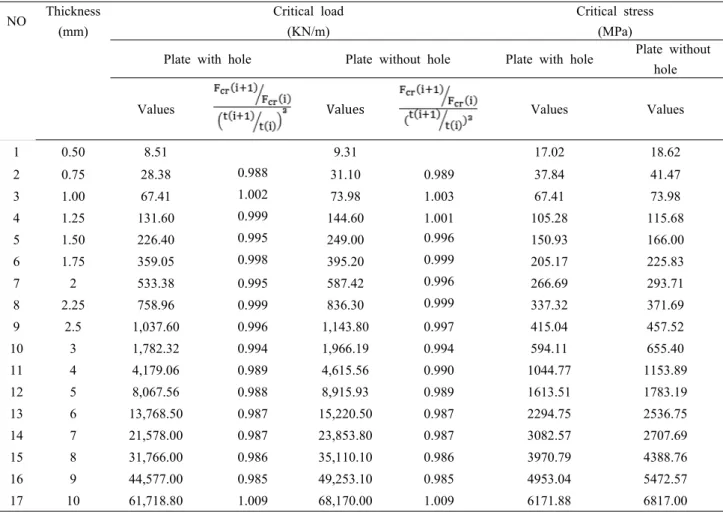
Table 1. Critical Loads and Stresses for Plates with Varying Thickness with and without Holes NO Thickness
(mm)
Critical load (KN/m)
Critical stress (MPa)
Plate with hole Plate without hole Plate with hole Plate without hole
Values Values Values Values
1 0.50 8.51 9.31 17.02 18.62
2 0.75 28.38 0.988 31.10 0.989 37.84 41.47
3 1.00 67.41 1.002 73.98 1.003 67.41 73.98
4 1.25 131.60 0.999 144.60 1.001 105.28 115.68
5 1.50 226.40 0.995 249.00 0.996 150.93 166.00
6 1.75 359.05 0.998 395.20 0.999 205.17 225.83
7 2 533.38 0.995 587.42 0.996 266.69 293.71
8 2.25 758.96 0.999 836.30 0.999 337.32 371.69
9 2.5 1,037.60 0.996 1,143.80 0.997 415.04 457.52
10 3 1,782.32 0.994 1,966.19 0.994 594.11 655.40
11 4 4,179.06 0.989 4,615.56 0.990 1044.77 1153.89
12 5 8,067.56 0.988 8,915.93 0.989 1613.51 1783.19
13 6 13,768.50 0.987 15,220.50 0.987 2294.75 2536.75
14 7 21,578.00 0.987 23,853.80 0.987 3082.57 2707.69
15 8 31,766.00 0.986 35,110.10 0.986 3970.79 4388.76
16 9 44,577.00 0.985 49,253.10 0.985 4953.04 5472.57
17 10 61,718.80 1.009 68,170.00 1.009 6171.88 6817.00
Fig. 2 Seed Size on Plate
4. NUMERICAL INVESTIGATIONS
The buckling analysis of plate with through-thickness holes are performed to find the critical load of such plates for specific condition from which criteria for designing the size of hole which are implemented in plates as well as the dimensions of corresponding plate, for desired applying load, can be determined. A dimensionless parameter, a kind of aspect ratio, is presented here to generalize the analysis results. The ratio of diameter of the hole to the width of plate, α
=d/a, is to be called hole aspect ratio for which the critical buckling loads for different situations will be obtained based on finite element analyses.
4.1 Effect of Plate Thickness and Corresponding Buckling Coefficients
Analyzing the effects of thickness on buckling of plate having through-thickness holes was undertaken to find the range of permissible applying load in terms of the plate thickness. Critical loads and critical stresses of plates with holes, with respect to different values of thickness, as well as those for plates without holes are provided in Table 1.
As given in Table 1, as the thickness of the plate increases, the buckling load increases as it may already expected. However, the trend is nonlinear because the buckling load is proportional to t3 approximately while the critical stress is a function of t2. If we look into the results, we can find a logical relationship between
≈
(2)
The relationship between critical stresses and thicknesses of the plates can be written as Eq. (3):
≈
(3)
By having buckling coefficient for a plate of thickness of , it is possible to approximately calculate the critical load of any desired plate having the thickness of . It can provide designers a quick view about the desired plate, i.e., they can quickly find out the load carrying capacity of a desired plate.
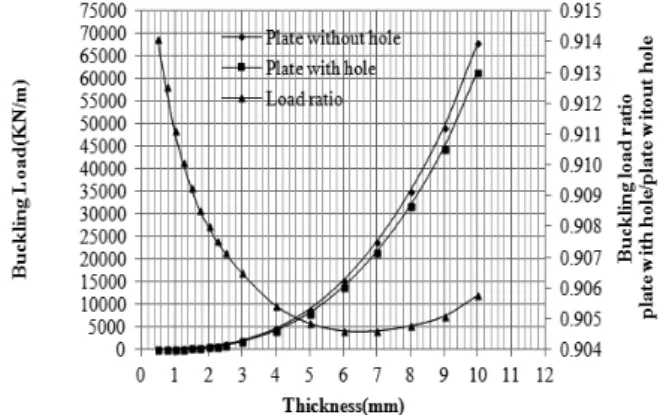
Fig. 3 Comparative Graph for Buckling Loads of Plates with and without Holes and Load Ratio Versus Thickness
Buckling loads of plates with and without holes as well as the ratio of critical loads of plate with holes to the plate without holes are provided in Fig.3. The results denoted with triangle symbols shows the changes in ratio of buckling loads for plate with holes to that of plate without holes. As can be seen for thin plates, both plates provide buckling loads very close to each other but by increasing the thickness the differences become more considerable as can be seen by the line with triangle symbols. The minimum amount occurred for the plates having the thicknesses in the range from 5mm to 8mm for which the maximum decrease in buckling load due to the existence of hole is occurred i.e., the maximum
NO Thickness
(mm) Kc Kc(w/ Hole)/Kc(w/o Hole)
Plate with hole
Plate without hole
1 0.5 3.604 3.943 0.91
2 0.75 3.561 3.938 0.91
3 1.00 3.569 3.923 0.91
4 1.25 3.567 3.919 0.91
5 1.50 3.551 3.906 0.91
6 1.75 3.547 3.904 0.91
7 2.00 3.530 3.887 0.91
8 2.25 3.527 3.822 0.91
9 2.50 3.245 3.577 0.91
10 3.00 2.880 3.177 0.91
11 4.00 2.849 3.147 0.91
12 5.00 2.816 3.112 0.91
13 6.00 2.781 3.074 0.91
14 7.00 2.745 3.034 0.91
15 8.00 2.727 2.992 0.91
16 9.00 2.703 2.948 0.91
17 10.00 2.680 3.166 0.91
Fig. 4 Comparative Graph for Critical Stresses of Plates with and without Holes and Stress Ratio Versus Thickness
The results for critical stresses are provided in Fig.
4. The stresses for both plates with and without holes
having the thicknesses from 0.5mm to 5mm are close to each other but the differences in critical stresses are getting increased for plates having thicknesses from 5mm to 10mm. The results for critical stress ratios state that the existence of holes in plate has more effect on plates having the thicknesses in the range from 5mm to 8mm than the other plates.
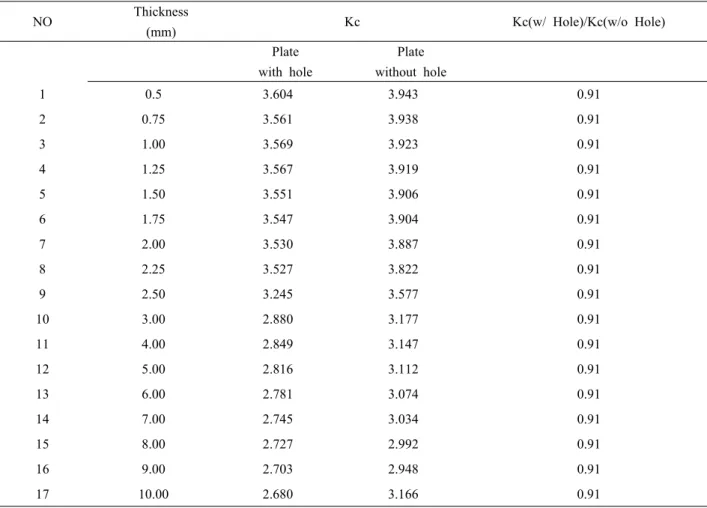
By considering the results given in Table 1, obtained from finite element analyses, the buckling coefficients, Kc, can be calculated as given in Table 2. Buckling coefficients, Kc, given in Table2 correspond to
. The given results for buckling coefficients show that as the thickness increases the buckling coefficients decreases for both plates with and without holes. Plates with holes provide smaller buckling coefficients having ratio of approximately 0.91.
Table 2. Buckling Coefficient, , for Different Thicknesses (for α=0.2)
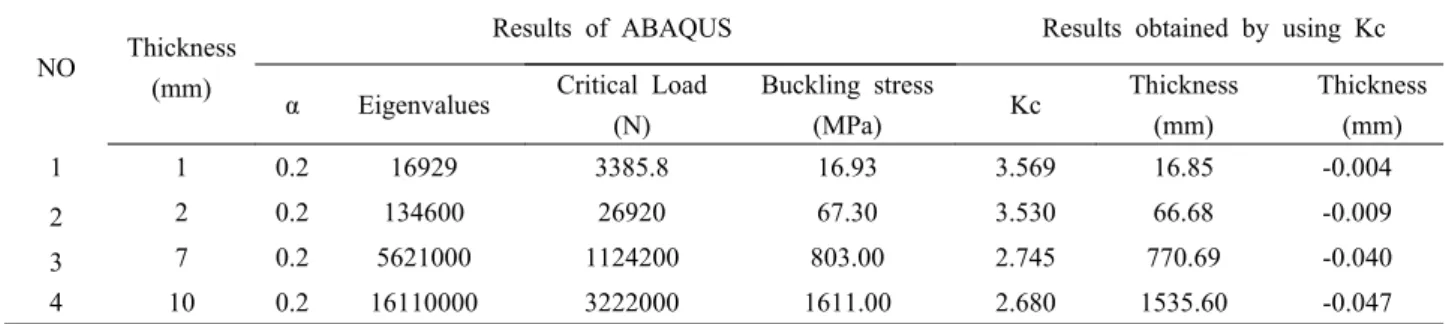
Table 3. Comparison of Buckling Loads and Stresses Employing the Proposed Buckling Coefficients for Plates in Different Dimensions
NO Thickness (mm)
Results of ABAQUS Results obtained by using Kc
α Eigenvalues Critical Load (N)
Buckling stress
(MPa) Kc Thickness
(mm)
Thickness (mm)
1 1 0.2 16929 3385.8 16.93 3.569 16.85 -0.004
2 2 0.2 134600 26920 67.30 3.530 66.68 -0.009
3 7 0.2 5621000 1124200 803.00 2.745 770.69 -0.040
4 10 0.2 16110000 3222000 1611.00 2.680 1535.60 -0.047
5.DEMONSTRATION OF THE GENERALITY OF BUCKLING COEFFICIENTS
In order to investigate the generality of buckling coefficients proposed, we analyze plates in different dimensions having width of 200mm and length of 400mm and having α of 0.2. Two thicknesses of 1mm and 2mm corresponding to thin plates and other two of 7mm and 10mm corresponding to thick plates are considered. By using ABAQUS, the critical stresses are calculated. Then the theoretical critical stresses are calculated by using the presented buckling coefficients in Table 2 and Eq. (1). Thereafter the results obtained from ABAQUS models and those calculated by buckling coefficients are compared and the errors are calculated. The results are provided in Table. 3.
By taking look into the results it can be found that the buckling coefficients obtained in this study can be applied to plates having different dimensions but having the same ratio (α). The last column of Table 3 shows the differences between buckling stresses calculated using Kc and those obtained from FEM analyses. As can be seen in the table errors are small, and good agreement is observed for the results obtained from both FEM and proposed method.
6. CONCLUSIONS
This study dealt with analyzing buckling of plate with through-thickness holes under various conditions to find buckling coefficients, , by which the buckling stresses of plates are calculated. To clarify the trend of buckling of plate several results are presented: the
by increasing the thickness of plate both buckling load and critical stress increase. The results for plates without holes are also provided as well as the ratio of buckling load and critical stress of plates with holes to those of plate without holes. Results showed that buckling loads of plates with and without through-thickness holes corresponding to thin plates are close to each other and by increasing in thickness the differences are getting increased. The generality of buckling coefficients is demonstrated with plates in different dimensions.
ACKNOWLEDGMENT
This work was supported by the Human Resources Development program (No. 20124030200050) of the Korea Institute of Energy Technology Evaluation and Planning(KETEP) grant funded by the Korea government Ministry of Trade, Industry and Energy.
References
Chio et al. (2012), “An Analytical Study on the Buckling of Orthotropic Plates and Local Buckling of Compression Members”, Journal of Korean Society for Advanced Composite Structures, Vol. 3, No. 1, pp. 21-28.
Cristopher D. M, B.W. Schafer (2009), Elastic buckling of thin plates with holes in compression or bending, journal of Thin-Walled Structures, Vol.47, pp. 1597 –1607.
G. M. Hong, C. M. Wang and T. J. Tan (1993), Analytical buckling solutions for circular Mindlin
deformation, Archive of Applied Mechanics, Vol.
63, 534-542.
Gerard, G. and Becker, H(1957), Handbook of structural stability- Buckling of flat plates, National advisory committee for aeronautics, New York university.
Husam Al Qablan, Hasan Katkhuda and Hazim Dwair i(2009), Assessment of the Buckling Behavior of Square Composite Plates with Circular Cutout Subjected to In-Plane Shear, Jordan Journal of Civil Engineering, Vol. 3, No. 2.
Jodoin, et al (2012), Analysis of Buckling, Vol. III
Khaled M., El-Sawy, Aly S. Nazmy (2001), Effect of aspect ratio on the elastic buckling of uniaxially loaded plates with eccentric holes, Thin-Walled Structures, Vol. 39, pp. 983–998.
Kwon and Jung (2012), “Comparison of Improved Explicit Method and Predictor Correct -Method”, Journal of Korean Society for Advanced Composite Structures, Vol. 3, No. 4, pp. 1-9.
Mitao Ohga, Tsunemi Shigematsu, & Kouichi Kawaguchi (1995), “Buckling Analysis of Thin-Walled Members With Variable Thickness”, Journal of Structural Engineering, Vol. 121:919-924.
Tom, Pollock (1993), Introduction to Buckling, Dept. of Aerospace Engineering, Texaz A&M University, USA.
William L., (1998), Mechanical and Thermal Buckling Behavior of Rectangular Plates With Different Central Cutouts, Dryden Flight Research Center, NASA, US.