Effect of bite force on orthodontic mini-implants in the molar region: Finite element analysis
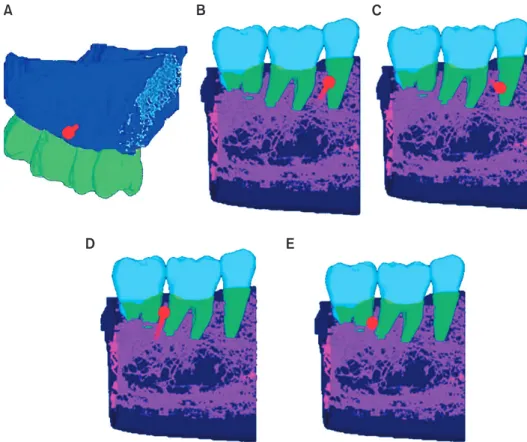
Objective: To examine the effect of bite force on the displacement and stress distribution of orthodontic mini-implants (OMIs) in the molar region according to placement site, insertion angle, and loading direction. Methods: Five finite element models were created using micro-computed tomography (microCT) images of the maxilla and mandible. OMIs were placed at one maxillary and two mandibular positions: between the maxillary second premolar and first molar, between the mandibular second premolar and first molar, and between the mandibular first and second molars. The OMIs were inserted at angles of 45°
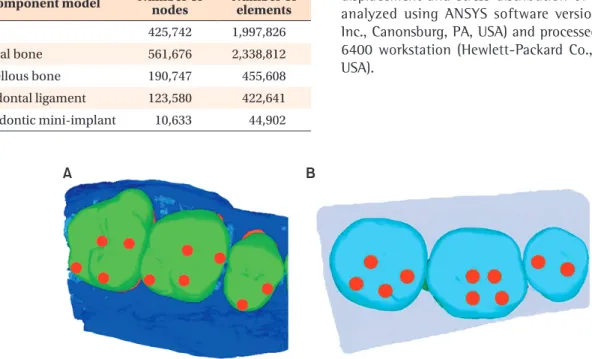
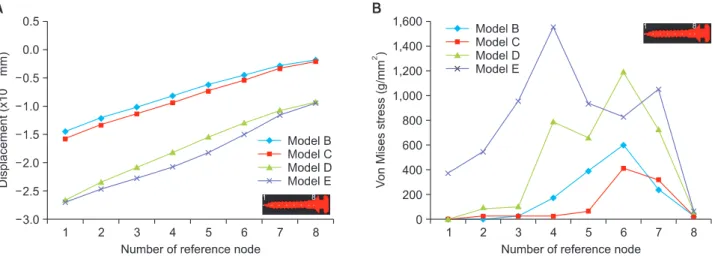
and 90° to the buccal surface of the cortical bone. A bite force of 25 kg was applied to the 10 occlusal contact points of the second premolar, first molar, and second molar. The loading directions were 0°, 5°, and 10° to the long axis of the tooth. Results: With regard to placement site, the displacement and stress were greatest for the OMI placed between the mandibular first molar and second molar, and smallest for the OMI placed between the maxillary second premolar and first molar. In the mandibular molar region, the angled OMI showed slightly less displacement than the OMI placed at 90°. The maximum Von Mises stress increased with the inclination of the loading direction. Conclusions: These results suggest that placement of OMIs between the second premolar and first molar at 45° to the cortical bone reduces the effect of bite force on OMIs.
[Korean J Orthod 2013;43(5):218-224]
Key words: Bite force, Orthodontic mini-implant, Finite element analysis, Stability
Hyeon-Jung Lee
aKyung-Sook Lee
bMin-Ji Kim
bYoun-Sic Chun
ba
Department of Orthodontics, School of Dentistry, Chonnam National University, Gwangju, Korea
b
Department of Orthodontics, Graduate School of Clinical Dentistry, Ewha Womans University, Seoul, Korea
Received December 4, 2012; Revised March 15, 2013; Accepted March 20, 2013.
Corresponding author: Youn-Sic Chun.
Professor, Department of Orthodontics, Graduate School of Clinical Dentistry, Ewha Womans University, 1071 Anyangcheon-ro, Yangcheon-gu, Seoul 158-710, Korea
Tel +82-2-2650-5112 e-mail [email protected]
*The work was supported by the Ewha Global Top 5 Grant 2011 of Ewha Womans University.
© 2013 The Korean Association of Orthodontists.
The authors report no commercial, proprietary, or financial interest in the products or companies described in this article.
This is an Open Access article distributed under the terms of the Creative Commons Attribution Non-Commercial License (http://creativecommons.org/licenses/by-nc/3.0) which permits unrestricted non-commercial use, distribution, and reproduction in any medium, provided the original work is properly cited.