• 검색 결과가 없습니다.

Effects of orthodontic mini-implant position in the dragon helix appliance on tooth displacement and stress distribution: a three-dimensional finite element analysis

N/A
N/A
Protected

Academic year: 2022

Share "Effects of orthodontic mini-implant position in the dragon helix appliance on tooth displacement and stress distribution: a three-dimensional finite element analysis"

Copied!
9
0
0

로드 중.... (전체 텍스트 보기)

전체 글

(1)

a

Assistant Professor,

g

Professor, Division of Orthodontics, Department of Dentistry, School of Medicine, Ewha Womans University.

b

Visiting Scholar, Division of Orthodontics, Department of Dentis- try, University of Nebraska Medical Center.

c

Former Student, Department of Orthodontics, Graduate School of Clinical Dentistry, Ewha Womans University.

d

Associate Professor, Division of Orthodontics, Department of Dentistry, College of Medicine, The Catholic University of Korea, St. Mary’s Hospital.

e

Associate Professor, Department of Orthodontics, University of Ulsan College of Medicine, Asan Medical Center.

f
Associate Professor, School of Mechanical and Automobile Engineering, Kunsan National University.

Corresponding author: Youn-Sic Chun.

Division of Orthodontics, Department of Dentistry, School of Medicine, Ewha Womans University, 911-1 Mok-dong, Yang- cheon-gu, Seoul 158-710, Korea.

+82 2 2650 5114; e-mail, [email protected].

Received August 27, 2010; Last Revision October 22, 2010;

Accepted October 25, 2010.

DOI:10.4041/kjod.2011.41.3.191

Effects of orthodontic mini-implant position in the dragon helix appliance on tooth displacement and stress distribution:

a three-dimensional finite element analysis

Min-Ji Kim, DDS, MSD, PhD,

a

Sun-Hyung Park, DDS, MSD, PhD,

b

Hyeon-Seong Kim, DDS, MSD,

c

Sung-Seo Mo, DDS, MSD, PhD,

d

Sang-Jin Sung, DDS, MSD, PhD,

e

Gang-Won Jang, MSD, PhD,

f

Youn-Sic Chun, DDS, MSD, PhD

g

Objective: The purpose of this study was to investigate the stress distribution on the orthodontic mini-im- plant (OMI) surface and periodontal ligament of the maxillary first and second molars as well as the tooth displacement according to the OMI position in the dragon helix appliance during scissors-bite correction.

Methods: OMIs were placed at two maxillary positions, between the first and the second premolars (group 1) and between the second premolar and the first molar (group 2). The stress distribution area (SDA) was analyzed by three-dimensional finite element analysis. Results: The maximal SDA of the OMI did not differ between the groups. It was located at the cervical area and palatal root apex of the maxillary first molar in groups 1 and 2, respectively, indicating less tipping in group 2. The minimal SDA was located at the root and furcation area of the maxillary second molar in groups 1 and 2, respectively, indicating greater palatal crown displacement in group 2. Conclusions: Placement of the OMI between the maxillary second premolar and the maxillary first molar to serve as an indirect anchor in the dragon helix appliance mini- mizes anchorage loss while maximizing the effect on scissors-bite correction. (Korean J Orthod 2011;

41(3):191-199)

Key words: Orthodontic mini-implant, FEM

INTRODUCTION

Scissors-bite is a condition in which the maxillary

teeth are abnormally positioned in the buccal direction

(or lingual direction for the mandibular teeth) to result

in total crossbite.

1,2

Correcting this condition is a prob-

lematic issue because the treatment methods used so

far have limitations. For example, a sound third molar

is required for use after extracting the maxillary second

molar,

3

and the application of a magnetic force with

corticotomy requires a surgical procedure and its result

depends on the patient's condition.

4

Further, the modi-

fied transpalatal arch causes loss of anchorage and can

be used only in mild cases because of limited space

for lingual attachment on the affected second molar.

5

(2)

Node numbers of the OMI

Element numbers of the OMI

Total node numbers

Total element numbers

OMI 2,392 8,571 87,476 404,560

Maxillary first molar 6,494 28,196

PDL of maxillary first molar 4,616 4,540

Maxillary second molar 4,722 20,195

PDL of maxillary second molar 3,288 3,255

Table 2. Elements and number of nodes in the finite element analysis

Element type Young’s modulus (g/mm

2

) Poisson’s ratio

Teeth Solid 45 2E6 0.3

Periodontal ligament Solid 45 5.0 0.3

Alveolar bone Solid 45 2E5 0.3

Splinting wire (0.018" × 0.025") Beam 4 2E7 0.3

Dragon helix (0.016" × 0.025") Beam 4 1.1E7 0.3

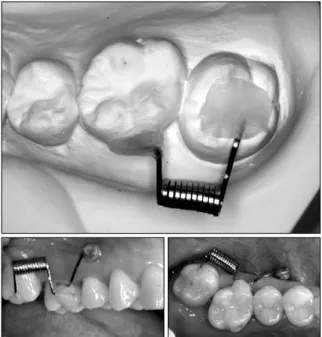
Table 1. Element type, Young’s modulus, and Poisson’s ratio of the material compounds of the finite element models Fig 1. Clinical application of the dragon helix appliance

for tipping and intruding the maxillary second molar.

The molar intrusion arch and cross-arch elastic also have disadvantages such as altered occlusion.

6,7

Recent- ly, the orthodontic mini-implant (OMI) was introduced for intrusion and correction of the maxillary second

molar, but more than one implant is needed for direct bony anchorage and it is yet difficult to control torque and rotation.

8,9

The dragon helix appliance combined with OMI- based indirect skeletal anchorage has been introduced recently to correct scissors-bite.

1

This system consists of a helix with two arms, about 5 mm in length, made by 0.016" × 0.022" stainless steel wire set at an angle of 110

o

(Fig 1). One arm is attached to the occlusal surface of the maxillary second molar, while the other is attached to the buccal side of the maxillary first molar. This device produces about 200 - 250 g of or- thodontic force without causing occlusal interference.

The anchor tooth is connected to the OMI by a rigid wire such as 0.019" × 0.025" stainless steel, which provides strong indirect skeletal anchorage during the treatment of scissors-bite.

10-13

However, considering that the OMI is the most im- portant part of the appliance for anchorage, its position might have some effect on the efficiency of anchorage.

The purpose of this study was to investigate the stress

distribution on the OMI surface and periodontal liga-

ment (PDL) of the maxillary first and second molars

as well as the tooth displacement according to the

(3)

OMI position in the dragon helix appliance during scissors-bite correction.

MATERIAL AND METHODS

A typodont model of the maxillary left quadrant with scissors-bite at the second molar, which was ex- truded and buccally inclined, was fabricated. The mod- el was three-dimensionally (3D) scanned and 3D com- puter-aided design (CAD) data were acquired by using Computer-Aided Three-Dimensional Interactive Appli- cation Version 5 (CATIA V5; Dassault Systèmes, Vélizy-Villacoublay, France). The PDL attached to the root surfaces was fabricated from Hyper Mesh 8.0 (Altair Engineering, Troy, MI, USA). The Young’s modulus and Poisson’s ratio values of the PDL, alveo- lar bone, connecting wire, and dragon helix were as- sumed from an isotropic homogeneous linear elastic model (Table 1).

CATIA V5 was also used to create a finite element model of an OMI. Table 2 shows the elements and number of nodes. The dimensions of the OMI were 9 mm length, 5.7 mm spiral part, 0.6 mm pitch, and 5.7

o

taper angle. The dragon helix appliance was shaped in- to a spring of 2 mm diameter and 11 turns with 0.016"

× 0.022" stainless steel wire. It was placed at the crown of the maxillary first molar and intrusively over- corrected second molar. Activation of the dragon helix appliance was simulated by fixing the distal arm to the affected second molar using the Constraint Equation of Ansys (ANSYS, Canonsburg, PA, USA). The appli- ance was assumed to produce about 200 - 250 g of force.

1

The OMI and first molar were connected with 0.018" × 0.025" stainless steel wire for indirect anchor- age, and the first and second molars were connected with the dragon helix appliance. Two groups were ana- lyzed on the basis of the OMI position. In group 1, the OMI was positioned between the first and the second premolars, and in group 2, it was placed between the second premolar and the first molar. The stress dis- tribution of the OMI and PDL of the first and second molars as well as the tooth displacement were ana- lyzed by finite element analysis with Ansys version 11

and HP workstation XW 6400 (Zeon 1.6 Ghz, *2 CPU, RAM 4G).

The von Mises stress on the first and second molars, and the OMI was determined to evaluate the stress distribution. Displacement graphs of the axes of the OMI (from the center of the head to the screw end tip) and thefirst and second molars (from the palatal cusp tip to the palatal root apex) were used to observe the amount and pattern of displacement.

RESULTS

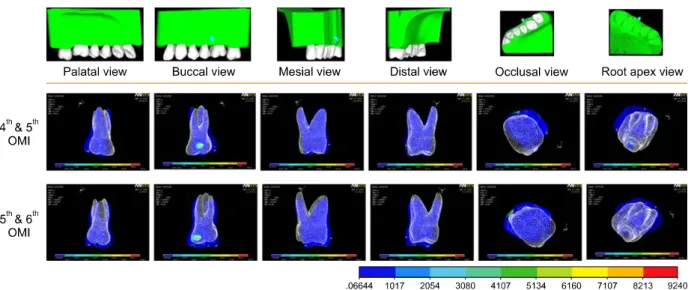
The maximal stress distribution area (SDA) of the maxillary first and second molars, and the OMI is shown in Fig 2 (in red). In group 1, the maximal SDA was observed at the cervical area of the first molar while the minimal SDA (in blue) was noted at the root apexes of the second molar. In group 2, the maximal SDA was observed at the palatal root apex of the first molar while the minimal SDA was noted at the furca- tion area of the second molar (Fig 2). Therefore, in group 1, the first molar showed greater tendency for buccal crown tipping but the second molar showed controlled tipping, while in group 2, the latter tooth showed uncontrolled tipping, presenting greater palatal crown movement.

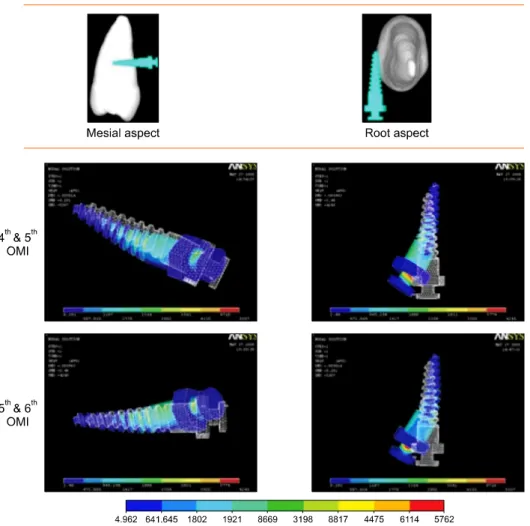
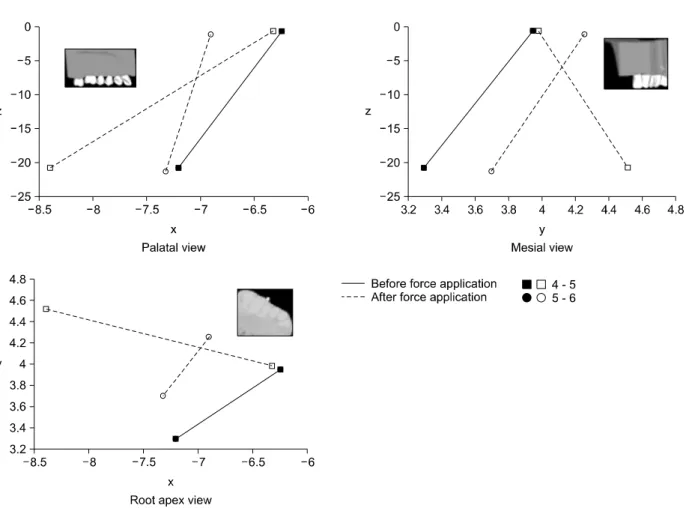
Although the maximal SDA on the OMI was not different between the groups, mesial bending of the OMI head was detected (Fig 3). From the magnified graph in Fig 4, the OMI head exhibited greater mesial displacement in group 1. Comparisons of the displace- ment of the maxillary first molars in the two groups are shown in Figs 5 and 6. The first molar crown moved distally and buccally in both groups, but the amount of displacement was greater in group 1.

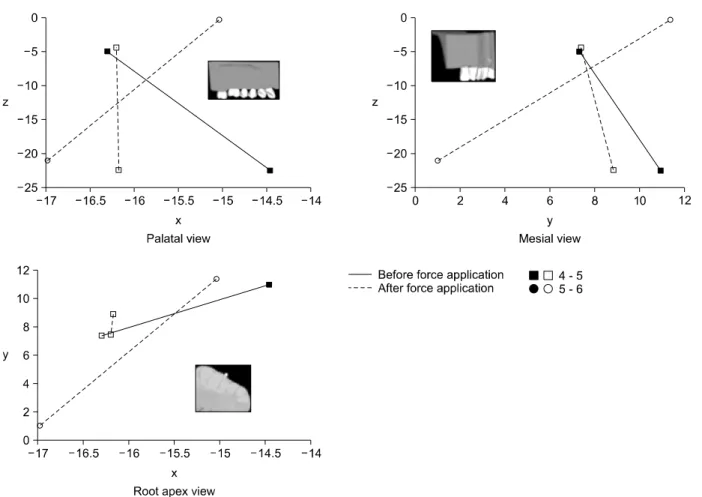
Further, the second molar crown in both groups

showed distal movement, but the amount of displace-

ment was greater in group 2 (Figs 7 and 8). Moreover,

mesial and intrusive displacement of the second molar

root was noted in group 2, whereas palatal displace-

ment was confined to the crown of this tooth in group

1. Therefore, the movement of the second molar was

more efficient in group 2.

(4)

Fig 2. The stress distribution on the periodontal ligament of the maxillary first and second molars as well as the orthodontic mini-implant (OMI) according to the OMI position. The color change from blue to red indicates increase in force. 4th &

5th OMI and 5th & 6th OMI indicate OMIs implanted between 1st and 2nd premolars, and between 2nd premolar and

1st molars, respectively.

(5)

Fig 3. Displacement of the orthodontic mini-implant according to its position (magnification, × 500). White and blue indicate before and after the force application, respectively. 4th & 5th OMI and 5th & 6th OMI indicate OMIs implanted between 1st and 2nd premolars, and between 2nd premolar and 1st molars, respectively.

DISCUSSION

OMIs have been widely used in orthodontics since their introduction as an effective anchor.

9,14,15

Their easy application, in expensiveness, and possibility of immediate loading are well-recognized advantages.

When an orthodontic force is applied directly to the OMI, it enables direct anchorage. This method of di- rect anchorage is more popular than indirect anchorage, which is considered to cause interference in osseo- intergration.

16

However, direct anchorage with the OMI has disadvantages such as difficulty in placing it be- tween anatomical structures, difficulty in controlling torque and rotation, and often requiring more than one implant, all of which could be overcome by an indirect

method.

10,11,13

The dragon helix appliance combined with OMI-

based indirect anchorage has exhibited efficient treat-

ment of scissors-bite by applying palatal and intrusive

forces to the affected molar.

1

This appliance was in-

troduced to enable better comfort to patients, due to its

small volume, and minimal or no loss of anchorage,

due to the OMI as an indirect anchor.

1

The insertion

position or angle of the OMI can influence its stability

and efficiency, which have been studied in the direct

anchorage system.

17,18

Placement of the OMI between

the maxillary second premolar and the maxillary first

molar, which was the recommended OMI position in-

many studies,

1,19,20

is often difficult because of anatom-

ical limitations or root proximity.

9,14

(6)

Fig 5. Displacement of the maxillary first molar according to mini-implant's position. White and blue indicate before and after the force application, respectively. 4th & 5th OMI and 5th & 6th OMI indicate OMIs implanted between 1st and 2nd premolars, and between 2nd premolar and 1st molars, respectively.

Fig 4. Graph representing the displacement of the OMI (from the center of the head to the screw end tip, magnification

x 1,000). The larger X, Y, and Z values indicate mesial, buccal, and apical movements, respectively. OMI, Orthodontic

mini-implant; 4 - 5, between 1st and 2nd premolars; 5 - 6, between 2nd premolar and 1st molar.

(7)

Fig 7. Displacement of the maxillary second molar according to mini-implant's position. White and blue indicate before and after force application, respectively. 4th & 5th OMI and 5th & 6th OMI indicate OMIs implanted between 1st and 2nd premolars, and between 2nd premolar and 1st molars, respectively.

Fig 6. Graph representing the displacement of the maxillary first molar (from the palatal cusp tip to the palatal root apex, magnification x 50). The larger X, Y, and Z values indicate mesial, buccal, and apical movements, respectively.

4 - 5, between 1st and 2nd premolars; 5 - 6, between 2nd premolar and 1st molar.

(8)

Fig 8. Graph representing displacement of the maxillary second molar (from the palatal cusp tip to the palatal root apex, magnification x 50). The larger X, Y, and Z values indicate mesial, buccal, and apical movements, respectively.

4 - 5, between 1st and 2nd premolars; 5 - 6, between 2nd premolar and 1st molar.

In this study, the maximal efficiency of indirect an- chorage was observed when the OMI was positioned between the second premolar and the first molar (group 2). The maxillary first molar showed bodily movement and less buccal crown displacement, and the maxillary second molar showed not only greater palatal crown movement but also intrusion in this group. The OMI showed greater displacement in group 1, which had a longer distance between the anchor tooth and the OMI. This finding indicates that a shorter distance be- tween the anchor tooth and the OMI in the indirect an- chorage system results in a more efficient anchorage unit. From the buccal and palatal views, the crowns of the maxillary first and second molars tipped distally.

This could be explained as a step bend effect, because the dragon helix appliance was fabricated with rec-

formed a step from the buccal view. Although minor movements of the OMI and maxillary first molar were noted in this study, the movements were considered tobe undetectable clinically, because of the indirect skeletal anchorage unit. The major clinical effect was considered to be palatal tipping and intrusion of the maxillary second molar, which was the most efficient when the OMI was placed between the second pre- molar and the first molar (group 2).

There might be other factors influencing indirect an- chorage, such as the length and thickness of the con- necting wire, occlusal force, position of the wire at- tachment on the crown, and method of attachment.

Finite element analysis calculates the initial moment

difference of the load, which does not include the

long-term reaction.

21-23

Therefore, the results could dif-

(9)

ticatory force, complex anatomical structures, other bi- ological features, and the combination of these factors.

Further studies should focus on the effects of these factors on indirect anchorage with this system.

CONCLUSION

Three-dimensional FEA of the dragon helix appli- ance combined with the OMI-based indirect skeletal anchorage indicated that placement of the OMI be- tween the maxillary second premolar and the maxillary first molar enables more efficient anchorage and great- er movement for scissors-bite correction than place- ment of the OMI between the maxillary first and the maxillary second premolars.

REFERENCES

1. Yun SW, Lim WH, Chong DR, Chun YS. Scissors-bite correc- tion on second molar with a dragon helix appliance. Am J Orthod Dentofacial Orthop 2007;132:842-7.

2. Harper DL. A case report of a Brodie bite. Am J Orthod Dentofacial Orthop 1995;108:201-6.

3. Orton-Gibbs S, Orton S, Orton H. Eruption of third permanent molars after the extraction of second permanent molars. Part 2:

Functional occlusion and periodontal status. Am J Orthod Dentofacial Orthop 2001;119:239-44.

4. Ramsay DS, Wallen TR, Bloomquist DS. Case report MM.

Surgical-orthodontic correction of bilateral buccal crossbite (Brodie syndrome). Angle Orthod 1990;60:305-11.

5. Kucher G, Weiland FJ. Goal-oriented positioning of upper sec- ond molars using the palatal intrusion technique. Am J Orthod Dentofacial Orthop 1996;110:466-8.

6. Chun YS, Woo YJ, Row J, Jung EJ. Maxillary molar intrusion with the molar intrusion arch. J Clin Orthod 2000;34:90-3.

7. Legan HL. Orthodontic planning and biomechanics for trans- verse distraction osteogenesis. Semin Orthod 2001;7:160-8.

8. Park YC, Lee SY, Kim DH, Jee SH. Intrusion of posterior

teeth using mini-screw implants. Am J Orthod Dentofacial Orthop 2003;123:690-4.

9. Kanomi R. Mini-implant for orthodontic anchorage. J Clin Orthod 1997;31:763-7.

10. Cope JB. Temporary anchorage devices in orthodontics: a paradigm shift. Semin Orthod 2005;11:3-9.

11. Celenza F, Hochman MN. Absolute anchorage in orthodontics:

direct and indirect implant-assisted modalities. J Clin Orthod 2000;34:397-402.

12. Kyung SH, Choi HW, Kim KH, Park YC. Bonding ortho- dontic attachments to miniscrew heads. J Clin Orthod 2005;

39:348-53.

13. Kyung SH, Lim JK, Park YC. The use of miniscrew as an an- chorage for the orthodontic tooth movement. Korean J Orthod 2001;31:415-24.

14. Bae SM, Park HS, Kyung HM, Kwon OW, Sung JH. Clinical application of micro-implant anchorage. J Clin Orthod 2002;

36:298-302.

15. Park HS, Kwon OW, Sung JH. Uprighting second molars with micro-implant anchorage. J Clin Orthod 2004;38:100-3.

16. Park HS. Orthodontic treatment using micro-implant. 2nd ed.

Seoul: Daehan Narae Publishing Inc., 2006. p. 1-414.

17. Wilmes B, Su YY, Drescher D. Insertion angle impact on pri- mary stability of orthodontic mini-implants. Angle Orthod 2008;78:1065-70.

18. Lee KJ, Joo E, Kim KD, Lee JS, Park YC, Yu HS. Computed tomographic analysis of tooth-bearing alveolar bone for ortho- dontic miniscrew placement. Am J Orthod Dentofacial Orthop 2009;135:486-94.

19. Lim JE, Lim WH, Chun YS. Cortical bone thickness and root proximity at mandibular interradicular sites: implications for orthodontic mini-implant placement. Korean J Orthod 2008;38:

397-406.

20. Park HS. An anatomical study using CT images for the im- plantation of micro-implants. Korean J Orthod 2002;32:435-41.

21. Kim CN, Sung JH, Kyung HM. Three-dimensional finite ele- ment analysis of initial tooth displacement according to force application point during maxillary six anterior teeth retraction using skeletal anchorage. Korean J Orthod 2003;33:339-50.

22. Cheon OJ, Kim TW, Suhr CH. Three-dimentional finite ele- ment analysis of the phenomenon produced during retraction of four maxillary incisors. Korean J Orthod 1995;25:525-41.

23. Yoon HJ, Lim YK, Lee DY, Jo YS. Three-dimensional finite element analysis on the effect of maxillary incisor torque.

Korean J Orthod 2005;35:137-47.

수치

Table 2. Elements and number of nodes in the finite element analysis
Fig 2. The stress distribution on the periodontal ligament of the maxillary first and second molars as well as the orthodontic mini-implant (OMI) according to the OMI position
Fig 3. Displacement of the orthodontic mini-implant according to its position (magnification, × 500)
Fig 4. Graph representing the displacement of the OMI (from the center of the head to the screw end tip, magnification x 1,000)
+3

참조

관련 문서