Gender Differences in Factors Related to Prehospital Delay in Patients with ST-Segment Elevation
Myocardial Infarction
Hee-Sook Kim1,2, Kun-Sei Lee3, Sang Jun Eun4, Si-Wan Choi5, Dae Hyeok Kim6, Tae-Ho Park7, Kyeong Ho Yun8, Dong Heon Yang9, Seok Jae Hwang10, Ki-Soo Park11, and Rock Bum Kim12
1Division of Infectious Disease Surveillance, Korea Centers for Disease Control and Prevention, Cheongju;
2Department of Public Health Science, Graduate School of Public Health and Institute of Health and Environment, Seoul National University, Seoul;
3Department of Preventive Medicine, Konkuk University College of Medicine, Seoul;
4Department of Preventive Medicine, Chungnam National University School of Medicine, Daejeon;
5Department of Internal Medicine, Chungnam National University Hospital and School of Medicine, Daejeon;
6Department of Internal Medicine, Inha University Hospital, Incheon;
7Department of Internal Medicine, Dong-A University College of Medicine, Busan;
8Department of Cardiovascular Medicine, Wonkwang University Hospital, Iksan;
9Department of Internal Medicine, Kyungpook National University School of Medicine, Daegu;
10Department of Internal Medicine, Gyeongsang National University School of Medicine and Hospital, Jinju;
11Department of Preventive Medicine, Gyeongsang National University School of Medicine and Institute of Health Sciences, Jinju;
12Center for Regional Cardiocerebrovascular Disease, Gyeongsang National University Hospital, Jinju, Korea.
Purpose: The aim of our study was to investigate gender differences in factors related to prehospital delay and identify whether the knowledge of acute myocardial infarction symptoms affects this delay in Korean patients with ST-elevation myocardial infarc- tion (STEMI).
Materials and Methods: A total of 350 patients (286 men, 64 women) with confirmed STEMI were interviewed to investigate socio- demographics, history of disease, symptom onset time, and factors that contributed to delayed decision time in seeking treatment and hospital arrival time from symptom onset. Factors associated with prehospital delay were examined separately by gender using univariate and multivariate analyses.
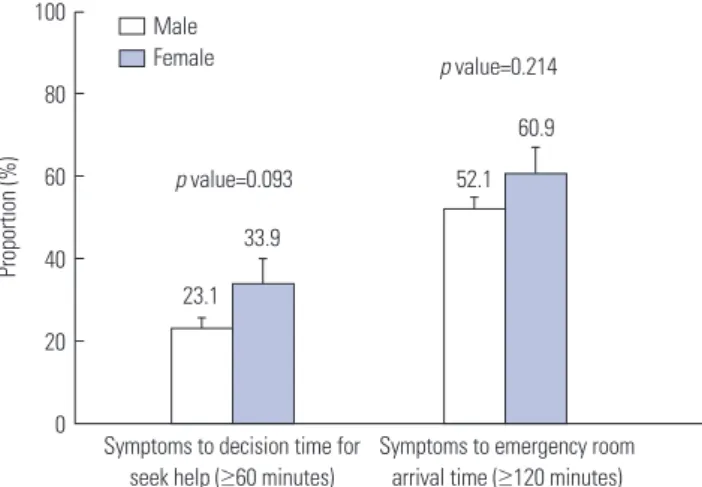
Results: Female patients had higher proportions of ≥60-minute decision time and ≥120-minute arrival time compared to male patients (33.9% vs. 23.1%, 60.9% vs. 52.1%, respectively). However, the difference was not statistically significant (p=0.093 and 0.214, respectively). Previous cardiovascular disease (CVD) was associated with increased decision time in men, whereas, in women, lower educational status caused a greater delay in decision time. Factors associated with hospital arrival time excluding delayed decision time were referral from another hospital, previous CVD, and percutaneous coronary intervention in men, and referral from another hospital in women.
Conclusion: Gender differences exist in factors related to prehospital delay. Therefore, public education to reduce prehospital delay should be conducted according to gender with a focus on the pertinent factors.
Key Words: Acute coronary syndrome, healthcare timeout, sex differences
pISSN: 0513-5796 · eISSN: 1976-2437
Received: December 14, 2016 Revised: February 22, 2017 Accepted: March 19, 2017
Co-corresponding authors: Dr. Rock Bum Kim, Center for Regional Cardiocerebrovascular Disease, Gyeongsang National University Hospital, 79 Gangnam-ro, Jinju 52727, Korea.
Tel: 82-55-750-9194, Fax: 82-55-750-9145, E-mail: [email protected] and
Dr. Ki-Soo Park, Department of Preventive Medicine, Gyeongsang National University School of Medicine and Institute of Health Sciences, 15 Jinju-daero 816beon-gil, Jinju 52727, Korea.
Tel: 82-55-772-8095, Fax: 82-55-772-8099, E-mail: [email protected]
•The authors have no financial conflicts of interest.
© Copyright: Yonsei University College of Medicine 2017
This is an Open Access article distributed under the terms of the Creative Commons Attribution Non-Commercial License (http://creativecommons.org/licenses/by-nc/4.0) which permits unrestricted non-commercial use, distribution, and reproduction in any medium, provided the original work is properly cited.
Yonsei Med J 2017 Jul;58(4):710-719 https://doi.org/10.3349/ymj.2017.58.4.710
INTRODUCTION
Prompt reperfusion therapy, including percutaneous coronary intervention (PCI) and fibrinolytic therapy in patients with ST- segment elevation myocardial infarction (STEMI) is very im- portant. Because prompt salvaging of the critical myocardium as much as possible improves patient survival rates or out- comes,1-3 effort is expended to reduce symptom onset-to-hos- pital arrival time (prehospital time) and door to needle time (hospital time, i.e., from presentation to treatment).
There are many factors affecting prehospital delay, which comprised of patient delay (decision time) and transport de- lay. Identification of factors influencing the delays may help re- duce the time to receive treatment. Numerous studies on the factors related to prehospital delay in patients with acute myo- cardial infarction (AMI) have been conducted in many coun- tries.4-9 However, few studies involving Korean patients with AMI have been conducted.10,11
Previous studies identified several major categories that might predict prehospital delay, such as socio-demographic factors, context at symptom onset, and clinical, cognitive, and behavioral factors.12-14 Among these factors, a significant cogni- tive factor known to be related to decision time delay is knowl- edge or recognition of AMI symptoms. Symptoms are a core el- ement of a patient’s decision to seek help, and have a decisive effect on the correct triage, thus affecting the decisions regard- ing additional early medical intervention.15 Moreover, there may be gender differences regarding time to seek medical care.
Several studies have reported that women are more likely to experience longer delays than men.4,16,17 However, other studies have suggested that there are no gender differences in prehos- pital time delay.18,19 Thus, the relationship between gender and prehospital delay times in AMI is currently unclear, partially because of the differences in design and methodology in the studies.
Outcomes in women such as early death occur more fre- quently than in men; additionally, in-hospital and overall mor- tality after AMI is higher in women than in men.20 Thus, we be- lieve that the reason for the higher mortality in women is a difference in prehospital delay, and it is important to identify the gender-related factors related to prehospital delay.
Consequently, the objective of this study was to investigate gender differences in factors related to prehospital delay, and to identify whether knowledge of AMI symptoms affects the delay in Korean patients with STEMI.
MATERIALS AND METHODS
Study participants
The participants were patients hospitalized with STEMI at 6 PCI-capable tertiary hospitals in various regions of Korea from July 2014 to June 2015.
Inclusion criteria for the present study were: 1) final diag- nosis of STEMI, 2) hospitalization within 72 hours after the onset of symptoms, 3) hemodynamic stability (stable blood pressure and consistent blood flow), 4) Korean native speaker, and 5) mental alertness (information communicated through conversation). Among 359 patients with STEMI who were consecutively admitted during the data collection period, 350 (286 men and 64 women) were finally included in this study.
Participants were selected using an electronic medical recod- ing system and then interviewed face-to-face after obtaining consent and agreeing to be in the study. The interview was con- ducted in the education room of the cardiac ward, and took less than 20 minutes. The survey was completed within 3 days after admission to the hospital.
At each hospital, the study design and protocol were ap- proved by the Institutional Review Board (IRB) before data col- lection, and the IRB of Seoul National University approved the present study.
Questionnaire and data collection
The investigator developed a special questionnaire for this study in collaboration with several cardiologists, which was pre-tested on patients with STEMI and subsequently modi- fied. The final questionnaire comprised 5 domains including:
1) sociodemographic characteristics, 2) history of disease, 3) symptoms and awareness of AMI, 4) patient decision time, and 5) transport-related items.
More detailed items on the questionnaire, which were col- lected by interview after admission, were as follows: sociode- mographic characteristics such as age (categorized as <60 and
≥60 years when analysis), gender, education level (categorized as ≤middle school and ≥high school), medical insurance status (national health insurance and Medicaid), residence (urban and rural), whether the patient lived alone or not, and health behavior (smoking status, alcohol use, and obesity).
Moreover, data regarding disease history [family history of cardiovascular diseases (CVD) and personal history of hyper- tension, diabetes mellitus, dyslipidemia, CVD, PCI, or stroke]
were collected.
Information on symptoms and quality of symptoms includ- ed the chief complaint, accompanying symptoms, and onset time during the acute phase of STEMI. Patients were ques- tioned on the 10 symptoms using a Yes/No format. These symp- toms included the following: 1) chest pain, 2) radiating pain, 3) dyspnea, 4) sweating, 5) weakness, 6) indigestion, 7) nausea or vomiting, 8) dizziness, 9) palpitations, and 10) other (an op- tion to write in the symptom). During analysis, these symptoms were categorized into two groups such as “chest pain” and
“other symptoms” as a major symptom. Awareness of AMI symptoms was asked using the following question: “Did you usually know the AMI disease” and “Did you usually know the early symptoms of AMI”; patients answered “Yes” or “No” to these questions. Additionally, patients who answered “Yes”
Table 1. Socio-Demographic, Clinical History and Knowledge Characteristics of Participants between Male and Female
Variables Male (n=286) Female (n=64) p value
Age, mean (±SD) 59.2 (±11.9) 71.1 (±11.5) <0.001
<60 yr 152 (53.1) 12 (18.8) <0.001
≥60 yr 134 (46.9) 52 (81.2)
Education level, n (%) <0.001
<Middle school 83 (30.2) 42 (79.2)
≥Middle school 192 (69.8) 11 (20.8)
Medical insurance status, n (%) 0.746
National Health Insurance 272 (95.1) 62 (96.9)
Medicaid 14 (4.9) 2 (3.1)
Residency region, n (%) 0.849
Urban 243 (85.0) 54 (84.4)
Rural 43 (15.0) 10 (15.6)
Living with others, n (%) 0.023
Alone 31 (10.9) 14 (21.9)
With family 254 (89.1) 50 (78.1)
Smoking status, n (%) <0.001
Non-smoker 49 (17.1) 63 (98.4)
Current or past smoker 237 (82.9) 1 (1.6)
Alcohol use status, n (%) <0.001
Non-drinker 83 (29.0) 42 (65.6)
Current drinker 203 (71.0) 22 (34.4)
Body mass index, n (%) 0.003
<25.0 kg/m2 165 (57.7) 50 (78.1)
≥25.0 kg/m2 121 (42.3) 14 (21.9)
Family history of CVD, n (%) 134 (46.9) 17 (26.6) 0.003
Hypertension, n (%) 104 (36.4) 38 (59.4) 0.001
Diabetes mellitus, n (%) 71 (24.8) 19 (29.7) 0.431
Dyslipidemia, n (%) 35 (12.2) 11 (17.2) 0.307
Previous CVD, n (%) 46 (16.1) 18 (28.1) 0.031
Previous PCI, n (%) 23 (8.0) 7 (10.9) 0.460
Previous stroke, n (%) 13 (4.6) 5 (7.8) 0.343
Symptoms onset time, n (%) 0.256
Weekday and day (8 am–6 pm) 106 (37.1) 29 (45.3)
Weekend or night (6 pm–8 am) 180 (62.9) 35 (54.7)
Knowledge of disease for AMI, n (%) 0.049
Did not known 84 (33.7) 28 (48.3)
Known 165 (66.3) 30 (51.7)
Knowledge of symptoms for AMI, n (%) <0.001
Did not known 170 (67.5) 53 (89.8)
Known 82 (32.5) 6 (10.2)
Major symptom, chest pain, n (%) 1.000
Chest pain 246 (86.0) 55 (85.9)
Other symptoms 40 (14.0) 9 (14.1)
Use of EMS, n (%) 0.886
Did not used 175 (61.8) 40 (63.5)
Used 108 (38.2) 23 (36.5)
Referral hospital, n (%) 0.324
Did not referred 120 (42.0) 22 (34.4)
Referred 166 (58.0) 42 (65.6)
were asked about the following symptoms, consisting of 5 di- chotomous Yes/No items: chest pain, radiating pain, dyspnea, sweating, and weakness/dizziness. When patients answered more than 3 symptoms correctly, we determined that the pa- tient had knowledge of AMI symptoms.
Transport-related items comprised the use of emergency medical service (EMS) and whether the patient arrived directly at the hospital. These items were investigated using the medi- cal record systems.
Prehospital delay was divided into patient decision time and arrival time. Patient decision time is the elapsed time from symptom onset to the decision to seek medical care or call EMS. We obtained the symptom onset time and decision time to seek medical care via interview. We then calculated the de- cision time and categorized the times as <60 minutes and ≥60 minutes during analysis. The arrival time is the elapsed time from symptom onset to arrival at the emergency room (ER).
We investigated arrival time at the ER through the hospital medical record system. Based on this time, we calculated the time from symptom onset to ER arrival and categorized it to
<120 minutes and ≥120 minutes.
Statistical analysis
Fisher’s exact test was performed to compare the difference be- tween male and female patients based on socio-demographic characteristics, clinical history, knowledge of AMI, decision time, and arrival to ER time.
In men and women, separate univariate logistic regression analyses were performed to calculate the odds ratio (OR) and to confirm factors related to the decision time (<60 minutes vs. ≥60 minutes). After that, by gender, multivariate logistic re- gression analyses were performed to confirm factors related to the decision time after adjustment. For the selection of vari- ables for adjustment, when the p value was less than 0.20 in the univariate logistic regression analysis, the variables were included for the adjustment. Additionally, we included the known risk factors (age, education level, medical insurance, living with others, history of hypertension, diabetes mellitus, previous CVD and PCI, symptoms onset time, knowledge of disease and symptoms for AMI, and major symptoms) and considered the affected decision time and arrival time for the adjustment in multivariate logistic model. Using modeling in
the multivariate logistic analysis, the multicollinearity between risk factors was confirmed by correlation coefficient between the risk factors. If the correlation coefficient was more than 0.8, we omitted the risk factor in the model. We conducted the same analysis to confirm the factors related to arrival in ER time (<120 and ≥120 minutes) in both genders. All analyses were performed using IBM SPSS Statistics for Window version 20 (IBM Corp., Armonk, NY, USA). The statistical significance level (α) was set at 0.05.
RESULTS
Characteristics of men and women
Among patients with STEMI, 286 (81.7%) were men and 64 (18.3%) were women. Patient characteristics are shown in Ta- ble 1. Many differences in socio-demographic, clinical history, and knowledge of disease characteristics between genders were seen.
The mean age of male patients was 59.2 years, which was less than the 71.1 years of the female patients (p<0.001). Additional- ly, the proportion of men with greater than middle school edu- cation was higher than that of women. Moreover, the propor- tion of men who lived with family was greater than that of women. The proportion of patients with body mass index (BMI)
>25.0 kg/m2, family history of CVD, hypertension, and previous CVD was greater in male than in female patients (all has sta- tistically significant level).
Differences in prehospital delay between men and women
A total of 23.1% of the male patients and 33.9% of the female patients decided to seek medical assistance at a hospital ≥60 minutes after symptom onset. Moreover, it took more than 120 minutes for 52.1% and 60.9% of the male and female patients, respectively, to arrive at the ER after symptom onset. Although both percentages were lower in male patients, no statistically significant difference was observed between the two genders (p=0.093 and 0.214, respectively) (Fig. 1).
Table 1. Socio-Demographic, Clinical History and Knowledge Characteristics of Participants between Male and Female (Continued)
Variables Male (n=286) Female (n=64) p value
Decision time,* minute 0.712
Mean (±SD) 49.4 (±85.2) 59.2 (±95.6)
Median (Min–Max) 25.0 (5.0–720.0) 20.0 (10.0–480.0)
Arrival time,† minute 0.041
Mean (±SD) 251.6 (±435.2) 438.7 (±706.2)
Median (Min–Max) 124.5 (10.0–3138) 171.0 (17.0–1814)
SD, standard deviation; CVD, cardiovascular disease; PCI, percutaneous coronary intervention; AMI, acute myocardial infarction; EMS, emergency medical service.
*Decision time: the time of symptom onset to decision seek help, †Arrival time: the time of symptom onset to emergency room visiting.
Factors associated with a prolonged delay in deciding to seek medical assistance at a hospital
Factors that led to the decision to seek medical assistance at a
hospital were separately analyzed for male and female patients using univariate and multivariate logistic regression. In uni- variate logistic regression for male patients, the OR for a delay
≥60 minutes in deciding to seek medical assistance at a hospital was higher in those with dyslipidemia and those with a history of CVD {2.24 [95% confidence interval (CI), 1.03–4.90] and 2.66 [95% CI, 1.00–7.09], respectively}. A multivariate logistic regres- sion was subsequently conducted with these and other vari- ables (age, educational level, medical insurance, living with others, smoking status, hypertension, diabetes mellitus, dyslip- idemia, previous CVD and PCI, symptom onset time, knowl- edge of disease and symptoms for AMI, and major symptoms) showing a high significance, albeit not statistical significance, as covariates. The OR for a delay ≥60 minutes in deciding to seek medical assistance at a hospital was high [4.86 (95% CI, 1.13–28.74)] in patients with a history of CVD (Table 2).
In the univariate analysis for female patients, the OR for a de- lay ≥60 minutes in deciding to seek medical assistance at a hos- pital was very high [9.44 (95% CI, 1.09–81.88)] in those with low education. Moreover, after adjustment by the other variables (age, living with others, hypertension, diabetes mellitus, previ- Fig. 1. Proportion for patients of the ≥60 minutes of symptoms to decision
seek help time and the ≥120 minutes of symptoms to emergency room arrival time between male and female. Error bars on the bar chart is stan- dard error.
100 80 60 40 20
0 Symptoms to decision time for seek help (≥60 minutes)
Symptoms to emergency room arrival time (≥120 minutes)
52.1 60.9
33.9 p value=0.093
p value=0.214 Male
Female
23.1
Proportion (%)
Table 2. Related Factors on Time from Symptom Onset to Seek Medical Care in Male and Female by Univariate and Multivariate Logistic Regression Analysis
Variables Male Female
Crude OR p value Adjusted OR p value Crude OR p value Adjusted OR p value Age, more than 60 yr 1.10 (0.62–1.95) 0.744 0.89 (0.43–1.87) 0.766 0.65 (0.18–2.42) 0.525 4.40 (0.60–48.07) 0.123 Education level,
≤middle school 1.62 (0.88–3.01) 0.124 0.79 (0.37–1.72) 0.555 9.44 (1.09–81.88) 0.042 33.28 (3.78–293.04) 0.011
Medical insurance, Medicaid 1.69 (0.36–7.84) 0.503 0.73 (0.13–4.10) 0.718 - - - -
Residency region, rural 1.47 (0.70–3.09) 0.310 - - 1.65 (0.30–9.06) 0.567 - -
Living with others, alone 0.89 (0.34–2.31) 0.815 0.75 (0.22–2.62) 0.656 0.73 (0.18–2.96) 0.655 0.83 (0.10–7.22) 0.867 Smoking status,
current/past smoker 1.89 (0.80–4.47) 0.146 2.18 (0.83–5.68) 0.113 - - - -
Alcohol use status,
current drinker 1.07 (0.58–2.01) 0.821 - - 0.76 (0.23–2.45) 0.644 - -
Body mass index,
≥25.0 kg/m2 0.74 (0.41–1.33) 0.313 - - 0.83 (0.22–3.15) 0.784 - -
Family history of CVD, yes 0.91 (0.51–1.61) 0.745 - - 1.25 (0.37–4.18) 0.721 - -
Hypertension, yes 1.18 (0.65–2.13) 0.594 0.90 (0.42–1.93) 0.795 0.49 (0.16–1.50) 0.211 0.10 (0.01–0.83) 0.033 Diabetes mellitus, yes 1.84 (0.99–3.44) 0.055 2.05 (0.93–4.54) 0.076 0.84 (0.24–2.92) 0.789 3.39 (0.41–27.80) 0.256
Dyslipidemia, yes 2.24 (1.03–4.90) 0.043 1.73 (0.70–4.26) 0.232 1.14 (0.29–4.52) 0.849 - -
Previous CVD, yes 2.66 (1.00–7.09) 0.050 4.86 (1.13–28.74) 0.032 1.18 (0.34–4.10) 0.789 1.01 (0.07–13.55) 0.996 Previous PCI, yes 0.29 (0.07–1.29) 0.105 1.27 (0.10–16.50) 0.854 0.75 (0.13–4.30) 0.750 17.96 (0.20–165.02) 0.211
Previous stroke, yes 0.97 (0.20–4.78) 0.966 - - 0.63 (0.06–6.50) 0.698 - -
Symptoms onset time,
weekend and night time 1.59 (0.86–2.94) 0.143 1.68 (0.83–3.42) 0.151 0.85 (0.28–2.57) 0.769 0.31 (0.05–2.12) 0.232 Knowledge of disease for AMI,
did not known 1.12 (0.59–2.14) 0.731 1.08 (0.46–2.50) 0.866 1.56 (0.50–4.88) 0.442 0.69 (0.11–4.21) 0.685 Knowledge of symptoms for AMI,
did not known 0.97 (0.52–1.84) 0.937 0.76 (0.34–1.69) 0.501 2.12 (0.22–20.55) 0.515 5.76 (0.65–512.54) 0.770 Major symptom, chest pain 1.02 (0.44–2.37) 0.970 0.73 (0.27–1.99) 0.538 2.81 (0.30–25.98) 0.362 0.26 (0.01–5.73) 0.393 OR, odds ratio; CVD, cardiovascular disease; PCI, percutaneous coronary intervention; AMI, acute myocardial infarction.
ous CVD and PCI, symptoms onset time, knowledge of disease and symptoms for AMI, and major symptoms), the OR for a delay ≥60 minutes in deciding to seek medical assistance at a hospital increased to 33.28 (95% CI, 3.78–293.04) in female pa- tients with low education (Table 2). However, patients with hy- pertension had a shorter decision time [0.10 (95% CI, 0.01–0.83)].
Factors associated with a prolonged delay in arrival at ER
Regarding the factors that influenced the delay in arrival at the ER (‘arrival time’), the use of EMS and visits to other hospitals were included as variables, and the data for both genders were analyzed separately. In univariate analysis for male patients, those with a history of CVD, those who did not use EMS, those who visited other hospitals, and those who decided to seek medical assistance late at a hospital presented at the ER later. A multivariate analysis was conducted with these variables, age, education level, medical insurance, place of residence, living with others, drinking status, hypertension, diabetes mellitus, previous history of PCI, symptom onset time, knowledge of disease and symptoms for AMI, and major symptoms as co- variates. The OR of arriving at the ER ≥120 minutes after symp-
tom onset was 7.25 (95% CI, 1.69–31.12) in those with history of CVD, 7.25 (95% CI, 1.17–44.97) in those with a history of PCI, 4.02 (95% CI, 1.89–8.56) in those who visited other hospitals, and 74.82 (95% CI, 17.98–311.38) in those who made late deci- sions (Table 3).
According to the univariate analysis conducted for female patients, factors that exerted statistically significant influences on arrival time included age, education level, place of resi- dence, living with others, drinking status, hypertension, dia- betes mellitus, history of CVD and PCI, symptoms onset time, knowledge of disease and symptoms for AMI, and major symp- toms. The OR for late arrival was 5.65 (95% CI, 0.99–23.69) for patients with low education, 17.0 (95% CI, 4.70–61.49) for those who visited other hospitals, and 18.9 (95% CI, 3.85–92.68) for those who made late decisions. Those who drank alcohol arrived at the ER earlier (Table 3).
DISCUSSION
Timely reperfusion is very important for patients with myo- cardial infarction. Therefore, patients should arrive at the hos- Table 3. Related Factors on Time form Symptom Onset to Emergency Room Arrival in Male and Female by Univariate and Multivariate Logistic Re- gression Analysis
Variables Male Female
Crude OR p value Adjusted OR p value Crude OR p value Adjusted OR p value Age, more than 60 yr 1.27 (0.79–2.02) 0.321 2.04 (0.94–4.45) 0.073 4.12 (1.09–15.61) 0.037 2.88 (0.80–10.43) 0.107 Education level, ≤middle school 1.22 (0.73–2.04) 0.455 0.98 (0.45–2.13) 0.958 8.53 (1.89–38.43) 0.005 5.65 (0.99–23.69) 0.062
Medical insurance, Medicaid 1.70 (0.55–5.20) 0.354 2.71 (0.48–15.36) 0.259 - - - -
Residency region, rural 1.67 (0.86–3.26) 0.130 1.87 (0.74–4.76) 0.188 2.97 (0.58–15.31) 0.194 2.97 (0.58–15.31) 0.194 Living with others, alone 1.51 (0.70–3.24) 0.290 1.63 (0.52–5.10) 0.403 1.20 (0.35–4.11) 0.772 0.83 (0.24–2.85) 0.772
Smoking status, current/past smoker 0.86 (0.47–1.60) 0.644 - - - -
Alcohol use status, current drinker 1.43 (0.86–2.39) 0.173 1.84 (0.86–3.96) 0.116 0.37 (0.13–1.08) 0.070 0.26 (0.09 –0.78) 0.016
Body mass index, ≥25.0 kg/m2 0.84 (0.53–1.34) 0.467 - - 0.82 (0.25–2.72) 0.742 - -
Family history of CVD, yes 0.96 (0.60–1.52) 0.847 - - 0.64 (0.21–1.96) 0.432 - -
Hypertension, yes 1.26 (0.78–2.05) 0.348 0.70 (0.33–1.52) 0.371 0.73 (0.26–2.05) 0.547 1.01 (0.37–2.77) 0.987 Diabetes mellitus, yes 1.46 (0.85–2.52) 0.171 1.49 (0.62–3.58) 0.377 1.14 (0.38–3.46) 0.813 1.37 (0.46–4.13) 0.574
Dyslipidemia, yes 0.97 (0.48–1.97) 0.933 - - 0.47 (0.13–1.73) 0.254 - -
Previous CVD, yes 2.61 (1.34–5.09) 0.005 7.25 (1.69–31.12) 0.008 1.87 (0.62–5.66) 0.265 1.19 (0.39–3.68) 0.758 Previous PCI, yes 0.69 (0.29–1.62) 0.390 7.25 (1.17–44.97) 0.033 0.44 (0.09–2.15) 0.308 0.83 (0.17–4.07) 0.822
Previous stroke, yes 2.12 (0.64–7.05) 0.220 - - 0.96 (0.15–6.18) 0.964 - -
Symptoms onset time,
weekend and night time 0.80 (0.49–1.29) 0.355 0.58 (0.29–1.19) 0.137 0.70 (0.25–1.94) 0.495 1.24 (0.46–3.35) 0.665 Knowledge of disease for AMI,
did not known 1.25 (0.74–2.13) 0.400 0.89 (0.37–2.09) 0.782 3.92 (1.28–12.02) 0.017 1.72 (0.57–5.18) 0.335 Knowledge of symptoms for AMI,
did not known 1.15 (0.68–1.95) 0.603 0.99 (0.43–2.26) 0.979 3.30 (0.55–19.69) 0.190 0.72 (0.19–2.69) 0.634 Major symptom, chest pain 0.69 (0.35–1.36) 0.283 0.57 (0.20–1.67) 0.308 2.19 (0.53–9.09) 0.282 0.52 (0.12–2.16) 0.365 Use of EMS, did not used 1.96 (1.20–3.18) 0.007 1.28 (0.61–2.68) 0.509 20.40 (5.47–76.15) 0.000 2.48 (0.72–8.58) 0.152 Referral hospital, referred 3.79 (2.31–6.23) 0.000 4.02 (1.89–8.56) <0.001 14.45 (4.10–50.94) 0.000 17.0 (4.70–61.49) <0.001 Make decision, late decision 32.31 (9.78–106.71) 0.000 74.82 (17.98–311.38) <0.001 13.96 (2.79–69.77) 0.001 18.9 (3.85–92.68) 0.003 OR, odds ratio; CVD, cardiovascular disease; PCI, percutaneous coronary intervention; AMI, acute myocardial infarction; EMS, emergency medical service.
pital and receive treatment as soon as possible after symptom onset. The American College of Cardiology Foundation/Ameri- can Heart Association guidelines recommend that patients receive treatment within 120 minutes.21 Thus, a 120-minute
“symptom onset-to-door time” duration is considered the gold standard for preventing cardiac muscle necrosis.6 However, delays in prehospital time remain common in many patients.
In the present study, the time from symptom onset to the deci- sion to seek medical assistance at a hospital exceeded 60 min- utes in 23.1% of male patients and 33.9% of female patients.
Moreover, the arrival time exceeded 120 minutes for 52.1% of male patients and 60.9% of female patients. Therefore, there is a need to investigate the factors influencing the time at which patients decide to seek medical assistance and arrival time at a hospital in patients with myocardial infarction. Furthermore, basic data are required to establish national policies to decrease delays. In particular, the characteristics (age at onset, symp- toms, medical history, and prognosis) of AMI differ greatly be- tween men and women,22-25 and differences in decision time or symptom onset to arrival time were also observed in cer- tain studies;12,17,26-29 thus, separate investigations are necessary for male and female patients.
In the present study, 286 of 350 patients with myocardial in- farction (81.7%) were men, while 18.3% were women. Differ- ences were observed in socioeconomic characteristics, clinical characteristics, and knowledge of AMI. The mean age was low- er and educational level was higher in male patients. The pro- portions of smokers and alcohol consumers, those living with family and those with a BMI ≥25 kg/m2 were also higher in male patients. Moreover, more male patients had a family his- tory of CVD and appropriate knowledge of AMI and its symp- toms. The proportion of female patients with history of CVD was high. The present study did not differ considerably from previous studies in terms of patient characteristics. In most studies,16,17,30,31 the mean age and proportions of CVD history of the male patients were lower than that of female patients, while the mean education level was lower for female than for male patients.
In the present analysis, the proportion of persons who decid- ed to seek medical assistance at a hospital ≥60 minutes after symptom onset was 10.8% higher in female than in male pa- tients (33.9% in female patients and 23.1% in male patients).
Moreover, the proportion of those who arrived at the ER ≥120 minutes after symptom onset was 8.8% higher in female than in male patients (60.9% in female patients and 52.1% in male patients). However, these differences were not statistically sig- nificant. Currently, studies have reached inconsistent conclu- sions regarding the time spent deciding to seek medical assis- tance at a hospital, arrival time, or prehospital time. Some studies concluded that there was no difference between male and female patients;19,32-34 whereas other studies concluded that female patients had longer delays12,26-28,35,36 or that the pre- hospital time was longer in male patients. In our study, the
10.8% and 8.8% differences in proportions between male and female patients may have been non-significant due to the small sample size. In other words, the notion that female pa- tients tended to arrive later at hospitals appears rational.
When factors influencing the time spent deciding to seek medical assistance at a hospital in male and female patients were analyzed, male patients with a history of CVD made later decisions (OR, 4.86; decision delay ≥60 minutes). Moreover, although the differences were not statistically significant (p>
0.05), male patients with diabetes and dyslipidemia tended to make decisions to seek medical assistance at a hospital later.
Such findings are similar to those of the randomized clinical trial conducted by Mooney, et al.37 They divided 1944 patients who were treated for acute coronary syndrome into an inter- vention group receiving education and a control group (n=972 patients in each group). In the control group, the arrival time was more prolonged for recurrent episodes of acute coronary syndrome than for the initial episode. Considering the results of our study and those of the study by Mooney, et al.,37 patients who appear to be less interested in their health seem to have worse health-related behaviors. Accordingly, these people would be more susceptible to chronic diseases and myocardi- al infarction. In addition, these people would arrive at hospitals later when myocardial infarction symptoms appear, since they appear uninterested in their symptoms or consider them triv- ial. Because a recurrent infarction in patients with previous CVD may be associated with different symptoms and more tol- erable pain compared to first infarction,38 education on pre- vention and recurrence would be necessary in male patients with chronic diseases or a history of AMI.
Among the female patients, the time spent deciding to seek medical assistance at a hospital was more prolonged in those with low education. Up to the present, studies in female pa- tients have investigated prehospital delay times according to education level only. Moser, et al.17 found no differences by ed- ucation level. However, some studies39-41 that did not assess male and female participants separately reported that educa- tion level exerted significant influences on the decision time to seek medical assistance at a hospital, and, as in the present study, the delay in these studies could have been further pro- longed in female patients. Late decisions in poorly educated female patients may be due to aging and lack of knowledge of symptoms for AMI. In fact, in our data, poorly educated fe- male patients were older and did not have knowledge of symp- toms for AMI compared to highly educated female patients.
Therefore, preventive measures and education for females should be customized appropriately for their education level.
The present study also analyzed factors influencing arrival time with some predictable outcomes. The OR for an arrival time delay ≥120 minutes was 74.82 for men who made late decisions to seek medical assistance at hospitals. Moreover, the arrival time was also prolonged when patients visited oth- er hospitals. This is consistent with the findings of several pre-
vious studies,7,10,27,36,42 which reported that the arrival and treat- ment delay times are prolonged when patients visit other hospitals that are unable to treat their conditions. In contrast, the use of EMS did not exert any significant influence on arrival time (OR 1.28). This finding contradicts the findings of some previous studies,12,43 but is consistent with those of other studies.37 Since the use of EMS requires additional time to call the EMS and travel, it would not have exerted any significant influence. Par- ticularly for those living in urban areas where the distance to hospitals is often short, the arrival time would not have been different considerably according to EMS use. Other factors that influenced arrival time included a history of CVD and PCI. These factors also influenced the time spent deciding to seek medical assistance at a hospital; in other words, they are effective modifiers of arrival time. Patients with disease histo- ries made decisions late to seek medical assistance at a hospi- tal, which prolongs the arrival time.
Similarly, the time spent deciding to seek medical assis- tance at a hospital was a factor that influenced the arrival time of female patients; late decisions resulted in late arrival at the ER. Moreover, patients arrived at the ER later when they visit- ed other hospitals. As in male patients, arrival time was not influenced by use of the EMS. Those that consumed alcohol arrived at the hospital earlier; however, due to the small num- ber of female patients who consumed alcohol, this finding is unreliable. Furthermore, in univariate analysis, the arrival time was prolonged in those with low education; however, in mul- tivariate analysis, education level did not lead to any significant differences in arrival time. Since this finding is inconsistent with those of other previous studies,39-41 an analysis of more patients would be required to assess arrival time by education level. Nonetheless, since those with low education made deci- sions late to seek medical assistance at a hospital, these late decisions would have led to ER arrival delays.
Limitations
The present study has several limitations. First, symptom on- set and the time spent deciding whether to seek medical assis- tance at a hospital, which are important variables in the present study, were recalled based on the patients’ memories. Although the investigation was conducted by a professional nurse, re- call bias could have been present. Second, patients who died on arrival and those who could not be interviewed because of their severity of condition were not investigated. Such funda- mental limitations must be considered in the interpretation of our results. Third, a smaller number of female patients was in- cluded, considering the whole patient could have led to limit- ed reliability. In fact, the CIs in female patients were often very wide. Furthermore, even OR values that were deemed clini- cally significant had no statistical significance because of the small sample size. This necessitated the interpretation of the absolute OR and CI values.
Conclusion
Despite the limitations due to the study design, the present study is significant as it addresses the need to separately ana- lyze the decision times to seek medical assistance at a hospital and arrival times for each gender among patients with myocar- dial infarction. This is because myocardial infarction presents different characteristics in men and women. Moreover, since few studies have investigated Korean patients, our study’s find- ings are even more significant and may be used to prepare national policies. Factors that influenced the time spent de- ciding to seek medical assistance at a hospital included CVD history in men and a lower education level in women. Visits to other hospitals influenced the arrival time for both men and women. In addition, the arrival time in men was delayed when the patients had a previous history of CVD or PCI.
These findings suggest the need to prepare appropriate ed- ucation programs on preventing cardio-cerebrovascular dis- eases for men and women. For men, education about symp- toms and the risks of complications would be required for those with chronic diseases or CVD. For women, customized education for individuals with different educational back- grounds would be required. Furthermore, for symptomatic pa- tients to arrive as early as possible at a hospital for treatment, the contents of educational programs for the general public and emergency medical technicians should to be reinforced.
ACKNOWLEDGEMENTS
This study was supported by funding from the Ministry of Health and Welfare and six regional Cardiocerebrovascular Centers.
REFERENCES
1. Bulluck H, Yellon DM, Hausenloy DJ. Reducing myocardial in- farct size: challenges and future opportunities. Heart 2016;102:
341-8.
2. Antman EM, Anbe DT, Armstrong PW, Bates ER, Green LA, Hand M, et al. ACC/AHA guidelines for the management of patients with ST-elevation myocardial infarction; A report of the American College of Cardiology/American Heart Association Task Force on Practice Guidelines (Committee to Revise the 1999 Guidelines for the Management of patients with acute myocardial infarction). J Am Coll Cardiol 2004;44:E1-211.
3. Baek YS, Park SD, Kim SH, Lee MJ, Shin SH, Kim DH, et al. Clinical and angiographic predictors of microvascular dysfunction in ST- segment elevation myocardial infarction. Yonsei Med J 2015;56:
1235-43.
4. Nguyen HL, Saczynski JS, Gore JM, Goldberg RJ. Age and sex dif- ferences in duration of prehospital delay in patients with acute myocardial infarction: a systematic review. Circ Cardiovasc Qual Outcomes 2010;3:82-92.
5. Goldberg RJ, Spencer FA, Fox KA, Brieger D, Steg PG, Gurfinkel E, et al. Prehospital delay in patients with acute coronary syndromes (from the Global Registry of Acute Coronary Events [GRACE]).
Am J Cardiol 2009;103:598-603.
6. Peng YG, Feng JJ, Guo LF, Li N, Liu WH, Li GJ, et al. Factors associ- ated with prehospital delay in patients with ST-segment elevation acute myocardial infarction in China. Am J Emerg Med 2014;32:
349-55.
7. Løvlien M, Schei B, Hole T. Prehospital delay, contributing as- pects and responses to symptoms among Norwegian women and men with first time acute myocardial infarction. Eur J Cardiovasc Nurs 2007;6:308-13.
8. Isaksson RM, Holmgren L, Lundblad D, Brulin C, Eliasson M.
Time trends in symptoms and prehospital delay time in women vs. men with myocardial infarction over a 15-year period. The Northern Sweden MONICA Study. Eur J Cardiovasc Nurs 2008;7:
152-8.
9. Fukuoka Y, Dracup K, Rankin SH, Froelicher ES, Kobayashi F, Hi- rayama H, et al. Prehospital delay and independent/interdepen- dent construal of self among Japanese patients with acute myocar- dial infarction. Soc Sci Med 2005;60:2025-34.
10. Park YH, Kang GH, Song BG, Chun WJ, Lee JH, Hwang SY, et al.
Factors related to prehospital time delay in acute ST-segment ele- vation myocardial infarction. J Korean Med Sci 2012;27:864-9.
11. Hwang SY, Zerwic JJ, Jeong MH. Impact of prodromal symptoms on prehospital delay in patients with first-time acute myocardial infarction in Korea. J Cardiovasc Nurs 2011;26:194-201.
12. Goldberg RJ, Steg PG, Sadiq I, Granger CB, Jackson EA, Budaj A, et al. Extent of, and factors associated with, delay to hospital pre- sentation in patients with acute coronary disease (the GRACE reg- istry). Am J Cardiol 2002;89:791-6.
13. Dracup K, Moser DK, Eisenberg M, Meischke H, Alonzo AA, Braslow A. Causes of delay in seeking treatment for heart attack symptoms. Soc Sci Med 1995;40:379-92.
14. Moser DK, Kimble LP, Alberts MJ, Alonzo A, Croft JB, Dracup K, et al. Reducing delay in seeking treatment by patients with acute coronary syndrome and stroke: a scientific statement from the American Heart Association Council on cardiovascular nursing and stroke council. Circulation 2006;114:168-82.
15. DeVon HA, Ryan CJ, Rankin SH, Cooper BA. Classifying subgroups of patients with symptoms of acute coronary syndromes: a cluster analysis. Res Nurs Health 2010;33:386-97.
16. Meischke H, Larsen MP, Eisenberg MS. Gender differences in re- ported symptoms for acute myocardial infarction: impact on pre- hospital delay time interval. Am J Emerg Med 1998;16:363-6.
17. Moser DK, McKinley S, Dracup K, Chung ML. Gender differences in reasons patients delay in seeking treatment for acute myocar- dial infarction symptoms. Patient Educ Couns 2005;56:45-54.
18. Goff DC Jr, Feldman HA, McGovern PG, Goldberg RJ, Simons- Morton DG, Cornell CE, et al. Prehospital delay in patients hospi- talized with heart attack symptoms in the United States: the RE- ACT trial. Rapid Early Action for Coronary Treatment (REACT) Study Group. Am Heart J 1999;138(6 Pt 1):1046-57.
19. Goldberg RJ, Yarzebski J, Lessard D, Gore JM. Decade-long trends and factors associated with time to hospital presentation in pa- tients with acute myocardial infarction: the Worcester Heart Attack study. Arch Intern Med 2000;160:3217-23.
20. Jneid H, Fonarow GC, Cannon CP, Hernandez AF, Palacios IF, Maree AO, et al. Sex differences in medical care and early death after acute myocardial infarction. Circulation 2008;118:2803-10.
21. American College of Emergency Physicians; Society for Cardio- vascular Angiography and Interventions, O’Gara PT, Kushner FG, Ascheim DD, Casey DE Jr, et al. 2013 ACCF/AHA guideline for the management of ST-elevation myocardial infarction: executive summary: a report of the American College of Cardiology Founda- tion/American Heart Association Task Force on Practice Guide- lines. J Am Coll Cardiol 2013;61:485-510.
22. Rosengren A, Wallentin L, K Gitt A, Behar S, Battler A, Hasdai D.
Sex, age, and clinical presentation of acute coronary syndromes.
Eur Heart J 2004;25:663-70.
23. Canto JG, Goldberg RJ, Hand MM, Bonow RO, Sopko G, Pepine CJ, et al. Symptom presentation of women with acute coronary syndromes: myth vs reality. Arch Intern Med 2007;167:2405-13.
24. Hailer B, Naber C, Koslowski B, van Leeuwen P, Schäfer H, Budde T, et al. Gender-related differences in patients with ST-elevation myocardial infarction: results from the registry study of the ST ele- vation myocardial infarction network Essen. Clin Cardiol 2011;34:
294-301.
25. Canto JG, Rogers WJ, Goldberg RJ, Peterson ED, Wenger NK, Vac- carino V, et al. Association of age and sex with myocardial infarc- tion symptom presentation and in-hospital mortality. JAMA 2012;
307:813-22.
26. Walsh JC, Lynch M, Murphy AW, Daly K. Factors influencing the decision to seek treatment for symptoms of acute myocardial in- farction: an evaluation of the Self-Regulatory Model of illness be- haviour. J Psychosom Res 2004;56:67-73.
27. McGinn AP, Rosamond WD, Goff DC Jr, Taylor HA, Miles JS, Chambless L. Trends in prehospital delay time and use of emer- gency medical services for acute myocardial infarction: experience in 4 US communities from 1987-2000. Am Heart J 2005;150:392-400.
28. Ting HH, Bradley EH, Wang Y, Lichtman JH, Nallamothu BK, Sulli- van MD, et al. Factors associated with longer time from symptom onset to hospital presentation for patients with ST-elevation myo- cardial infarction. Arch Intern Med 2008;168:959-68.
29. McKee G, Mooney M, O’Donnell S, O’Brien F, Biddle MJ, Moser DK. Multivariate analysis of predictors of pre-hospital delay in acute coronary syndrome. Int J Cardiol 2013;168:2706-13.
30. Heer T, Gitt AK, Juenger C, Schiele R, Wienbergen H, Towae F, et al.
Gender differences in acute non-ST-segment elevation myocar- dial infarction. Am J Cardiol 2006;98:160-6.
31. Løvlien M, Schei B, Hole T. Myocardial infarction: psychosocial aspects, gender differences and impact on pre-hospital delay. J Adv Nurs 2008;63:148-54.
32. Grace SL, Abbey SE, Bisaillon S, Shnek ZM, Irvine J, Stewart DE.
Presentation, delay, and contraindication to thrombolytic treat- ment in females and males with myocardial infarction. Womens Health Issues 2003;13:214-21.
33. Dracup K, Moser DK. Beyond sociodemographics: factors influ- encing the decision to seek treatment for symptoms of acute myo- cardial infarction. Heart Lung 1997;26:253-62.
34. McKinley S, Moser DK, Dracup K. Treatment-seeking behavior for acute myocardial infarction symptoms in North America and Australia. Heart Lung 2000;29:237-47.
35. Heer T, Schiele R, Schneider S, Gitt AK, Wienbergen H, Gottwik M, et al. Gender differences in acute myocardial infarction in the era of reperfusion (the MITRA registry). Am J Cardiol 2002;89:511-7.
36. O’Donnell S, Condell S, Begley C, Fitzgerald T. Prehospital care pathway delays: gender and myocardial infarction. J Adv Nurs 2006;53:268-76.
37. Mooney M, McKee G, Fealy G, O’ Brien F, O’Donnell S, Moser D.
A randomized controlled trial to reduce prehospital delay time in patients with acute coronary syndrome (ACS). J Emerg Med 2014;
46:495-506.
38. Kirchberger I, Heier M, Golüke H, Kuch B, von Scheidt W, Peters A, et al. Mismatch of presenting symptoms at first and recurrent acute myocardial infarction. From the MONICA/KORA Myocar- dial Infarction Registry. Eur J Prev Cardiol 2016;23:377-84.
39. Zhang B, Zhang W, Huang R, Zhu H, Liu J, Jiang D, et al. Gender and age differences associated with prehospital delay in Chinese patients presenting with ST-elevation myocardial infarction. J Car-
diovasc Nurs 2016;31:142-50.
40. Song L, Yan HB, Yang JG, Sun YH, Hu DY. Impact of patients’ symp- tom interpretation on care-seeking behaviors of patients with acute myocardial infarction. Chin Med J (Engl) 2010;123:1840-5.
41. Nguyen HL, Gore JM, Saczynski JS, Yarzebski J, Reed G, Spencer FA, et al. Age and sex differences and 20-year trends (1986 to 2005) in prehospital delay in patients hospitalized with acute myocardi- al infarction. Circ Cardiovasc Qual Outcomes 2010;3:590-8.
42. Johansson I, Strömberg A, Swahn E. Factors related to delay times in patients with suspected acute myocardial infarction. Heart Lung 2004;33:291-300.
43. Perkins-Porras L, Whitehead DL, Strike PC, Steptoe A. Pre-hospital delay in patients with acute coronary syndrome: factors associat- ed with patient decision time and home-to-hospital delay. Eur J Cardiovasc Nurs 2009;8:26-33.