• 검색 결과가 없습니다.

Arterial Occlusive Disease Complicating Radiation Therapy of Cervical Cancer

N/A
N/A
Protected

Academic year: 2022

Share "Arterial Occlusive Disease Complicating Radiation Therapy of Cervical Cancer"

Copied!
4
0
0

로드 중.... (전체 텍스트 보기)

전체 글

(1)

Yonsei Med J http://www.eymj.org Volume 53 Number 6 November 2012 1220

Case Report http://dx.doi.org/10.3349/ymj.2012.53.6.1220

pISSN: 0513-5796, eISSN: 1976-2437 Yonsei Med J 53(6):1220-1223, 2012

Arterial Occlusive Disease Complicating Radiation Therapy of Cervical Cancer

Ki-Bum Won, 1,2 Byeong-Keuk Kim, 2 Young-Guk Ko, 2 Myeong-Ki Hong, 2 Donghoon Choi, 2 and Yangsoo Jang 2

1

Division of Cardiology, Department of Internal Medicine, Myongji Hospital Cardiovascular Center, Kwandong University College of Medicine, Goyang;

2
Division of Cardiology, Department of Internal Medicine, Severance Cardiovascular Hospital, Yonsei University College of Medicine, Seoul, Korea.

Received: July 7, 2011 Revised: September 5, 2011 Accepted: October 10, 2011

Corresponding author: Dr. Donghoon Choi, Division of Cardiology, Department of Internal Medicine, Severance Cardiovascular Hospital, Yonsei University College of Medicine, 50 Yonsei-ro, Seodaemun-gu, Seoul 120-752, Korea.

Tel: 82-2-2228-8460, Fax: 82-2-393-2041 E-mail: [email protected]

∙ The authors have no financial conflicts of interest.

© Copyright:

Yonsei University College of Medicine 2012 This is an Open Access article distributed under the terms of the Creative Commons Attribution Non- Commercial License (http://creativecommons.org/

licenses/by-nc/3.0) which permits unrestricted non- commercial use, distribution, and reproduction in any medium, provided the original work is properly cited.

Radiation-induced arterial disease is caused by significant atherosclerosis in the circumjacent vessels being irradiated. Even though this has been recognized as survival of cancer patients treated with radiotherapy improves, it is a problem that is often under-reported. We present a case of chronic thromboembolic occlusion of right common iliac artery in a 53-year-old woman who was treated with radiation therapy for cervical cancer 13 years ago. We initially performed percutaneous transluminal angioplasty with thrombolytic therapy, but had to cease thrombolytic therapy due to upper gastrointestinal bleeding of Dieulafoy’s lesion, nevertheless, achieved good results after revascularization by Fogarty embolectomy.

Key Words: Radiation-induced arterial disease, thromboembolic occlusion, ath- erosclerosis

INTRODUCTION

Radiation-induced arterial disease causes long-term complications such as steno- sis, thrombosis, pseudoaneurysm and rupture.

1-4

These complications arise several years after radiation therapy.

5,6

Stenoses and occlusions are more often reported than ruptures and pseudoaneurysm, but remain very rare.

7,8

Treatment of such le- sion is difficult for several reasons. Here, we report our experience in the manage- ment of complication after radiation therapy for cervical cancer.

CASE REPORT

In June 2009, a non-smoking 53-year-old woman, without lipid metabolic disor-

ders or hypertension, was admitted with complaints of progressive claudication in

the right thigh and calf at 100 yards over a period of 2 years, and numbness and

tingling in the right ankle over 1 month. She was treated for a squamous carcino-

ma of the cervix with metastasis of right external iliac lymph nodes, stage IIB, and

underwent transvaginal hysterectomy and postoperative radiotherapy 13 years

ago. Radiotherapy consisted of 5400 cGy external radiotherapy, intrapelvic opti-

(2)

Radiation Arteritis and Cervical Cancer

Yonsei Med J http://www.eymj.org Volume 53 Number 6 November 2012 1221

DISCUSSION

Radiation-induced arterial disease which complicates radia- tion therapy is rare. Radiation damage to arteries occurs ini- mal dose of 5040 cGy and booster dose of 360 cGy for

metastatic lymph nodes with 10 MV energy photobeams using semiextended field, and she was treated daily with 5 sessions per week over 7 weeks and 180 cGy per fraction.

The patient underwent small bowel resection due to bowel ischemia 2 years ago.

Clinical examination revealed absence of right femoral and distal pulses. The initial laboratory data showed hemo- globin of 10.1 g/dL, leukocyte 9060/µL with 80.6% neutro- phils, blood urea nitrogen 19.8 mg/dL, creatinine 0.78 mg/

dL, total cholesterol 118 mg/dL, triglyseride 62 mg/dL, high density lipoprotein 40 mg/dL, and low density lipo- protein 67 mg/dL. Laboratory data associated coagulation was within normal range (PT 12.6 sec, aPTT 25.5 sec, pro- tein C 124%, protein S 89%, C3 90.0 mg/dL, C4 27.9 mg/

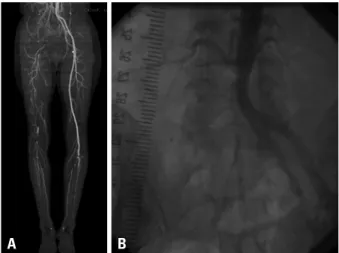
dL). Autoantibody tests for rheumatoid factor, lupus antico- agulant, anticardiolipin, anti ds-DNA, and P-ANCA/C-AN- CA were negative. The ankle-brachial index (ABI) on the right was 0.12, while that on the left was 1.13. A lower ex- tremity computed tomographic angiography (CTA) showed chronic thromboemblic occlusion extending from the right common iliac artery to the popliteal artery (Fig. 1A). Diag- nostic transbrachial arteriography showed same result as that with CT angiography (Fig. 1B).

Initially, the patient was treated by a percutaneous trans- luminal angioplasty (PTA) with thrombolytic therapy. Ac- cording to our standard protocol, urokinase (UK) 300000 units were injected via infusion catheter and 200000 units were injected via sheath, and infusion of 80000 units per hour and heparin via sheath was kept continuously. Twenty hours after initiating thrombolytic therapy, we observed up- per gastrointestinal bleeding due to Dieulafoy’s lesion at the duodenal bulb. We, therefore, performed therapeutic endos- copy, epinephrine injection and hemoclipping, and discon- tinued injection of UK and heparin. Follow up angiography revealed improved flow of common iliac artery (CIA), but thromboembolic occlusion remained. We performed Redo- Fogarty embolectomy and found 10×0.5 cm sized organiz- ing thrombi via the right common femoral artery incision site (Fig. 2). After the embolectomy, CTA revealed im- proved flow of the lesion, and the right ABI rose to 0.89 (Fig. 3). The patient was discharged with medication of as- pirin 100 mg once daily (o.d.), clopidogrel 75 mg o.d., beraprost 40 µg o.d. and warfarin 2.5 mg o.d. Since then, there was one episode of treatment with PTA at the proxi- mal portion of right superficial artery. With medical treat-

ment, her lower limbs remain asymptomatic. Fig. 3. A lower extremity computed tomographic angiography demon- strates successful revascularization after Fogarty embolectomy.

Fig. 2. The 10×0.5 cm sized organizing thrombi after Redo-Fogarty embolec- tomy.

Fig. 1. (A) A lower extremity computed tomographic angiography demon- strates chronic thromboemblic occlusion extending from the right common iliac artery to the popliteal artery. (B) Diagnostic angiography demonstrates total occlusion of right common iliac artery.

A B

(3)

Ki-Bum Won, et al.

Yonsei Med J http://www.eymj.org Volume 53 Number 6 November 2012 1222

sheath. Nevertheless, we actually achieved good results af- ter Fogarty embolectomy.

Radiation-induced arterial disease is coordinative to ac- celerated atherosclerosis, and should be considered as a major risk factor for the development of ischemic syn- dromes in the irradiated field.

15

Development of this disor- der is related to the delivery technique of radiation, the dose of radiation, and the extent of exposed vasculature. Preven- tive measures should, therefore, be aimed at accurate limi- tation of the irradiated field, avoidance of overdoses, and reversal of associated atherosclerotic risk factors. Early ob- servation and detection should also be needed for cancer survivors who previously received radiation therapy.

REFERENCES

1. McCready RA, Hyde GL, Bivins BA, Mattingly SS, Griffen WO Jr. Radiation-induced arterial injuries. Surgery 1983;93:306-12.

2. Hughes WF, Carson CL, Laffaye HA. Subclavian artery occlusion 42 years after mastectomy and radiotherapy. Am J Surg 1984;147:

698-700.

3. Har-Shai Y, Schein M, Molek AD, Peled IJ, Best LA. Ruptured mycotic aneurysm of the subclavian artery after irradiation. A case report. Eur J Surg 1993;159:59-60.

4. Ross HB, Sales JE. Post-irradiation femoral aneurysm treated by iliopopliteal by-pass via the obturator foramen. Br J Surg 1972;59:

400-5.

5. de Baere T, Ousehal A, Kuoch V, Sapoval M, Lagrange C, Roche A. Endovascular management of bleeding iliac artery pseudoan- eurysms complicating radiation therapy for pelvic malignancies.

AJR Am J Roentgenol 1998;170:349-53.

6. Pettersson F, Swedenborg J. Atherosclerotic occlusive disease af- ter radiation for pelvic malignancies. Acta Chir Scand 1990;156:

367-71.

7. Mellière D, Becquemin JP, Berrahal D, Desgranges P, Cavillon A.

Management of radiation-induced occlusive arterial disease: a re- assessment. J Cardiovasc Surg (Torino) 1997;38:261-9.

8. Katras T, Baltazar U, Colvett K, Rush D, Dunn J, Stanton P Jr.

Radiation-related arterial disease. Am Surg 1999;65:1176-9.

9. Butler MJ, Lane RH, Webster JH. Irradiation injury to large arter- ies. Br J Surg 1980;67:341-3.

10. Modrall JG, Sadjadi J. Early and late presentations of radiation ar- teritis. Semin Vasc Surg 2003;16:209-14.

11. Jurado JA, Bashir R, Burket MW. Radiation-induced peripheral artery disease. Catheter Cardiovasc Interv 2008;72:563-8.

12. Levenback C, Burke TW, Rubin SC, Curtin JP, Wharton JT. Arte- rial occlusion complicating treatment of gynecologic cancer: a case series. Gynecol Oncol 1996;63:40-6.

13. Andros G, Schneider PA, Harris RW, Dulawa LB, Oblath RW, Salles-Cunha SX. Management of arterial occlusive disease fol- lowing radiation therapy. Cardiovasc Surg 1996;4:135-42.

14. Farrugia M, Gowda KM, Cheatle TR, Ashok TP. Radiotherapy- related axillary artery occlusive disease: percutaneous translumi- nal angioplasty and stenting. Two case reports and review of the literature. Cardiovasc Intervent Radiol 2006;29:1144-7.

tially with an injury to the extremely radiosensitive endothe- lial cell layer and then causes prolonged effects of peripheral fibrosis and accelerated atherosclerosis, which occur over the course of decades.

9,10

The manifestation of atheroscle- rotic process in these vessels includes stenosis, thrombosis, and aneurismal dilatation.

1-4

Radiation-induced arterial dis- ease of aortoiliac arteries has been known to most com- monly occur as a consequence of treatment for rectal, uro- logic, or gynecologic cancer. Establishing a presumptive diagnosis of radiation-induced occlusive arterial disease is based on the clinical history and angiographic appearance of lesion. Evidence of occlusive disease within the irradiat- ed field with relative sparing of non-irradiated arteries is highly suggestive of radiation-induced occlusive arterial disease.

11

However, other extremely rare cases of arterial occlusion are not limited to radiation field, because coagu- lation abnormalities have previously been presented in pa- tients who had been treated for gynecologic cancer.

12

In the present case, the patient complained of intermittent claudi- cation in the right thigh and calf, and had received postop- erative radiotherapy in the pelvic area for cervical cancer 13 years ago. She had no other cardiovascular risk factor and arterial occlusive diseases, and never smoked. Labora- tory data associated coagulation was within normal range, and autoantibody tests were all negative. Considering all the factors, therefore, we concluded the diagnosis of radia- tion-induced arterial occlusive disease. The history of small bowel resection due to bowel ischemia might have been as- sociated with previous radiation therapy.

The treatment of arterial lesion related to prior radiation

is recommended for indications similar to atherosclerotic

occlusive lesion, unless there is a poor long-term prognosis

associated with malignancy.

10

A variety of endovascular

and surgical procedures may be used to treat radiation-in-

duced occlusive disease in the aortoiliac artery.

10

The pres-

ence of sclerosis in surrounding tissues and increased risk

of postoperative infection mandate the use of autogenous

conduits as well when possible.

13,14

Recently, advanced per-

cutaneous intervention has emerged as the treatment of

choice for these lesions, however, the length of diseased ar-

tery and the circumjacent fibrosis limit its efficacy.

11

In our

case, we initially considered thrombolytic therapy because

of chronic thromboemblic total occlusion affecting from

the right CIA to the popliteal artery with diminutive caliber

of remaining arteries. However, we had to stop thrombolyt-

ic therapy due to upper gastrointestinal bleeding, and could

not inject enough dosage of UK via infusion catheter and

(4)

Radiation Arteritis and Cervical Cancer

Yonsei Med J http://www.eymj.org Volume 53 Number 6 November 2012 1223 accelerated development of atherosclerosis: a report of three cases.

Ann Vasc Surg 2002;16:671-5.

15. Pherwani AD, Reid JA, Keane PF, Hannon RJ, Soong CV, Lee B.

Synergism between radiotherapy and vascular risk factors in the

수치

Fig. 2. The 10×0.5 cm sized organizing thrombi after Redo-Fogarty embolec- embolec-tomy.

참조

관련 문서