논문 2011-48TC-3-8
Cross Entropy 기반의 주파수 영역에서 스펙트럼 센싱 성능 개선
( An Improved Cross Entropy-Based Frequency-Domain Spectrum Sensing )
타사미아*, 구 준 롱*, 장 성 진*, 김 재 명***
( Tasmia Ahmed, Junrong Gu, Sung Jeen Jang, and Jae Moung Kim )
요 약
본 논문은 주파수 영역에서 과거와 현재에 센싱된 결과들의 관계를 이용한 스펙트럼 센싱기법을 제안하였다. 기존에 제안된 대부분의 스펙트럼 센싱기법은 해당 시간에 센싱된 우선사용자의 신호만을 다루고 있다. 해당 시간 이전의 우선사용자의 상태 는 조건부확률을 사용하여 검출기의 신뢰성을 증가시킬 수 있다. 따라서, 본 논문은 이전 시간과 해당 시간의 스펙트럼 센싱 결과를 사용하는 cross entropy 기반의 스펙트럼 센싱기법을 제안하며 이를 통해 우선사용자 신호 검출 성능을 향상시키고 잡 음에 강인한 성능을 가질 수 있다. 이전 시간에 검출된 신호가 잡음인 경우 cross entropy 기반의 스펙트럼 센싱 성능 감소는 기존의 entropy 기반의 센싱기법과 동일하게 된다. 이러한 문제를 해결하기 위해 본 논문에서는 보다 향상된 cross entropy 센 싱기법을 제안하였다. 본 논문은 시뮬레이션을 통해 가장 최근에 제안된 주파수 영역에서의 entropy 기반 스펙트럼 센싱기법 보다 제안된 방법이 더 나은 성능을 보이는 것을 보였다.
Abstract
In this paper, we present a spectrum sensing method by exploiting the relationship of previous and current detected data sets in frequency domain. Most of the traditional spectrum sensing methods only consider the current detected data sets of Primary User (PU). Previous state of PU is a kind of conditional probability that strengthens the reliability of the detector. By considering the relationship of the previous and current spectrum sensing, cross entropy-based spectrum sensing is proposed to detect PU signal more effectively, which has a strengthened performance and is robust. When previous detected signal is noise, the discriminating ability of cross entropy-based spectrum sensing is no better than conventional entropy-based spectrum sensing. To address this problem, we propose an improved cross entropy-based frequency-domain spectrum sensing. Regarding the spectrum sensing scheme, we have derived that the proposed method is superior to the cross entropy-based spectrum sensing. We proceed a comparison of the proposed method with the up-to-date entropy-based spectrum sensing in frequency-domain. The simulation results demonstrate the performance improvement of the proposed spectrum sensing method.
Keywords : Cross Entropy, Entropy, Frequency-Domain, Spectrum Sensing, Cognitive Radio.
* 학생회원, ** 평생회원, 인하대학교 정보통신대학원 (INHA-WiTLAB, Graduate School of IT &
Telecommunication)
※ 이 논문은 2010년도 정부 (교육과학기술부)의 재원 으로 한국연구재단의 지원을 받아 수행된 연구임 (No. 2010-0008000)
※ 본 연구는 지식경제부 및 정보통신산업진흥원의 대 학 IT연구센터 지원사업의 연구결과로 수행되었음 (NIPA-2011-C1090-1011-0007)
접수일자: 2010년9월30일, 수정완료일: 2011년3월17일
Ⅰ. Introduction
In the wireless communication system, spectrum is a very costly and limited resource which has to be used efficiently. Many researchers have pointed out that spectrum management is a much bigger problem in reality than spectrum availability. Due to logistical
issues, some frequency bands are overcrowded but so -me others are virtually empty[1]. Cognitive radio (CR) is a promising solution to improve the utilization of the radio spectrum[2~5]. To have a brief idea of how cognitive radio works, at first one can consider Secondary User (SU) senses PU channel to detect spectrum holes. Then the Secondary User makes decision whether PU is idle. If so, it takes action to access the PU’s channel. The spectrum sensing function enables the cognitive radio to adapt to its environment by detecting spectrum holes[6].
The spectrum sensing is one of the most challenging issues in cognitive radio systems, which will be our focus of this paper. Spectrum sensing is classified into four mainstream methods[7~8]. They are the energy detection, the matched filter, the cyclostationary based spectrum sensing and the entropy-based spectrum sensing. The energy detection detects the energy level of PU signal.
Though it is simple and easy to implement, its performance is sensitive to noise. The matched filter requires less time to achieve high processing gain due to coherency, but it requires a prior knowledge of the primary user signal. If this information is not accurate, then the matched filter cannot work. The cyclostationary feature detector can identify the observed signal type. However, it is computationally complex and requires significantly long observation time. The newly developed entropy based spectrum sensing outperforms all the spectrum sensing methods under certain assumptions.
All the previous spectrum sensing methods do not consider the relationship of the previous and current spectrum sensing of PU. However, knowledge on previous status of PU in spectrum sensing is very helpful for efficient spectrum sensing. Luckily the cross entropy-based spectrum sensing measures the relationship of the previous and current status of PU in the spectrum sensing. Therefore, we employ cross entropy in spectrum sensing and term it as cross entropy-based spectrum sensing. In the cross entropy-based spectrum sensing, the status of PU in
previous spectrum sensing is considered known to SU (e.g. by acknowledgement packet between SUs).
Then the cross entropy value are calculated and compared to a threshold respecting the PU state in previous spectrum sensing.
In the cross entropy-based spectrum sensing, there are two cases corresponding to whether PU is idle or active in previous spectrum sensing. Consider the case that PU is idle in previous spectrum sensing.
There are two outcomes of cross entropy value regarding current state of PU: outcome 1) the cross entropy value when PU is idle currently and outcome 2) the cross entropy value when PU is active currently. The cross entropy value is the sum of entropy value and Kullback-Leibler divergence value.
For outcome 1), the Kullback-Leibler divergence value tends to be zero, however, it is greater than zero in outcome 2). Moreover, as the entropy value of PU signal is less than that of noise, the Kullback-Leibler divergence value has shortened the distance which is the difference of the cross entropy values of outcome 1) and outcome 2). This has deteriorated the spectrum sensing performance. To address this problem, we propose an improved spectrum sensing method for which the difference of these outcomes is greater than that of cross entropy-based spectrum sensing (When PU is active in the previous spectrum sensing, the cross entropy-based spectrum sensing works smoothly).
In this paper, we present an improved cross entropy-based frequency-domain spectrum sensing method to overcome degraded performance of cross entropy based spectrum sensing. To facilitate analysis, we adopt the framework of [9] for our proposed spectrum sensing method (of course, the frame work of [8] is also feasible). Firstly, we formulate the cross entropy-based spectrum sensing to improve the performance of [9]. Following the performance analysis of the cross entropy-based spectrum sensing, we have obtained our improved cross entropy-based frequency-domain spectrum sensing method. Furthermore, we prove that the
proposed spectrum sensing method is robust against noise uncertainty and discriminating ability is also enhanced which leads to a superior spectrum sensing performance.
This paper is organized as follows. In section Ⅱ, we introduce the spectrum sensing method of [9], and present our system model based on it. In section Ⅲ, at first, we formulate cross entropy-based spectrum sensing, then derivate the spectrum sensing policy based on cross entropy-based spectrum sensing and estimate the proposed method. The simulation results of both Gaussian channel and Rayleigh fading channel are shown in section Ⅳ. Finally, Section Ⅴ concludes the paper.
Ⅱ. System Model
In this section, firstly, we introduce the spectrum sensing method of [9] briefly. Afterwards we depict the system model for our proposed spectrum sensing method based on it.
1. The Spectrum Sensing Method of [9]
The authors of [9] emphasize the robustness of their proposed method, and term it as entropy-based robust spectrum sensing. Histogram diagram is adopted to estimate entropy in [9] with probability space partitioned into equal dimensions in frequency-domain.
Then, the estimated entropy of noise is proved to be a constant while the entropy of the PU signal is not, which is the key reason why it is robust. Therefore the spectrum sensing performance of [9] is superior to its time domain counterpart.
We summarize the system model of [9] as Fig.1.
To have clear sense of the robustness of [9], we
그림 1. 참고문헌 [9]의 시스템 모델 Fig. 1. System model of [9].
그림 2. 가우시안 백색잡음의 추정 엔트로피 Fig. 2. Estimated entropy of Gaussian White Noise.
re-simulate entropy distribution of noise when estimating the entropy using different partitioning schemes of histogram method. There are generally two partitioning scheme. The first is fixed bin width, and the number of bins changes with noise power. The other is fixed bin number, and the bin width changes with the spectrum magnitude. The authors of [9] has shown that with probability space partitioned into fixed dimensions, the entropy of the WGN is a constant, and the frequency-domain entropy-based detection is thus intrinsically robust against noise uncertainty, which is confirmed by Fig.2
We have the following parameter settings: the frequency is 60 kHz and the bin number is 15.
Sampling time duration is 0.001s. Each point is obtained by averaging 10000 runs.
Fig.2 shows the estimated entropy of Gaussian White Noise with fixed bin number and fixed bin width. We observe that the estimated entropy is a constant for a given bin number, whereas the entropy is linearly proportional to noise power under a fixed bin width. The results indicate that the entropy-based detector can be robust against noise uncertainty by partitioning the probability space into fixed dimension.
2. System Model of Proposed Method
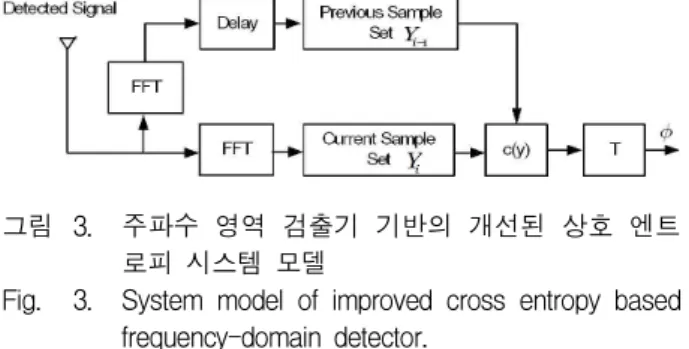
Referring to [9], the structure of improved cross entropy-based frequency-domain detector is presented as follows:
그림 3. 주파수 영역 검출기 기반의 개선된 상호 엔트 로피 시스템 모델
Fig. 3. System model of improved cross entropy based frequency-domain detector.
The structure of the improved cross entropy-based detector in the frequency-domain is shown in Fig.3.
There are two sample data sets in Fig.3: one is current spectrum sensing data sets and another is for previous. FFT is applied to the both data sets.
Finally, a value is calculated based on improved cross entropy, which will be further explained in section III.
Applying discrete Fourier transform (DFT) to a signal with frequency bandwidth
Bw
and central frequencyf
c. The general discrete signalx(n)
at the received signal can be expressed as
(1)
Wheres(n)
is the primary signal of interest,w(n)
represents background noise which follows Gaussian distribution
, andN
is the sample size. If PU is activey(n)
follows Gaussian distribution
,
.We have following hypothesis in frequency- domain.
(2)
WhereN
is the DFT size,Y
,S
andW
denote the complex spectrum of the received signal, primary signal, and noise respectively. In hypothesis
, the received signal consists of the both primary signal and background noise. The authors of [9] have shown the spectrum magnitude of the received signal follows Rice distribution in
, while with its entropy generally different from that of Rayleigh distribution in
.However, the relationships of the detected data set
in previous and current spectrum sensing are not considered in [9]. We will discuss this point in next section.
Ⅲ. The Articulation of Improved Cross Entropy-Based Frequency-Domain Spectrum
Sensing
In this section, we first present the cross entropy-based spectrum sensing, and then proposed the improved cross entropy-based frequency-domain spectrum sensing based on the analysis of cross entropy-based spectrum sensing. And finally we provide the estimate of spectrum sensing strategy.
3.1 The Cross Entropy-Based Spectrum Sensing
The cross entropy between two probability distributions measures the average number of bits needed to identify an event from a set of possibilities
[7]. Cross entropy is defined by (3).
log (3)
The Cross entropy-based spectrum sensing considers the relationship of previous and current data sets of PU by calculating cross entropy of neighboring detected data sets. In cross entropy-based spectrum sensing, · indicates the probability distribution of the magnitude of sampling outputs in previous spectrum sensing, while ·
indicates that in current spectrum sensing. Then the cross entropy value is compared to a threshold to decide the current PU state.
3.2 The Improved Cross Entropy-Based Frequency-Domain Spectrum Sensing
From (3), we know,
log
log
log
(4)
Where
indicates the entropy and
indicates the Kullback–Leibler divergence[8].
Comparing (3) and (4) and scrutinize then more carefully, we find that, the second term
in the last line of (4) has increased the value of (4) comparing to entropy. As ≥ ≥.Without losing of generality, consider that PU is idle in previous spectrum sensing. To decide the current state of PU, we take the cross entropy-based spectrum sensing and the entropy-based spectrum sensing respectively for comparison.
We define the spectrum sensing strategy
temporarily and consider following two scenarios:(1) The current state of PU is idle.
indicates the value of cross entropy.
indicates the value of entropy.
indicates the value of Kullback–Leibler divergence.
(5)
Where,
≈ . The current state of PU is idle.As the detected signal of previous spectrum sensing is noise, which abides Gaussian distribution. The detected signal of current spectrum sensing is noise too, which also abides Gaussian distribution.
(2) The current state of PU is active.
indicates the value of cross entropy.
indicates the value of entropy.
indicates the value of Kullback–Leibler divergence.
(6)
Where,
. The current state of PU is active.As the detected signal of previous spectrum sensing is noise, which abides Gaussian distribution. The detected signal of current spectrum sensing is PU signal polluted by noise, which abides a mixed distribution.
Subtracting (6) from (5), we get,
(7)
deteriorates the performance of cross entropy-based spectrum sensing, even renders its discriminating ability worse than the entropy-based spectrum sensing.To improve the performance of cross entropy spectrum sensing, and in the meanwhile to utilize the state transfer information, we redefine in Fig.3 by (8)
(8)
In the case that PU is active in previous spectrum sensing, we need not modify , just set
. We have (9).
(9)
Where indicates the value of (9) in scenario that PU is active in previous spectrum sensing and idle in current spectrum sensing;
and
are corresponding to the entropy value and the Kullback –Leibler divergence value. indicates the value of (9) in scenario that PU is active in both previous spectrum sensing and current spectrum sensing;
and
are corresponding to the entropy value and the Kullback–Leibler divergence value.We propose the Improved Cross Entropy-Based Frequency-Domain Spectrum Sensing as (10).
if det if det
(10)
Most of the time, when taking current spectrum sensing, SU already knows the exact state of PU of previous spectrum sensing. Thus, (10) is feasible.3.3 The Estimate of Improved Cross Entropy-Based Frequency-Domain Spectrum Sensing
Following the entropy estimation method, we consider the histogram method to estimate the probability of each state. The spectrum sensing window deals with a set of continuous
N
samples
≤
. Then the range of the maximum and minimum of
is separated intoL
equal intervals with boundaries for thek
th interval.
and
, respectively central point of the first and the last bin ,withK
satisfying (11). and are mean and variance of
.
≤
(11)
indicates the number of contained in the
k
th interval, withå
L= =k nk N
1' . Then, ≤ ≤. We can obtain the estimation: ′ ≤ ≤ in a similar manner, where ′ indicates the number of samples falling into
k
th interval,å
L= =k nk N
1' . The number of states of the random variable is equal to the bin number
L
. From (10), we get (12)
log
i f
det
log i f
det
(12)
Substituting value of
p
(k
),q
(k
) into (12), we attain the estimate as (13).
′
i f
det
′
i f
det
(13)
Ⅳ. Simulation
In this section, we have compared the performance of the improved cross entropy-based frequency- domain spectrum sensing with that of robust entropy-based frequency-domain spectrum sensing[7,
9]. We have applied same parameters with [9]. The Single Sideband Signal contaminated by White Gaussian Noise is selected as candidate signal. We provide the distribution of the improved cross entropy-based frequency-domain spectrum sensing with two cases (case1 when PU is idle in spectrum sensing and case2 when PU is active in previous
spectrum sensing). We also provide the receiver operation characteristic (ROC) in Gaussian channel and Rayleigh fading channel.
To evaluate the performance of the improved cross entropy-based frequency-domain spectrum sensing, We consider, the bandwidth,
B
w =12 kHz, the carrier frequency,f
c =40 kHz and the sampling frequency,f
s=100 kHz. For the simulation result, the probability space is partitioned into equal bin number,
L
=15 and the number of points in the FFT,N
=128. The sample size is 5000 and the nominal noise power is -90 dBm.Each point in the following plots is the average of 1000 runs.
1. Gaussian Channel
(1) The Distribution of Estimated Entropy and Our Proposed Method
We have compared with improved cross entropy- based frequency-domain spectrum sensing with entropy-based frequency-domain spectrum sensing.
The results are shown in Fig.4 and Fig.5.
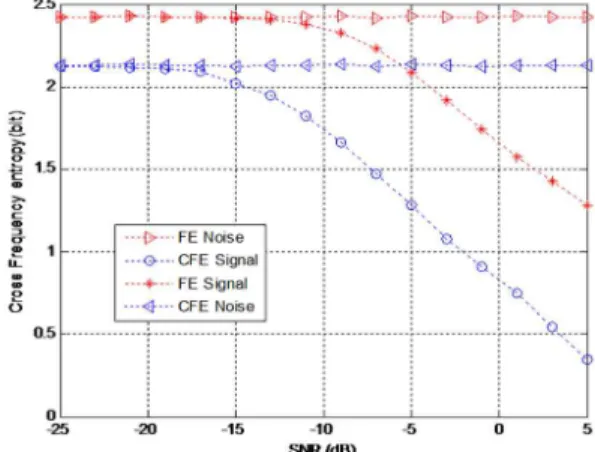
“CFE” indicates improved cross entropy-based frequency-domain spectrum sensing, while “FE”
indicates entropy-based frequency-domain spectrum sensing. Fig.4 describes the distribution of current spectrum sensing values when PU is idle in previous spectrum sensing and Fig.5 describes the distribution
그림 4. 이전 센싱에서 우선사용자가 없을 경우 Fig. 4. When PU is idle in previous spectrum sensing.
그림 5. 이전 센싱에서 우선사용자가 있을 경우 Fig. 5. When PU is active in previous spectrum
sensing.
of current spectrum sensing values when PU is active in previous spectrum sensing. From Fig.4 and Fig.5, we can conclude that when PU is idle, the detected signal is Gaussian noise which is random and contains no information. However when PU is active, the detected signal contains information, thus it is no longer completely random and leads to a decreased entropy signal.
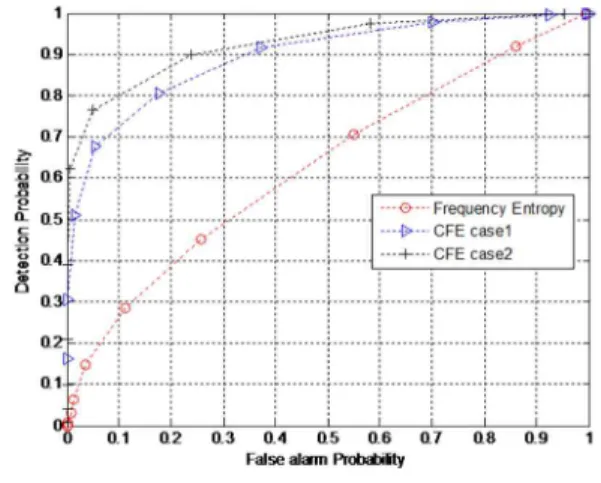
(2) Comparison of Detection Performance Fig.6 shows the comparison of the detection performance between the proposed scheme in two cases (case1 when PU is idle in previous spectrum sensing and case2 when PU is active in previous
그림 6. ROC 곡선의 성능 비교
Fig. 6. Comparison of detection performance.
spectrum sensing) and frequency-domain entropy- based detection. This figure shows the detection performances in both cases of proposed scheme are better than entropy-based frequency-domain spectrum sensing.
(3)Comparison of Receiver Operation Characteristic Fig.7 illustrates the ROC curves of improved cross entropy-based frequency-domain spectrum sensing and entropy-based frequency-domain spectrum sensing under Gaussian channel, where SNR=-10dB.
In this figure, it is observed that the improved spectrum sensing strategy behaves best compared to the current ones.
그림 7. ROC 곡선의 성능 비교 Fig. 7. The comparison of ROC curves.
2. Rayleigh Fading Channel
The primary signal is a single sideband (SSB) signal, which is assumed to experience deep fading that the magnitude follows Rayleigh distribution with the delay time of each path is 0.01s and the path numbers is 15.
(1) The Distribution of Estimated Entropy and Our Proposed Method
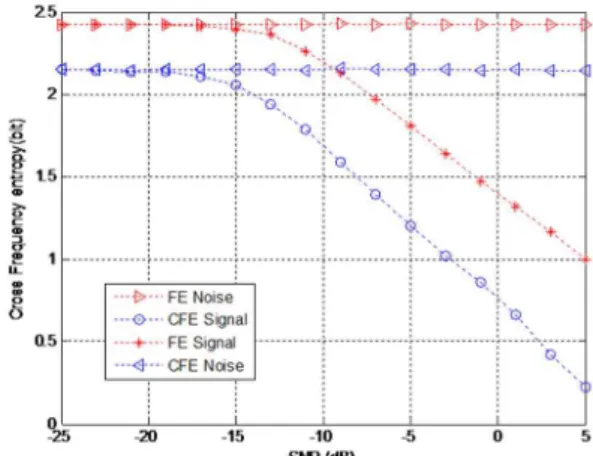
To illustrate the improvement of the distribution of improved cross entropy-based frequency-domain spectrum sensing comparing with conventional entropy-based frequency-domain spectrum sensing, the case of the distribution of current spectrum
그림 8. 이전 센싱에서 우선사용자가 없을 경우 Fig. 8. When PU is idle in previous spectrum sensing.
그림 9. 이전 센싱에서 우선사용자가 있을 경우 Fig. 9. When PU is active in previous spectrum
sensing.
sensing values when PU is idle in previous spectrum sensing and the distribution of current spectrum sensing values when PU is active in previous spectrum sensing under Rayleigh fading channel is simulated and shown in Fig.8 and Fig.9. From Fig.8 and Fig.9, we can conclude that the discriminating ability has been strengthened by improved cross entropy-based frequency-domain spectrum sensing.
(2) Comparison of Detection Performance We have compared the detection performance of the proposed scheme in two cases (case1 when PU is idle in previous spectrum sensing and case2 when PU is active in previous spectrum sensing) with the
Fig. 10. 검출 성능의 비교
Fig. 10. Comparison of detection performance.
frequency-domain entropy-based detection in Rayleigh fading channel. Fig.10 shows the detection performances of the proposed scheme are more robust than conventional one.
(3) Comparison of Receiver Operation Characteristic
By selecting SNR=-10, we have simulated the ROC curves of improved cross entropy-based frequency- domain spectrum sensing and entropy-based frequency-domain spectrum sensing in Rayleigh fading channel. Fig.11 shows that the detection ability of the proposed scheme has outperformed than the entropy-based frequency-domain spectrum sensing.
Fig. 11. ROC 곡선의 비교
Fig. 11. The comparison of ROC curves.
Ⅴ. Conclusion
In this paper, an improved cross entropy-based spectrum sensing has been proposed to improve the detection performance. Cross entropy is adopted for spectrum sensing to consider the relationship of previous and current status data sets of PU. Based on it, we proposed an improved cross entropy-based spectrum sensing detects PU signal more efficiently.
Reference
[1] Santosh V. Nagaraj. “Entropy Based Spectrum Sensing in Cognitive Radio,”
Signal Processing,
Vol. 89, no. 2, pp: 174-180, Feb, 2009.[2] S.Haykin, “Cognitive Radio: Brain-Empowered Wireless Communications,”
IEEE J. Select.
Areas Commun.
, vol. 23, no. 2, pp201-220, Feb, 2005.[3] N. devroye, P. Mitran and V. Tarokh,
“Achievable Rates in Cognitive Radio Channels,”
IEEE Trans .Inform. Theory,
vol. 52, no. 5, pp1813-1827, May 2006.[4] S. Srinivasa, S.A. Jafar and N. Jindal, “On the Capacity of the Cognitive Tracking Channel,”
IEEE International Symposium on Information Theory,
pp2077 – 2081, Jan. 2006.[5] J.Mitola, III and G. Maguire, Jr., “Cognitive radio: Making software radio more personal,”
IEEE Personal Communications,
vol. 6, pp13-18, Aug. 1999.[6] Yucek T., and Arslan, H., “A survey of spectrum sensing algorithms for cognitive radio applications,”
Communications Surveys &
Tutorials,
vol. 11, no. 1, pp116–130, IEEE 2009.[7] Ya Lin Zhang, Qin Yu Zhang, and Tommaso Melodia; “A Frequency-Domain Entropy-Based Detector for Robust Spectrum Sensing in Cognitive Radio Networks,”
Communications Letters, IEEE,
vol. 14, No .6, pp533–535, June 2010.[8] Thomas M. Cover, Joy A. Thomas. Elements of Information Theory, Second Edition. John Wiley
& Sons .Hoboken, New Jersey.
[9] Zhang Y., Zhang Q., Wu S.. “Entropy-based robust spectrum sensing in cognitive radio,”
IET Commun.
vol. 4, no. 4, pp428-430, 2010.[10] SungHwan Sohn, SungJeen Jang, JaeMoung
Kim, “A real time sensing through the eigenvalue detection in cognitive radio,” IEEK Telecommunications, vol. 47-TC, no. 7, pp1-7, July 2010.
[11] Md. Imrul Hassan, JuBin Song, Young-Il Kim,
“Throughput capacity of a wireless multi-hop relay network using cognitive radio,” IEEK Telecommunications, vol. 44-TC, no. 5, pp33-39, May 2007.
저 자 소 개
타사미아
(학생회원)2005년 Daffodil International대학 교 전자통신공학과 학사 2009년∼현재 인하대학교 정보
통신대학원 석사 과정
<주관심분야 : 무선인지기술>
장 성 진
(학생회원)2007년 인하대학교 전자공학과 학사
2009년 인하대학교 정보통신 대학원 석사
2009년∼현재 인하대학교 정보 통신대학원 박사 과정
<주관심분야 : 이동통신, 무선인지기술>
구 준 롱
(학생회원) 2005년 중국 동북대학교통신공학 학사 2008년 중국 대련이공대학교
통신정보계통공학 석사 2008년∼현재 인하대학교 정보 통신대학원 박사 과정
<주관심분야 : 이동통신, 무선인지기술>
김 재 명
(평생회원)-교신저자 1974년 한양대학교 전자공학과학사
1981년 미국남가주대학교(USC) 전기공학과 석사
1987년 연세대학교 전자공학과 박사
1974년 3월∼1979년 6월 한국과학기술연구소, 한국 통신기술연구소 근무
1982년 9월∼2003년 3월 한국전자통신연구원 위성통신연구단장/무선방송연구소 소장 2003년 4월~현재 인하대학교 정보통신대학원
교수, 통신위성 우주산업연구회 회장 외 기술 자문으로 다수 활동 중
<주관심분야 : 차세대 무선이동통신 및 Cognitive Radio, UWB
![그림 1. 참고문헌 [9]의 시스템 모델 Fig. 1. System model of [9].](https://thumb-ap.123doks.com/thumbv2/123dokinfo/5241263.625342/3.892.475.781.157.403/그림-참고문헌-의-시스템-모델-fig-system-model.webp)