논문 2011-48TC-11-4
잡음 전력의 불확실성이 에너지 검파 기반의 스펙트럼 감지에 미치는 영향
( Effects of Noise Power Uncertainty on Energy Detection for Spectrum Sensing )
임 창 헌** ( Chang Heon Lim )
요 약
스펙트럼 감지를 하기 위해 에너지 검파기는 수신 신호의 에너지를 미리 정해둔 임계값과 비교하여 1차 사용자가 면허 대 역 내에서 활동을 하는 지 여부를 판단한다. 여기에서 임계값은 해당 주파수 대역에 존재하는 잡음의 전력 수준과 관련이 있 다. 에너지 검파에 대한 과거의 연구 대부분은 잡음 전력을 미리 정확하게 알고 있다는 가정에 기초한 것이었다. 그러나 실제 환경에서는 잡음 전력에 대한 불확실성이 존재하기 때문에 이 가정은 현실적으로 유효하지 않다. 그러므로 잡음 전력의 불확 실성이 에너지 검파기의 스펙트럼 감지 성능에 미치는 영향을 파악할 필요가 있다. 이에 이 논문에서는 유수 정리(residue theorem)에 기반을 둔 적분을 활용하여 그 영향을 수학적으로 분석하고 그 결과를 제시하고자 한다.
Abstract
In spectrum sensing, an energy detector compares the energy of a received signal with a predetermined detection threshold and decides whether a primary user is active or not in a licensed frequency band. Here the detection threshold is related to the noise power level in the band. Most previous works on energy detection have assumed that the noise power is exactly known a priori. However, this assumption does not hold in practice since there may be some uncertainty about the noise power. So it is necessary to investigate its effects on the performance of energy detection for spectrum sensing. In this paper, we analyze the effects using the residue theorem for contour integral and present the associated numerical results.
Keywords : cognitive radio, spectrum sensing, energy detection, hypothesis testing, noise uncertainty
Ⅰ. INTRODUCTION
Recently, cognitive radio[1] has been recognized as a promising means to implement the concept of dynamic spectrum access and to resolve the scarcity of radio spectrum due to the traditional fixed
* 평생회원, 부경대학교 전자공학과 (Pukyong National University)
※ 이 논문은 2010학년도 부경대학교의 지원을 받아 수행된 연구임(PK-2010-0012000201013800)
접수일자: 2011년7월26일, 수정완료일: 2011년11월14일
spectrum allocation policy. In dynamic or opportunistic spectrum access, a secondary user should not cause harmful interference to a primary user in a licensed band and is required to be equipped with the capability of spectrum sensing to monitor the activity of a primary user. Cognitive radio inherently possesses this ability and can be an appropriate approach for realizing a secondary terminal.
Most spectrum sensing techniques[2] may be classified into three categories which are respectively
based on matched filtering, energy detection, and feature extraction. Among these, the energy detection does not require any prior knowledge of a primary user signal and is relatively simple to implement, which has brought about a lot of research work toward it.
An energy detector determines a detection threshold on the basis of the noise power in a licensed band and is required to be aware of the noise power there for its successful operation. Most research efforts on energy detection have assumed that the noise power is available a priori. However, in practice, it is difficult to obtain the exact value of the noise power since several factors such as calibration error, temperature change, and interference contribute the noise power uncertainty[3]. In [4], Cabric found that the inaccuracy of the noise power may degrade the performance of an energy detector significantly.
In [5], Tandra, et al. stated that the detection performance may not improve with increasing the observation time in case there is some uncertainty about the noise power. However, the degradation of the sensing performance which is attributed to the noise power uncertainty has not been analyzed yet.
In this paper, we assume that an energy detector estimates the noise power and the associated estimation error has a uniform distribution. Then we analyze the effects of the estimation inaccuracy on the sensing performance of the energy detector in terms of detection probability and false alarm probability.
Ⅱ. SYSTEM MODEL
The problem of spectrum sensing can be formulated as a hypothesis testing with two hypotheses: one hypothesis indicates no active primary user and the other hypothesis represents the presence of an active primary user. Then the received signal of a secondary user can be described by
(1) where is the primary user signal, and is a bandpass noise confined to the licensed band of bandwidth and exhibits zero mean and power spectral density of
. Also let denote the amplitude channel gain between a primary user and a secondary user, which is assumed to be constant over each transmission period and to have a Rayleigh distribution.
We assume that an energy detector calibrates the noise power or equivalently the noise power spectral density in a licensed band and determines the detection threshold accordingly. Let
denote an estimate of the noise power spectral density. In order to characterize the uncertainty about the noise power, we assume that the exact value of the noise power spectral density
is a random variable with a
uniform distribution over a range
around
the estimate of
[6]
where represents the uncertainty of the noise power and is equal to or greater than 1. Accordingly, the probability density function (PDF) of can be written as
≤≤
(2)
for and
(3)
for , where ⋅ is the Dirac delta function.
The energy detector is presumed to adopt the following test statistic X for detection of a primary user[7]
(4)
where is an observation time.
Ⅲ. PERFORMANCE ANALYSIS
1. False Alarm Probability
When the primary user is idle, the received signal is composed of only the noise component .
When is given and a time bandwidth product
is approximated by an integer [7], the test statistic
follows a gamma distribution with and
[8~9] and its PDF is represented by . For a random variable , we denote its PDF by
and its moment generating function (MGF) by
∞∞ (5)(5) allows us to transform the conditional PDF
to the conditional MGF which is given by [11]
(6) By definition, the conditional false alarm probability
for a given can be expressed as
∞ (7)where is a detection threshold. Applying the contour integral based approach[10] for calculating a cumulative probability to (7) results in
exp
exp
(8)
where ⋯ are the poles of and ⋅ is the gamma function. As mentioned in Section II, since is assumed to be a random variable over an interval
, we can
produce the unconditional false alarm probability for by averaging over as follows:
(9) where ⋅ represents the expectation operator, and are respectively defined as
exp
exp
(10)
(11)
with being the upper incomplete gamma function defined as
∞
. Note that is reduced to (8) for .
2. Detection Probability
When a primary user occupies a licensed frequency band, the received signal is described by
. Let denote the energy of the signal for the observation interval . Also let represent the normalized SNR of
. Then, when
and are given, the conditional MGF of the test statistic is given by [8] [11]
exp
(12)
Since the channel between the primary user and the secondary user is assumed to be under a Rayleigh fading, the PDF of must be
exp
≥
(13) where is the expectation of . Hence, averaging (13) over produces given by [11]
∞∞
(14)
In general, when is given, the conditional detection probability may be expressed as
∞ (15)The procedure of obtaining (8) from (7) enables us to convert (15) into
exp
exp
exp
×
exp
≥
(16) where ⋯ are the poles of .
Then the unconditional detection probability for
can be obtained by averaging over and using the following integral formula
∞
(17) where ⋅ ⋅⋅ represents the Whittaker function[12] and is given by
(18) where is defined as
and
exp
exp
(19)
Also, becomes (16) for .
Ⅳ. NUMERICAL RESULTS
Here we present some numerical examples of the analysis in Section III for the case that dB and a desired of are assumed.
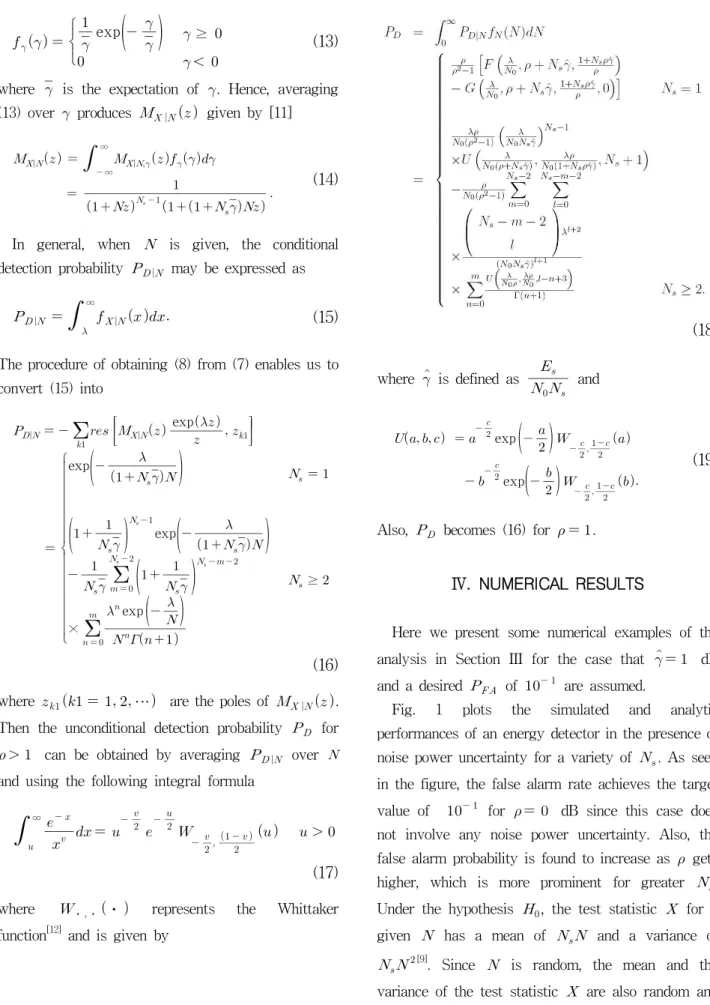
Fig. 1 plots the simulated and analytic performances of an energy detector in the presence of noise power uncertainty for a variety of . As seen in the figure, the false alarm rate achieves the target value of for dB since this case does not involve any noise power uncertainty. Also, the false alarm probability is found to increase as gets higher, which is more prominent for greater . Under the hypothesis , the test statistic for a given has a mean of and a variance of
[9]. Since is random, the mean and the variance of the test statistic are also random and
그림 1. 잡음 전력의 불확실성이 오경보 성능에 미치는 영향
Fig. 1. Effects of noise power uncertainty on the false alarm performance.
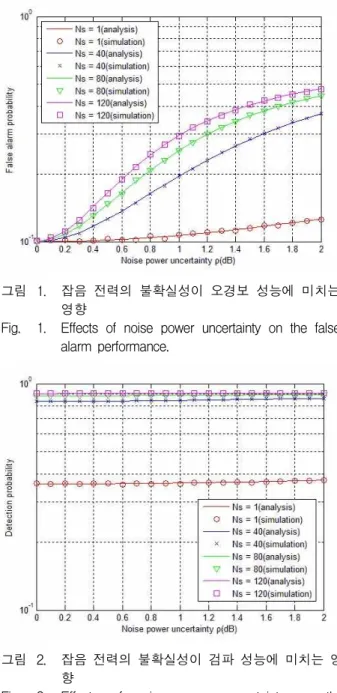
그림 2. 잡음 전력의 불확실성이 검파 성능에 미치는 영 향
Fig. 2. Effects of noise power uncertainty on the detection performance.
their possible values extend over a wider range for a larger . This implies that the false alarm probability tends to degrade more rapidly for a higher
as increases.
Fig. 2 also illustrates the effects of noise power uncertainty on the performance of the detection probability for several values of . As is shown, the detection probability increases at a relatively low rate as grows.
V. CONCLUSIONS
We analyzed the performance degradation of an energy detector in the presence of noise power uncertainty. We assumed a uniform distribution for the noise power uncertainty and presented analytical forms for the false alarm probability and the detection probability. This analysis will be a useful reference for designing an energy detector.
REFERENCES
[1] J. Mitola and G. Q. Maguire, “Cognitive radio:
making software radios more personal,” IEEE Pers. Commun., vol. 6, no.4, pp. 13-18, Aug.
1999.
[2] T. Yucek and H. Arslan, “A survey of spectrum sensing algorithms for cognitive radio applications,” IEEE comms. surveys, vol. 11, no.
1, pp.116-130, 2009.
[3] IEEE 802.22 Working Group, “Spectrum sensing requirements summary,” Document Number 22-06-0089-04-0000.
[4] D. Cabric, “Addressing the feasibility of cognitive radios,” IEEE Signal Processing Mag., pp.85-93, Nov. 2008.
[5] R. Tandra and A. Sahai, “SNR walls for signal detection,” IEEE Journal of Selected Topics in Signal Processing, vol.2,no.1, pp.4-17, Feb. 2008.
[6] S. Liu, J. Shen, R. Zhang, Z. Zhang, and Y. Liu,
“Information theoretic criterion-based spectrum sensing for cognitive radio,” IET Communications, vol.2, no.6, pp.753-762, July 2008.
[7] H. Urkowitz, “Energy detection of unknown deterministic signals,” Proceedings of the IEEE, vol. 55, no. 4, pp. 523-532, April 1967.
[8] A. D. Whalen, Detection of Signals in Noise, Academic Press, Inc., 1971.
[9] V. K. Rohatgi, An Introduction to Probability Theory and Mathematical Statistics, John Wiley
& Sons, Inc., 1976.
[10] X. Y. Hou, N. Morinaga, and T. Namekawa,
“Direct evaluation of radar detection probabilities,” IEEE Trans. Aerosp. Electron.
Syst., vol. 23, no. 4, pp. 418-424, July 1987.
[11] C. H. Lim, “Adaptive Energy Detection for Spectrum Sensing in Cognitive Radio,” Journal of the IEEK, Telecommunications, vol. 47, no. 8,
저 자 소 개 임 창 헌(평생회원)
1986년 서울대학교 전자공학과 학사
1988년 한국과학기술원 전기 및 전자공학과 석사
1993년 한국과학기술원 전기 및 전자공학과 박사
1994년∼현재 부경대학교 전자공학과 교수
<주관심분야 : 통신, 레이더 신호처리>
pp. 42-46, Aug. 2010.
[12] I. S. Gradshteyn and I. M. Ryzik, Table of Integrals, Series, and Products, Academic Press, 1965.