• 검색 결과가 없습니다.

Development of a Dike Line Selection Method Using Multispectral Orthoimages and Topographic LiDAR Data Taken in the Nakdong River Basins

N/A
N/A
Protected

Academic year: 2021

Share "Development of a Dike Line Selection Method Using Multispectral Orthoimages and Topographic LiDAR Data Taken in the Nakdong River Basins"

Copied!
8
0
0

로드 중.... (전체 텍스트 보기)

전체 글

(1)

http://dx.doi.org/10.7848/ksgpc.2015.33.3.155

Development of a Dike Line Selection Method Using Multispectral Orthoimages and Topographic LiDAR Data Taken

in the Nakdong River Basins

Choung, Yun Jae

1)

Abstract

Dike lines are important features for describing the detailed shapes of dikes and for detecting topographic changes on dike surfaces. Historically, dike lines have been generated using only the LiDAR data. This paper proposes a new methodology for selecting an appropriate dike line on various dike surfaces using the topographic LiDAR data and multispectral orthoimages taken in the Nakdong River basins. The fi rst baselines were generated from the given LiDAR data using the modified convex hull algorithm and smoothing spline function, and the second baselines were generated from the given orthoimages by the Canny operator. Next, one baseline was selected among the two baselines at 10m intervals by comparing their elevations, and the selected baseline at 10m interval was defined as the dike line segment. Finally, the selected dike line segments were connected to construct the 3D dike lines. The statistical results show that the dike lines generated using both the LiDAR data and multispectral orthoimages had the improved horizontal and vertical accuracies than the dike lines generated only using the LiDAR data on the various dike surfaces.

Keywords : Dike Lines, LiDAR, Multispectral Orthoimages, Canny Operator

Original article

Received 2015. 05. 08, Revised 2015. 06. 22, Accepted 2015. 06. 25

1) Member, Research Institute of Spatial Information Technology, GEO C&I Co., Ltd. (E-mail: [email protected])

This is an Open Access article distributed under the terms of the Creative Commons Attribution Non-Commercial License (http://

1. Introduction

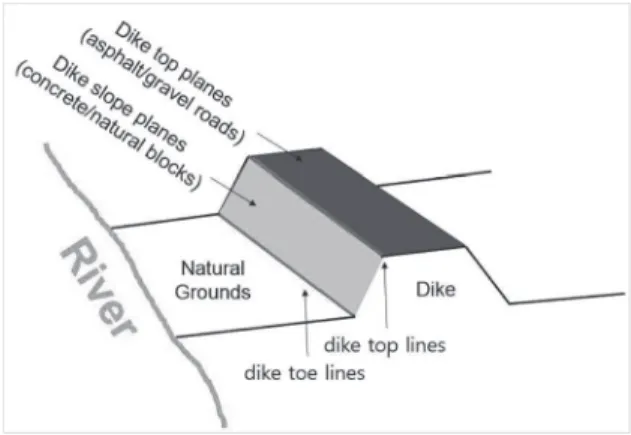
A dike (or levee, bank) is defi ned as "a man-made structure, usually an earthen embankment, designed and constructed in accordance with sound engineering practices to contain, control, or divert the fl ow of water in order to reduce the risk from temporary fl ooding" (FEMA (Federal Emergency Management Agency), 2015). A typical dike consists of the dike top and the dike slope planes that are covered by the various materials (Choung, 2014b). The dike top lines are the lines that join the dike top and slope planes, and the dike toe lines are the lines between the natural ground and the dike slope plane (Choung, 2014b). In this research, both dike top and toe lines are defi ned as the dike lines. The locations of both dike lines on dike surfaces are shown in Fig. 1.

Fig. 1. Locations of the dike top lines (blue) and the dike toe lines (red) on a typical dike, revised from a

fi gure in FEMA (2015)

(2)

In Fig. 1, the dike top lines are located along the boundaries between the asphalt/gravel roads and the concrete/natural blocks, and the dike toe lines are located along the boundaries between the concrete/natural blocks and the natural grounds. Fig. 1 also shows that both lines are located on the dikes surfaces where the slope sharply changes. Due to the locations of the dike lines on the dike surfaces, the geometric and spectral patterns of the dike surfaces should be considered for mapping the dike lines (Choung, 2014b; Kim et al., 2004; Lee, 2010).

Historically, the geometric information provided by the topographic LiDAR (Light Detection and Ranging) data has been considered only for mapping the dike surfaces or the dike lines. Choung (2014a) used the LiDAR point cloud and the spectral information obtained from the image sources for identifying the main materials on the dike surfaces.

Brügelmann (2000), Briese (2004) and Brzank et al. (2008) developed the methodologies for extracting the dike lines from the grid format. Choung (2014b) recently developed a methodology for generating the dike lines having the smoothing-curve patterns by using the LiDAR point cloud.

However, the previous research was limited to map the dike lines because the use of the LiDAR data considered only the geometric parameters for mapping the dike lines on the dike surfaces with various geometric and spectral patterns.

The use of the high-resolution images for mapping the dike lines is effi cient because such images provide the seamless edges that are useful for describing the detailed shapes of the dikes. In addition, LiDAR data generally have lower horizontal accuracy than high-resolution images (Choung et al., 2013; Liu et al., 2009). Thus this research develops a dike line selection method using LiDAR data and multispectral orthoimages for mapping dike lines on the various dike surfaces.

2. Study Areas and Data Sets

Due to the data availability, we selected the Nakdong River basins that include the 13km length of the Nakdong River, as the study area. In the study area, we selected the six dikes that were not under construction for testing the developed dike line selection method (see Fig. 2).

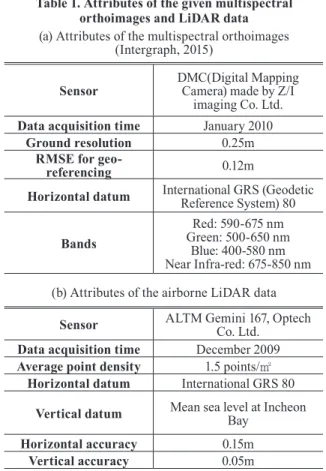
The attributes of the multispectral orthoimages and the LiDAR data used in this research are shown in Table 1.

In this research, the ERDAS Imagine software was used to generate the orthoimages using the 6~10 ground truths per each single image by the cubic interpolation method.

Fig. 2. Six dikes selected in the study area

Table 1. Attributes of the given multispectral orthoimages and LiDAR data (a) Attributes of the multispectral orthoimages

(Intergraph, 2015)

(b) Attributes of the airborne LiDAR data

Sensor DMC(Digital Mapping

Camera) made by Z/I imaging Co. Ltd.

Data acquisition time January 2010

Ground resolution 0.25m

RMSE for geo-

referencing 0.12m

Horizontal datum International GRS (Geodetic Reference System) 80 Bands

Red: 590-675 nm Green: 500-650 nm

Blue: 400-580 nm Near Infra-red: 675-850 nm

Sensor ALTM Gemini 167, Optech Co. Ltd.

Data acquisition time December 2009 Average point density 1.5 points/㎡

Horizontal datum International GRS 80 Vertical datum Mean sea level at Incheon

Bay

Horizontal accuracy 0.15m

Vertical accuracy 0.05m

(3)

3. Methodology

The developed dike line selection method was operated as follows: The two different baselines (named as the fi rst and second baselines) were separately extracted from the LiDAR data and the multispectral orthoimages using the different methods. Next, appropriate baseline segments were selected as the dike line segments at constant intervals by comparing their elevations. Finally, the selected dike line segments were connected to construct the 3D dike lines. The fl owchart of the operation of the developed dike line selection method is shown in Fig. 3.

3.1 Generation of the first baselines

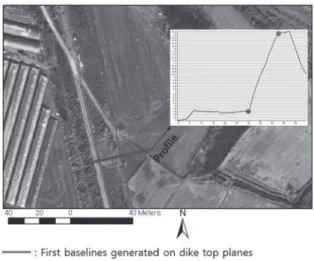
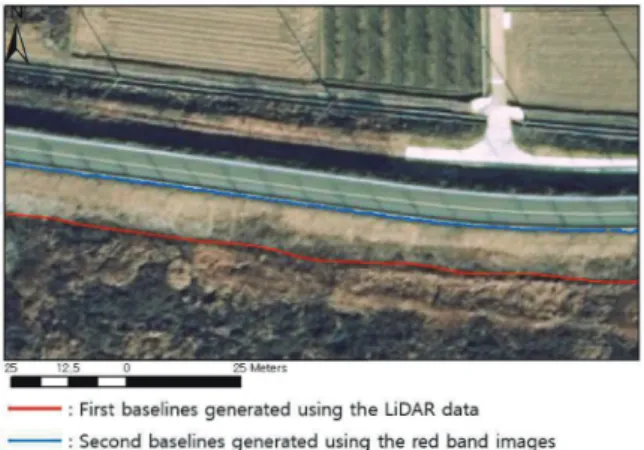
This section explains the process of extracting the fi rst baselines from the given LiDAR data. In this research, the fi rst baselines were generated using the process developed by Choung (2014b). First, the DSM (Digital Surface Model) was generated from the given LiDAR point cloud, then the dike top and slope planes were extracted from the DSM by the slope difference analysis (Choung, 2014b). Next, the modifi ed convex-hull algorithm was employed to extract the boundary points of each top and slope planes, and fi nally, the smoothing spline function was employed to generate the fi rst baselines with the smoothing-curve patterns (Choung, 2014b). Examples of the fi rst baselines extracted from the LiDAR data are shown in Fig. 4.

The elevation profi le in Fig. 4 shows that the fi rst baselines extracted from the LiDAR data were not located along the boundaries of the surface materials and were generally located on the dike surfaces where the geometric patterns signifi cantly changed. In this research, the fi rst baselines were generated by using the Matlab R2009b language and the ArcGIS 10.1 software.

3.2 Generation of the second baselines This section explains the process of extracting the second baselines from the given multispectral orthoimages. As shown in Table 1, the given multispectral orthoimages consisted of four bands: the red, green, blue and NIR (Near Infra-Red) bands. From these four bands, we select the appropriate one for extracting the edges, including the thematic information about major materials on the dike surfaces. In this research, we selected the red band based on the following assumptions. Firstly the visible structures constructed by humans are well recognized in the visible bands provided by the multispectral imaging systems (Jensen, 2006). Secondly the red band is the most insensitive to noises caused by atmospheric scattering among the three visible bands due to its longest wavelength among the three visible bands (Jensen, 2006). Fig. 5 shows the spectral refl ectance curves for various materials in the Fig. 3. Flowchart of the operation of the developed dike

line selection method

Fig. 4. Examples of the fi rst baselines on dike top (red) and slope planes (blue) generated using the process

developed by Choung (2014b)

(4)

visible and infrared ranges.

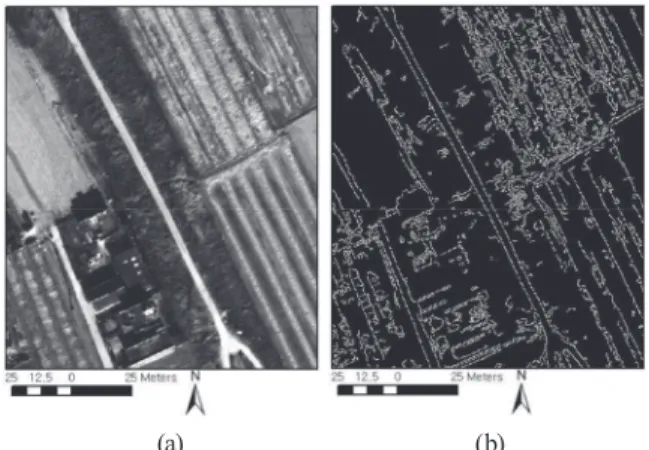
In Fig. 5, the refl ectance differences between the different objects (asphalt, concrete, natural materials, etc.) on the dike surfaces are signifi cant in the red band range. Thus we used the red band images to extract the second baselines located between the different objects on the dike surfaces. In this research, the edge detection method was used to extract the second baselines from the red band images. The edge detection method is an image-processing technique to identify sudden changes or discontinuities in the digital images, that has multiple fundamental steps, such as the image-smoothing step for noise reduction, edge point detection step, edge localization step, etc (Gonzalez and Woods, 2007). In this research, the Canny operator was employed to extract the edges from the images because of its superior performance

over other operators. Fig. 6 shows examples of the edges detected from the red band image by the Canny operator ((a) original red band image and (b) detected edges from the red band image by the Canny operator).

Fig. 6 shows that numerous edge segments were extracted from the red band image by the Canny operator. In this research, we manually selected the edge segments located along the boundaries of the surface materials. Since the manual selections of the valuable edges require the huge manual labors, we need to develop the automatic method for selecting the valuable edges in the future research. After the valuable edges were selected, the edges were manually connected by the straight line segments to construct the second baselines. An example of the constructed second baselines is shown in Fig. 7.

Fig. 7 shows that the second baselines were not generated on the dike surfaces where the boundaries of the surface materials, such as the soil roads, were not well recognized.

3.3 Construction of the 3D dike lines

After the two baselines were generated on the entire dike top and toe surfaces, one baseline was selected as the dike line segments at constant intervals by comparing their elevations through the following steps. On the dike toe surface, the baseline with the lower elevation was selected Fig. 5. Spectral refl ectance curves for various materials

in the visible and infrared ranges(Horing, 2015)

(a) (b)

Fig. 6. Examples of the edges detected from the red band image by the Canny operator

Fig. 7. Example of the constructed second baselines

(5)

as the dike toe line segment, while on the dike top surface, the baseline with higher elevation was selected as the dike top line segment. Fig. 8 shows the operations showing the selection of the dike top and toe line segments.

Fig. 8(a) shows that the fi rst baseline (red dot) was selected as the dike toe line because it had a lower elevation than the second baseline (blue dot). Fig. 8(b) shows that the second baseline (blue dot) was selected as the dike top line segment because it had a higher elevation than the fi rst baseline (red dot). If the second baselines were not generated on the top or toe surfaces, the fi rst baselines were automatically selected as the dike line segments.

For a detailed examination of selecting one baseline, the process for selecting one baseline was carried out at 10m intervals. Finally, the 3D dike top and toe lines were

separately constructed by connecting the selected dike line segments. Fig. 9 shows examples of the constructed 3D dike lines that consist of the two different baselines (the fi rst baselines generated using the LiDAR data and the second baselines generated using the red band images).

4. Results and Discussion

In this research, we generated the 200 checkpoints on dike top and toe surfaces to measure the accuracies of the generated dike top and toe lines. These checkpoints were generated at 100m intervals and the reference lines were generated along the checkpoints through the manual digitization. The X, Y coordinates of the checkpoints were obtained from the given orthoimages, whereas the Z coordinates of the checkpoints were obtained from the given LiDAR data. Examples of the generated checkpoints on the dike top and toe surfaces are shown in Fig. 10.

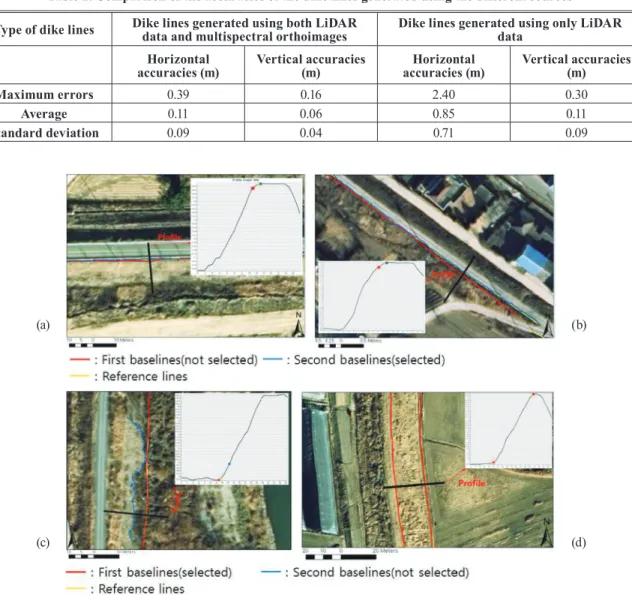
The horizontal and vertical accuracies of the constructed dike lines were obtained by measuring the shortest distances from each checkpoint to the generated dike lines. In this research we compared the accuracies of the dike lines generated using only the LiDAR data and the other dike lines generated using both LiDAR data and the multispectral orthoimages. Table 2 shows the comparison of the accuracies of both dike lines generated using the different sources.

(a) (b)

Fig. 8. Operations showing the selection of the dike top and toe line segments

Fig. 9. Examples of the dike lines that consist of the fi rst and second baselines

Fig. 10. Examples of the checkpoints generated on the

dike top and toe surfaces

(6)

The statistical results in Table 2 show that the dike lines generated using both LiDAR data and multispectral orthoimages had the improved horizontal and vertical accuracies than the dike likes generated using only the LiDAR data. Fig. 11 shows examples of the baselines selected as the dike lines or the non-selected baselines on the various dike surfaces.

Figs. 11(a) and (b) show that the second baselines were selected as the dike top lines due to their higher elevations than the fi rst baselines, Fig. 11(c) show that the fi rst baselines were selected as the dike toe lines due to their

Table 2. Comparison of the accuracies of the dike lines generated using the different sources Type of dike lines Dike lines generated using both LiDAR

data and multispectral orthoimages Dike lines generated using only LiDAR data

Horizontal

accuracies (m) Vertical accuracies

(m) Horizontal

accuracies (m) Vertical accuracies (m)

Maximum errors 0.39 0.16 2.40 0.30

Average 0.11 0.06 0.85 0.11

Standard deviation 0.09 0.04 0.71 0.09

Fig. 11. Examples of the baselines selected as the dike lines or the non-selected baselines on the various dike surfaces (a)

(c)

(b)

(d)

lower elevation than the second baselines, and Fig. 11(d) shows that the fi rst baselines were selected as the dike top and toe lines because the second baselines were not generated due to the same materials on the dike surfaces and the natural grounds,

5. Conclusions

This research proposes a new methodology for selecting

the appropriate dike lines on the various dike surfaces. The

two different baselines were separately extracted from the

(7)

LiDAR data and the multispectral orthoimages taken in the Nakdong River basins, and one baseline was selected as the dike line segment on the various dike surfaces by comparing their elevations. The 3D dike lines were finally constructed by connecting the selected dike line segments.

The statistical results show that the dike lines generated using both LiDAR data and multispectral orthoimages had the improved vertical and horizontal accuracies than the dike lines generated using only the LiDAR data on the various dike surfaces, because the geometric and spectral information provided by the LiDAR data and multispectral orthoimages can be simultaneously used for generating the dike lines on the dike surfaces with the various geometric and spectral patterns.

However, in the future research, we need to use the ground truths that are obtained using the ground surveying method to measure the exact accuracies of the generated dike lines.

Dike lines are the important features for describing the dike surfaces and for estimating erosions on the dike surfaces. Thus, in the future research, the multi-temporal data sets would be used for analyzing the erosion patterns on the various dike surfaces.

Acknowledgements

This research was supported by a grant (13SCIPS01) from Smart Civil Infrastructure Research Program funded by Ministry of Land, Infrastructure and Transport (MOLIT) of Korea government and Korea Agency for Infrastructure Technology Advancement (KAIA).

References

Briese, C. (2004), Three-dimensional modelling of breaklines from airborne laser scanner data, Proceedings of the 10th ISPRS Congress, ISPRS, 12-23 July, Istanbul, Turkey, unpaginated CD-ROM.

Brügelmann, R. (2000), Automatic breakline detection from airborne laser range data, International Archives of Photogrammetry and Remote Sensing, 16-22 July,

Amsterdam, The Netherlands, Vol. 33, No. B3, pp. 109-115.

Brzank, A., Heike, C., Goepfert, J., and Woergel, U. (2008), Aspects of generating precise digital terrain models in the Wadden Sea from lidar water classification and structure line extraction, ISPRS Journal of Photogrammetry &

Remote Sensing, Vol. 63, No. 5, pp. 510-528.

Choung, Y. (2014a), Mapping levees using LiDAR data and multispectral orthoimages in the Nakdong River basins, South Korea, Remote Sensing, Vol. 6, No. 9, pp. 8696-8717.

Choung, Y. (2014b), Accuracy assessment of the levee lines generated using lidar data acquired in the Nakdong River basins, South Korea, Remote Sensing Letters, Vol. 5, No.

10, pp. 853-861.

Choung, Y., Li, R., and Jo, M. (2013), Development of a vector-based method for coastal bluffline mapping using LiDAR data and a comparison study in the area of Lake Erie, Marine Geodesy, Vol. 36, No. 3, pp. 285-302.

FEMA (2015), FEMA levee resources library, FEMA, http://

www.fema.gov/living-levees-its-shared-responsibility/

fema-levee-resources-library (last date accessed: 5 May 2015).

Gonzalez, R. and Woods, R. (2007), Digital Image Processing (3rd Edition), Prentice Hall, Upper Saddle River, NJ, USA.

Horing, N. (2015), Global land vegetation, Old Dominion University, http://www.ccpo.odu.edu/~lizsmith/SEES/

veget/vg_class.htm (last date accessed: 11 March 2015).

Intergraph (2015), Digital mapping camera system, Intergraph, http://www.geospace.co.za/pdf/DMC%20 Brochure.pdf (last date accessed: 11 March 2015).

Jensen, J.R. (2006), Remote Sensing of the Environment: An Earth Resource Perspective(2nd Edition), Prentice Hall, Upper Saddle River, NJ, USA.

Kim, K., Im, D., and Yeo, H. (2004), Inspection of the river basin for management of their natures, Journal of , Vol. 37, No. 4, pp.109-118. (in Korean with English abstract) Lee, J.S. (2010), River Engineering and Design, Saeron

Books, Seoul, Korea.

Liu, J., Li, R., Deshpande, S., Niu, X., and Shih, T. (2009),

Estimation of blufflines using topographic LiDAR data

and orthoimages, Photogrammetric Engineering and

Remote Sensing, Vol. 75, No. 1, pp. 69-79.

(8)

수치

Fig. 1. Locations of the dike top lines (blue) and the  dike toe lines (red) on a typical dike, revised from a
Table 1. Attributes of the given multispectral  orthoimages and LiDAR data (a) Attributes of the multispectral orthoimages
Fig. 4. Examples of the fi rst baselines on dike top (red)  and slope planes (blue) generated using the process
Fig. 6. Examples of the edges detected from the red  band image by the Canny operator
+3

참조

관련 문서

1 John Owen, Justification by Faith Alone, in The Works of John Owen, ed. John Bolt, trans. Scott Clark, "Do This and Live: Christ's Active Obedience as the

~ The streak lines can be used to trace the travel of a pollutant downstream from a smoke stack or other discharge. ~ In steady flow, Lagrangian path lines are the same as

95 Effects of the heat treatment of the substrate on residual stress distributions for the case of the deposition of multiple lines and layers

In the heating method by line heating, the initial properties of steel are changed by variables such as temperature, time, and speed. The experimental data

On the basis of the detailed professional studies on the topic of reconciliation for all times and places, I will vision the unified Korea in peace with

Based on the research described above, a work expressing the formative beauty of lines, which is the most basic in calligraphy, was produced by using

As examined above, based on the type changes this study confirmed that <Seoyukyonmunrok> has plenty of 'aaba' type structures and most lines are

For each of several tests, elastic, plastic, and total strain data points are plotted versus life, and fitted lines are also